
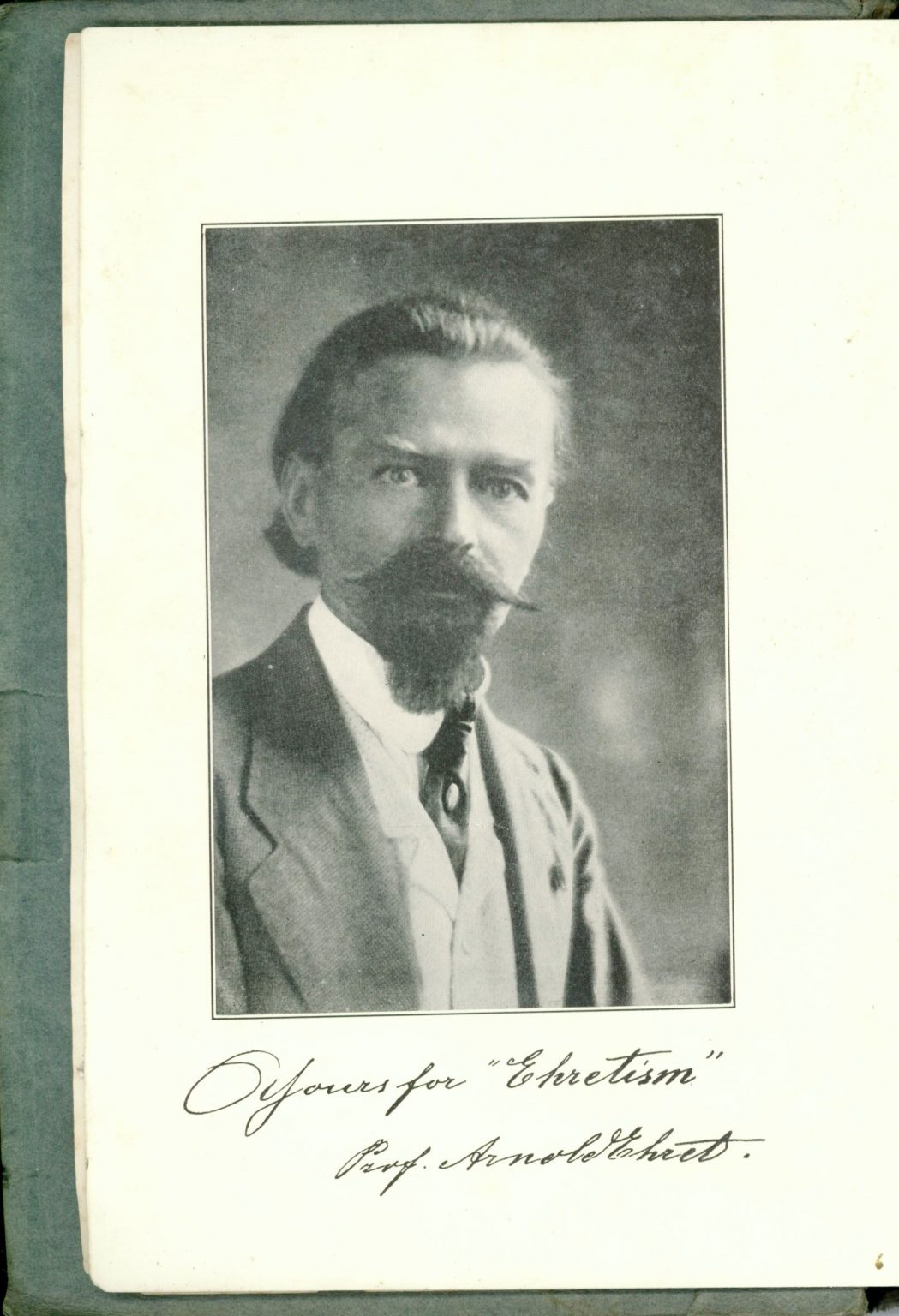
The following Biography of Prof. Arnold Ehret is an excerpt from the Mucusless Diet Healing System: Annotated, Revised, and Edited by Prof. Spira:
Biographical Sketch of Prof. Arnold Ehret by Prof. Spira
Professor Arnold Ehret was a German healer, dietitian, philosopher, teacher, visionary, and one of the first people to advocate fasting and a plant-based, vegan, and mucus-free lifestyle as a therapy for healing. For over 100 years, his written works and teachings have touched the lives of thousands of health-seekers pursuing higher levels of vitality. Ehret’s most famous books, Mucusless Diet Healing System and Rational Fasting, continue to increase in popularity as plant-based, vegan, and raw-food diets become more prevalent. Ehret believed that pus- and mucus-forming foods were unnatural for humans to eat, and suggested that a diet of fruits and green leafy vegetables (i.e., mucus-free foods), are the most healing and powerful foods for humans. Ehret offers a sophisticated yet simple and safe transitional system for those who endeavor to stop eating pus- and mucus-forming foods.
Early Life
Arnold Ehret was born July 29, 1866, near Freiburg, in Baden, Germany. His father was a gifted farmer who was so technologically advanced that he crafted all of his own farming equipment. Like his father, Ehret would be endowed with a passion for studying the cause and effect of phenomena. His courses of interest were physics, chemistry, drawing, and painting. He also had an affinity for linguistics and could speak German, French, Italian, and English.
At the age of 21, he graduated as a professor of drawing and was drafted into the military only to be discharged because of heart trouble. At the age of 31, he was diagnosed with Bright’s disease (inflammation of the kidneys) and pronounced incurable by 24 of Europe’s most respected doctors. He then explored natural healing and visited sanitariums to learn holistic methods and philosophies. In a desperate attempt to quench his misery, Ehret decided to stop eating. To his amazement, he did not die but gained strength and vitality.
In 1899, he traveled to Berlin to study vegetarianism, followed by a trip to Algiers in northern Africa where he experimented with fasting and fruit dieting. Due to his new lifestyle, Ehret completely cured himself of all of his diseases and could then perform great feats of physiological strength, including an 800-mile bicycle trip from Algiers to Tunis. His discovery caused him to posit that pus- and mucus-forming foods are the fundamental cause for all human illness, and that fasting (simply eating less) is Nature’s primary method of cleansing the body of the effects of unnatural eating.
Successful Healer
In the early 1900s, Ehret opened a hugely popular sanitarium in Ascona, Switzerland where he treated and cured thousands of patients considered incurable by the so-called “medical authorities.” During the latter part of the decade, Ehret engaged in a series of fasts monitored by German and Swiss officials. Within a period of 14 months, Ehret completed one fast of 21 days, one of 24 days, one of 32 days, and one of 49 days, which stood as a world record for many years. Ultimately, Ehret became one of the most in-demand health lecturers, journalists, and educators in Europe, saving the lives of thousands of people.
On June 27, 1914, just before World War I, Ehret left from Bremen for the United States to see the Panama Exposition and sample the fruits of the continent. He found his way to California, which was of special interest to him. This was because the region was undergoing a horticultural renaissance due to botanists like Luther Burbank, who later paid tribute to Ehret.
At the time, the University of California, Riverside also owned the world’s largest collection of rare fruits. When the war prevented Ehret from returning to Germany, he settled in Mount Washington (Los Angeles), where he prepared his manuscripts and diplomas in his cultivated eating gardens. He and other “Back to Naturists” began to influence local populations of young people to investigate plant-based, natural living.
Benedict Lust, a student of Ehret’s and early proponent of naturopathy, initially distributed the English-language books of Ehret, Kneipp, Kuhne, Just, and Engelhardt in the United States. This included Ehret’s Kranke Menschen (literally, sick human beings) which became a best seller. Ehret worked at Lust’s Yungborn Sanitarium for 5 years.
Then, Ehret opened his own sanitarium in Alhambra, California before a lecture tour. His course on the Mucusless Diet Healing System became a book of 25 lessons for his students. The book, along with Rational Fasting, became his most important and popular publications. Ehret also developed and marketed his popular Inner clean Herbal Laxative formula.
Death
On October 9, 1922, just 2 weeks after he completed the Mucusless Diet Healing System, he finished a series of four lectures on regaining health through fasting and the “Grape Cure” (grape and grape juice fasting) at the Assembly Room of the Angelus Hotel on 4th and Spring Streets, where it was reported that over a hundred persons were unable to find seats. After leaving the building, between 11:00 p.m. and 11:30 p.m., Ehret, aged 56, fell and sustained a fatal blow to his skull.
According to Ehret’s business partner and publisher, Fred S. Hirsch, DNS, he was walking briskly on a wet, oil-soaked street during foggy conditions when he slipped on the curb and fell backward onto his head. Hirsch did not actually witness the fall but found Ehret lying on the street. Carl Kuhn, Ehret’s German publisher during the 1920s, even questioned whether Ehret’s fall was really an accident. Benedict Lust maintained that Ehret was wearing his first pair of new dress shoes and slipped as a result of his unfamiliarity with the footwear.
To this day, the true nature of Ehret’s death raises suspicion among his followers. Ehret’s powerful healing successes along with his influential and revolutionary new lifestyle threatened the medical, meat, and dairy industries. Due to these factors, many believe that foul play was involved in Ehret’s untimely death. His writings on religion and family were also considered quite controversial. In the decades following Ehret’s death, Fred Hirsch had many legal battles with medical authorities over the word “mucus” and the Innerclean laxative.
Legacy
Arnold Ehret is a cultural icon and was an important protagonist of the emerging back-to-nature renaissance in Germany and Switzerland during the latter part of the nineteenth century. The influence of this renaissance spread to America and influenced many counter-cultural movements including the beat generation, the vegetarian-driven “hippie” movement, veganism, and fruitarianism. Throughout the twentieth century, Ehret’s teachings have thrived and developed through the sincere efforts of a small group of dedicated Ehretists. Today, Ehret’s teachings are gaining wider acceptance throughout the world as more people seek to investigate plant-based, vegan healing and detoxification.
Arnold Ehret’s Mucusless Diet Healing System is a dietary and lifestyle approach that emphasizes the elimination of mucus-forming foods to promote health and healing. Ehret, a German healer and philosopher, believed that many diseases stem from the accumulation of mucus and toxins in the body. His system combines fasting with a diet primarily consisting of raw and cooked fruits, starchless vegetables, and leafy greens, which he referred to as “mucus-free foods.”
Ehret’s philosophy also includes the idea that the body has a natural ability to heal itself when freed from obstructions like mucus and waste. He advocated for a gradual transition to this diet, allowing the body to adapt and cleanse itself over time. His teachings have influenced many in the fields of natural health and plant-based living.
If you’re interested in exploring his work further, you can find more details in his book, which is available on platforms like Internet Archive or Mucus Free Life. Let me know if you’d like to dive deeper into any specific aspect!
Arnold Ehret’s Mucusless Diet Healing System is a dietary and lifestyle philosophy that emphasizes the elimination of mucus-forming foods to promote health and healing. Ehret believed that mucus-forming foods, such as meat, dairy, and processed items, are unnatural for humans and contribute to illness. Instead, he advocated for a diet rich in fruits, green leafy vegetables, and other plant-based, mucus-free foods2.
The system also incorporates fasting as a method to cleanse the body of accumulated waste and toxins. Ehret’s approach is designed to transition individuals gradually to a mucus-free diet, allowing the body to adapt and heal over time. His teachings have influenced many health enthusiasts and proponents of plant-based diets2.
If you’re curious to explore more, you can find additional details here or here. What are your thoughts on this philosophy?
1healsa.co.za 2www.mucusfreelife.com
Arnold Ehret’s Mucusless Diet Healing System stands out from other health diets due to its unique focus on eliminating mucus-forming foods to promote healing and vitality. Here’s how it compares:
- Philosophy: Unlike many diets that emphasize calorie counting or macronutrient balance, Ehret’s system is rooted in the idea that mucus-forming foods are the primary cause of disease. This contrasts with diets like keto or paleo, which focus on specific food groups for weight loss or energy optimization2.
- Food Choices: The Mucusless Diet prioritizes fruits, leafy greens, and starchless vegetables, avoiding processed foods, dairy, and meat. This aligns somewhat with plant-based diets but diverges from others like Mediterranean or DASH diets, which include a broader range of foods3.
- Fasting: Ehret’s system incorporates fasting as a key component for detoxification and healing. While intermittent fasting is popular in many modern diets, Ehret’s approach is more holistic, combining fasting with dietary transitions3.
- Transitioning: Ehret emphasizes a gradual shift to mucus-free foods, allowing the body to adapt. This is different from diets that often encourage abrupt changes or strict adherence.
- Health Goals: While many diets focus on weight loss, heart health, or managing specific conditions, Ehret’s system aims for overall vitality and natural healing.
If you’d like, I can dive deeper into specific comparisons or explore how this diet might align with your health goals!
1www.mucusfreelife.com 2www.neuronutritionhealth.com 3www.mucusfreelife.com
The key principles of Arnold Ehret’s Mucusless Diet Healing System revolve around promoting health by eliminating mucus-forming foods and cleansing the body. Here are the main ideas:
- Mucus-Free Foods: The diet emphasizes consuming fruits, green leafy vegetables, and other plant-based, non-mucus-forming foods. These are considered natural and optimal for human health.
- Elimination of Mucus-Forming Foods: Foods like meat, dairy, processed items, and starchy vegetables are avoided, as they are believed to produce mucus and contribute to illness.
- Fasting and Cleansing: Periodic fasting is a core component, aimed at detoxifying the body and removing accumulated waste and toxins.
- Gradual Transition: Ehret advocated for a gradual shift to a mucus-free diet, allowing the body to adapt and heal over time.
- Vitality and Healing: The system views disease as the body’s effort to eliminate waste and toxins. By following the diet, the body is supported in its natural healing processes.
- Individualized Approach: The diet is tailored to each person’s needs, with adjustments made based on their health condition and progress.
Ehret’s philosophy is rooted in the idea that a clean, mucus-free body leads to better health and vitality. If you’d like to explore this further, let me know!
How does fasting support the mucusless diet?
Fasting plays a central role in Arnold Ehret’s Mucusless Diet Healing System as a method to cleanse and rejuvenate the body. Here’s how it supports the diet:
- Eliminates Toxins: Fasting allows the body to focus on eliminating accumulated waste, mucus, and toxins, which Ehret believed were the root causes of disease.
- Rest for the Digestive System: By abstaining from food, the digestive system gets a break, enabling the body to redirect energy toward healing and repair.
- Accelerates Transition: Fasting helps ease the transition to a mucus-free diet by clearing out residues of mucus-forming foods from the body.
- Enhances Vitality: Ehret viewed fasting as a way to restore the body’s natural vitality and energy by removing obstructions caused by unhealthy eating habits.
- Supports Natural Healing: Ehret believed that the body has an innate ability to heal itself when freed from the burden of processing mucus-forming foods and toxins.
Fasting, combined with a gradual shift to mucus-free foods, is a cornerstone of Ehret’s philosophy for achieving optimal health. If you’d like, I can share more about how to approach fasting safely!
Arnold Ehret’s Mucusless Diet Healing System recommends fasting as a key practice for cleansing and healing. Here are some fasting methods highlighted in his philosophy:
- Short Fasts: These are brief periods of fasting, such as skipping breakfast or fasting for a day, to give the digestive system a break and promote gradual detoxification.
- Extended Fasts: Longer fasting periods are suggested for deeper cleansing, but Ehret emphasized the importance of preparing the body through a gradual transition to a mucus-free diet before attempting extended fasts.
- Fruit-Based Fasting: Consuming only fruits during a fast is recommended as a gentle way to cleanse the body while still providing some nutrients.
- Dry Fasting: Ehret occasionally mentioned fasting without food or water, but this method requires caution and should only be undertaken with proper understanding and preparation.
- Rational Fasting: Ehret’s concept of “rational fasting” involves fasting in a way that aligns with the individual’s health condition and readiness, ensuring safety and effectiveness.
Ehret believed that fasting should be approached thoughtfully and tailored to each person’s needs. If you’re considering fasting, it’s essential to consult with a healthcare professional to ensure it’s safe for you. Would you like to explore more about how to transition into fasting?
What are the health benefits of fasting in this diet?
Fasting, as part of Arnold Ehret’s Mucusless Diet Healing System, is believed to offer several health benefits by promoting detoxification and supporting the body’s natural healing processes. Here are some key benefits:
- Detoxification: Fasting helps the body eliminate accumulated waste, mucus, and toxins, which Ehret considered the root causes of many illnesses.
- Improved Digestion: By giving the digestive system a break, fasting allows it to reset and function more efficiently.
- Enhanced Vitality: Ehret believed that fasting restores the body’s natural energy and vitality by removing obstructions caused by unhealthy eating habits.
- Support for Healing: Fasting is thought to accelerate the body’s ability to heal itself by redirecting energy from digestion to repair and regeneration.
- Mental Clarity: Many proponents of fasting report improved focus and mental clarity, which Ehret attributed to the removal of toxins affecting the brain.
- Gradual Transition to Healthier Eating: Fasting can ease the shift to a mucus-free diet by clearing out residues of mucus-forming foods.
These benefits align with Ehret’s philosophy of achieving optimal health through cleansing and nourishment. If you’d like, I can share more about how to approach fasting safely or explore other aspects of this system!
Safe fasting in Arnold Ehret’s Mucusless Diet Healing System requires careful preparation and mindfulness.
Here are some tips to ensure a safe and effective fasting experience:
- Gradual Transition: Begin by reducing mucus-forming foods and incorporating more fruits and vegetables into your diet before attempting a fast. This helps your body adapt.
- Stay Hydrated: Drink plenty of water during fasting to support detoxification and prevent dehydration.
- Start Small: Begin with short fasting periods, such as skipping a meal or fasting for a day, and gradually increase the duration as your body becomes accustomed.
- Listen to Your Body: Pay attention to how you feel during fasting. If you experience discomfort or weakness, consider breaking the fast and consulting a healthcare professional.
- Break the Fast Gently: After fasting, reintroduce food gradually, starting with light, mucus-free options like fruits and vegetables.
- Seek Guidance: If you’re new to fasting, consider consulting a healthcare provider or a practitioner familiar with Ehret’s system for personalized advice.
- Avoid Overexertion: Rest and avoid strenuous activities during fasting to allow your body to focus on healing and detoxification.
These tips align with Ehret’s philosophy of fasting as a tool for cleansing and rejuvenation. If you’d like to explore more about fasting or the diet itself, let me know!
Popular diets emphasize different foods based on their goals and philosophies. Here’s a snapshot of key foods recommended in some well-known diets:
- Mediterranean Diet: Focuses on whole grains, fresh fruits and vegetables, nuts, seeds, olive oil, and lean proteins like fish and poultry. Red wine is also included in moderation.
- Keto Diet: Prioritizes high-fat foods like avocados, nuts, seeds, fatty fish, and oils, while minimizing carbohydrates. Low-carb vegetables like spinach and broccoli are staples.
- Plant-Based Diets (e.g., Vegan): Centered around fruits, vegetables, legumes, whole grains, nuts, and seeds. Animal products are excluded.
- DASH Diet: Designed to lower blood pressure, it includes fruits, vegetables, whole grains, lean proteins, and low-fat dairy while limiting salt and saturated fats.
- Paleo Diet: Encourages eating like our ancestors, focusing on lean meats, fish, fruits, vegetables, nuts, and seeds, while avoiding processed foods, grains, and dairy.
- High-Fiber Diet: Emphasizes fiber-rich foods like whole grains, legumes, fruits, and vegetables to promote digestion and satiety.
Each diet has its unique approach to health and nutrition. Which one resonates with you?
1nutritionsource.hsph.harvard.edu 2thewell.northwell.edu 3health.usnews.com
What are some recipes for these recommended foods?
Here are some recipe ideas for the foods recommended in popular diets:
- Mediterranean Diet: Try a classic Greek salad with tomatoes, cucumbers, olives, feta cheese, and a drizzle of olive oil. Pair it with grilled salmon seasoned with lemon and herbs.
- Keto Diet: Make a creamy avocado and spinach smoothie with almond milk. For dinner, enjoy a zucchini noodle pasta with a rich pesto sauce and grilled chicken.
- Plant-Based Diet: Whip up a hearty lentil and vegetable stew with carrots, celery, and tomatoes. For dessert, indulge in a chia seed pudding with almond milk and fresh berries.
- DASH Diet: Prepare a quinoa bowl with roasted vegetables, grilled chicken, and a sprinkle of low-fat cheese. Add a side of steamed broccoli for extra nutrients.
- Paleo Diet: Grill a grass-fed steak and serve it with roasted sweet potatoes and sautéed spinach. For breakfast, try a fruit salad with nuts and seeds.
- High-Fiber Diet: Bake a batch of oatmeal muffins with bananas and walnuts. For lunch, enjoy a black bean and corn salad with a lime vinaigrette.
Here are some additional plant-based recipe ideas to inspire your meals:
- Lentil and Veggie Buddha Bowl: Cook lentils and season with cumin, olive oil, and a squeeze of lemon. Add roasted cauliflower, shredded carrots, bell peppers, and leafy greens. Drizzle with tahini sauce and sprinkle with seeds or nuts.
- Avocado Toast with Berries: Toast whole-grain bread, mash half an avocado on top, and add fresh berries. Finish with a drizzle of honey and a sprinkle of vegan cheese.
- Black Bean-Tomato Chili: Combine black beans, diced tomatoes, onions, and spices like cumin and chili powder. Simmer until thickened and serve with a side of cornbread.
- Roasted Pumpkin and Brussels Sprouts: Toss pumpkin chunks and Brussels sprouts with olive oil, salt, and pepper. Roast until caramelized and serve as a side or over quinoa.
- Grilled Cauliflower Wedges: Slice cauliflower into thick wedges, season with olive oil and red pepper flakes, and grill until tender. Serve with a tahini or chimichurri sauce.
If you’d like more recipes or detailed instructions, let me know! You can also explore more ideas here. 1 Feasting At Home 2 Fit Foodie Finds 3 www.tasteofhome.com
If you’d like detailed recipes or cooking tips for any of these, let me know! You can also explore more ideas here. A Scientific Method of Eating Your Way to Health
Arnold Ehret’s mucusless diet healing system – Search Videos