
36-year study reveals what really affects Antarctic ice thickness
Story by Mac Olivea
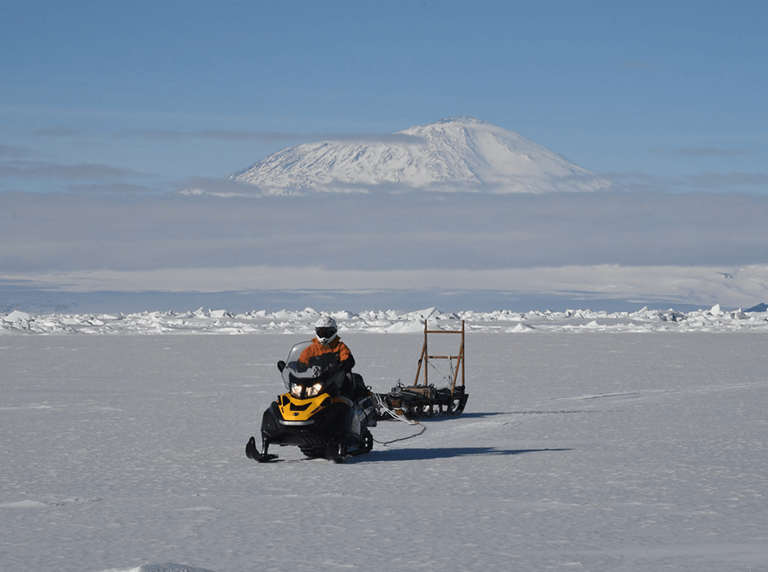
The sea ice in Antarctica’s McMurdo Sound has held secrets beneath its surface for decades. Now, scientists have unlocked some of those mysteries by studying how this fast ice—frozen sea water attached to the coast—has changed from 1986 to 2022. These findings don’t just matter to researchers and station crews; they also matter to the animals that call Antarctica home and the global climate system at large.
What Fast Ice Really Means
Fast ice isn’t the same as the floating, broken pack ice often shown in images of the polar regions. This type of sea ice clings to the shore and stays in place for weeks, months, or even longer. For wildlife like penguins and seals, it’s more than a frozen surface—it’s a vital platform for breeding, resting, and feeding. Underneath, fast ice shelters algae, krill, and fish from predators and cold temperatures.
It also provides a safe route for scientists studying the atmosphere above and the ocean below. “The ice needs to be stable and thick enough to do this safely,” explained one of the researchers.
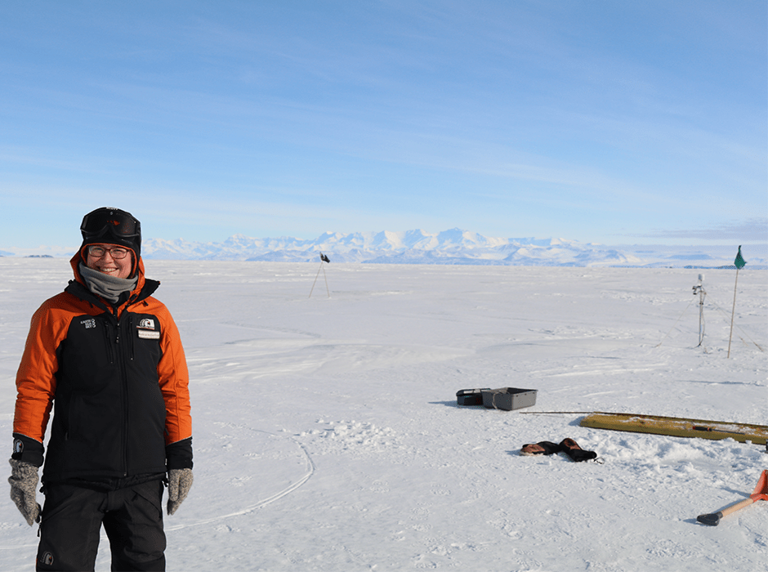
Maren Richter on the fast ice next to a measurement site from which a sea ice core was taken. Coring equipment and part of the automated measuring site is on the right. The Trans-Antarctic Mountains are visible in the background. (CREDIT: Inga Smith)© The Brighter Side of News
Researchers at the University of Otago in New Zealand wanted to understand what factors control how thick this fast ice gets. So they analyzed over 30 years of direct, in-person measurements taken from a flat, stable 14-by-20-kilometer section of McMurdo Sound. These data form one of the longest and most detailed records of Antarctic fast ice in the world.
What the Long-Term Data Reveals
When scientists studied the data, they didn’t find a simple upward or downward trend in ice thickness. Instead, they saw that it changed year by year. Some years the ice grew thicker; other years it stayed thin. What caused this?
The answer comes down to three key things: temperature, wind, and storms.
Thicker ice formed during colder winters, especially when the average air temperature dropped below normal. Strong winds from the south, which push warmer air away and bring in colder conditions, also helped build thicker ice. Fewer storm events gave the ice more time to grow undisturbed.
Related Stories
・Antarctica’s melting ice sheets may trigger massive volcanic activity
・Scientists provide a chilling look at Antarctica’s future without ice
・Pyramid hidden for millennia discovered in Antarctica
But monthly averages couldn’t always explain the changes. Even when one factor pointed toward thicker or thinner ice, the outcome often depended on a mix of other conditions. “Most of the variability in fast-ice thickness cannot be explained by a single driver,” the study stated. That’s why scientists suggest a new approach—looking at specific events, like intense storms, and how they impact the ice over shorter periods.
One of the study’s main goals was to find out whether climate change has already affected fast ice in this part of Antarctica. The answer, surprisingly, is not yet—at least not in an obvious way.
“The ocean/ice/atmosphere system there seems to still be able to balance out effects of climate change,” said Dr. Maren Richter, the lead researcher who completed the work as part of her PhD. She pointed out that while air temperatures have slightly increased over the last 10 years, the full dataset from the mid-1980s to 2022 shows no clear long-term trend.
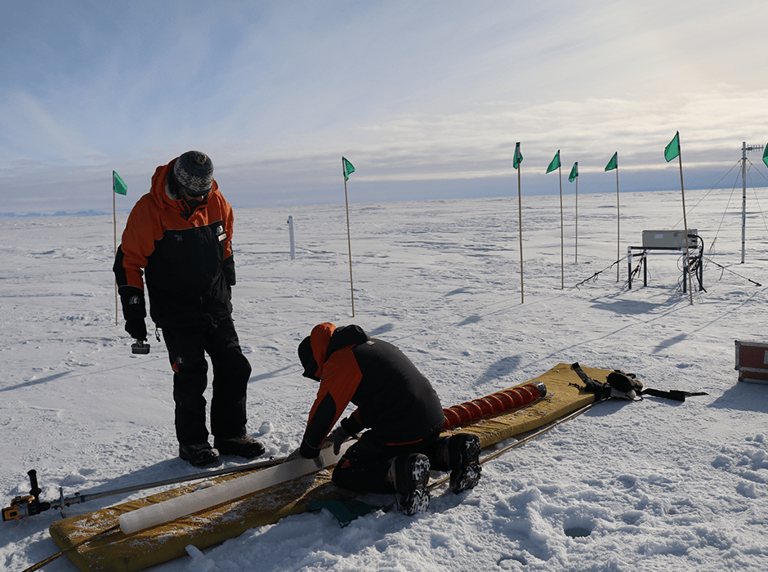
Maren Richter (kneeling) pieces together a sea ice core taken at an automated measuring station (seen on the right). Professor Lars Smedsrud, of the University of Bergen, is seen standing. (CREDIT: Inga Smith)© The Brighter Side of News
That doesn’t mean nothing is changing. Dr. Richter cautioned that 30 years is still a short time when trying to understand long-term climate patterns. There may have been changes earlier that went unmeasured. She also stressed that other regions of Antarctica do show trends in ice thickness, extent, and persistence.
nHer supervisor, Associate Professor Inga Smith, added that fast ice may cover less area than pack ice, but it plays a big role in Earth’s climate system. It also supports the breeding cycles of many Antarctic animals.
Why Long-Term Monitoring Matters
By tracking how thick the ice is each year and what affects it, researchers now have a baseline. That means they can more easily tell when something unusual happens. If future years show major differences from this baseline, it might be a sign that climate change is starting to overpower natural variation.
Dr. Richter emphasized the value of such long-term datasets. “Only long time series of observations allow us to distinguish between natural variability and trends influenced by climate change,” she said.
She also hopes this information will help scientists plan research safely and give supply teams guidance on what type of ship can reach the research stations depending on the ice thickness.
The data could also help fine-tune computer models that simulate future changes. These models can use the baseline to test how fast ice might behave 50 or even 100 years from now, especially in a world with more carbon dioxide in the atmosphere.
“Now might be the last time we can observe some systems before effects of climate change dominate over natural variability,” she said.
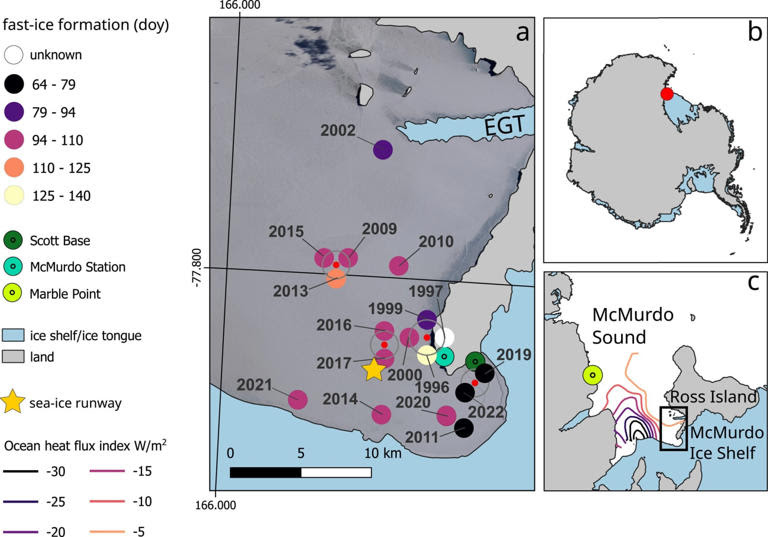
(a) Map of McMurdo Sound with position in Antarctica (b), and relative to Ross Island (c). (CREDIT: U.S. Geological Survey) © The Brighter Side of News
Looking to the Future
Although fast ice in McMurdo Sound hasn’t shown a clear trend yet, that doesn’t mean it’s safe from future changes. The next steps include examining how specific weather events, like powerful storms, affect the ice in real time. This approach could uncover patterns that monthly averages overlook.
The results of the study, published in the Journal of Geophysical Research: Oceans, show that the icy grip of Antarctica is more complex than it seems. With careful tracking and smart modeling, scientists can continue to uncover what lies beneath—and prepare for what’s to come.
Note: The article provided above by The Brighter Side of News.

An international team of scientists announced Thursday they’ve successfully drilled one of the oldest ice cores yet, penetrating nearly 2 miles (2.8 kilometers) to Antarctic bedrock to reach ice they say is at least 1.2 million years old.
Analysis of the ancient ice is expected to show how Earth’s atmosphere and climate have evolved. That should provide insight into how Ice Age cycles have changed, and may help in understanding how atmospheric carbon changed climate, they said.
“Thanks to the ice core we will understand what has changed in terms of greenhouse gases, chemicals and dusts in the atmosphere,” said Carlo Barbante, an Italian glaciologist and coordinator of Beyond EPICA, the project to obtain the core. Barbante also directs the Polar Science Institute at Italy’s National Research Council.
The same team previously drilled a core about 800,000 years old. The latest drilling went 2.8 kilometers (about 1.7 miles) deep, with a team of 16 scientists and support personnel drilling each summer over four years in average temperatures of about minus-35 Celsius (minus-25.6 Fahrenheit).
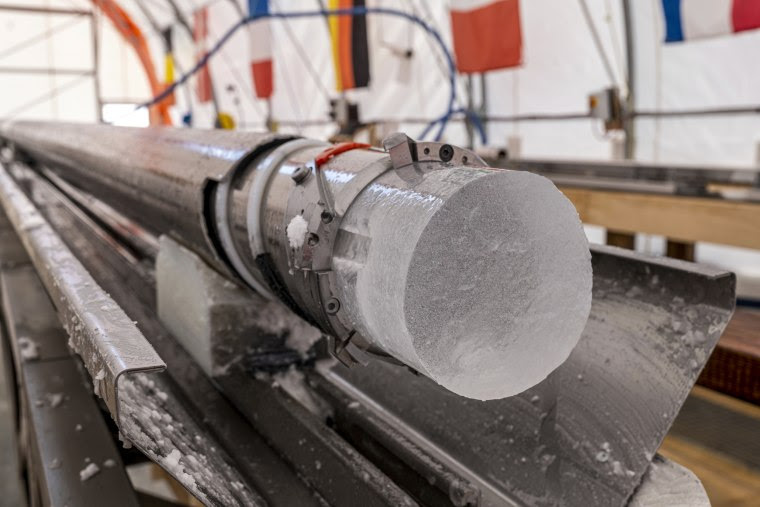
An ice core drilled by a research team at Little Dome C field base during the cutting phase Tuesday. PNRA / IPEV Beyond Epica via AP
Italian researcher Federico Scoto was among the glaciologists and technicians who completed the drilling at the beginning of January at a location called Little Dome C, near Concordia Research Station.
“It was a great moment for us when we reached the bedrock,” Scoto said. Isotope analysis gave the ice’s age as at least 1.2 million years old, he said.
Both Barbante and Scoto said that thanks to the analysis of the ice core of the previous Epica campaign they have assessed that concentrations of greenhouse gases, such as carbon dioxide and methane, even during the warmest periods of the last 800,000 years, have never exceeded the levels seen since the Industrial Revolution began.
“Today we are seeing carbon dioxide levels that are 50% above the highest levels we’ve had over the last 800,000 years,” Barbante said.
The Little Dome C field base and drilling station is in eastern Antarctica. PNRA / IPEV Beyond Epica via AP
The European Union funded Beyond EPICA (European Project for Ice Coring in Antarctica) with support from nations across the continent. Italy is coordinating the project.
The announcement was exciting to Richard Alley, a climate scientist at Penn State who was not involved with the project and who was recently awarded the National Medal of Science for his career studying ice sheets.
Alley said advancements in studying ice cores are important because they help scientists better understand the climate conditions of the past and inform their understanding of humans’ contributions to climate change in the present.
He added that reaching the bedrock holds added promise because scientists may learn more about Earth’s history not directly related to the ice record itself. “This is truly, truly, amazingly fantastic,” Alley said. “They will learn wonderful things.”