

1 Corinthians 2:9 no eye has seen no ear has heard – Search
The phrase “no eye has seen, no ear has heard” is from 1 Corinthians 2:9, which states: “Rather, as it is written: ‘No eye has seen, no ear has heard, no heart has imagined, what God has prepared for those who love Him'”. This verse emphasizes the idea that the blessings and plans God has for those who love Him are beyond human comprehension and imagination. Bible Hub+2
The eye functions by processing light to enable vision.
- Light enters through the cornea, which bends the light to help focus it.
- It then passes through the pupil, controlled by the iris, which adjusts the amount of light entering the eye.
- After the pupil, light travels through the lens, which further focuses the light onto the retina at the back of the eye, where photoreceptor cells convert the light into electrical signals. 2
- These signals are sent to the brain via the optic nerve, allowing us to perceive images. 2
This intricate process allows us to see and interpret the world around us.
The human eye is like a high-powered camera, capturing light and converting it into electrical signals that the brain interprets as images.
Here’s how it works:
- Cornea & Lens: Light enters the eye through the cornea, which bends the light to help focus it. The lens fine-tunes this focus to direct light onto the retina.
- Pupil & Iris: The iris (the colored part) controls how much light enters by adjusting the size of the pupil—like a camera aperture.
- Retina & Photoreceptors: The retina, located at the back of the eye, contains photoreceptor cells (rods and cones) that convert light into nerve signals.
- Rods: Help detect light intensity and motion, making them key for night vision.
- Cones: Detect color and detail, helping us see vivid images in daylight.
- Optic Nerve & Brain: The optic nerve carries these signals to the brain, where they’re processed into the images you actually see.
It’s a fascinating, lightning-fast system, allowing you to take in the world’s beauty in real time. Pretty incredible, isn’t it?
How does the eye compare to a camera’s function?
The eye and a camera have striking similarities in how they process light, but the eye has some unique advantages.
Here’s a comparison:
- Lens & Focus: Both have lenses that bend light to focus on a surface—retina in the eye, sensor in a camera. The eye’s lens dynamically changes shape for different focal distances, while a camera uses mechanical focusing.
- Aperture & Light Control: The pupil adjusts size automatically like a camera’s aperture, regulating how much light enters based on brightness.
- Image Processing: Cameras capture images as digital data, while the eye sends signals to the brain, which reconstructs a continuous, detailed visual experience.
- Color & Dynamic Range: The eye perceives a wider dynamic range and adjusts in real-time to lighting changes far better than most cameras.
- Peripheral Vision vs. Framing: Cameras have fixed frames, while eyes allow peripheral vision, offering a broader, natural view of surroundings.
So while cameras mimic the eye’s function, the human eye remains unmatched in adaptability and processing power. Amazing, right?
Explain how the eye processes images in detail.
The eye processes images in a sophisticated way, transforming light into signals that the brain interprets. Here’s how it works in detail:
1. Light Entry & Focus
- Light enters the eye through the cornea, which bends it slightly.
- The pupil adjusts its size (controlled by the iris) to regulate how much light enters.
- The lens fine-tunes the focus by changing shape, ensuring light converges precisely onto the retina.
2. Retina & Photoreceptor Activation
- The retina, located at the back of the eye, contains rods and cones—specialized photoreceptor cells.
- Rods: Work in low-light conditions and detect motion.
- Cones: Handle color perception and sharpness, functioning best in bright light.
- The photoreceptors convert incoming light into electrical signals.
3. Signal Transmission via the Optic Nerve
- These signals are processed into nerve impulses and sent through the optic nerve.
- The optic nerve carries this data from both eyes to the brain.
4. Brain Processing & Image Formation
- The brain, particularly the visual cortex, interprets these electrical signals.
- It combines images from both eyes, adjusts for color, depth, and motion, and constructs the final visual experience.
- Your brain fills in blind spots and corrects distortions, creating a seamless perception of reality.
This all happens in milliseconds, allowing you to see the world in vivid detail.
Amazing, right?
What About Seeing And Hitting A 105 mph baseball or 80 mph fastpitch softball and making contact.
Nebraska Softball’s Jordy Bahl Fouls Off 79.4 MPH Pitch – A Reaction Time Feat That Defies Logic
Nebraska Softball’s Jordy Bahl Fouls Off 79.4 MPH Pitch Defying Logic
SEC softball player tosses fastest pitch ever in NCAA Super Regional
This Softball Pitcher Just Threw The Fastest Pitch of All Time
79.4 meters per second in miles per hour (79.4 m/s to mph)
Fastpitch softball – Wikipedia
Fastest Pitch in NCAA Softball history #softball #ncaa
The softball world is talking about Saturday night, especially after Tennessee’s Karlyn Pickens broke her record by delivering a pitch against Nebraska’s Jordy Bahl at 79.4 mph on Saturday night during Game 2 of the Knoxville Super Regional.
While Pickens was quite impressive with her feat, what Bahl did defied logic because she fouled it off. Years ago, Sports Science broke down a pitch from Canadian Olympic medalist Danielle Lawrie.
The show studied her movement and physiology to determine that the average softball pitcher who starts at a rubber from 43 feet away from home plate, releases the ball just 37 feet from the batter.
From a distance of just 37 feet, a pitch at 79.4 mph is traveling at roughly 116.5 feet per second. That means it reaches the batter in about 0.318 seconds.
Let that sink in – 0.318 seconds. The average time it takes a human to blink can range from 0.1 to 0.4 seconds.
According to a study done by the University of Cambridge, the fastest reaction time recorded was .101. In the Guiness Book of World Records, the fastest response time to a punch is .186.
The average human reaction time is 0.250 seconds and the time it takes to swing a bat is roughly 0.150 seconds. While reacting and swinging overlap, the window for Bahl to process, decide, and act is nearly nonexistent.
Yet somehow, she managed to foul it off. Mathematically, what Bahl did in Nebraska’s 3-2 loss bordered on impossible and to the human eye seemed unbelievable.
79.4 MPH from 43 feet away? That’s Real GAS

Karlyn Breaks NCAA Softball Pitching Record with 79.4 MPH Fastball
the new fastest pitch in NCAA Softball history, breaking her own record of 78.2
In a remarkable display of athletic prowess, Karlyn, a standout athlete from the Tennessee softball team, has set the new benchmark in NCAA Softball history by clocking a blistering 79.4 miles per hour (MPH) pitch. This record-breaking achievement not only showcases her incredible skills but also highlights the evolution of softball as an increasingly competitive sport. The previous record, which Karlyn herself set at 78.2 MPH, has now been surpassed, demonstrating her continuous improvement and dedication to the game.
The Significance of Karlyn’s Achievement
Karlyn’s recent accomplishment is significant for several reasons. Firstly, it emphasizes the advancements in training techniques and the level of commitment that athletes are making to improve their performance. Pitching at such high velocities requires not only physical strength but also refined technique, mental focus, and strategic thinking.
Secondly, breaking a record in a sport as competitive as NCAA Softball elevates the awareness and recognition of women’s sports. Achievements like Karlyn’s inspire young athletes and serve as a reminder of the extraordinary capabilities of female athletes. As women’s sports gain more visibility, records like this contribute to the growing narrative that they deserve the same recognition and resources as their male counterparts.
The Evolution of Fastpitch Softball
Fastpitch softball has evolved dramatically over the years, with athletes pushing the boundaries of speed and skill. The increasing velocity of pitches is a testament to the rigorous training regimens that modern athletes undergo. Coaches focus on strength training, agility drills, and advanced pitching techniques to enhance performance. Karlyn’s success can be attributed to the culmination of these factors, which have collectively raised the bar for aspiring softball players.
Breaking Down the Mechanics of a Fast Pitch
To understand the significance of Karlyn’s record-breaking pitch,
it is essential to consider the mechanics involved in delivering a fastpitch softball.
A successful fast pitch involves a combination of speed, accuracy, and movement. The pitcher’s grip on the ball, the angle of release, and the follow-through all plays critical roles in achieving maximum velocity.
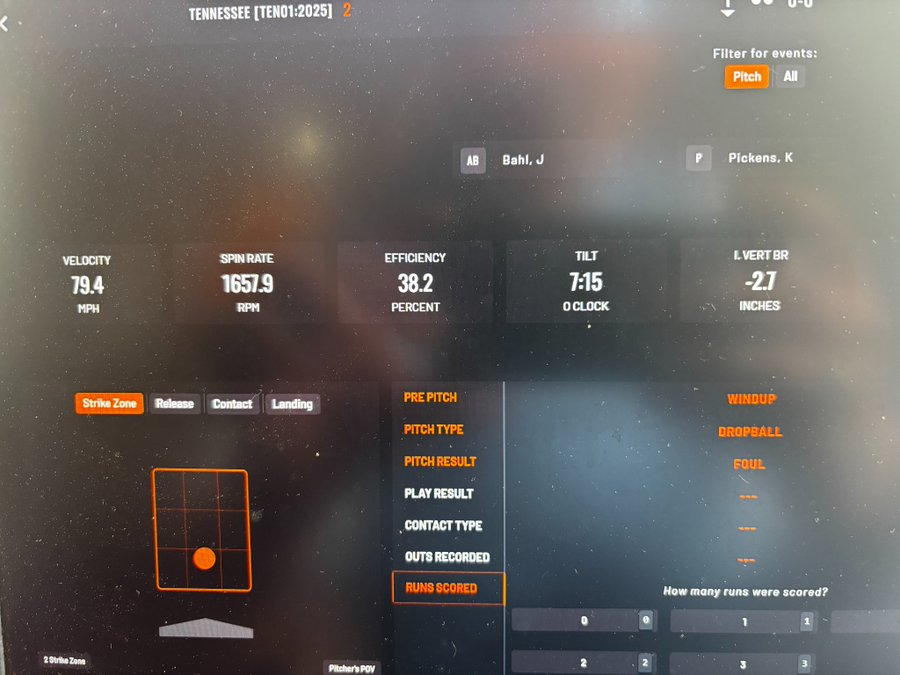
Tennessee Softball @Vol_Softball confirmation via @Yakkertech
Karlyn’s technique likely includes specific steps such as:
- Wind-Up: A proper wind-up helps generate the necessary momentum for the pitch.
- Arm Positioning: The arm must be positioned correctly to ensure a powerful release.
- Follow-Through: A strong follow-through not only aids in speed but also helps prevent injuries.These elements, when executed flawlessly, culminate in a pitch that can reach speeds of 79.4 MPH, as Karlyn has demonstrated.
- The Impact of Speed on the Game
The speed of a pitch can significantly influences the outcome of a game. Hitters must react quickly to fast pitches, which can lead to more strikeouts and a greater challenge for opposing teams. Karlyn’s new record may not only impact her individual performance but could also change how teams approach their strategies when facing her on the mound. - Additionally, the psychological aspect of facing a fast pitcher can weigh heavily on batters. The fear of being struck out or hitting a ball at such high speeds can create pressure, making it difficult for players to perform at their best. This psychological edge could be a game-changer for Karlyn and her team in high-stakes matchups.
- The Community Response
The response to Karlyn’s achievement has been overwhelmingly positive, with fans and fellow athletes celebrating her remarkable feat. Social media platforms, including Twitter, have been abuzz with congratulatory messages, highlighting the growing support for women’s sports and female athletes. The tweet from Tennessee Softball announcing her record garnered significant attention, showcasing the pride and excitement within the community.Inspiring Future Generations
Karlyn’s record is not just an achievement for her but also a beacon of inspiration for young athletes. Aspiring softball players can look up to her as a role model, motivating them to push their limits and strive for greatness. The visibility of her accomplishment serves as a reminder that hard work, dedication, and resilience can lead to extraordinary outcomes. - Conclusion
Karlyn’s accomplishment of pitching a record-breaking 79.4 MPH fastball is a landmark moment in NCAA Softball history. It symbolizes the relentless pursuit of excellence that defines not only her career but also the evolution of women’s sports as a whole. As she continues to break records and inspire others, Karlyn stands as a testament to the power of determination, skill, and the unwavering spirit of athletes everywhere. - The significance of her achievement extends beyond the field; it encourages a new generation to dream big, work hard, and believe in their capabilities. As we celebrate Karlyn’s success, we also recognize the importance of supporting and promoting women’s sports, ensuring that their stories and accomplishments receive the attention they rightfully deserve.
- A 100 mph baseball pitch is roughly equivalent to a 70 mph fastpitch softball pitch in terms of reaction time for the batter. This is because the softball mound is closer to the batter than the baseball mound, meaning hitters have less time to react to the pitch. If you’re interested in a conversion chart for different pitch speeds, you can check it out
- 1
Baseball Speed Compared To Softball: The Surprising Truth Behind The Pitch
How does the distance between the mound and batter affect pitch speeds?
The distance between the mound and the batter plays a huge role in how fast a pitch feels to the hitter. In baseball, the mound is 60 feet, 6 inches from home plate2. In fastpitch softball, the pitching distance is 43 feet for college and professional levels.
Since softball pitchers throw from a closer distance, a 70 mph softball pitch reaches the batter in about the same time as a 100 mph baseball pitch. The shorter distance means hitters have less reaction time, making even slower pitches feel much faster.
This difference also affects pitch movement—softball pitches tend to have more rise, drop, and lateral movement because of the underhand motion and shorter reaction time.
Want to dive deeper into the physics behind it?
1www.platecrate.com 2www.internationalsoftball.com
Can you explain the physics behind pitch speeds?
Absolutely! The physics behind pitch speeds involves velocity, spin, air resistance, and biomechanics. Here’s a breakdown:
1. Velocity & Energy Transfer
- A pitch’s speed comes from the energy transfer through the pitcher’s body—from the legs, through the core, and into the arm.
- Newton’s Third Law of Motion applies: as the pitcher pushes off the mound, an equal and opposite reaction propels the ball forward.
2. Spin & Magnus Effect
- The spin rate of a pitch affects its movement. The Magnus force causes the ball to curve based on its rotation.
- A fastball with backspin resists gravity, staying higher in the strike zone.
- A curveball with topspin drops faster due to the downward Magnus force.
3. Air Resistance & Drag
- As the ball moves through the air, it experiences drag, which slows it down.
- Seam orientation affects how air flows around the ball, influencing movement and speed.
4. Biomechanics & Pitching Motion
- Pitchers generate speed through a sequence of movements, including leg drive, hip rotation, and arm acceleration.
- Proper mechanics help maximize velocity while reducing injury risk.
1entertainment.howstuffworks.com 2www.popsci.com 3suchbaseball.com
Can you explain the Magnus Effect in more detail?
Absolutely! The Magnus Effect is a fascinating phenomenon in fluid dynamics that explains how a spinning object moving through a fluid (like air or water) experiences a force perpendicular to its direction of motion. This effect is responsible for the curve of a soccer ball, the movement of a baseball pitch, and even the lift generated by certain aircraft designs.
How It Works
When an object—such as a ball or cylinder—spins as it moves through the air, it creates differences in air pressure around it:
- The side of the object spinning in the same direction as the airflow speeds up the air, reducing pressure.
- The opposite side, where the object spins against the airflow, slows the air down, increasing pressure.
- This pressure difference generates a sideways force, causing the object to curve in the direction of the lower-pressure side.
Real-World Applications
- Sports: The Magnus Effect explains the curve of a soccer ball during a free kick, the drop of a curveball in baseball, and the movement of a spinning tennis ball.
- Aviation: Some experimental aircraft use rotating cylinders instead of wings to generate lift.
- Marine Engineering: Rotor ships use spinning cylinders to harness wind power for propulsion.
Can you explain different pitching styles in fastpitch softball?
Absolutely! Fastpitch softball pitchers use a variety of pitches to keep batters guessing.
Here are some of the most common styles:
Fastballs
- Four-seam fastball – The fastest pitch, thrown with a straight trajectory.
- Two-seam fastball – Slightly slower than the four-seam but has more movement.
Breaking Balls
- Curveball – Spins downward and away from the batter.
- Slider – Moves more horizontally than a curveball.
- Screwball – Breaks in the opposite direction of a curveball.
- Drop ball – Falls sharply as it reaches the plate.
- Riseball – Moves upward as it approaches the batter.
Changeups
- Circle change – Gripped with a circular formation to reduce speed.
- Back-hand release – Flipped backward to slow the pitch down.
- Knuckle change – Thrown using the knuckles for deceptive movement.
Knuckleball
- Knuckleball – Minimal spin causes unpredictable movement, making it tough to hit.
Each pitch has unique characteristics that can be used strategically depending on the batter’s tendencies and game situation.
What are the speed ranges for different softball pitch types?
Softball pitchers use a variety of pitch types, each with its own speed range.
Here are some common ones:
- Fastball: 60–75 mph
- Curveball: 45–65 mph
- Changeup: 40–65 mph
- Slider: 45–85 mph
- Knuckleball: 40–60 mph
- Riseball: 60–70 mph
- Drop ball: 55–65 mph
- Screwball: 50–60 mph
These speeds can vary based on the pitcher’s skill level, mechanics, and environmental conditions. Elite pitchers can consistently throw in the upper ranges, while younger or developing players may fall on the lower end.
Want to dive deeper into the mechanics of these pitches?
1
How do fastpitch and slowpitch softball pitches compare?
Fastpitch and slowpitch softball have distinct pitching styles that significantly impact the game’s pace and strategy.
- Pitching Motion: Fastpitch pitchers use a windmill motion, generating high speeds and spin, while slowpitch pitchers deliver the ball with a high-arcing lob.
- Speed: Fastpitch pitches can reach 60–75 mph, whereas slowpitch pitches are much slower, typically under 25 mph.
- Reaction Time: Fastpitch batters have less time to react due to the speed and shorter distance, while slowpitch batters have more time to track the ball.
- Strategy: Fastpitch relies on speed, deception, and movement, whereas slowpitch focuses on placement and accuracy.
- Base Running: Fastpitch allows stealing bases, adding a strategic element, while slowpitch generally does not permit stealing.
Jennie Finch 70 mph pitch to mlb players in 2009 – Search Videos
What is the difference in mechanics baseball and fastpitch softball – Search Videos