The Crazy Horse Memorial – Search Videos is a mountain monument under construction on privately held land in the Black Hills, in Custer County, South Dakota, United States.
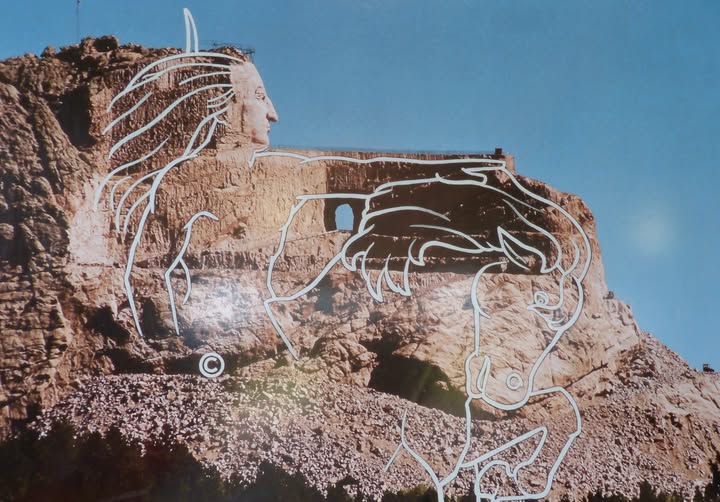
It will depict the Oglala Lakota warrior Crazy Horse, riding a horse and pointing to his tribal land. The memorial was commissioned by Henry Standing Bear, a Lakota elder, to be sculpted by Korczak Ziolkowski. It’s operated by Crazy Horse Memorial Foundation, a nonprofit organization. The monument has been in progress since 1948 and is far from completion.[4][5]
Overview
The memorial master plan includes the mountain carving monument, a Native American Museum of North America, and a Native American Cultural Center. The monument is being carved out of Thunderhead Mountain, on land considered sacred by some Oglala Lakota, between Custer and Hill City, roughly 17 miles (27 km) from Mount Rushmore.[5]
The sculpture’s final dimensions are planned to be 641 feet (195 m) long and 563 feet (172 m) high. The outstretched left arm will be 263 feet (80 m) long, the opening under arm 70 feet (21 m) wide and 100 feet (30 m) high, and the extended index finger 29 feet 6 inches (9 m) long.[1] The face of Crazy Horse, completed in 1998, is 87 feet 6 inches (26.7 m) high;[1] by comparison, the heads of the four U.S. Presidents at Mount Rushmore are each 60 feet (18 m) high.
Crazy Horse
Main article: Crazy Horse
Crazy Horse was a Native American war leader of the Oglala Lakota. He took up arms against the U.S. Federal government to fight against encroachments on the territories and way of life of the Lakota people.
His most famous actions against the U.S. military included the Fetterman Fight (21 December 1866) and the Battle of the Little Bighorn (25–26 June 1876). He surrendered to U.S. troops under General George Crook in May 1877 and was fatally wounded by a military guard, allegedly[6][7] while resisting imprisonment at Camp Robinson in present-day Nebraska. He ranks among the most notable and iconic of Native American tribal members and was honored by the U.S. Postal Service in 1982 with a 13¢ postage stamp that is part of its Great Americans series.[8]
History of the monument
Henry Standing Bear (Mato Naji), an Oglala Lakota chief, and well-known statesman and elder in the Native American community, recruited and commissioned Polish-American sculptor Korczak Ziolkowski to build the Crazy Horse Memorial in the Black Hills of South Dakota.
In October 1931, Luther Standing Bear, Henry’s older brother, wrote to sculptor Gutzon Borglum, who was carving the heads of four American presidents at Mount Rushmore. Luther suggested that it would be “most fitting to have the face of Crazy Horse sculpted there.
Crazy Horse is the real patriot of the Sioux tribe and the only one worthy to place by the side of Washington and Lincoln.” Borglum never replied.[9] Thereby, Henry Standing Bear began a campaign to have Borglum carve an image of Crazy Horse on Mount Rushmore.[10] In summer of 1935, Standing Bear, frustrated over the stalled Crazy Horse project, wrote to James H. Cook, a long time friend of Chief Red Cloud‘s, “I am struggling hopelessly with this because I am without funds, no employment and no assistance from any Indian or White.”[11]
On November 7, 1939, Henry Standing Bear wrote to the Polish-American sculptor Korczak Ziolkowski, who worked on Mount Rushmore under Gutzon Borglum. He informed the sculptor, “My fellow chiefs and I would like the white man to know that the red man has great heroes, too.”[12]
Standing Bear also wrote a letter to Undersecretary Oscar Chapman of the Department of the Interior, offering all his own fertile 900 acres (365 ha) in exchange for the barren mountain for the purpose of paying honor to Crazy Horse.
The government responded positively, and the U.S. Forest Service, responsible for the land, agreed to grant a permit for the use of the land, with a commission to oversee the project. Standing Bear chose not to seek government funds and relied instead upon influential Americans interested in the welfare of the American Indian to privately fund the project.[13]
In the spring of 1940, Ziolkowski spent three weeks with Standing Bear at Pine Ridge, South Dakota, discussing land ownership issues and learning about Crazy Horse and the Lakota way of life. According to Ziolkowski, “Standing Bear grew very angry when he spoke of the broken Treaty of Fort Laramie (1868). That was the one I’d read about in which the President promised the Black Hills would belong to the Indians forever. I remember also how his old eyes flashed out of that dark mahogany face, then he would shake his head and fall silent for a long while.”[12]
Construction under Ruth Ziolkowski (1982–2014)
After Ziolkowski died in 1982 at age 74, his widow Ruth Ziolkowski, took charge of the sculpture, overseeing work on the project as CEO from the 1980s to the 2010s.[14][15] Ruth Ziolkowski focused on the completion of Crazy Horse’s face first, instead of the horse as her husband had originally planned. She believed that Crazy Horse’s face, once completed, would increase the sculpture’s draw as a tourist attraction, which would provide additional funding.[14] She also oversaw the staff, which included seven of her children.[15]Construction on the monument in 2020
Sixteen years later, in 1998, the head and face of Crazy Horse were completed and dedicated; Crazy Horse’s eyes are 17 feet (5.2 m) wide, while his head is 87 feet (27 m) high.[16][17][18] Ruth Ziolkowski and seven of the Ziolkowskis’ 10 children carried on work at the memorial.[19]
Daughter Monique Ziolkowski, herself a sculptor, modified some of her father’s plans to ensure that the weight of the outstretched arm was supported sufficiently.[20] The foundation commissioned reports from two engineering firms in 2009 to help guide completion of the project.[20]
Work commenced on the horse after two years of careful planning and measurements.[14] Since the completion of the head and face, much of the monument’s sculpting work has been dedicated to the much larger horse portion.[21][16][17]
Ruth Ziolkowski died on May 21, 2014, at the age of 87.[22] Monique Ziolkowski became CEO and three of her siblings continued to work on the project, as well as three of the Ziolkowskis’ grandsons, including Caleb, who has gone on to become the “chief mountain officer”.[23]
Construction since 2014
With Monique Ziolkowski as CEO, work focused on finishing the outstretched left arm of Crazy Horse, in addition to expanding the on-site Indian University of North America,[24] a joint-venture with Black Hills State University that has offered summer programs for university students of Native American descent since 2011.[25]
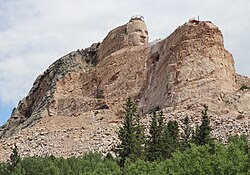
Monique Ziolkowski stepped down as CEO in 2021 to focus on artwork and other aspects of the memorial site,[26] with the foundation eventually naming Whitney A. Rencountre II, who had held various education-based positions including associate director of the Indian University, as its new CEO in August 2022.[27]
The memorial celebrated its 75th anniversary in 2023.[28] Crazy Horse’s left hand was finished by 2024, with finishing work commencing in summer 2024 on the backside of his arm to make way for a new tower crane designed to reach all parts of the carving. The crane, with an estimated cost of $5.2 million, was made possible by several anonymous donations and was procured in 2023, with all parts weighing 25,000 pounds (11,000 kg) combined, and was shipped to the mountain on 17 truck beds.[29]
Source: Crazy Horse Memorial – Wikipedia
What is the current status of the Crazy Horse Monument?
As of now, the Crazy Horse Monument remains a work in progress—more than 75 years after construction began in 1948. The face of Crazy Horse was completed and unveiled in 1998, but the rest of the sculpture, including the horse and extended arm, is still under development.
The project is entirely privately funded, which means it relies on admission fees and donations rather than government support. This, combined with the technical challenges of carving into iron-heavy rock and the harsh South Dakota weather, has contributed to the slow pace.
There’s no official timeline for completion, and the Crazy Horse Memorial Foundation has emphasized that the monument is as much about the journey and cultural preservation as it is about the final sculpture. If you visit today, you’ll see the completed face, ongoing work on the rest of the figure, and a cultural center that includes a museum and educational exhibits.
The outstretched arm of the Crazy Horse Memorial is intentionally pointing toward the lands of the Lakota people, specifically Pine Ridge, South Dakota. This gesture is deeply symbolic—when asked where his lands were, Crazy Horse is said to have replied, “My lands are where my dead lie buried.”
The sculpture captures that sentiment, with Crazy Horse pointing to his ancestral homeland. It’s a powerful tribute carved into Thunderhead Mountain, and when completed, it will be the largest mountain carving in the world.
Pretty awe-inspiring, don’t you think?
1www.distractify.com 2en.wikipedia.org

“A Hidden America: Children of the Plains” [Original Air Date 10/14/2011]
Was a White American television documentary about four children who live at Pine Ridge, a Lakota Sioux Indian reservation in south-western South Dakota. The show appeared on ABC as part of “20/20”. It was hosted by Diane Sawyer.
One of the children tried to hang herself at age 11. She drew a picture of it complete with a broken heart. Her mother is being destroyed by drink. Her bedroom is too cold to sleep in. She showed Diane Sawyer all her clothes – on three hangers. She does well at school and wants to become a schoolteacher, teaching children Lakota.
Families: Most parents are absent or hooked on drugs and drink. Most are out of work. Uncles and grandparents try to hold things together. People live in falling-apart, ill-heated houses. In one three-bedroom house there were 19 people.
Schools: lack money and are falling apart too. One school they showed still had asbestos, which causes cancer. What little money they get has to go to books, computers and teachers.
Food: The free food the government sends is not healthy. Half the people have diabetes. Most Lakota Indians never see 60. For many children their only solid meal is at school. When a Subway sandwich shop opened one women was amazed by the cucumbers: fresh vegetables are that expensive.
Businesses: There are no banks or malls or cinemas. The few businesses there are more regulated than a nuclear power plant.
Liquor stores: Just outside the reservation stand four liquor stores. Together they sell 4 million cans of beer a year. They are owned by outsiders.
The show was excellent:
- Visibility: American television almost never shows Indian reservations – or other poor places in America that are far from Hollywood and New York. In American society Native Americans are out of sight, out of mind.
- Large audience: ABC can easily pull in millions of viewers, unlike PBS or YouTube.
- Material help: The show gave viewers ways to help Pine Ridge – and some have. The show even helped one of the children find his father.
But it was terrible too:
- Teflon history: Near the beginning Diane Sawyer said, “But tonight is not about history.” We are given almost no way to understand what we are seeing, like the drunken men sleeping on sidewalks. Just passing references to broken treaties, boarding schools and such.
- Helpless darkies: You hear little about what the Lakota have been doing and are doing to make things better.
- White gaze: This show was made by and for white people. It would have been ten times better if Diane Sawyer had just walked down the street and let people speak their minds. Or what about segments written and produced by people from Pine Ridge? Where is the Lakota gaze?
- Do not talk to the old people: Except for Diane Sawyer herself, everyone over the age of 30 appears only briefly and almost accidentally. As if Sawyer is not particularly interested in understanding what is going on.
See also:
- YouTube: More than that... – a video made by Lakota schoolchildren in answer to the documentary
- The Sioux today
- race and crime and poverty and television
- white gaze
- darkies
- Teflon Theory of History
- black pathology
- The lies you were taught about Native Americans
The Plight of Pine Ridge Indian Reservation
Faces a multitude of challenges, including poverty, lack of access to healthcare, education, and healthy food options. As of 2025, South Dakota has the highest Native American poverty rate in the country at 45.18%, with Pine Ridge Reservation residents living in poverty at an estimated 53.75%.
The reservation’s per capita income is just $8,768, and unemployment is as high as 89%, limiting economic mobility and access to basic needs. Residents often struggle with inadequate housing and overcrowded living conditions, and the educational system faces significant challenges, impacting the youth’s access to quality education and hindering long-term opportunities.
Healthcare disparities are severe, with life expectancy on the reservation being the lowest in the United States, at just 52 years for women and 48 years for men. Limited medical facilities and high rates of chronic illness and mental health conditions create a public health crisis that further compounds the effects of poverty.1
Pine Ridge Reservation: waiting for stimulus help. 153,849 views May 13, 2009
In communities where it is a struggle to meet the most basic needs, the country’s 565 tribes are gearing up to apply for economic stimulus money that will help build and repair ailing infrastructure on their reservations. Video by Marisol Bello and René Alston/USA TODAY
ABC: A Hidden America: Children of the Plains – watch the show (5 PARTS)
Inside life on the Lakota Sioux reservation l Hidden America: Children of the Plains PART 1/5
Suicide rates, alcoholism among Lakota tribe | Hidden America: Children of the Plains PART 2/5
Lakota girl dreams of being next ‘American Idol’ | Hidden America: Children of the Plains PART 3/5
Lakota girl dances through family tragedy | Hidden America: Children of the Plains PART 4/5
Low life expectancy on Pine Ridge Reservation | Hidden America: Children of the Plains PART 5/5
Ted Cruz, Cory Booker have tense exchange during Senate hearing tied to Trump’s executive powers
Toby Keith Performs “Don’t Let the Old Man In” at the 2023 People’s Choice Country Awards | NBC