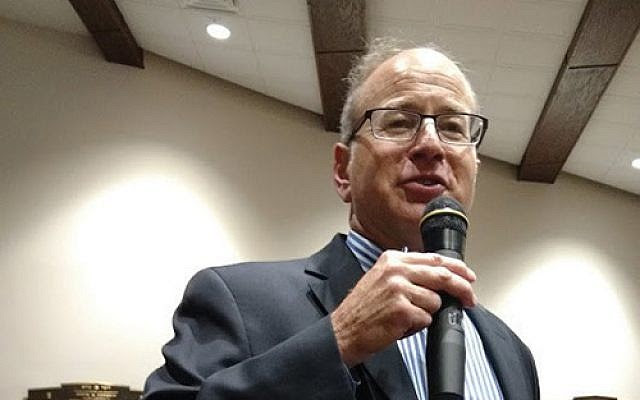
Rabbi Ken Spiro said Jews are driven by “spiritual genetics” to help fix the world, which explains their support for liberal candidates. Photo by Debra Rubin
Why do Jews usually vote Democratic? It’s in their DNA | New Jersey Jewish News
Rabbi says ‘spiritual genetics’ leads to support for liberal causes
Election Day saw significant wins by Democrats in key races throughout the country and here in New Jersey, where Phil Murphy’s decisive victory marked an end to the eight-year Republican reign in the governor’s office. If history is any guide, Jews likely played a role in the progressive candidates’ soaring successes.
In an Election Day talk by Rabbi Ken Spiro, the senior lecturer at Aish HaTorah Jerusalem said that 73% of American Jews identify as liberal and support Democratic candidates, even if their level of affluence would appear to lead them to choose Republicans as better serving their own economic interests. (Sociologist Milton Himmelfarb famously said, “Jews earn like Episcopalians, and vote like Puerto Ricans.”)
So why do American Jews continue to support liberal causes and progressive candidates?
Spiro said it’s in their blood.
As the polls were closing on Nov. 7, Spiro presented “In God We Trust: The Impact of Judaism on Modern Political Thought and Jewish Political Affiliation” at Congregation B’nai Tikvah in North Brunswick.
That drive to do good in the world — the mitzvah of tikkun olam, literally “repairing the world” — he said, stretches back many centuries, is rooted in Torah, and was an imperative of the Jews long before most of the world embraced the concept of social responsibility.
The commitment to improve the world has been passed down through generations and explains American Jews’ continuing to identify as liberal, he said, pointing out that, in contrast, only 28 percent of the general American population identify as liberals.
“It’s in the Jewish DNA,” he said.
Terming it “spiritual genetics,” Spiro said until modern times Jews, like other people, lived close together and rarely traveled more than a few miles from their hometowns. Such closed communities provided fertile ground for the cultivation of certain traits to be passed from generation to generation and become deeply ingrained. These traits included a “crazy” drive to succeed, which, Spiro said, helps explain why almost a quarter of the Nobel prizes in math, science, and medicine have gone to Jews.
As they arrived in America in waves in the late 19th century, Jews began to channel their “spiritual genetics” into leadership roles in the labor movement. Over time that same drive led Jews to support and become leaders in the civil rights and women’s movements and other socially progressive causes, said Spiro, and put them in positions to found and helm numerous organizations devoted to helping Jews and non-Jews alike.
These attitudes generated by social concerns quickly spilled over into politics. To this day, Spiro said, most Jews have voted for the Democrat presidential candidate in every race for more than a century — with two exceptions: In his second run in 1980, Jimmy Carter received only 45 percent of the Jewish vote. However, even in that race more Jews voted for the Democrat than for Republican Ronald Reagan, who received only 39 percent; Independent candidate John Anderson made up the gap.
The other exception was in 1920, when Socialist Eugene Debs took 40 percent of the Jewish vote while the eventual victor, Republican Warren Harding, and his Democratic opponent James Cox split the rest.
Jews’ gravitation toward socialism and even a “misguided” early embrace of communism was motivated by the desire to bring positive change, said Spiro. In fact, “the Jewish people have been a civilizing force in the world,” introducing the concept of monotheism, a system of courts and justice, living in peace with neighbors, the importance of an educated society, and social responsibility.
“In a world where Jews are only a tiny percentage of the population, what is the secret of the disproportionate importance the Jews have had in the history of Western culture?” Spiro asked.
Answering his own question, he said the Jewish Bible and its teachings have long influenced American institutions and life, starting with the Pilgrims, Christian refugees who considered their journey a modern-day Exodus, the Atlantic Ocean as their Red Sea, as they fled repression in Europe.
In fact, he said, one of the quotations on the Liberty Bell, “proclaim liberty throughout all the land,” comes from Leviticus, and reflects how the Founding Fathers were inspired by the Jewish Bible.
Yet if it is the teachings and ethical structure of Judaism that have informed the good work of the Jewish community over the centuries, Spiro said, it’s troubling that many Jews act without any real knowledge of Judaism. To wit, research polls have shown the primary connection of many Jews to their religion is through social responsibility.
“I would say God is an Independent, and His platform is Torah,” Spiro said. “The messengers have largely forgotten the message. It doesn’t matter if you run the largest charity in the world; your light needs to recharge and it’s that light of Jews for Judaism that makes us better human beings.”
Jews spreading socialism/communism in Europe. – Search Videos
Explain to me how any person of Jewish faith could vote as a democrat? – Search
It boggles my mind! Common Sense
Jews comprise approximately 12% of New York City‘s population, making the Jewish community the largest in the world outside of Israel. As of 2020, over 960,000 Jews lived in the five boroughs of New York City,[1] and over 1.9 million Jews lived in the New York metropolitan area, approximately 25% of the American Jewish population.[2]
Nearly half of the city’s Jews live in Brooklyn.[3][4] The first recorded Jewish settler was Jacob Barsimson, who arrived in August 1654 on a passport from the Dutch West India Company.[5] Following the assassination of Alexander II of Russia, for which many blamed “the Jews”, the 36 years beginning in 1881 experienced the largest wave of Jewish immigration to the United States, when the Jewish population rose from about 80,000 in 1880 to 1.5 million in 1920.[6]
In 2012, the largest Jewish denominations in New York City were Orthodox, Haredi, and Conservative Judaism.[7] Reform Jewish communities are prevalent throughout the area. Temple Emanu-El in Manhattan is the largest Reform Jewish synagogue in the world. The large Jewish population has led to a significant impact on the culture of New York City.[8] After many decades of decline in the 20th century, the Jewish population of New York City has seen an increase in the 21st century, owing to the high birth rate of the Hasidic and other Orthodox communities.[9]
Historical population
Ultra-Orthodox Jewish residents in Brooklyn, nicknamed “the most Jewish spot on Earth.”[4] Home to the largest Jewish community in the United States, with more than 561,000 living in the borough, larger than that of Tel Aviv.[3]
| Year | Jewish Population | Total city Population | Percentage of city |
|---|---|---|---|
| 1654 | 23 | 1,000 | 2.3 |
| 1750 | 300 | 13,000 | 2.3 |
| 1850 | 16,000 | 515,000 | 3.1 |
| 1859 | 40,000 | 813,000 | 4.9 |
| 1880 | 80,000 | 1,206,000 | 6.6 |
| 1920 | 1,600,000 | 5,620,000 | 28.5 |
| 1950 | 2,000,000 | 7,900,000 | 25.3 |
| 1981 | 1,100,000[10] | 7,000,000 | 15.8 |
| 1991 | 1,027,000[10] | 7,340,000 | 14 |
| 2002 | 972,000[10][11] | 8,000,000 | 12 |
| 2012 | 1,100,000[9] | 8,340,000 | 13.2 |
| 2023 | 960,000[12] | 8,260,000 | 11.6 |
There are 1.3 million Jews in the New York metropolitan area, making it the second largest metropolitan Jewish community in the world, after the Tel Aviv Metropolitan Area in Israel (however, Tel Aviv proper has a smaller population of Jews than New York City proper, making New York City the largest community of Jews in the world within a city proper). New York City’s Jewish population is more than the combined Jewish populations of Chicago, Philadelphia, San Francisco, and Washington, D.C.,[13] and more than Jerusalem and Tel Aviv combined. Russian, Lithuanian, and Polish Jews immigrated during the mid-19th century in large numbers.
The number of Jews in New York City soared throughout the beginning of the 20th century and reached a peak of 2 million in the 1950s, when Jews constituted one-quarter of the city’s population. New York City’s Jewish population then began to decline because of low fertility rates and migration to suburbs and other states, particularly California and Florida. Though there were small Jewish communities throughout the United States by the 1920s, New York City was home to about 45% of the entire population of American Jews.[14]
A new wave of Ashkenazi and Bukharian Jewish immigrants from the former Soviet Union began arriving in the 1980s and 1990s. In 2002, an estimated 972,000 Ashkenazi Jews lived in New York City and constituted about 12% of the city’s population. Many Jews, including the newer immigrants, have settled in Queens, south Brooklyn, and the Bronx, where at present most live in middle-class neighborhoods. The number of Jews is especially high in Brooklyn, where 561,000 residents—one out of four inhabitants—is Jewish.[15][16] As of 2012, there are 1.1 million Jews in New York City.[17]
New York City is home to many Orthodox Jews. The world headquarters of the Chabad, Bobov, and Satmar branches of Hasidism are located there, as well as other Haredi branches of Judaism. While three-quarters of New York Jews do not consider themselves religiously observant, the Orthodox community is rapidly growing due to the high birth rates of Hasidic Jews, while the number of Conservative and Reform Jews has been declining. Borough Park, known for its large Orthodox Jewish population, had 27.9 births per 1,000 residents in 2015, making it the neighborhood with the city’s highest birth rate.[18]
However, the most rapidly growing community of American Orthodox Jews is located in Rockland County and the Hudson Valley of New York, including the communities of Monsey, Monroe, New Square, Kiryas Joel, and Ramapo.[19] According to a 2011 UJA-Federation of New York community study, there were 340,000 Haredi Jews in the greater New York metropolitan area.[20]
Many rapidly growing Orthodox Jewish communities there have made their home in New Jersey, particularly in Lakewood and surrounding Ocean County, where Beth Medrash Govoha, the world’s largest yeshiva outside Israel, is located.[21] Prominent Orthodox organizations such as Agudath Israel of America and the Orthodox Union have their headquarters in New York.
Sephardic Jews, including Syrian Jews, have also lived in New York City since the late 19th century. Many Sephardi immigrants have settled in New York City and formed a Sephardi community. The community is centered in Brooklyn and is primarily composed of Syrian Jews. Other Sephardi Jews in New York City hail from Egypt, Israel, Lebanon, and Morocco.[22] Sephardi Jews first began arriving in New York City in large numbers between 1880 and 1924.
Most Arab immigrants during these years were Christian, while Sephardi Jews were a minority and Arab Muslims largely began migrating during the mid-1960s.[23] When Syrian Jews first began to arrive in New York City during the late 1800s and early 1900s, Eastern European Ashkenazi Jews on the Lower East Side sometimes disdained their Syrian co-coreligionists as Arabische Yidden, Arab Jews.
Some Ashkenazim doubted whether Sephardi/Mizrahi Jews from the Middle East were Jewish at all. In response, some Syrian Jews who were deeply proud of their ancient Jewish heritage, derogatorily dubbed Ashkenazi Jews as “J-Dubs”, a reference to the first and third letters of the English word “Jew”.[24] In the 1990 United States Census, there were 11,610 Sephardi Jews in New York City, comprising 23 percent of the total “Arab population” of the city.[25]
Arab Jews in the city sometimes still face anti-Arab racism. After the September 11 attacks, some Arab Jews in New York City were subjected to arrest and detention because they were suspected to be Islamist terrorists.[26] Egyptian Jews arrived in New York City more recently than the Syrian Jews, with many of the Egyptian Jews speaking Ladino as well as Arabic and French.
The vast majority Egyptian-Jewish immigrants to the city are Sephardi/Mizrahi, with very few being Ashkenazi. Ladino-speaking Egyptian Jews have tended to settle in the Forest Hills neighborhood of Queens. Very few Egyptian Jews lived in New York City or elsewhere in the United States prior to the 1956 Suez Crisis.
Prior to the Immigration and Nationality Act of 1965, the quota for Egyptian immigrants was set at 100 people per year. Because of antisemitism directed against Egyptian Jews in Egypt, a small number of Egyptian-American Jews in New York City banded together as the “American Jewish Organization for the Middle East, Inc.” to advocate for Jewish Egyptian refugees.
There are two major communities of Egyptian Jews, one in Queens and another in Brooklyn. Egyptian Jews in Queens helped found Shearith Israel Congregation, while Egyptian Jews in Brooklyn’s Bensonhurst neighborhood largely attended Syrian-Jewish synagogues.[27]
While the majority of Jews in New York City are non-Hispanic whites, some Jewish New Yorkers identify as Asian, Black, Latino, or multiracial. According to the same 2011 UJA-Federation of New York study, 12% of Jewish households in the city were non-white or biracial.[28] Many Central Asian Jews, predominantly Bukharian Jews from Uzbekistan, have settled in the Queens neighborhoods of Rego Park, Forest Hills, Kew Gardens, and Briarwood.[14]
As of 2001, an estimated 50,000 Bukharian Jews resided in Queens.[29] Queens is also home to a large Georgian-American community of about 5,000, around 3,000 of whom are Georgian Jews. Queens has the third largest population of Georgian Jews in the world after Israel and Georgia. Forest Hills is home to the Congregation of Georgian Jews, the only Georgian-Jewish synagogue in the United States.[30] There has also been a sizeable community of Mountain Jews from Azerbaijan and the South Caucasus in Brooklyn.[14]How historical is Khazaria in Crusader Kings 3? – YouTube – Search
How can we apply lessons from WWII to today’s political climate?
Jews spreading socialism/communism in Europe. – Search Videos
The shadow of World War II still stretches across our world, and it’s hard-earned lessons are incredibly relevant today. Here are a few key takeaways we can apply to modern political dynamics:
- The danger of unchecked authoritarianism: WWII revealed how fragile democratic institutions can be in the face of rising nationalism, propaganda, and the erosion of civil liberties. Today, protecting free press, judicial independence, and fair elections is just as vital.
- The importance of economic stability: The Great Depression contributed to the rise of extremism in the 1930s. Ensuring economic opportunity, reducing inequality, and addressing discontent are critical to maintaining social cohesion and trust in institutions.
- The peril of scapegoating and propaganda: Dehumanizing rhetoric against minorities fueled horrific policies in the 1930s and ’40s. We must remain alert to divisive narratives that shift blame onto vulnerable groups and question simplistic solutions to complex problems.
- The power of international cooperation: WWII gave birth to institutions like the United Nations, created to foster peace and collaboration. In a world facing global threats—from climate change to pandemics—working together across borders is more essential than ever.
- Vigilance against historical amnesia: Forgetting—or willfully distorting—history allows past mistakes to repeat. Promoting education, critical thinking, and historical literacy is a safeguard against creeping extremism.
History doesn’t repeat itself exactly, but it does echo. Recognizing the early warning signs of political deterioration can help us act before a crisis unfolds. Want to zoom in on any of these or tie them to specific events happening today?What are the key factors that led to World War II?
Several major factors converged to ignite World War II—each feeding into the next like dominoes ready to fall.
Here are some of the most pivotal:
- Treaty of Versailles (1919): Designed to punish Germany after World War I, the treaty imposed crushing reparations, territorial losses, and military restrictions. It left Germany economically wrecked and politically humiliated—fertile ground for extremism.
- Economic Instability: The Great Depression of the 1930s rippled across the globe, causing massive unemployment and hardship. Desperation made populations more vulnerable to radical leaders promising change.
- Rise of Totalitarian Regimes: Fascist leaders like Hitler in Germany, Mussolini in Italy, and the militarist government in Japan capitalized on national grievances. They promised restoration of power and greatness, often scapegoating minorities and other nations.
- Expansionist Aggression: Japan invaded Manchuria in 1931 and China in 1937. Italy attacked Ethiopia in 1935. Germany reoccupied the Rhineland, annexed Austria (Anschluss), and seized Czechoslovakia—all before the war officially began.
- Appeasement and Inaction: Britain and France, still reeling from WWI, pursued appeasement—hoping to avoid another conflict. The 1938 Munich Agreement, where Hitler was granted the Sudetenland, is a prime example.
- Nazi-Soviet Pact (1939): Germany and the Soviet Union secretly agreed to divide Eastern Europe. Just days after signing the pact, Hitler invaded Poland, prompting Britain and France to declare war.
Every one of these threads wove together a volatile tapestry.
Once Poland was invaded in September 1939, the world could no longer look the other way. If you didn’t understand how WWII happened, this is it. – Search
Jewish Bolshevism – Wikipedia, also Judeo–Bolshevism, is an antisemitic and anti-communist conspiracy theory that claims that the Russian Revolution of 1917 was a Jewish plot and that Jews controlled the Soviet Union and international communist movements, often in furtherance of a plan to destroy Western civilization.
It was one of the main Nazi beliefs that served as an ideological justification for the German invasion of the Soviet Union and the Holocaust.[2] After the Russian Revolution, the antisemitic canard was the title of the pamphlet The Jewish Bolshevism, which featured in the racist propaganda of the anti-communist White movement forces during the Russian Civil War (1918–1922).
During the 1930s, the Nazi Party in Germany and the German American Bund in the United States propagated the antisemitic theory to their followers, sympathizers, and fellow Travellers.[3][4] Nazi Germany used the trope to implement anti-Slavic policies and initiate racial war against Soviet Union, portraying Slavs as inferior humans controlled by Jews to destroy Aryan people.[5][6]
In Poland, Żydokomuna was a term for the antisemitic opinion that the Jews had a disproportionately high influence in the administration of Communist Poland. In far-right politics, the antisemitic canards of “Jewish Bolshevism”, “Jewish Communism”, and the ZOG conspiracy theory are catchwords falsely asserting that Communism is a Jewish conspiracy.[7]
Jewish Bolshevism – Wikipedia
Are saying that because of all the conspiracy theories that formed about Jews spreading socialism/communism in Europe. Which gave rise to the racist fascists which scapegoated them all as communists wanting to control the world and blamed them for making the Aryan race less “pure”. I know so many Jewish people who refuse to acknowledge the anti Semitism problem on the left because they vote Democrat.
Orthodox Jews vs. Zionism – Search
It’s really obvious to me and that’s…. Very scary.
Anne Frank Free Palestinian – Search Videos
𝐏𝐇𝐎𝐄𝐍𝐈𝐗 𝐃𝐑𝐀𝐆𝐎𝐍
@XPHOENIXDRAGON
 Sabbatai Zevi declared himself the messiah of Jews in 1666, proclaiming that redemption was available through acts of sin.
After Zevi’s death in 1676, his Kabbalist successor, Jacob Frank, expanded upon this occult philosophy. is Anne Frank related to Jacob Frank – Search
41 years later, in 1717, they would infiltrate Masonry guilds & establish Freemasonry. Frank had a huge impact on the inner core of Freemasonry known as the Illuminati, formed in 1776. || Trump was kicked out of the Freemason Occult – Search Videos
Freemasonry would become the hidden force behind events like revolutions, creation of the U.N., Israel & the E.U, both World Wars, & assassinations of Kennedys that tried to thwart the efforts of the network on American soil.
The Illuminati Agenda is to control every living thing by introducing programs, technology & education is against almighty God. They took over governments, schools, companies, entertainment industries & social media, to control public knowledge of their existence.
One thought: If you follow every rule your whole life, you can’t understand what power truly is. You’re perspective is limited to the dogma(s) of the time 𝐏𝐇𝐎𝐄𝐍𝐈𝐗𝐃𝐑𝐀𝐆𝐎𝐍 on X: “Sabbatai Zevi declared himself, the messiah of Jews in 1666, proclaiming that redemption was available through acts of sin. After Zevi’s death in 1676, his Kabbalist successor, Jacob Frank, expanded upon this occult philosophy. 41 years later, in 1717, they would infiltrate https://t.co/ZceHrubPOr” / X