
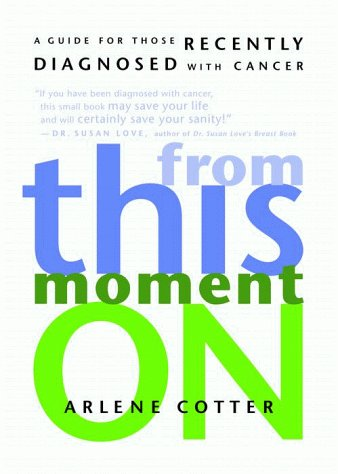
Arlene Cotter is a Vancouver-based design professional, graphic designer, and cancer survivor.
Author and Patient . . . – arlenecotter.com
She has authored “From This Moment On: A Guide for Those Recently Diagnosed With Cancer,” which she wrote after her own terminal diagnosis of stage IV non-Hodgkin’s lymphoma. Cotter’s work often reflects themes of awareness, healing, and transformation, and she collaborates on communication projects in both the public and private sectors. Her design and writing projects aim to create socially, environmentally, and economically sustainable solutions that brand 2D/3D/digital/social spaces, communications, and environments.
Her journey through prognosis, treatment, remission, and recurrence initiated the writing of “From This Moment On: A Guide for Those Recently Diagnosed With Cancer.”
“The year following my cancer diagnosis, while struggling to live, I read as much as I could about cancer and healing. But nothing gave me the basic preparation that I needed. All required more concentration than was realistic for someone who had just been diagnosed with cancer, and all were intimidating.”
As a cancer survivor, Cotter knows the overwhelming and uncertain feelings that envelop a person once they hear the words “You’ve got cancer” from their doctor. ~Search Videos
Cotter’s work stands out because it’s deeply rooted in lived experience. She recognized that many resources available to newly diagnosed patients were too dense or intimidating, and she aimed to create something accessible and comforting.
Arlene Cotter was inspired to write From This Moment On after her own experience with a cancer diagnosis. She understood firsthand how overwhelming and disorienting that moment can be—and how difficult it is to find clarity amid the chaos.
Her goal was to create a resource that felt like a calm, steady companion during one of life’s most turbulent times. Rather than offering dense medical jargon or clinical advice, Cotter focused on emotional guidance, personal empowerment, and practical steps for navigating the early stages of illness. She wanted readers to feel supported, understood, and capable of reclaiming control over their lives—even in the face of uncertainty.
Cotter’s background in design and communication also shaped the book’s format: it’s visually accessible, easy to dip into, and intentionally crafted to offer comfort and insight on every page. Her message is clear—cancer is an ordeal, yes, but it can also be an opportunity for transformation.
MY CANCER JOURNEY – arlenecotter.com
So, it’s official. You’ve been diagnosed with cancer.
And from this moment on your life will never be the same. No matter how much others may wish to help, you alone must initiate the journey.
This is the first step.
Following a positive cancer diagnosis:
You may feel overwhelmed and uncertain about the future. From This Moment On walks you through the stages of illness, treatment, and recovery. It shows you how to accept and move through your anxiety or pain; to gain a sense of control; to find people who can help; and, most important, to decide how you want to live the rest of your life.
Open the book to any page and find something of value. Soak up its wisdom in an hour. Or return to it again and again for encouragement and solace.
From This Moment On will prove a calm and forthright companion on one of life’s most challenging journeys. Cancer is an ordeal, but it is also an opportunity. Exactly what kind of opportunity will be up to you.
Arlene Cotter herself is a designer and writer based in Vancouver, whose work often explores themes of healing and transformation. Her book has been praised by figures like Dr. Susan Love and Julia Sweeney for its clarity and emotional resonance.
If you’re facing a diagnosis—or supporting someone who is—this book might be the gentle companion you didn’t know you needed.
 From This Moment On by Arlene Cotter is a compassionate and empowering guide for those who have just received a cancer diagnosis. Written from a place of deep understanding, Cotter’s book offers emotional and practical support for navigating the initial shock and the journey ahead.
 What the book offers:
- Emotional grounding: Helps readers process fear, anxiety, and uncertainty.
- Practical advice: Guides through stages of illness, treatment, and recovery.
- Empowerment: Encourages readers to take control and make meaningful choices about how they want to live.
- Accessible wisdom: Designed so you can open to any page and find something valuable—whether you need comfort, clarity, or courage.
Cotter herself is a designer and writer based in Vancouver, whose work often explores themes of healing and transformation. Her book has been praised by figures like Dr. Susan Love and Julia Sweeney for its clarity and emotional resonance
If you’re facing a diagnosis—or supporting someone who is—this book might just be the steady companion you need. Would you like a quote from it or suggestions for similar reads?
Can you provide some examples of practical advice offered?
Absolutely. Arlene Cotter’s From This Moment On is filled with gentle, practical guidance for those navigating the emotional terrain of a cancer diagnosis. Here are some examples of the kind of advice she offers:
 Practical Advice Highlights
- Take ownership of your journey Cotter emphasizes that while others may support you, you alone must initiate the journey. This means making decisions that reflect your values, priorities, and emotional needs.
- Find your footing emotionally She encourages readers to accept and move through anxiety or pain, rather than suppress it. This emotional honesty is key to regaining a sense of control.
- Build your support network Cotter advises finding people who can help—not just medically, but emotionally and spiritually. Whether it’s friends, therapists, or support groups, connection is crucial.
- Live intentionally One of the book’s central messages is to decide how you want to live the rest of your life. This could mean reevaluating relationships, career paths, or personal goals in light of your diagnosis.
- Using the book as a companion Cotter designed the book so readers can open it to any page and find something of value. It’s not meant to be read cover-to-cover, but rather dipped into for comfort and clarity when needed.
This isn’t a clinical manual—it’s a soulful guide that helps people reclaim agency and meaning during one of life’s most difficult chapters. If you’d like, I can share a few sample reflections or quotes from the book to give you a taste of its tone.
Can you share more quotes from the book?
Certainly. From This Moment On by Arlene Cotter is filled with poignant reflections designed to offer strength, clarity, and comfort. Here are a few quotes that capture the spirit of the book:
 Selected Quotes from From This Moment On:
- “So, it’s official. You’ve been diagnosed with cancer. And from this moment on your life will never be the same.” — This opening line sets the tone for the book: honest, direct, and deeply empathetic.
- “No matter how much others may wish to help, you alone must initiate the journey. This is the first step.” — Cotter reminds readers that healing begins with personal agency.
- “Cancer is an ordeal, but it is also an opportunity. Exactly what kind of opportunity will be up to you.” — A powerful reframing of illness as a potential turning point for growth and transformation.
- “Open the book to any page and find something of value.” — Cotter designed the book to be a companion, not a textbook—something you can return to again and again for solace.
These quotes reflect Cotter’s belief that even in the face of fear and uncertainty, there is room for choice, meaning, and renewal. If you’d like, I can help you explore themes from the book like resilience, identity, or navigating relationships during illness.
Can you summarize the book’s main message?
Certainly. Arlene Cotter’s From This Moment On delivers a deeply compassionate and empowering message for anyone facing a cancer diagnosis—or any life-altering event.
 Main Message Summary
At its heart, the book encourages readers to reclaim control and meaning in their lives from the moment of diagnosis onward. Cotter doesn’t offer medical advice; instead, she provides emotional and spiritual guidance to help readers:
- Accept the reality of their situation with honesty and courage.
- Recognize their personal power to shape how they respond to illness.
- Live intentionally, making choices that reflect their values and desires.
- Find clarity and calm amid chaos, using the book as a steady companion.
- Transform adversity into opportunity, seeing illness not just as a challenge, but as a chance to reevaluate and renew.
Cotter’s tone is gentle but firm, reminding readers that while others may walk beside them, the journey is theirs alone to define. It’s a book about dignity, agency, and the quiet strength that can emerge in life’s most difficult moments.
Can you provide a summary of key topics covered?
Absolutely. Arlene Cotter’s From This Moment On: A Guide for Those Recently Diagnosed with Cancer is a deeply empathetic and practical resource designed to support individuals in the immediate aftermath of a cancer diagnosis. Here’s a summary of the key topics it covers:
Key Topics in the Book
- Emotional Response to Diagnosis
- Acknowledges the shock, fear, and confusion that often follow a diagnosis.
- Offers strategies for grounding oneself emotionally and mentally.
- Navigating the Journey
- Walks readers through the stages of illness, treatment, and recovery.
- Encourages readers to take ownership of their path and make informed decisions.
- Finding Support
- Helps identify people and resources that can offer meaningful assistance.
- Emphasizes the importance of building a support network.
- Regaining Control
- Provides tools to help readers feel empowered rather than helpless.
- Encourages proactive engagement with medical professionals and personal care.
- Living with Intention
- Invites readers to reflect on how they want to live the rest of their lives.
- Frames cancer not just as an ordeal, but as an opportunity for transformation.
- Accessible Wisdom
- Designed so readers can open to any page and find something valuable—whether it’s comfort, clarity, or courage.
- Offers short, digestible insights that can be revisited again and again.
This book is not just a guide—it’s a companion. Cotter’s tone is calm, forthright, and deeply human, making it a source of solace and strength during one of life’s most challenging moments.
Would you like a quote from the book or recommendations for similar reads that offer emotional support and guidance?
What are some specific strategies mentioned for emotional grounding?
Arlene Cotter’s From This Moment On offers a gentle but powerful toolkit for emotional grounding, especially tailored for those grappling with the shock of a cancer diagnosis. While the book is designed to be opened at any page for insight, several recurring strategies stand out:
 Specific Emotional Grounding Strategies
- Breath Awareness
- Cotter encourages readers to pause and focus on their breath as a way to anchor themselves in the present moment. This simple act can interrupt spiraling thoughts and restore a sense of calm.
- Naming the Emotion
- Instead of suppressing fear, anger, or sadness, Cotter suggests identifying and naming the emotion. This helps create space between the feeling and the self, making it easier to manage.
- Creating a Safe Space
- She recommends finding or creating a physical space that feels safe—whether it’s a quiet room, a favorite chair, or even a corner with comforting objects—to retreat to when emotions feel overwhelming.
- Writing It Out
- Journaling is presented as a way to externalize inner turmoil. Cotter emphasizes that writing doesn’t need to be polished—it just needs to be honest.
- Micro-Decisions
- When life feels out of control, Cotter advises making small, intentional choices—like what to eat, what to wear, or when to rest—to reclaim a sense of agency.
- Visual Anchors
- She suggests using visual cues like photographs, nature scenes, or meaningful symbols to ground oneself emotionally and reconnect with hope or purpose.
- Permission to Feel
- One of her most compassionate strategies is simply giving yourself permission to feel whatever arises, without judgment. This validation can be deeply healing.
These strategies aren’t just about coping—they’re about reclaiming your emotional landscape in a time of upheaval. Cotter’s tone throughout is calm, forthright, and deeply human, making these practices feel accessible and empowering
Would you like to explore how to apply one of these strategies in your own life, or perhaps pair them with mindfulness or meditation techniques?
What are some other grounding techniques I should know?
Great question—grounding techniques are like emotional life rafts, helping you stay anchored when the waves of stress, anxiety, or overwhelm start crashing in. Here are some powerful and diverse strategies you might find helpful:
 Mental Grounding Techniques
These help redirect your thoughts and bring your mind back to the present.
- 5-4-3-2-1 Technique: Name 5 things you can see, 4 you can touch, 3 you can hear, 2 you can smell, and 1 you can taste.
- Alphabet Game: Pick a category (e.g., animals, foods) and name one item for each letter of the alphabet.
- Describe Your Environment: In detail, describe your surroundings—colors, textures, sounds—as if you’re narrating to someone who can’t see it.
- Positive Affirmations: Repeat calming phrases like “I am safe,” “This feeling will pass,” or “I am in control.”
 Physical Grounding Techniques
These engage your body to help regulate your nervous system.
- Cold Water Splash: Splash your face with cold water or hold an ice cube to jolt your system back to the present.
- Movement: Stretch, walk, dance, or do jumping jacks—anything to reconnect with your body.
- Touch Textures: Run your fingers over different surfaces (fabric, wood, metal) and focus on the sensation.
- Weighted Blanket or Pressure: Applying gentle pressure can be soothing and help you feel more secure.
 Soothing Grounding Techniques
These focus on comfort and self-compassion.
- Visualization: Imagine a safe or peaceful place in vivid detail—what you see, hear, smell, and feel.
- Music or Sound: Listen to calming music, nature sounds, or even white noise.
- Aromatherapy: Use essential oils like lavender, peppermint, or eucalyptus to stimulate your senses.
- Self-Soothing Rituals: Sip warm tea, wrap yourself in a cozy blanket, or hold a comforting object.
These techniques can be mixed and matched depending on what you need at the moment—some people find physical grounding works best during panic, while mental techniques help with rumination or overthinking.
What is the science behind grounding techniques?
Grounding techniques—whether psychological or physical—are backed by intriguing science that spans both mental health and biophysics. Let’s break it down into two main categories:
Psychological Grounding (for anxiety, trauma, and stress)
These techniques are rooted in cognitive-behavioral therapy (CBT) and mindfulness practices. The science here focuses on how grounding helps regulate the nervous system and shift attention away from distressing thoughts or sensations.
- Interrupts the stress response: Grounding activates the prefrontal cortex, helping override the fight-or-flight response triggered by the amygdala.
- Engages the senses: Techniques like the 5-4-3-2-1 method stimulate sensory input, which can calm the brain and reduce dissociation or panic.
- Promotes mindfulness: By anchoring attention to the present moment, grounding reduces rumination and improves emotional regulation.
- Reduces cortisol: Mindfulness-based grounding has been shown to lower cortisol levels, the hormone associated with stress.
 Physical Grounding (aka “Earthing”)
This is the practice of physically connecting with the Earth—like walking barefoot on grass or using grounding mats. The theory is based on biophysics and the Earth’s natural electrical charge.
- Electron transfer: The Earth carries a negative charge. When your skin touches it, electrons may transfer into your body, potentially neutralizing free radicals.
- Inflammation reduction: Some small studies suggest grounding may reduce markers of inflammation and improve wound healing2.
- Improved sleep and mood: Preliminary research shows that grounding may help regulate circadian rhythms and reduce stress, fatigue, and depression.
- Heart rate variability: Grounding has been linked to improved heart rate variability, a marker of autonomic nervous system balance.
Note: While physical grounding (earthing) shows promise, it’s still under-researched. Most studies are small and not yet widely replicated, so it should complement—not replace—evidence-based medical care
If you’re curious about trying grounding, you can start with simple practices like breathwork, sensory awareness, or even walking barefoot in your backyard. Want help building a personalized grounding routine based on your lifestyle or emotional needs?
1www.webmd.com 2www.healthline.com 3health.clevelandclinic.org
Can grounding techniques help with specific anxiety disorders?
Yes—they absolutely can. Grounding techniques are especially effective for managing symptoms of specific anxiety disorders, including:
Generalized Anxiety Disorder (GAD)
- Challenge racing thoughts: Mental grounding like naming objects in the room or reciting facts can interrupt worry spirals.
- Sensory focus: Physical grounding (e.g., holding an ice cube or touching textured objects) helps redirect attention from abstract fears to concrete sensations.
 Panic Disorder
- Interrupt panic cycles: Techniques like deep breathing, counting steps, or focusing on the breath can help regulate the nervous system during an attack.
- Immediate relief: Cold water on the face or holding something cold can activate the parasympathetic nervous system, calming the body quickly.
 Post-Traumatic Stress Disorder (PTSD)
- Reduce dissociation: Grounding helps bring individuals back to the present when flashbacks or emotional flooding occur.
- Safe space visualization: Imagining a calming environment can soothe hyperarousal and reestablish a sense of safety.
 Social Anxiety Disorder
- Pre-event calming: Before social situations, grounding can reduce anticipatory anxiety—like focusing on breath or repeating affirmations.
- In-the-moment regulation: Tactile grounding (e.g., holding a smooth stone or bracelet) can provide discreet support during interactions.
 Obsessive-Compulsive Disorder (OCD)
- Disrupt compulsive loops: Grounding can act as a cognitive “reset,” helping shift focus from intrusive thoughts to neutral stimuli.
- Mindfulness-based grounding: Encourages acceptance of uncertainty and reduces compulsive checking or reassurance-seeking.
These techniques don’t replace therapy or medication, but they’re powerful tools for self-regulation and emotional resilience. Many therapists incorporate grounding into treatment plans, especially for trauma-informed care.
Would you like help tailoring a grounding routine to a specific anxiety pattern or situation you’re facing?
1www.healthline.com 2health.clevelandclinic.org 3www.choosingtherapy.com
Shania Twain Playlist – From This Moment On