
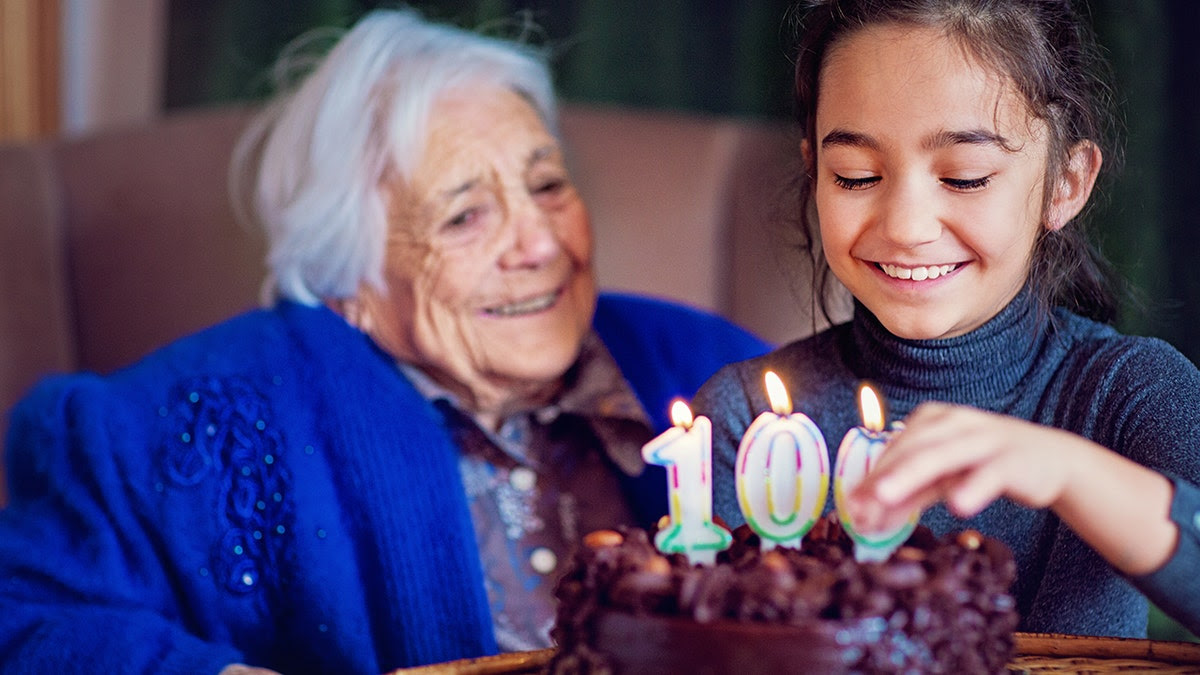
People who live to 100 are less likely to experience fatal conditions compared to people who live shorter lives, researchers discovered. (iStock)
What people who live to 100 years old have in common, according to science
Research shows centenarians have lower disease rates throughout their lives

Published August 14, 2025 7:00am EDT
Doctor says focus on this food group for longevity
Board-certified physician and bestselling ‘Forever Strong’ author Dr. Gabrielle Lyon shares her mission to highlight the importance of skeletal muscle health.
Living to see 100 is a major feat that has a common thread.
Recent studies of centenarians – people who are in their 100s – have found that they suffer from fewer diseases overall, develop them more slowly and are less likely to experience fatal conditions compared to people who live shorter lives.
One 2024 study from Sweden, published in the journal GeroScience, considered historical data from people over 60 years old born between 1912 and 1922.
STUDY REVEALS WHY ‘SUPER AGERS’ MAINTAIN ‘OUTSTANDING MEMORY’ INTO THEIR 80S
Researchers followed these individuals from 1972 to 2022, considering the age of their death and also medical complications like stroke, myocardial infarction, hip fracture and various cancers.
Centenarians were found to have a lower age-specific lifetime risk for all conditions except hip fractures, which suggests that 100-year-olds are able to delay and avoid many major age-related diseases rather than surviving them.
The findings challenge the idea that a longer life span inevitably leads to higher disease rates, the researchers stated.
Another study in August 2025, conducted by the same researchers and published in The Lancet, looked into how older individuals accumulate and manage health conditions over a lifespan, instead of avoiding them.
AGING HITS A DRAMATIC TURNING POINT AT ONE SPECIFIC NUMBER, SCIENTISTS DISCOVER
The researchers tracked the health of participants born between 1920 and 1922, comparing the disease trajectories of centenarians to those who did not live as long.
Those 100 and older were found to have fewer diagnosed conditions and also accumulated diseases at a slower rate.
Centenarians have been found to have fewer diagnosed health conditions and to accumulate diseases more slowly. (iStock)
The researchers found that cardiovascular diseases were the most common diagnoses across all ages, but they contributed less to the overall disease burden among those who made it to 100.
Malignancies, like cancer cells that typically spread, were more largely present in centenarians, while neuropsychiatric conditions, such as anxiety disorders and dementia, were less common.
YOUR HEART MAY BE OLDER THAN YOU THINK — AND THE NUMBER COULD PREDICT DISEASE RISK
People in their 100s were also found to have fewer diseases occurring at the same time and were more likely to have conditions confined to a single disease group.
“Future research should aim to identify genetic, epigenetic and environmental factors underlying these patterns to inform early-life preventive strategies that promote longevity and resilience,” the researchers noted.
People born in the 1920s avoided harmful food additives and radiation for many years, a gerontologist said. (iStock)
What sets centenarians apart
Dr. Macie P. Smith, a licensed social worker and gerontologist based in South Carolina, said it makes “complete sense” that people who avoid serious illnesses like stroke and heart disease live beyond 100 years old.
People who have reached 100 are considered “traditionalists,” who have typically avoided exposure to harmful elements such as radiation, additives, preservatives and artificial coloring in foods, Smith told Fox News Digital.
“They also were not exposed to an abundance of modern medicine,” she said.
“They relied more on natural remedies and organic foods.”
Modern-day technology and global connections, which were not available to centenarians, could also contribute to stress and other mental health factors, according to Smith.
Modern-day technology and global connections, which were not available to centenarians, could also contribute to stress and other mental health factors, an expert said. (H. Armstrong Roberts/ClassicStock/Getty Images)
“They had the ability to mind their own business while reducing their stress levels,” she said. “That alone brings about longer life … When you mind other people’s business, you take on other people’s problems, thereby increasing stress levels. This is called vicarious trauma.”
Smith also believes the older generation is more “free-spirited.”
“They didn’t take on the restrictions that we take on today to look a certain way or be a certain way in public,” she said. “There was a lot less scrutiny back in those days.”
“Yes, they had their struggles that we don’t see today; however, they just showed up in a different way, and they were handled in a different way.”
Adopting a healthy lifestyle now will help ward off health complications later, a doctor said. (iStock)
Choosing your path when you’re younger will determine how you live when you’re older, Smith noted, whether it’s independently or dependently, or living on your own or in a community.
Making healthy lifestyle decisions early on can also significantly reduce the risk of complications in the future, which can impact longevity.
For more Health articles, visit foxnews.com/health.
Smith recommends eating a low-fat, low-salt, brain-healthy diet and eliminating processed foods, while managing stress, engaging with family and friends, staying active and getting adequate sleep.
“This will prolong life and improve the quality of life,” she said.
Scientists Studied 3000 People Over 95 – They All Do These 5 Things Daily! – YouTube
Discover the secrets to a long, vibrant life! In this captivating video, we dive into groundbreaking research where scientists studied 3000 people over 95 to uncover the 5 daily habits they all share. These longevity secrets will inspire and motivate you to transform your daily routine! From simple lifestyle changes to powerful habits, learn how centenarians thrive with energy and joy. Unlock the key to living longer and healthier by adopting these 5 daily habits revealed by science. Don’t miss out—watch now to start your journey to a longer, happier life with these proven longevity secrets! Welcome to ‘Advice for the Elderly’! In this Channel, we share essential tips and advice for seniors to lead a healthy and happy life. From health and wellness tips to financial advice and staying active, our goal is to provide valuable information to enhance the quality of life for the elderly. Don’t forget to like, comment, and subscribe for more helpful videos! Scientist studied over 3000 people over 95 – They all do these 5 things daily – Search

Want to Live a Lot Longer? Science Says Do These 5 Things Every Day. (Only, There’s 1 Little Problem)
EXPERT OPINION BY BILL MURPHY JR., FOUNDER OF UNDERSTANDABLY AND CONTRIBUTING EDITOR, INC. @BILLMURPHYJR
OCT 1, 2019
We don’t have time to deal with things that are merely important.
We’re busy dealing with things that are truly urgent.
Maybe there isn’t a fountain of youth. But there is a series of simple, scientifically proven habits that can add years to your life, on average.
However, there is also a problem: Many of these habits are things highly successful people often feel forced to set aside.
It’s especially true for entrepreneurs and successful business people (and those who hope to be successful in business). As my colleague Jessica Stillman put it a few years ago, memorably quoting Randi Zuckerberg: “Work, Sleep, Family, Fitness, or Friends: Pick Three.”
The fact that you’re reading this tells me you’re likely going to pick “work” as one of your three choices.
I’m not going to tell you that you need to change your habits. For one thing, I’m an insane workaholic, so it would be the height of hypocrisy.
But on the assumption that perhaps you’re in a similar boat, here are the five top health habits science says will extend your life, along with the life reality for extremely busy entrepreneurs, and some good news about what you can do anyway.
(Credit to Christie Aschwanden, whose work inThe Washington Post got me thinking about this.)
1. Get more exercise.
We know that regular exercise can lead to greater longevity: Between 30 and 40 minutes of jogging a day, five days a week, for example, can supposedly help your body mimic the “natural age progression” of someone nine years younger.
- The summary: “The most powerful way to promote longevity and improve your long-term health is also simple and, depending on how you do it, free,” as Aschwanden writes.
- The reality: That’s a beautiful thought. But honestly, it requires five hours a week or more of dedication. I know a lot of entrepreneurs who simply don’t have that time — and if they do find it, it’s time they’re going to devote to their families.
- The good news: You don’t have to do much. You just have to do something. “Going from sedentary to even just a bit of exercise is where you get the biggest payoffs,” as Aschwanden writes, including lower risk of heart disease and diabetes.
2. Get more sleep.
This one makes me laugh, because sleep is always the first thing to go. In fact, you probably know a lot of business people who actually brag about how little sleep they get.
- The summary: “Take someone who needs seven hours of sleep per night and restrict them to only five … and they experience metabolic changes,” Aschwanden writes, citing Satchidananda Panda of the Salk Institute for Biological Studies.
- The reality: Heck, I’m writing this at 1 a.m. because I just don’t have time to get around to this until late at night. It sucks, but it’s where we are.
- The good news: Your body will more or less let you know when you’re getting enough sleep. Mainly, you need to trust yourself and listen.
3. Eat better and drink only in moderation.
When it comes to pure longevity, the dietary strategy that seems to offer the most promise is simply caloric restriction. (Personally: no thanks.) Separately, it won’t surprise you to learn that drinking copious amounts of alcohol will negatively impact longevity.
- Summary: “A Mediterranean diet — with its heart-healthy emphasis on fish, vegetables, fruits, nuts, healthy fats like olive oil, whole grains and limited consumption of red meat — is probably the best approach for improving longevity.” Carstensen says.
- Reality: Actually, of the five items on this list, I think this is one of the two easiest to comport with the aggressive, entrepreneurial lifestyle. Mainly, it’s because it doesn’t take much longer to eat healthily or drink in moderation than it does to be less careful.
- Good news: Personally, I try to limit myself to five liquids: water, coffee, tea, beer and wine. The extra good news is that while we don’t understand why, as one researcher puts it: “I do firmly believe that modest drinking improves longevity.”
4. Manage stress.
Ha ha ha ha ha ha. No, seriously folks, tip your servers, I’ll be here all week.
- Summary: This one makes sense, but the scientific argument requires connecting the dots. In short, “many conditions associated with older age,” as Carstensen puts it, “share a common ingredient: inflammation.” And stress can lead to inflammation.
- Reality: I mean, you’re running a business. You’re taking the risk, and carrying it all on your shoulders. By definition it’s stressful.
- Good news: Managing stress effectively is likely to make you a better leader, and more successful, regardless of its difficulty.
5. Connect with people and have a purpose.
It’s almost too easy: every serious study that talks about happiness and purpose in life comes down to one thing: connecting with other people and creating purpose.
- Summary: “Forging connections with other people has been found to be a powerful way to manage stress and improve your overall well-being,” Carstensen writes.
- Reality: I’m going to put this with No. 3 above, meaning it’s one of the two healthy lifestyle practices on this list most entrepreneurs seem to aspire to accomplish.
- Good news: “People who have a strong sense of purpose and meaning in their lives have a markedly lower risk of death than those who don’t.”
Which States Really Have the Highest Homicide Rates, Red or Blue? The Stats Will Surprise You
Scientist studied 4,330 centenarians, found two things they have in common
Study finds generations born after 1939 unlikely to reach 100 years of age
Research finds people who live past 100 all have one thing in common
See How Long You Were Supposed to Live Based on Your Birth Year
Discover the Countries With the Longest Life Expectancy | Watch
Why a retirement age of 74 is a bad idea, according to science