
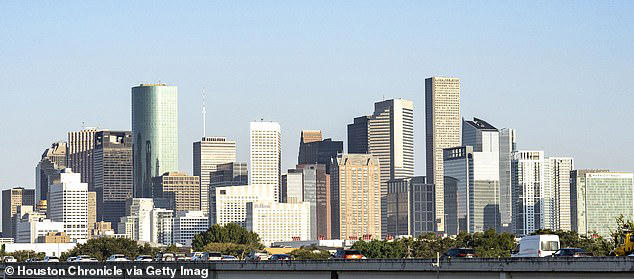
Houston, Texas, has the highest poverty rate among all cities, according to data from the US Census Bureau
Inside red state city where one in five residents live in poverty
Story by Jack Toledo
SORRY JACK TOLEDO MOST BIG CITY MAYORS ARE DEMOCRAT!!!
John Harris Whitmire (born August 13, 1949)[2] is an American attorney and also politician who has served as the 63rd mayor of Houston, Texas, since 2024. Whitmire was previously a Democratic member of the Texas House of Representatives from 1973 until 1983, and the Texas State Senate from 1983 to 2023. In the state senate, he represented District 15, which included much of northern Houston.
In November 2021, Whitmire announced his candidacy for mayor of Houston in the 2023 election. In November 2023, he advanced to a runoff with Representative Sheila Jackson Lee. He won the runoff by a wide margin on December 9, 2023.[3]
A Texas metropolis has the highest poverty rate among all cities in America, according to data from the US Census Bureau.
New data shows that in 2024, 21.1 per cent of residents in Houston lived at or below the federal poverty line.
The national poverty rate of the US is 10.6 percent, which is nearly half of the rate of Houston, according to census data.
Daniel Potter, the Director of the Houston Population Research Center at the Kinder Institute, told ABC 13 that the issue is not due to a low number of jobs.
He believes that Houston’s poverty issue is due to a lack of higher-paying opportunities.
Director Potter told the outlet: ‘We’re missing jobs that are paying between about $100,000 and $150,000. These are not entry-level positions we’re talking about.
‘These are your mid-career. These are positions that oftentimes people are working towards.’
A study this year by the Kinder Institute for Urban Research found that the gap for homeownership in Houston and Harris County has increased as land prices outpaced wage gains.

A homeless man panhandles at I-69 and Weslayan Street in Houston in January this year

In 2024, 21.1 per cent of residents in Houston lived at or below the federal poverty line. Pictured: Homeless outreach teams are seen above in Houston in December 2024
The study also found that significant rent increases have added roughly 15,000 new cost-burdened renters in the year.
More than half of Houstonians are spending more than 30 percent of their income on rent, according to ABC.
‘When I’m taking half of my income and I’m putting it into just my lodging, it is leaving very little behind for me to have money for my food, my utilities, my insurances,’ said Potter.
23 Cities with Highest Homeless Population in the US [Report of 2025] – North American Community Hub
List of current mayors of the top 100 cities in the United States – Ballotpedia
He added: ‘It’s just recognizing we’ve got to make sure we’re prioritizing those living wage positions because we’ve got folks that are working here. It’s just making sure they’ve got those opportunities.’
The director also highlighted that Houston’s poverty rate has decreased from 15 years ago, when he stated that it was about one in four people in the city who were living in poverty.
On July 9, Houston Mayor John Whitmire discussed his plan for addressing homelessness in the city.
‘There’s no doubt about it, a solution to the homeless conditions is a top priority, it’s one of the reasons I listed for running office, certainly for the mayor’s office, and I know all of us share that.
‘We’ve made progress, this is just going to be another tool in the kit if the council approves it to where we can encourage individuals to get out of the elements to get healthcare, food and a bed that are not receiving it.
.

There are a total of 3,325 people experiencing homelessness in Houston.

Of those people, 1,282 live unsheltered a 15.8 percent increase from 2024 and 2,043 are staying in shelters a 6 percent decrease from the year before
‘It’s just wrong for people to live in those conditions, and it’s wrong for the public to have to engage this population in public spaces.’
There are a total of 3,325 people experiencing homelessness in Houston, according to the Coalition for the Homeless of Houston/Harris County.
Of those people, 1,282 live unsheltered, a 15.8 percent increase from 2024 and 2,043 are staying in shelters, a 6 percent decrease from the year before.
While Houston suffers from poverty, a suburb on the outskirts was recently rated the hottest zip code in the US.
Cypress, Texas was ranked number one in the most popular ZIP codes for movers in 2025, according to a report by Moving Place.
Cypress is home to more than 200,000 people and is about 30 minutes away from Houston. It welcomed 3,636 movers from May to January this year.
- Why are eye-catching Cypress neighborhoods becoming the top choice for families relocating to the outskirts of Houston?
- Why are Gen Z renters in cities like Houston and San Antonio spending over 60% of their income on rent?
- What makes Texas home to the fastest growing wealthy suburbs in America as people flock to Fulshear?
- What makes Texas cities a haven for new homeowners seeking booming opportunities and affordable living?
- Why are disenchanted Californians, including top celebrities, abandoning Austin for alternative Texas hotspots like Houston?
Why Do America’s Cities Have Such Terrible Mayors?
Could Changing the Incentives Change the Quality of the Candidates?
By Matthew Gasda
Matthew Gasda is a critic, writer, and director. He is the founder of the Brooklyn Center for Theater Research. His novel The Sleepers has just appeared with Skyhorse Publishing.
New York City’s imminent Democratic primary on June 24th, which is most likely to select the next mayor of the city, and features a cast of borderline criminals, progressive grandstanders, and city government careerists and apparatchiks, has got me thinking. Why do America’s biggest cities have terrible mayors? The ultra-partisan answer is that America’s big cities are Democrat-run, and the Democratic Party is traditionally more focused on big national legislation than on governance, administration, or executive leadership. But that answer doesn’t strike me as fully explanatory: there are structural reasons why urban voters in the United States must choose between transparently terrible candidates.
Urban dysfunction is a failure of professional class incentives and party machinery that mistake symbolic performance for potential competence. NYC’s entrenched machine politics, for instance, prioritizes loyalty and connections over competence, while campaign finance systems that appear to be democratizing still put candidates’ name recognition before fresh talent and perspective (Andrew Cuomo is the most painfully obvious example). Meanwhile, the Democratic Party, across the country, has become shrill and performative, rewarding candidates who can deliver the most dramatic progressive rhetoric rather than those who can manage budgets, coordinate services, and solve practical problems, or even develop a consistent, unifying message.
The Democratic Party has become shrill and performative, rewarding candidates who can deliver the most dramatic progressive rhetoric rather than those who can solve practical problems.
In Chicago, Brandon Johnson’s approval rating has been below 15% (14% as of January 2025). Los Angeles’s Karen Bass has watched her city burn (twice now). Michelle Wu’s progressive policies in Boston—particularly her sanctuary city stance—have put her at odds with the city’s business leaders, and her reelection campaign against Josh Kraft has grown contentious as a result, even though she is likely to win re-election. Portland is experiencing civilian flight and depopulation (though recent efforts to increase police staffing and implement data-driven crime reduction strategies have shown some positive effects). Seattle is grappling with budget reallocations (cuts to police and human services), ongoing housing policy battles over zoning and rent control, and increasing tension between a ideological progressive city council and the more pragmatic Mayor Bruce Harrell, who has pushed for a public safety agenda and a rollback of some earlier left-wing initiatives.
At this point in the 2020s, Democrat mayors seem corrupt and incompetent (as the response to the LA and Chicago riots is making clear). But the issue isn’t that we’re getting Democrats per se, it’s that the party itself has been selecting for most partisan, most bought, most insider Democrats, while talent moulders (Zohran Mamdani’s relative success in his candidacy for NYC mayor is proof that there is an immense hunger for earnestness, youth, and authenticity); and equally, that most big cities do not have meaningful opposition parties: so the Democrats face little pressure to promote candidates who can pass the test of a competitive election. Cities like New York, Chicago, San Francisco, and LA have ultra-high concentrations of talented and able Americans, but politics doesn’t attract that talent; local public service seems to attract sociopaths who seek a path for self-advancement.
Why? I would suggest that the concentration of professional political operatives—people working in and for politics, messaging, consulting, and the broader professional-managerial class—in cities like L.A., Chicago, San Francisco, New York, or Boston (or indeed Philadelphia, D.C., and Atlanta) creates a filter through which it’s very hard for non-neurotic, non-careerist potential politicians to pass; too many professional political operatives control practical access to city politics. You have to run their playbook to run for office and have to be willing to play dirty. City politics is arcane, complex, and in many ways captured by an insider class. Because there are so many better, higher-paying jobs available, we end up with a mixture of career insiders like Lander, Cuomo, or Stringer, or Democratic Socialists like Mamdani, who run on slogans and “visions”.
City politics is arcane, complex, and in many ways captured by an insider class.
Some of Mamdani’s major talking points and policy proposals are vague and poorly thought through. Free citywide buses seem like a fair reward for hard working citizens, but bus fares are a basic check against vagrancy on buses. I’m not sure bus drivers want to lose a legal control point for who gets on. Again, low-cost grocery stores run by the city are possible—but it’s unclear how these stores would be implemented: whether they’d be built on existing city-owned property, or if the city would need to acquire property or leases; whether they’d be unionized; whether they’d be competitive with existing social welfare options; and whether cheaper, healthier groceries would go to the people who need them most.
Mamdani also talks about the price of housing and food scarcity in New York’s school-age population, but rent-control laws like the 2019 Housing Stability and Tenant Protection Act (HSTPA)—though they undeniably strengthen tenant security—tend to reduce the supply of available housing, creating perverse incentives for landlords to keep units off-market. And while New York City’s schoolchildren deserve much healthier and more nutritious meals, it’s hard to imagine city-run initiatives fully mastering the supply chains—procurement, storage, preparation, equitable distribution of fresh food—when the DOE already moves about 230 million meals a year and only ~60 percent of school kitchens can cook from scratch; a school-meals fix therefore need not entail a Soviet-sized food bureaucracy but rather focused kitchen upgrades and the use of Albany’s “30 % NY-grown” reimbursement bonus.
Progressive campaigns just haven’t resulted in good governance. I’d like to believe that Mamdani is the exception, but I’m skeptical. Career hack Andrew Cuomo doesn’t deserve his pole position, which is based on name recognition and the deep roots of the Cuomo machine that is nested inside the larger Democratic machine. Cuomo’s campaign handlers don’t want to let him speak publicly—and for good reason. Cuomo is just a free floating signifier whose brand pays the salaries of PMC operatives. They want him to run so they can get paid. And yet, Cuomo’s track record on COVID politics, when he mashed emergency laws like video game buttons, should disqualify him from citywide office.
America’s cities deserve better. Bad urban governance is one of the major reasons Americans are feeling pessimistic right now (many New Yorkers are just happy that Eric Adams has managed to increase the number of not-overflowing trash cans on city streets–having learned to expect that nothing will get better, only worse). Granular increases and declines in quality of life have massive second order, holistic effects.
So I think cities would do well to adopt two basic filters, or radical changes, to the process of electing mayors.
Cities would do well to adopt two basic filters, or radical changes, to the process of electing mayors.
One, raise executive salaries to competitive levels—levels competitive with corporate executives or near enough to draw talent and competence—but let voters, not bureaucrats, select thresholds for the mayor’s paycheck on the same ballot that chooses the candidate. If pay now flows from a collective verdict, candidates must persuade the electorate that their track record and plan justify the figure; compensation becomes a referendum on trust and results. When an incumbent runs again, voters revisit the same mayor’s pay, and, if the mayor has actually delivered, the public can reward that record by raising the candidate’s pay, or signal disappointment by sliding the pay back down. This provides a mechanism, I think, for voters to say: “you’re the best choice we have right now, but you’re not doing a good enough job”. This system also creates a stronger accountability loop: the paycheck is re-negotiated in public, the campaign narrative shifts from party politics to concrete deliverables (“Did the streets get cleaner, did crime fall, did housing approvals speed up?”).
Second: cities should employ a system whereby two mayoral spots on the ballot are reserved for ordinary residents who volunteer, clear a simple eligibility screen, and are then chosen by public lottery. Each citizen-slot entrant receives the same public campaign grant which the top-funded insider would get, and a place in any debates, guaranteeing real exposure and a fair fight. These candidates would be a public option hedge against insiders.
Finally, urban civic pragmatism does not have to be expressed in technocratic terms. There’s a rich tradition from Lewis Mumford to Jane Jacobs to Christopher Alexander that champions human-scale governance: cities designed around what works for residents rather than theories of political economy or bureaucratic efficiency. Good city policy should feel intuitive and responsive to human needs, not require specialized knowledge to navigate or understand; city bureaucracies must serve and not be served. If incentives were structured along the lines I’ve suggested above, then it’s possible that mayors themselves would finally start to govern in the human-scaled ways that voters reward, and that pull creative, original political souls into the political arena and off the sidelines.
Understanding Japan’s Homeless Population Compared to North America | Watch
This video explores also the unique social, cultural, and economic factors that shape homelessness in Japan, contrasting it with the situation in North America. We examine why Japan’s homeless population is less visible, how societal norms influence their living conditions, and the key differences in public perception and support systems.