
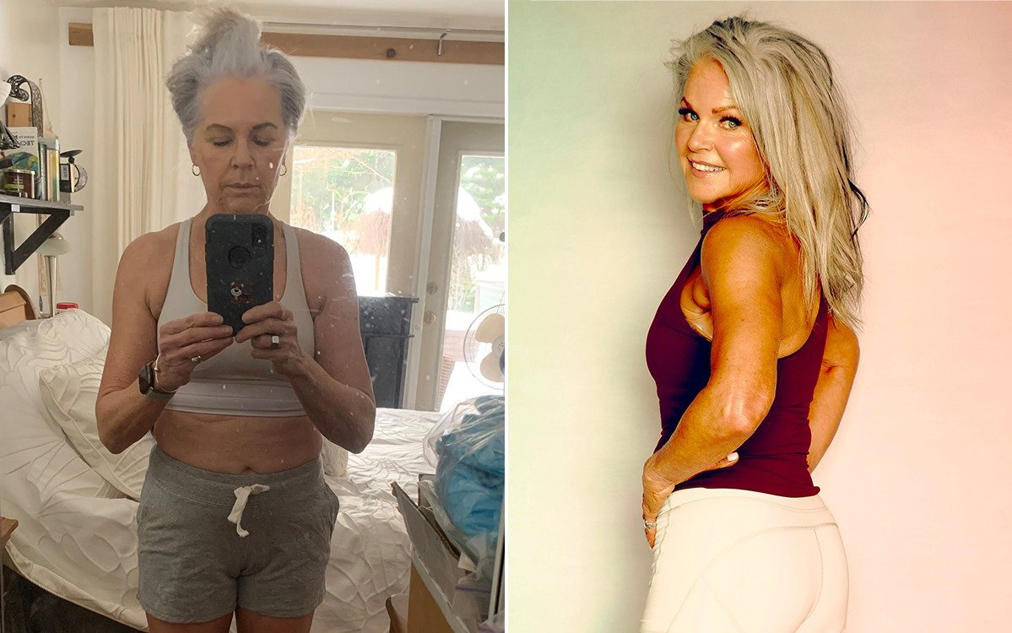
Emmie Sanh before and after her fitness journey, when she started eating a protein-rich diet and training five times a week
At 71, I’m fitter, stronger and happier than ever
Story by Emmie Sanh – Search Images
Stronger Than Ever at 71: Strength Is Just Getting Started
In an October 2025 interview, Yahoo Style published a story titled “I’m stronger than ever at 71. Here are my tricks to making workouts sustainable.” The subject, Emmie Sanh, shared how she keeps fit with a mix of strength training, jump exercises, and consistency. (Yahoo Style)
She includes plyometric exercises (jump training) such as squat jumps, burpees, and frog jumps in many of her sessions to help improve bone density. (Yahoo Style) She also emphasizes recovery, listening to her body’s limits, and gradually increasing intensity. Her story proves it’s possible to be stronger than ever at 71 with the right approach to fitness and recovery. (Yahoo Style)
How the Stronger Than Ever at 71 Routine Works
Emmie’s workouts combine strength training (weights or resistance), cardio, and plyometrics. The jumps boost bone health and agility. She balances harder sessions with rest or lighter moves to avoid injury. (Yahoo Style)
She mentions that sustainable fitness isn’t about going “all out” every day — it’s about doing what you can, recovering, and staying consistent over many months and years. Her method shows that being stronger than ever at 71 comes from steady habits, not extremes. (Yahoo Style)
Why Her Story Matters
- It challenges the idea that fitness peaks early in life — you can get stronger at 70+ with smart training.
- It shows that workout sustainability is as important as intensity — longevity matters.
- For English learners, it’s inspiring and gives good vocabulary around fitness and aging.
Vocabulary
- Sustainable (adjective) – able to be maintained over time.
- Example: She looks for sustainable workout habits that last decades.
- Plyometric (adjective) – relating to jump training.
- Example: Her routine includes plyometric moves like burpees.
- Bone density (noun) – a measure of strength and health of bones.
- Example: Jumping exercises help with bone density.
- Recovery (noun) – the process of healing between exercise sessions.
- Example: She gives her muscles enough recovery time.
- Intensity (noun) – the strength or force of something.
- Example: She increases intensity gradually.
- Agility (noun) – ability to move quickly and easily.
- Example: Her workouts improve agility.
- Balance (verb) – to create stability between different elements.
- Example: She balances hard workouts with rest.
- Consistency (noun) – doing something regularly or steadily.
- Example: Consistency is a key to long-term strength.
- Limit (noun / verb) – the point beyond which something cannot continue / to set a boundary.
- Example: She listens to her body’s limit.
- Gradual (adjective) – happening slowly over time.
- Example: The increase in her training load is gradual.
Discussion Questions (About the Article)
- What is Emmie Sanh’s approach to making workouts sustainable at 71?
- Why does she include plyometric (jump) exercises in her routine?
- How does she balance challenge and recovery?
- Do you think it’s possible to get stronger in your 70s? Why or why not?
- Which part of her method would you try or adapt for yourself?
Discussion Questions (About the Topic)
- What does “workout sustainability” mean to you?
- How should older adults adjust their exercise compared to when they were younger?
- What role does recovery play in a long-term training plan?
- Are high‑intensity workouts always better, or is consistency more important?
- How can we motivate people of all ages to stay active safely?
Related Idiom or Phrase
“Slow and steady wins the race.”
This reminder fits well here — consistent, gradual effort over years often leads to stronger outcomes than short bursts of extreme effort.
Sassy at 71: Gran who decided to take up weights says she’s never felt stronger Like a lot of women, I spent most of my younger years trying to be as skinny as possible, getting by on a very seventies diet of cottage cheese and Ryvita crackers. Then, as I aged, I continued to struggle with my weight, constantly trying the next diet and chasing the slim ideal. I never felt good enough and I could never get to a place where I was able to accept myself as I was.
Now, at 71, I’m fitter, stronger and happier than ever. I truly believe that I’ve never looked better, but for me, getting in shape has only ever been about how it makes me feel, rather than how it makes me look. I’ve joined the legion of modern female fitness influencers who value strength over a small dress size – even if I’m a few decades older than most.
I’ve always been pretty active. I was a horticulturalist, in British Columbia, on the pacific coast of Canada until I retired from full-time work at 60, in 2014. So, I spent most of my time outside, whether it was mowing lawns or weeding gardens, or even climbing trees to prune them. Even when I stopped working full-time, I began part-time in a garden centre.
But apart from picking up the odd dumbbell in my forties, and going through the aerobics and step class crazes back in the day, I was never someone who exercised consistently. You lose muscle as you age, and I still needed the upper body strength to wield chainsaws over my head – but I had no real strategy and I certainly wasn’t trying to get buff.

Now retired, Sahn plans to spend the next 30 years hiking, mountain biking and adventuring
The age things really started to change
It was when I entered my fifties that things got really tough and my body started to change. I accumulated more weight over time, and I had awful night sweats. Sometimes my brain fog was so severe, that I couldn’t remember my colleagues’ names. My anxiety was through the roof too, and it was during this time that my marriage to the father of my children fell apart. It was completely devastating. These days women talk about menopause more, and there’s a lot of research into the benefits and safety of options like Hormone Replacement Therapy (HRT). Twenty years ago that wasn’t the case, and it wasn’t easy to get HRT either.
Nevertheless I kept up my active job, even during lockdown, as the garden centres in Canada remained open. But that was an incredibly painful time. It was through Covid that my 96-year-old mother started to show signs of cancer. She declined medical intervention because she wanted to spend her last years in peace and quiet. The last year of her life was the hardest, as I watched her body decline while her mind remained as sharp as ever. I was her primary caregiver. She had a real love for life and wanted to make the most of every day, but it’s incredibly hard to watch someone that you love get worse, particularly while you’re so isolated yourself.
I was constantly riding an emotional roller-coaster. Some days I felt so lucky to be there with my mother and our conversations brought me joy. Others, I was despairing, and fearing the pain she might have to endure towards the end of her life.
One morning I just decided that enough was enough, that things needed to change for me. Because I’ve always loved being active, I immediately looked for ways to move more. I’d been following Train with Joan, a fabulous woman in her seventies who makes fitness content for women of a similar age – for some time. I thought she was just incredible, so I signed up to her 12-week fitness challenge when she released it at the start of January 2022. I realised I wasn’t taking care of myself, not eating well and drinking wine every night to cope. I felt awful so I decided to do something about it.

Sanh started working out in her laundry room with weights and bands
First, I started to meditate every day. It was empowering and helped me to shift my energy. Then, I’d work out in the laundry room beside my mother’s suite, with light weights and bands to start with. I worked out a schedule with my mum so that I could leave her alone for about an hour, which enabled me to go to a nearby gym. I lost 15lbs in 3 months and I was thrilled. I felt and looked different, like a new and much happier person, and I was able to cope better.
The impact of losing my mother
When I was 68, my mother passed away, after her long and fierce battle with cancer. We had always been so close, so I was devastated. But we all go through so much in life, and there’s a lesson in all of it if we can look past the initial emotional turmoil.
That loss made me realise that I didn’t have so much time left myself. I faced my own mortality and realised how many years I had behind me. That made me think really hard about what I wanted my life to be like, at 70, 80, 90 or beyond. I decided that I just wanted to be as fit and happy as possible. I bought myself a Smith machine, some free weights, an Olympic bar and bench, and used it to kit out my own gym in my basement. I started to share my journey online to keep myself accountable. I’ve made many online friends who all share the same dreams and goals. They have become some of my best friends.
I’ve now finally retired for good. I plan to spend the next 30 years hiking, mountain biking and adventuring in the beautiful hills in Canada, and living life to the fullest doing everything I love.

‘I really feel that I can do anything that I put my mind to,’ says Sahn
How I stayed fit
I turned my hobby into a lifestyle. These days I get up at five in the morning every day. I have a protein-heavy breakfast and a coffee, and then the first thing I do is meditate for 10-15 minutes and then journal. I think that staying fit is a matter of mentality, and focusing on the reasons you are getting into the gym in the first place keeps me motivated.
After that, I go down to my basement and work out. I finish up at about half past eight. Then I take my dog for a walk, which is when I get in somewhere between 8000-10,000 steps, depending on what I need to do that day.
After that I’ve got the rest of the day to myself. Often I’ll go on a bike ride, or I’ll spend it with my grand-children. I go to bed pretty early these days, at about 9pm, and I don’t drink unless it’s really a special occasion. I find that alcohol doesn’t really agree with me, and it certainly makes it harder to stay consistent. It totally wrecks my sleep too.

As well as improving her muscle tone and definition, Sahn now has more energy and motivation
How I make my gym sessions work for my age
When it comes to my gym sessions, I have to think about things a little differently to someone who’s in their forties or fifties. Your muscle mass declines as you age, which means that it’s certainly tougher to put on muscle by the time you’re 70, but it’s far from impossible. First, you really have to stretch well. I spend a long time stretching before I work out, which for me means doing a lot of hip swings and leg swings.
Then I gradually increase the amount I’m lifting. For example, if I’m doing hip thrusts, I’ll use a barbell with 20kg on each end to continue my warm-up, and then I’ll gradually add more until I’ve done about six or seven sets.
All in all, I can certainly lift my own body weight, which is just over 60kg (9st 6lb), and I’m trying to push further. But you really must start slowly – with just five or 10kg, to avoid putting too much strain on your joints. They get weaker as you get older, and they really take a beating throughout your whole life. Learning proper form is crucial for training and needs to be nailed down before adding weights.
Aging might be a given, but feeling and slowing down doesn’t have to be !Facebook

Sahn can now lift her own body weight, which is just over 60kg (9st 6lb)
I have two rest days a week, to make sure I’m giving my body a long time to recover. I’m careful with how I cool down, too. I have a foam roller that I use on my hips, and I like red light therapy, because it reduces inflammation and helps me to recover more quickly.
‘I’m stronger than ever at 71. Here are my tricks to making workouts sustainable’ – Yahoo Life UK
I stick to a careful diet but don’t cut out any foods
Diet is crucial. I try to eat about 160g of protein a day, to feed my muscles so that they can grow. In terms of calories, I’m not currently trying to lose weight and I’m not trying to get bigger, either. Given my age, and my activity level, that means I eat about 1800 calories a day.
I find it easiest to stick to the same handful of meals so that I can be sure of hitting my protein goal.
For breakfast I like to have sourdough bread with some egg whites, spinach and mozzarella cheese, with protein powder in my coffee. Lunch might be an avocado and chicken salad with some fruit, and dinner is a salad too, with chicken, fish or beef. I try to mix it up for a good balance of micronutrients, and I have most of my carbs in the morning, because that’s when I need the energy to do my workouts. If I want a snack, it’s Greek yoghurt and berries for extra protein and antioxidants.
I don’t cut any food out, though. I eat what I like if I’m craving something, or I’m out for a meal with my family, and I just go back to my routine the next day and don’t worry about it. I have some balance in my lifestyle, as well as a routine that keeps me at my fittest.
I believe that now, I look the best I ever have: with more muscle tone and definition, a bright smile and a tight tummy. But I feel better than ever, too. I have so much energy and motivation. I really feel that I can do anything that I put my mind to.
My top fitness tips
Build up slowly
Your body needs more time to get accustomed to new exercises than a younger person’s. Do what feels safe and only build up to more weights or reps, or more complicated movements, when you feel confident.
Get your diet right
You can’t put on muscle and feel fitter unless you are eating enough protein, around 2g per kilogram of your body weight at least. Otherwise you will be left feeling fatigued and you won’t see the body recomposition that you want. Focus on eating protein first, then work out what you want to eat in terms of healthy fats (like oily fish, avocado and nuts) first. It’s actually good for our health to put on a little weight in our seventies, so don’t worry about eating too much, as long as it’s all good stuff.
Pay attention to your mindset
I’ve realised just how negatively I was thinking about myself and my body before I started exercising. It sounds like a trendy young person thing, but journaling is really helpful, because it means that you can identify the negative thoughts that are holding you back from being consistent and feeling your best. I really can’t recommend it enough.
The best time to start is now
If you’re in your fifties and you’re reading this, you have a long time to do the hard work to make sure you’re still fit and thriving by your seventies. I only wish I had started earlier. No matter your age, there is no time like the present to make a change.