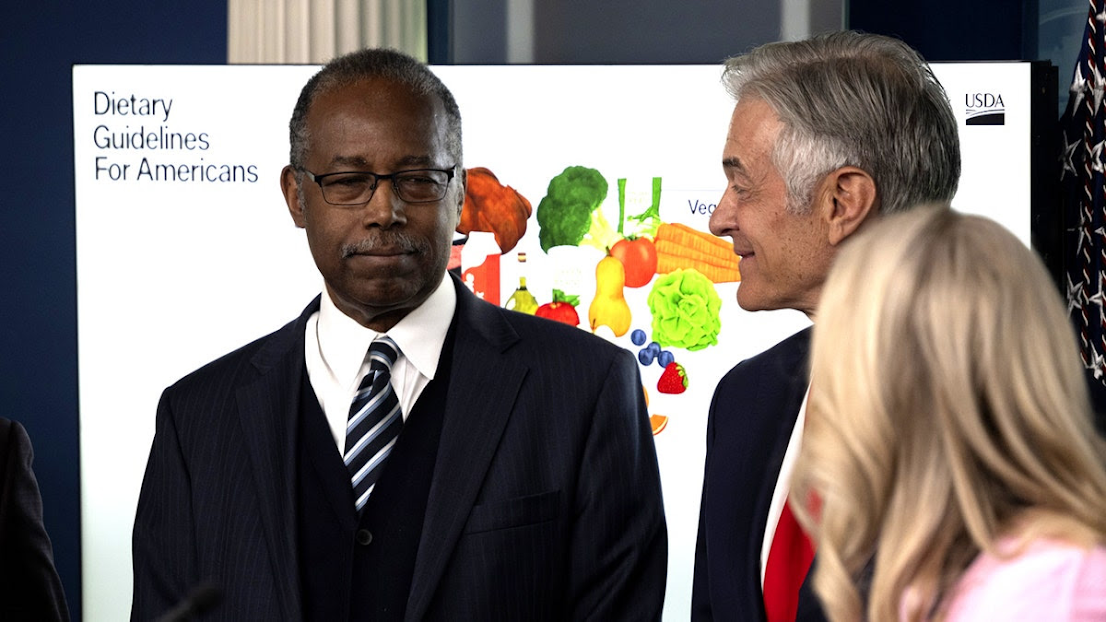
Dr. Ben Carson, USDA’s national advisor for nutrition, health and housing, told Fox News Digital that dietary guidelines were first proposed in 1980 to inform Americans about healthy eating. (Celal Gunes/Anadolu via Getty Images)
Food pyramid faces scrutiny as Ben Carson reveals why Americans don’t have to eat meat and says Americans have ‘deviated’ from original 1980s nutrition goals by ‘rubber-stamping’ processed foods

RFK Jr.’s new food pyramid puts meat, dairy at the top. What you should eat
The national nutrition advisor speaks with Fox News Digital about the HHS’ recent food pyramid flip, as health officials now prioritize meat and dairy over processed foods and whole grains.
The new food pyramid has been flipped on its head, with HHS officials releasing guidance that prioritizes meat, dairy and vegetables and pushes whole grains to the bottom.
Dr. Ben Carson, USDA’s national advisor for nutrition, health and housing, told Fox News Digital in an interview that dietary guidelines were first proposed in 1980 to inform Americans about healthy eating.
“[The purpose] was to educate the populace about nutrient-rich foods … the things that are helpful to you, the things that are harmful to you. Over the course of time, [we] deviated from those goals,” Carson said. “And [we] started rubber-stamping all of these highly processed foods, these quick things. It has not been good for us.”
HEALTH EXPERTS REACT AS ANDREW HUBERMAN BACKS TRUMP ADMIN’S NEW FOOD PYRAMID
“You are what you eat,” Carson said, sharing that Americans should think of their bodies as high-performance vehicles.
“You’re going to put premium gasoline in it, because you want premium performance,” he said. “If you decide to dilute it, it’s not going to go as far or as fast.”
Carson also used the car-fueling example to address those who claim that eating healthy foods is too expensive.
“Maybe the premium gasoline costs a little bit more, but how much does it cost down the road when you have to replace the engine, when you haven’t put the right things into it?” he said. “So we’re really trying to bring some logic and common sense back.”
CLICK HERE TO SIGN UP FOR OUR LIFESTYLE NEWSLETTER
The new guidelines promote protein, dairy and healthy fats, recommending a daily protein target of about 0.54-0.73 grams per pound of body weight.
Doctors, dietitians react to new nutrition guidelines and saturated fat intake | Fox News
The new guidelines promote protein, dairy and healthy fats. (realfood.gov)
The New Dietary Guidelines Quietly Admit They Were Wrong (Here’s the Proof)
About 16 to 20 million people, or 4% to 6% of Americans, identify as vegetarians and vegans who eat only plant-based foods, according to the Vegetarian Resource Group.
Carson admitted that he “seldom” eats meat himself and believes he is “reasonably healthy.”
CLICK HERE FOR MORE LIFESTYLE STORIES
For those concerned the new guidance might lead Americans to eat too much red meat, Carson said, “Instead of thinking about it as too much red meat, let’s look at the overall recommendation — and that is that you eat 1.2 to 1.6 grams per kilogram of body weight per day. Now, how you get that protein doesn’t matter. If it’s drinking milk, if it’s eating cheese — as long as you maintain high-performance fuel for your engine.”
The nutrition advisor pointed to “blue zones,” the regions with exceptionally long-lived populations known for a focus on plant-based diets.
“Some people say, you see these skinny people because they’re vegetarians. Have you ever seen a skinny elephant? You know they’re vegetarian,” said Carson.
Dr. Ben Carson reveals he ‘seldom’ eats meat amid new food pyramid’s protein push
How much red meat is too much? Experts weigh in on food pyramid updates
About 16 to 20 million people, or 4% to 6% of Americans, identify as vegetarians and vegans who eat only plant-based foods, according to the Vegetarian Resource Group. (iStock)
While the updated dietary guidelines emphasize whole, nutrient-dense foods, Carson cautioned against relying solely on GLP-1s like Ozempic for weight loss.
“All these artificial methods don’t last a very long time. You have to keep taking them, and they’re expensive,” he said.
About one in eight American adults, roughly 12%, have used GLP-1 drugs for obesity and diabetes, with around 6% currently taking them as they rise in popularity, as Fox News Digital previously reported.
TEST YOURSELF WITH OUR LATEST LIFESTYLE QUIZ
“It’s not just a matter of what you eat. It’s a matter of how many calories you burn,” Carson added. “If you have more calories going out than you’re taking in, you’re going to lose weight.” SOURCE: Ben Carson challenges changes to food pyramid, focusing on meat consumption | Fox News
Noel Watson
Is Keto Right for Stage 4 Cancer?
A nuanced look at Professor Thomas Seyfried’s metabolic theory
I’m often asked whether a ketogenic diet is appropriate for stage 4 cancer with metastasis, especially in light of Professor Thomas Seyfried’s influential work on cancer as a metabolic disease.
The honest answer is more complex than most social media posts suggest.
What Seyfried gets right
Professor Seyfried has made an important contribution by showing that many cancers rely heavily on fermentation (the Warburg effect) due to dysfunctional mitochondria.
In certain cancers particularly some brain tumours strict therapeutic ketosis can:
Lower glucose
Reduce insulin/IGF-1 signalling
Stress highly glycolytic tumour cells
In those specific contexts, keto can slow tumour growth.
That matters.
Where the story becomes incomplete
Not all cancers behave the same especially in advanced or metastatic disease.
Many late-stage cancers:
• Retain functional mitochondria
• Are OXPHOS-dominant, not glycolysis-dominant
• Can use fatty acids and ketones as fuel
• Exhibit the Reverse Warburg Effect (tumour cells feeding off surrounding stromal cells)
In these cases, ketones may feed the cancer rather than starve it.
Metastatic cancer is metabolically flexible
By stage 4, cancer is often highly adaptable:
• It can switch fuel sources
• It thrives under stress
• It adapts to glucose restriction
• It may become more aggressive when pushed too hard
This is why some patients initially respond to keto and then progress.
The real-world risks of strict keto in stage 4
Worsening weight loss & muscle wasting
Reduced immune resilience
Increased fatigue
Possible tumour adaptation to fat/ketone metabolism
There is no strong clinical evidence that keto alone improves survival in advanced solid tumours.
Even Seyfried acknowledges keto works best as part of a broader metabolic strategy, not as a standalone solution.
A more balanced metabolic approach
Many advanced cancer patients do better with:
• Lower glycaemic load (not zero carbs)
• Adequate protein to preserve muscle
• Anti-inflammatory, plant-rich foods
• Targeted metabolic therapies (repurposed drugs & supplements)
• Supporting the immune system, not suppressing it
This avoids excess glucose without aggressively feeding ketones either.
Keto is a tool not a cure.
And in stage 4 metastatic cancer, it is a double-edged sword.
Cancer metabolism is far more complex than one diet or one pathway.
Personalisation matters. Biology matters. Context matters.
If this post helped clarify the discussion around cancer metabolism, please feel free to share informed conversations to save lives.
#CancerMetabolism #Stage4Cancer #KetoAndCancer #WarburgEffect #ReverseWarburg
#OXPHOS #MetabolicTherapy #PersonalisedCancerCare #ThinkBeyondOneTheory
 Author
As someone who follows only a plant-based diet, I make sure to prioritise protein, especially important when dealing with advanced cancer. I focus on beans, lentils, pulses, soy, seitan, and other plant proteins to maintain muscle mass, support the immune system, and help my body cope with stress. Even while keeping carbs moderate and avoiding excessive sugars, adequate protein is key and it’s completely possible on a plant-based approach.
Noel Watson I try to get enough protein too. Mostly from foods but occasionally from a protein powder drink. Barilla pasta makers have pasta with added protein. Just something to consider once in a while.
I find this to be very accurate. Cancer uses so many things for fuel. Traditional keto cuts off carbohydrates, but at the expense of a lot of fat and protein and methionine, which all can fuel cancer. Veg and fruit are the perfect anti-cancer diet. The loads of phytonutrients compounds, the lower methionine, fat, and even refined carbs is a winning approach.
JoAnne Johnson Evangelista Cancer is incredibly flexible when it comes to fuel glucose, ketones, fats, protein, even methionine so cutting just one source isn’t enough. That’s why a well-planned plant-based approach, rich in vegetables, fruits, legumes, and phytonutrients, is so powerful.
It naturally limits methionine, saturated fat, and refined carbs, while giving the body antioxidants and immune support all without stressing the patient’s metabolism. This is the kind of metabolic strategy that respects biology rather than following one-size-fits-all rules.
Thomas Seyfried stresses adequate proteins too so I am not sure that would be different. However he also says not more proteins than necessary since the liver converts it to glucose. He also says Keto alone will not work, you also need to add glutamine inhibitors and intermittent fasting. I have a 3c cervix cancer and started on Low GI when I got the diagnosis, however I did not tolerate conventional therapy well.
I noticed the pain from my metastasis disappeared after the first dose when I was also given Keytruda. But I got a full body rash and had to remove it. After the second dose I got the pain back from the metastasis. I then went Keto to lower the inflammatory response, within 24 hrs. the pain had disappeared.
I got in a bad state from my dose 2 chemo, so I had to stop eating twice a day, strict intermittent fasting that TS says is an integral part, I totally agree with you regarding nourishment for the healthy body triumphing starving the cancer when feeling unwell.
After a week of small portions of veggie heavy keto, I plan to start adding back my supplements and intermittent fasting soon. It is a jungle out there of contradicting recommendations, I think all we can do is to cautiously observe our body’s reactions and try to make healthy choices that give the most life energy.
High fiber is often best for cancer patients. Plant fiber, whole grains, beans, nuts. Fermented foods. Avoiding animal products as much as possible, although I actually do consume a lot of low fat or no fat dairy personally (namely 2 percent milk and greek yogurt). I went from “there’s no more we can do for you, you’re times up” stage 4 to “this is a miracle, the cancer is gone” in 8 weeks.
Pamela Duke-Goussy
States Depends on the kind of cancer.
Interesting, Maybe this is better for those who don’t have leaky gut, where the gut is compromised. Plant nutrients are less bio available. Beans have more nutrients than steak but most beans can’t be absorbed by the human gut but all can be that are at stake. In this case the SCD diet – Search may be a better path.
Author
David Fleming always good to hear from you David!
Gut health matters a lot when it comes to absorbing nutrients from plants. Some plant compounds, like lectins or phytates, can reduce absorption if the gut lining is compromised, which is why diets like SCD (Specific Carbohydrate Diet) or GAPS can help “reset” the gut for some people.
That said, there are ways to improve plant nutrient absorption even with a sensitive gut: fermentation, soaking, sprouting, or cooking can break down anti-nutrients and make vitamins and minerals much more bioavailable.
At the end of the day, we all have to try to work out what’s best for ourselves specifically and I have great respect for all the research you have done personally over the last 40 years.
Noel Watson Thank you Noel, anything that breaks down into sugars is a problem for me.
Cooked veg just blocked me up and no matter how much food I ate I still felt I hadn’t eaten anything at all bar a full stomach.
I still have problems with dairy products so I ferment them.
This is the first time my health has improved and I have been able to stay on the diet for 2 years.
I usually only last at best 4 months before all my symptoms come back but on carnivore it’s just continued healing.
I tried to add fruit back and raw unfermented milk back in but that just didn’t work for me.
Some people just need to stop eating high processed denatured foods to gain their health but people with fungal issues and dysbiosis and probably autoimmune disease need to be really strict.
I’m only 105 days since my last carb so it’s still early but I can see the healing taking place slowly. Yes you are right, it’s finding out what works best for you and sticking with it.
It’s sad that money is being made of people suffering from cancer and that we even get it in the first place due to the modern lifestyle shaped by big corporations.
As Jesus said the love of money is the root of all evil. Not money, but the love of it.
Loving ourselves, loving others, and loving the planet we live on is the key.
Love means to value and if we all valued others as we do ourselves then we could nearly erritacate disease altogether.
The agricultural system would run according to natural law, loving the planet. The food industry would not produce food that is slowly poisoning us and big pharma would actually be motivated to curing illness rather than managing it for profit.
You are an example of love as you reach out to help others, keep up the great work.
This will bring it into some perspective!
I am also in stage 4. (Gastrointestinal stromal tumor) After 7 months my metastase shrunk and the other metastase disappeared.
My next scan is over a year. I wanted to go further with keto this year. Do you recommend otherwise?
Noel Watson Noel, keto is a …. FAD.
Professor Thomas Seyfreid – Bing Search
Candace Riegel yes. I know this. Usually comes down to stage and what Dr.s suggest with their treatment plan. What isn’t usually said is how many calories to try to hit and macro breakdown daily. That’s why I mentioned eating the most anti-inflammatory way possible The other day to start.
Just curious, I am stage 4 as well. Was doing keto. What would you guess your carbs to be per day? I am switching to plant based.
Mark Allen some people do a plant based keto as well. I’m stage 4 as well and trying to figure out where do I head, I’m doing low carbs, no sugars, been told to do keto, others say better to do more Mediterranean, then you have meats vs veggies or something in between, takes time to see what your body responds well to, not easy
Roy Gutierrez With stage 4 breast cancer, I was on a keto vegan diet for 4 years. Then for the last 8 years I’ve been on a similar diet, but not so strict (more berries than keto, occasional organic eggs, etc). I’ve now survived stage 4 for more than 11.5 years. I give more credit to my IV vitamin C and hyperbaric oxygen treatments than my diet, but I believe my diet has helped.
Most relevant is selected, so some comments may have been filtered out.
Stephanie Offman McKeith
Julie McFadden who has dedicated her life to caring for terminal cancer patients. She has worked in hospice care for nearly a decade and has been involved in educating and comforting patients and their families about the end-of-life journey. McFadden’s work has been recognized, and she is known for her book, “Nothing to Fear: Demystifying Death to Live More Fully,” which addresses the emotional aspects of dying and provides practical advice for both patients and caregivers. Her dedication to hospice nursing and her efforts to shift the conversation around end-of-life care have made a significant impact on the field. Sent Home to Die — ProPublica
Dispelling Common Hospice Myths: Exposing the Facts – Notre Dame Health Care
Nurse who ‘experienced death’ says it’s ’beyond anything she could describe’
Former ICU Nurse Reveals Why She Became a Hospice Nurse (Exclusive)Cancer & Hospice: What to Expect & When to Call Hospice
She documented patients given 3-6 mos to live & defied their prognosis according to a pattern oncologists refused to acknowledge. Patients who lived 10+ yrs after their terminal diagnosis all did the same thing.
They stopped.
Stopped chemo. Stopped radiation. Left the hospital. Chose different therapy and worked to heal their systems.
The ones who followed docs orders = died on schedule.
It was undeniable. Those who followed through with aggressive treatment died in their predicted timeline. Those who quit, changed nothing medically – they just lived. There were spontaneous remission rates 40 times higher. Oncologists dismissed improvements & labeled them “unexplained” statistical anomalies. The nurse concluded that treatment clearly didn’t extend life, it guaranteed a race to death.
Immunology research uncovered the variables: chemotherapy obliterates the immune system, the thing that fights cancer. The drugs kill cancer cells but also squashes your body’s ability to kill future cancer cells (reoccurrence). It’s a tradeoff of short term (possible) tumor reduction for long term immuno collapse. When you hear stories of the cancer coming back with a vengeance, this is ‘part’ of the reason why. The other part is that chemo doesn’t kill cancer stem cells. The tumor load may be eliminated, but there are still cancerous cells lurking, waiting to set up again.
If you don’t do the same kind of research I do, I’ll tell you that the cancer industry profits $200 BILLION annually. Hospitals, oncologists, pharma – entire careers depend on patients in treatment. The ones who quit & survive cannot be studied but the system carries on and keeps selling poison as the cure (& only option).
Now, we have a divide & expect people to take sides: conventional & natural (the medical establishment needs one silenced & the people need them to be integrated). One side trusts doctors completely & follows every protocol because “trust the science” & “doctors know best”. They die on schedule wondering why treatment didn’t work.
The other questions how detonating your immunity to kill cancer makes sense. One group spends their final months in hospitals, away from those they love, getting weaker. The other walks away & sometimes lives with a better quality of life. Both had terminal diagnosis. The difference = one stopped fighting their very own body & let it fend off the disease.
We all have the choice; we’re just not all properly equipped to make informed decisions.
*of course, chemo and radiation are appropriate in some circumstances, but with a supportive plan to regenerate health. Without getting to the root cause and improving healing conditions, the body cannot fully overcome the disease burden. An upgraded approach to cancer is desperately needed. Especially now that the system has created turbo cancers from the jabs they forced on the world.
Carlos Charlie M. Gonzalez
We always have choices. Choose to live or die. Choose to take this path of healing or that one of destroying the body’s immune system. Choose to think positively or negatively. Choose to eat this or that… the ONLY thing we have to do in this world is make Choices. Better Choices Better Outcomes.
Victoria L Morales
My late husband did “preventative chemo” at first. The cancer came back 5 years later. He refused chemo/radiation this time and only wanted herbs. They gave him 4 months. I kept him around for 4 more years with herbal medicine. But in the end cancer won the battle. I couldn’t afford the fancier “alternative medicine” treatments. But I used every natural protocol I could. He was stubborn and refused to change his diet. Kept eating sugar and fried foods etc. But I have no regrets. I did my best. It was what he wanted.
Author
Stephanie Offman McKeith
Victoria L Morales it’s certainly not the only solution, but you just can’t go wrong in any situation when you fuel your body and mind appropriately – whether it prolongs life or not – it definitely improves it. Good for you, I remember how much effort you gave
Lisa Brache
I wish the alternative hospitals were more clear about treatment, more accessible and affordable. We spent over $80,000 to go to Mexico for my mom. I did see healing take place there in the 3 weeks but, unfortunately, no one who I met there made it. You come back to the US and you’re doomed. Something needs to change. I think there is a lot of corruption when it comes to cancer treatments. Even on the alternative side of things. Taking advantage of desperate people. 💔
Megan Hall-Frump
I love this…!! I have a cousin right now, younger than me, who is a very healthy guy, diagnosed with stage 4 colon… he’s opting for all the medical stuff and it’s killing me. He had his port put in on Monday this week… 💔😭 I’m praying God will turn this around- that he will see the corruption before it’s too late!!
It’s so incredibly hard to sit back and watch those we love go down a path we can’t support!! I’ve tried getting him to reach out to you.
Others have tried talking to him. He’s dead 😓 set on this, and it’s breaking my heart!
He’s so smart too! We have had conversations in the past about a lot…!! I WISH he’d had a wake up… 😭 5 kids, a wife… a lot of life before him!! He’s only going to be 46 in July!!
Patricia Anderson
Reason I wrote my book Trilogy 1 “Cancer and Broccoli” – Search Videos available on Amazon – to support the immune system based on food and scientific research, including Cancer Nobel prize winners work known since the 1930’s. – Search Videos
Plus Barbara O’Neill Cancer – Search Videos