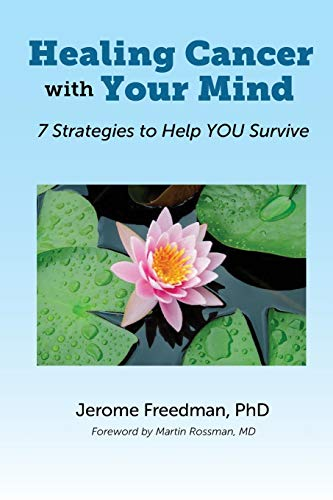
Healing Cancer with Your Mind: 7 Strategies to Help YOU Survive
By Jerome Freedman and Jerome Freedman Dr
Foreword by Dr. Martin Rossman, MD. Healing Cancer with Your Mind: 7 Strategies to Help YOU Survive reveals the personal power that you possess for self-healing.
Learning and applying the 7 strategies discussed in this book will guide you on a journey to spiritual and physical healing. Whether you are a cancer patient yourself or supporting someone who is, this book should be an essential element in your treatment and healing arsenal.
His book, “Healing Cancer with Your Mind” gives readers a nurturing, helping hand throughout the entire cancer journey, especially with regard to developing a meditation practice. -Kelly Turner, PhD, Author of the NYTimes Bestseller “Radical Remission: Surviving Cancer Against All Odds”.
Jerome was diagnosed with muscle invasive bladder cancer on January 29, 1997. The diagnosis was based on a transurethral resection surgery.
Having done his research, he contacted a doctor at Harvard and Mass General Hospital about a clinical trial for a bladder sparing protocol. To Jermoe’s surprise, Dr.Shipley called back and shared the protocol with Jerome’s medical team and the treatment began a couple of weeks later. The treatment involved chemotherapy in conjunction with radiation therapy.
Jerome experienced several recurrences over the years, each time treating them with surgery and infusions. In 2018 a recurrence involved hospitalization and tubes were placed in each kidney. This time Jerome was faced with a decision to have a radical cystectomy or given the choice to do immunotherapy. By 2019 there was little evidence of bladder cancer and infusions continued, with no side effects. He still has a tube in one kidney and is otherwise thriving! email: Jerome@mountainsangha.org
One of his main healers was the Isadora Duncan Award winner and innovative dance performer and teacher, Anna Halprin: “I am a cancer survivor, so what I have to share comes from personal experience.
ABOUT ANNA HALPRIN – Anna Halprin, A Life of Dance
After surviving cancer in the early 1970s, Halprin founded the Tamalpa Institute in 1975 to use movement as therapy for cancer and other illnesses.
Cancer is like enlightenment at gunpoint.
Anna Halprin – Portraits in Faith
Anna Halprin is a renowned dancer and the founder of postmodern dance.
She is also a cancer survivor who faced her diagnosis at the age of 51.
Halprin used dance as a means to confront her illness and found healing through movement.
Working-with-Anna-Halprin-DTAA-Vol-3-No-3.pdf
She documented her healing process in her work, “Dark Side Dance,” and developed the Therapeutic Psychokinetic Visualization Process, which involves dance and imagery to promote healing and personal growth. Halprin’s experiences with cancer and her approach to dance highlight the profound connection between art and healing, emphasizing that dance can serve as a powerful tool for self-discovery and empowerment.
In Memoriam – Anna Halprin (1920-2021) – Thrive Global
Even if you are well and want to see strategies to prevent cancer, this book is for you.
BONUS READ: Stop Cancer in Its Tracks: Your Path to… book by Jerome Freedman
Healing Cancer with Your Mind guides you and your family through the difficult times of a cancer diagnosis.
The Seven Strategies to Help YOU Survive will help you and your loved ones to Get inspired to take charge of your medical treatment, be involved with and be truthfully informed by your doctors, oncologists, and surgeons.
A one‑page version in the tone of the book focuses on clarity, calm authority, and a sense of personal agency.
Seven Strategies for Engaging Your Mind in Healing
Mind–body healing begins with the understanding that your attention, emotions, and inner life influence how your body responds to challenges. These seven strategies offer a practical way to participate in your own healing, not as a replacement for medical care, but as a powerful complement to it.
1. Cultivate Mindful Awareness
Awareness is the ground on which all healing choices rest. By learning to steady your attention in the present moment, you reduce the pull of fear and create space for clarity. Mindfulness helps you respond rather than react, allowing your body to shift out of chronic stress and into a state more capable of repair.
2. Engage in Guided Imagery
Your imagination is a potent ally. When you picture your body healing, your treatments working effectively, or your immune system strengthening, you activate pathways that calm the nervous system and support resilience. Imagery gives you a way to participate actively in your healing process.
3. Regulate Your Nervous System
Breathwork, relaxation practices, and body‑based awareness help quiet the fight‑or‑flight response. When your body feels safe, it can rest, digest, repair, and restore. These practices are simple, learnable, and profoundly stabilizing.
4. Honor and Express Your Emotions
Cancer brings a wide range of emotions—fear, anger, grief, hope. Allowing these feelings to be acknowledged and expressed reduces internal strain. Emotional honesty frees energy that can be redirected toward healing and connection.
5. Reframe Your Thoughts and Strengthen Meaning
Your thoughts shape your experience. By noticing unhelpful patterns and gently shifting them toward more balanced perspectives, you reduce unnecessary suffering. Many people also find that exploring meaning, purpose, and values becomes a source of strength during treatment.
6. Lean on Supportive Relationships
Healing is not meant to be done alone. Supportive relationships—friends, family, community, or groups—buffer stress and remind you that you are held, seen, and valued. Connection is medicine in its own right.
7. Align Your Daily Habits with Healing
Small, consistent choices reinforce your body’s natural capacity to heal. Gentle movement, nourishing food, restorative sleep, time in nature, and creative or spiritual practices all contribute to a sense of vitality and agency.
Investigate which alternative and complementary medical practices can benefit you and your situation.
Discover the lifestyle changes you may want to make to better your healing chances.
Learn how meditation practices can help you make responsible decisions for your care and feel confident that you made the right decision and much more.
Rely on your family and friends to get things done for you that you can’t do for yourself. Build a medical team of physicians and other practitioners that you can trust.
Give back to your community when you are ready and able.
From the Foreword: “As a physician who has practiced holistic medicine, now called Integrative Medicine, for over 4 decades, I can attest to the value of the strategies that Dr. Freedman recommends including in your treatment program.” –Martin Rossman, MD, author of The Worry Solution and Guided Imagery for Self-Healing Here is what Dr. Kelly Turner, PhD has to say about Healing Cancer with YOUR Mind: “Dr. Freedman speaks from experience, both as a cancer survivor himself, and the father of a Radical Remission cancer survivor.
One must face it and do something.
The 7 Strategies … provides us with realistic and practical modalities that give us strength to face the challenges of cancer and hope to survive. This is a must read book for anyone facing cancer or their caretaker.” –Anna Halprin, PhD, dance pioneer, author, choreographer, and winner of the Isadora Duncan award and many others.
A seminar participant had this to say: “As a nutritionist and naturopath, I was drawn to the event because I found it fascinating that mindfulness could heal cancer. Originally thinking I would only stay a few minutes for the event, I not only stayed the whole time, but learned so much from Jerome and the 7 strategies.
Jerome is such an amazing person who has contributed so much and the mindfulness meditation sessions during the event and discussion amongst the attendees was dynamic to say the least. I believe Jerome’s testimony and book gives people power.
Power that they can overcome the biggest of odds.Power that there are alternatives to just chemotherapy.. –Immanuel Lewis, an elite holistic and naturopathic nutritionist practicing in Santa Monica.
Outline the common mind–body practices
Mind–body practices center on the idea that thoughts, emotions, beliefs, and attention patterns can influence physical well‑being. The approaches below are the ones most consistently used in integrative cancer care and closely align with the methods taught by clinicians like Dr. Martin Rossman.
 Mindfulness and Present‑Moment Awareness
Mindfulness trains attention away from catastrophic thinking and toward grounded awareness. It reduces stress reactivity, improves emotional regulation, and helps people navigate uncertainty without becoming overwhelmed. Regular practice can shift the nervous system toward calmer, more restorative states.
 Guided Imagery and Visualization
Guided imagery uses intentional mental pictures to evoke relaxation, hope, and a sense of agency. People often visualize the immune system working effectively, treatments doing their job, or the body healing. The value isn’t in literal biological control but in reducing stress hormones and increasing a sense of inner participation in healing.
 Emotional Expression and Support
Unprocessed fear, anger, or grief can amplify stress responses. Mind–body approaches encourage safe emotional expression—through journaling, counseling, support groups, or creative outlets. Feeling understood and connected improves resilience and reduces isolation.
 Breathwork and Relaxation Training
Slow, intentional breathing activates the parasympathetic nervous system. Techniques include diaphragmatic breathing, progressive muscle relaxation, and body scans. These practices reduce anxiety, improve sleep, and help the body shift out of chronic fight‑or‑flight states.
 Cognitive Reframing and Meaning‑Making
This involves noticing unhelpful thought patterns and replacing them with more balanced, empowering interpretations. It’s not forced positivity—it’s learning to respond to fear with clarity rather than panic. Many people also explore meaning, purpose, and values as part of their healing journey.
 Social Connection and Support Networks
Strong social ties correlate with better emotional and physical outcomes. Mind–body programs emphasize building supportive relationships, asking for help, and staying connected to the community. Connection reduces stress load and reinforces a sense of belonging.
 Lifestyle Alignment and Self‑Care
Mind–body healing includes choices that support the body’s natural repair systems:
- Gentle movement
- Restorative sleep
- Nourishing food
- Time in nature
- Creative or spiritual practices
These behaviors reinforce a sense of agency and help the body recover from stress.
If you want, I can map these practices into a structured “seven‑strategy” framework similar to what the book likely uses, or tailor them to a personal healing plan.
map these practices into a structured “seven‑strategy” framework
1. Cultivating mindful awareness Mindfulness becomes the stabilizing foundation. It trains attention away from fear spirals and toward grounded presence, reducing stress reactivity and creating the mental clarity needed for healing decisions.
2. Use guided imagery to support healing Imagery engages the imagination as a therapeutic tool. Visualizing the body healing, treatments working effectively, or the immune system strengthening helps shift physiology toward relaxation and resilience.
3. Regulate the nervous system through breath and relaxation Breathwork, body scans, and progressive relaxation calm the fight‑or‑flight response. This supports sleep, reduces anxiety, and gives the body more bandwidth for repair.
4. Process emotions and cultivate emotional resilience Fear, grief, anger, and uncertainty are natural. Expressing them safely—through journaling, counseling, or supportive conversations—reduces internal stress load and prevents emotional suppression from becoming another burden.
5. Reframe thoughts and strengthen meaning-making Cognitive reframing helps interrupt catastrophic thinking and replace it with balanced, empowering interpretations. Many people also explore purpose, values, and meaning as part of their healing identity.
6. Build and lean on supportive relationships Connection reduces isolation and buffers stress. Support groups, trusted friends, family, and community reinforce a sense of belonging and shared strength.
7. Aligning daily habits with healing Gentle movement, restorative sleep, nourishing food, time in nature, and creative or spiritual practices reinforce the body’s natural repair systems and strengthen a sense of agency.
If you want, I can turn this into a one‑page summary, a personal practice plan, or a version written in the tone of the book.
How trauma stays in the body and how to remove it with Bessel van der Kolk | Full Interview