
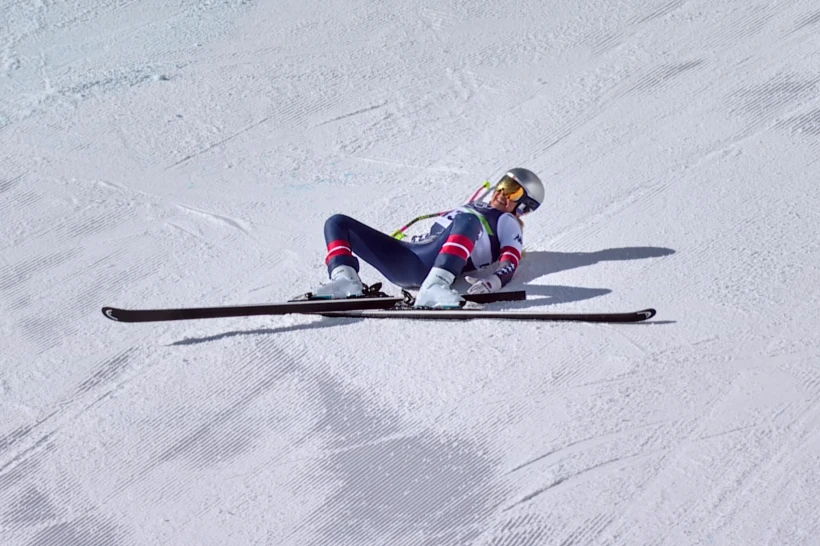
In this image taken from video provided by Olympic Broadcasting Services, OBS, United States’ Lindsey Vonn lays on the course after crashing during an alpine ski women’s downhill race, at the 2026 Winter Olympics, in Cortina d’Ampezzo, Italy, Sunday, Feb. 8, 2026. By Uncredited – Olympic Broadcasting Services
Lindsey Vonn’s skis didn’t come off during Olympic crash and a different binding system isn’t close.
By ANDREW DAMPFPAT GRAHAM,
Lindsey Vonn says Olympic injury ‘more severe’ than broken leg – NewsBreak
CORTINA D’AMPEZZO, Italy (AP) — The images of Lindsey Vonn down on the snow, screaming in pain and then being airlifted off the course by helicopter after her crash at the Olympics were a stark reminder of the dangers of the downhill.
So is this: Her skis didn’t come off.
Vonn’s boots remained locked into her skis even after her pinwheeling fall at the Milan Cortina Games, pointing awkwardly in different directions as she slid to a stop in obvious agony.
It is impossible to know whether Vonn would have suffered a less serious injury — her complex tibia fracture has already required multiple surgeries — had her skis been released. But the devastating injury has put a spotlight on the importance of bindings, which hold boots to the skis and remain some of the oldest technology in the sport.
Officials told The Associated Press that a binding system designed to automatically release skis when a racer like Vonn loses control is still in the drawing-board phase after years of stalled discussions.
“Unfortunately, sometimes it does take horrific accidents to shine even more of a light on what can be done,” said Sophie Goldschmidt, president and CEO of the U.S. Ski and Snowboard Association. “It’s an area we can’t be competitive in; we’ve all got to be in it together with our different country counterparts and FIS (the International Ski and Snowboard Federation).”
Bindings haven’t significantly changed in their basic design for half a century: Once a skier steps in toe-first and then locks in by stepping down with their heel, pressure needs to be applied for the system to release the boot. Less-skilled skiers have bindings that release more easily to avoid leg injuries; the higher the skill level and the more serious the skiing, the more the bindings are cranked down to keep elite racers on their skis.
Few were surprised that Vonn’s skis did not release. The question is whether they should have.
A ‘smarter’ binding could ensure an ‘athlete’s skis would pop off’
A so-called “smart binding” system based on an algorithm and designed to automatically release when a skier loses control “would have surely” helped prevent Vonn from breaking her leg, said Peter Gerdol, the FIS women’s race director at the Olympics and on the World Cup circuit.
“That’s exactly what the system will be designed to do,” Gerdol told AP. “Her skis would have definitely popped off. … We’ve seen a lot of other cases in which the bindings don’t open and it results in knee issues, especially when the still-attached ski acts as a lever, either on the net or on the snow or on a gate or on any other obstacle. The leg becomes blocked and the knee gives out.”
Nine days before her Olympic crash, Vonn tore the ACL in her left knee in a crash in Crans-Montana, Switzerland. She ended up in the safety nets with her skis still attached.
A smart-binding system could borrow technology from the safety air bag system that became mandatory for skiers this season in the speed events.
“It’s still going to take time to develop but the idea is that the binding would be triggered by the same algorithm that prompts the airbag to inflate,” Gerdol said. “The heel piece would slide back and the athlete’s skis would pop off.”
Algorithm measuring rotations and body position needs to be adapted,
Dainese and its sister company, D-Air Lab, spent years developing an algorithm for airbags to inflate under skiers’ racing suits after creating a similar system for motorcycle racing.
In coordination with the FIS, Dainese is sharing the airbag algorithm with top binding suppliers such as Look, Tyrolia, Salomon, Atomic and Marker in order to adapt the formula to release skis.
Releasing skis is potentially more dangerous than inflating an airbag. Elite skiers are sometimes capable of spectacular recoveries after flying into the air and they also can often use their skis to brake before slamming into safety fences.
“It’s a very complicated project,” said Marco Pastore, a Dainese representative on the circuit for the air bag system. “If you release a binding, you’ve got to be absolutely sure you do it at the right moment. For the air bag you can look at the rotations and the entire body position. But with the bindings you’ve got to examine how the feet move, what the trajectory of the skis is — plus a series of other variables.”
Finances are an issue for complicated safety projects.
While the FIS wants to coordinate the project, issues remain over who will pay for it.
“These are very costly projects and to be honest Dainese has not made much” from the air bags, Pastore said. “Right now it’s costing us money. Everyone wants these great things but at the end of the day someone has to pay for it.”
Sasha Rearick, the head coach of the U.S. men’s ski team from 2008-18, recalls binding discussions when he was in charge of the World Cup coaches’ work group nearly a decade ago.
“The problem is that Dainese is the one who’s putting the money and all the investments,” Rearick said. “So if they’re sharing it with the binding companies, the binding companies now need to invest heavily, and it probably costs (a lot).”
Markus Waldner, the men’s World Cup and Olympics race director, said earlier this season that FIS is “working with biomechanists and manufacturers to refine boot and binding standards to reduce the likelihood of catastrophic edge catches at high speed.”
Still, Gerdol suggested the project could be anywhere from two to six years away from being implemented.
Will ski racers use this technology?
To avoid skis popping off, ski technicians crank up racers’ bindings so they are virtually locked in.
Leo Mussi, the ski technician for American downhillers Bryce Bennett and Sam Morse, said he sets his racers’ bindings at up 200 kilograms (440 pounds) of pressure — more than double what a store-bought binding is even capable of.
Austrian racer Marco Schwarz suffered a serious knee injury in a December 2023 crash during the Bormio downhill. His skis didn’t release as he slid into the safety netting.
“It’s tough to say,” he said of whether the skis popping off would’ve saved him from injury, and he isn’t sure about changing things.
“The best way is to keep it simple,” Schwarz said. “I don’t want to push too much into more technology.”
Nina O’Brien, an American who had to endure four surgeries after a gruesome compound fracture at the 2022 Beijing Olympics, said she didn’t fault any equipment issues for her crash and credited her technician.
“Regardless if I’ve worn the skis that morning, clicked out and gotten a coffee,” O’Brien said, “when I step back in, he checks them to make sure they’re perfect.”
Advancements in ski racing safety have been slow
The air bag system was first tested on the World Cup circuit back in 2013 and only this season became mandatory for the speed events of downhill and super-G. In between, some skiers said the bags hindered their aerodynamics, were uncomfortable to wear or could actually cause injuries.
Safety issues became more of a pressing issue recently when Italian skier Matteo Franzoso died following a crash in preseason training in Chile.
“Unfortunately, it always takes something serious to happen for people to say, ‘No. Now we need to do something,’” Pastore said.
This is also the first season in which a cut-resistant undergarment is required for all events on the World Cup and at the Olympics.
There is plenty of room for safety advancements. While the smart-bindings system is being developed, Rearick — now the director of Apex 2100, an international ski academy in Tignes, France — suggested addressing the racing suits.
“Make one suit of material for everybody that’s a little bit warmer, that’s a little bit slower, that’s cut-proof,” Rearick said. “That will make the sport a lot safer for everybody.”
[HD] LINDSEY VONN // The Legend – TRIBUTE ᴴᴰ
** Bassetti’s message blends praise and criticism. **
Matteo Bassetti, professor of infectious diseases at the University of Genoa – Search Videos, wished Lindsey Vonn a speedy recovery after her Olympic crash but highlighted Italy’s public healthcare system as superior to that of the U.S. In a translated post, he wrote that Italy cares for everyone regardless of status or nationality, unlike the U.S., and suggested Vonn explain this to Donald Trump and Robert F. Kennedy Jr.
His post included a photo of Vonn’s injured leg and had replies disabled, but still drew nearly 1,000 quote posts in its first 12 hours
Italian doctor shades Trump while boasting about his country taking care of US Olympian Lindsey Vonn
Lindsey Vonn returns to US after Olympic downhill crash, multiple leg-fracture surgeries in Italy
Italian Doctor Bashes Trump And America While Wishing Lindsey Vonn Well | OutKick
Lindsey Vonn injury update: “Surgery went well – now I can go back to the U.S.”
Winter Olympics: Doctor Shades Donald Trump After Lindsey Vonn’s Injury
Lindsey Vonn issues new injury update, confirms surgery & recovery plan
Lindsey Vonn back in US, grateful for Italian help in recovery.
Vonn’s crash ended historic Olympic bid Lindsey Vonn, 41, became the oldest woman to compete in alpine skiing at the Winter Olympics but saw her comeback end in a crash just 13 seconds into the downhill race. She had been skiing with a torn ACL from a prior event, aiming for a medal in her final Games. The accident caused a complex tibia fracture, leading to at least four surgeries in Italy before her return home.
Lindsey Vonn reacts to historic achievements of fellow athletes at 2026 Winter Olympics
Lindsey Vonn says she still can’t stand following 2026 Winter Olympics crash
Lindsey Vonn back in the US, grateful for Italian help in recovery
After arriving back in the U.S., Vonn posted that she hadn’t stood in over a week but was grateful to be home. She thanked Italian doctors and staff for their care and shared videos showing her recovery process, including eating, hair washing, and muscle therapy in bed. She urged fans not to be sad, framing her experience as an example of resilience and determination.
Winter Olympics 2026: Lindsey Vonn posts video of recovery after surgeries, says she’s ‘slowly coming back to life’ – Search
Vonn’s rehabilitation is expected to involve additional operations in the U.S. after her initial four surgeries in Italy. Before her discharge, she indicated she might need a fifth procedure once home, with earlier updates noting at least two more surgeries planned. She acknowledged the long road ahead but expressed optimism and gratitude for the support she has received.
Italy versus United States HealthCare – Search Videos
The healthcare systems in the United States and Italy differ significantly in structure, funding, accessibility, and overall effectiveness, with Italy offering universal coverage and lower out-of-pocket costs compared to the US.
Overview of the Italian Healthcare System – SearchUniversal Coverage: Italy’s healthcare system, known as the Servizio Sanitario Nazionale (SSN), provides universal coverage to all residents, funded primarily through taxes. This ensures that citizens and legal residents have access to a wide range of medical services, including primary care, hospital care, and preventive services, often at little to no cost.
Regional Organization: The SSN operates on a regional basis, allowing regions to tailor healthcare services to their specific needs. While this can lead to variations in quality, it generally ensures that healthcare is accessible to all.
Quality of Care: Italy consistently ranks high in healthcare quality, with a strong emphasis on preventive care and a high doctor-to-patient ratio. Italians enjoy one of the highest life expectancies in the world, often attributed to the effectiveness of their healthcare system.
Overview of the United States Healthcare System
Mixed System: The US healthcare system is a hybrid of public and private providers. While government programs like Medicare and Medicaid offer coverage for specific populations, the majority of Americans obtain health insurance through their employers or purchase it individually.
High Costs: The US spends significantly more on healthcare per capita than any other country, yet many Americans face high out-of-pocket costs, including deductibles and co-pays. This can lead to substantial medical debt, even for those with insurance.
Access Disparities: Access to healthcare in the US is often tied to one’s ability to pay, resulting in disparities in care. Many individuals remain uninsured or underinsured, which can limit their access to necessary health services.
Key Differences
Coverage: Italy provides universal healthcare coverage, while the US system often leaves individuals reliant on private insurance, which can be costly and inconsistent.
Cost: Italians generally pay less out-of-pocket for healthcare services compared to Americans, who face higher costs despite having insurance.
Quality and Outcomes: Italy’s healthcare system is associated with better health outcomes, including higher life expectancy, compared to the US, where healthcare quality can vary widely based on insurance coverage and geographic location.
Conclusion
The comparison between the healthcare systems of the United States and Italy highlights fundamental differences in how each country approaches healthcare delivery. Italy’s commitment to universal coverage and lower costs contrasts sharply with the US’s mixed system, which often results in significant financial burdens for individuals. Understanding these differences can inform discussions about potential healthcare reforms and improvements in both countries.
Download our E-Book – Freedom Practice Coaching
Jacquelyn Martin, who is a staff photographer for the Associated Press and usually covers politics, was on her first Winter Olympics assignment when she captured Lindsey Vonn’s devastating crash on Sunday. She discusses the moment Vonn’s Olympic dream ended.
Each weekday morning, “CBS Mornings” co-hosts Gayle King, Tony Dokoupil and Nate Burleson bring you the latest breaking news, smart conversation and in-depth feature reporting. “CBS Mornings” airs weekdays at 7 a.m. on CBS and streams it at 8 a.m. ET on the CBS News app.
Russian skater Adeliia Petrosian, a mystery internationally, shows well at Olympics – The Athletic
Bonus: Adeliia PETROSIAN – Short Program / Olympics 2026 : r/FigureSkating