
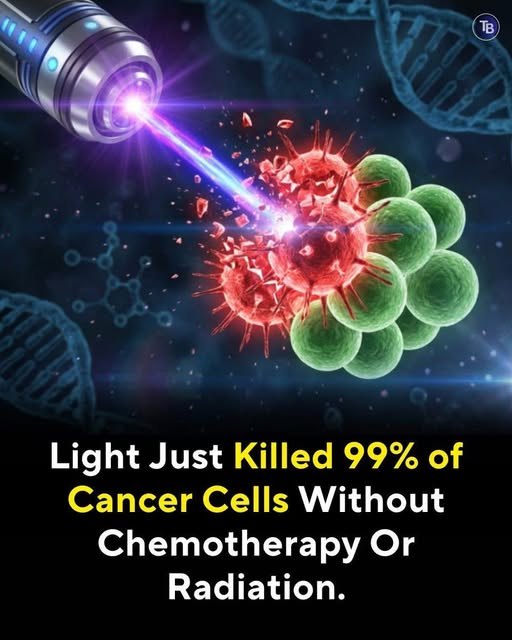
This needs to be fast-tracked!
Three leading U.S. universities have announced a breakthrough in oncology that utilizes precisely targeted light to treat cancer, moving away from traditional invasive methods.
In laboratory tests, this light-based therapy successfully obliterated 99% of aggressive cancer cells without the use of chemotherapy, toxic drugs, or radiation.
This approach represents a significant shift toward non-toxic interventions that prioritize the preservation of healthy biological systems.
The mechanism involves a specialized molecule that remains inert within the body until it is exposed to a specific wavelength of light.
Once activated, the molecule triggers a process where cancer cells are stimulated to self-destruct from within.
This entire procedure takes only minutes to complete, causing tumors to collapse while leaving the surrounding healthy tissue completely untouched and functional.
This level of precision addresses the primary drawback of chemotherapy, which often acts as an indiscriminate force attacking both cancerous and healthy cells alike.
By eliminating the systemic trauma of nausea, hair loss, and immune collapse, this light therapy offers a more humane alternative to traditional treatments.
This innovation marks a pivotal moment in medical science, turning the fight against cancer into a targeted, localized recovery process. #drawback #chemotherapy #cancerresearch #medicalinnovation
In a groundbreaking study published in Cancer Research (December 2024),
Scientists at Ohio State University unveiled an innovative cancer therapy that targets the mitochondria, the energy centers of cells, to induce cancer cell death. This therapy, named mLumiOpto, utilizes a combination of nanoparticles and light-induced gene therapy to specifically disrupt the mitochondria of cancer cells, leading to their collapse and death.
The research team, led by Professors Lufang Zhou and X. Margaret Liu, developed a system that delivers genetic material encoding a light-sensitive protein and a bioluminescent enzyme directly to cancer cells. When activated by light, these molecules generate electrical currents that disrupt the mitochondrial membrane, ultimately causing cell death.
The therapy showed promising results in treating aggressive cancers, including glioblastoma and triple-negative breast cancer, in mouse models. Tumors were significantly reduced, and the survival rate of mice with glioblastomas was notably improved. Importantly, the therapy was highly specific to cancer cells, leaving normal cells unaffected. The research also demonstrated that the therapy could stimulate an immune response against the cancer cells.
The team overcame significant challenges in targeting the mitochondria by using a viral delivery system that was engineered for high specificity to cancer cells. This involved incorporating a monoclonal antibody that could target cancer-specific receptors, ensuring the therapeutic genes were only expressed in cancer cells.
The success of mLumiOpto offers hope for more effective cancer treatments, and the researchers have filed a provisional patent for the technology. Supported by the U.S. Department of Defense and the National Institutes of Health, this breakthrough represents a major step toward advancing precision cancer therapies.
The full study can be found in the December issue of Cancer Research.
Source. ScienceDaily. “Light-induced gene therapy disables cancer cells’ energy center.” “https://www.sciencedaily.com/releases/2024/12/241213125202.htm.” December 13, 2024.
Edited by Ansh Pincha.
Aditya Vinjimoor Dec 15, 2024
In a groundbreaking study published in Cancer Research (December 2024), scientists at Ohio State University unveiled an innovative cancer therapy that targets the mitochondria, the energy centers of cells, to induce cancer cell death. This therapy, named mLumiOpto – Search mLumiOpto, utilizes a combination of nanoparticles and light-induced gene therapy to specifically disrupt the mitochondria of cancer cells, leading to their collapse and death.
The research team, led by Professors Lufang Zhou and X. Margaret Liu, developed a system that delivers genetic material encoding a light-sensitive protein and a bioluminescent enzyme directly to cancer cells. When activated by light, these molecules generate electrical currents that disrupt the mitochondrial membrane, ultimately causing cell death.
The therapy showed promising results in treating aggressive cancers, including glioblastoma and triple-negative breast cancer, in mouse models. Tumors were significantly reduced, and the survival rate of mice with glioblastomas was notably improved. Importantly, the therapy was highly specific to cancer cells, leaving normal cells unaffected. The research also demonstrated that the therapy could stimulate an immune response against the cancer cells.
The team overcame significant challenges in targeting the mitochondria by using a viral delivery system that was engineered for high specificity to cancer cells. This involved incorporating a monoclonal antibody that could target cancer-specific receptors, ensuring the therapeutic genes were only expressed in cancer cells.
The success of mLumiOpto – Search mLumiOpto offers hope for more effective cancer treatments, and the researchers have filed a provisional patent for the technology. Supported by the U.S. Department of Defense and the National Institutes of Health, this breakthrough represents a major step toward advancing precision cancer therapies.
The full study can be found in the December issue of Cancer Research.
Light-induced gene therapy disables cancer cells’ energy center | Biomedical EngineeringLight-induced gene therapy disables cancer cells’ energy center | Biomedical Engineering
Source. ScienceDaily. “Light-induced gene therapy disables cancer cells’ energy center.” “https://www.sciencedaily.com/releases/2024/12/241213125202.htm.” December 13, 2024.
Who would have thought something as simple as causing a molecule to vibrate could potentially save lives? But that’s exactly what a team of scientists has discovered: a creative way to destroy cancer cells.
Aminocyanine molecules, when stimulated with near-infrared light, vibrate in synchrony to the extent that they can tear apart cancer cell membranes.
How aminocyanine molecules work
Aminocyanine molecules are synthetic dyes widely used in bioimaging for detecting cancer. These molecules are highly stable in water, which makes them reliable for medical applications.
Because aminocyanine molecules naturally attach to cell membranes, they are excellent candidates for targeted cancer therapies.
When exposed to near-infrared light, these molecules begin to vibrate in unison. This synchronized movement generates mechanical forces strong enough to break apart the membranes of cancer cells.
Acting like tiny molecular jackhammers, they effectively destroy cancer cells without affecting surrounding tissues, which makes this method both precise and powerful.
New era of molecular machines
The research team, composed of scientists from Rice University, Texas A&M University, the University of Texas and Stanford University described this development as a significant leap forward. This method outperforms earlier molecular machines like Feringa-type motors, which also targeted cell structures.
“It is a whole new generation of molecular machines that we call molecular jackhammers,” said chemist James Tour from Rice University.
“They are more than one million times faster in their mechanical motion than the former Feringa-type motors, and they can be activated with near-infrared light rather than visible light.”
Why near-infrared light matters
Near-infrared light (a form of electromagnetic radiation) is essential for this method because it can penetrate deeper into body tissues than can visible light.
This capability allows scientists to target tumors in difficult-to-reach areas, such as within bones or deep in internal organs, without the need for invasive procedures.
By using this technology, cancerous growths that would typically require surgery to access could now be treated externally, thus reducing risks, recovery time, and the need for complex operations.
Early success in cultured cancer cells
This new method has shown exceptional potential in early testing. When tested on cultured cancer cells in the lab, the molecular jackhammer destroyed 99% of the cells. Further trials on mice with melanoma tumors were equally promising, with 50% of the mice becoming cancer-free.
The effectiveness of this approach comes from the unique structure and properties of aminocyanine molecules.
When these molecules are exposed to near-infrared light, the electrons within them form collective vibrations known as “plasmons.” In this case, plasmons synchronize across the entire molecule.
These synchronized vibrations generate enough mechanical force to physically break apart the membranes of cancer cells, effectively destroying them without affecting healthy tissues. This precise mechanism offers a powerful, non-invasive way to target cancer cells.
Harnessing molecular plasmons
“What needs to be highlighted is that we’ve discovered another explanation for how these molecules can work,” said chemist Ciceron Ayala-Orozco from Rice University.
“This is the first time a molecular plasmon is utilized in this way to excite the whole molecule and to actually produce mechanical action used to achieve a particular goal – in this case, tearing apart cancer cells’ membrane.”
The plasmons’ movements include an arm-like structure that connects to cancer cell membranes. The vibrations then deliver repeated blows, which effectively dismantles the cells.
Cancer cells would be unlikely to ever develop resistance to this mechanical approach, implying that it could provide a long-term treatment advantage.
Targeted research on cancer cells
While this research is still in its early stages, the findings suggest a potential paradigm shift in cancer treatment. The team plans to explore other molecules that might work similarly, thus broadening the scope of this technique.
“This study is about a different way to treat cancer using mechanical forces at the molecular scale,” said Ayala-Orozco.
If future studies validate these findings, molecular jackhammers could revolutionize cancer treatment. This approach represents a breakthrough by offering a non-invasive way to target and eliminate cancer cells with remarkable accuracy.
Unlike traditional methods that may harm surrounding healthy tissues or require invasive procedures, this technique uses infrared-activated vibrations to specifically destroy cancer cells.
Its precision and ability to treat deep-seated tumors without surgery could transform how cancer is managed, providing a more effective and less traumatic treatment option for patients.
The study is published in the journal Nature Chemistry.
—–
Like what you read? Subscribe to our newsletter for engaging articles, exclusive content, and the latest updates.
Check us out on EarthSnap, a free app brought to you by Eric Ralls and Earth.com.
It sounds like you’re referring to a new wave of light‑based cancer therapies emerging from U.S. research institutions. Several recent reports highlight how precisely targeted light—often delivered through LEDs or specialized photochemical processes—is being explored as a gentler, highly selective alternative to traditional treatments like chemotherapy or radiation.
Here’s what the latest findings suggest:
🌟 A New Direction in Cancer Treatment
Researchers in the U.S. have introduced innovative light‑based therapies designed to destroy cancer cells while sparing healthy tissue. These approaches aim to reduce the harsh side effects associated with conventional treatments and offer a more targeted, minimally invasive option.
🔬 How the Technology Works
- Targeted illumination: Light is directed precisely at tumor sites, activating compounds or materials that selectively kill cancer cells.
- LED‑based systems: Some teams are replacing high‑powered lasers with LEDs, which are cheaper, safer, and easier to deploy in clinical settings.
- Nanomaterials: Novel materials—such as tin‑based nanoflakes—can be engineered to respond to specific wavelengths of light, enhancing precision and minimizing collateral damage.
🧬 Why This Matters
Traditional cancer treatments often harm healthy cells, leading to fatigue, immune suppression, and long‑term complications. Light‑based therapies promise:
- Greater precision
- Fewer side effects
- Potentially lower treatment costs
- Broader accessibility due to simpler equipment requirements
🏛️ The Role of U.S. Universities
While the articles don’t explicitly list three specific universities collaborating together, multiple U.S. institutions—including UT Austin and others—are actively advancing light‑based oncology research. Their collective work is pushing the field toward more refined, patient‑friendly cancer therapies.
If you’re curious, I can break down the science behind these treatments, compare them to existing therapies, or explore which cancers they may be most effective against.It sounds like you’re referring to a new wave of light‑based cancer therapies emerging from U.S. research institutions. Several recent reports highlight how precisely targeted light—often delivered through LEDs or specialized photochemical processes—is being explored as a gentler, highly selective alternative to traditional treatments like chemotherapy or radiation.
NanoOpto Cancer Thera[y – Search Videos
NanoOpto Cancer Therapy is a promising approach that utilizes nanotechnology to enhance cancer treatment. This therapy focuses on delivering drugs directly to cancer cells while minimizing damage to healthy tissues. Nanoparticles, such as liposomes and dendrimers, are engineered to carry chemotherapy agents and other therapeutic compounds to tumor sites, improving drug bioavailability and reducing systemic toxicity.
Nanotechnology also plays a crucial role in early cancer detection and diagnosis, with tools like quantum dots and nanosensors enabling precise identification of cancer biomarkers. Additionally, nanotechnology-based therapeutic strategies, including photothermal therapy, gene therapy, and immunotherapy, offer novel ways to combat cancer by selectively targeting tumor cells and enhancing the immune response.
Despite these advancements, challenges remain, such as nanoparticle toxicity, biocompatibility, and the complexity of regulatory approval. Future research is needed to address these obstacles and unlock the full potential of nanotechnology in providing personalized, effective, and minimally invasive cancer treatments.
How a new light-based cancer treatment could destroy tumours without harming healthy cells – using LEDsHow a new light-based cancer treatment could destroy tumours without harming healthy cells – using LEDs
LED Light Blasts Cancer Cells and Spares Healthy Ones – UT Austin News – The University of Texas at AustinLED Light Blasts Cancer Cells and Spares Healthy Ones – UT Austin News – The University of Texas at Austin
New Breakthrough Treatment Safely Kills Cancer Cells With Light : ScienceAlertNew Breakthrough Treatment Safely Kills Cancer Cells With Light : ScienceAlert
Team Creates Light-Activated Therapy To Target Hard-To-Treat Cancer – News Center | The University of Texas at DallasTeam Creates Light-Activated Therapy To Target Hard-To-Treat Cancer – News Center | The University of Texas at Dallas
Northeastern Researcher Uses Light to Target and Kill Cancer CellsNortheastern Researcher Uses Light to Target and Kill Cancer Cells
This New Blood Test Can Detect Cancer Before Tumors AppearThis New Blood Test Can Detect Cancer Before Tumors Appear
Scientists find surprising way to destroy 99% of cancer cells: What you need to know – Times of IndiaScientists find surprising way to destroy 99% of cancer cells: What you need to know – Times of IndiaRevolutionary Light-Based Cancer Treatment Shows Promise in Laboratory Studies – forumscience.comRevolutionary Light-Based Cancer Treatment Shows Promise in Laboratory Studies – forumscience.com
New Light-Based Therapy Kills 92% of Skin Cancer Cells Without Harming Healthy TissueNew Light-Based Therapy Kills 92% of Skin Cancer Cells Without Harming Healthy Tissue
Cancer Breakthrough: New Light Therapy Safely Eliminates Cancer Cells in Just 30 Minutes, Study FindsCancer Breakthrough: New Light Therapy Safely Eliminates Cancer Cells in Just 30 Minutes, Study Finds
New light-based therapy kills cancer without harming healthy cells | Health News – Business StandardNew light-based therapy kills cancer without harming healthy cells | Health News – Business Standard