
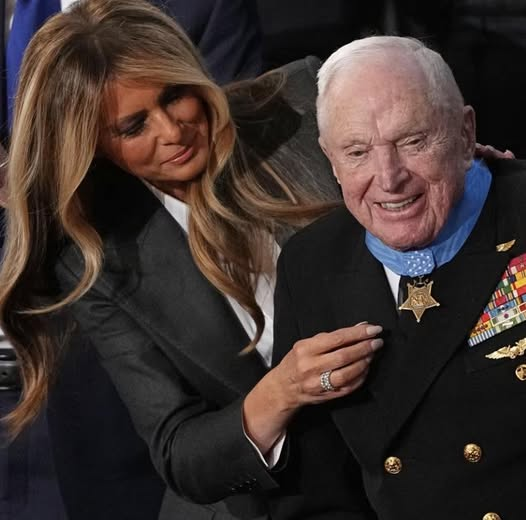
 President Donald Trump and First Lady Melania Trump just awarded 100-year-old Navy fighter pilot Royce Williams the Medal of Honor!
cen·ten·ar·ian [ˌsɛntɪˈnɛːriən]
- a person who is a hundred or more years old.
Royce Williams was born on 4 April 1925, and grew up in Wilmot, South Dakota and Clinton, Minnesota.[5] He and his brother aspired to become pilots; both enlisted during World War II, although Royce Williams’ flight training was deferred while he attended college in Minnesota. He qualified as a naval aviator at Pensacola August 1945.[6]
He is known for his solo dogfight with seven Soviet pilots during the Korean War in 1952, which military experts have called “one of the greatest feats in aviation history”.[3] Originally awarded the Silver Star in 1953 for his conduct during the dogfight, in 2023 he was given an upgrade to the Navy Cross, the Navy’s second highest decoration. In 2026, Williams was awarded the Medal of Honor.[4] Williams is the last living Medal of Honor recipient of the Korean War.[note 1]
Near the end of a long State of the Union address, when most Americans were thinking about bed rather than history, the focus shifted to a man who had once stared down Soviet fighter jets in a frozen sky and survived to tell almost no one about it.
Royce Williams was just a young Navy lieutenant in November 1952 when he launched from the deck of the USS Oriskany in an F9F Panther and flew into what would become one of the most extraordinary aerial engagements in American military history. What unfolded that day was not a routine patrol or a brief exchange of fire but a sustained, desperate dogfight against multiple Soviet MiG-15s, aircraft that were faster, more maneuverable, and more heavily armed than the jet he was flying.
The MiG-15 had clear advantages on paper. It could outclimb the Panther, outturn it, and unleash higher caliber firepower. In almost every technical comparison, the odds leaned heavily toward the Soviet pilots. Yet Williams did not disengage at the first sign of trouble. He maneuvered, fired, absorbed damage, and stayed in the fight long after prudence might have suggested breaking away. By the time his ammunition was gone, four MiGs had been shot down.
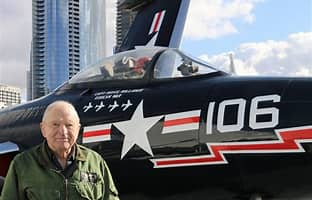
His own aircraft was barely holding together.
After landing, mechanics counted 263 holes punched through the fuselage. Hydraulic systems were compromised. The jet had taken such punishment that it was ultimately pushed overboard because it could not be salvaged. Even the return to the carrier was a trial in itself, as Williams had to guide a crippled aircraft onto a pitching deck in rough seas, knowing that a mistake at that stage would be unforgiving.
What makes the story even more remarkable is what followed. The United States was not officially acknowledging direct combat with Soviet forces in Korea, and the engagement was classified to avoid inflaming tensions that might have widened the conflict only a few years after World War II. The public record softened the details. The extraordinary clash in the sky was tucked away in official files. Williams himself said little about it for decades.
He went on to complete a distinguished naval career and retired as a captain. He built a life beyond the cockpit and watched as the Korean War settled into the uneasy category of the “Forgotten War,” overshadowed by the global scale of World War II before it and the cultural upheaval of Vietnam after it. Meanwhile, one of the longest and most lopsided dogfights in U.S. history remained largely unknown to the broader public.
The Medal of Honor carries a strict standard of conspicuous gallantry and intrepidity at the risk of life above and beyond the call of duty. Williams’ actions in 1952 fit that standard without ornament or exaggeration. He faced superior aircraft flown by skilled adversaries. He remained engaged while massively outnumbered. He fought until he ran out of ammunition. He brought home a plane that by all rights should not have made it back.
More than sixty years passed before the nation formally placed its highest military decoration around his neck. That delay speaks less to oversight than to the complicated realities of Cold War secrecy and bureaucratic caution. Fellow veterans pressed for recognition. Lawmakers revisited the record. Declassified information clarified what had long been obscured. Eventually, the historical record aligned with the scale of the achievement.
Seeing a centenarian aviator in full dress uniform receiving the Medal of Honor offers a rare bridge across generations. The world of 1952, with its carrier decks and early jet fighters, feels distant from the era of stealth aircraft and satellite-guided munitions. Yet the qualities that defined Williams’ actions remain constant in every age of warfare: composure under pressure, disciplined skill, and the willingness to accept grave personal risk in service of mission and country.
The Korean War’s geopolitical consequences are still visible today in the divided Korean Peninsula and in the long shadow of Cold War rivalries that continue to shape global tensions. Williams’ dogfight took place in that fraught environment, when American and Soviet forces tested one another under layers of diplomatic ambiguity. Every engagement carried strategic implications that extended far beyond the cockpit.
Royce Williams did not build a public identity around that day in November 1952. He carried the memory quietly, as many in his generation did, allowing the work itself to stand without flourish. The Medal of Honor does not transform what he accomplished, but it does place an unmistakable marker in the historical record. It ensures that the story of a young lieutenant who fought against the odds in a snow-choked sky will not be confined to classified archives or fading recollections.
In honoring him at 100 years old, the country acknowledged not only a single dogfight but an entire era of service that has too often been compressed into footnotes. Royce Williams’ name now sits firmly among those whose courage was tested at the outer edge of possibility and proved equal to the moment.
May God Bless E. Royce Williams – Wikipedia 

President Donald Trump and First Lady Melania Trump just awarded 100-year-old Navy fighter pilot Royce Williams the Medal of Honor!
Near the end of a long State of the Union address, when most Americans were thinking about bed rather than history, the focus shifted to a man who had once stared down Soviet fighter jets in a frozen sky and survived to tell almost no one about it.
Royce Williams was just a young Navy lieutenant in November 1952 when he launched from the deck of the USS Oriskany in an F9F Panther and flew into what would become one of the most extraordinary aerial engagements in American military history. What unfolded that day was not a routine patrol or a brief exchange of fire but a sustained, desperate dogfight against multiple Soviet MiG-15s, aircraft that were faster, more maneuverable, and more heavily armed than the jet he was flying.
The MiG-15 had clear advantages on paper. It could outclimb the Panther, outturn it, and unleash higher caliber firepower. In almost every technical comparison, the odds leaned heavily toward the Soviet pilots. Yet Williams did not disengage at the first sign of trouble. He maneuvered, fired, absorbed damage, and stayed in the fight long after prudence might have suggested breaking away. By the time his ammunition was gone, four MiGs had been shot down.
His own aircraft was barely holding together. After landing, mechanics counted 263 holes punched through the fuselage. Hydraulic systems were compromised. The jet had taken such punishment that it was ultimately pushed overboard because it could not be salvaged. Even the return to the carrier was a trial in itself, as Williams had to guide a crippled aircraft onto a pitching deck in rough seas, knowing that a mistake at that stage would be unforgiving.
What makes the story even more remarkable is what followed. The United States was not officially acknowledging direct combat with Soviet forces in Korea, and the engagement was classified to avoid inflaming tensions that might have widened the conflict only a few years after World War II. The public record softened the details. The extraordinary clash in the sky was tucked away in official files. Williams himself said little about it for decades.
He went on to complete a distinguished naval career and retired as a captain. He built a life beyond the cockpit and watched as the Korean War settled into the uneasy category of the “Forgotten War,” overshadowed by the global scale of World War II before it and the cultural upheaval of Vietnam after it. Meanwhile, one of the longest and most lopsided dogfights in U.S. history remained largely unknown to the broader public.
The Medal of Honor carries a strict standard of conspicuous gallantry and intrepidity at the risk of life above and beyond the call of duty. Williams’ actions in 1952 fit that standard without ornament or exaggeration. He faced superior aircraft flown by skilled adversaries. He remained engaged while massively outnumbered. He fought until he ran out of ammunition. He brought home a plane that by all rights should not have made it back.
More than sixty years passed before the nation formally placed its highest military decoration around his neck. That delay speaks less to oversight than to the complicated realities of Cold War secrecy and bureaucratic caution. Fellow veterans pressed for recognition. Lawmakers revisited the record. Declassified information clarified what had long been obscured. Eventually, the historical record aligned with the scale of the achievement.
Seeing a centenarian aviator in full dress uniform receiving the Medal of Honor offers a rare bridge across generations. The world of 1952, with its carrier decks and early jet fighters, feels distant from the era of stealth aircraft and satellite-guided munitions. Yet the qualities that defined Williams’ actions remain constant in every age of warfare: composure under pressure, disciplined skill, and the willingness to accept grave personal risk in service of mission and country.
The Korean War’s geopolitical consequences are still visible today in the divided Korean Peninsula and in the long shadow of Cold War rivalries that continue to shape global tensions. Williams’ dogfight took place in that fraught environment, when American and Soviet force tested one another under layers of diplomatic ambiguity. Every engagement carried strategic implications that extended far beyond the cockpit.
Royce Williams did not build a public identity around that day in November 1952. He carried the memory quietly, as many in his generation did, allowing the work itself to stand without flourish. The Medal of Honor does not transform what he accomplished, but it does place an unmistakable marker in the historical record. It ensures that the story of a young lieutenant who fought against the odds in a snow-choked sky will not be confined to classified archives or fading recollections.
In honoring him at 100 years old, the country acknowledged not only a single dogfight but an entire era of service that has too often been compressed into footnotes. Royce Williams’ name now sits firmly among those whose courage was tested at the outer edge of possibility and proved equal to the moment.
May God Bless Royce Williams! 
He is a great hero God bless you sir very thankful for u and u are a great man
Doug Atkinson
All very true and accurate .. but as I have read extensively about this incident, I’d like to add a few things that make it even more remarkable … All of this took place in a raging blizzard , over oceans that were so cold that life would be measured in minutes if he had to bail out … with little chance of  rescue
The mission started as a pair of aircraft but his wingman had to turn back leaving him alone to face at least seven opponents
All flying much faster aircraft by at least 100 miles an hour …
The pilots he faced were all very experienced combat veterans, a couple of which were actual aces in WW2 and all of them had kills to their credit …
Also the air battle went on for a relatively long period of time … over twenty minutes…If he had not prevailed his aircraft carrier was the real target and would have been wide open to direct attack risking thousands of lives …
I have read various accounts in different publications about this incident and every time I learn something more amazing about it… he was also ordered not to talk about this and obeyed that order for 40 years until other people started talking about it. I think this would be a fantastic subject for a movie as this guy is a huge incredible hero
Connie Sharp
Was humbled by the smile on his face in full uniform at 100 years old!! God bless the USA. May we bring back history in our classrooms to teach students what price was paid to make this country what it is and the real price of freedom!!
Ariel Sue Blackketter Lohberger
Zeland Rainey, another Korean War veteran from my church, and my father, a WWII veteran, were both proud to have served their country. They would have loved seeing this man so honored. I’m glad he lived to receive the medal in person – and have his story told to the nation. We all needed to hear it.
Daniel O’shaughnessy
I came across this story on you tube man can he ever keep a secret the record shows that out of 7 planes only 1 made it back and it was damaged I’m just really Thankful that he was recognized while still being alive
Steve Stapletun
I met two Medal of Honor recipients and they both said it was their brothers that did not return who are the heros. Some of the most humble people I ever meet. Real Leaders and Real heros
Robin DeMartini
The look on his face when he realized what she was placing on him. 
Diane Pederson Welna
This gave me goosebumps! 1952 was my birth year. As I was brought into this world, extraordinary was taking place, my future freedoms protected, my life, liberty and pursuit of happiness was in my future. Thank you Lord for Captain Royce Williams and for all of those who served!
Curtis W Cleveland
The real price of freedom is not measured by how many taillights are kicked out on an ICE Vehicle. This man represents what brings freedom to our country and the citizens who reside here.
James Murphy
I saw a video recently of the USS Oriskany being scuttled to form an artificial reef. Hats off to Captain Williams! I’m glad he got the recognition he has long deserved, for 74 years! Wow!
Jeff Scheid
There should be a movie about him! The younger generation needs to understand the significant sacrifices, of so many in the military, that gives them the freedoms we have today.
Tammy Crosley Stockbridge
The standing ovation must have lasted 2 full minutes AND he deserved it.
Bill Hanlon
To all the doubters, Trump does occasionally have a good idea & does a good thing…
Al Harvey
This is an incredible story of an incredible event executed by an incredible man. I am happy that the world now knows and acknowledges his heroism some 74 years ago.
Ron Clark Sr
We all walk among heroes, last night we saw one of them Navy Captain Royce Williams as he received the MOH. It was inspiring to see this 100 year old Navy Aviator in full uniform standing tall with great respect for his Country. May we all take this moment to realize that our Nation is great and is now moving into a new era for all of us.
With the 250 Anniversary at hand to celebrate 1776  we give thanks to God for all of his blessings.

Sharon Doan
This award and the hero who received it brought tears to my eyes. You see Lieutenant Royce Williams was not fighting to receive recognition. He fought for the people of the United States of America. He was willing to die for them.
Dale Miller
As an avid researcher and student of military aircraft, my jaw literally hit the floor when I listened to what he had done. The plane he flew, the F9F, was incredibly inferior to the mig as a dog fighter. He didn’t stand a chance. But from a heart of pure bravery he joined the fight with no intention of losing. Last night. What happened in that room to those two soldiers was the most perfect thing I’ve ever seen. Very few receive that medal. Those two get to stand on the front row.
David L Goode
Quite a nice picture! A one hundred year old hero of the 1952 Korean conflict and a young hero of the 2026 capture of Maduro in Venezuela both receiving the Congressional Medal of Honor.
Cammy Fulmer
Thank you for explaining it all. I watched last night with tears in my eyes. I did not understand why he could not talk about it. That generation loved the United States, and they protected the ones who wanted freedom.
Captain Williams certainly deserved the medal and the respect given. I am sorry it could not have come sooner.
Many good men died in that war. Every South Korean I talk with is so thankful to the United States for what our young men did for them. May our younger generations NEVER forget what freedom costs.
Bob Overton
I would encourage EVERYONE of my FB friends, and actually EVERYONE in general, to read this short piece on this 100 YEAR OLD, AMERICAN HERO!!! I don’t care what politics are, or anything else. Just take a moment and read this….
Heather Taylor
His story made me cry, to think of the fear I know he felt, while courageously continuing to fight against overwhelming odds. To have the records sealed for over 50 yrs, finally have them opened, so that we, the people, can finally honor a soldier, thankfully alive, who fought bravely, for America. This is what runs so deep in protecting America’s freedoms, and shows again, the fortitude of the American soldier.
Doyle Clemmons
Long time coming. My father flew 37 missions in a B 17 Bomber. His plane barely made it back across the English Channel 6 times with multiple dead crew members. He lived to come back. So many like this were never recognized.
Renon Bennett
My brother would be so Proud he was in Korea during the conflict! He passed away 6 months ago at 93,, He went on an honor flight! Was the highlight of his life! I received a hat !just like the one the 100 year gentleman received, when he passed away
Jay Howard
Brings back memories of my Navy Brother-on-law who served on the Tortuga that helped bombard North Korea so the US troops could break out of the bottom part of South Korea and push back to the Manchurian border!
Douglass MacArthur wanted to proceed from there but Harry Truman would not agree!
Susan Hess Murphy
Loved seeing all of the recognitions of military heroes as well as the families (and victims of violence) in our country (and acknowledging our Olympic teams). The speech was the longest in recent history but much time was spent giving recognition to heroes.
Paul Snyder
Your more than honorable service is so appreciated. Congratulations Sir !
The mission you flew, from the USS Oriskany aircraft carrier, was named after the battle of Oriskany.
This makes the people of Oriskany New York, even prouder of you !
Connie Olind
Tears right here. When this “greatest generation” is gone, their sacrifices will slowly fade. My father, father-in-law and uncle all fought in WWII. When I see a veteran like this, it reminds me of their sacrifices and how all those young men and women were SO PATRIOTIC AND LOVED THEIR COUNTRY!!!
Another reason for our country to come together and celebrate our loved ones who are now gone and gave so much!!! 

Greg Whiting
“Where do we get such men? They leave this ship and they do their job. Then they must find this speck lost somewhere on the sea. When they find it they have to land on its pitching deck. Where do we get such men?” Admiral Tarrant, from the James Michener’s novel, The Bridges at Toko-Ri
Jerry Antos
God bless him. For a great overview of the Grumman F9F panther, watch The Bridges At Toko-Ri (1954) (1080p) Classic & Older Hollywood Films
Sandra Sinanian
Wow, the story honors more than just Mr. Williams, so much we don’t know, a child at the time Mr. Williams was fighting Russian MIG’s…… maybe schools should have been teaching current history as it unfolded, what we don’t know could teach us a lot more. Just watching his smile last night made me sit up and pay attention, I need more of this today!!
Mike Belter
Actually from what I’ve heard the ONLY advantage the F9F Panther had over the MIG 15 was turn radius. Williams was able to use that to single handedly fight the seven MIGs. Of the seven, only one made it back alive to document the encounter in Soviet records. Unfortunately, gun cameras could only give Williams four confirmed kills.
Nick Olson
This story is emblematic of the Greatest Generation. They illustrated selflessness over selfishness, honor over celebrity, responsibility over entitlement, determination over victimhood, and on and on. I take off my hat and cover my heart in memory of their illustrious example.
Christopher Edward Ansardi
Ya’ll left out that he did this in a Grumman F9F Panther which was a far inferior fighter to the MIG-15. For him to pull this feat off vs 1 MIG would take an extraordinary pilot much less to shoot down 4 outta the 7 MIGS he was facing!! Congratulations on winning the MOH Capt. Royce Williams!!
Ken Mason
Anyone who is a Top Gun fan knows Mavericks dad launched from Oriskany. He got into a dogfight that was never acknowledged and considered classified. He stayed in a battle longer than he had until his aircraft sustained major damage; he saved many and shot down more. The difference is Mav’s father didn’t make it back, the story goes. Makes me wonder if someone had some inside information when they created the backstory for Top Gun. Congratulations sir your country thanks you for your duty
James Klug
The 4 MIGS he shot down were officially never there. The US powers at the time were fearful of a war with the USSR, so under orders, he kept that secret since the Korean War. A true patriot.
Ed Rodenbeck
Also front and center for the public to see and hear is the fact our Country always classifies heroic actions to hide them from the population in general. I personally know of actions that happened in Vietnam 68 & 69 that are still classified to this day, and I’m almost 90 years old. President Trump has been the most transparent and honest President in my lifetime.
Katharine Tharp
Thank you Captain Williams for your gallantry and courage . I often wonder with the patriotism of the 18th century – 20th century with the advancements in weapons how the military service men and women would have handled the power of today’s weapons . Either way fighting for what you believe in is always a difficult endeavor no matter the level of weapons and patriotism .
Al Cheramie
Long overdue and few today understand how much this man’s aircraft was outclassed by the Korean Migs, yet he fought like a champ and won. Skill, tenacity and a little bit of luck he shot down 4 and damaged 2 others. The reasons given for no acknowledgment at the time were rather meek but I was there and do not know why nor was it appropriate for the time.
Mark Medlin
The Oriskany was also mentioned in Top Gun, when Viper shared how Maverick’s dad was killed.
Hank Fusco
His story is on UTube. It depicts his flying in an F9f Navy Panther jet going against Mig 15’s. According to YouTube, this dogfight was suppressed because he shot down Russian pilots in the Korean War, and our government did not want to antagonize the Russian Government.
Bill Carlson
The panther was obsolete before it hit the fleet. An ok ground support platform, it was later changed to have swept wings. It had one advantage, it was tough like most naval aircraft. Incredible feat.
Harry Thomas
Amazing story. The Mig 15 was far superior to the F9F in every aspect and he shot down four in one engagement. Where was his wing man?
Arina Haldemann
One of the most remarkable dogfights of the Korean War era. Facing superior MiG-15s in an F9F Panther and bringing that aircraft home is extraordinary skill and composure under pressure. A historic recognition
Dennis Laurent
This man was actually flying an inferior plane. The 4 MIGs he shot down were almost 100mph faster than his F9 Panther.
But the F9 Panther could maneuver quicker. Very impressive!
Who designed and built the F9F Panther? Quite a durable aircraft! – Search
Royce Williams – Wikipedia || Captain Elmer Royce Williams – Search Videos
Medal of Honor Citation
For conspicuous gallantry and intrepidity at the risk of his life above and beyond the call of duty on 18 November 1952 while leading a division of three jet fighters attached to Fighter Squadron SEVEN HUNDRED EIGHTY-ONE (VF-781) and embarked on the USS ORISKANY. While flying a combat patrol mission over the northeastern coastal waters of enemy-held North Korea, Lieutenant Williams demonstrated extraordinary heroism by intercepting a superior force of attacking enemy MiG-15 fighters in order to protect the ships of Task Force 77.
After thwarting the enemy’s initial attack, he maneuvered his aircraft to make two firing passes on one MiG, which then spiraled into the sea. He inflicted heavy damage to a second MiG-15, which started smoking badly and retired from the fight. When his own aircraft was severely damaged by a direct hit from one of the remaining enemy MiG-15s, Lieutenant WIlliams evaded further enemy attack while continuing to direct the dogfight.
He eventually found cover in a cloud bank, broke off the engagement, and miraculously landed his nearly uncontrollable aircraft on the USS ORISKANY. His exceptional airmanship, coupled with his complete disregard for his own personal safety, resulted in the destruction of three enemy MiG-15s and severe damage to a fourth, and undoubtedly saved the lives of hundreds of Task Force 77 sailors. By his undaunted courage, bold initiative, and total devotion to duty, Lieutenant Williams reflected great credit upon himself and upheld the highest traditions of the United States Naval Service.
Captain E. Royce Williams – Congressional Medal of Honor | Representative Darrell Issa
Read the full transcript of Trump’s 2026 State of the Union – National | Globalnews.ca
Retired Navy Capt. Royce Williams shares declassified heroic story | Fox News
How To Live To Be 100: 10 Science-Backed Secrets Of Centenarians
Top 6 women’s sports moments of 2026 Winter Olympics
Valor Friday : This ain’t Hell, but you can see it from here
Lieutenant E. Royce Williams: U.S. Navy Pilot
Sunshine Morris
Working as a traveling cna for many many years, I’ve come across many. I took the 15 min every chance I had to listen to their stories. I was amazed and honored to have those moments. The stories they had. The sacrifice they gave to make sure we are where we are today. And for people to just dishonor it because of their tantrums irritates me. I salute u mister and always will
Bill Spencer
That’s the problem with geopolitical wars. Those who decide the outcomes and political repercussions regularly disregard the intense struggles of the actual hero’s just to stay alive, let alone fight. The term,”acceptable losses” comes to mind. Thank you Sir, for your exceptional Bravery and Service.
Sheila Kelly
I want to thank him for his courage and service. My dear late dad fought in WW11 and the Korean War. He was in the Air Force and was the one that sat in the very nose of the planes for the bombing. I appreciate every single man and woman that serves our country so that I and many others have freedom. Thank you
Janet Bridges
Was absolutely the most special and insightful time of the President’s speech; everyone felt and showed incredible respect and honor for this brave Navy centurion hero. We need more movies and more stories to be played depicting these brave military men. 
John Ochs
Wow! I flew the F-9 in advanced jet training, it was my first jet, & no comparison to the F-14 that I flew just a few years later!
John Cary Blinn
Downed 4 out of 7 in one dog fight in a plane riddled with 236 bullet holes…don’t know why this particular fight was a national secret
Gene Peters
Flew off the deck of the USS Oriskany CVA 34. That ship now sits at the bottom of the ocean off the coast of Florida serving as a fish sanctuary. I spent two years on that ship and never heard that story. What a history! I was only eight years old at that time, wow!
David Mize
I dove on the Oriskiny shortly after it was sunk off of Pensacola. It’s a real treat to see such an aircraft carrier underwater. The deck at that point was 134 feet and it kept sinking into the sand. I don’t know how to know it’s probably 140 feet or more to the deck.
Jaimie E. Kintz
Congratulations Sir for your brave actions! True valor!! The USS Oriskany is now an artificial reef and beloved diving destination 22 miles off the coast of Pensacola. FL. It is the largest artificial reef in the world.
Joe Manzella
What an awesome honor for a Korean War veteran. And what a well built plane that he flew that absorbed that much punishment. The Soviets had the superior planes on paper, but it took the skill of Mr Williams to win the dog fight. 
Alan Yarnold
That Panther fighter was a tough bird,as every hit on it was a 23 or 37 mm cannon shell!
Robert Barber
To borrow a line from “Top Gun Maverick” – “It’s not the plane, it’s the pilot.”
Jack Rowden Hughes[1] (born May 14, 2001) is an American professional ice hockey player who is a center and alternate captain for the New Jersey Devils of the National Hockey League (NHL).