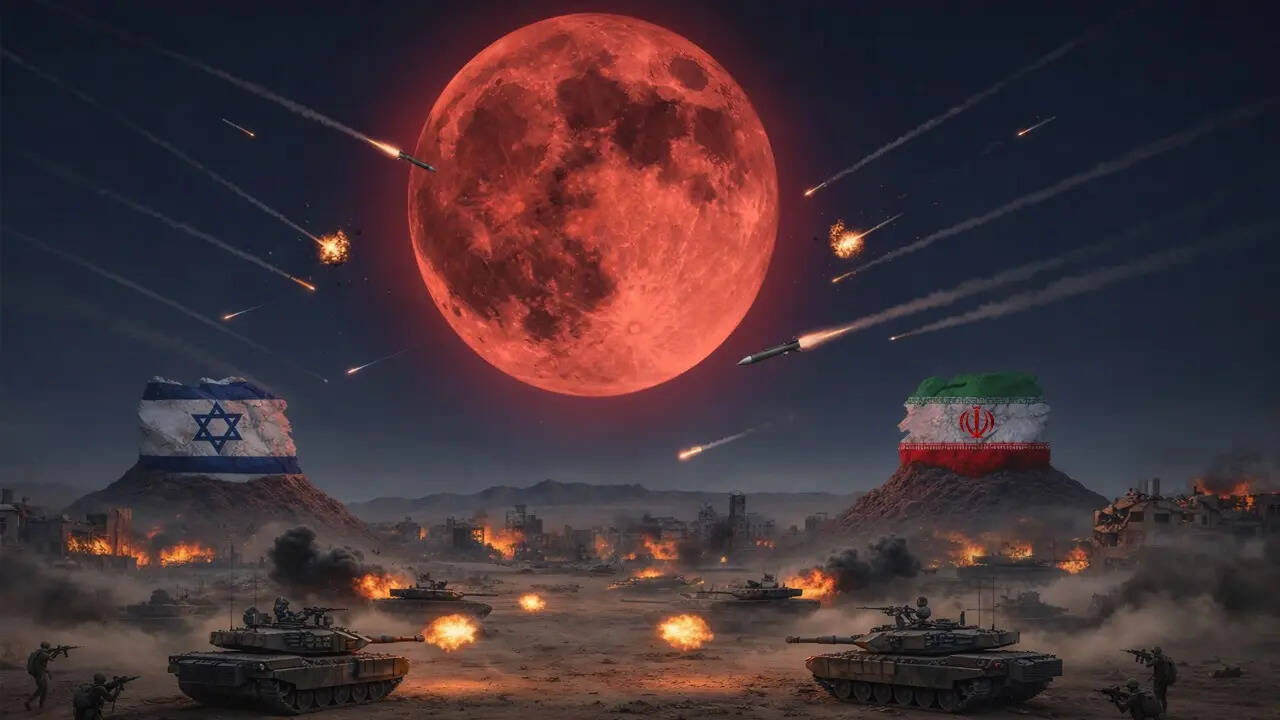
A Blood Moon falls again as Israel observes Purim – amid rising Middle East tensions. (Image is AI-generated)
Written by: Diana George
Updated Mar 3, 2026, 11:55 IST
The Blood Moon, The Bible and The Middle East War – Why ‘Signs In The Heavens’ Are Fuelling ‘End-Times Debate’
Blood Moons coinciding with Jewish feasts amid the Israel-Iran war are fuelling fresh Biblical prophecy and end-times debate. Here’s what it means.
Are these just eclipses, or ‘signs in the heavens’ foretold in the Bible?
In recent months, the appearance of unusual celestial phenomena – such as the appearance of a series of blood moons especially around Jewish feasts – has led to intense discussion among Christians, theologians, and believers around the world about Biblical prophecy and the coming “end times”.
For the past two years, the Blood Moon has fallen on or around separate Jewish feasts such as the Feast of Purim or the Feast of Trumpets (Rosh HaShanah, the Jewish New Year), leading to much debate about Biblical prophecy and the coming “end times”.
Just for reference, the two Blood Moons of 2025 fell on March 14 (Feast of Purim) and September 7 (around the Feast of Rosh Hashanah), respectively. This year, the Blood Moon falls tonight, March 3, which is again when Israel is observing the Feast of Purim.
The debates have grown louder amid the growing conflict in the Middle East – which again are a portend of the end-times, as per Bible readers – particularly the war involving Israel and Iran and concerns over nuclear escalation.
For many believers, the “signs in the heavens” have deep theological implications – signs that Bible has often used to speak about the end of the age. For example, according to the Bible, in Joel 2:30–31, God says He will show “wonders in the heavens and on the earth,” including that the “moon will turn to blood” before “the great and dreadful day of the Lord”. The New Testament book of Acts 2:19–20 quotes Joel again, linking cosmic signs to divine action. Revelation 6:12 describes a scene where “the moon became as blood” as part of the apocalypse.
What Is A ‘Blood Moon’?
A blood moon is simply a total lunar eclipse. The Earth passes between the Sun and the Moon, and sunlight filtered through Earth’s atmosphere casts a reddish glow on the lunar surface. For centuries, however, rare or dramatic celestial events like blood moons have held a place in human imagination and theology.
The End-Times Narrative
In 2014–15, some Christian pastors popularised the idea that sequences of blood moons – basically a set of four, called tetrads – might correlate with major world events, and relate particularly to Israel. They suggestedt hat previous tetrads coincided with major historic turning points and that new sequences could signify something similar.
Such thinking has resurfaced today, with a fresh series of blood moons and other celestial displays across 2025 and 2026, which are likely to continue till 2033. Some Christian news outlets have framed these events as prophetic indicators, especially given the backdrop of the Middle East conflict.
Biblical Basis for ‘Signs in the Heavens’
In Luke 21:25–28, Jesus speaks of “signs in the sun, in the moon, and in the stars,” along with “nations in distress and perplexity”, indicating global turmoil coinciding with heavenly signs.
For believers focused on prophecy, this combines spiritual expectation with real-world events such as wars, famine, natural disasters, and international conflict – conditions described as signalling the beginning of the end.
Why the Middle East War Amplifies Interpretations
The current Middle East conflict adds fuel to the prophetic discussions. “Wars and rumors of wars” are explicitly mentioned in Jesus’ teaching about signs of the times (Matthew 24:6). When global tensions rise alongside unusual celestial events, many believers see it as a convergence of signs that aligns with Biblical warnings.
Some prophecy watchers argue that celestial events such as the blood moon should not be dismissed simply as natural phenomena, even if scientists explain their mechanics. For them, the timing of such events – alongside world crises – raises deeper theological questions about whether history is moving toward a climactic moment foretold in scripture.
Science Vs Prophecy
It’s important to balance these views with scientific understanding. Astronomers emphasise that lunar eclipses and blood moons are predictable and well-understood events that occur as part of celestial mechanics. There is no physical evidence that blood moons cause wars.
Likewise, theologians too caution against reading scripture in a strictly literal predictive way. Biblical writers often used symbolic language and imagery, to convey spiritual truths, and not forecast precise dates. Many experts argue that while Biblical passages mention signs, they don’t provide timetables.
The Debate Among Believers
Within Christian communities, opinions vary: Some see blood moons as direct prophetic signals, representing unfolding end-times events or divine intervention. Others view them symbolically, as part of a larger scriptural narrative connecting heaven and earth. Still others caution against speculative date-setting, emphasising that Jesus warned “no one knows the day or hour” of future fulfillment.
What Does This Mean for Today?
The blood moon phenomenon, the Middle East war, and the debate over signs in the heavens are all converging in real time to provoke discussion – and for many, introspection.
Whether one interprets these events through the lens of biblical prophecy, scientific curiosity, or a mix of both, the global attention they attract shows humanity’s enduring fascination with the heavens and what they might reveal about our future.
Climate Change and the Collapse of Biblical Stewardship / Saturday, March 7, 2026, 6pm on TV-44
In a world flooded with fear driven climate narratives, Christians are often told that faithfulness means panic, control, and economic sacrifice that hurts the poorest people on earth. But what if the loudest voices claiming to “save the planet” are actually causing the most damage to people and societies?
Join Eric Hovind as he sits down with Dr. Calvin Beisner to examine what Scripture actually teaches about the earth, humanity’s role as stewards, and the real world consequences of modern environmental policies.
They’ll discuss the notion that biblical earth stewardship values human life, encourages responsible development, protects the poor, and honors God as Creator rather than treating nature as a god itself.
This episode challenges the idea that saving the planet requires harming people and instead presents a hopeful, biblical vision rooted in truth, wisdom, and the gospel of Jesus Christ.
Greta Thunberg: Who is the climate activist and what has she achieved?
Greta Thunberg: TIME’s Person of the Year 2019 | Time
Greta Thunberg was named Time magazine’s 2019 Person of the Year. She is youngest figure to receive the distinction in its 92-year history.
“She became the biggest voice on the biggest issue facing the planet this year, coming from essentially nowhere to lead a worldwide movement,” Time Editor-in-Chief Edward Felsenthal said at the announcement on Wednesday. “She embodies youth activism.”
The 16-year-old Swedish climate activist has become an iconic face in the fight to save the planet from climate change. Last year, she began spending her Fridays protesting by herself outside the Swedish parliament, and that effort grew to her leading a host of student-led climate strikes involving millions of people all around the world.
Thunberg sailed on a solar-powered boat from England to New York for a United Nations climate summit instead of flying, emphasizing it’s less harmful to the environment.
She then drew worldwide attention for her fiery speech at the U.N., where she accused world leaders of stealing her dreams and childhood with their inaction on climate change.
“Entire ecosystems are collapsing. We are in the beginning of a mass extinction, and all you can talk about is money and fairy tales of eternal economic growth. How dare you!” she asked at the U.N. in September. “The eyes of all future generations are upon you. And if you choose to fail us, I say — we will never forgive you.”
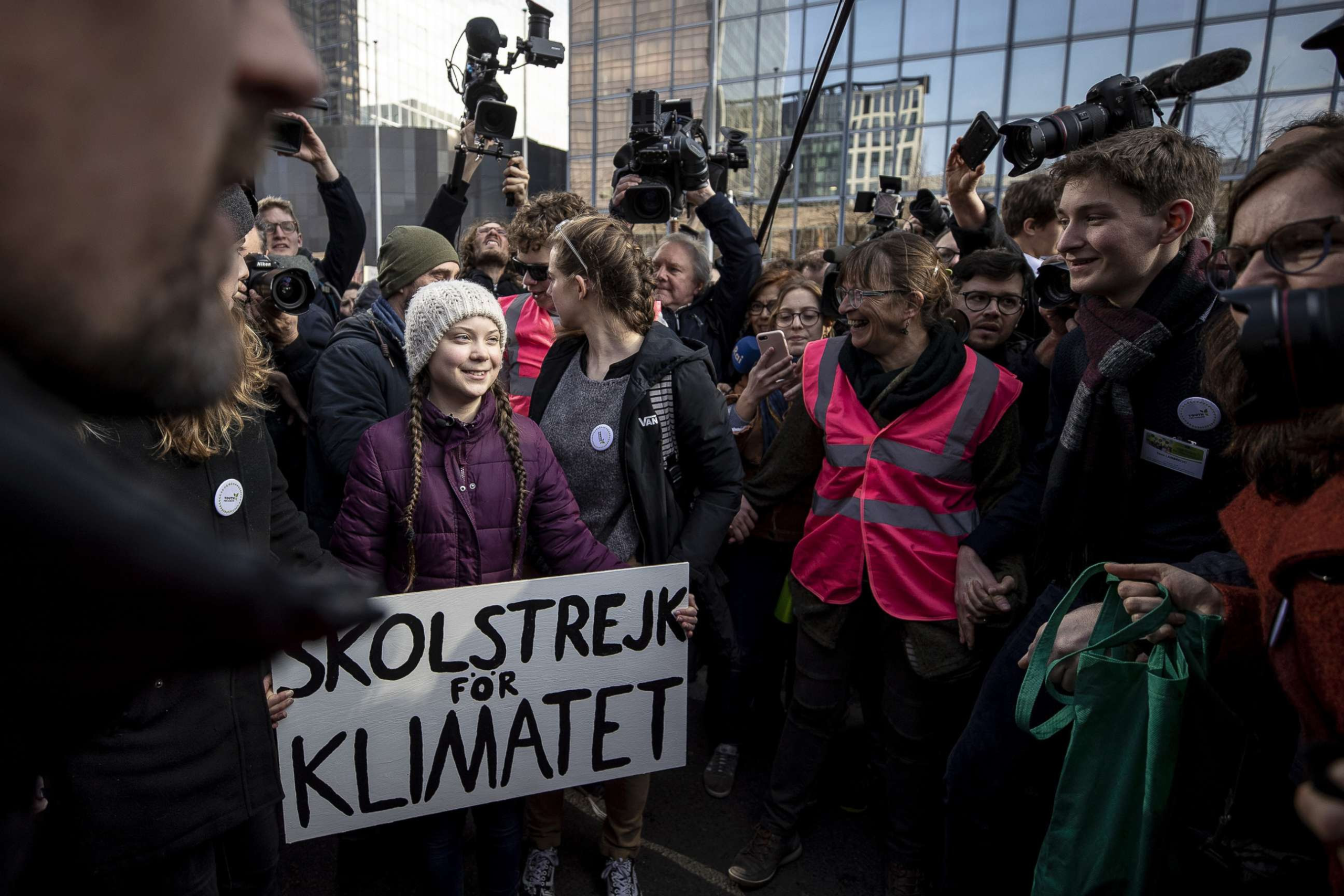
Greta Thunberg, climate activist attends 7th Brussels youth climate march on Feb. 21, 2019 in Brussels, Belgium. Maja Hitij/Getty Images, FILE
Thunberg, who was nominated for a Nobel Peace Prize in March, has vowed the marches will continue until world leaders give serious attention to protecting the environment for future generations.
“Her rise in influence has been really extraordinary,” Felsenthal said Wednesday. “She was a solo protester with a hand-painted sign 14 months ago. She’s now led millions of people around the world, 150 countries, to act on behalf of the planet, and she’s really been a key driver this year taking this issue from backstage to center.”
Felsenthal added that Thunberg “represents a broader generational shift in the culture that we’re seeing from the campuses of Hong Kong to the protests in Chile to Parkland, Florida, where the students marched against gun violence, where young people are demanding change urgently.”
Thunberg has been very vocal about her diagnosis of Asperger’s, a neurological disorder characterized by difficulty with social and communication skills, and has compared it to a superpower, as she believes it’s helped her stay focused on her goals.
As Time announced its distinction, Thunberg was attending U.N. climate talks at the COP25 conference in Madrid.
“Nearly 1 in 5 Cancers Are Found By Accident,” Says Delhi-Based Oncologist | Times Now
Israel: The Prophetic Connection – 03/08/2026 – – Search Videos
The Prophetic Connection with John Tweedie – YouTube