
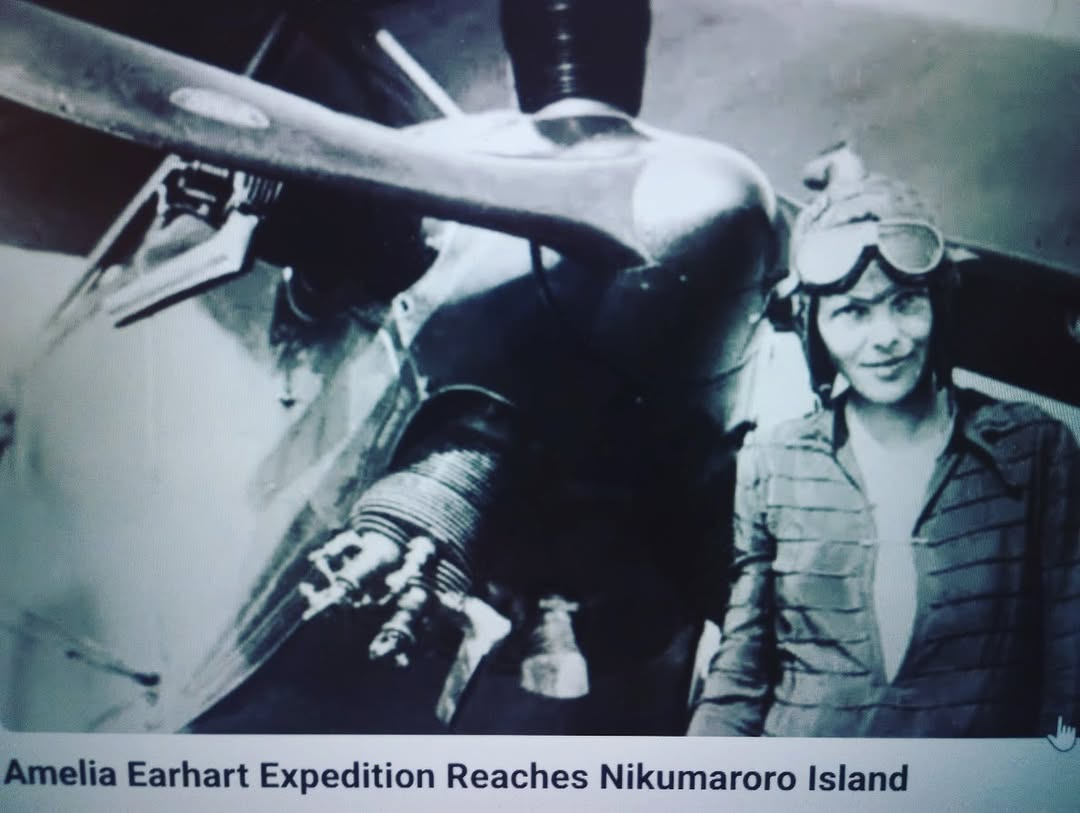
A research team associated with Purdue University, the Archaeological Legacy Institute, and the Purdue Research Foundation departed on October 2 and is expected to reach Nikumaroro by October 12.
Crew searching for Amelia Earhart arrives at crab-infested island
A team from Purdue University is investigating a potential discovery of Amelia Earhart’s plane on Nikumaroro Island. The expedition aims to identify the Taraia Object, a visual anomaly in the lagoon, as the missing aircraft.
A Purdue‑backed expedition has traveled to Nikumaroro Island—home to giant coconut crabs up to one meter across—to investigate a possible underwater object believed to be Amelia Earhart’s missing Lockheed Electra 10‑E, while also preparing for the dangers posed by the island’s large, meat‑eating crabs.
Their mission is to investigate the “Taraia Object,” a submerged anomaly detected by satellite imagery that may be the wreckage of Earhart’s aircraft. 
Findings are expected to be announced by October 16.
The Island and Its Giant Crabs
Nikumaroro, part of the Kiribati Republic, is known for its population of coconut crabs (Birgus latro), described as “bird‑eating behemoths” with leg spans up to one meter and the ability to lift objects as heavy as a 10‑year‑old child. These crabs are known to hunt rats and large birds and pose enough risk that the expedition team plans to leave the island before sundown each day.
Why the Crabs Matter to Earhart Theories
One long‑standing theory suggests that Earhart may have survived a crash landing on Nikumaroro but succumbed to injuries, after which coconut crabs scattered her remains. This idea is supported by anecdotal accounts, biological evidence, and historical reports of bones found on the island in 1940.
Expedition Goals
- Verify whether the Taraia Object is the wreckage of Earhart’s Lockheed Electra 10‑E.
- If confirmed, plan a full archaeological excavation in a future mission.
- Navigate environmental hazards including dense vegetation, rats, and the island’s large predatory crabs.
The expedition reflects ongoing efforts to resolve one of aviation history’s most enduring mysteries. Could a crab (or crabs) be responsible for the ultimate demise of one of the 20th century’s great American heroes?
As researchers make their way to the remote Pacific island of Nikumaroro in search of the famed aviator Amelia Earhart, they’ll contend with thick vegetation, rats and giant meat-eating crabs.
Meat-eating crabs?!
Yes, meat-eating crabs. Nikumaroro, an island that’s controlled by the nation of Kiribati, is home to coconut crabs, a species of arthropod that the London Museum of Natural History calls “bird-eating behemoths” that thrive on “isolated tropical islands.”

A giant coconut crab on Christmas Island in 2022. By JohnKarmouche, Getty Images
“Their leg span is up to a meter,” or more than three feet, the museum says on its website, and the crabs, which can live up to 60 years, “have incredible grip strength and they can lift objects the weight of a 10-year-old child.”
The museum describes the crabs, whose scientific name is Birgus latro, as “absurdly large, land-dwelling, bird-hunting crustaceans.” Once fully grown, they can only live on land, and they’re known to hunt rats and large migratory birds, the museum says.
The Taraia Object expedition, which includes researchers from Indiana-based Purdue University, Purdue’s Archaeological Legacy Institute and the Purdue Research Foundation, departed on Oct. 2 and is expected to reach the island by Oct. 12.
They’re in search of the plane that belonged to Earhart and her navigator, Fred Noonan, who went missing in 1937 as they attempted to be the first people to fly around the world at the Equator. (Purdue produced a podcast series about Earhart and the search for her plane.) A new search: Is it her plane? New Amelia Earhart expedition begins
Photo of pilot Amelia Earhart standing by her plane circa 1935. By Getty Images
While the research team is en route to Nikumaroro, communication is difficult. But one member of the team, Steve Schultz, senior vice president and general counsel at Purdue University, indicated that the team is well aware of the danger they pose, saying in an email through the university, “The coconut crabs are one of the reasons we’re leaving the island every night before sundown.”
Meanwhile, at least one theory has Earhart meeting her demise not in a crash, but instead at the hands, uh, claws of the giant coconut crabs, who have an excellent sense of smell and may have detected a wounded Earhart on the beach after a crash landing.
A 2013 article in Smithsonian Magazine, drawing on a story in Environmental Graffiti (a now-defunct online publication), lays out the long-held, if somewhat gruesome, theory that Earhart and Noonan crash-landed their Lockheed Electra 10-E in a lagoon on Nikumaroro and she survived, but was wounded.
The kaveo or coconut crab isn’t a crab but the biggest arthropod. By Patrick Bouvier, Getty Images/iStockphoto
The theory goes that the crabs, whose huge claws are strong enough to crack coconuts open, were drawn to the smell of blood and descended on the wounded aviator, overtaking her and, well, taking her.
Smithsonian Magazine quotes Environmental Graffiti, which wrote: “In 1940, researchers discovered a fraction of a skeleton on the island that matched the description of Amelia Earhart. Now, even more interesting clues are arising that seem to substantiate the idea that this is where she met her demise. The most compelling hypothesis currently under consideration is that coconut crabs overwhelmed her where she lay.”
In 2007, researchers even tried to test the theory, using a small pig carcass to see how the crabs would react, Environmental Graffiti said; the bones, it continued, were quickly removed and scattered by the crabs.
The search explained: Amelia Earhart vanished in 1937. A new search for her plane has begun.
A giant coconut crab beside a coconut that gives a true idea of its immense size. By JohnKarmouche, Getty Images
Christmas Island, Territory of Australia, October 10th 2022: Christmas Island is an Australian Territory located in the Indian Ocean south of Java.
Perhaps the scariest thing about all of this?
Coconut crabs, according to the London Museum of Natural History, aren’t even the world’s largest crabs. The Japanese spider crab, the Monterey Bay Aquarium says, can be as large as 12 feet from claw to claw.
Here’s a Japanese Spider Crab: The Original Kaiju for those of you like me who wanted to go straight to Google to see one. Crazy looking shit!
Phaedra Trethan is a national correspondent for USA TODAY, writing about history and Americana. Contact her by email at ptrethan@usatoday.com, on X @wordsbyphaedra, on BlueSky @byphaedra, or on Threads @by_phaedra.
This article originally appeared on USA TODAY: Amelia Earhart expedition team heads to island of huge, hunting crabs
I was stationed on Diego Garcia in the Indian Ocean and there were coconut crabs on that island. They’re not a danger unless you fall asleep in the jungle. Their diet consists mainly of: Coconuts – They use their incredibly powerful claws to tear open coconuts and eat the flesh. Fruits – Especially fallen tropical fruits, including figs and pandanus fruit. Nuts and seeds – An important part of their natural diet. Dead animals – They scavenge carcasses, including dead birds, fish, and other crabs. Small animals – Occasionally rats, birds, turtle hatchlings, and other small creatures. Other coconut crabs – They sometimes practice cannibalism.
Coconut crabs are endangered in most inhabited islands that are part of their habitat. They hide from humans. When they are smaller, birds prey on them. They are a delicacy that are often kept for months by some Pacific Islanders as they are fed before being roasted for their wonderfully sweet meat. Has this guy from Purdue actually been to Micronesia before?Reply(4)