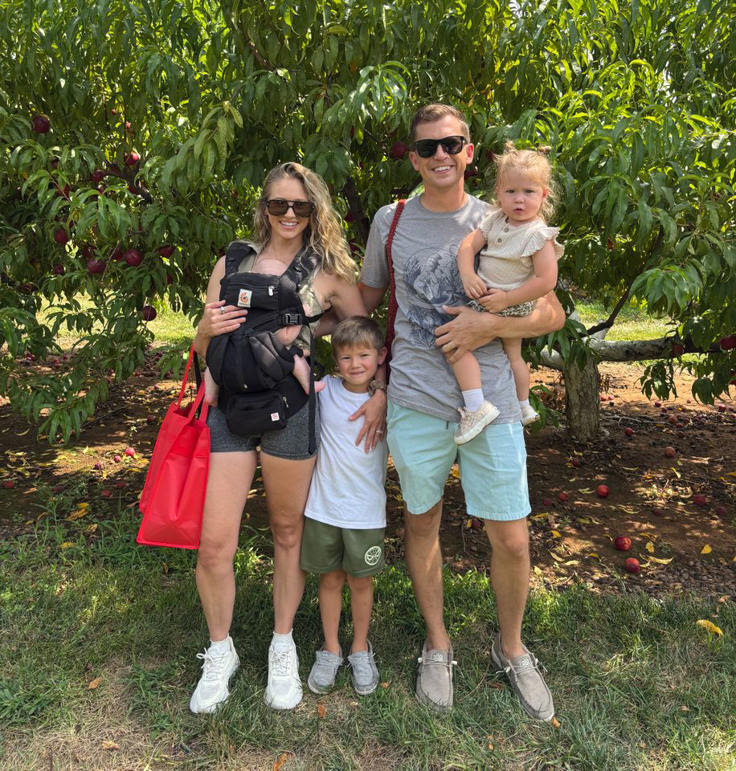
Kelly Spill with husband John Bonito and their three children: Jayce, Mya and Nash on Sept. 23, 2025 Credit: Kelly Spill
Mom’s rectal cancer disappears in 5 months without chemo or surgery thanks to groundbreaking new drug (exclusive)
Story by Wendy Grossman Kantor
The FDA just approved Jemperli for some adults with locally advanced rectal cancer, offering an effective immunotherapy treatment option
Key takeaways
- Targeted Treatment: Jemperli (dostarlimab-gxly) is FDA-approved for adults with locally advanced MSI-H/dMMR rectal cancer, offering a non-surgical, chemo-free option.
- Patient Success Story: Kelly Spill, diagnosed at 28 with stage 3 rectal cancer, saw her tumor completely disappear in 5 months through a Jemperli clinical trial, achieving no evidence of disease.
- Quality of Life Impact: Unlike traditional treatments, Jemperli allows patients to avoid colostomy, radiation side effects, and early menopause, enabling normal life events like having children.
Kelly Spill was 28 when she was diagnosed with stage 3 colon cancer. With an 8-month old baby and a new fiancé, she couldn’t imagine enduring chemo, radiation and surgery. So when biomarker genetic tests showed that she was eligible to participate in a clinical trial for a new treatment, a targeted immunotherapy: Jemperli (dostarlimab-gxly), she jumped at the chance. Five months later, the tumor was completely gone, and she was declared no evidence of disease.
“It can eradicate cancers,” says Dr. Luis Diaz, gastrointestinal medical oncologist at Memorial Sloan Kettering Cancer Center. “It’s leading to cure — not just shrinkage of tumor, not just prolonged life, but cure in these patients where they no longer need chemotherapy, radiation or surgery, and that’s a tremendous impact.”
Traditional treatment for rectal cancers, like Kelly’s, often leave patients with bladder dysfunction, sexual dysfunction, an ostomy bag and in young women’s cases, put them into menopause, according to Diaz. But Spill was able to have two babies after completing treatment. “It never would have happened were it not for this treatment,” says Dr. Andrea Cercek, gastrointestinal medical oncologist at Memorial Sloan Kettering, who treated Spill. “It’s a cure, with a significantly better quality of life.”
In September, Spill hit her five-year cancer-free mark.
On Monday, October 19, the FDA approved this treatment for adults with stage 2 and stage 3 MSI-H/dMMR locally advanced rectal cancer. “This drug was a miracle to my life,” says Kelly Spill, now 34, a stay-at-home mother of three children, Jayce, 7, Mya, 3 and Nash, 1, in Tinton Falls, N.J., and co-founder of Mingling Mamas, a postpartum support group. “Jemperli saved me. It saved my family too.”
She shares her story in her own words with PEOPLE’s Wendy Grossman Kantor.
When I was around eight months pregnant in February 2019, I started seeing blood in my stool. I told my partner, John Bonito and I told my mom. They both said the same thing: Talk to your doctor.
I told my OB about the blood and that I also felt constipated. It was right before I was about to give birth. My doctor’s like, “Things are moving around. This is normal.” I didn’t question it.
My baby boy, Jayce, was born on April 3, 2019. Life was good.
At my six-week postpartum checkup, I told the doctor I was still seeing blood in my stool. My OB said, “Keep an eye on it. I’m 99.9% positive you have internal hemorrhoids.”
I started to not feel well every day. I had abdominal pain in addition to blood in the stool and constipation. I thought, “Something’s not right.” I was taking ibuprofen round the clock.
My primary care doctor did a blood test and another exam and also said it’s probably internal hemorrhoids.
My partner, John Bonito, (now a 38-year-old middle school special education teacher) asked me to marry him in July.

Baby Jayce holds the ring on the day John proposed to Kelly Credit: Kelly Spill
A month later, we moved from San Diego, to Bradley Beach, N.J., to be closer to family, especially my mom, Susan Spill, a retired special education supervisor.
As time went on, my symptoms got worse. By January 2020, I was feeling more pain in my abdomen and more blood in my stool. The constipation was so awful. I couldn’t eat. I started to lose weight. I lost about seven pounds. I already weighed about 115 at the time so it looked like a lot. People were telling me, “You need to eat a cheeseburger.”
One morning I went to the bathroom and it looked like I had my period and it wasn’t. That’s when I was very concerned.
I went to a family clinic that took my limited insurance. Again, I was told it might be internal hemorrhoids. It made me feel crazy. A nurse I met there told me, “If you don’t find your answer here, keep searching because you know your body best. Nobody knows your body like you.”
I will remember that for the rest of my life. My mom looked at me and I was like, “We need to figure this out.” The next day I had the same episode where it was like I had my period and that’s when we really knew it was serious.
I finally had a colonoscopy on January 17, 2020.
That’s when they found the tumor. I was 28 years old. I was engaged to be married. Our son was 8 months old.
The doctor couldn’t determine if it was cancer until he sent it to pathology. But I knew it was something bad. I went out in the parking lot with my mom and I just lost it. I started crying.
Two weeks later, my mom and I were at Walmart when I got the call that it was cancerous. I’m thinking, “Am I going to die?”
My mom is a saint. I don’t know how anybody goes through any type of cancer not having someone next to them listening, writing things down. It’s so much information. It’s a lot of big words, and you’re so sick and scared and you don’t even know what’s going on. Having her by my side was a blessing. She helped me me figure out the next steps.
John and I got married right away so I could be on his health insurance for treatment. We got married January 27, 2020.

Kelly Spill and John Bonito on their wedding day, January 2020 Credit: Kelly Spill
On my wedding day, I walked down the stairs thinking that I was going to pass out, I felt so sick. We tied the knot and then came right back home.
My first appointment at Memorial Sloan Kettering Cancer Center in New York was in February 2020. They told me I had stage 3 rectal cancer. They said the treatment plan would be chemotherapy and then radiation and oral chemotherapy. After that, surgery.
The doctor said I would most likely have a colostomy bag for the rest of my life. But the other news was worse: “After the radiation, after surgery, you most likely will never be able to carry another child again.”
That’s when I broke. I started hysterically crying, and that’s when it hit: This is really happening to me.
I was in my own sorrow.
Before starting chemo, we did go through IVF and we created and froze four embryos, two boys and two girls. That actually was the most painful process of my journey because I had the tumor sitting right there, a centimeter from my anal opening, and then I’m growing all these eggs and it was extremely painful.

Kelly Spill at the beach with her son, Jayce, July 30, 2020, covering her treatment port. Credit: Kelly Spill
The first week of March we had an appointment at MSK to set the chemo appointment and chat with the doctors about the treatment plan.
Thankfully, a research nurse told me about an opportunity for a different treatment plan. She told me that I had the biomarker for a clinical trial for a new type of immunotherapy called Jemperli. Only three people prior to me have been on the medication. I’d be the fourth patient in the country. I said, “Okay, I’ll try it.” I thought to myself, “What do I have to lose?” If it doesn’t work, we’ll just go back to treatment A.”
My first treatment was the third week of March 2020. I had an infusion every three weeks for 30 minutes, and by the second infusion, I had already started to feel better.
It’s kind of gross to tell, but I always feel like it’s important: I went to the bathroom a few hours after the second treatment — and I was actually able to go — I was actually concerned because of how much I had to go.
I told my doctor’s and they said, “That’s a great sign. It means your tumor’s shrinking.”
I started feeling better. I was tired, but it could have just been motherhood. I didn’t feel any serious side effects from this treatment.

Kelly Spill with her husband John Bonito and three kids December 14, 2025 Credit: Kelly Spill
By my fourth treatment, we found out that my tumor had shrank 50 percent, which was a miracle. When we heard that news, I looked at my mom, she looked me, I’m like, “Oh my God, this is amazing.” I’m also thinking, “Maybe I can have another baby.” That was always on my mind.
Leaving that appointment, a nurse pulled my mom aside and said, “The three people ahead of Kelly, they did not have to go through any radiation or chemo, their tumor just completely disappeared.”
My mom told me, she was thinking, “Do I tell my daughter this? Do I get our hopes up? What do I do?”
She told me. I was like, “Oh my God, what?” I started crying. I had hope.
We both said, “We’re not going to tell anybody. We don’t want to jinx it.”
Of course, we went home and we told everybody.
By my ninth treatment, my tumor had completely disappeared. I was declared no evidence of disease on August 19, 2020. It had only been five months.

Kelly Spill on Sept. 17, 2021 Credit: Kelly Spill
I look at my husband, he looks at me, I’m like, “This is a miracle.” And I’m thinking, “Can I have a baby?” My oncologist recommended waiting at least two years, because if the cancer’s going to come back it’s mostly likely going to come back within two years.
I thought being in survivorship would be a breeze. I thought that it’s like butterflies and rainbows, but it couldn’t be any further from that. I was having panic attacks and anxiety attacks, and I didn’t know why. I felt so lost. I didn’t know who I was at this point.
In the summer of 2021, my husband and I took my parents’ RV and we drove cross country hitting 15 national parks. We called it our elope-cation. We were already legally married, but we eloped in the rainforest in Olympic National Parks. My parents watched our little boy during that time for a month, which is crazy, and we were able to get away and just reconnect.
It was just beyond beautiful.

John Bonito, Kelly Spill, Jayce and Mya on Oct. 9, 2023 Credit: Kelly Spill
My husband saved my life too. Our relationship was very fast. We met, we got pregnant, I had cancer, and then I begged him to marry me because I needed health insurance. He wanted to do all those things. He completely saved me. He’s such a beautiful soul and he stuck by my side from day one. He hasn’t left. He’s amazing.
After two years, I got the green light from my oncologist so we could start the process of having a baby. We used one of our frozen embryos, and we were able to choose baby girl. I found out that I was pregnant November 11th, 2022. Our daughter Mya was born on July 14, 2023.
I was declared five-years cancer free in September 2025. At the time, I was 33 and pregnant with our third child.

Kelly Spill and husband and children, pregnant with her third child, in April 2025 Credit: Kelly Spill
Going through cancer completely changed my perspective on life and the way that I see this world now. It’s important for people to share their stories. I share mine on Instagram and Stand up to Cancer. It’s important for people to self-advocate and to remember that even though you’re going to a doctor and you’re asking them questions, you still have to do your own homework. You to know your body. Trust your gut.
I do like to push for colonoscopies at young age. If you’re feeling any symptoms, if you even think something might be going on, get a colonoscopy. It’s not scary. It’s okay. It could be a scarier situation if you wait. Get checked.

Kelly Spill and her husband John Bonito and three children: Jayce, Mya and Nash in September 2026 Credit: Kelly Spill
I know how much this new treatment could save somebody. The only catch is that their tumor has to test positive for a certain mutation called MMRD, and if they don’t test for that, they can’t go on this drug. But if they do test for it, they can go on this drug and they can have a majorly different outcome than going through chemotherapy, radiation, and surgery.
I am very lucky.
Read the original article on People