
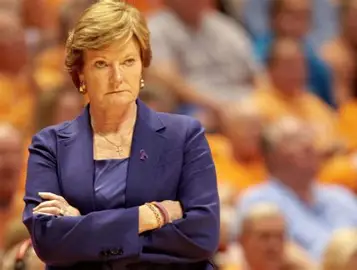
The cold stare she directed at her players with her steely blue eyes, especially those who didn’t play well. At the officials who dared to make a bad call.
The fiery competitiveness. And, most of all, a winning attitude.
All of these traits describe the one and only Pat Summitt, the legendary Tennessee women’s basketball coach, who led the Lady Volunteers to eight national championships and set a standard in the sport long before anyone had heard of Geno Auriemma. “I didn’t want to be bigger than Tennessee. While continuing to work was good for me, the Lady Vols weren’t my personal health clinic.”
Like many documentaries about notable subjects, this one begins with a look at the early life of Summitt — born Patricia Susan Head. She went from working hard on a Tennessee dairy farm to the hardwood at UT Martin, then to Knoxville and the University of Tennessee, where she became a head coach at age 22.
And, like many documentaries, especially given the magnitude and impact Summitt had on and off the court, this one feels incomplete, though it is an enjoyable watch, filled with laughs and heartbreak, especially in the last 30 minutes of the film. Roberts mentioned before a screening of the film that the project “was 10 years in the making,” but it actually took about 18 months to produce.
The filmmakers make the decisions on what to include, who to interview, and the runtime, but at a brisk 83 minutes, “Breaking Glass” hardly gives Summitt’s life the scope and depth it deserves.
Of course, Summitt’s life and career have been the subject of many documentaries, including “Pat XO” in 2013 by Lisa Lax and Nancy Stern Winters, which was part of ESPN’s Nine for IX series.
One thing that could have used a deeper dive: the rivalry between UConn and Tennessee that started in the mid-1990s, which can arguably be seen as the moment when women’s college basketball became a fixture in the sports world. The story is told in such a way that it’s hardly surprising that Auriemma wasn’t interviewed for the film and is only shown through archival footage. But that rivalry alone could fill 83 minutes and fully explain why women’s basketball is at its peak popularity today.
Summitt was known as being a stickler for detail, and those who ran afoul of that philosophy felt her wrath more times than not.
One player highlighted in the film was Abby Conklin, who played for the Lady Vols from 1993 to 1997 and was part of two championship teams. Summitt is seen not only giving Conklin tough love but also encouraging her, and the dynamics of that relationship could be another telling point in how special a person Summitt was. Although spending considerable time on her via the storytelling, Conklin was not interviewed in the film.
The film’s bright spot is highlighting Summitt’s well-documented accomplishments over 38 seasons ruling Rocky Top, making the college basketball world take notice — from serving as co-captain and winning a silver medal with the U.S. Olympic team at the 1976 Montreal Olympics, to eight years later winning gold as the coach at the Los Angeles Games.
But Summitt’s biggest impact was who she impacted: her players, with every one of her 161 players in her tenure graduating, and her family’s continued support of the Pat Summitt Foundation, which is raising money to help expand Alzheimer’s services and research.
This article originally appeared on USA TODAY: New Pat Summitt documentary is a very enjoyable watch, but incomplete
A look at Pat Summitt’s remarkable life beyond basketball | Watch
A new Hulu documentary spotlights Hall of Fame coach Pat Summitt this month. Summitt led the University of Tennessee Lady Vols from 1974 to 2012. She became the first National Collegiate Athletic Association coach to reach 1,000 wins, finishing with 1,098 and eight National Collegiate Athletic Association championships. She also coached the United States women’s Olympic basketball team to gold in 1984. Off the court, she married Ross Barnes “R.B.” Summitt in 1980; their divorce was finalized in 2008, and they had a son, Tyler, in 1990. Summitt died in 2016 from Alzheimer’s at age 64, after creating the Pat Summitt Foundation to help find a cure.
Remembering Pat Summitt: Singular Presence, Transformative Coach
Pat Summitt’s Life Beyond Basketball — New Hulu Documentary
A new Hulu Original, “Breaking Glass: The Pat Summitt Story,” offers a rare, intimate look at the Hall of Fame coach’s life beyond the basketball court 

The film is an 82‑minute documentary (1h 22m) released on March 25, 2026.
It highlights Pat Summitt’s groundbreaking career, her leadership philosophy, and her impact on women’s college basketball. 
Content & Themes
The documentary covers:
Summitt’s rise from a Tennessee dairy farm to becoming an eight‑time NCAA champion.
Her record 1,098 career wins and zero losing seasons.
Her “Definite Dozen” leadership principles.Rare archival footage provided by her son, Tyler Summitt.
Interviews with major sports figures including Dawn Staley, Billie Jean King, Tamika Catchings, and Peyton Manning. 
Production
Director: Dawn PorterExecutive Producer: Robin Roberts
Produced by: Rock’n Robin Productions, Trilogy Films, Tribeca Studios
This documentary serves as a comprehensive portrait of Pat Summitt’s legacy and her transformative influence on women’s sports.
Beyond the Winning Streak
While Summitt’s 1,098‑win career and eight NCAA titles remain central, the documentary also highlights:
- Personal life: Her marriage to R.B. Summitt (1980–2008), the birth of her son Tyler in 1990, and his later coaching career
- Adversity: Her public battle with early‑onset Alzheimer’s disease, a rare and courageous step that drew national attention. She continued coaching into her final season despite the diagnosis, sweeping floors, taping ankles, and driving the team van — actions that became part of her legacy
WBIR.com+1.
- Impact on others: Summitt’s influence on players, staff, and the sport itself, including her openness with media and her dedication to people around her
How the Film Is Told
Executive Director Morgan Vance of the Pat Summitt Foundation says the doc is “really Pat’s story but from her own words,” relying on archival footage and interviews that have never been released before
In short: Breaking Glass is both a celebration of Summitt’s historic athletic career and a deeply personal portrait of the woman behind it — showing how she navigated victory, family, and illness, leaving a legacy that inspired women and athletes worldwide
The documentary follows Summitt’s childhood to becoming one of the most successful coaches in the sport, while also highlighting her battle with early-onset Alzheimer’s disease.
“It’s really Pat’s story but from her own words, her voice,” said Morgan Vance, Executive Director at the Pat Summitt Foundation. “We’re so excited to introduce this kind of side of Pat that probably not a lot of people have seen.”
Vance said the film leans heavily on home videos and interviews that have never been released, allowing Summitt to tell her story in her own words.
“It’s a lot of home videos, interviews that people haven’t seen before, so it’s really Pat getting to tell her story.”
The documentary also revisits one of the most difficult chapters of Summitt’s life, her Alzheimer’s diagnosis, and how she chose to face it publicly.
“To get to see someone of such a prominent figure go through it and very boldly go through it and publicly go through it…I hope that it opens a lot of doors,” Vance said.
Beyond basketball, Vance said the film highlights Summitt’s impact on the people around her and the way she handled adversity.
“What I hope they see is how she never backed down in the face of adversity, how she always had a goal that she was working towards and just how much she cared about other people.”
Longtime sports writer Maria Cornelius said she remembers just how unprecedented Summitt’s career and final seasons were.
“Throughout that entire season, you are aware that this is a historic event that a coach would get diagnosed with Alzheimer’s and continue to coach another season.”
Cornelius said Summitt not only embraced the spotlight but also used it to grow the game.
“She courted the media. She wanted the media in her practices and covering her program.”
Her legacy, Cornelius said, is unmatched.
“That’s why I call it unprecedented. There will not be another situation again that follows what she did, where I mean she swept the floors, she taped the ankles, she drove the team van.”
“She paved the way for so many people and you realize that every time you walk in that arena and you look up,” she added.
Nearly a decade after her death, those closest to her say it’s critical to continue telling her story.
“It is very important that we never lose sight of who she was and what she did because she is Lady Vol’s basketball, and she always will be,” Cornelius said.
Pat Summitt’s son, Tyler Summitt, said he is grateful to the production teams behind the project, including Robin Roberts, a close family friend and producer on the film.
“I am grateful to Rock’n Robin Productions, Tribeca Studios, and Trilogy Films for making this happen. Robin was one of my mom’s closest friends, and there is nobody my family trusts more to lead this project. I know everyone will love the never-seen-before footage of my mom and I’m excited to hear what everyone thinks!”
Pat Summitt’s death
Summitt died in 2016 from Alzheimer’s. She was 64 years old. Prior to her passing, she created the Pat Summitt Foundation to help find a cure for the disease. She also continued coaching for a little while, despite her initial diagnosis.
“Numbers have a strange slipperiness for me, a lack of specificity; they suggest nothing,” Summitt wrote in her 2013, memoir Sum It Up. “If you ask me how many games we won in 1998, or what happened in the 2008 national championship game, I struggle to remember which one it was. But if you tell me who was on the team—if you prompt me with names rather than numbers…they bring it all back. Show me a picture of a former player, frozen in an old team photo, and I remember her.”
Summitt, the Hall of Famer who died at the age of 64 in 2016 after a battle with early-onset Alzheimer’s, is the subject of a new documentary directed by Dawn Porter (winner of the 2025 Emmy Award for Best Documentary for “The Sing Sing Chronicles”), and executive produced by “Good Morning America” co-anchor Robin Roberts.

Pat Summitt during a 2008 game.© Brendan Maloney, US PRESSWIRE
Pat Summitt: The Standard — The Greatest Coach Women’s Basketball Has Ever Seen
More: Robin Roberts explains the making of new Hulu film on Pat Summitt
“Breaking Glass: The Pat Summitt Story” features interviews with her closest confidants, including coaches, former players, her son, and ex-husband, and incorporates Summitt’s own voice from unheard audio from interviews with former Washington Post columnist Sally Jenkins.
Pat Summitt never wandered too far from the Tennessee hay fields where she grew up doing her chores. The winningest Division 1 college basketball coach of all-time, with 1,098 victories and eight national titles over an incredible 38-year career at the University of Tennessee, was honest, accessible, and always put in the work. In a profession full of hucksters, Summitt, who died on Tuesday at 64 after battling early onset dementia, Alzheimer’s type, was the real deal. All of Summitt’s players who completed their basketball eligibility graduated. It could have always been about her. She was that good, that influential. But she never lost her curiosity about, and care for, others. No college coach was as important, or as transformative, as Pat Summitt.
When she first started coaching at Tennessee, a couple of years after Title IX was enacted in 1972, Summitt drove the van. Her team once slept in another team’s gym instead of actually splurging for a hotel room. As a fundraiser to pay for uniforms, she once held a doughnut sale.
By the time Summitt was done in 2012, the women’s Final Four became a nationally televised spectacle that filled NBA arenas. Summitt’s sideline intensity, and the ferocity and skill of her gifted teams, attracted fans and won her widespread respect. By simply going about her business, Summitt—the first women’s basketball coach to make $1 million a year—showcased the best of women’s sports. Her teams proved that women’s basketball should share an ESPN stage with the men.
This visibility has inspired legions of girls to pick up a basketball, or a soccer ball or some other sport. In 1972, fewer than 300,000 girls participated in high school sports. When Summitt left the sidelines 40 years later, there were more than 3 million. “She paved the way,” Kim Mulkey, head women’s basketball coach at Baylor University, told ESPN Tuesday morning. “We have the salaries we have today because of Pat Summitt, we have the exposure we have today because of Pat Summitt.
She wasn’t afraid to fight.”
Her fight continued after she announced, in 2011, her diagnosis of early onset dementia. She coached one more season and started the Pat Summitt Foundation to raise research money for Alzheimer’s. “Put away your hankies,” Summitt wrote in a letter posted on the foundation’s website. “There’s not going to be any pity party. We’re going to fight, and we’re going to fight publicly.” In January 2015, Summitt’s foundation and University of Tennessee Medical Center announced a partnership to launch The Pat Summitt Alzheimer’s Clinic. The clinic is scheduled to open in December.
In 2012, President Obama awarded Summitt the Presidential Medal of Freedom, the highest civilian honor for an American. “Coach Summitt is an inspiration—both as the all-time winningest NCAA coach, and as someone who is willing to speak so openly and courageously about her battle with Alzheimer’s,” Obama said. “Pat’s gift has always been her ability to push those around her to new heights, and over the last 38 years, her unique approach has resulted in both unparalleled success on the court and unrivaled loyalty from those who know her and those whose lives she has touched. Pat’s coaching career may be over, but I’m confident that her work is far from finished.”
Pioneer, hoops junkie, millionaire coach unafraid to don a cheerleading outfit and start singing “Rocky Top,” Tennessee’s unofficial fight song, in front of thousands at a Tennessee men’s home game, or at a bar spending time with close friends. She was a singular presence; it’s hard to overstate Summitt’s impact.
“In modern history, there are four figures that belong on the Mount Rushmore of women’s sports—
Billie Jean King, Babe Didrikson Zaharias. Pat Summit and Mikaela Shiffrin
Inside Breaking Glass: The Pat Summitt Story, with award-winning director Dawn Porter
Everything Kim Caldwell said after Tennessee’s season opener vs. Duquesne
Pat Summitt Dies After Battling Early Alzheimer’s
Remembering the Legend: The Legacy of Pat Summitt