After CBS News report on rare eye cancer mystery, hundreds share similar stories.
Ashley McCrary – Living with Ocular Melanoma
Ashley is a member of the Auburn cluster & a huge advocate for ocular melanoma & research for years!
Here’s a little snippet of her story:
“I was first diagnosed when I was 42 years old. It was 2012 & I lived in Memphis, TN with my husband & 4 children, the youngest was 7.
I had gone to the beach with family friends. My friend Jill asked me about a black spot on my eye. I hadn’t noticed it. I went into the bathroom & to my dismay there was an irregular black spot on my iris. I showed my husband, whose nickname for me was “Sweet eyes” & he had not noticed it either. I am ashamed to admit I went home & did nothing for about a month. I googled “change in iris color,” but nothing alarming came up.
A month later, on my daughter’s birthday, my husband & I were invited to a dinner party—which we only attended since our daughter was spending time with a friend.
My husband was the administrator for an oncology group in Memphis and the dinner party was at one of the doctor’s house. While there, a friend asked me about the black spot. She had her husband look at it & he strongly suggested I see a doctor as soon as possible.
On Monday I made an appointment with a local Ophthalmologist, but being a new patient it was going to be three weeks till I could get in to see the doctor. I can not believe I am admitting this but I had never had an eye exam except during elementary school. The only “symptoms” I was having was occasional blurriness.
While running errands I saw a large sign outside a “Visionworks” that read, “FREE EYE EXAM” so I walked in & asked for an eye exam. The beautiful young Optometrist did her exam & recommended eye glasses. When she completed the exam I asked her, “What do you think about the black spot on my eye?” She sat back & said, “You do have a black spot on your eye. Let me make a phone call.” She said I needed a dilated eye exam & she got me into Dr. Mathews who was a local Ophthalmologist…& so my story really begins!”
- Man Dies of Bird Flu Strain Never Before Found in a Human
- Democrats Put GOP on the Record on Contraception
- Gene Therapy Offers ‘Astounding’ Results in Deaf Kids
- Texas Democratic Rep Has Pancreatic Cancer
- Cancer Is Causing ‘Financial Toxicity’ in US
Rare Eye Cancer Strikes Dozens in 2 Areas
It’s not yet clear what is causing the apparent clusters of ocular melanoma
After noticing black spots in her iris, Ashley McCrary was diagnosed with ocular melanoma. “I was like, ‘Well, I know two people who’ve had this cancer,'” McCrary tells CBS News. To say that’s unlikely is an understatement: Between five and six out of every one million people are diagnosed with the rare eye cancer, yet two of McCrary’s friends also had it; the three attended Auburn University in Alabama together.
Another Auburn alum was also diagnosed; the women started a Facebook page to look for other alums dealing with the same cancer—and 36 people have gotten in touch so far, McCrary tells CBS. According to the page, most of those affected attended Auburn between 1983 and 2001. Last month, WLTZ reported that at least 31 people who attended or worked at the university from 1980 to the early 1990s have been diagnosed with ocular melanoma. Earlier this month, Healthline put the number diagnosed in the area at 33.
Similarly, a number of people in the Huntersville, North Carolina, area have also been diagnosed with ocular melanoma, also known as uveal melanoma. CBS puts the number at 18, while WFAE reports that 23 people who lived, worked, or spent significant time in Mecklenburg County since 2000 have been diagnosed with the disease.
Many of the patients in both areas are young women, Newsweek reports, despite the fact that the disease is typically more common in older people and men. Officials have so far been unable to determine what might be causing the apparent clusters of cases (though the Alabama Department of Health’s official stance is that “it would be premature to determine that a cancer cluster exists in the area”), but doctors in Philadelphia are studying the patients, some of whom travel there for treatment in a clinical trial. Doctors at Columbia University are also studying the tumors of diagnosed patients, and Auburn University has put together a committee to investigate. (More cancer stories.)
She gives hope to cancer patients Ashley McCrary – Search Videos (bing.com)
Ashley McCrary | Patient | Ocular Melanoma
Interviewed on May 12, 2023
“I hadn’t been to the eye doctor since probably elementary school. Before my diagnosis, I had a little bit of blurry vision looking at a computer screen, but it was minimal. I didn’t think anything of it. But one night in 2012, we were out to dinner with colleagues from my husband’s oncology group, and one of the wives noticed a black spot on my iris. Her husband, who is a doctor, took a look at it. He wasn’t alarmed, but said I needed to have it looked at. So I did.

Soon after, I saw an optometrist, who sent me to an ophthalmologist, who sent me to an ocular oncologist. I didn’t even know ocular oncologists existed. We found out I had ocular melanoma, also known as uveal melanoma (UM), in my right eye. So, I had my eye surgically removed. Prior to the surgery, I was told that we were just gonna keep an eye on it (no pun intended).
But the cancer ended up being more serious than we originally thought. After genetic testing, which was fairly new at the time, we learned that the type of UM I had was very likely to come back. I was put on surveillance, with scans every four to six months. Honestly, I felt like I was just going to be that one person where the statistics worked in my favor. And for eight years, my scans were clear.

Things quickly went from being totally fine to not fine
Fast forward to October 2020. Shortly after moving to Auburn with my family, my doctor called and said I needed to come in to talk about my recent scans. They told me I needed to bring my husband Dave with me. I texted my friend, Marlena Orloff, a doctor in Philadelphia I had met through UM research in years prior, and I said “I think we’re getting some bad news. They told me to bring Dave today, and that hasn’t happened before.” Things quickly went from being totally fine to not fine.
During the appointment, the doctor showed me an image of my liver. It was black with white dots all over. We called it starry night, as if we were looking up at the night’s sky and seeing the stars. Except the stars were 100 tumors. We knew then that my cancer had metastasized, and that nowhere in Alabama offered the treatment I would need.
The places you’d go would of course be Thomas Jefferson, Columbia, Sloan Kettering, Duke, MD Anderson, & UCLA. So, I was really lucky that I already had a relationship with the doctors in Philadelphia. Within a week we had a plan. Everything happened so fast. This isn’t the typical scenario. Usually it takes 6 to 8 weeks to get an appointment, and then another 3-4 weeks to figure out your treatment. I was very fortunate.

The doctors in Philadelphia did a biopsy and looked for genetic markers. Not all doctors would have known to look for those markers – they were just buzzwords for most at the time – so again, I was very lucky. They found I had two markers indicative of aggressive cancer. I started with Immunoembolization (IE) for 8 months, and was also moved to the top of the clinical trial list.
That way, I had time during my initial treatment to learn about the clinical trial, ask questions, process it, and be ready to make a quick decision if IE didn’t work. And sure enough, in May, we found “innumerable new tumors.”
Normally when you’re diagnosed with metastatic disease, you have about a year, year and a half to live. And since my cancer is so rare (6 out of 1 million people are diagnosed per year), there aren’t many treatment options. So the idea of being on a clinical trial that could potentially work – and was working – was very, very encouraging. I was ready to sign the papers.
But Dave was more hesitant. He said, “Wait a minute. The second person died in this trial. Can we talk about that? You’re going to be a human experiment. You know that, right?” He was hopeful for a more conservative approach. But I was ready to go. We had read the material in advance. We were prepared. But when it came down to signing the paper, his hand was trembling. It’s hard. He’s really just a beautiful soul.

To Dave’s point, in the early days of the trial before I joined, the first participant responded really well. Her name was Summer. She was in her mid 20s and was a friend of mine. But the second person, she was in her 70s, and after taking her first dose, she died the next day. So, they had to stop the trial and figure out what happened. This meant that Summer’s treatment stopped.
Unfortunately, she had no other options, and so she passed away. That was really hard. It turns out that the older woman died from a heart attack. She had comorbidities that she was unaware of. I was fortunate, because by the time I was ready to join the trial, they had already restarted it. 15 people were on it and were doing really well. So that made the decision easier for me.
I’ve never experienced pain like that in my life
I arrived for my first day of treatment in Philadelphia on a beautiful day in July. I was in a cute sundress. Normally you have to change into a gown and lay in the bed and get your treatment. They told me I didn’t need to change my clothes, I could just hang out. I had friends who came by to cheer me up.
So I was in my cute dress, with my cute friends, and my cute husband. I tell you this because it just felt very relaxed and casual. There was not a whole lot of stress about it. The doctors came in and gave me the infusion, and still within two hours I was feeling great.
During this time, a friend of mine took a picture with me, and I have a smile on my face. But within minutes of that picture, I went from 0 to 500 pain. I’ve never experienced pain like that in my life, and I’ve had four children. It scared everybody. Emergency teams were coming in.
I couldn’t lay in bed or sit up. I knelt on the ground with part of my body on the bed, in my cute sundress. My husband was trying to rub my back because that’s where the pain was so bad. The doctor came in and said the only reason my back would be hurting that bad was if the treatment was attacking a tumor in my back or kidneys (we found out later it wasn’t a tumor, it was just a painful response to treatment that only happened the first time). He was completely perplexed as to why I was in so much pain. It was very scary.
It felt like five years of intense pain before I got morphine. Four hours later, the real symptoms kicked in: fever, shakiness, joint and back pain, and a dip in blood pressure. This would eventually happen like clockwork every time for 6-12 weeks. I got pre-drugs moving forward. Once I got through the initial dose escalations, it became an outpatient infusion. So I fly to Philly once a week for my infusions and stay in a hotel with a plethora of medicine with me, since I know what to expect with side-effects. I’ve now done this 94 weeks in a row.
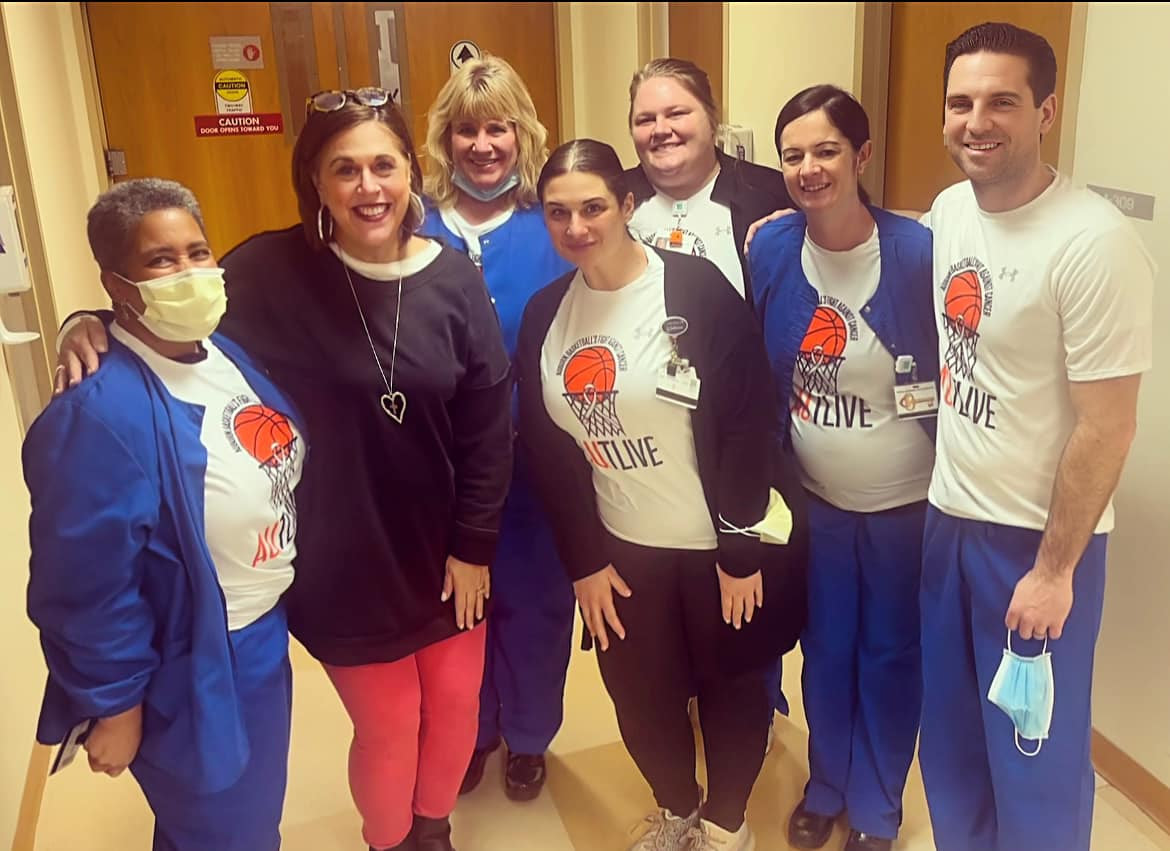
My results have been shared all over the world
Other people have responded well to treatment, but I had a miraculous response over a period of time. I went from over 100 tumors down to 10. And then from 10 down to six. Two of my target tumors had shrunk 50% in size. My results have been shared all over the world.
Eventually, though, we found that one rogue tumor had grown, and it’s not easy to get approval to stay on a trial if your disease progresses. The trial sponsor didn’t want me to continue with it, but my doctor really pushed for it, because they knew the treatment was working for all the other tumors. It was just that rogue one, which they could treat with radiation.
So I got permission to stay on the trial for five more weeks, but my latest scans have shown that more tumors have started growing again and I have a growing tumor in my lung.
So, I’m at a pivotal point now. I’m in my third week of being treated beyond progression. My scans are on May 31st, and we’re supposed to come up with a Plan B, because I may not be approved for the trial anymore.
There were 16 people in the trial to start. Now there’s only seven. Some people had disease progression and passed away, some had trial burnout. Some couldn’t afford it. There are only a few places in the US you can go for treatment. There’s just not a whole lot of people who can do this once a week, every week, for the rest of their lives. To fly there every week, stay at a hotel, get Ubers, meet with the nurse practitioner…it’s very expensive. There’s a lot the trial will pay for, but it doesn’t cover everything and they don’t pay for someone to come with you.
I kind of have what they call survivor’s guilt
My situation is extremely uncommon. I’m a unicorn when you consider I don’t have a financial burden in all of this. Through a divine encounter at work, I met representatives from Aflac and ultimately learned I qualified for their cancer plan. So, Aflac really bridges the gap in terms of what the Sponsor pays and what I have to pay out of pocket.
Aflac even covers for a person to go with me to Philadelphia every week. I wouldn’t be able to do it without them. But no one else on the trial has a cancer plan like I do.
So I’ve seen financially how people have had to drop off the trial because they just couldn’t afford it anymore. I’ve seen where people used to have someone come with them but can’t anymore because it’s too expensive.
So, they don’t have a secondary person to be there if anything bad happens. It would be scary to navigate that alone. I kind of have what they call survivor’s guilt. I see people who follow the typical statistics and pass away WAY too young because they just don’t have options.
There are people who would give anything to be on the trial I’m on, but the trial’s not accepting any more UM patients right now. Part of that is because the drug they’re testing (Prame) is working on other cancers as well, and since another treatment for UM was recently FDA approved [Kimmtrak], they closed the trial to UM patients. I’m just lucky I have options.
Before my diagnosis, I learned some tough lessons from friends who had passed away
One of them was such an optimist. Even when the doctors were telling her she had two weeks to live, she was still optimistic. The doctor encouraged her to tell her children about her prognosis, but she didn’t. So, things were left unsaid. They never talked about her funeral. It was very hard on her husband.
My other friend had a lot of unresolved relationships. Pain and regrets and people who needed to be forgiven. So, when I was diagnosed, a light switch went off. I wrote each of my four children a letter…you know, just things you want to say. I had people in my life I needed to forgive, and others from whom I needed forgiveness.
I wanted to handle it all the right way. My husband gave me perspective though. He reminded me frequently, you’re not dead yet, be thankful for today and LIVE! He was right, but I wanted everyone to be keenly aware of my prognosis.
My whole attitude has been, if this is happening, it’s for a reason. I knew God had a plan and purpose for my life. So instead of feeling sorry for myself or crawling in a hole, I look at everything as an opportunity and think, how can I use this to make a positive impact?
How can I live this out with grace?
I just look for opportunities in every single detail of every single day. I see the same servers at every single restaurant I go to when I’m in Philadelphia. I have the same Uber driver who takes me to the airport each week. His name is Geurino. He’s from Haiti. And he sometimes impacts me more than my doctors do.
The way he prays for me and the way he just speaks over my life is very tender and endearing. And the people who go with me to Philadelphia…there’ve been a lot of them. They see what I see, are impacted by it, and then they come back and use it to impact other people. It’s just this whole butterfly effect.
They also see the reality that it is okay to not be okay all the time.
This situation can be very heavy. People will ask where I get my strength from. I always say my strength comes from God; I could not do it without Him. All I can try to do with this cancer is look for opportunities to be positive, to be optimistic but not naive, to be real, to be transparent.

.jpg)
It’s important to have levity and laughter
My birthday is this week. Mother’s day is this week. All of my children and my daughter-in-law are coming to town, which doesn’t happen often. I didn’t ask for it, it was planned behind the scenes because they all understand that this might be a tricky year. We also have a big trip planned this summer. We don’t do stuff like that. So there’s a heaviness to it. We’re just trying to enjoy each day. We’re not suppressing it – we all have addressed what’s happening – but there’s a Southern saying: “don’t borrow worry.” We don’t know what’s going to happen later. I mean, I could live to be a hundred. Who knows. I don’t want to go into it thinking this will be my last Mother’s Day, because I want to be happy. But it’s all still very sobering.
It’s important to have levity and laughter. Dave provides that for me. The world sees him as an introvert…quiet and stoic. But he’s not that way with me. As recent as two years ago, we would go on dates once a week, and in the car we would do carpool karaoke. I never shared it with anyone or recorded them. It was our little secret. But recently he recorded one for me and shared it on Facebook. He rapped to “The Champion,” by Carrie Underwood and Ludacris, one of my favorite songs. It’s gone viral. He helps us laugh even when things are hard.”
We first connected with Ashley in May of 2023. Here’s an update since then:
June 13, 2023:
“Today Dave and I will be leaving for Philly for a new adventure in my battle against Ocular Melanoma. This will be my 99th trip for the Prame treatment but this week we will be adding Tebe (or Kimmtrak) to help fight the cancer that has now spread to my lungs. I am so thankful I have an option. I will go in the hospital for this treatment on Wednesday morning and will discharge Thursday. We will fly back that night. Then I will do these two more times before moving to outpatient weekly infusions.
Just this week I had two friends pass away, Dustin Alinger a week ago and just a short time ago today… my friend Clay Butler. They both ran out of treatment options. With a rare cancer that has no cure, options are few.”
October 11, 2023
“So excited to share the reports from my MRI and CTs. Dave and I found out late this afternoon. Both scans showed either stable tumor in my liver and lungs with a couple of tumors that shrunk! There were also NO new tumors which is so exciting. I found out there is a 1cm nodule in my right breast that was there before and it is unchanged. We are thrilled with this report and completely humbled as we believe the confidence we have is in God through the treatment he has provided through my team in Philly.
This is a huge win for us.
We are once again able to exhale and continue treatment for 12 more weeks!! I recognize what a gift this is since many don’t have the options or outcomes I have. And I am so thankful for Immunocore, the sponsor of both Prame and Kimm Trak. They are the reason I’m alive.
This is a picture of two members of my team… my amazing husband and my main nurse Christie Muldoon. I couldn’t do it without them.
Inspiring Strength
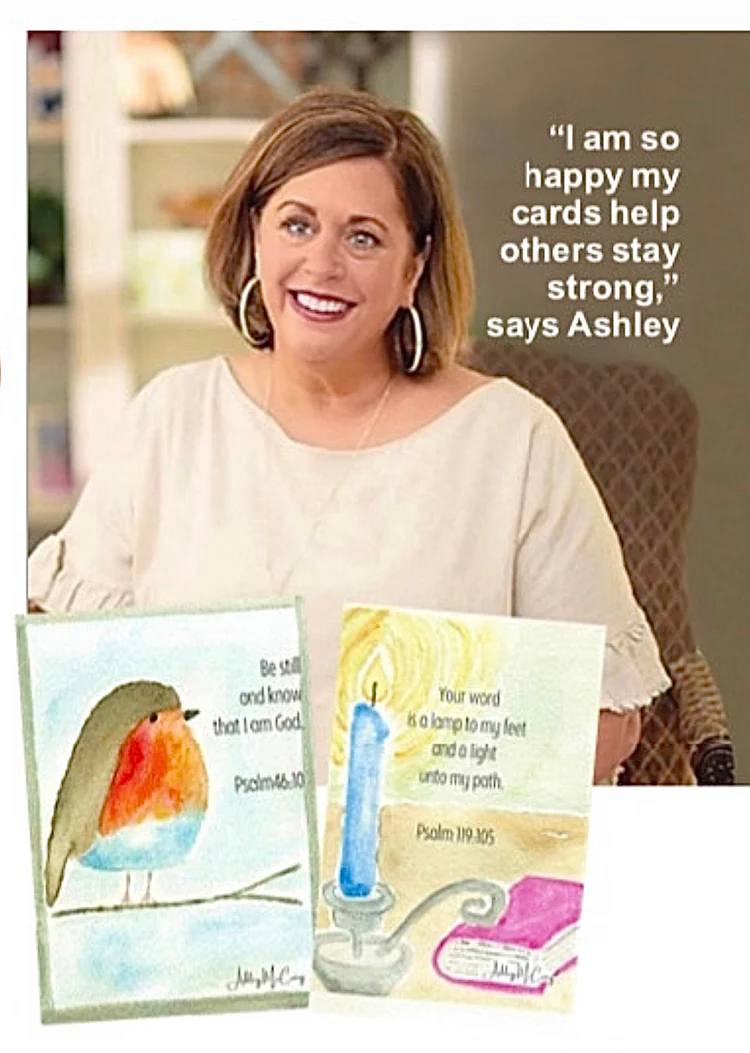
To relieve stress, in 2023 Ashley started waterColor painting: How could I blend my love, passion and desire to help other people she wondered. The answer came in the form of painting Bible verses that have inspired her, along with bright flowers and cute animals, and selling the cards — with all the proceeds going to help fund other patients’ trips for treatment.
Ashley ended spreading the word on social media and created a website EyeonGrace.com benefiting people with Ocular Melanoma needing travel assistance and, soon people were contacting her wanting to buy cards to help themselves or a loved one going through a troubling situation or challenging situation..
Before long Ashley was helping other cancer patients raise money for their own treatments. Today Ashley’s cancer is stable and she has sold over $10,000 worth of cards, which also includes non religious cards, such as, birthday cards. I love being able to help others and gives me a sense of purpose, knowing I am helping others in the same situation she went through and doing good in the world.
Eye on Grace Art (@eyeongraceart) • Instagram photos and videos
Eye on Grace Art by Ashley McCray on Facebook
Ashley’s Advice for Caregivers
“I think it’s sometimes harder for the caregiver than the person in treatment. My husband loves me so much, but he can’t fix this. So he has this helpless kind of feeling. The support he needs is different from what I need. And if you don’t get that support, if you’re not careful, you’re going to hit a wall.
Because there’s this heaviness all the time, every single day. I get to just focus on me, but he has to focus on everyone plus his job. It is a lot to deal with. It’s been almost three years of treatment and I still get cards in the mail almost every day, while Dave’s dealing with work, the emotions related to what I’m going through, and the general stress of life.
He has compounding issues trying to take care of everyone else. So I look for opportunities for him to have time with his friends. And my kids…it is rare that anyone is ministering to them about all this. So when people say, Ashley, what can I do for you? I say if you want to minister to me, minister to my family. I don’t need the Chick-fil-A gift card, but they do.
We are also big advocates of therapy.
Dave has been a few times and it’s really helped. He has the opportunity to meet with other men through online support groups who can encourage him. I just really feel for the caregivers. They didn’t sign up for this. It is so important that their needs are met too and often their needs are greatly overlooked.”