
Local Man Has Bird Flu
First human case in Ohio, 69th nationally, risk still low
By Daily Standard Staff
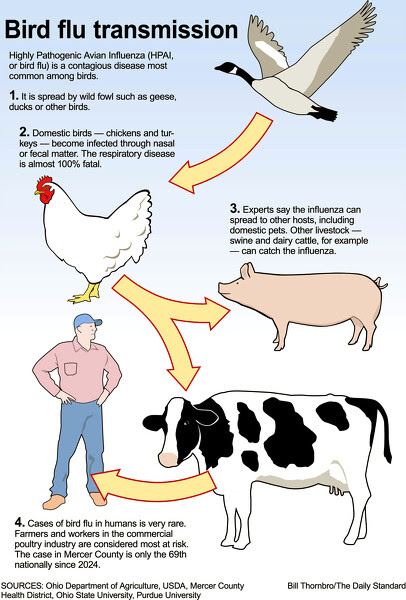
Highly Pathogenic Avian Influenza (HPAI, or bird flu) is a contagious disease most common among birds.
By WILLIAM KINCAID and ABIGAIL MILLER
CELINA – A Mercer County farm worker has been infected with the first probable human case in Ohio of Highly Pathogenic Avian Influenza (HPAI), commonly referred to as bird flu.
The unidentified man was in contact with dead commercial poultry that were infected with the virus, according to an Ohio Department of Health news release on Wednesday. Mercer County Health District confirmed that it received notification from the ODH that a Mercer County resident has tested positive for influenza A (H5N1).
This marks the 69th human case of HPAI nationally since the beginning of 2024.
No other details about the case were revealed, but the Centers for Disease Control and Prevention considers the current risk of bird flu for the general public to be low. However, people with close and prolonged contact with infected birds are at greater risk, according to the release. Farm workers, veterinarians and those who may have close contact with infected birds or other animals should take extra precautions.
The Mercer County Health District also issued a news release, underscoring that it’s been in communication with ODH.
“We have provided healthcare providers with up-to-date information on HPAI and testing details. We are monitoring those who have been exposed to the virus for symptoms,” the release states.
One of the 69 confirmed human cases of HPAI resulted in the death of a Louisiana man who was older than 65, had underlying medical problems and had been in contact with sick and dead birds in a backyard flock. Moreover, a genetic analysis had suggested the bird flu virus had mutated inside the patient, which could have led to the more severe illness.
All but three of the cases involved exposures related to commercial agriculture and related operations or wild birds, according to ODH. There are no known cases of human-to-human transmission to date.
Mercer County remains the epicenter of this year’s bird flu outbreak. As of Wednesday, there have been 38 confirmed detections within the county in 2025, affecting 5,562,166 commercial birds, or 63.2% of Mercer County’s commercial poultry, based on the size of the county’s commercial inventory reported in the USDA’s 2022 Agriculture Census.
As required, the commercial facilities in Mercer County where HPAI was detected are under quarantine and the involved poultry have been depopulated.
“While the risk to Ohioans is low, the best way to prevent bird flu is to avoid unprotected exposures to sick or dead birds or to their environment,” ODH Director Bruce Vanderhoff said in a statement. “People should avoid direct contact with poultry or wild birds and take proper precautions, including reaching out for guidance regarding personal protection and safe handling, if you must be around sick or dead birds.”
Mercer County had a commercial inventory of 8.8 million turkeys, layers, pullets and broilers, according to USDA’s 2022 Ag Census.
“Ohio is experiencing the largest outbreak of positive detections in commercial poultry to date, which requires critical action from our department and our federal partners, to contain and prevent the spread of disease,” ODA Director Brian Baldridge said in a statement. “As we continue to respond to these incidents, our staff on site continues to educate farmers and their workers on best biosecurity practices. We strongly encourage all Ohio farmers to use good biosecurity to help keep the disease away from the farm.”
Dozens of people have been placed under monitoring for bird flu symptoms since the outbreak began earlier this year in Mercer County, according to health district epidemiologist Deb Scheer.
“Currently the risk to the general public is going to be low, but we’re always going to be taking full precautions and working, definitely, with the Ohio Department of Health, who works very closely with CDC,” Scheer stressed.
The health district’s board of health members on Wednesday morning heard about bird flu monitoring protocols for humans. The CDC in late December said eye redness has been the predominant symptom among recent U.S. cases of avian influenza A (H5N1) virus infection. Respiratory symptoms and fever were also reported.
ODH’s Bureau of Infectious Diseases lets the health district know when there’s an outbreak at a commercial poultry operation, noted Michelle Kimmel, who was promoted from registered environmental health specialist to full-time administrator of the Mercer County Health District in December.
“If there are particular workers that have been exposed, those names are given to Deb and she interviews (them),” she said.
Biosecurity guidance for poultry workers
• Prevent contact with wild birds and waterfowl. Keep birds indoors when possible. Add wildlife management practices around your farm.
• Keep visitors to a minimum. Only allow those who care for your poultry to have contact with them and make sure they follow biosecurity principles.
• Wash hands before and after contact with live poultry. Use soap and water. If using a hand sanitizer, first remove manure, feathers and other materials from your hands.
• Provide disposable boot covers (preferred) and/or disinfectant foot baths for anyone having contact with a flock. If using a foot bath, remove all droppings, mud or debris from boots and shoes using a long-handled brush before stepping in. Always keep it clean.
• Establish a rodent and pest control program. Deliver, store and maintain feed, ingredients, bedding and litter to limit exposure to and contamination from wild animals.
• Use drinking water sourced from a contained supply (well or municipal system). Do not use surface water for drinking or cleaning.
• Clean and disinfect tools and equipment before moving them to a new poultry facility. Trucks, tractors, tools and equipment should be cleaned and disinfected prior to exiting the property. Do not move or reuse anything that cannot be cleaned.
• Look for signs of illness in birds. Monitor egg production and death loss, discoloration and/or swelling of legs, wattles and combs, labored breathing, reduced feed/water consumption.
SOURCE: Ohio Department of Agriculture
The workers are asked about their last exposure to birds, whether they were wearing personal protective equipment and if they were experiencing any signs or symptoms of illness.
There are three tiers of monitoring protocols based on levels of potential exposure. Individuals who had no exposure to potentially infectious animals or their environment are considered lower risk.
Individuals who had some exposure to potentially infectious animals or their environment but were wearing PPE at the time are considered tier 2, while those not wearing PPE under similar circumstances are elevated to tier 3.
Those under the first two tiers are educated and told to self-monitor for 10 days, Scheer said. Tier 3 monitoring involves daily phone calls from the health district to learn if symptoms have emerged.
“Now if they were exposed and they’re ill, we definitely would recommend that the appropriate specimens are collected,” Scheer said. “If somebody would test positive, we’re definitely going to monitor them very closely, and their contacts.”
As of Wednesday, there have been 58 commercial premises in Ohio in 2025 where HPAI was confirmed: 38 in Mercer County, 18 in Darke and one each in Van Wert and Auglaize counties. A total of 10,635,797 commercial poultry have been affected.
The current HPAI outbreak began in the United States in February 2022 in a commercial flock, per USDA. Since then, around 157.8 million commercial and backyard poultry have been affected.
Bird flu is primarily spread by wild birds such as ducks and geese as they migrate. While it is fatal to a variety of animals, including chickens, those species can generally carry it without getting sick, which offers the virus a chance to mutate and thrive.
From wild birds, avian influenza then spreads to other hosts, such as domestic poultry, pets, dairy cattle and more.
The virus was detected for the first time in U.S. dairy cattle in March 2024. It has infected more than 950 herds in 16 states. California has been the hardest hit, with around 736 cases in dairy herds, though several other states have had dozens of cases, including Colorado, Texas and Michigan. One dairy herd in Ohio was confirmed with bird flu, but that was in April 2024.
Ohio Department of Agriculture maintains that it is safe to eat properly cook poultry and pasteurized dairy products. Generally, people should follow food safety practices and cook poultry, eggs and beef to a safe internal temperature in order to kill bacteria and viruses. The proper handling and cooking of all poultry and eggs to an internal temperature of 165 degrees is recommended as a general food safety precaution.
If people are exposed to a sick or dead bird, they should monitor themselves for any new respiratory symptoms and contact their health care provider or local health department should they develop symptoms.
Sick or dead wild birds can be reported to the Ohio Department of Natural Resources at 1-800-WILDLIFE. Sick or dead poultry can be reported to the Ohio Department of Agriculture at 614-728-6220.
-The Associated Press contributed to this report.
US eggs prices hit a record high of $4.95 and are likely to keep climbing
Story by JOSH FUNK

Egg Prices© Stephen Smith
OMAHA, Neb. (AP) — Egg prices hit a record high as the U.S. contends with an ongoing bird flu outbreak, but consumers didn’t need government figures released Wednesday to tell them eggs are terribly expensive and hard to find at times.
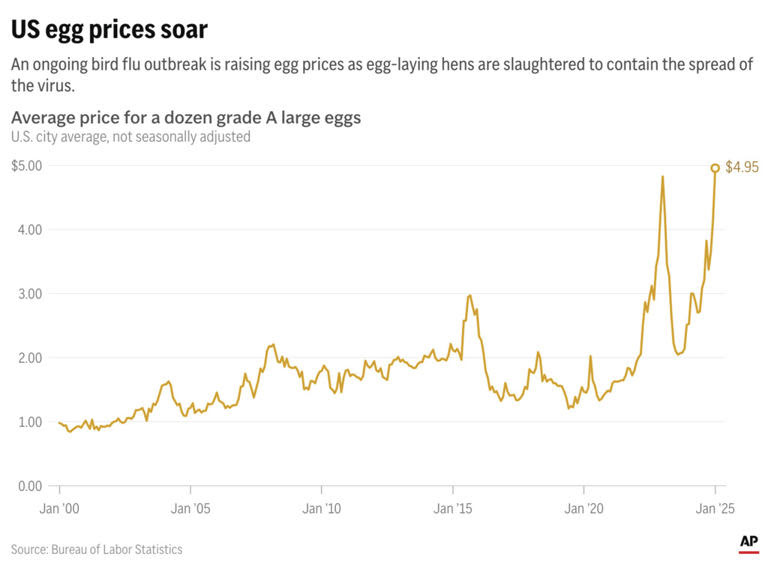
The latest monthly consumer price index showed that the average price of a dozen Grade A eggs in U.S. cities reached $4.95 in January, eclipsing the previous record of $4.82 set two years earlier and more than double the low of $2.04 that was recorded in August 2023.
The spike in egg prices was the biggest since the nation’s last bird flu outbreak in 2015 and accounted for roughly two-thirds of the total increase in food costs last month, according to the U.S. Bureau of Labor Statistics.
Of course, that is only the nationwide average. A carton of eggs can cost $10 or more in some places. And specialized varieties, such as organic and cage-free eggs, are even more expensive.
“We do use eggs a little less often now. You know, because of the price,” said Jon Florey as he surveyed his options in the egg case at Encinal Market in Alameda, California. “I was going to make a quiche that I like to make and it’s about six eggs, so I figured I’d do something else.”
When are egg prices expected to go down?
Embed-Chart-Egg-Prices© Kevin S. Vineys
Relief is not expected any time soon. Egg prices typically spike around Easter due to high holiday demand. And the U.S. The Department of Agriculture predicted last month that egg prices were likely to go up 20% this year.
Egg Prices© Nam Y. Huh
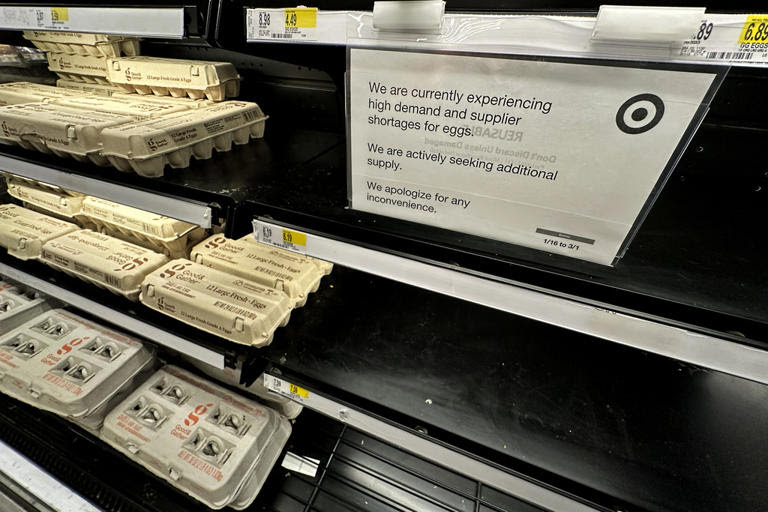
Even if shoppers can afford eggs, they may have difficulty finding them at times. Some grocers are having trouble keeping their shelves stocked, and customers are encountering surcharges and limits on how many cartons they can buy at a time.
Encinal Market owner Joe Trimble said he has a hard time getting all the eggs he orders from his suppliers, so most of the time his shelves are only about 25% full.
“It’s something you don’t think about until you look at the shelf and it’s nearly empty,” Trimble said. Eggs are “just expected to be there in the same way you expect there to be milk. It’s a key item to have in a grocery store because people don’t go out looking for something else to eat on a Saturday morning. They want it. They want to have some scrambled eggs or over-easy eggs on a Saturday morning.”
How bad is the bird flu outbreak?
The main reason that eggs are more expensive is the bird flu outbreak. When the virus is found on a farm, the entire flock is killed to limit the spread of disease. Because massive egg farms may have millions of birds, just one outbreak may put a dent in the egg supply. Nearly 158 million birds have been slaughtered overall since the outbreak began.
The Agriculture Department says more than 23 million birds were slaughtered last month and more than 18 million were killed in December to limit the spread of the bird flu virus. Those numbers include turkeys and chickens raised for meat, but the vast majority of them were egg-laying chickens.
And when there is an outbreak on a farm, it often takes several months to dispose of the carcasses, sanitize the barns and raise new birds until they are old enough to start producing eggs, so the effects linger.
Bird flu cases often spike in the spring and fall when wild birds are migrating because they are the main source of the virus, but cases can pop up any time of year. The virus has also spread to cattle and other species, and dozens of people — mostly farmworkers taking care of ill animals — have been sickened.
But health officials say the threat to human health remains low and eggs and poultry are safe to eat because sick animals aren’t allowed into the food supply. Plus, properly cooking meat and eggs to at least 165 degrees Fahrenheit kills any virus, and pasteurization neutralizes bird flu in milk.
What else is driving egg prices up?
Egg farmers also face higher feed, fuel and labor costs these days because of inflation. Plus, farmers are investing more in biosecurity measures to try to protect their birds.
Ten states have passed laws allowing the sale of eggs only from cage-free environments. The supply of those eggs is tighter and focused in certain regions, so the effect on prices can be magnified when outbreaks hit cage-free egg farms.
Many of the egg farms with recent outbreaks were cage-free farms in California. Cage-free egg laws have already gone into effect in California, Massachusetts, Nevada, Washington, Oregon, Colorado and Michigan.
Total demand for eggs is also up significantly in recent years. Consumers are buying more eggs, and the growth of all-day breakfast restaurants is adding to demand.
CoBank analyst Brian Earnest said the current cost of eggs could discourage some buying, which would ease the demand pressure but might not have a noticeable effect. It will likely take months for egg producers to fill the gaps in supply.
“As consumers continue to stock up on eggs, supplies at the store level will remain tight, and with Easter right around the corner, that could prolong the tighter supplies,” Earnest said.
While prices remain elevated, producers of baked goods and other food items that rely on eggs as a main ingredient will have to decide how much to increase prices or reduce production, he said.
Associated Press reporter Terry Chea contributed to this report from Alameda, California.
___
California is at the center of the country’s egg mess. Here’s why and what’s coming
Eggflation in full effect as price of eggs cracks records high amid bird flu outbreak
Egg prices hit record high and likely to keep climbing – Search Videos