
Soar Above Everest: Pristine Peaks from a Drone’s Eye View | Watch
Still peaking: ‘Cancer climber’ finds new ways to keep inspiring

Mansfield News Journal
Sean Swarner: The First Cancer Survivor To Stand On Top Of The World | EP. 440
MANSFIELD – Sean Swarner went to great lengths — and greater heights — to practice social distancing even before it became a thing. There was no mass gathering waiting for him when he reached the top of Mount Everest in 2002. Or when he scaled the highest peak on the other six continents to complete the Seven Summits. Or when he trekked to the South Pole in 2015 and the North Pole in 2017.
The 1993 Willard High School graduate literally stood alone in becoming the first cancer survivor to climb Everest as well as the only person to complete the Explorer’s Grand Slam — reaching the Seven Summits and both Poles — and finish the Ironman Triathlon, the almost inhuman three-pronged race of swimming, biking and running that he tackled in 2008 at age 34.
He did it all after surviving two terminal cases of cancer as a teenager and being left with only one functioning lung.
Love of Life Over fear of cancer – Search
But, hey, he’s always had a healthy sense of humor.
“I have no idea why they call it the Explorer’s Grand Slam,” he said recently about being one of only 69 adventurers to accomplish that goal. “To me it sounds like a Denny’s breakfast platter.” You’ve heard about laughter being the best medicine?
Swarner, as a teenager, needed it in large doses.
Nothing is more devastating than finding out, at 13, you’ve got Stage 4 Hodgkin’s Lymphoma and have three months to live. You survive that only to learn, at 16, you have an unrelated form of cancer called Askin’s Sarcoma and are given two weeks to live. He was listed in the medical journals as the only person to ever have both forms of deadly cancer. That’s the kind of distancing from people that no one seeks.
But Swarner beat incredible odds both times and would continue to do so with his inspiring feats of physical and spiritual strength. Each time he completed a leg of the Grand Slam he carried a flag dedicated to everyone impacted in some way by cancer. Inscribed on the rainbow-colored flag he took to the North Pole were 1,960 names and the word HOPE.
“It’s amazing how the body adjusts,” he said. “I think I have one big, bulldog lung that over the years I’ve trained to get stronger and stronger. It’s more psychological than anything else.” For someone so averse to sitting still and staying put, COVID-19 has probably been every bit as nerve-wracking as walking precariously across aluminum ladders, sometimes three of them fastened together, over bottomless crevasses on his ascent of Everest — all 29,029 feet.
This health crisis has made him stir crazy.
“Last year I put in about 250,000 miles on American Airlines traveling around, making (motivational) presentations,” Swarner said when reached at his home in Castle Rock, Colorado, “and this is the longest I’ve been home in 15 years. So I’m jumping out of my skin to go somewhere and just travel.”
Still climbing
When it’s safer to fly, he’s looking at taking a group, through Swarner Expeditions, to Everest base camp, possibly next spring. The campsites at 17,600 feet on the mountain and takes two weeks to reach. “I would be using that trip as a vehicle to help people overcome their fears and gain their confidence back,” the 45-year-old Swarner said. “It’s kind of like an immersive experience to empower people.”
Swarner estimates he’s been to the top of Mount Kilimanjaro, the highest peak in Africa at 19,341 feet, 18 or 19 times. He tries to take a small group up every year and offers a free trip to a cancer survivor. That survivor, in turn, is responsible for using the climb as a fund-raiser to send another survivor the following year.
“It’s kind of paying it forward and keeping it in the cancer community,” Swarner said. “We actually raised enough money to take three survivors this year and would have left (this) week. All three said they want to go next year.” At this point, Swarner could probably scale Kilimanjaro blindfolded.
“I don’t know about that,” he said, laughing, “but they did adopt me into the Chagga Tribe, a local (Tanzanian) tribe at the base of the mountain. They gave me a name in Swahili.”
It’s Mzungu kichaa.
“Loosely translated,” Swarner said, “it means crazy white man.”
The Power of Resilience with Sean Swarner – YouTube
Love of Life Over fear of cancer – Search
Sounds about right.

Last Friday was the 13th anniversary of Swarner’s ascent of Alaska’s Mount Denali, also known as McKinley, which completed his climb of the Seven Summits in a six-year span.
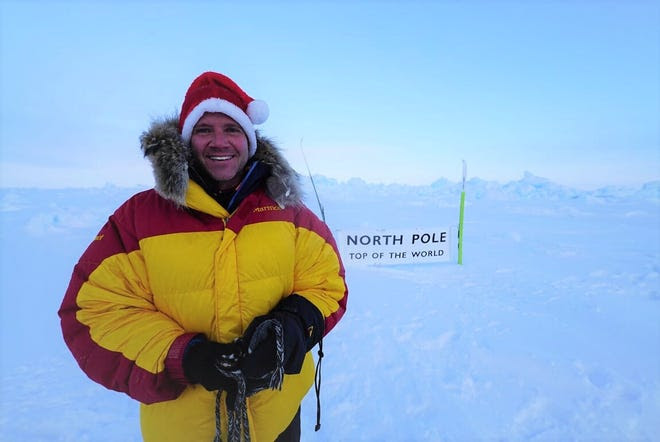
Eight years would pass before he skied to the South Pole and then three years ago, in April, he made it to the North Pole. That latter adventure — a seven-day, 80-mile journey over floating ice in which his party braved minus-70 wind chills, pulled 150-pound sleds, risked frostbite and kept a wary eye on polar bears — was captured in a one-hour documentary called “True North: The Sean Swarner Story.” It can be streamed at Amazon.com.
Travel to the North Pole with Sean Swarner
“Both (poles) are unique and have different obstacles to overcome,” Swarner said, “but the North Pole, hands down, is much more dangerous.” Of the 15 people who set out for the North Pole, several had to be evacuated for frostbite or exhaustion, including Swarner’s team doctor.

And for those who made it, the only way they knew they arrived at the earth’s true north (90 degrees north latitude) was by GPS. There’s no land mass, no distinguishing features, just polar ice. And that ice is constantly shifting.
“If you look at the world as a glass of ice water, the northern polar ice cap is like the ice cubes floating on the water,” Swarner said. “You have these arctic currents flowing underneath. One night we set up camp and literally floated 2 miles backwards. It’s insane.
“In the middle of the night, you could hear the ice cracking all around you.”
True North, The Sean Swarner Story is a jaw-dropping look at how far a man will go to feel alive, and to bring hope to millions of people touched by cancer around the world.
When he was young, Swarner was diagnosed with two life threatening forms of cancer. Now, the unshakeable survivor has set his sights on the North Pole. True North follows Swarner as he tries to make history and inspire cancer fighters to keep pushing forward.
Welcome to SurvivorNetTV’s film True North. This documentary follows the story of author and adventurer Sean Swarner as he takes on his most daunting challenge yet.
As a teenager, Swarner was diagnosed with two lethal forms of cancer. Now, he’s trekking to the brutal and unforgiving North Pole. True North is the inspiring account of Swarner’s quest to bring hope to millions of people touched by cancer around the world.
“I didn’t choose to go crawl up in a corner and die and think, ‘Okay, well, that’s it, I’m done, game over,” Swarner tells SurvivorNet about his cancer battles. Swarner was first diagnosed with cancer at just 13-years-old, and was diagnosed with a separate second cancer at 16. His oncologists declared his condition as terminal, and he was told he would only have two weeks to live.
He battled the odds, and he came out on top. “Nobody knows how much time you have left on the planet. So, what I wanted to do was make the most of it. If the prognosis is going to be alive for 14 days, I want to truly love and live life. I still do,” Swarner continues. Swarner is on a mission, a Mission of Hope, a profound and symbolic honor for the millions affected by cancer worldwide.
He has dedicated each one of his climbs to the cancer patients he hopes to inspire, symbolized by a flag he carries with him to each peak. His exploration to the North Pole is no different. With the help of Vern Yip, television personality and interior designer, Swarner designs the Flag of Hope. Months leading up to his final endeavor, Swarner takes the Flag of Hope across the country. One by one, those affected by cancer put their names on the flag.
United by one purpose, Swarner hopes to cover the world in hope.
If he’s successful, Swarner stands to become the world’s first cancer survivor to complete the Explorer’s Grand Slam–scaling the highest point on all seven continents and then hiking to the North and South Poles. Only a handful of people have ever done it, but no one who’s faced the overwhelming odds Swarner has.
Learn more about SurvivorNet’s rigorous medical review process.
Marriage Pole-posal
It’s easy for Swarner to romanticize that sometimes-harrowing experience, especially since he proposed to his girlfriend, Julissa Perez, on his satellite phone from the North Pole.
“I go, ‘Hey, when I get home, let’s go somewhere warm, so I can thaw out,'” Swarner recounted. “My brain … you know how fast your brain thinks. I said, ‘Let’s get married.’ There was this long pause and I’m thinking, oh, crap, did we get disconnected? Is she thinking about this? What’s going on? Then she said yes.” It gets better.

“Later I called her and I told her out of respect for her family and culture (Julissa is from Puerto Rico), don’t tell anybody,” Swarner said. “I want to ask your parents for permission. She said, ‘Well, everybody already knows.’
“She went on to tell me that when I called from the North Pole, she knew I was going to make it that day. So when I called she had me on speaker phone and her whole family was there.” They met in 2011 when Swarner was giving a presentation in San Juan. Julissa was in the front row and he had to keep telling himself during his address to stop staring. They were sitting at separate tables afterward, neither making a move, when he found out from her friend that Julissa wanted to meet him as much as he wanted to meet her.
Marriage doesn’t mean Swarner is going to settle down. Now that he’s also a certified performance coach as well as a motivational speaker, author (his book “Keep Climbing” was on the New York Times bestseller list), and founder of the nonprofit organization, The Cancer Climber Association, he plans to launch “The Summit Challenge” at SeanSwarner.com on July 1.
He will be giving clients a series of seven challenges, each to be completed in three weeks.
“The goal is to really impact their lives,” he said. “We can stay in a state of suffering from pain or grief or we can choose to change into a state of joy and happiness.”
New goals to reach
Swarner, who was back home last year to receive the Distinguished W Alumni Award from the Willard City Schools, also has two new extreme adventures on his radar.
Next year he’d like to run a marathon on each of the seven continents in seven days. That’s 26.2 miles a day.
“You get off the plane, you run, you eat, you get back on the plane, you fall asleep, you wake up, you run, you eat, you get back on the plane, you sleep … repeat, repeat, repeat,” he said of the whirlwind pace he would keep.
.
Why couldn’t he? He spent only seven months training to climb Everest and just five months preparing for the Ironman, against the advice from experts. And unlike most Seven Summiteers, he started with Everest instead of finishing with the highest and hardest peak.
He’s not wired like you or me. Or anybody. As for the other goal on Swarner’s wish list, that would truly test his motto: Redefining Impossible. “I’d love to get in touch with Elon Musk or Richard Branson,” he said, “and take a ride into space.” Makes perfect sense. Space … the final frontier for Sean Swarner to conquer.

Space for Humanity by Sean Swarner
Meet two-time terminal cancer survivor Sean Swarner.
His first goal was to crawl 8 feet from the hospital bed to the bathroom. He went on to climb the highest point on every continent (including Mt. Everest), skied to both the North and South Poles, and completed the Ironman World Championship in Hawaii – all with one lung. Sean was diagnosed with two deadly, different, and unrelated forms of cancer, once at the age of thirteen and again at the age of sixteen, where he was given only 3 months and then 14 days to live, respectively. He was in a coma for a year and lost the function of his right lung.
However, Sean astounded the medical community when he survived both these deadly diseases and realized that after defeating cancer twice, no challenge would ever be too great, no peak too high, and no obstacle too difficult. Always inspiring, his goal is to take a million people touched by cancer on a flag into space, to change peoples’ perspectives on possibilities, uniting humanity and the globe – shining light in a world of darkness.
Sean says, 2017 was an amazing year and I’m grateful for the completion of the Explorer’s Grand Slam (highest mountain on every continent and the North and South Poles), and completing something no other person in history has ever accomplished.
But it was more than that.
What meant the most was taking a flag that had thousands of people touched by cancer to the top of the world – the North Pole.
The struggles people endure, the hardships people face, but within it all, there remains one common thread … HOPE!
Losing hope can easily mean death when you’re fighting for your life, and I want to encourage people battling for survival to never give up.
Sean Swarner was voted one of the top 8 most inspirational people in history and was the recipient of the Don’t Ever Give Up Award presented by the Jimmy V Foundation and ESPN. Sean is the only person in history to climb Everest, the highest mountain on every continent, ski to both Poles and complete the Hawaii Ironman triathlon.
He only has one lung. Sean is a two-time cancer survivor who was first diagnosed at age 13 with Hodgkin’s Disease and later with Askin’s sarcoma. He was given just 14 days to live and is the only person in the world to ever have been diagnosed with both these deadly cancers. Sean told ESPN Radio‘s Bob Valvano, brother of Jimmy, that he would have been more likely to win the lottery four or five times with the same numbers than to have survived both these terminal cancers.
However, he did survive, although he has only one fully functioning lung.
Sean was featured on ESPN (July 27, 2007) with a 10-minute segment on his life story and struggle. Amazon recently posted a film about his recent expedition to the North {ole. He established his own foundation (The Cancer Climber Association) which promotes cancer awareness and completely funds a survivor’s trip to Africa. He also authored his book Keep Climbing, which recounts his story and journey from the depths of his near death experience to the peaks he climbed to reach the top of the world 17 years later.
Other books include his 7 Summits to Success series, empowering others to their best.
On April 11, 2017, Sean completed a trek to the North Pole.
On May 16, 2002, Sean summited Mount Everest. Again – Search
Sean Swarner climbed Mount Everest once, in 2002, becoming the first cancer survivor to reach the summit. His achievement is even more remarkable considering he did it with only one lung after surviving two different types of cancer. 1
Swarner has since gone on to climb the highest mountain on every continent and continues to inspire others through his foundation, the Cancer Climber Association. 2
His story is truly one of resilience and determination! 1guideposts.org 2www.today.com
Sean Swarner, a two-time cancer survivor, successfully climbed Mount Everest in 2002124.
He is one of less than 200 people in the world to have climbed all seven peaks3.
What challenges did Swarner face while climbing Everest?
Sean Swarner faced immense challenges while climbing Mount Everest, beyond the usual dangers of extreme cold, avalanches, and low oxygen levels. His biggest obstacle was his own body—having survived two aggressive cancers, he climbed with only one functioning lung.
The lack of oxygen at high altitudes is already a major challenge for climbers, but for Swarner, it was even more difficult. He had to carefully manage his breathing and energy levels to avoid exhaustion. Additionally, his past cancer treatments had weakened his body, making the physical demands of the climb even more grueling3.
Despite these challenges, Swarner persevered, proving that determination and hope can overcome even the most daunting obstacles. His journey continues to inspire cancer survivors and adventurers alike.
Would you like to hear more about his other incredible achievements?
1guideposts.org 2 news.cancerconnect.com 3www.today.com
What strategies did Swarner use to manage his health during the climb?
Sean Swarner had to be incredibly strategic in managing his health while climbing Mount Everest, especially since he was doing it with only one lung. Here are some key strategies he used:
- Controlled Breathing: With reduced lung capacity, Swarner had to be mindful of his oxygen intake, pacing himself carefully to avoid exhaustion.
- Physical Conditioning: He trained rigorously beforehand to strengthen his body and improve endurance, ensuring he could handle the extreme conditions.
- Mental Resilience: Swarner relied on a strong mindset, using hope and determination to push through the toughest moments.
- Careful Acclimatization: He took time to adjust to the altitude, minimizing the risk of altitude sickness, which could be especially dangerous given his medical history.
- Support System: He had a team to monitor his health and provide assistance when needed, ensuring he could safely navigate the climb.
His journey is a testament to the power of perseverance and preparation. Would you like to learn more about his other adventures?
1www.today.com 2guideposts.org 3news.cancerconnect.com
What kind of physical training did Swarner undergo?
Sean Swarner underwent intense physical training to prepare for climbing Mount Everest, especially given his unique challenge of having only one functioning lung. His training included:
- Cardiovascular Endurance: He focused on improving his lung capacity and stamina through activities like running, swimming, and cycling.
- Strength Training: He built muscle strength to handle the physical demands of climbing, including carrying heavy gear and navigating steep terrain.
- Altitude Acclimatization: He trained at high elevations to adapt to lower oxygen levels, reducing the risk of altitude sickness.
- Mental Conditioning: He practiced visualization techniques and mental resilience exercises to stay focused and motivated during the climb.
- Expedition-Specific Training: He simulated climbing conditions by hiking with weighted backpacks and practicing technical climbing skills.
His preparation was crucial in overcoming the extreme challenges of Everest. You can read more about his journey HERE and HERE.
Would you like to explore more about his other adventures?
How many times did Sean Swarner climb Mount Everesett – Search
How many times did Sean Swarner climb Mount Everest – Search
SEAN SWARNER WILLARD OHIO – Search Videos 1
SEAN SWARNER WILLARD OHIO – Search Videos 2
Sean Swarner: Explorer and cancer survivor *interview*
LIVESTRONG Films: Sean Swarner – Search
Sean Swarner Wikipedia – Search
December 27, 2017Filed Under: Stories of Hope
Tagged With: Stories of hope