
Story behind The Staircase Loretto Chapel ‘1998 – Search
Posted on March 20, 2022 by Ernest in Movies
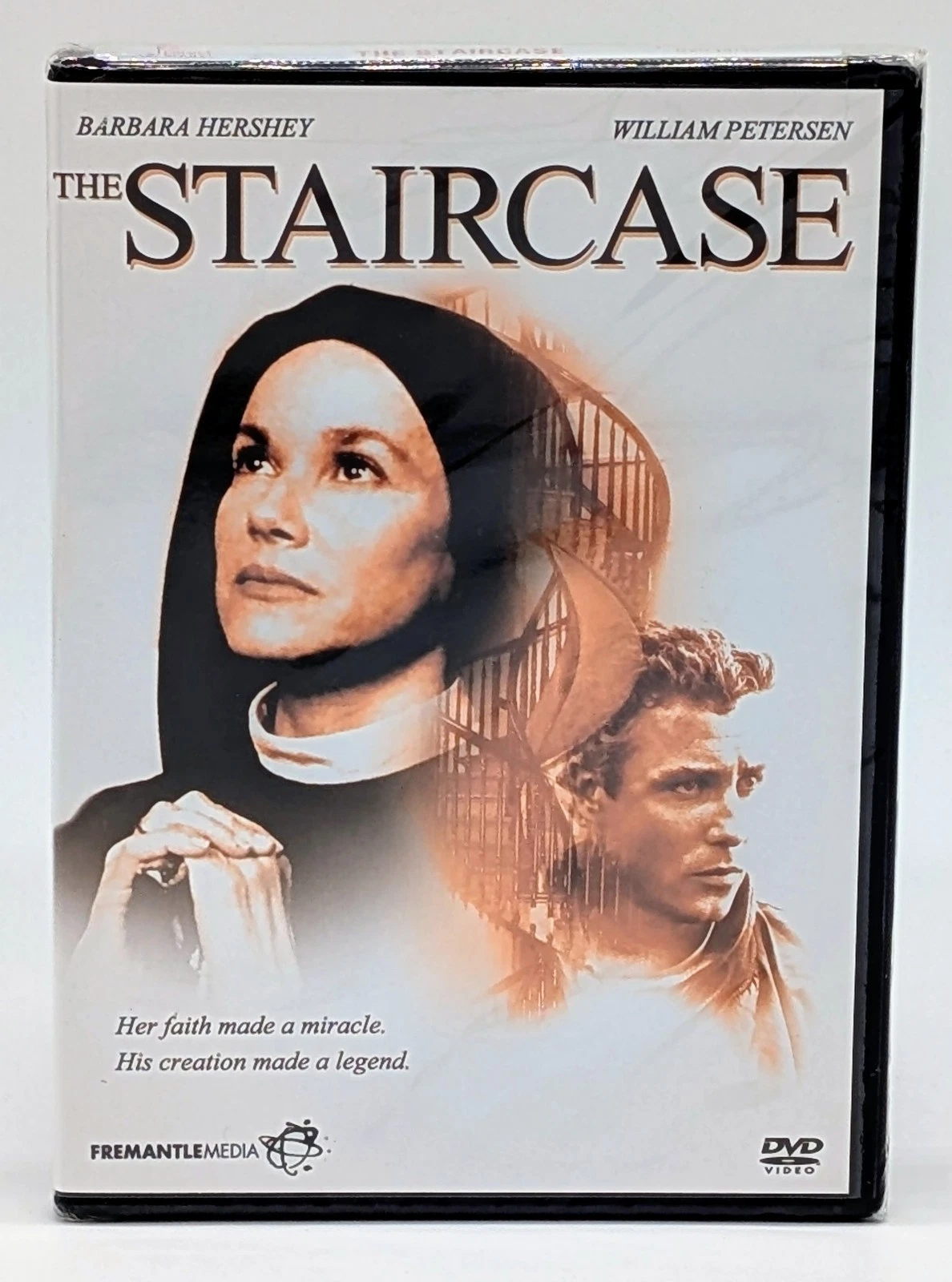
THE STAIRCASE, 1998 | STEFAN CLASSIC FILMS™ (SCF)
There are movies for the eyes and there are those for the mind. But some exceptional movies speak directly to the soul. Karen Arthur’s TV movie The Staircase (1998) is one such rare gem. Written by Christopher Lofton, The Staircase shows the desperation of a dying nun, Mother Madalyn, in the late 19th century to see the construction of a staircase in a newly built chapel in a small New Mexico town. When a stranger passing by the town commits to building the staircase, the nun believes her prayers have been answered. Will she live to see the staircase and whether the arrival of the stranger is divine intervention are the key elements of interest in this faith-based story.
Barbara Hershey as Mother Madalyn and William Petersen as Joad, the carpenter, deliver impeccable performances as the lead characters with good acting by the supporting cast and believably realistic conflict, both internal and external. The dialogue is excellent and Hershey’s agony and self-doubt run in touching contrast with Petersen’s calm and confidence. The subplot of Mother Madalyn’s past trauma and the bitterness it left in her, now to be washed off by the godly work of the stranger, add to the aesthetic and spiritual merit of the story.
The spiritual worth of the story is also strengthened by the fact that it is based on a true story—that of Loretto Chapel in Santa Fe, New Mexico.
The Miraculous Staircase in the Chapel of Loretto in Santa Fe, NM
As the chapel says on its website, the Sisters of Loretto prayed a nine day novena (special prayer) to St. Joseph to seek guidance on how to get the staircase built. It was on the final day of their prayer that the mysterious carpenter arrived in the town, carrying only a hammer and a carpenter’s square.
The Staircase is the movie the spiritual healer ordered for the soul.
Deep in the Southwestern United States is Santa Fe, the City of Holy Faith. It was here that in the 1800s seven nuns set up a school for girls, and when it was time, they built a chapel. This is where the legend of the Loretto Chapel staircase began, and ever since, faithful visitors have been flocking to the church to get a peek at the subject of the Santa Fe miracle – the chapel stairs.
The Loretto Chapel staircase allows access to the choir loft 22 ft. above. Source: Wikimedia Commons.
History of the Loretto Chapel
During 1872, the Bishop of the Santa Fe archdiocese was Jean-Baptiste Lamy. French by birth, he was elected as the very first Bishop of the diocese and commissioned and oversaw the construction of a chapel named Our Lady of Light in 1873. A religious order called the Sisters of Loretto would maintain the chapel.
The Loretto Chapel, Santa Fe, was built in a Gothic style by Antoine and Projectus Mouly from Paris. Source: Wikimedia Commons, Christopher Michel.
An interior view of the Loretto Chapel and staircase connecting the choir loft. Source: artelis.pl
Constructed in the popular Gothic Revival style, the whole chapel was designed by renowned French architect Antoine Mouly. Unfortunately, Mouly never lived to see the work completed. The structure was sound and almost finished by 1878. The only thing lacking was a means to ascend to the choir loft. The chapel was not the largest sanctuary in the world, so a standard staircase was ruled to be too large to be practical. Other churches and chapels of the same period had ladders as opposed to stairs. However, the Sisters quickly dismissed this idea due to their attire.
Without a way to reach the loft, the chapel would not be able to function properly. While the likely proposals, suggestions, and ideas were being debated by members of the construction industry, the Sisters considered this to be nothing more than a test of their faith.
Legend of the Loretto Chapel Staircase
Sometime around 1880, the entire order began to pray to St. Joseph – the patron saint of carpenters – to help with a solution for the chapel stairs. On the 9th day of prayer, a visitor arrived at their door with his mule and some tools. The first thing the man revealed to the Sisters was that he was a carpenter by trade. He was invited in and discovered the dilemma left behind with the untimely passing of the original architect. The solo workman, unlike many tradesmen that had a look prior to him, said that it was possible to construct a useful staircase to the loft without becoming an eyesore in the available space. The only condition he placed upon the Sisters was that he would have to work in private.
The Sisters were only too pleased to agree to these terms if it meant getting their staircase done. While they used the chapel for their own activities, the carpenter retreated – returning only when the chapel was empty. Some of the Sisters did state they saw wood soaking in tubs they provided for him. Reports made at the time do contradict one another. Some insist that construction was completed quickly, while others reported that it took longer than might have been necessary.
The Carpenter Disappears
When the spiral staircase was finished, the Sisters were delighted with how it turned out. So much so that they organized a banquet in honor of the carpenter. This was when he was discovered missing. At no time during his work did he identify himself. He never asked for, nor received, payment for his labor or even supplies. Exactly who this man was is just one of the many mysteries surrounding the Loretto Chapel staircase.
Construction Mysteries
Another mystery is the construction of the Loretto staircase itself. There are no central columns or support beams, and it appears that all the weight is self-supported at the base. The craftsman did not use nails or glue; he only used wooden pegs to secure the steps. Additionally, there were no railings. The legend says that some of the nuns were so afraid to descend the 22-foot drop that they would crawl down on their hands and knees. There are only 33 steps, however, the staircase wraps around 360 degrees twice. The number 33 is a significant number, being the age of Jesus at his crucifixion. The Sisters were adamant that it was Joseph himself that came to their rescue. Thus, people have given the stairs the nickname, St. Joseph’s Staircase.
When local trade suppliers were contacted in an effort to track this craftsman down, none of them could help inquiries in any way at all. No bill of sales could be retrieved and the lumber that was used was discovered to be of an unknown type. Whatever the wood that was used, it was not indigenous to the Santa Fe area.
François-Jean Rochas may have built the Loretto Chapel staircase.
A modern analysis revealed the wood to be spruce, but a variety that nobody was familiar with. It was concluded that the closest possible locale for wood of this type would have been somewhere like Alaska. Why would a Victorian carpenter transport scores of lumber with nothing more than a mule, just on the off-chance that it might be needed to build a staircase thousands of miles away?
Sorting Through the Fact and Fiction
As with all legends, there is some truth and some fiction to the story about the Loretto Chapel Staircase. Mary J. Straw Cook, a historian, researched the Sante Fe stairs for 7 years. She compiled enough evidence about the mysterious carpenter that she was able to write a book called, “Loretto: The Seven Sisters and Their Santa Fe Chapel,” in 1984. Cook says that she found an entry in the nuns’ daybook dated 1881 which indicated that they had paid a man named Rochas “for wood.”
Cook also found an old newspaper article in The New Mexican that said Mr. Rochas had been shot in the chest in his Dog Canyon home, and that he had been a skilled woodworker who built the impressive Loretto Chapel staircase. According to Cook, Francois-Jean Rochas was a member of a French secret society of highly skilled craftsmen and artisans called the Compagnons, which has existed since the Middle Ages. Cook says that Rochas came to the U.S. specifically to build the Sante Fe staircase and that he had the wood shipped from France. Mr. Rochas is buried at the Our Lady of the Light Catholic Cemetery.
Source: François Jean “Frank or Frenchy” Rochas (1843-1894) – Find a Grave Memorial
The Persisting Miracle
The Story of Francois Jean Rochas ‘Frenchy’ of Dog CanyonThe inspirational legend resulted in the creation of books and a 1998 movie, called The Staircase, starring Barbara Hershey and William Petersen. While some of the legends may have been demystified with information about its supposed builder, many people who have seen the stairs claim this makes it no less of a miracle. Where did the inspiration and knowledge come from to build a stunning staircase that still impresses even the best craftsmen around today?
What cannot be debated is the marvelous work of art that was left behind. It can still be seen today, but the chapel is more of a corporate venue and museum these days. Significant events of a religious nature – such as weddings – can still be conducted there. Most visitors do actually come just to see the Loretto Chapel staircase that some have dubbed as miraculous.
Did ‘Frenchy,’ the Dog Canyon cattleman, build ‘The Staircase’ in Santa Fe?
Santa Fe — the City of Holy Faith. It was here that in the 1800s seven nuns set up a school for girls, and when it was time, they built a chapel. This is where the legend of the Loretto Chapel staircase began. Ever since, faithful visitors have been flocking to the church to get a peek at the subject of the Santa Fe miracle — the chapel stairs.
History of the Loretto Chapel
By Roswell Daily Record
In 1872, the Bishop of the Santa Fe archdiocese was Jean-Baptiste Lamy. French by birth, he was elected as the very first bishop of the diocese and commissioned and oversaw the construction of a chapel named Our Lady of Light in 1873. A religious order called the Sisters of Loretto would maintain the chapel.
It was built in the popular Gothic Revival style, and the entire chapel was designed by renowned French architect Antoine Mouly. Unfortunately, Mouly never lived to see the work completed. The structure was sound and almost finished by 1878. The only thing lacking was a means to ascend to the choir loft. The chapel was not a very big sanctuary, so a standard staircase was ruled to be too large to be practical. Other churches and chapels of the same period had ladders as opposed to stairs. However, the sisters quickly dismissed this idea due to their dress; it wouldn’t be practical.
Without a way to reach the loft, the chapel would not be able to function properly. While the likely proposals, suggestions and ideas were being debated by members of the construction industry, the sisters considered this to be nothing more than a test of their faith. The entire order began to pray to St. Joseph — the patron saint of carpenters — to help with a solution for the chapel stairs. This was around 1880. On the ninth day of prayer, a visitor arrived at their door with his mule and some tools.
The first thing the man revealed to the sisters was that he was a carpenter by trade. He was invited in, and discovered the dilemma left behind with the untimely passing of the original architect. The solo workman, unlike many tradesmen prior to him, said that it was possible to construct a useful staircase to the loft without becoming an eyesore in the available space. The only condition he placed upon the sisters was that he would have to work in private. The sisters were only too pleased to agree to these terms if it meant getting their staircase done.
While they used the chapel for their own activities, the carpenter retreated — returning only when the chapel was empty. Some of the sisters said they saw wood soaking in tubs they provided for him. Reports made at the time do contradict one another. Some insist that construction was completed quickly, while others reported that it took longer than might have been necessary.
There is no mystery to Santa Fe’s famous spiral staircase – Everyday Knosticism
The Spiral Staircase was finally completed and the sisters were thrilled. They wanted to have a party in honor of the amazing craftsman carpenter, but he was gone. He had never given them his name, nor asked for or received payment. Who was this man? That is one of the many mysteries surrounding the Loretta Chapel Staircase.
How does the staircase stand up?
Another mystery is the construction of the Loretto staircase itself. There are no central columns or support beams, and it appears that all the weight is self-supported at the base. The craftsman did not use nails or glue; he only used wooden pegs to secure the steps. Additionally, there were no railings. The legend says that some of the nuns were so afraid to descend the 22-foot drop that they would crawl down on their hands and knees. There are only 33 steps, however, the staircase wraps around 360 degrees twice. The number 33 is a significant number, being the age of Jesus at his crucifixion. The sisters were adamant that it was St. Joseph himself that came to their rescue. Thus, people have given the stairs the nickname, St. Joseph’s Staircase.
When local trade suppliers were contacted in an effort to track this craftsman down, none of them could help in any way at all. No bill of sales could be retrieved and the lumber that was used was discovered to be of an unknown type. Whatever the wood that was used, it was not indigenous to the Santa Fe area.
A modern analysis revealed the wood to be spruce, but a variety that no one was familiar with. It was concluded that the closest possible locale for wood of this type would have been somewhere like Alaska. Why would a Victorian carpenter transport scores of lumber with nothing more than a mule, just on the off-chance that it might be needed to build a staircase thousands of miles away?
So how did this really come about? Mary J. Straw Cook, a historian, researched the Santa Fe stairs for seven years. She found many clues about the mysterious carpenter, enough so that she compiled it into a book called “Loretta: The Seven Sisters and Their Mysterious Chapel,” which was published in 1984.
Did Frenchy belong to a secret society?
Cook also found an old newspaper article in The New Mexican that said Rochas had been shot in the chest in his Dog Canyon home, and that he had been a skilled woodworker who built the impressive Loretto Chapel staircase. According to Cook, Rochas was a member of a French secret society of highly skilled craftsmen and artisans called the Compagnons, which has existed since the Middle Ages. Cook says that Rochas came to the U.S. specifically to build the Santa Fe staircase and that he had the wood shipped from France.
While some of the legends may have been demystified with information about its supposed builder, many people who have seen the stairs claim this makes it no less of a miracle. Where did the inspiration and knowledge come from to build a stunning staircase that still impresses even the best craftsmen around today?
Was this reclusive little Frenchman that seemingly had no close friends, special in some way? Why did he come to the United States, really?
What cannot be debated is the marvelous and miraculous work of art that was left behind.
Janice Dunnahoo is an archive volunteer at the Historical Society for Southeast New Mexico Archives. She can be reached at 575-622-1176 or by email at jdhist4@outlook.com.
References: The Loretto Chapel’s Miracle Staircase – DesertUSA
Stockman & Carpenter
400 Years in Downtown Santa Fe | Travels With Cookie
The Loretto Chapel is a former Roman Catholic church in Santa Fe, New Mexico, United States, that is now a privately owned museum and a wedding chapel. It is known for its unusual helix-shaped spiral staircase, also known as the “Miraculous Stair”. The Cathedral Basilica of Saint Francis of Assisi, commonly known as Saint Francis Cathedral, The Cathedral Basilica of St. Francis of Assisi: Welcome! is a Catholic cathedral in downtown Santa Fe, New Mexico, and is situated 510 feet northeast of Loretto Chapel.