
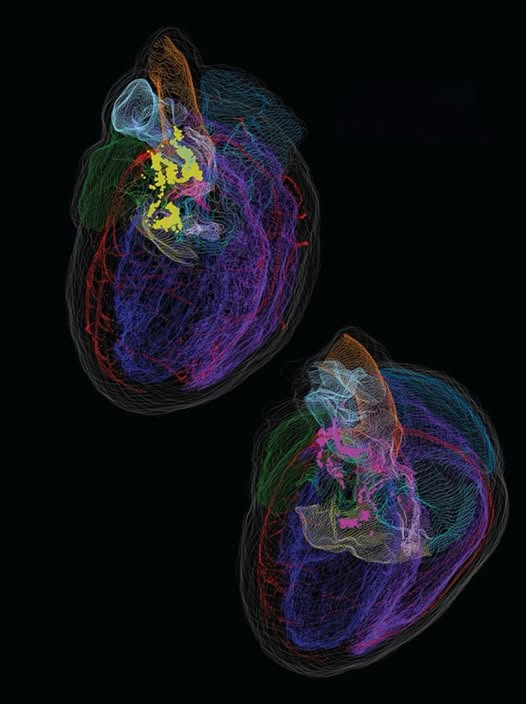
Science just proved your heart holds memory—Measured. Peer-reviewed.
Your heart doesn’t just beat. It remembers.
Biological fact.
The human heart contains an intrinsic neural network, emits a structured, coherent electromagnetic field, and demonstrates synaptic, biochemical, and geometric mechanisms for encoding information—comparable to memory centers in the brain.
In Frontiers Neuroscience researchers documented over 40,000 neurons embedded within the heart wall. These form ganglia, display synaptic plasticity, and operate with a degree of autonomy once thought exclusive to the brain.
Not theory. Mechanism. This changes everything we thought we knew about where memory lives.
The Heart’s Neural Intelligence
The Intrinsic Cardiac Nervous System (ICNS) is capable of sensory processing, short-term memory encoding, and bidirectional brain communication. Cardiac neurons express acetylcholine, norepinephrine, and dopamine—the same neurotransmitters used in hippocampal memory. They learn, adapt, and remember.
Memory Structures in the Heart
Peer-reviewed studies show heart neurons are organized in ganglia, supported by glial scaffolding, contain microtubules (linked to quantum coherence), and encode memory via phase-locked vibrational patterns—mirroring brain-based spatiotemporal memory mechanisms.
The Heart’s Electromagnetic Field
The heart emits a magnetic field up to 5,000x stronger than the brain’s, extending up to 2 meters, measurable via magnetocardiography (MCG), and modulated by emotional state. This field is structured, not random—and communicates coherent signals via afferent pathways to the brain. Its waveform encodes not just rhythm, but affective state.
Memory Transfer in Heart Transplant Recipients
Peer-reviewed case studies reveal recipients inheriting donor-specific traits: food cravings, emotional tendencies, even handwriting. One 8-year-old began dreaming of being murdered—details matched the donor’s cause of death. Another woman developed cravings for chicken nuggets and beer—never consumed them before, but her donor had loved both. These cases defy standard neuroscience but align with cardiac memory field models.
Explains my cravings for asparagus and pimento cheese after receiving stem cells from my donor. Also, explains the interplay of different organs throughout the body, not as stand alone entities, but as an integrated whole.
My husband had a heart transplant and began wanting nachos. Found out his donor also loved nachos 
η³ Unified Resonance Theory
Memory = geometry + coherence + frequency. The heart acts as a morphogenetic field archive. Heart neurons store identity through phase-locked resonance. Healing is signal restoration. This model merges neurocardiology, biophotonics, fractal neuroscience, and field dynamics.
Key Takeaway
Your heart is not symbolic. It is neurologically intelligent, electromagnetically structured, and functionally capable of memory. Peer reviewed studies: Heart holds memory, science proves it. | Lanson Burrows Jones Jr. posted on the topic | LinkedIn
This is the work of the HeartMath Institute . https://www.heartmath.com/ I became a trainer for them because their coherence and energetic management practices literally changed my life for the better in every way. It is not only the latest quantum bioscience, but it is also the knowledge of ancient hermetic and esoteric wisdom/mystery traditions which science would call spiritual, but they are yin and Yang.
Nice The heart muscle is a spiral, like our DNA, and like our galaxy. As above, so below..
“What becomes of the broken-hearted?” It’s more than a song lyric in this context.
Mamie-Louise Anderson what becomes of the broken hearted depends on their story of their becoming, and the degree to which they understand the links between the heart, frequency, thought and intention, and free will 
There’s no shortage of people ‘dying from’ (having an actual fatal physiological event) after a significant emotional impact that affects the heart at an energetic level as the ‘home’ of love and grief etc.
But perception is key. We are what we proclaim.
There are 11 times more communication pathways from heart TO head than the other way round. So if we consciously connect with genuine gratitude to the heart and the gift of feeling…..whatever that feeling is (no bypassing!).
Oxygenate in your favorite way……then send the energy from the heart up to the brain. Using your thoughts ONLY as a tool to execute the will of the heart, instruct it to assist you in the process of extracting the ‘gifts in the wound’ so to speak.
Activate the ‘wanted’ frequencies, gratitude for the commitment to chosen soul contracts and subsequent learnings; the increased resilience on all levels as we crack open, break down, and rebuild; appreciating whatever we connect more deeply to in our spiritual practice (as we tend to in crisis  ), prayer/creative expression/connection with others/(especially pets!)/meditation; music; nature; exercise; the development of new insights and intentions based on the contrast of experience.
Draw that energy back into the heart and illuminate the other chakras.
Pull the pillar of light down from the cosmos, through the crown, fill the body and run it to earth’s core. Encode the cosmic light residing in the solar plexus chakra with filaments of light containing the information from the frequencies generated by thought and send them to the heart. Oxygenate again, while illuminating the heart with light, information, frequency, intention, and most of all……
GRATITUDE!!!
Pull the pillar of light into the body from crown and root, and close the connection.
Sit in stillness and silence for a few minutes reflecting on your experience 
Try having a heart attack after that one 
Catt Mann Duu Heart Chakra is what resonates Love, compassion, and emotional balance. The heart chakra, known as Anahata in Sanskrit, resonates with love, compassion, and emotional balance. It is the center of our emotional well-being, influencing our ability to give and receive love, as well as to cultivate meaningful relationships.
When balanced, it promotes feelings of warmth, kindness, and emotional healing, allowing for a deeper connection with oneself and others. However, when imbalanced, it can lead to emotional pain, difficulties in relationships, and a lack of self-love246.
Your memory will live in our hearts forever.
Quotes like “To live in hearts we leave behind is not to die” and “Those who live in the hearts of others never die” beautifully illustrate this idea, reminding us that even after they are gone, their presence remains with us 2 4 5.
Your heart has a memory – Search Videos
The human heart has always been a symbol of love and romance. In reality, however, it is an organ that pumps blood around our bodies.
So where has this emotional connection to love come from?
No other organ in the human body has this connection with an emotion, so could there be something behind the literature and poetry, and if so, could science provide an explanation?
There are some researchers that believe this connection is possible because the human heart has a mind of its own. And these connections are not based on theories, but actual scientific experiments.
But in order to have a mind we have to be able to think, and for that we need neurons. It was once thought that the only organ in the human body to have neurons was the brain, but now we know this is not true.
One researcher to explore this juxtaposition of the human heart as an organ and a symbol of love science documentary filmmaker David Malone. His film “Of Hearts and Minds” examines several experiments, and the results might surprise you.
There are neurons in your heart
We assume that the brain is controlling our emotions, but Professor David Paterson, Ph.D. at Oxford University, disputes this. He says that the brain is not the only organ that produces emotions. This is because the heart actually contains neurons similar to those in the brain, and these fire in conjunction with the brain. The heart and the brain are therefore connected:
When your heart receives signals from the brain via the sympathetic nerves, it pumps faster. And when it receives signals through the parasympathetic nerves, it slows down, says Paterson.
Neurons are associated with thought processes in the brain, but highly specialized ones have been found situated on the right ventricle surface. It begs the question, what are thought process neurons doing in an organ that pushes blood around our body?
These heart neurons can think for themselves
In an experiment, a piece of right ventricle from a rabbit, where these specialized neurons have been found, is placed in a tank with oxygen and nutrients. The piece of heart manages to beat on its own, despite being unattached, suspended and having no blood flowing through it. When Professor Paterson shocks the heart tissue it immediately slows down this beating. Professor Paterson believes that is a direct decision made by the neurons as they respond to the impulse.
The human heart reacts strongly to negative emotions
Health studies have proved that intense anger has an adverse effect on the heart, increasing the risk of a heart attack by five times. Also, Intense grief is also extremely unhealthy. You are 21 more times more likely to have a heart attack the day immediately after you have lost a loved one. Studies have shown that people who have suffered prolonged stressful situations, such as soldiers, combat veterans, doctors, all have higher rates of heart problems than the rest of the population.
On an ECG readout, if we are under stress, our heartbeat shows up in a series of jagged and erratic lines. This is called an incoherent heart rhythm pattern. This means that our autonomic nervous system (ANS) is out of sync with each other. Scientists liken this to driving a car and having one foot on the gas (the sympathetic nervous system) and the other on the brake (the parasympathetic nervous system) simultaneously.
But it also reacts strongly to positive emotions
By contrast, when we experience pleasure, joy or contentment, our heart rhythms become very orderly and look like a smooth wave. Scientists call this a coherent heart rhythm pattern where the two branches of the ANS are completely in sync and working together.
Positive emotions, therefore, have some bearing on our hearts and can actually have healing properties. Studies have shown that in cases of people who had an increased risk of early-onset coronary artery disease, those that showed a happy outlook and cheerful persona had their risk of a heart attack reduced by one-third.
Mind over matter you might think but which mind and where?
The heart also affects your mind
In a final test in the film, Malone looks at images, some neutral and some frightened. Some are synced in time to his heartbeat, and others are not. The results revealed that when he saw the frightened images in sync with his heartbeat he perceived them as being ‘more intensely frightened’ than when he saw them out of sync.
This would suggest that his heartbeat is affecting his mind, and processed a greater reaction in connection with the images and the heartbeat. During the test, researchers mapped the exact area of the brain that was affected by the heart, which was the amygdala.
The amygdala is known as the fight or flight brain structure and processes fear reactions, alongside signals from the heart. In this experiment, however, it is the human heart that is affecting the brain in the first instance.
Malone argues that:
It is our heart working in tandem with our brain that allows us to feel for others… It is ultimately what makes us human… Compassion is the heart’s gift to the rational mind.
Is this just wishful, poetic thinking?
However, there are still some scientists that argue having neurons in the heart does not make it a thinking organ. There are also neurons in the spinal cord and the nervous system, but they do not have minds either.
Some scientists believe the reason for neurons in the heart is that it is a highly specialized organ that requires neurons to regulate and process the extreme demands of the cardiovascular system.
The neurons in the brain are not the same as the neurons on the heart, and having neurons present does not indicate consciousness. The brain consists of an intricate pattern of neurons, organized in a specialized way that allows us to produce cognitive thought.
References:

Sub-editor & staff writer at Learning Mind
Janey Davies has been published online for over 10 years.
She has suffered from a panic disorder for over 30 years, which prompted her to study and receive an Honours degree in Psychology with the Open University. Janey uses the experiences of her own anxiety to offer help and advice to others dealing with mental health issues.
The Heart’s Hidden Brain: Unveiling Cardiac Intelligence