
Green Energy and How to Overcome Them | Opinion
From Fossil Fuels to Renewables: A Guide to Sustainable Energy Transition | Watch
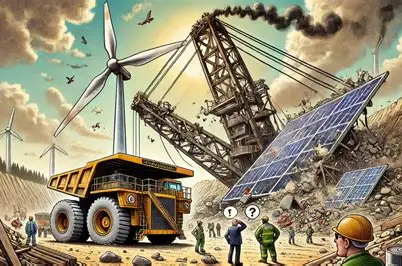
In order to promote truly green energy solutions, we need to highlight and debate some of the current practices of green energy more openly. Only by doing so can we device smart alternatives and work-around solutions that seek to mitigate the risk of the “green paradox.”
As we discuss in our forthcoming book, Designing Smart and Resilient Cities for a Post-Pandemic World: Metropandemic Revolution, supporting renewable types of energy is essential in order to achieve a robust, environment friendly and sustainable distribution of energy in the future.
However, studies show that wind power technology may have greater environmental impact than either nuclear power or hydropower. Also, the environmental impact is particularly an issue during the manufacturing phase of wind turbines, as these require special materials that may necessitate considerable tracts of land.
The supple, light and robust characteristics of wood springing from the Ochroma pyramidale (commonly known as the balsa tree) makes it ideal for use as core material when manufacturing various parts of the blades of wind turbines. A rough average of 150 cubic meters (5,300 cubic feet) of balsa wood is needed to manufacture a single wind turbine unit with 100-meter blades.
Commercial balsa wood is chiefly supplied by Ecuador, which accounts for up to 95 percent of all exports. China is the largest consumer, claiming roughly 78 percent of all exported balsa wood, to a market that is seeing steady increase of demand owing to various Chinese wind energy projects. The global “balsa fever” has directly impacted the deforestation of the Amazon. This is due to legal as well as irregular and illegal logging, which also imposes a great amount of suffering on the Indigenous peoples living in the area.
What can be done to remedy this paradox? Some alternative substitutes to balsa do exist, such as polyvinyl chloride (PVC) or polyethylene terephthalate (PET), or other various types of artificial admixture. There is also the possibility to use plantation-grown balsa trees instead, although these presently only exist in limited scales, and mostly so in Papua New Guinea, the world’s second largest balsa wood export nation.
Moreover, wind farms are known to impact the local wildlife to varying degrees. A way to mitigate some of this impact is to build offshore wind farms. However, these are difficult to construct in a secure and robust manner in waters deeper than around 60 meters, as a floating-wind-anchored turbine anchored on the ocean floor would be needed for depths deeper than that.
Similarly, there is also a high purchasing cost for solar power systems. Apart from the solar panels themselves, there is also a considerable cost in regards to inverter, batteries, wiring, and installation. Solar energy is popular discourse commonly referred to as “green energy.”
The pollution associated with the manufacturing process of the solar photovoltaic systems and the transportation of solar panels contributes toward the use of some toxic and hazardous materials, as well as the emission of greenhouse gases.
In addition, solar panels take up vast land areas and particularly so if they are to produce larger quantities of electricity. Moreover, solar energy needs to either be consumed instantly or stored (most commonly) in large batteries.
The Green Energy Paradox – Search Images

The offshore wind farms in the Belgian North Sea, in the port of Ostend. JAMES ARTHUR GEKIERE/BELGA MAG/AFP via Getty Images
Another often overlooked aspect that applies to both wind and solar power is that their respective turbines and panels are facing extreme recycling challenges.
The average lifespan of a wind turbines is roughly 20 years, whereas for a solar panel it is somewhere between 25 to 30 years. Decommissioning wind turbines comes with a steep cost, roughly $532,000 per wind turbine.
For offshore wind turbines the cost ranges anywhere from $223,000 to $668,800 per MW. The data regarding the cost of decommissioning solar panels is currently somewhat sketchy. However, available estimates point to a rough $60,000 for a ground-mounted 2-MW solar panel system, bringing the cost to an approximate $30,000 per MW.
While some materials are recyclable, the large wind turbine blades are not. The result is that they are often buried in landfills. Although particular solar panel components are recyclable, the aluminum frame being a notable example, many other components are not as recyclable. This means that worn out solar panel’s photovoltaic system are destined to the same end as wind turbine blades, namely in landfills where they release toxic materials into the earth.
By 2050, turbine blades will make up for approximately 43.4 million tonnes, or about 96 billion pounds of waste. Last year, wind turbine maker Vestas announced new plans for technology with the ability to separate the glass or carbon fiber from the resin in the blades, which would, in theory, render them recyclable.
While worn out blades and panels will not be a pressing issue for another decade or two, it is nevertheless important to take preventive action now. The recyclable materials in old solar modules alone will have an expected value of roughly $450 million in recoverable assets by 2030 and $15 billion by 2050. Given this lucrative potential, there should be greater incentive for both companies and researchers to find ways to optimize the recycling of blades and panels than what we are seeing at the moment.
Finding ways to address the green paradox is essential if we wish to be as sustainable and environment friendly as we purport ourselves to be. The next generation will hold us accountable by the actions we take today and this, in no small part, involves purported “green” solutions as well.
Anthony Larsson, PhD, is an author, editor and researcher.
He currently serves as Fellow at the Stockholm Chamber of Commerce, Sweden.
Dr. Larsson has previously been a researcher at the Stockholm School of Economics Institute for Research (SIR). He has also been a researcher at Karolinska Institutet, Sweden, from where he received his PhD.
He also holds an MBA and MSc degrees in political science, social anthropology, as well as business administration and economics respectively, in addition to an associate’s degree in psychology.
To date, he has authored, co-authored and edited five books along with numerous peer-reviewed scientific research papers. You may follow his research either on his Routledge author page, his Amazon author page, or his Goodreads author page.
Andreas Hazigeorgiou, PhD, is the CEO of the Stockholm Chamber of Commerce, Sweden, and affiliated researcher at the School of Architecture and the Built Environment, KTH Royal Institute of Technology. Dr. Hatzigeorgiou’s research has been published in peer-reviewed journals and in reports for organizations such as the OECD.
He received his PhD in economics from Lund University, Sweden, and graduated as a Fulbright Scholar from the Gerald R. Ford School of Public Policy at the University of Michigan, Ann Arbor. He has been the recipient of several grants and scholarships, among others from the Royal Swedish Academy of Engineering Sciences, and the Swedish Royal Court.
Dr. Hatzigeorgiou has also served as advisor to Sweden’s minister for trade and Nordic cooperation and as a researcher at the World Bank in Washington, D.C. Selected among Sweden’s top agenda-setters within climate and sustainability, Dr Hatzigeorgiou is a frequent participant in the debate on cities, business climate, entrepreneurship, sustainability and innovation.
Discover the truth behind renewable energy!
The Hidden Life Cycle of Solar Panels – Search Videos
Discover The Hidden Life Cycle of Solar Panels from creation to sustainable energy!  Uncover the secrets behind their lifecycle and why they matter for our planet. Join the green revolution today! #SolarEnergy #EcoFriendly #RenewableEnergy
Unraveling the Myths Surrounding Renewable Energy Adoption – Search Videos
 Unraveling the Myths Surrounding Renewable Energy Adoption There’s so much misinformation out there, and we’re here to set the record straight. Let’s dive into the myths and shine some light on the path to a sustainable future! #GreenEnergy #MythBusting #Sustainability
10 Facts About Renewable Energy That Will Inspire a Greener Future | Watch
Nuclear Power Comeback Triggered By AI Data Centers | Watch
The Surge of Climate Skeptics on the Scientific Stage
Scaling up production of low-carbon hydrogen
Hydrogen produces zero greenhouse gas emissions at its point of use. It’s also versatile – suitable for power generation, trucking, and heat-intensive industries like steel and chemicals. We are scaling up production of low-carbon hydrogen to reduce CO2 emissions in our own facilities, and helping others do the same.
Any list of “hard-to-decarbonize” sectors typically includes the chemical industry. That’s because producing olefins – the building blocks for plastics and other modern materials – requires a large amount of heat. In fact, temperatures inside the furnaces that “crack” hydrocarbon molecules into olefins exceed 2,000 degrees Fahrenheit.
But what if these furnaces could run on hydrogen,
A fuel that produces no CO2 emissions when combusted?
That would be a game changer.
And that’s exactly what ExxonMobil is doing right now at our olefins plant in Baytown, Texas, where we’ve designed and installed pyrolysis burners that can operate on up to 100% hydrogen fuel. A total of 44 burners were installed in one of the plant’s steam cracking furnaces.
Commercial testing of these next-generation burners began in December. We tested at 98% hydrogen, which is the maximum hydrogen concentration currently available for commercial demonstration at the site, and we were able to produce ethylene and other olefins identical to those produced via traditional methods.
We’re proud to be the first company in the world to successfully demonstrate this technology at industrial scale. “We’re leading the way on hydrogen because with global demand for plastics continuing to grow, finding ways to reduce emissions from olefins production is crucial,“ said Dan Holton, senior vice president of ExxonMobil Low Carbon Solutions.
I Switched to Green Hydrogen—Here’s Why It’s Not the Endgame
Why Green Hydrogen Is Essential For Our Future! | Watch
Green versus Blue Hydrogen – Search
Getting “hydrogen-ready”
What’s next? We plan to install these 100% hydrogen-capable burners in additional steam cracking furnaces at our Baytown Olefins Plant over the next few years.
We’re getting “hydrogen-ready” because we’re planning to build a plant at Baytown that would produce up to 1 billion cubic feet per day of hydrogen. And not just any hydrogen: Ours will have very low carbon intensity because we will capture and store more than 98% of the CO2 emissions associated with its production.
Switching to hydrogen can significantly reduce CO2 emissions. For example, at the furnace in which we installed the new burners, we demonstrated a 90%* reduction in direct CO2 emissions from the furnace during our tests.
We hope our successful commercial test can encourage other manufacturers to make a similar switch. By using hydrogen to reduce emissions from olefins production, we can help reduce the carbon footprint of many essential products – everything from food packaging to car parts to medical equipment.
Today, pyrolysis burners are largely fueled by hydrocarbons, particularly natural gas.
The successful demonstration of these burners was the culmination of more than four years of work by our scientists, engineers and other specialists.
We are proud to be leading the way on hydrogen.
As a landmark report by the National Petroleum Council said, hydrogen can reduce emissions at a lower cost to society than other options – while also supporting economic growth, creating jobs and strengthening energy security.
The views expressed in these articles are the writers’ own.
Unexpected reuse of plastic bottles into a useful greenhouse for your plants | Watch
7 Countries Making Unexpected Progress on Carbon Emissions | Watch
Exploring Renewable Energy Adoption Trends Across US States | Watch
How important is hydrogen for Germany’s energy mix? | Watch
Why ‘Going Green’ Isn’t Always the Planet-Saving Solution
Can We Achieve 100% Renewable Energy by 2050? | Watch
Electric Cars Destroy Tires—Here’s Why It Happens So Fast
15 Reasons People Are Starting to Turn on Electric Cars
Top 10 Most Promising Climate Solutions | Watch
Going Green Will Not Save Us | Watch