
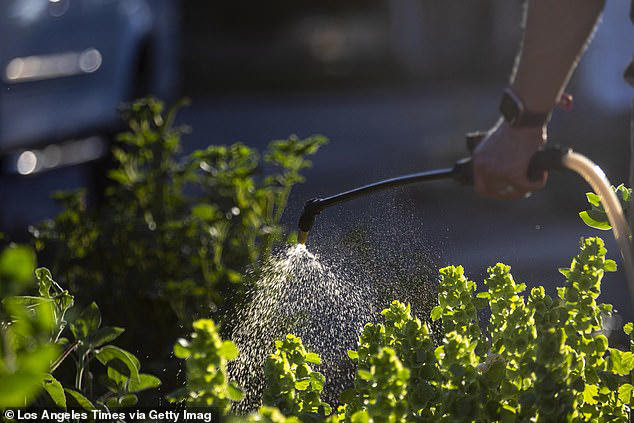
Pesticide 2,4-D is a widely used herbicide that helps controls the growth of weeds such as clovers and dandelions around a variety of field, fruit and vegetable crops
You may think you’re being healthy by filling your plate with fruits and vegetables, but experts are warning the nutritious staples may actually be covered in cancer-causing chemicals.
Based on the most recent data collected by the US Geological Survey in 2019, harvesters across Iowa, Missouri, Kansas, Illinois, Indiana, Ohio, Kentucky, Oklahoma and parts of Texas have been using the toxic herbicide 2,4-D at high amounts.
The chemical was an active component in Agent Orange – the defoliant used by American forces during the Vietnam War to destroy forestry and crops – and is now a widely used herbicide to control the growth of weeds around crops.
Farmers across the Midwest and southern states typically spray the pesticide over corn plants, soybeans, rice, wheat, hay, barley, oats, rye, sugarcane and tobacco.
Due to its ability to completely destroy vegetation, the International Agency for Research on Cancer classified 2,4-D as a ‘possible human carcinogen’ in 2015.
The classification came as a result of multiple studies suggesting that high exposure to the herbicide could damage human cells and was seen to cause cancer in animals.
While direct exposure to Pesticide 2,4-D is rare for most Americans, the toxins from the herbicide can accumulate in the body through eating unwashed grains and other crops.
And while the chemical may only be used on crops in select states, the crops from those states are shipped nationwide – indicating that all Americans are at a risk.
David Goldsmith, an environmental epidemiologist at George Washington University in Washington, DC, said: ‘The public needs to be informed and vigilant about the use of herbicides, keeping them away from children and schools.’
He told Newsweek: ‘I am concerned if farmers or farmworkers are not using effective safety gear and thus may be excessively exposed via inhalation or skin contact.
 Related video: Chemicals in plastic kill over 350,000 people (The Washington Post – Video) – Search
‘I am also concerned that 2,4-D may contaminate drinking water sources. Although, I believe that there is a direct risk for people who buy produce from fields that have had 2,4-D used on them.’
Talking about why the herbicide was being heavily used only in certain states, Gurumurthy Ramachandran, director of the Johns Hopkins Education and Research Center for Occupational Safety and Health noted that it was due to their particular type of produce.
He said: ‘The Midwest, Great Plains, and Northwestern US have the highest 2,4-D usage, largely because these regions are the primary producers of corn, soybeans, wheat, and other field crops that are commonly treated with 2,4-D.’
No usage of the toxic pesticide was seen in states such as California – known for producing artichokes, broccoli, carrots and lettuce – and states in the New England region.
Sparse use of 2,4-D was reported in Idaho, Montana, Washington, Arizona, New Mexico and Wyoming – all known for producing onions, potatoes, carrots, lentils, sweet corn, beans, peppers and pumpkins.
The data also showed low use by farmers in Florida, North Dakota, South Dakota and Wisconsin, where agricultural produce is mostly focused on celery, peas, brussels sprouts, okra, radishes, summer squash, winter squash, tomatoes and cucumbers.

America’s silent poisoning: Map shows the US states most at risk
Shockingly, data from the CDC also shows that Kentucky has the highest rates of cancer in the US – particularly lung, colon and pancreatic cancers – followed closely by Iowa and Louisiana.
Federal agencies across the US, including the Environmental Protection Agency, have deemed 2,4-D as safe for humans, despite research suggesting otherwise.
While not completely banned across the entire European Union, 2,4-D is heavily restricted and its use is significantly curtailed in many countries in the region.
In one such instance, the herbicide was not approved for use on lawns and gardens in countries like Denmark and Norway.
America’s silent poisoning: Map shows the US states most at risk
Due to its capacity to completely destroy vegetation, the International Agency for Research on Cancer classified 2,4-D as a ‘possible human carcinogen’ in 2015
Due to its capacity to completely destroy vegetation, the International Agency for Research on Cancer classified 2,4-D as a ‘possible human carcinogen’ in 2015
A 2022 BMC study found that one in three Americans had higher than acceptable levels of exposure to the toxic herbicide and were at the risk of leukemia in children, birth defects and reproductive problems in adults.
According to the Natural Resources Defense Council, scientists have also previously found links between exposure to 2,4-D and non-Hodgkin’s lymphoma (a form of blood cancer) and sarcoma (a soft-tissue cancer).
Additionally, the agency warned that high exposure to the herbicide can negatively alter the functioning of various hormones including estrogen, androgen, and thyroid hormones – paving the way for the development of cancer.
Gerald LeBlanc, a professor in the Department of Biological Sciences, North Carolina State University, told Newsweek: ‘IARC has classified 2,4-D as a Group 2B carcinogen, which means that it is possibly carcinogenic to humans.
‘In my estimation, 2,4-D might cause cancer in humans, but only at unrealistically high exposure levels.’
However, it is possible that the herbicide can cause internal body damage over time if consumed through foods.
Toxins are often stored in fat tissues, organs such as the liver and kidneys and even within nerve cells and bone marrow when ingested. An overload of harmful toxins in the body can eventually cause fatal damage to cells, tissue and crucial organs.
Ramachandran noted: ‘The issue is that pesticides can remain on or in food, and chronic dietary exposure has been linked to increased risks of metabolic syndrome, cancers, and other health problems. ‘They can also contaminate water, air, and soil, potentially affecting people living near treated fields or those exposed through drift and runoff.’
As a result, he advised Americans to ‘wash all fruits and vegetables thoroughly before consumption; consider choosing organic produce to reduce dietary pesticide exposure, especially for children and pregnant women; and avoid entering fields or areas recently treated with pesticides and follow posted warnings.’

Due to its capacity to completely destroy vegetation, the International Agency for Research on Cancer classified 2,4-D as a ‘possible human carcinogen’ in 2015
A 2022 BMC study found that one in three Americans had higher than acceptable levels of exposure to the toxic herbicide and were at the risk of leukemia in children, birth defects and reproductive problems in adults.
According to the Natural Resources Defense Council, scientists have also previously found links between exposure to 2,4-D and non-Hodgkin’s lymphoma (a form of blood cancer) and sarcoma (a soft-tissue cancer).
Additionally, the agency warned that high exposure to the herbicide can negatively alter the functioning of various hormones including estrogen, androgen, and thyroid hormones – paving the way for the development of cancer.
Gerald LeBlanc, a professor in the Department of Biological Sciences, North Carolina State University, told Newsweek: ‘IARC has classified 2,4-D as a Group 2B carcinogen, which means that it is possibly carcinogenic to humans.
‘In my estimation, 2,4-D might cause cancer in humans, but only at unrealistically high exposure levels.’
However, it is possible that the herbicide can cause internal body damage over time if consumed through foods.
Toxins are often stored in fat tissues, organs such as the liver and kidneys and even within nerve cells and bone marrow when ingested.
An overload of harmful toxins in the body can eventually cause fatal damage to cells, tissue and crucial organs.
Ramachandran noted: ‘The issue is that pesticides can remain on or in food, and chronic dietary exposure has been linked to increased risks of metabolic syndrome, cancers, and other health problems.
‘They can also contaminate water, air, and soil, potentially affecting people living near treated fields or those exposed through drift and runoff.’
As a result, he advised Americans to ‘wash all fruits and vegetables thoroughly before consumption; consider choosing organic produce to reduce dietary pesticide exposure, especially for children and pregnant women; and avoid entering fields or areas recently treated with pesticides and follow posted warnings.’
Pesticides: a life ruined by glyphosate
Story by Valérie Gauriat
Ludovic Maugé, whose life now hangs by a thread,
is among those for whom the product’s toxicity is undeniable.
But 30 years of exposure to glyphosate has shattered his dreams and his existence. He was diagnosed five years ago with an intravascular B-cell lymphoma, a rare form of cancer. It has been recognised as an occupational disease.
Glyphosate is the most widely used herbicide in the world and also the most controversial. It has been classified as “probably carcinogenic” by the International Agency for Research on Cancer (IARC) since 2015. More recent studies from research institutes such as the French National Institute of Health and Medical Research (INSERM) have established a likely link between exposure to the chemical and certain forms of cancer.
Yet, the European Union has extended its authorisation until 2033, relying on studies by EFSA and ECHA, the European authorities for food and chemical safety. Several environmental and consumer rights organisations challenged the decision before the European Court of Justice last April.
The gap between assessments results from the methodologies used by research institutes and European regulatory agencies, according to Xavier Coumoul, a toxicologist and researcher at Inserm in France. “When a pesticide manufacturer wants to market a product, the regulatory agencies require the manufacturer to conduct its own tests to prove the product is safe,” he explains.
This process raises many questions surrounding the independence of these surveys.
“EFSA gives little consideration to epidemiological studies and relies considerably on what the industry provides, whereas Inserm or IARC rely much more on the academic literature and monitoring real-life product use.”
After undergoing more chemotherapy than is usually permitted, his last hope, he says, is a transplant using his own modified stem cells. It’s a vanishingly small chance. “As my oncologist told me, we can no longer speak of a cure,” he confides.
Since his cancer was recognised as an occupational disease, Ludovic receives a modest social allowance, along with monthly compensation of 180 euros from Bayer-Monsanto — which manufactured the product that poisoned him.
“It’s a pittance, but I don’t care. What mattered most to me was to see my illness recognised as work-related.”
Despite his daily ordeal, Ludovic, who can no longer work, wants to take his fight further. “What I want is to spread the message to everyone. Glyphosate destroyed my life — it poisoned me. These products destroy people and destroy nature,” he insists. He is outraged by the EU’s decision to renew glyphosate’s authorisation.
“When I see politicians reauthorizing these products, it makes me furious. It’s the pesticide lobby. Unfortunately, we can’t do anything against these politicians and Bayer-Monsanto. If I had one thing to say to the European Union, it’s this: just ban these products. That’s it.” At the time of the broadcast of this report, several associations launched a mobilization against a bill of law aimed at easing the use of pesticides in France.
When Corporate Farming took Over Amish Farming it changed Deer Routing
The Truth About “Organic” Food Labels—What Farmers Wish You Knew
The Real Wild West Divider Line Boom and Bust #103 – Search Videos
The Cancer Survivor’s Guide: The… book by Michael Feuerstein