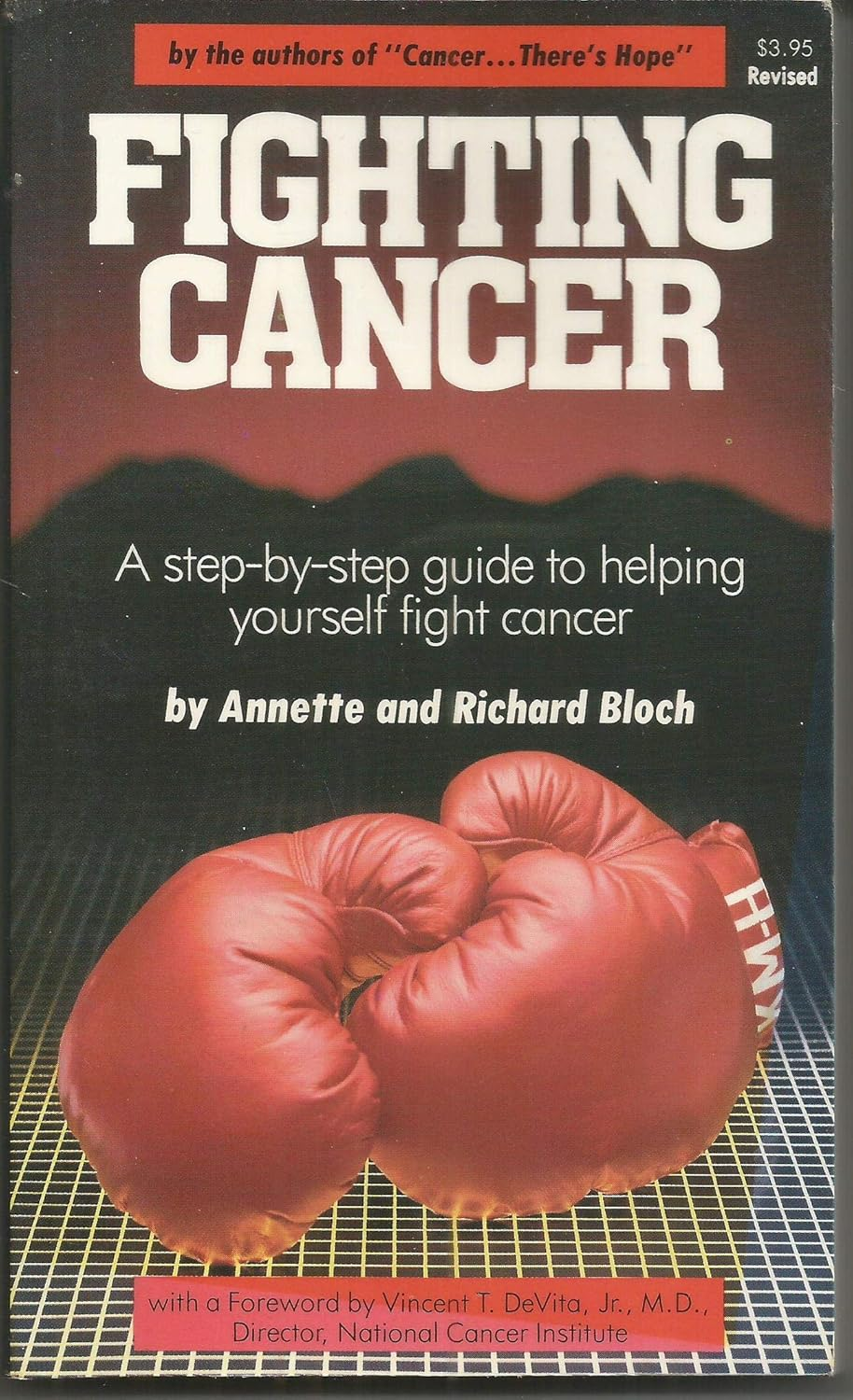
Fighting Cancer: A Step-By-Step Guide to Helping Yourself Fight Cancer
By Annette Block and Richard Bloch
Richard Adolf Bloch (February 15, 1926 – July 21, 2004)[1][2] was an American entrepreneur, and philanthropist best known for starting the H&R Block tax preparation and personal finance company with his older brother Henry in 1955. His personal experience with cancer led him to invest in helping others fight and overcome the disease.
Early life and education
Bloch was born to a Jewish family in Kansas City, the son of Hortense (Bienenstock) and Leon Bloch.[3][4] In the 4th grade, Bloch found a hand press in his uncle’s attic and began his first business as a printer. By the time he was 12, he had three automatic presses and was providing printing services to several Kansas City high schools. He sold his business to an Iowa college to use as a print course teaching model.
When he was 16, he entered the Wharton School (part of the University of Pennsylvania). In college Bloch was a member of Zeta Beta Tau, the campus’ Jewish fraternity. The youngest member of his class, he received a Bachelor of Science degree in economics in 1945. He helped pay his college expenses by purchasing used cars, repairing them and selling them for a profit.
Founding H. & R. Block
Bloch returned to Kansas City after graduating, married his wife, Annette, and began working in the municipal bond business. Around the same time, his brothers Henry and Leon launched the United Business Co. bookkeeping business. His brothers asked him to come aboard as an accountant.
Bloch left the business for about a year in 1953 to become a retail jewelry efficiency expert. While stranded on a San Francisco business trip, he realized his family in Kansas City was a top priority and returned. Soon after, Leon left the bookkeeping business to pursue a career as an attorney.
In 1955, Henry and Richard Bloch renamed the business H&R Block, changing the spelling to avoid mispronunciation, and focused on tax preparation services. While Henry managed the company in Kansas City, Richard concentrated on nationwide expansion. By 1969, he shifted his efforts overseas while Henry took charge of the company’s domestic business.
Cancer
Bloch was diagnosed with terminal lung cancer in 1978, and told he had three months to live. He refused to accept the prognosis, and sought treatment at the M.D. Anderson Center in Houston, Texas. After two years of aggressive therapy, his cancer went into remission. By 1980, he was focusing his energies on funding cancer research, and in 1982 he sold his interest in H&R Block.
Richard and Annette Bloch founded the Cancer Hotline in 1980 to educate newly diagnosed cancer patients, and their friends and families about available treatment resources. Later, they founded the R. A. Bloch Cancer Management Center and the R. A. Bloch Cancer Support Center at the University of Missouri–Kansas City. Ronald Reagan appointed him to a six-year term with the National Cancer Advisory Board in 1982.
He was a member of the President’s Circle of the National Academy of Sciences, the Institute of Medicine, and the National Institutes of Health Office of Alternative Medicine. He also received the 1994 American Society of Clinical Oncology‘s Public Service Award and the 1995 Layman’s Award from the Society of Surgical Oncology.
In the late 1980s, Bloch was diagnosed with colon cancer, which was also successfully treated.[1] Richard A. (Dick) Bloch, co-founder of H&R Block, Inc., born in Kansas City, Missouri on February 15, 1926, was the youngest of three sons.
An entrepreneur at heart, at age nine he bought a hand printing press and started a business. He was so successful that by his twelfth birthday, he had progressed to three automatic presses and was doing much of the printing for all the high schools in Kansas City. After high school, he sold his business to a college in Iowa as a model shop for use in printing courses.
Dick attended the Wharton School of Finance at the University of Pennsylvania where he received a bachelor of science degree in economics at the age of 19. While in college, he bought cars, took them apart, put them back together and then sold them to pay for his expenses. After graduation, Bloch joined his older brother, Henry, in the formation of a bookkeeping and tax preparation company. They started a new company in 1955 specializing in just tax preparation, H & R Block, Inc. Today H & R Block operates more than 11,000 offices worldwide and prepares over 24,000,000 income tax returns annually.
In 1978, Dick was told he had terminal lung cancer with 3 months to live. Refusing to accept this prognosis, he went to a major comprehensive cancer center where, after 2 years of aggressive therapy, he was told he was cured. After Dick’s bout with cancer, he focused his attention on working “to help the next person who gets cancer.” He sold his interest in H&R Block, Inc. and retired from the company in 1982 to be able to devote all his efforts to cancer. To do this, he and Annette, his wife, formed the R.A. Bloch Cancer Foundation.
Richard and Annette Bloch are founders of the Cancer HotLine in Kansas City, a volunteer organization that matches cancer patients with a survivor of that type of cancer. The Cancer Hotline has received more than 200,000 calls from newly diagnosed cancer patients since its inception in 1980.
They also founded the R.A. Bloch Cancer Management Center at the University of Missouri – Kansas City. This was a free multidisciplinary second opinion panel staffed from 1980 to 1995 by over 100 physicians donating their time to help some 250 cancer patients per year know they were receiving the best possible treatment. Because of greatly increased demand, it was closed and replaced by local institutions offering a similar service.
On May 1, 1988, the R. A. Bloch Cancer Support Center was dedicated on the grounds of the University of Missouri – Kansas City. It was a relaxing, comfortable place for patients and their supporters to congregate for the purposes of sharing and education. This was coordinated by professionals and like all other Bloch programs, completely free. Innovative support programs were developed at the Center and sent out into the community. Once these programs were established throughout the area, they felt that it was no longer necessary to maintain the facility. The Support Center closed in 2001.
Dick conceived of a computer program which the National Cancer Institute implemented under the name “PDQ” for “Physicians Data Query.” It gives the state-of-the-art treatment for every type and stage of cancer and all the current clinical trials. This information is gathered from every cancer center in the United States and over 22 foreign countries and is continuously updated by a staff of 108 researchers.
In government publications it states, “If physicians avail themselves of the opportunity now offered by PDQ, the NCI estimates the national survival rates would rise by at least 10% or more than 40,000 lives per year.” The government named the building housing this program in Bethesda, MD the R.A. Bloch International Cancer Information Center.
Dick and Annette are the authors of three books.
Annette Modell Bloch was born in Philadelphia, Pennsylvania where she lived until her marriage to Dick. She and Dick have three daughters, seven grandchildren, and seven great grandchildren. A breast cancer survivor… Read full bio
CANCER . . . there’s hope in the story of Richard and Annette’s fight against his “terminal” lung cancer. It is written, not to tell a story, but to show others what they can do to battle this disease. Fighting Cancer is a step-by-step guide for cancer patients to help themselves fight the disease. Guide for Cancer Supporters is written to help supporters exclusively. All three are available free by calling the Bloch Cancer HotLine at 800-433-0464 or from our website www.blochcancer.org.
Dick and Annette started the Fighting Cancer Rally in 1986 to demonstrate that death and cancer are not synonymous and there is a possibility of a quality of life after the diagnosis of cancer. Over 700 Cancer Survivor Day Rallies now are held simultaneously across the United States and in over 15 countries on the first Sunday in June.
At the Rally in Kansas City in June 1990, the first R.A. Bloch Cancer Survivors Park was dedicated to the 5,000,000 living Americans who had been diagnosed with cancer, 2,000,000 of whom were considered cured. Today those figures have more than doubled!
In addition to Kansas City, other Richard and Annette Bloch Cancer Survivors Parks have been completed in Bakersfield, CA; Baltimore, MD; Chicago, IL; Cleveland, OH; Columbia, SC; Columbus, OH; Dallas, TX; Houston, TX; Indianapolis, IN; Jacksonville, FL; Memphis, TN; Minneapolis, MN; Mississauga, Ontario, Canada; New Orleans, LA; Omaha, NE; Ottawa, Ontario, Canada; Phoenix, AZ; Rancho Mirage, CA; Sacramento, CA; San Diego, CA, Santa Rosa, CA; Tucson, AZ, and Tampa, FL.
Annette and Dick talked to over 1,000 cancer patients individually each year, listening to their problems and trying to help them and their families. They went around the country speaking to different groups and organizations. They have been the subject of articles in numerous magazines including Family Circle, Medical World News, People, Cosmopolitan, Vogue, and Reader’s Digest. They have appeared on national television on every major network and in numerous documentaries. They have received awards or been honored by such organizations as the American Cancer Society, the Sertoma Club, the Department of Health and Human Services, the Rotary Club, the Lion’s Club, Church of Jesus Christ of Latter-day Saints, and they received the Mankind Award from Cystic Fibrosis.
Annette Modell Bloch was born in Philadelphia, Pennsylvania where she lived until her marriage to Dick. She and Dick have three daughters, seven grandchildren, and seven great grandchildren. A breast cancer survivor and philanthropist, Annette is president of the R.A. Bloch Cancer Foundation and oversees the Bloch Cancer Hotline. She is a trustee of the Palm Springs Art Museum and is very involved with Gilda’s Club and the Desert AIDS Project in Palm Springs. Annette’s work on behalf of heart and cancer patients has established the Richard and Annette Bloch Heart Rhythm Center, Richard and Annette Bloch Cancer Care Pavilion and Radiation Oncology Pavilion at the University of Kansas Hospital.
Richard A. (Dick) Bloch, born in Kansas City, Missouri on February 15, 1926, was the youngest of three sons. An entrepreneur at heart, at age nine he bought a hand printing press and started a business. He was so successful that by his twelfth birthday, he had progressed to three automatic presses and was doing much of the printing for all the high schools in Kansas City. After high school, he sold his business to a college in Iowa as a model shop for use in printing courses.
Dick attended the Wharton School of Finance at the University of Pennsylvania where he received a bachelor of science degree in economics at the age of 19. While in college, he bought cars, took them apart, put them back together and then sold them to pay for his expenses. After graduation, Bloch joined his older brother, Henry, in the formation of a bookkeeping and tax preparation company. They started a new company in 1955 specializing in just tax preparation, H & R Block, Inc. Today H & R Block operates more than 11,000 offices worldwide and prepares over 24,000,000 income tax returns annually.
In 1978, Dick was told he had terminal lung cancer with 3 months to live. Refusing to accept this prognosis, he went to a major comprehensive cancer center where, after 2 years of aggressive therapy, he was told he was cured. After Dick’s bout with cancer, he focused his attention on working “to help the next person who gets cancer.” He sold his interest in H&R Block, Inc. and retired from the company in 1982 to be able to devote all his efforts to cancer. To do this, he and Annette, his wife, formed the R.A. Bloch Cancer Foundation.
Richard and Annette Bloch are founders of the Cancer Hot Line in Kansas City, a volunteer organization that matches cancer patients with a survivor of that type of cancer. The Cancer Hotline has received more than 200,000 calls from newly diagnosed cancer patients since its inception in 1980.
They also founded the R.A. Bloch Cancer Management Center at the University of Missouri – Kansas City. This was a free multidisciplinary second opinion panel staffed from 1980 to 1995 by over 100 physicians donating their time to help some 250 cancer patients per year know they were receiving the best possible treatment. Because of greatly increased demand, it was closed and replaced by local institutions offering a similar service.
On May 1, 1988, the R. A. Bloch Cancer Support Center was dedicated on the grounds of the University of Missouri – Kansas City. It was a relaxing, comfortable place for patients and their supporters to congregate for the purposes of sharing and education. This was coordinated by professionals and like all other Bloch programs, completely free. Innovative support programs were developed at the Center and sent out into the community. Once these programs were established throughout the area, they felt that it was no longer necessary to maintain the facility. The Support Center closed in 2001.
Dick conceived of a computer program which the National Cancer Institute implemented under the name “PDQ” for “Physicians Data Query.” It gives the state-of-the-art treatment for every type and stage of cancer and all the current clinical trials. This information is gathered from every cancer center in the United States and over 22 foreign countries and is continuously updated by a staff of 108 researchers. In government publications it states, “If physicians avail themselves of the opportunity now offered by PDQ, the NCI estimates the national survival rates would rise by at least 10% or more than 40,000 lives per year.” The government named the building housing this program in Bethesda, MD the R.A. Bloch International Cancer Information Center.
Dick and Annette are the authors of three books. CANCER . . . there’s hope is a story of Richard and Annette’s fight against his “terminal” lung cancer. It is written, not to tell a story, but to show others what they can do to battle this disease. Fighting Cancer is a step-by-step guide for cancer patients to help themselves fight the disease. Guide for Cancer Supporters is written to help supporters exclusively. All three are available free by calling the Bloch Cancer HotLine at 800-433-0464 or from our website www.blochcancer.org.
Dick and Annette started the Fighting Cancer Rally in 1986 to demonstrate that death and cancer are not synonymous and there is a possibility of a quality of life after the diagnosis of cancer. Over 700 Cancer Survivor Day Rallies now are held simultaneously across the United States and in over 15 countries on the first Sunday in June.
At the Rally in Kansas City in June 1990, the first R.A. Bloch Cancer Survivors Park was dedicated to the 5,000,000 living Americans who had been diagnosed with cancer, 2,000,000 of whom were considered cured. Today those figures have more than doubled!
In addition to Kansas City, other Richard and Annette Bloch Cancer Survivors Parks have been completed in Bakersfield, CA; Baltimore, MD; Chicago, IL; Cleveland, OH; Columbia, SC; Columbus, OH; Dallas, TX; Houston, TX; Indianapolis, IN; Jacksonville, FL; Memphis, TN; Minneapolis, MN; Mississauga, Ontario, Canada; New Orleans, LA; Omaha, NE; Ottawa, Ontario, Canada; Phoenix, AZ; Rancho Mirage, CA; Sacramento, CA; San Diego, CA, Santa Rosa, CA; Tucson, AZ, and Tampa, FL.
Annette and Dick talked to over 1,000 cancer patients individually each year, listening to their problems and trying to help them and their families. They went around the country speaking to different groups and organizations. They have been the subject of articles in numerous magazines including Family Circle, Medical World News, People, Cosmopolitan, Vogue, and Reader’s Digest.
They have appeared on national television on every major network and in numerous documentaries. They have received awards or been honored by such organizations as the American Cancer Society, the Sertoma Club, the Department of Health and Human Services, the Rotary Club, the Lion’s Club, Church of Jesus Christ of Latter-day Saints, and they received the Mankind Award from Cystic Fibrosis.
In 1982, Dick was appointed by President Reagan to the National Cancer Advisory Board for a 6-year term. In 1989, he was selected as one of the “Most Caring Individuals” from 4,000 nominees by the Caring Institute in Washington.
He was a member of the President’s Circle of the National Academy of Sciences, the Institute of Medicine and was on the NIH’s Office of Alternative Medicine for two years. Dick received the American Society of Clinical Oncology’s Public Service Award in 1994 in recognition of exemplary contributions to the field of oncology and to patients with cancer.
He received the 1995 Layman’s Award from the Society of Surgical Oncology at their Annual Convention. Also in 1995, Dick and Annette received Coping Magazine’s 1995 Hero Award for Lifetime Achievement. In 2003, Dick was honored as the first recipient of the Allesandro di Montezemolo Lifetime Achievement Award given by the American Italian Cancer Foundation for his dedication to helping cancer patients, especially the development of PDQ.
Dick died in 2004 of heart failure. His family and staff continue his work through the R A Bloch Cancer Foundation to give hope and help to those diagnosed with cancer. Amazon.com: Richard Bloch: books, biography, latest update
Cancer …there’s hope
In 1978, Richard Bloch, co-founder and honorary chairman of the board of H&R Block, Inc., was diagnosed with lung cancer and told he had only a few months to live. With the help of his wife, Annette, the doctors who said he could lick the disease, and with a stubborn determination to survive, Bloch waged a bitter, painful, two-year war on the insidious disease.
He was completely cured.
So dramatic was his fight and recovery that Bloch and his wife decided to spend their lives helping to convince others that they too can cope with cancer. The purpose of this book is to advise cancer patients, their relatives and friends what could be involved and what some of their options are.
It is also to advise doctors and other professionals what reactions there could be to statements or treatments. The more knowledge we have about this dreaded disease, the better we can help ourselves and others cope.
How does the immune system fight Cancer Bing Videos