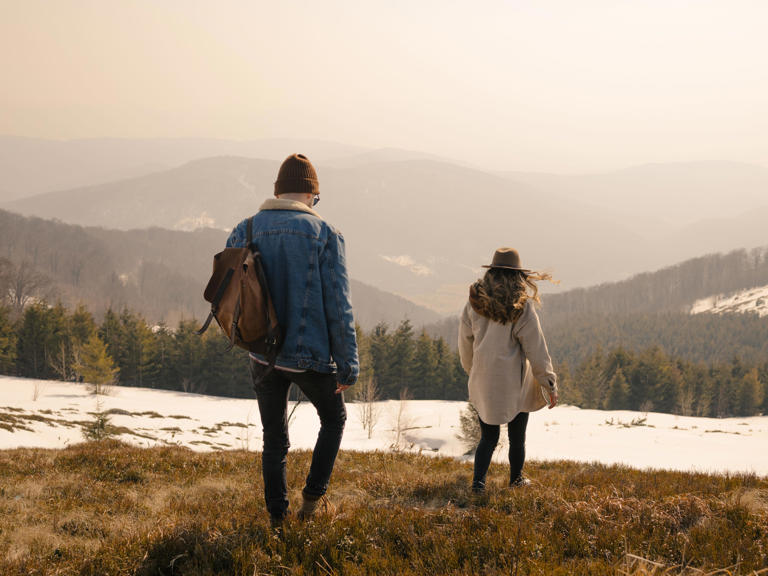
The author and his wife (not pictured) found their marriage getting stronger after moving to a small town in the mountains. © Serhii Mazur/Getty Images
Moving to a small town strengthened our marriage. Being far from friends and family meant we had to learn to communicate better.
Story by insider@insider.com (Adam Meyer)
- My wife and I have been living in a small town of about 11,000 people for eight years.
- We moved to spend more time with our kids and enjoy a slower pace of life.
- Moving away from our friends and family had the unexpected benefit of strengthening our marriage.
Eight years ago, my wife and I did something our friends and family thought was borderline crazy: We packed up our lives in Calgary, Alberta (population of just under 1.5 million), and moved to Nelson, British Columbia — a quiet mountain town of about 11,000 people nestled in the West Kootenays.
We moved so we could spend more time with our two kids, have less financial pressure, and experience a slower pace of life. But what we didn’t realize was that moving to a remote town would also strip away every bit of outside support we’d been leaning on, and ultimately strengthen our marriage.
We learned to communicate better
In Calgary, our relationship was buffered by a wide social network. If we fought, I might grab a beer with a friend, and my wife might go for coffee with hers. If we needed a babysitter, grandparents were happy to step in.
In Nelson, however, life is different. We didn’t know anyone our first year here. There were no casual friend drop-ins, no relatives to swoop in for a date night, no colleagues to vent to over lunch. When tensions rose, whether over money, sleep deprivation, or whose turn it was to make dinner, there was no one else to absorb the frustration.
Without the option to escape into our respective social circles, arguments sometimes felt more intense. But over time, that changed. We began to see each other less as adversaries in a disagreement and more as co-problem-solvers building a new life together.
It took time and effort to learn how to communicate more directly. For example, asking for help outright instead of hoping the other would notice and making passive-aggressive comments. We worked on apologizing quickly, knowing we couldn’t afford to stew in silence for days.
Moving to a small town strengthened our marriage. Being far from friends and family meant we had to learn to communicate better.
We built a new rhythm together
Life in the big city meant we lived and died by our calendars: work events, dinners with friends, birthday parties, and a dozen other commitments that kept us perpetually in motion. Conversely, our social calendar was blank that first year in Nelson.
That emptiness turned out to be an unexpected gift. We began cooking dinner together most nights, experimenting with new recipes because we finally had time for it. We took slow walks along the scenic lakefront, pushing the stroller and talking about things we’d never made space for before. Things like what kind of life we wanted and what our priorities were (like me eventually leaving my day job and taking the leap to become a freelance writer).
Even small, everyday rituals like making coffee in the morning while the kids played or folding laundry together in the evening became a kind of glue that bonded us. We were no longer ships passing each other in the night; we were living alongside each other as companions in a way we hadn’t since before becoming parents.
We relied on each other in ways we never had before
Of course, there were hard days. I missed having friends to grab a beer or go for a run with; my wife missed the spontaneous coffee dates with her mom. But in hindsight, those challenges were the training ground for a stronger marriage.
Moving to a remote mountain town stripped away the noise and convenience that had been cushioning our relationship in the big city. The change forced us to build something more durable than habit or routine. We learned how to rely on one another as true partners, not just live together like roommates. And that, more than the mountains, the lake, or the slower pace of life, has been the biggest gift this little town has given us.
I’m a city girl who moved to an 80-person community in remote Canada. I never expected how much my life would improve.© Hilary Messer-Barrow – Search
- I moved from Vancouver, British Columbia, to the 80-person community of Beaver Creek, Yukon.
- I had to learn a lot — including how to cook, since I’m five hours from the nearest grocery store.
- The biggest surprise was how well I adjusted to my new lifestyle and learned to love alone time.
After spending my whole life in a Canadian city, I relocated to an 80-person community.
I was born and raised a city girl, but at the beginning of 2019 I moved from the temperate metropolis of Vancouver, British Columbia, to the remote, 80-person community of Beaver Creek, Yukon.
My boyfriend (now my husband) had to relocate for work, and there was never a question whether I’d join him. But I still had major reservations.
I always imagined we’d stay in Beaver Creek for the shortest time possible and move away. But the moment I arrived, I realized this place would change my life.
Here are some of the things that surprised me most after the move.
I was blown away by the kindness and support from my new neighbors. ©Hilary Messer-Barrow
The weather in Beaver Creek can be harsh (I’m talking minus 40 degrees Fahrenheit), and the winters are long and dark. Plus, we’re a 10-hour round trip from the nearest hospital.
Neighbors check in with one another. They offer to pick up groceries when they go five hours into town, help if you have vehicle trouble, and give you the cup of sugar you’re missing.
My own experience was a flat tire at the height of the coronavirus pandemic. The Alaska Highway was even quieter than usual. I had the jack under the car, and I was desperately trying to remove the tire, which was stuck.
The first car that came by stopped to help, and so did the second. A local Royal Canadian Mounted Police officer came out to help me, and when he couldn’t, he drove an hour and a half to ask a neighbor for assistance.
Up here, that’s just what you do.
I learned to cook and realized I love it. ©Hilary Messer-Barrow
Before I moved, loading up at the Whole Foods salad bar was as close as I got to cooking. A friend once stayed at our apartment while we were on holiday and lamented that we didn’t own a single pot or pan.
I was in for a shock when I suddenly had to learn how to cook and stock a pantry with food that lasts six to eight weeks in between shopping trips.
The drive to and from the nearest grocery store is incredibly beautiful. On the Alaska Highway, the views are out of this world, and it’s not uncommon to see bears, moose, lynx, coyotes, and even wolves. But it’s also a 10 hours round trip.
I was surprised to find that I like cooking — love it, even. I also love planning our meals, organizing the freezer and pantry, and thinking ahead.
I’ve learned to make preserves, yogurt, and kombucha. I bake our own bread and bagels. And, if we have a hankering for a sweet, I make that, too: pies, kettle corn, candied fruits.
I’ve connected with the land around me. ©Hilary Messer-Barrow
In Vancouver, I had easy access to restaurants, shops, parks, beaches, and mountains, and I didn’t ever really think about it. When I learned we’d be moving, I was horrified.
How would I live without all of this? Surprise: Remote Northern Canada has made me appreciate everything about the outdoors. I hike and cross-country ski, and I marvel every single day at how lucky I am.
My friends and family cannot believe that urban Hilary has embraced Beaver Creek.
I’ve learned to love and cherish my alone time. ©Hilary Messer-Barrow
“Aren’t you lonely?” is a frequent refrain I hear when people find out about my living situation. And I was really lonely during those first dark, cold months. My husband was working 12-hour shifts, sometimes during the day, sometimes overnight.
Time dragged. I’d go for walks with our new puppy, but in the dead of winter it’s easy to walk in Beaver Creek without seeing a soul. Days went by without any real human interaction aside from my husband.
I tried to learn how to cook. I did my home workouts. I kept up with remote work. I called my friends and family back in Vancouver. And still, the days were long and the loneliness felt overwhelming.
It wasn’t long before I learned to embrace my time alone, especially in nature. Beaver Creek is a beautiful place surrounded by mountains, trees, rivers, and streams.
Compared with green spaces in the city, the land here is untouched, and experiencing all that alone has been transformational.
Now, alone time outside is the most restorative part of my day. I can’t live without it, no matter the weather.
.
The light (and lack of it) has definitely affected me. ©Hilary Messer-Barrow
In the winter, the nights are long, and the days bring half-light, nothing more. I arrived in the Yukon shortly after the winter solstice, when the sun came up at about noon and was gone again mere hours later.
I found it exhausting. I’m an early riser, and that didn’t change, but by 4 p.m. I wanted to go to bed.
Eventually, I learned to turn on more lights and get outside regardless of the dark. I even learned to love the nuances of darkness, especially the moon and stars.
The dark winters were definitely an adjustment, but what really surprised me was the light in the summers. The midnight sun, as it’s affectionately called, comes gradually but with a force.
I recall telling a friend, a lifelong Northerner, that I had no problem falling asleep, so I was confident the midnight sun wouldn’t affect me. I was so wrong.
In the summer, I find myself working away at something, unaware that it’s midnight or 1 a.m. That first summer, I lay awake in bed, trying to relax, my whole body yearning to do a workout, tackle a deep clean, or complete a 1,000-piece puzzle.
We quickly learned that blackout curtains and a rigid evening routine were essential at this time of year.
The biggest surprise was how well I adapted to all the changes. ©Hilary Messer-Barrow
I don’t like change, so the move was petrifying.
But all the things I feared were things I ended up embracing: I’m much stronger than I thought I was, I can cook, I can change a tire, I’m comfortable walking in the wilderness alone with a knife and bear spray, I can garden.
Had someone told me over five years ago that I’d be the person I am today, I would’ve laughed. Now, here I am, feeling so happy.
This story was originally published on April 24, 2022, and was most recently updated on March 17, 2025.
I live off the grid — to get groceries, it’s a 300-mile commute that takes 2 days