
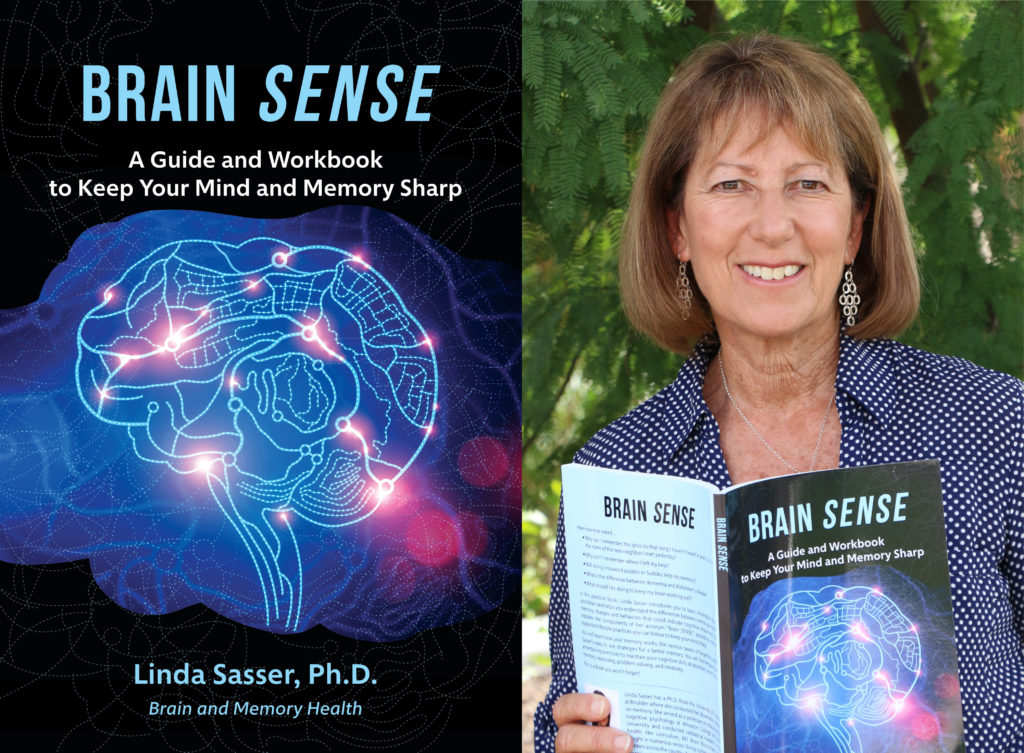
Brain SENSE : A Guide and Workbook to Keep Your Mind and Memory Sharp
Linda Sasser, Ph.D.
Purchase here from Amazon: Brain SENSE
Have you ever asked…
- Why can I remember the lyrics to that song I haven’t heard in years, but not the name of the new neighbor I met yesterday?
- Why can’t I remember where I left my keys?
- Will doing crossword puzzles or Sudoku help my memory?
- What is the difference between dementia and Alzheimer’s disease?
- What should I be doing to keep my brain working well?
- Video – Brain and Memory Health
Would you like a summary of the Brain SENSE acronym
Absolutely! The Brain SENSE acronym from Brain SENSE: A Guide and Workbook to Keep Your Mind and Memory Sharp by Dr. Linda Sasser is a framework designed to promote cognitive wellness through everyday habits. Each letter stands for a key principle that supports brain health:
 B.R.A.I.N. S.E.N.S.E. Breakdown
- B – Believe in your brain’s ability to change Emphasizes neuroplasticity—the brain’s capacity to adapt and grow at any age.
- R – Reduce chronic stress Chronic stress impairs memory and cognitive function; managing it is essential for mental clarity.
- A – Activate your brain daily Engage in mentally stimulating activities like puzzles, reading, or learning new skills.
- I – Include physical exercise Regular movement boosts blood flow to the brain and supports memory and executive function.
- N – Nurture social connections Meaningful relationships and social engagement help protect against cognitive decline.
- S – Sleep well Quality sleep is vital for memory consolidation and overall brain health.
- E – Eat brain-healthy foods A diet rich in antioxidants, omega-3s, and whole foods supports cognitive function.
- N – Notice what you’re doing Practicing mindfulness improves attention and reduces forgetfulness.
- S – Seek new learning Lifelong learning keeps the brain agile and builds cognitive reserve.
- E – Embrace a positive attitude Optimism and resilience are linked to better brain health and aging outcomes.
This acronym serves as both a guide and a checklist for maintaining mental sharpness:
Exactly — the Brain SENSE acronym is both a practical guide and a daily checklist for keeping your mind agile and memory strong.
Here’s how you can use it as a personal brain-health tracker:
 Brain SENSE Daily Checklist
| Principle | Daily Action Example |
|---|---|
| B – Believe in your brain’s ability to change | Remind yourself: “I can learn and grow at any age.” |
| R – Reduce chronic stress | Practice deep breathing or take a short walk to decompress. |
| A – Activate your brain daily | Solve a puzzle, read a chapter, or learn a new word. |
| I – Include physical exercise | Do 30 minutes of walking, stretching, or dancing. |
| N – Nurture social connections | Call a friend or join a group activity. |
| S – Sleep well | Aim for 7–8 hours of restful sleep. |
| E – Eat brain-healthy foods | Choose leafy greens, berries, or omega-3-rich foods. |
| N – Notice what you’re doing | Stay present while completing tasks — avoid multitasking. |
| S – Seek new learning | Try a new hobby or explore a topic you’re curious about. |
| E – Embrace a positive attitude | Reflect on something you’re grateful for today. |
You can even print this out and check off each item as part of your morning or evening routine.
Here’s a simple and engaging Brain SENSE Daily Tracker you can use to check off each brain-healthy habit during your morning or evening routine:
Brain SENSE Daily Tracker
| Principle | Daily Action |
|---|---|---|
| ☐ | B – Believe in your brain’s ability to change | Say: “I’m capable of learning and growing.” |
| ☐ | R – Reduce chronic stress | Take 5 deep breaths or a short walk. |
| ☐ | A – Activate your brain daily | Read, solve a puzzle, or learn something new. |
| ☐ | I – Include physical exercise | Move your body for at least 30 minutes. |
| ☐ | N – Nurture social connections | Talk to a friend or join a group activity. |
| ☐ | S – Sleep well | Aim for 7–8 hours of restful sleep. |
| ☐ | E – Eat brain-healthy foods | Choose berries, greens, or omega-3s. |
| ☐ | N – Notice what you’re doing | Stay present and avoid multitasking. |
| ☐ | S – Seek new learning | Explore a new topic or hobby. |
| ☐ | E – Embrace a positive attitude | Reflect on one thing you’re grateful for. |
What are Dr Sasser’s Theories About Brain Sense
Dr. Linda Sasser’s theories about Brain SENSE center on the idea that brain health can be actively maintained and improved through intentional lifestyle choices, grounded in neuroscience and educational psychology.
Here’s a deeper look at her key concepts and theoretical foundations:
Core Theories Behind Brain SENSE
- Neuroplasticity at Every Age Dr. Sasser emphasizes that the brain retains its ability to change and grow throughout life, even into our 90s. This belief underpins her encouragement for lifelong learning and mental engagement.
- The Brain SENSE Framework The acronym SENSE originally stood for:
- Socialization
- Exercise
- Nutrition
- Sleep
- Education These five pillars are evidence-based lifestyle factors that support cognitive vitality. Later, she expanded this into the full Brain SENSE model, adding more detailed behavioral strategies.
- Memory as a Learnable Skill Drawing from her background in educational psychology, Dr. Sasser views memory not as a fixed trait but as a skill that can be strengthened. She teaches techniques like association, visualization, and repetition to improve recall.
- Distinguishing Normal Aging from Cognitive Decline A major goal of her work is to help people understand the difference between typical age-related forgetfulness and signs of cognitive impairment. This empowers individuals to seek help when needed and avoid unnecessary worry.
- The PAVE Strategy In addition to Brain SENSE, Dr. Sasser developed the PAVE method to enhance memory:
- Pay Attention
- Actively Involve
- Visualize
- Exercise These strategies are designed to stimulate multiple areas of the brain and reinforce learning.
- Faith and Purpose as Cognitive Anchors In her later work, Dr. Sasser integrates spirituality and purpose as important motivators for brain health, especially for older adults. She believes that meaningful engagement in life contributes to mental resilience.
Let’s build your personalized Brain SENSE Plan—a weekly guide tailored to help you stay mentally sharp, energized, and emotionally balanced.
You can use this as a habit tracker, journal prompt, or daily wellness check-in:
Your Personalized Brain SENSE Plan
 Weekly Goals
| Principle | Goal |
|---|---|
| Belief | Affirms your ability to grow: “I am capable of learning and adapting.” |
| Reduce Stress | Choose one stress-reducing activity: meditation, walking, journaling, or music. |
| Activate Brain | Pick a mental challenge: crossword, book, podcast, or new skill. |
| Include Exercise | Schedule 3–5 sessions of movement: walking, yoga, dancing, or strength training. |
| Nurture Connections | Reach out to at least 3 people this week—call, text, or meet. |
| Sleep Well | Set a consistent bedtime and wind-down routine. |
| Eat Smart | Add brain-friendly foods: berries, leafy greens, nuts, fish, or whole grains. |
| Notice Mindfully | Practice mindfulness once a day—focus on breathing, eating, or walking. |
| Seek Learning | Explore something new: a documentary, article, or hobby. |
| Embrace Positivity | Write down one thing you’re grateful for each day. |
 Daily Tracker Template &Tracker
| Day | B | R | A | I | N | S | E | N | S | E | NOTES & Reflection |
|---|---|---|---|---|---|---|---|---|---|---|---|
| Monday | ☐ | ☐ | ☐ | ☐ | ☐ | ☐ | ☐ | ☐ | ☐ | ☐ | |
| Tuesday | ☐ | ☐ | ☐ | ☐ | ☐ | ☐ | ☐ | ☐ | ☐ | ☐ | |
| Wednesday | ☐ | ☐ | ☐ | ☐ | ☐ | ☐ | ☐ | ☐ | ☐ | ☐ | |
| Thursday | ☐ | ☐ | ☐ | ☐ | ☐ | ☐ | ☐ | ☐ | ☐ | ☐ | |
| Friday | ☐ | ☐ | ☐ | ☐ | ☐ | ☐ | ☐ | ☐ | ☐ | ☐ | |
| Saturday | ☐ | ☐ | ☐ | ☐ | ☐ | ☐ | ☐ | ☐ | ☐ | ☐ | |
| Sunday | ☐ | ☐ | ☐ | ☐ | ☐ | ☐ | ☐ | ☐ | ☐ | ☐ |
Or customize it based on your lifestyle, age, or goals?
 Practical Application
Dr. Sasser’s theories are not just academic—they’re embedded in her workbook Brain SENSE, her BE! Brain Enrichment courses, and her public seminars. She encourages people to track their habits, challenge their minds, and stay socially and emotionally connected.
In this practical book, Linda Sasser introduces you to basic information about your brain and helps you understand the differences between normal age-related memory changes and behaviors that could indicate cognitive impairment. She explains the components of her acronym “Brain SENSE,” providing research-supported lifestyle practices you can follow to keep your mind sharp.
You will learn how your memory works, the various causes of forgetting, and Dr. Sasser’s easy to use strategies for a better memory. You will find engaging and entertaining exercises to maintain your cognitive skills of attention, word fluency, memory, reasoning, problem solving, and creativity.
This is a book you won’t forget!
Listen to SENSE Your Way to Better Brain Health: Strategies from Dr. Linda Sasser
Linda Sasser helps people make sense of brain health – Forward From 50
brain sense : a guide and workbook to keep your mind and memory sharp linda sasser, ph.d. – Search
brain sense : a guide and workbook to keep your mind and memory sharp linda sasser, ph.d. – Search
The #1 SIMPLE Way To STOP Dementia Before It Starts – YouTube
THIS Is #1 FASTEST Way To Get Dementia (Science Backed)
STOP Doing THIS! Your Dementia Risk Skyrockets By 80%
Chronic Disease Doctor: We Can Now Reverse Some Stage 4 Cancer? – YouTube
Dr. William Li is a world-renowned medical scientist specializing in chronic disease and blood vessel growth. Dr. William Li reveals the shocking truth about what you’re really eating.
He is Founder & President of the Angiogenesis Foundation, and his groundbreaking research has led to 44 medical treatments that target over 70 diseases. He is also the bestselling author of ‘Eat to Beat Your Diet’.
He explains:  The number one common food that feeds cancer cells The surprising link between salt and accelerated aging How poor sleep is connected to belly fat The hidden health risks of microplastics in your diet How sugar quietly fuels chronic diseases.
Is your daily diet secretly fuelling chronic disease?
00:00 Intro 02:17 What Will People Get Out of This Conversation? 03:03 What Key Diseases Correlate to Diet? 04:24 Where Is Our Society at with Health and Food? 07:56 How Cancer Works in Our Body 14:40 How to Lower Your Risk of Cancer 15:59 Foods That Fuel Cancer 17:46 Debunking “Superfoods” 18:29 Risks of Electrolytes 19:36 Lowering the Body’s Defenses: Risk of Consuming Added Sugars 21:16 Alcohol 21:57 Risks of Drinking Alcohol 22:32 How Does Stress Impact Immunity? 24:39 The Relationship Between Stress, Sleep, and Sickness 26:19 Why Lack of Sleep Contributes to Stress: The Glymphatic System 27:49 Deep Sleep Clears Your Mind and Burns Fat!
29:50 Why Are Cancer Cases in Young People Increasing?
32:43 Microplastics in Our Bodies 37:05 How Can I Lower My Exposure to Microplastics? 37:43 Benefits of Green Tea—but the Danger of Teabags! 40:06 Which Tea Has the Best Health Benefits? 41:22 Is Matcha Good for Me? 42:21 The Link Between Cured Meats and Cancer 45:59 My Personal Story with Cancer 58:39 Groundbreaking New Studies with AI 1:02:28 Successful Cancer Treatment Linked to Specific Gut Bacteria 1:08:51 What’s the Best Food Diet? 1:12:53 Why Is Japan Considered One of the Healthiest Countries? 1:16:19 The Different Body Fat Types and How They Affect You 1:29:31 Visceral Fat: Dangerous for Cancer 1:38:22 The Link Between Fat and Coffee 1:41:33 Is Fasting Good for Fat Loss? 1:46:18 Brain Diseases 1:52:35 Food Is Medicine 1:54:10 Should We Use Food Supplements? 1:57:05 The Superfoods Helping Our Body
@tarable7778
3:06 THAT IS KEY.my grandma lived to ninety nine, my uncle just passed this year at ninety four. They were farmers, ate what they grew. I’m lucky to have lived with them most of my childhood.i am trying to eat healthy like they did, but the store food is Not the same as homegrown farmer food.
Top Actionable Takeaways from Dr Lee’s • Drink 3–4 cups of coffee or tea daily (matcha, green or Earl Grey) to boost immune patrol • Eat these superfoods every week: • A handful of tree nuts (walnuts, almonds) • ½ cup cooked tomatoes (2–3×/wk) • ½ cup berries (daily) • Generous servings of leafy greens (kale, bok choy) • Swap out plastic cups/plates/tea bags for glass, ceramic or loose-leaf/powdered teas to avoid microplastics • Fast 12–16 hours each day: finish dinner by 8 PM and wait at least 1 hour after waking to eat • Activate brown fat with cold showers or cool-room sleeping to burn harmful visceral fat • Manage stress with short micro-breaks (deep breathing, quick walks or sprints) so cortisol spikes stay brief • Prioritize 7–9 hours of quality sleep—deep REM clears brain toxins and rebuilds defenses • If needed, top off with vitamin D, omega-3s and targeted probiotics (e.g. pomegranate-boosted Akkermansia)
You can purchase Dr William’s book, ‘Eat To Beat Your Diet’, here: https://amzn.to/44HiE7Z
Read Comments in the Youtube Links:
@caroldanson5476
I am a retired RN with my degree and have questioned the health care system I was working in Ontario. At the age of 26 I decided not to eat any man made stuff, like margarine, salad dressings with sugar ( I make my own vinegar and oil) and most canned foods and meats like hot dogs and other prepared meats. At 78 I feel healthy, still doing exercises and healthy activities. I am a Christian and use prayer to complete my healthy lifestyle.
@sloaneandres5291
RN/NP here as well. Been a nurse since 1987 and totally lost faith in the system 15 years ago. Jesus has given us AMAZING bodies if we just took care of them. I am constantly telling my patients to eat right, exercise, sleep and then you can get rid of all the HTN, DM 2, and cholesterol drugs which are killing people in the long run.
@amandaholley8717
@oldsage578 That’s tough … and I’m sure there are many in there who value you so much. My mother has had to use the hospitals … Well, it was occasional staff that made a difference. The kindness of human beings is a powerful healing mechanism. and yes, take pack lunches and avoid hospital food and drinks like the plague. Crazy system we live in.
I have been told the UK health care system is deliberately pressured in order to force privatization. So, folks like you have a task that might take its toll. Don’t let it. Look after yourself. Perhaps train yourself in an alternative therapy. I’m sure you’d be grateful that you did … and feel independent!
@RS-ud6np
Amen. Fact is we are all going to pass away. We owe it to ourselves to explore and research, and read the #1 selling book in the world, the answers are there, how it all started, and how it will end on earth but it doesn’t have to end here, eternal life is promised. Read the Good book.
DO YOUR OWN RESEARCH….Best of luck to you.