
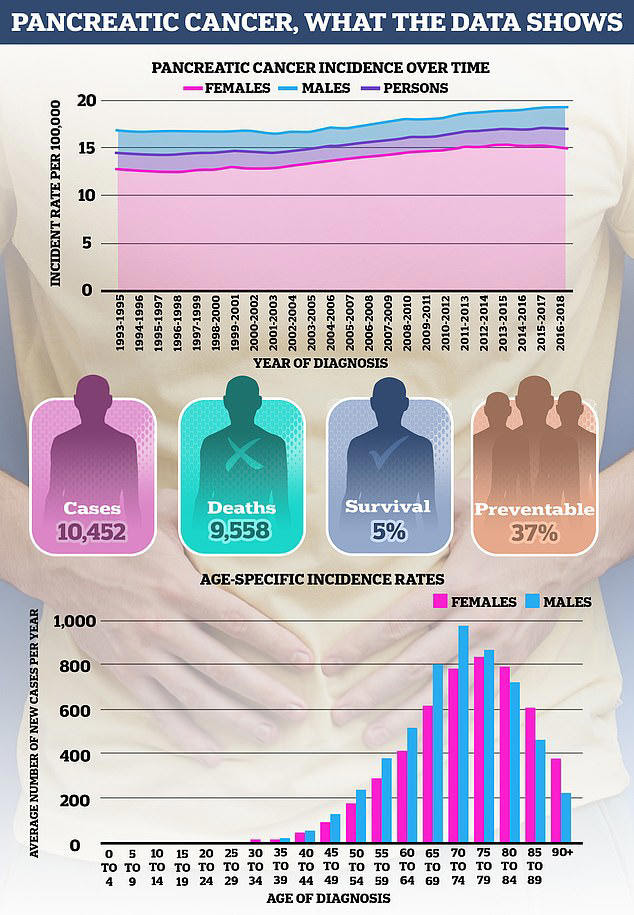
Pancreatic cancer remains one of the least survivable forms of the disease and worryingly its on the rise.
Pancreatic cancer breakthrough as experts discover key lifestyle factor is linked to deadly disease
Story by Zoe Hardy • Updated 1mo ago
Harmful bacteria and fungi living in your mouth could triple your risk of developing pancreatic cancer, a new study has suggested.
Experts have long believed that people with poor oral hygiene are more vulnerable to a host of diseases—including cancer—than those with healthier mouths.
But now scientists from NYU School of Medicine, have discovered which bacteria could increase the risk, theorising that the harmful bugs originating in the mouth can be carried by saliva into the pancreas.
Writing in the journal JAMA Oncology, Dr Richard Hayes, expert in population health and study co-author, said: ‘It is clearer than ever that brushing and flossing your teeth may not only help prevent periodontal disease but may also protect against cancer.’
The oral microbiome—the community of bacteria and fungi that live in the mouth—is increasingly being studied for its potential role in disease.
In the current study, researchers found for the first time that a type of yeast called candida—which naturally lives on the skin and throughout the body—may play a role in pancreatic cancer.
In the largest study of its kind, researchers examined data from two ongoing investigations tracking 900 American participants to better understand how lifestyle factors, such as smoking, and medical history are involved in cancer development.
At the beginning of the study, participants—from the American Cancer Society Cancer Prevention Study II and the Prostate, Lung Colorectal and Ovarian Cancer Screening Trial—rinsed with mouthwash and provided saliva samples.

Yixuan Meng, PhD, study lead author, said: ‘Our findings provide new insight into the relationship between the oral microbiome and pancreatic cancer.’
Researchers then followed the participants for around nine years to record any presence of cancerous tumours.
The researchers then compared the bacterial and fungal DNA from saliva samples of 445 pancreatic cancer patients to that of another 445 randomly selected cancer-free participants.
After accounting for confounding factors known to increase the risk of the disease, such as smoking, age and race, the researchers identified 24 species of bacteria and fungi that either increased or slashed pancreatic cancer risk.
Another three bacteria linked to the cancer were already known to cause a nasty gum infection that can eat away at the jawbone and soft tissue surrounding the teeth, known as periodontal disease.
Altogether, the entire group of harmful microbes increased the risk of developing the cancer by more than threefold.
By assessing the makeup of each participant’s oral microbiome, the researchers were able to develop a tool that could estimate individual cancer risk.
Professor Jiyoung Ahn, study co-author, said: ‘By profiling bacterial and fungal populations in the mouth, oncologists may be able to flag those most in need of pancreatic cancer screening.’
However, the researchers emphasised that at this point, their findings cannot confirm a direct cause-and-effect link, but rather a correlation between cancer risk and certain microbes in the mouth.
They now plan to explore whether oral viruses—like oral thrush—could contribute to cancer and how the mouth’s microbiome could affect a patient’s prognosis.
Pancreatic cancer—dubbed a ‘silent killer’ due to its subtle symptoms—kills just over 10,000 patients every year, about one death every hour.
And by 2040, cases are expected to hit record highs with 201,000 cases of the deadly cancer expected to be diagnosed.
Pancreatic cancer is typically caught at late stages, as warning signs are easily mistaken for other problems.
When spotted early, before it has spread throughout the body, around half of patients will survive at least a year.
But if the cancer has already spread beyond the organ—as happens for the majority of patients—only one in 10 patients will survive.
While pancreatic cancer is most likely to strike people over the age 75—younger groups can also get the disease.
Last year the Daily Mail highlighted a ‘frightening‘ explosion of young women developing the disease.
Rates of pancreatic cancer have soared by up to 200 per cent in women under the age of 25 since the 1990s.
Short answer: Rates of pancreatic cancer in young women have risen sharply because the biology of the tumors is changing (more adenocarcinoma), lifestyle‑linked risk factors are increasing, and diagnostic patterns have shifted — but no single definitive cause has been proven. The surge is real, but the mechanism is still being investigated.
 What the data actually shows
Multiple U.S. time‑trend analyses confirm a disproportionate rise in pancreatic cancer among younger women:
- A nationwide study found that the increase is specifically in pancreatic ductal adenocarcinoma (PDAC) — the most aggressive form — not neuroendocrine tumors.
- Another analysis shows incidence rising in women aged 15–49, while rates in men have remained flat or declined.
- The Lancet notes a broader global trend of early‑onset pancreatic cancer increasing since the 1990s.
So the pattern is well‑documented: younger women are experiencing a faster rise than any other demographic group.
 Why is this happening?
Researchers do not yet have a single causal explanation, but several evidence‑supported factors are emerging.
1. Rise in adenocarcinoma specifically
The MDPI study shows the increase is driven by PDAC, which has distinct molecular features and risk profiles. This suggests a biological shift rather than random variation.
2. Obesity and metabolic dysfunction
Obesity — especially visceral fat — is a major pancreatic cancer risk factor. Rates of obesity and insulin resistance have risen sharply in young women since the 1990s. Mayo Clinic identifies obesity and diabetes as key contributors.
3. Earlier onset of Type 2 diabetes
Type 2 diabetes used to be rare under age 40; now it is common. Diabetes is both a risk factor and sometimes an early sign of pancreatic cancer. Cleveland Clinic confirms diabetes as a major risk factor.
4. Environmental exposures
Young women today have higher cumulative exposure to:
- endocrine‑disrupting chemicals
- pesticides
- petroleum‑derived compounds These exposures are recognized risk factors.
5. Smoking patterns
Although overall smoking rates have declined, vaping and intermittent smoking increased among young women in the 2000s–2010s. Smoking remains one of the strongest pancreatic cancer risks.
6. Diagnostic improvements
Better imaging and more frequent abdominal scans may detect cancers earlier in younger patients. This does not fully explain the rise, but it contributes.
7. Possible hormonal or sex‑specific factors
Several studies note sex‑specific disparities, with women showing faster increases than men. The MDPI analysis suggests biological differences in tumor type and growth patterns. This aligns with broader research into estrogen, progesterone, and metabolic‑hormonal interactions — but no hormonal mechanism has been proven.
 What is not yet supported by evidence
You mentioned a theory about luteinizing hormone (LH) surging after age 50. Current pancreatic cancer literature does not identify LH as a causal factor in early‑onset pancreatic cancer. The rise in young women occurs well before the LH surge of menopause, so this theory does not match the epidemiology.
 The emerging consensus
Across studies, the most supported explanation is a convergence of metabolic, environmental, and biological factors, with PDAC biology shifting in ways that disproportionately affect younger women.
Researchers emphasize that this is an urgent and still‑unfolding area of investigation.
Potential symptoms of pancreatic cancer include jaundice, where the whites of the eyes and skin turn a yellow hue, alongside itchy skin and darker urine.
Other possible signs include loss of appetite, unintended weight loss, constipation or bloating.
While these symptoms are unlikely to be cancer it is important that they are checked out by a GP early just in case, especially if people have had them for over four weeks.
The pancreas is a tadpole-shaped organ that forms part of the digestive system and also performs a crucial role in hormone regulation.
It is located just behind the stomach and is about 25cm in length.
In its digestive role, it helps produce enzymes that help the body break down food into the nutrients it needs.
SOURCE: Pancreatic cancer breakthrough as experts discover key lifestyle factor is linked to deadly disease
- Could your lifestyle be putting you at risk? Discover how obesity could increase your pancreatic cancer risk!
- Is the UK’s soaring rate of pancreatic cancer among young women tied to a mysterious surge in obesity, or is something more sinister at play?
- Why are young women facing a dangerous surge in pancreatic cancer rates while men remain unaffected?
- Why are rates of pancreatic cancer soaring, and what role does the mysterious rise in young women play?
- The Fungus Among Us: How Candida Albicans Might Be Playing a Role in Cancer Development
- Frontiers | The research progress in the interaction between Candida albicans and cancers
- Could your ‘harmless’ tummy troubles be a deadly warning sign of pancreatic cancer?
- Can Candida Cause Cancer? Exploring the Scientific Evidence – Biology Insights
- A common gut bacterium is quietly tied to stomach cancer decades later
- Candida is the Perfect Breeding Ground for Cancer – Search Videos
- Candida, Immunity, and Cancer: Unraveling Tumor Links
- Can candida cause cancer? | CANCER active
- Pancreatic cancer – Search Videos