
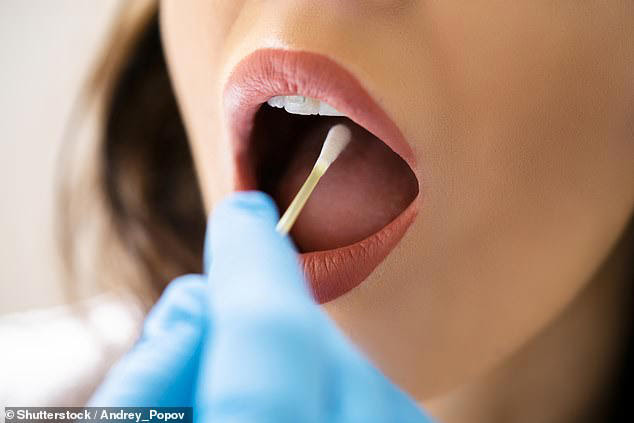
Yixuan Meng, PhD, study lead author, said: ‘Our findings provide new insight into the relationship between the oral microbiome and pancreatic cancer.’
Pancreatic cancer breakthrough as experts discover key lifestyle factor is linked to deadly disease
Story by Zoe Hardy
Harmful bacteria and fungi living in your mouth could triple your risk of developing pancreatic cancer, a new study has suggested.
Experts have long believed that people with poor oral hygiene are more vulnerable to a host of diseases—including cancer—than those with healthier mouths.
But now scientists from NYU School of Medicine, have discovered which bacteria could increase the risk, theorising that the harmful bugs originating in the mouth can be carried by saliva into the pancreas.
Writing in the journal JAMA Oncology, Dr Richard Hayes, expert in population health and study co-author, said: ‘It is clearer than ever that brushing and flossing your teeth may not only help prevent periodontal disease but may also protect against cancer.’
The oral microbiome—the community of bacteria and fungi that live in the mouth—is increasingly being studied for its potential role in disease.
In the current study, researchers found for the first time that a type of yeast called candida—which naturally lives on the skin and throughout the body—may play a role in pancreatic cancer.
In the largest study of its kind, researchers examined data from two ongoing investigations tracking 900 American participants to better understand how lifestyle factors, such as smoking, and medical history are involved in cancer development.
At the beginning of the study, participants—from the American Cancer Society Cancer Prevention Study II and the Prostate, Lung Colorectal and Ovarian Cancer Screening Trial—rinsed with mouthwash and provided saliva samples.
Researchers then followed the participants for around nine years to record any presence of cancerous tumours.
The researchers then compared the bacterial and fungal DNA from saliva samples of 445 pancreatic cancer patients to that of another 445 randomly selected cancer-free participants.
After accounting for confounding factors known to increase the risk of the disease, such as smoking, age and race, the researchers identified 24 species of bacteria and fungi that either increased or slashed pancreatic cancer risk.
Another three bacteria linked to the cancer were already known to cause a nasty gum infection that can eat away at the jawbone and soft tissue surrounding the teeth, known as periodontal disease.
Altogether, the entire group of harmful microbes increased the risk of developing the cancer by more than threefold.
By assessing the makeup of each participant’s oral microbiome, the researchers were able to develop a tool that could estimate individual cancer risk.
Professor Jiyoung Ahn, study co-author, said: ‘By profiling bacterial and fungal populations in the mouth, oncologists may be able to flag those most in need of pancreatic cancer screening.’
However, the researchers emphasised that at this point, their findings cannot confirm a direct cause-and-effect link, but rather a correlation between cancer risk and certain microbes in the mouth.

Pancreatic cancer remains one of the least survivable forms of the disease and worryingly its on the rise. Source for data: Cancer Research UK
They now plan to explore whether oral viruses—like oral thrush—could contribute to cancer and how the mouth’s microbiome could affect a patient’s prognosis.
Pancreatic cancer—dubbed a ‘silent killer’ due to its subtle symptoms—kills just over 10,000 patients every year, about one death every hour.
And by 2040, cases are expected to hit record highs with 201,000 cases of the deadly cancer expected to be diagnosed.
Pancreatic cancer is typically caught at late stages, as warning signs are easily mistaken for other problems.
When spotted early, before it has spread throughout the body, around half of patients will survive at least a year.
But if the cancer has already spread beyond the organ—as happens for the majority of patients—only one in 10 patients will survive.
While pancreatic cancer is most likely to strike people over the age 75—younger groups can also get the disease.
Last year the Daily Mail highlighted a ‘frightening‘ explosion of young women developing the disease.
Rates of pancreatic cancer have soared by up to 200 per cent in women under the age of 25 since the 1990s.
Whilst numbers remain low, oncologists cannot explain the surge in young women, with no such spike noted in men of the same age.
Overall, incidences of the disease have increased by around 17 per cent in Britain over the same timespan, with soaring obesity rates and environmental factors suspected to be behind the trend.
Potential symptoms of pancreatic cancer include jaundice, where the whites of the eyes and skin turn a yellow hue, alongside itchy skin and darker urine.
Other possible signs include loss of appetite, unintended weight loss, constipation or bloating.
While these symptoms are unlikely to be cancer it is important that they are checked out by a GP early just in case, especially if people have had them for over four weeks.
The pancreas is a tadpole-shaped organ that forms part of the digestive system and also performs a crucial role in hormone regulation.
It is located just behind the stomach and is about 25cm in length.
In its digestive role, it helps produce enzymes that help the body break down food into the nutrients it needs.
Charity, Cancer Research UK, estimates 22 per cent of cases of the disease are caused by smoking, known to increase the likelihood of gum disease, and 12 per cent by obesity.
Key takeaways
- Fiber & Gut Bacteria: Increasing fiber intake fuels beneficial gut bacteria, supports regular bowel movements, and may protect against IBS, IBD, and colon cancer. Aim for at least 28g/day from beans, chia seeds, berries, and avocado.
- Hydration & Digestion: Drinking enough water keeps stools soft, aids nutrient absorption, and maintains a balanced gut microbiome. Men: ~13 cups/day, Women: ~9 cups/day.
- Exercise & Gut Function: Regular physical activity stimulates intestinal movement, reduces inflammation, and lowers the risk of constipation and colon cancer. Even light daily exercise helps improve gut health.
A dietitian shares 5 tips to improve your gut health in 30 days
Key takeaways
- Fiber & Gut Bacteria: Increasing fiber intake fuels beneficial gut bacteria, supports regular bowel movements, and may protect against IBS, IBD, and colon cancer. Aim for at least 28g/day from beans, chia seeds, berries, and avocado.
- Hydration & Digestion: Drinking enough water keeps stools soft, aids nutrient absorption, and maintains a balanced gut microbiome. Men: ~13 cups/day, Women: ~9 cups/day.
- Exercise & Gut Function: Regular physical activity stimulates intestinal movement, reduces inflammation, and lowers the risk of constipation and colon cancer. Even light daily exercise helps improve gut health.
- Pancreatic cancer may be connected to feelings/shock related to an anger/anxiety directed toward or around family inheritance. The G.N.M. Cure for Cancer
- SEE VIDEO AT THE BOTTOM OF THIS POST
- Could your lifestyle be putting you at risk? Discover how obesity could increase your pancreatic cancer risk!
- Is the UK’s soaring rate of pancreatic cancer among young women tied to a mysterious surge in obesity, or is something more sinister at play?
- Could your ‘harmless’ tummy troubles be a deadly warning sign of pancreatic cancer?
- Why are young women facing a dangerous surge in pancreatic cancer rates while men remain unaffected?
- Why are rates of pancreatic cancer soaring, and what role does the mysterious rise in young women play?
- A 70-year-old man in Manitoba has been given a death sentence. Stage 4 pancreatic cancer. – Search
BONUS:
Aflatoxin B1 in Peanut Butter
Aflatoxin B1 is the most toxic of several aflatoxins produced by molds such as Aspergillus flavus and Aspergillus parasiticus. These molds can contaminate peanuts and peanut butter during growth, harvest, or storage, especially in warm, humid conditions 
Regulatory Limits
- U.S. FDA: Maximum permissible aflatoxin levels in all foods, including peanut butter, are set at 20 parts per billion (ppb)
- European Union: Stricter limits apply — 4 ppb aflatoxins total and 2 mg/kg aflatoxin B1 specifically for peanuts and peanut butter
Recent Incidents
In July 2025, the Rapid Alert System for Food and Feed (RASFF) reported detection of aflatoxin B1 in various U.S.-origin peanut butter products 
Health Risks
Chronic exposure to aflatoxin B1 can:
- Increase risk of liver cancer
- Weaken the immune system
- Cause gastrointestinal issues
- Impair growth and development in children
Acute high-level exposure can lead to liver failure and death 
How to Reduce Risk
- Choose reputable brands that follow strict aflatoxin testing and storage practices
Eat Beautiful.
- Check for certifications such as “low aflatoxin” or “certified aflatoxin-free”.
- Store peanut butter in a cool, dry place to prevent mold growth.
- Avoid homemade peanut butter if not made from fresh, uncontaminated peanuts and processed under controlled conditions
- Be aware of recalls or advisories from the FDA or EU if contamination is reported.
Bottom Line
While aflatoxin B1 is not present in all peanut butter, contamination can occur, and recent detections show it’s a real concern. Opting for products from trusted sources, checking for safety certifications, and proper storage are key steps to minimize exposure. If you have a high risk for aflatoxin sensitivity (e.g., due to liver conditions), consider limiting peanut butter or choosing alternatives. I ate peanut butter every day for a week and this is what happened to my body—and blood sugar
Aflatoxin B1 Brain Cancer – Search
Why You Can’t Just ‘Get Over’ Trauma: The Science Behind Healing
Dolly Parton has passed away Aug 25, 2026, at the age of 80… In this interview with Dan Rather she talks about everything from her personal life to her hugely successful career. Dolly is one of the most cherished people in the world and she will be deeply missed.
Transcript of Dan Rather’s interview with Dolly Parton Interview, April 15, 2014.