Black Death

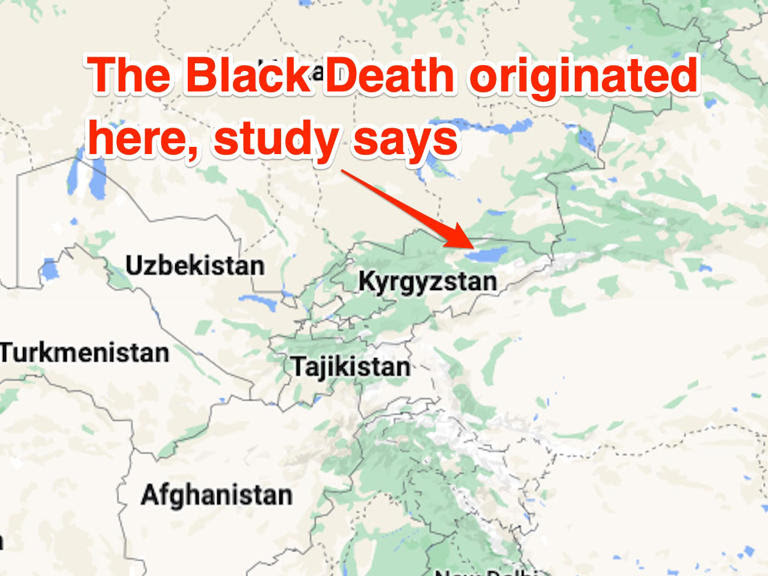
According to a new study, the Black Death originated near Lake Issyk Kul in the mountainous
Tian Shan region of northern Kyrgyzstan. Google Maps
  • Scientists say they have identified the origins of the Black Death, according to a new study.
  • The Black Death was a pandemic caused by bubonic plague that killed 75–200 million worldwide between 1347 to 1351.
  • The team of researchers believes the Black Death first originated in northern Kyrgyzstan in the late 1330s.

Scientists say they have finally pinpointed the origins of the historic Black Death plague, according to a new study.

The Black Death was a pandemic caused by the bubonic plague that killed an estimated 25 million people in Europe between 1347 to 1351 and tens of millions more worldwide, carried by rats infected with plague-carrying fleas.

Historians have long debated its geographical origins. However, according to a new study in the science journal Nature, the Black Death originated in northern Kyrgyzstan in central Asia in the late 1330s.

A team of researchers from Scotland’s University of Stirling, Germany’s Max Planck Institute, and the University of Tubingen analyzed ancient DNA from the teeth of seven skeletons discovered in cemeteries near Lake Issyk Kul in the mountainous Tian Shan region of Kyrgyzstan.

DNA sequencing found that three individuals carried Yersinia pestis, a bacterium linked to the outbreak of the plague that led to the Black Death, the study said. 

A painting titled "Carting the Dead" by French artist Jean-Pierre Moynet that depicts a cart of bodies that died from the Black Plague in the 1300s. Wikimedia Commons

A painting titled “Carting the Dead” by French artist Jean-Pierre Moynet that depicts a cart of bodies that died from the Black Plague in the 1300s. © Wikimedia Commons

Previously, the Black Death was believed to have originated in the Black Sea region in 1346, but the study said its findings predate that.

Related video: Did scientists find origins of black death, bubonic plague after 675 years?

  The scientists chose the cemeteries near Lake Issyk Kul because they had previously identified an unusually high spike in the number of burials between 1337 and 1339, according to the study.

Some of the headstones, written in the Syriac language, noted the causes of death as “pestilence” — an archaic word used to describe a fatal epidemic disease, especially bubonic plague.

The first victims of the Black Death would have died in agony. The most common symptoms of the bubonic plague were large, pustulant boils (buboes) in the groin, neck, and armpits. Acute fever and vomiting blood followed — The skin sores become black.

They would have died between two and seven days after infection. 

image.png
Yersinia pestis bacteria as seen under a microscope. This bacterium is the cause of the Bubonic plague, also known as the Black Plague or Black Death. NIAID.

The presence of Yersinia pestis in the three exhumed bodies from this cemetery points to an earlier origin date for the deadly plague than 1346, as was previously assumed. “Our study puts to rest one of the biggest and most fascinating questions in history and determines when and where the single most notorious and infamous killer of humans began,” said Philip Slavin, a University of Stirling historian, per Metro.

Doomsday’ Glacier Melting at Fastest Rate in 5,500 Years – Search (bing.com)

Wireless charging for electric cars is already here – but the technology isn’t for everybody yet.

Stellantis has run a successful trial for an EV that can charge itself without having to stop.

Watch: Biden Accidentally Reveals Notecard Detailing Instructions For Him

President Joe Biden has revealed the comically detailed notes he used during a meeting on Thursday in a video that has now gone viral. He was meeting with wind executives, after skipping a meeting with oil executives, when he revealed his cheat sheet to the camera, according to reports. During this meeting, Biden reflected on the U.S. Supreme Court’s decision to strike down a New York law requiring individuals to show “proper cause” in order to get a license to carry a firearm outside a home.

Biking Past a Large Bison Herd in Yellowstone – Search (bing.com)

Occurred on April 9, 2022 / Yellowstone National Park, Wyoming, USA: 27-year-old Caleb Dvorak bikes solo within feet of 75 bison in Yellowstone on Grand Loop Road on April 9th, 2022. Nobody was hurt in the filming of this video and no wildlife was disturbed. 

  According to TMZ, Niece Waidhofer, a model and influencer, was found dead at her home in Houston.

Her family reportedly confirmed she took her own life after battling mental health issues. – Search (bing.com)

Wealth of nations: Why some are rich, others are poor – and what it means for future prosperity (msn.com)

Supreme Court Overrules Roe v. Wade, Eliminates Constitutional Right to Abortion.

The Labor Shortage Is Only Getting Worse. What’s Causing It and How Can I Avoid Losing Staff?

China pursuing ‘largest military buildup in history since WWII,’ US commander says.

All of this volatility comes from battling inflation, says Josh Brown – Search (bing.com)

CNBC’s Josh Brown weighs in on Fed Chair Powell’s testimony to the House today. 

With CNBC’s Frank Holland and the ‘Halftime Report’ investment committee,

Brenda Vingiello, Pete Najarian and Jim Lebenthal.

Remember These African Celebrities? They All Changed A Lot… – Star Index News
Mom Started This Daily Ritual and It Practically Reversed… (health-headline.com)
Biden Urges Public to Vote After Supreme Court’s Abortion Decision (msn.com)
Nancy Pelosi blasted for her reactions to the end of Roe v. Wade (msn.com)
How big a bite is inflation really taking out of American savings? (msn.com)

Salt May Have Been Key to Life on Earth, New Study Suggests (msn.com)

Harris says abortion ruling poses ‘health care crisis’s for US (msn.com)
What you might not know about Mary and Joseph (msn.com)

What Amy Coney Barrett Said About Roe v. Wade As Decision Overturned (msn.com)
El Chapo’s Wife Emma Coronel Aispuro Sentenced to 3 Years in Prison (hiplatina.com)

Record gas prices and skyrocketing inflation take toll on Washington’s island communities
Wild solar weather is causing satellites to plummet from orbit. It’s only going to get worse.
Cold-Blooded Animals May Hold the Key to Long Life. A Huge Study Just Tried to Find It
El-Erian: It’s ‘uncomfortably possible’ that the Fed will ‘push us into recession’ (msn.com)
‘Intense’ Video Shows Moment Huge Bald Eagle Snatches Dog From Porch (msn.com)
Why The Science Behind The Maillard Reaction Was Ignored For Years (msn.com)
Heat Relief Is On the Way: Here’s When to Expect a Change | Watch (msn.com)
El-Erian Explains Why America is Entering A Horrific Financial Crisis – YouTube
‘Doomsday’ Glacier Melting at Fastest Rate in 5,500 Years – Search (bing.com)

What to do if a worst-case nuclear scenario actually happens (msn.com)

Must See: She Cannot Answer A Single Question | American Pride Daily
https://www.conservativejournalreview.com/biden-push-hits-snag/
Prehistoric viruses and bacteria in them glaciers – Search (bing.com)
Antarctic glaciers melting at fastest rate in 5,500 years | CTV News
This Just Killed the Future of Electric Cars | American Pride Daily

The pros and cons of buying an electric car (msn.com)

Life and Times of Stephen Hawking – Bing video
Where Is George Washington Buried? (msn.com)
Famous people who’ve survived polio (msn.com)
Why Did the Dinosaurs Die Out? – Bing video

Biden speaks on Supreme Court decision overturning Roe v. Wade (msn.com)
57 Wild And Wonderful Late-Night Talk Show Moments | History Daily
What economists like me got wrong about inflation (msn.com)
As Americans age, a demographic crisis looms (msn.com)
35 mind-blowing facts about our solar system (msn.com)

image.png

NowThis Earth – The Amazon Rainforest Is Reaching a Critical ‘Tipping Point’.

The Rainforest: Lungs of the Earth – Search (bing.com)
Dam in Brazil killing the rainforest – Search (bing.com)
Dam in brazil killing the rainforest – Search (bing.com)
Does the rainforest cool the equator – Search (bing.com)
Dam in Brazil collapse – Search (bing.com)

Posted in Uncategorized | Leave a comment

Intrusive Thoughts

Some anxiety is a typical part of life. It’s a byproduct of living in a busy world.
Intrusive thoughts: Why we have them, and how to take away their power

My understanding is that it’s a frequency thing. 
Everything has a frequency (thoughts, feelings, maladies/illnesses and normal wellness, etc.). So, when you shift the frequency of the thought/belief, feeling, or physicality, one
can heal it. HOWEVER, this doesn’t negate the responsibility of the person being healed because if they don’t make any changes (consciously choosing their thoughts and beliefs, consciously choosing their feelings and responses, and consciously choosing to make any necessary dietary or lifestyle changes), they will shift back to being exactly as they were prior to the healing. This aspect is frequently forgotten and ignored. This is why I am also a life coach so that we can work on the thought/belief/feeling/behavior that manifests their current issues so that the changes are permanent. ~ JENNIFER PASSAVANT – Search (bing.com)

Anxiety isn’t all bad, though. It makes you aware of danger, motivates you to stay organized and prepared, and helps you calculate risks. Still, when anxiety becomes
a daily recurrence, it’s time to act before it snowballs. Unchecked anxiety may greatly impact your quality of life. Take control by trying out the ideas below.
One must remember as we get older… our life dies around us. If one lives long enough. You have lost everyone around you(parents, siblings, some children and there you are feeling that sense of loss. That’s enough within yourself to lose your memory about your life. In some instances you lose every memory about your life and others trying to convince you …you have dementia. 
What is anxiety?

Anxiety is your body’s natural response to stress. It’s a feeling of fear or worry
that could be caused by a combination of factors that researchers believe range
from genetics to environmental to brain chemistry.

Some common symptoms of anxiety include:
increased heart rate
rapid breathing
restlessness
trouble concentrating

However, it’s important to note that anxiety can present itself in different ways for different people. While one person may experience a butterfly feeling in their stomach, another might have panic attacks, nightmares, or painful thoughts. With that being said, there’s a difference between everyday anxiety and anxiety disorders. Feeling anxious about something new or stressful is one thing, but when it gets to an uncontrollable or excessive point and starts to affect your quality of life, it could be a disorder.

Some anxiety disorders include:
panic disorder
post-traumatic stress disorder (PTSD)
obsessive-compulsive disorder (OCD)
separation anxiety
illness anxiety
phobia
generalized anxiety disorder (GAD)
social anxiety disorder 

How can I treat anxiety?
Anxiety can be treated in a variety of ways. One common treatment option is cognitive behavioral therapy (CBT), which helps provide people with tools to cope with anxiety when it occurs.
There are also certain medications, like antidepressants and sedatives, that work to balance brain chemistry and prevent episodes of anxiety. They may even ward off the
most severe symptoms.

If you’re looking to go a more natural route, though, there are little and big ways you can help combat anxiety. You can make adjustments to habits, like exercise, sleep, and diet.
You can also try something totally new, like aromatherapy or meditation. No matter what your lifestyle demands, there’s a natural way to help reduce anxiety for everyone.
If your loved one is beginning to show signs of anxiety, the first thing you should do is try to calm him down. Sometimes simple distraction could be enough to reduce anxiety and keep him calm. Try discussing something other than their illness or symptoms — perhaps the latest ball game or celebrity gossip.

Simple interventions that can be done at home to help with anxiety include:2

Distraction: Be careful with this, however, as patients nearing end of life will experience normal anxiety that needs to be validated and not only replaced with different thoughts.
Deep breathing: The power of mindful breathing is endless. Making the simple effort of gathering up your breath and allowing your exhalation (breathing out) to be longer than your inhalation, will increase the activity of your vagus nerve, which will help you relax.
Naming: Simple naming games—e.g., name five things you can see in the room, four things you can feel, three things you can hear, etc. These allow the patient to feel grounded in the moment, which is usually not as overwhelming as the mind can make it appear. Once we are more present, anxiety naturally dissipates.

Reassurance goes a long way
End of Life: Coping with Anxiety and Depression
By Gina Shaw

 Medically Reviewed by Carol DerSarkissian, MD
People often assume that those diagnosed with a life-threatening
illness will automatically experience depression.
True, people facing a serious illness are more likely than healthy people to suffer depression or anxiety. One study of terminally ill cancer patients, for example, found that at least 17% were clinically depressed. Other research points to even higher numbers of people with terminal illness meeting the criteria for major depression.
Experts point out that it’s perfectly natural to feel scared, sad, and anxious about death and the dying process. That’s because people are facing something that they’ve never
had to deal with before. But the palliative care team can help them work through these feelings.
True clinical depression, however, goes beyond this usual sadness and anxiety.
It’s important to understand the difference between this kind of depression and the normal grieving process that occurs for everyone who faces death. 
Clinical depression is often underdiagnosed, but it should be identified and treated.
Here are some of the signs that you or your loved one may be experiencing clinical depression:
You don’t feel like doing the activities you normally enjoy, even if they are things you can still physically do.
Even when you do participate in things you once enjoyed, you find that you are getting little pleasure out of them.
You have major changes in sleeping or eating habits — sleeping or eating much more,
or much less, than usual. (These symptoms can sometimes be the side effects of certain medications or treatments.)

You withdraw from your friends and family.
You think or talk seriously about suicide.

If you see these signs in a loved one, or find that you’re experiencing them yourself,
it’s important to talk with your doctor or someone else on your care team about them.
Get immediate medical help if you or a loved one is having thoughts of suicide.

Clinical depression in someone who is dying can be treated.
Antidepressant treatments work just as well in palliative care patients as in the general population. The most effective treatments for clinical depression usually combine short-term psychotherapy with antidepressant medications as needed. 
Palliative care professionals point out that coping with these emotions often involves educating not only the person who’s facing the diagnosis but also the people who are caring for that person about what they can expect. A lot of anxiety and negative emotions associated with a life-threatening illness come from feeling helpless and not knowing what’s happening. The social worker and other members of the palliative care team can answer questions, work with you through talk therapy, and help you live as well as you are able for as long as you can.
Much anxiety near the end of life may stem from not talking. Both the dying person and the people around the dying person are often reluctant to talk about what is happening because of how they think doing so will affect the other. Your palliative care team can
help the family talk calmly and not be alarmist about the process, dispelling a lot of the anxiety and making it easier on everyone.
 What if what you’re experiencing is grief and anxiety, not full-scale depression? 
When I had severe depression it was all about changing my outlook on LIFE!!!
In this case you might not need medications for anxiety or depression,
but that doesn’t mean your care team can’t help.

10 natural remedies for anxiety
1. Stay active
Regular exercise isn’t just about physical health — it can be a huge help to your mental health, as well.
2013 studyTrusted Source found that people with anxiety disorders who reported a
high level of physical activity were better protected against developing anxiety symptoms.
This could be for a variety of reasons. Exercise can divert your attention away from something that’s making you anxious.
Getting your heart rate up also changes the brain chemistry to create
more space for anti-anxiety neurochemicals, like:
serotonin
gamma-aminobutyric acid (GABA)
brain-derived neurotrophic factor (BDNF)
endocannabinoids
According to the American Psychological Association (APA), regular exercise leads to an enhancement of concentration and willpower, which can help certain anxiety symptoms.

When it comes to what type of exercise, this is more of a personal preference.
If you’re looking to really get your heart rate up, something like a HIIT class
(high-intensity interval training) or running is your best bet.
But if you’re looking to start off with something with a little lower impact, workouts,
like Pilates and yoga, could also be just as beneficial for your mental health.

2. Steer clear of alcohol
Drinking alcohol may take the edge off at first, since it’s a natural sedative. However, researchTrusted Source suggests there’s a link between anxiety and alcohol consumption, with anxiety disorders and alcohol use disorder (AUD) occurring hand-in-hand.

2017 reviewTrusted Source that looked at 63 different studies showed
that decreasing alcohol intake can improve both anxiety and depression.
Heavy drinking can interfere with the balance of neurotransmitters, which can be responsible for positive mental health. This interference creates an imbalance that may lead to certain symptoms of anxiety.
Anxiety may temporarily increase in early sobriety but can improve in the long run.

Alcohol has also been shown to disrupt your body’s natural ability to sleep by interfering with sleep homeostasis. And as we’ll later point out, a good night’s sleep is incredibly helpful when combating anxiety.

. Consider quitting smoking cigarettes
Smokers often reach for a cigarette during stressful times. Yet, like drinking alcohol, taking a drag on a cigarette when you’re stressed is a quick fix that may worsen anxiety over time.
ResearchTrusted Source has shown that the earlier you start smoking in life, the higher your risk of developing an anxiety disorder later. Research also suggests nicotine and other chemicals in cigarette smoke alter pathways in the brain linked to anxiety.
If you’re looking to quit, there are lots of different ways you can get started.
The Centers for Disease Control and Prevention (CDC)Trusted Source recommends finding a safe substitute for cigarettes, like toothpicks.
You can also take up habits that may distract you in order to create an environment that works for your smoke-free life. Additionally, you can make a plan with a support system who can provide everything from encouragement to distractions.

4. Limit caffeine intake
If you have chronic anxiety, caffeine is not your friend.
Caffeine may cause nervousness and jitters, neither of which is good if you’re anxious.
Research has shown caffeine may cause or worsen anxiety disorders. It may also cause panic attacks in people with panic disorder. In some people, eliminating caffeine may significantly improve anxiety symptoms.

Similar to alcohol, caffeine and anxiety are often linked, due to caffeine’s ability to alter brain chemistry.
For example, a 2008 studyTrusted Source showed that caffeine increases alertness by blocking the brain chemical adenosine, which is what makes you feel tired, while at the same time triggering the release of adrenalin.

With all this being said, a moderate intake of caffeine is safe for most people.

However, if you’re looking to cut back or completely cut out caffeine, you’ll want to start by slowly reducing the amount of caffeine you drink daily.
Start replacing these drinks with water to quench the thirst. This will not only satisfy your body’s need to drink a liquid, but it will also help flush caffeine from your body and keep you hydrated.
Gradually reducing your caffeine over the course of a few weeks can help adjust the habit without the body going through withdrawal.

5. Prioritize getting a good night’s rest
Sleep has been proven time and time again to be an important part of good mental health.
Even though a 2012 survey found that nearly a third of adults get less than 6 hours of sleep a night, the CDC recommendsTrusted Source that adults get 7 to 9 hours of sleep every day.
You can make sleep a priority by:
only sleeping at night when you’re tired
not reading or watching television in bed
not using your phone, tablet, or computer in bed
not tossing and turning in your bed or going to another room if you can’t sleep
avoiding caffeine, large meals, and nicotine before bedtime
keeping your room dark and cool
writing down your worries before going to bed
going to sleep at the same time each night

6. Meditate and practice mindfulness
A main goal of meditation is full awareness of the present moment, which includes noticing all thoughts in a nonjudgmental way. This can lead to a sense of calm and contentment by increasing your ability to mindfully tolerate all thoughts and feelings.
Meditation is known to relieve stress and anxiety and is a primary facet of CBT.
Research from John Hopkins suggests 30 minutes of daily meditation may alleviate
some anxiety symptoms and act as an antidepressant. 
How to meditate 
There are 9 popular types of meditation:
mindfulness meditation
spiritual meditation
focused meditation
movement meditation
mantra meditation
transcendental meditation
progressive relaxation
loving-kindness meditation
visualization meditation
Mindfulness meditation is generally the most popular form.
To mindfully meditate, you can close your eyes, breathe deeply, and pay attention to your thoughts as they pass through your mind. You don’t judge or become involved with them. Instead, you simply observe them and take note of any patterns.

7. Eat a balanced diet
Low blood sugar levels, dehydration, or chemicals in processed foods, such as artificial flavorings, artificial coloring, and preservatives, may cause mood changes in some people. A high-sugar diet may also impact temperament.
If your anxiety worsens after eating, check your eating habits. Stay hydrated, eliminate processed foods, and eat a balanced diet rich in complex carbohydrates, fruits and vegetables, and lean proteins.

8. Practice deep breathing
Shallow, fast breathing is common with anxiety. It may lead to a fast heart rate, dizziness or lightheadedness, or even a panic attack.
Deep breathing exercises — the deliberate process of taking slow, even, deep breaths —
can help restore normal breathing patterns and reduce anxiety.

9. Try aromatherapy
Aromatherapy is a holistic healing treatment that has been used by humans for thousands of years. The practice uses natural plant extracts and essential oils to promote the health and well-being of the mind, body, and spirit. Its goal is to enhance both physical and emotional health.
The essential oils created by the natural plant extracts may be inhaled directly
or added to a warm bath or diffuser. Aromatherapy is suggested to:
help you relax
help you sleep
boost mood
reduce heart rate and blood pressure
Some essential oils believed to relieve anxiety are:
bergamot
lavender
clary sage
grapefruit
ylang ylang

10. Drink chamomile tea
A cup of chamomile tea is a common home remedy to calm frayed nerves and promote sleep.
2014 studyTrusted Source showed chamomile may also be a powerful ally against GAD. The study found people who took German chamomile capsules (220 milligrams up to five times daily) had a greater reduction in test scores that measure anxiety symptoms than those who were given a placebo.
Another 2005 study found that chamomile extract helped sleep-disturbed rats fall asleep. Researchers believe that the tea may function like benzodiazepine, binding to benzodiazepine receptors and having benzodiazepine-like hypnotic activity.
Interested in other resources for mental health?
Explore our evidence-driven reviews of top providers, products,
and more to support your physical and emotional well-being.

Takeaway
If you’re feeling anxious, the above ideas may help calm you down.
Remember, home remedies may help ease anxiety, but they don’t replace professional help. Increased anxiety may require therapy or prescription medication. Talk with your doctor about your concerns.
Read this article in Spanish.

Caring for a Person With Dementia
By Eileen Beal
 Medically Reviewed by Sabrina Felson, MD

IN THIS ARTICLE
The Three Stages of Dementia
Resources for Dementia Caregivers
Dementia is a progressive loss of mental function due to certain diseases that affect the brain.
The losses are substantial. Over time, all types of dementia will lead to loss of memory, loss of reasoning and judgment, personality and behavioral changes, physical decline,
and death.
But the course dementia takes can vary widely from person to person.
It’s influenced by many factors, including age and other conditions a person may have.
REMEMBER THAT DOCTORS ARE ALWAYS QUICK TO WRITE OFF A PATIENT
WITH AN ANXIETY DISORDER OR DEPRESSION WITH DEMENTIA OF ALZHEIMER
Sixty to 80 percent of U.S. dementia cases are caused by Alzheimer’s disease. That’s more than 6 million people. The next most common dementias are vascular dementia, or tiny strokes in the brain, and Lewy Body dementia where alpha-synuclein protein lodges in certain regions of the brain.

The Three Stages of Dementia
After dementia is diagnosed, it usually follows a three-stage, downward trajectory.
In mild dementia, people may have difficulty remembering words and names, learning and remembering new information, and planning and managing complicated activities such as driving. They may also be experiencing sadness, anxiety, loss of interest in once pleasurable activities, and other symptoms of major depression.

In moderate dementia, judgment, physical function, and sensory processing are typically affected. This can cause problems with personal hygiene, inappropriate language, and wandering. This stage — when your loved one is able to get around but has poor judgment — is physically and emotionally challenging for the caregiver.
“My dad went from being Mr. Nice Guy to Mr. Obsessed. And things were always
worse at night. He was energized and I was physically exhausted,” says Robert Matsuda, a Los Angeles musician who worked full-time and cared for his father with Alzheimer’s Disease for three years before recently placing him in a nursing home.
As a patient moves from mild to moderate dementia, some home modifications that may include removal of throw rugs, installation of locks and safety latches, and the addition of a commode in the bedroom often need to be made.

This is also the time when the palliative care team should be brought in to support the caregiver and help manage behaviors.
“I was anxious at first, but when they showed me how to manage my dad’s behaviors and started bringing services into our home — the nurse, the home health aide — it was like the cavalry arrived,” says Matsuda. 
 In severe dementia, there may be extensive memory loss, limited or no mobility, difficulty swallowing, and bowel and bladder control issues. There may be a need for around-the-clock care. At this stage, the patient may have difficulty recognizing family members and caregivers.
Caregivers experiencing high stress levels during the moderate and severe stages may also be dealing with anticipatory grief associated with a feeling of impending loss of their loved one. Talking with the palliative care team’s social worker can help caregivers understand these feelings and develop strategies for dealing with them.
Experts warn that caregivers who do not get such help may be more likely to experience a prolonged, complicated period of grief after their loved one dies. 

Resources for Dementia Caregivers
There are many resources available to caregivers of a person diagnosed with dementia. The Alzheimer’s Association (800-272-3900) will refer you to your local chapter for information, resources, and their hands-on caregiver training workshops.
“I’ve been to our local association’s caregiver workshops and to their monthly support groups, too. Every time, when I leave, I’ve learned something — techniques, strategies, things like that — and that I’m not alone in this,” says George Robby who is caring for his wife with Alzheimer’s in their Chagrin Falls, Ohio, home.
Other good sources of information, assistance, and support include your local Area Agency on Aging (800-677-1116) and, for those caring for veterans, the Veterans Administration’s Caregiver Support Program (855-260-3274). Some senior care companies, including Silverado Senior Living and Home Instead Senior Care, offer programs and skill-building workshops at their facilities.

READ THIS NEXT
Alternative Treatments for Anxiety
Medically reviewed by Karin Gepp, PsyD
Here are some alternative treatments to help with anxiety.
READ MORE 
What Is the Link Between Anxiety and Insomnia?
Medically reviewed by Timothy J. Legg, PhD, PsyD
Poor sleep habits have been linked to problems like depression and anxiety,
and almost 2/3 of Americans state that stress causes them to lose sleep.
READ MORE
How to Ease Anxiety at Night
Medically reviewed by Gerhard Whitworth, R.N.
Anxiety may occur at night when you’re trying fall asleep. You may experience racing thoughts as well as physical symptoms, such as gastrointestinal…
READ MORE
What’s the Difference Between a Panic Attack and an Anxiety Attack?
Medically reviewed by Kendra Kubala, PsyD
Do you know the difference between a panic attack and an anxiety attack?
We explain the symptoms and how to treat these conditions.
READ MORE
Everything You Need to Know About Stress and Anxiety
Medically reviewed by Kendra Kubala, PsyD
While stress and anxiety are very similar, they have a few key differences.
Learn how each one shows up and how to manage symptoms.
READ MORE

Panic Disorder at the End-of-life
https://www.mypcnow.org › fast-fact › panic-disorder-at-the-end-of-life

Background Anxiety and fear occur commonly in the dying patient.
However, disabling anxiety and/or panic is not a normal aspect of the dying process.
Separating “normal” death-related … Depression, anxiety, and delirium in the terminally ill patient
https://www.ncbi.nlm.nih.gov 

Early treatment is, of course, dependent on early recognition of the problem; all too often, physicians wait until the last weeks of a dying patient’s life to decide to address the …
Beliefs, death, anxiety, denial, and treatment preferences in end-of …
https://pubmed.ncbi.nlm.nih.gov › 17387055
This study examined cultural and religious beliefs, death anxiety, denial, and medical treatment preferences in endof-life care in a sample of social work
students, community residents, and …
End-of-Life Care: Managing Common Symptoms
https://www.aafp.org

end of life depression
depression at end of life – Search (bing.com)
depression in end of life
depression and end of life
depression at the end of life
depression in end of life care
respiratory depression end of life

end of life anxiety
end of life anxiety in elders
anxiety at end of life – Search (bing.com)
what is end of life anxiety?

End of life anxiety treatment – Search (bing.com)

U.S. Economy Could Be Declared a Recession Within Weeks: Reagan Adviser (msn.com)

What if the Federal Reserve Has Inflation All Wrong? (msn.com)

Treatment of fever at the end of life is based on the patient’s life expectancy
goals of care. Anxiety depression and memory loss – Search (bing.com)

Memory loss due to anxiety and depression – Search (bing.com)

What a simple balance test may say about your overall health (msn.com)
Pain can cause memory loss or high blood pressure – Search (bing.com)

BONE HEALTH: Bone Spurs, Osteoporosis, and Other Issues –
Healthy Wealthy Wise Blog | Savvy Team (savvy-team.com)

Ability to stand on one leg for 10 seconds may predict longevity
Posted in Uncategorized | Leave a comment

Craziness in the World Today

Former guerilla and leftist Gustavo Petro wins Colombian election over millionaire
‘king of TikTok’ – ABC News

Like TRUMP: The President Who Did Everything Right and Got No Thanks!
Opinion by David Frum

Which would you prefer? An elderly TikTok star who compares himself to Donald Trump? Or a former Marxist guerrilla who attended the funeral of Hugo Chávez?
A candidate notorious for his radical flip-flops on public policy?
Or a candidate notorious for his intolerance of any kind of disagreement or dissent?
One who explained his praise for the Hitler dictatorship by claiming he had confused Adolf Hitler with Albert Einstein? Or one whose attempt to renationalize garbage collection in his city left mountains of trash piled in the streets?

Welcome to the Colombian presidential election of 2022. The second round of voting last night yielded a victory for candidate No. 2, the former guerrilla Gustavo Petro, over No. 1, Rodolfo Hernández. Obviously, either choice would have inscribed huge question marks over the future of one of the more successful democracies in Latin America.
But there’s another question mark, a retrospective one: How in the world did Colombia arrive at such a bizarre dilemma?
Colombia’s outgoing president, the moderate conservative Iván Duque Márquez, was barred from running again by the country’s strict single-term limit. In those four years, he oversaw a record of policy success unmatched in recent South American history. In return, he is leaving office with an approval rating in the low 20s, the worst any president has had in Colombian polling history. The party he belonged to has been wrecked and discredited.
I interviewed Duque on June 2, during a visit he made to Washington, D.C., and found him as baffled as anybody else by Colombia’s turn to extremism.
When Duque took office in 2018, he was only 42. Yet he seems as vexed by the impact of social media as politicians’ decades his elder. “The world has become very polarized,” he said. “Sound debates about policy issues don’t seem to be applauded today. It makes more applause if you decide to take a strong stand, even based on not-sound facts or on lies—but you get a lot of likes. That sometimes seems the temptation we have in modern politics.”

[Read: This country is setting the bar for handling migrants]

President Duque faced two big challenges in his four years in office: the COVID-19 crisis and the social collapse of neighboring Venezuela. He met both challenges in a careful, balanced, well-informed way.
On COVID, he rejected the dismissal and denial espoused by populists like Mexico’s Andrés Manuel López Obrador. Duque did not pursue dubious Chinese vaccines to win points from anti-American voters, as Peru’s leftist president, Pedro Castillo, did. Instead, Duque used the strong relationship with the United States built by Colombia’s moderate conservative leadership. Colombia qualified for the first exports of the Pfizer vaccine from the United States and began a national vaccination program early in 2021.
As of mid-June, at least 70 percent of Colombia’s population has been fully vaccinated with safe and effective vaccines developed by Western democracies.

On Venezuela, Duque agreed with his country’s right that the Chávez-Maduro dictatorship was repugnant, no model for anyone to follow. He took a hard line against Venezuelan subversion and threats to export revolution to Colombia.
At the same time, Duque extended refuge to Venezuelans fleeing the disaster in their country. He granted some 1.7 million Venezuelans the right to remain and work in Colombia for 10 years, the largest such temporary-protected-status program in the
history of the Western hemisphere.
As he coped with these emergencies, Duque upheld Colombia’s trading relationship with the United States, ratified by the U.S.-Colombia free-trade agreement that entered into force in 2012. Thanks to this agreement, Colombia has enhanced its traditional exports of oil and coffee. The country now supplies three-quarters of all the cut flowers sold in the United States. Colombia has also emerged as the world’s No. 3 avocado producer.
Colombia is surging out of the pandemic with one of the fastest-growing economies in Latin America. In the first quarter of 2022, Colombia’s output expanded at an annual rate of 7.5 percent. Duque used some of this wealth to bolster the nation’s shaky social-insurance system. He abolished tuition for virtually all students in Colombia’s public colleges and universities.
At every turn, he faced attacks either for doing dangerously too much, according to the hard right, or for doing offensively too little, according to the radical left.

[Read: The slow death of Colombia’s peace movement]

Colombian society remains cleaved by the aftermath of the left-wing insurgency of the 1970s and ’80s, as well as by the opportunistic alliance those guerrillas formed with drug-trafficking cartels like the one once run by the notorious Pablo Escobar. A lengthy peace process produced an agreement signed in 2016 that provided amnesty for former guerrillas. But the settlement was intensely resented by the many Colombians whose family and friends had been kidnapped or murdered by the insurgents. That resentment became the basis for a more militant Colombian far right—a resentment then reinforced by anti-immigrant sentiment, with the influx of hundreds of thousands of Venezuelans asylum seekers into Colombia.
Colombia’s new president will inherit all of these challenges, plus soaring inflation and a possible recession in the United States, by far Colombia’s most important trading partner. That record made it no wonder that President Duque received such a fond goodbye from President Joe Biden on Duque’s farewell tour of the United States. In sharp contrast, President-elect Petro has made his career by exploiting his country’s social divisions, not healing them.
Americans may have come to take for granted Colombia’s very recent, hard-won, and fragile achievement of social peace. The democratic world will sadly miss President Duque, perhaps more than it yet knows.

Biden’s China tariff policy could irritate union allies
Morgan Chalfant

President Biden is facing a tough decision on whether to lift some Trump-era tariffs on China, a move that economists say will help inflation but promises to anger labor unions. 
Biden said over the weekend that he was still weighing such a move, and officials have not offered a timeline on when he would make a decision. 
Some economists see a clear benefit to lifting some tariffs, which former President Trump imposed as part of a tit-for-tat trade war with China. 
Treasury Secretary Janet Yellen told ABC’s “This Week” on Sunday that some of the tariffs inherited by the Biden administration serve “no strategic purpose.” 
But the decision won’t come easily for Biden given the blowback he is risking from unions, which have publicly expressed their opposition to lifting tariffs. 
AFL-CIO President Liz Shuler, who Biden shared a stage with last week when he addressed the group’s convention in Philadelphia, told CNN on Wednesday that
“it’s the wrong time to relax tariffs on China.”

“We think it would have a marginal impact, at best, on inflation,” she added.
Biden has been ramping up his engagements with organized labor as Democrats worry about losing ground with blue-collar workers in the midterm elections. Democrats lost union workers in 2020 in states like Ohio to Trump, whose anti-free trade message resonated with the labor vote. Biden routinely praises Big Labor, saying that unions “brung me to the dance” in expressing his gratitude for union support during his political career. And, for the most part, labor’s bosses are largely in his corner, which is on display when they praise the president during his visits to their events.
But labor unions would clash with Biden if he decided to lift tariffs on China amid efforts to lean into their support. Labor unions filed an official comment to the Office of the U.S. Trade Representative earlier this month to push for tariffs to remain in place.
United Steelworkers President Thomas Conway, on behalf of the Labor Advisory Committee for Trade Negotiations and Trade Policy, wrote in a letter that “members of the LAC are united in the view that the overall level and the individually identified tariffs imposed on China pursuant to the 301 actions should be extended.” 
Trump imposed a raft of tariffs on China to punish Beijing for unfair trade practices that affected a wide variety of imports totaling about $350 billion. 
The Biden administration has broadly maintained Trump-era tariffs and last fall launched negotiations with China aimed at enforcing the “phase one” trade agreement between Washington and Beijing brokered by the Trump administration. China fell short on its purchasing commitments under that deal. At the same time, Biden administration officials have described the previous administration’s approach to trade with China as flawed and signaled the possibility for change. 
Experts say that lifting some Trump-era tariffs would help lower the cost of goods at a time when Americans are grappling with sky-high inflation, but that depends on companies passing on savings to consumers. 
Biden has limited tools with which to fight inflation, and lifting tariffs on goods from China is among a few actions under consideration at the White House as it looks to ease the burden of costs on families.
“We’re looking closely at it, and I anticipate the president will have more to say on that issue in the coming weeks,” White House National Economic Council Director Brian Deese said on CBS’s “Face the Nation” on Sunday. 
U.S. Trade Representative Katherine Tai is slated to appear before the Senate Appropriations Committee on Wednesday to testify on the fiscal 2023 funding request and could field questions about the policy decision process.
“My recommendation would be to remove the maximum amount of tariffs possible on China,” said Jason Furman, who served as chairman of the Council of Economic Advisers under former President Obama.
Furman estimated that consumers would feel the relief “probably within a few months,” depending how quickly retailers adjust prices after receiving relief from tariffs. He also argued that the Biden administration should be reviewing other tariffs, not just those on Chinese imports. 

“They should be pulling every lever they have,” Furman said. 
Larry Summers, who served as Treasury secretary under the Clinton administration, endorsed the idea during an appearance on NBC’s “Meet the Press” over the weekend. Biden subsequently said that he spoke to Summers on Monday morning. “Look, I think cutting the tariffs is clearly a good idea. It will hold down prices. It will enable us to take
a more strategic approach to dealing with China,” Summers said Sunday, predicting that
it could cut 1 percentage point or more from the consumer price index — a key inflation gauge — over time. 
An analysis produced by the Peterson Institute for International Economics earlier this year estimated that a package of tariff reductions including those targeting Chinese goods would amount to a reduction in the consumer price index of 1.3 percentage points and would save each household $797. Lifting the tariffs would also ease tensions with business groups, which have been lobbying the administration to repeal tariffs on goods from China. 
An end to the tariffs would boost the bottom line for some major retailers, manufacturers and tech giants that pay tariffs of up to 25 percent to import some Chinese goods. The National Retail Federation, which represents major retailers like Walmart and Target, launched an ad campaign this month to push for an end to the tariffs, arguing the tariffs have cost the average American family more than $1,200 a year since they were implemented in 2018. 
“While the Federal Reserve continues with its long-term strategy to stem inflation, we need the administration and Congress to move forward on steps to lower prices that can be taken immediately,” National Retail Federation CEO Matthew Shay said in a statement. “Repealing tariffs is one of those steps and one of the most effective and meaningful.”

‘Doomsday’ Glacier Melting at Fastest Rate in 5,500 Years – Search (bing.com)
According to a new study, the Thwaites Glacier in West Antarctica is losing ice
at an alarming rate.

As chemical fertilizer shortages persist, Pee cycling – the process of recycling human urine – could increase the yield of nutrient-rich crops. (msn.com)
Cathie Wood warns the Fed is ignoring dangerous signals and risks plunging the US into a recession with its huge rate hikes (msn.com)
The rise in inflation affects much more than just prices. These are additional effects you should know (msn.com)
Pressure on Trump and his allies intensifies as Jan. 6 committee rolls out shocking new evidence (msn.com)
80% of economists see ‘stagflation’ as a long-term risk. What it is and how to prepare for it
Fact check: Lifetime carbon emissions lower for electric vehicles than gas-powered cars
Solar is one of the cleanest power sources we’ve got. But it could be even greener.
FedEx Faces Big Changes as Its New Boss Confronts Higher Costs, Angry Drivers
Elon Musk Says U.S. Recession Is ‘Inevitable,’ More Likely In The Near Term

The comedown: After stimulus boom, Americans face a darkening economy (msn.com)
As Americans Feel the Weight of Inflation, Where Are They Placing Blame? (msn.com)
BONUS:  EXPLAINER: What’s next after Russia reduced gas to Europe? (msn.com)
What Net Worth Does It Take to Be Wealthy? Here’s What Americans Say (msn.com)
TRUMP PREDICTED BIDEN WOULD CAUSE A RECESSION, LARA TRUMP SAYS
Electric car revolution: You bought one, but can you get it serviced? (msn.com)
‘Plastitar’ a New Form of Pollution Threatening Oceans, Scientists Say – Search
The Great Reset: Turning Back the Clock On Civilization – Great Game India
The World Has a New Weapon: It’s Called ‘Fertilizer’ | Opinion (msn.com)

Biden Open to Sending Americans Money to Pay for Gas (msn.com)
These natural resources are going to run out very soon (msn.com)
Cost of Living Skyrocketing? Inflation May Be to Blame (msn.com)
Why doesn’t Biden want his HHS to obey existing law? (msn.com)
What we pay for when we pay for a gallon of gas (msn.com)
Here’s what Congress can do to lower inflation (msn.com)
Sick of inflation? Blame the Federal Reserve (msn.com)
Is The US On The Brink Of A Recession? (msn.com)
What to Watch in Tuesday’s Primaries (msn.com)

Image result for Americans  nostalgia

Why are Americans gripped by nostalgia?
Nostalgia is our national mode. We salvage artifacts of the past for entertainment, to calm present anxieties. We discuss the present in terms of the past, and we judge the present by the standards of long ago. One party seeks to recapture the economic conditions of the 1960s; the other would restore the family structure of the 1950s; our films and television cannot escape the Reagan era. Our cultural dialogue is a series of ironic or earnest references to earlier works. Discussions of movies, television and music tend to begin with the question, “Remember when?” Those words summon happy thoughts. So acute has the condition become that the great satirists of our age, Trey Parker and Matt Stone, parodied it last year in an episode of South Park. Residents of the town became addicted to “Member Berries.”

Ross Douthat says it’s a symptom of decadence.
“Not the decadence of orgies and debauchery, but the decadence of drift, stagnation, and repetition.” He quotes Jacques Barzun, who wrote that in periods of decadence “the forms of art as of life seem exhausted, the stages of development have been run through.” Yuval Levin, on the other hand, ascribes our “blinding nostalgia” to the dizzying changes of the early 21st century. “In our economy, our culture, our politics, and throughout our society, longstanding norms seem to be breaking down.” Writing in the neo-Marxist Jacobin, Samuel Earle points his finger at “global, neoliberal capitalism,” which, “by subjecting everything in the world to the logic of the market,” generates “enormous change in local communities with little to no regard for social cohesion.” Douthat and Barzun suggest that there isn’t enough novelty in the world; Levin and Earle, that there is too much.

Perhaps instability in the economic and social spheres moves us to stabilize the cultural and political ones, by clinging to franchises of yore, and by recalling national glories of old. Or perhaps we return to the past because we are experts in it. In his new collection of essays, X, Chuck Klosterman asks, “What if the feeling we like to call ‘nostalgia’ is simply the byproduct of accidental repetition?” He has listened to Ozzy Osbourne’s Bark at the Moon “more than all the other Ozzy solo albums combined,” he says, for the sole reason that “I had only six cassettes” as a teenager. Nostalgia for Klosterman has little to do with memory. He feels nostalgic for Bark at the Moon “because the middle ’80s were a time when I might lie on my bed and listen to a random Ozzy song 365 times over the course of 12 months. It’s not an emotional experience. It’s a mechanical experience.” Stranger Things, by this logic, satisfies our nostalgia craving because it’s an excuse to share our knowledge of all the Stephen King books we have read, all the Spielberg and Carpenter movies we have watched. “What seems like ‘nostalgia’ might be a form of low-grade expertise that amplifies the value of the listening event.”

I see what he means. How often did I watch Star Wars and Empire Strikes Back and Return of the Jedi as a kid, until I knew basically every line of dialogue, every fanfare and swell in the score, could mimic every sound effect? Do I feel nostalgia for Star Trek: The Next Generation because of what was going on in my life during middle school — not much — or because I have watched each episode of the series too many times to count, with the exception of “Conspiracy,” the existence of which I do not recognize? I feel no nostalgia for the rented townhouse where I first listened to Vs., but could describe to you in detail its layout, its fading tan wallpaper and thick brown carpet, because the memory of my surroundings is connected to “the listening event.” The fascination with early video games that manifests itself in the popularity of Ernest Cline’s Ready Player One — the film adaptation by Spielberg is forthcoming — is less a longing for the innocence of childhood than evidence of all the hours I wasted on Atari and NES.

Klosterman’s thesis is a clever explanation for certain forms of nostalgia, but not of others. It might tell me why I return to the first three Indiana Jones movies, but it doesn’t explain why Spielberg and George Lucas insist on making more of them. (I don’t need Jacobin to tell me the reason is money.) Nor does Klosterman’s mechanical basis for nostalgia apply to politics. We experience history only once, and Golden Ages are few and far between, and difficult to reproduce.

Why are Americans gripped by nostalgia?
“Nostalgia,” wrote Robert Nisbet, “breaks the telescopic relation of past and present that is the essence of ritual. It makes the past a cornucopia of anodynes and fancies to draw from at will. It seizes upon some period, decade, or century and bathes it in solutions of sentimentality. The past, so necessary to replenish the present when properly understood, takes the form of memorabilia, golden-oldies such as records, books, and movies which should not be wrenched from their ages.”

For Nisbet, nostalgia waxes as the traditional understanding of time wanes.
Human beings are temporal creatures. We need ways to understand and to order the past, the present, and the future. Normally we do this through religion, its holidays and life-cycle events. “The greatest barrier to nostalgia,” he writes, “in contrast to simple respect for the past, is a social structure in which the forces of stable growth outweigh those of instability and perceived formlessness. Ritual — religious, political, and other — is a strong force against nostalgia.” It may be that religion, by keeping us focused on a life to come, and by emphasizing righteous acts in the present, prevents us from becoming lost in memories and trinkets of the past. Then again there are plenty of religious people who are nostalgic about some earlier incarnation of their church or their country or their culture.

Do they lack ritual?
What would be useful is a grand unified theory of nostalgia, a way to tie together Star Trek: Into Darkness and MAGA hats, Back to the Future Day and Marine Le Pen. Sorry to say, no such theory exists. Maybe none is possible. Nostalgia in politics, in the marketplace, and in our psychology may be separate phenomena, may operate on different axes. I’m inclined to believe that the flight to the past is a consequence of our anxiety over the future: our fear of mortality, the precarious state of our country, the feeling that no one is entirely in control of his government, his destiny. Grim thoughts to ponder on my way home from work, as Dave Matthews Band plays on the radio, and I prepare for an after-dinner viewing of The Beast from 20,000 Fathoms. It was just on TCM.

More from MATTHEW CONTINETTI:
Republicans Surf the Red Wave – Search (bing.com)
The Iran Crisis Is Here – Search (bing.com)
There Is No Plan – Search (bing.com)
— Matthew Continetti is the editor-in-chief of the Washington Free Beacon,
where this column first appeared. © 2017 All rights reserved

TOP STORIES:
California Decides This Is a Great Time to Raise the State Gasoline Tax
JIM GERAGHTY
Here Comes Fiscal Armageddon
KEVIN D. WILLIAMSON
NRPLUS
The Taboo Lifts on Discussing Biden’s Age
JIM GERAGHTY

https://www.msn.com/en-us/news/us/the-smartest-us-presidents-based-on-their-iq-scores – Search (bing.com)

See What Your Favorite ’80s Sitcom Actresses Are Up To Today! – Pens & Patron (pensandpatron.com)

The 60 Most Memorable Olympic Uniforms to Ever Appear in the Games –
Iconic Outfits From the Olympics (womenshealthmag.com)

57 Wild And Wonderful Late-Night Talk Show Moments | History Daily   
Posted in Uncategorized | Leave a comment

Biden’s Oil and Gas Crisis

What’s Going to Happen to The Electric Car Batteries After Their Lifespans End?

The most frustrating thing about Biden’s oil and gas crisis
Opinion by Noah Rothman – Search (bing.com)

Have the crippling sanctions imposed on Russia as a response to its war of conquest
in Ukraine backfired on the West? That concern is being expressed across Europe and, increasingly, it is one that President Joe Biden’s administration shares. (Not to mention the mechanics reluctance to work on them and rejecting the cost of new tools.)
Bloomberg News reported last week that the White House was “initially impressed”
by the impact the post-invasion sanctions regime was having on the Russian economy
and by Western firms’ willingness to voluntarily divest from the Russian marketplace.
But, as that story points not, not only are those sanctions “exacerbating inflation” and “punishing ordinary Russians more than Putin or his allies,” the Russian energy sector — the country’s largest revenue generator by far — hasn’t suffered much at all.

The Kremlin is generating more revenue than it spends making war against Ukraine.
To the contrary, as The New York Times reported last Monday, “Russia’s revenues from fossil fuels” have soared over the course of the war. While the country’s overall energy exports have declined by volume, the report notes that “surging prices have more than canceled out the effects of that decline.” The Kremlin is generating more revenue than it spends making war against Ukraine, and new, stricter sanctions targeting Russian energy that are due to come online soon may come too late to shape the outcome of that conflict.
Countering the influence of Russian energy is a fiendishly complex problem. It’s been decades in the making, and it cannot be solved overnight. Moreover, the West’s eagerness to outsource its energy needs to foreign producers ensures that we have no one to blame but ourselves.
Putting downward pressure on energy prices is, I’d argue, Biden’s most urgent priority
at the moment, not only to limit Russia’s options in Ukraine but also to ease domestic inflation (because the cost of all goods is exacerbated by high energy costs). Toward that end, Biden has adopted two seemingly contradictory approaches to the problem.
On the one hand, he blames “Putin’s price hike” for Americans’ reduced purchasing power.
On the other, he accuses America’s fossil-fuel producers of greed for making profits off a high-demand product that is experiencing scarcity. 

President Biden demands oil companies explain lack of gasoline.
“At a time of war — historically high refinery profit margins being passed directly onto American families are not acceptable,” the president wrote in a letter to U.S. oil refining companies like Exxon Mobil and Chevron. These “companies must take immediate actions to increase the supply of gasoline, diesel, and other refined products,” he continued.
But increased domestic fossil-fuel production wouldn’t just help ease inflationary
pressure on the economy; exporting domestically produced fuel would help offset the world’s dependence on petrostates and their illiberal governments. Unfortunately, we’ve spent the better part of the last half-decade limiting our ability to respond to exigencies like the war in Europe.
At the end of 2018, the United States produced over 20 million barrels of petroleum products (crude oil, natural gas and refinery derivatives) per day. In 2019, the U.S. outpaced Saudi Arabia’s output for the first time in decades, and forecasts estimated
that the U.S. would become a net exporter of energy by 2022.
Also in 2019, Iranian-backed forces executed a sophisticated, multi-drone strike 
on a Saudi oil-processing plant, the culmination of a series of Iranian-linked strikes
on oil-producing targets in the kingdom and in the Strait of Hormuz. 

How the Strait of Hormuz could potentially lead to war with Iran.
In years prior, an attack on one of the world’s most productive refineries would have crippled the global economy and may even have necessitated an armed response by the countries dependent upon that supply. But the United States was able to stabilize global markets by releasing an unspecified amount from the country’s strategic reserves, and thus the attack barely made an economic ripple.
Not only did American energy production capacity ballast the global economy,
it may have also prevented violence. Much has changed in just a few intervening years. As National Review’s Jim Geraghty observed, the onset of the pandemic artificially truncated global energy consumption, which ensured that Americans didn’t notice as the nation dramatically curtailed its refinery capacity. A 2019 accident crippled the East Coast’s largest refinery, the Philadelphia Energy Solutions plant, and it was permanently mothballed in 2020. Over the course of 2020, that diabolical year, five more American refineries stopped producing petroleum products. Most of those facilities have transitioned or are currently transitioning to alternative fuels and biofuels processing facilities.

Reversing the decline of America’s domestic refining capabilities is just one facet of a comprehensive campaign to combat the influence of the world’s anti-Western petrostates.
Reversing the decline of America’s domestic refining capabilities is just one facet of a comprehensive campaign to combat the influence of the world’s anti-Western petrostates. But an all-hands-on-deck approach to addressing the global energy deficit that is hurting Americans and advancing Russian interests would require the Biden administration to take many measures they’ve so far avoided.

To the White House’s credit, the administration has already taken a few welcome steps
in that direction, albeit belatedly. In April, the administration loosened an executive order that put a stop to all new leases for oil and gas exploration on federal land, and also the president has dropped his crusade to anathematize the Saudi Kingdom and its crown prince, Mohamed bin Salman, a concession that corresponded closely with a long-delayed decision by the Saudi-led OPEC cartel to ramp up production in July and August.
There is, however, plenty the White House still refuses to do to ease the pressure on American wallets. The administration so far has not abandoned its objection to providing drilling leases in the Artic National Wildlife Refuge. It won’t rescind a day one executive order barring federal agencies from providing fossil fuel producers with “subsidies.”
It won’t allow three already approved offshore oil leases to move forward, taking millions of acres of exploitable deposits off the table.

The campaign to isolate Moscow and decouple the global energy market from reliance on Russian exports is proceeding in fits and starts. Remarkable progress toward that goal has been achieved in a staggeringly short period of time. But it was never going to be possible to wholly offset the world’s demand for Russian energy quickly enough to prevent petrodollars from fueling Moscow’s war in Europe.
There is one alternative to the energy produced and exported by totalitarian states, and that is the energy produced and exported by liberal, democratic states. However, the West has spent decades trading away its productive capacity in service to the idea that green energy was a sufficient replacement for fossil fuels. And where we needed to supplement our energy needs, we counted on the world’s most egregious human rights violators to provide the rest. This was always a devil’s bargain. Today, Ukraine is absorbing much of the cost of the West’s hunger for Russian energy, but its people won’t be the last to suffer for our delusions.


What happens to electric vehicle batteries when they die?
– Electric & Hybrid Vehicle Technology International.
Nor’Adila Hepburn – Search (bing.com)

While driving electric vehicles is a step towards a greener future, the car batteries that power them are not as sustainable. Though the battery is at the heart of any EV, most are made from lithium-ion and have a limited lifespan that starts to degrade from the first time you charge them. So what happens when they reach capacity?
The cycle of charging and discharging causes them to lose energy and power. The more charge cycles a battery goes through, the faster it will degrade. Once batteries reach 70 or 80% of their capacity, which happens around either 5 to 8 years or after 100,000 miles of driving, they have to be replaced, according to Science Direct.
Due to electric vehicles’ rising popularity, it goes without saying that their battery
waste will become a major issue. Experts estimate that 12 million tons of batteries will be thrown away by 2030, The Guardian reported. The conundrum that manufacturers and consumers have is that although they can be recycled, there are not enough facilities to handle them. To date, there are only four lithium-ion recycling centers in the United States (via WCNC). However, this number must grow exponentially — in the next few years as  Industry experts predict there will be 85 million electric vehicles on the road by 2030
(via ScienceDirect).

EV car
Recycling Is Complex
© Blue Planet Studio/ShutterstockEV car

Recycling car batteries is an arduous and dangerous process that involves splitting them apart to extract the metals inside. To do it, recyclers typically utilize two techniques: pyrometallurgy and hydrometallurgy, Science reported. Pyrometallurgy, the preferred method, shreds the battery down and then a burning process takes the metal out. With hydrometallurgy, the battery is submerged in acid to separate the metal. With either method, there is a risk of toxic fume emissions or an outright explosion (via Science).
There are other issues too. Unlike other compact batteries, EV batteries weigh about 960 pounds, according to Wired. If you are an EV manufacturer, finding proper transportation and storage could prove a logistical nightmare.
They are also a fire hazard if and when stored together. A report by the Environmental Protection Agency found that between 2013 and 2020, more than 240 lithium-ion battery fires broke out across 64 municipal waste facilities.
And that’s not all. If these batteries find their way to landfills, harmful toxins such as
lead and nickel can contaminate soil and groundwater supplies (via AZO CleanTech).

companies and EVs
Companies Are Giving EV Batteries A Second-Life
© Herr Loeffler/Shutterstockcompanies and EVs

Outside of recycling, old EV batteries can be repurposed as a renewable energy
source for homes and businesses. Even if they have a reduced storage capacity,
can be reused to store wind and solar energy, according to Innovative News Network
This can extend their life cycle by another seven to 10 years.
A good example of this is Toyota’s initiative to sustainably power Yellowstone Park.
The car company equipped the landmark with solar panels powered by batteries that
once belonged in Camry Hybrids, replacing diesel generators (via Toyota).
Toyota was not the only one, however. A Spanish company ran an experiment where
it converted used lithium-ion batteries into second-life batteries with great success. In particular, it proved the ability to use recycled electric vehicle batteries to help power one of the local electricity plants in the case that there is a temporary shutdown (via Enel).

Electrical disruptions caused by squirrels – Wikipedia

The $7 Trillion Cost Of Upgrading The U.S. Power Grid | OilPrice.com

Read this next: 12 Cars That Were Way Ahead of Their Time

Do you believe the current Electric car / Battery technology is appropriately designed for the fossil fuel problems that the world faces now?

Definitely not   62%

Definitely   7%

Possibly 17%

I’m not sure 9%

Other / No opinion   5%
                                                                                                                                     
The Texas Republican Party just voted ‘overwhelmingly’ to reject the legitimacy of Biden’s 2020 election win, and is trying to stir up fear about ‘possible fraud’ in the upcoming midterms (msn.com)
1 month after the Uvalde shooting, here are 5 questions that are still unanswered
Carole.King.and.James.Taylor.live.at.the.Troubadour.2010.
2022 U.S. Open Highlights: Round 4, Down the Stretch.
2022 U.S. Open Highlights: Round 4, Extended.

image.png
Posted in Uncategorized | Leave a comment

105th Anniversary of First Fatima

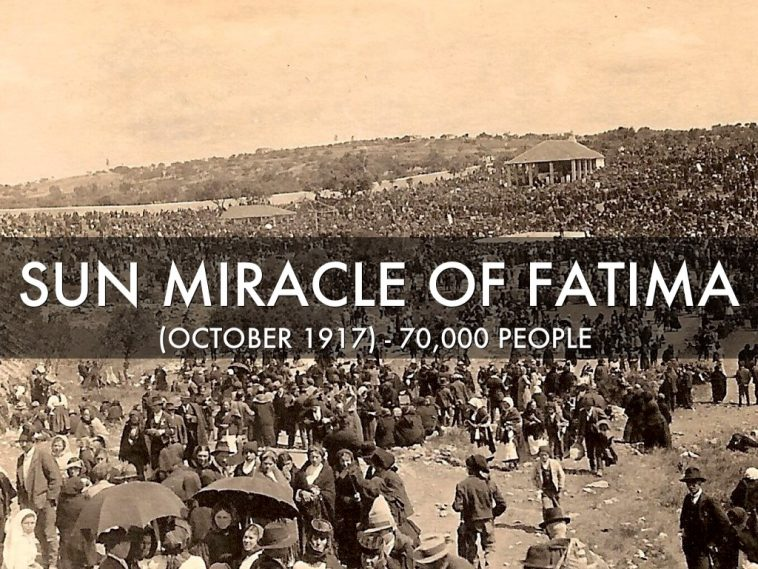
Miracle of the Sun October 13, 1917 – Bing video (PortugueseMilagre do Sol), Location of Fátima

Also known as the Miracle of Fátima, is a series of events reported to have occurred miraculously on 13 October 1917, attended by a large crowd who had gathered in Fátima, Portugal, in response to a prophecy made by three shepherd children, Lúcia Santos and Francisco and Jacinta Marto. The prophecy was that the Virgin Mary 
(Referred to as Our Lady of Fátima), would appear and perform miracles on that date. Newspapers published testimony from witnesses who said that they had seen extraordinary solar activity, such as the Sun appearing to “dance” or zig-zag in the sky, careen towards the Earth, or emit multicolored light and radiant colors.

According to these reports, the event lasted approximately ten minutes.
The local bishop opened a canonical investigation of the event in November 1917,
to review witness accounts and assess whether the alleged private revelations from Mary were compatible with Catholic theology. The local priest conducting the investigation was particularly convinced by the concurring testimony of extraordinary solar phenomena from secular reporters, government officials, and other skeptics in attendance.[1] Bishop José da Silva declared the miracle “worthy of belief” on 13 October 1930, permitting “officially the cult of Our Lady of Fatima” within the Catholic Church.[2]

At a gathering on 13 October 1951 at Fátima, the papal legate, Cardinal Federico Tedeschini, told the million people attending that on 30 October, 31 October, 1 November, and 8 November 1950, Pope Pius XII himself witnessed the miracle of the Sun from the Vatican gardens.[3][4] The early and enduring interest in the miracle and related prophecies has had a significant impact on the devotional practices of many Catholics.[5]

There has been much analysis of the event from critical sociological and scientific perspectives. According to critics, the eyewitness testimony was actually a collection
of inconsistent and contradictory accounts. Proposed alternative explanations include witnesses being deceived by their senses due to prolonged staring at the Sun and then seeing something unusual as expected.[6][7][8][9][10][11][12]


parhelion in rainbow colors,
photographed in 2005

Theologians, scientists, and skeptics have responded to claims that conflict
with established scientific knowledge regarding the behavior of the Sun. Science writer Benjamin Radford points out that “The sun did not really dance in the sky.
We know this because, of course, everyone on Earth is under the same sun, and if the closest dying star to us suddenly began doing celestial gymnastics a few billion other people would surely have reported it”. Radford wrote that psychological factors such as the power of suggestion and pareidolia can better explain the reported events. 

According to Radford, “No one suggests that those who reported seeing the Miracle of the Sun—or any other miracles at Fátima or elsewhere—are lying or hoaxing. Instead, they very likely experienced what they claimed to, though that experience took place mostly in their minds.”[8] Regarding claims of miraculous drying up of rain water, Radford wrote “it’s not clear precisely what the weather was at the time of the miracle”, and photography from the time of the event does not show that it had been raining as much or as long as was reported.[44]

In The Evidence for Visions of the Virgin Mary (1983), former editor of the ASSAP‘s journal, Kevin McClure, wrote that the crowd at Cova da Iria may have been expecting
to see signs in the Sun, since similar phenomena had been reported in the weeks leading up to the miracle. On this basis, he believes that the crowd saw what it wanted to see.
McClure also stated that he had never seen such a collection of contradictory accounts
of a case in any of the research that he had done in the previous ten years.[10]

According to theologian Lisa J. Schwebel, claims of the miracle present a number of difficulties. Schwebel states, “not only did all those present not see the phenomenon, but also there are considerable inconsistencies among witnesses as to what they did see”. Schwebel also observes that there is no authentic photo of the solar phenomena claimed, “despite the presence of hundreds of reporters and photographers at the field”, and one photo often presented as authentic is actually “a solar eclipse in another part of the world taken sometime before 1917”.[45] 

There is some evidence to the effect that the miracle was expected by witnesses.
The witness Joaquim Gregorio Tavares, who was present at Fátima on October 13, states, “We must declare that, although we admit the possibility of some miraculous fact, we were there while having in mind conversations we had earlier with cool-headed persons who were anticipating some changes of color in the Sun”[46] The villagers in Alburitel were preparing for a Sun miracle too.

According to Maria do Carmo, “It was anticipated that the miracle would involve the stars”.[47] This is likely due to the fact that in the months of July, August and September people at Fátima claimed the Sun’s light dimmed and the sky became dark enough for stars to become visible. This was denied too by many witnesses from the previous months. She also states on the morning of October 13th, “the people of Alburitel were darkening bits of glass by exposing them to candle-smoke so that they might watch the Sun, with no harm to their eyes.”[48]

Supernatural explanations, such as those by Father Pio Scatizzi, who argues that
observers in Fátima could not be collectively deceived, or that the effect was not seen by observatories in distant places because of divine intervention[49] have been dismissed by critics who say those taking part in the event could certainly be deceived by their senses,
or they could have experienced a localized, natural phenomenon. According to Benjamin Radford, “It is of course dangerous to stare directly at the sun, and to avoid permanently damaging their eyesight, those at Fátima that day were looking up in the sky around the sun, which, if you do it long enough, can give the illusion of the sun moving as the eye muscles tire.”[8] 

Others, such as professor of physics Auguste Meessen, suggest that optical effects
created by the human eye can account for the reported phenomenon. Meessen presented his analysis of apparitions and “Miracles of the Sun” at the International Symposium “Science, Religion and Conscience” in 2003.[50][51] While Meessen felt those who claim to have experienced miracles were “honestly experiencing what they report”, he stated Sun miracles cannot be taken at face value and that the reported observations were optical effects caused by prolonged staring at the Sun.[7] Meessen contends that retinal after-images produced after brief periods of Sun gazing are a likely cause of the observed dancing effects. 

Similarly, Meessen concluded that the color changes witnessed were most likely
caused by the bleaching of photosensitive retinal cells.[7] Shortly after the miracle,
the Catholic lawyer named Coelho said in his article that a few days later, he saw the exact same motions and color changes in the Sun as he did on October 13th. He says, “One doubt remained with us however. Was what we saw in the Sun an exceptional thing? Or could it be reproduced in analogous circumstances? Now it was precisely this analogy of circumstances that presented itself to us yesterday. We could see the Sun half overcast as on Saturday. And sincerely, we saw on that day the same succession of colors, the same rotary movement, etc.”[52]
Meessen observes that Sun Miracles have been witnessed in many places where religiously charged pilgrims have been encouraged to stare at the Sun. He cites the apparitions at Heroldsbach, Germany (1949) as an example, where many people within a crowd of over 10,000 testified to witnessing similar observations as at Fátima.[7] Meessen also cites a British Journal of Ophthalmology article that discusses some modern examples of Sun Miracles.[53] Prof. Dr. Stöckl, a meteorologist from Regensburg, also proposed a similar theory and made similar observations.[54]

Critics also suggest that a combination of clouds, atmospheric effects and natural
sunlight could have created the reported visual phenomena. 
Steuart Campbell, writing for the edition of Journal of Meteorology in 1989, postulated that a cloud of stratospheric dust changed the appearance of the Sun on 13 October, making it easy to look at, and causing it to appear to be yellow, blue, and violet, and to spin. In support of his hypothesis, Campbell reported that a blue and reddened Sun was reported in China as documented in 1983.[11] Paul Simons, in an article entitled “Weather Secrets of Miracle at Fátima”, stated that it is possible that some of the optical effects at Fátima may have been caused by a cloud of dust from the Sahara.[55]

Skeptical investigator Joe Nickell wrote that the “dancing sun” effects reported at Fátima were “a combination of factors, including optical effects and meteorological phenomena, such as the sun being seen through thin clouds, causing it to appear as a silver disc. Other possibilities include an alteration in the density of the passing clouds, causing the sun’s image to alternately brighten and dim and so seem to advance and recede, and dust or moisture droplets in the atmosphere refracting the sunlight and thus imparting a variety of colors”.

Nickell also suggests that unusual visual effects could have resulted from temporary retinal distortion caused by staring at the intense light of the Sun,[6] or have been caused by a sundog, a relatively common atmospheric optical phenomenon.[56][12] Nickell also highlights the psychological suggestibility of the witnesses, noting that devout spectators often come to locations where Marian apparitions have been reported “fully expecting some miraculous event”, such as the 1988 Lubbock apparition of Mary in also Texas, the Mother Cabrini Shrine near Denver, Colorado, in 1992, and Conyers, Georgia, in the early to mid-1990s.[6]

As America and the world grapple with the repercussions of an international pandemic and the economic and cultural ripple effects thereof, many are understandably searching for a glimmer of hope, a star by which to chart their course ahead. On October 16, 2021, at 12:00 noon in public squares across the country, many Americans did not have to look far. They caught a radiant glimpse of this hope in the faces of those participating in one of 17,000 Public Square Rosary Rallies. Whether the “rally” was attended by five people or two hundred, it became a channel of grace for those passersby whose hearts were open to Our Lady. This annual prayer effort is coordinated by the American Society for the Defense of Tradition, Family and Property (TFP) and its America Needs Fatima campaign. At each and every rally, hymns were sung in praise of the Blessed Virgin Mary and prayers were recited for the conversion of sinners and the unity and exaltation of Holy Mother, the Church.

Some of the other intentions prayed for were:
— To show God and His Blessed Mother our love and veneration.
— For the conversion of America.
— To stop sacrilege and blasphemy in society.
— That our national leaders would seek to honor God’s Law and pray for
the wisdom and knowledge necessary to solve America’s complex problems.
— For the urgent triumph of the Immaculate Heart of Mary in America and the world.
— In reparation for the countless sins committed daily against the most Sacred Heart
of Jesus and the most Immaculate Heart of Mary, including abortion and same-sex “marriage.”

105th Anniversary of First Fatima Apparition – Catholic Truth.
It seems like only two minutes ago we were marking the centenary of the Fatima apparitions at our Conference in the Eagle Lodge in Bishopbriggs, Glasgow, on 13th
May, 2017.  That was a wonderful day. The attendees signed an Open Letter to Pope Francis, asking him to do two things: (1) to release the full text of the Third Secret and
(2) to consecrate Russia to Our Lady’s Immaculate Heart, in union with all the bishops of the world, as she requested.   
Now, five years later we must acknowledge that neither of these requests has been met.  The deterioration of Catholic life across the globe confirms what we already do know about the Third Secret – that, as revealed by Cardinal Ciappi: “In the Third Secret it is revealed that the crisis in the Church begins at the top.”  
Further, as is very clear now, the consecration of Ukraine, Russia, and the whole of humanity prayed by Pope Francis on 25 March, evidently did not “work” – there has been no change in the tumultuous state of the world, except for the worse, and Russia has, manifestly, not converted to the Catholic Faith.

To refresh your memory about the events at Fatima, or, if you are new to the blog, click here to read the basic information. Share your thoughts about the fact that successive  popes and bishops, who hold the power, under God, to bring about world peace, have consistently failed to obey this simple request from Heaven. 
Did Pope Francis feel pressured into conducting the Ukraine-Russia consecration
because the Bishops of Ukraine asked him to do that, and did he then “make the best of it” by turning it into a humanitarian act of “compassion”? 
It obviously wasn’t the religious act required by God, so we continue to pray for that to come about sooner rather than later; the proponents of the New World Order are busy setting up the mechanisms for their long-awaited one-world government so time is
of the essence.

image.png
Please consider becoming a rosary rally captain in your area.

It’s simple.

Just click here to get started:  America Needs Fatima   #Fatima #Rosary #Crusade
Video: Fátima, Portugal – Bing video
Site: https://www.tfpstudentaction.org/
Instagram:  TFP Student Action • Instagram photos and videos  
Facebook:  TFP Student Action – Home | Facebook  
Twitter: https://twitter.com/tfpsa
Rick Steves Holy Land – YouTube
Rick Steves Fatima – YouTube
Posted in Uncategorized | Leave a comment

Better Together

Maria Menounous in silver dress at Vanity Fair party
John Shearer/Getty Images

Better Together with Maria Menounos – Bing video
Maria Menounos Says This Was the First Symptom of Her Brain Tumor
“MY BODY WAS TRYING TO SEND ME SIGNALS AND I WAS IGNORING THEM.”
By LAUREN GRAY

You may know Maria Menounos as an entertainment reporter, author, actor, producer, or even as a professional WWE wrestler. But the multi-hyphenate entertainer now has something even more extraordinary to add to that list: today, she’s a brain tumor survivor and health advocate. In 2017, just two months after her mother was diagnosed with brain cancer, the 43-year-old beauty was found to have a “golf-ball-sized” brain tumor, which was pressing on her facial nerves. The mother and daughter both underwent surgery and recovered together in the months that followed, as she shared in a video posted on YouTube this past April.

Fans were shocked by the news of Menounos’ illness, given her youth and penchant for health and fitness. Now, she’s opening up about the details of her condition and recovery—including the symptoms that also first alerted her to the fact that something was seriously wrong. Read on to learn which symptom she noticed first, and to find out how she’s been doing since the seven hour surgery that saved her life.

RELATED: Al Roker Is Warning Everyone to Do This After His Cancer Diagnosis.

image.png
Maria Menounos in black tube dress
Paul Archuleta/GC Images via Getty Images

Menounos says that she first realized she had a health problem
When she began experiencing daily headaches and dizziness. “I was getting these really terrible headaches every day and I’d get very lightheaded when I’d get up off the couch.
My vision was getting blurry,” she told Today in 2018.
On some days, her symptoms would be more severe, but Menounos says she chalked
it all up to stress, overexertion in her career, and the pressure of taking care of her ailing mother. The E! News host told the outlet that on occasion, she would even slur her speech. She recalled that in these moments, she would often joke about having a tumor, all the while believing herself to be largely healthy. “I never would have imagined in a million years that I had a brain tumor,” she said.

RELATED: The First Thing Sofía Vergara Did
When She Was Diagnosed With Thyroid Cancer.

image.png
Maria Menounos wearing black blazer
Presley Ann/Getty Images

Before that, she suffered much subtler symptoms
Though the recurring headaches and dizziness were the symptoms that ultimately pushed her to see a doctor, Menounos says that she experienced subtle symptoms for at least two years before seeking medical attention. “I was exhausted and I didn’t know why. Everyone told me it was because I worked so hard,” she recalled to Today. Though she didn’t take action at that time, she remembers that this explanation “didn’t really sit right” with her. “I remember feeling like my whole body was shutting down. I didn’t know what was wrong with me,” Menounos said. “Now I look back and tell myself that my body was screaming at me… My body was trying to send me signals and I was ignoring them because I was too busy,” she reflected.

The TV host shared that when she developed an earache on top of her other symptoms, she could no longer ignore that something was wrong. As she listed her symptoms in the doctor’s office, she finally had what she describes as an “aha moment”—the sudden realization that her own symptoms were not unlike her mother’s. After a series of scans, her doctor confirmed that she did in fact have a large, benign vascular tumor known as hemangioma in the back of her brain.

She says the biggest takeaway from her diagnosis is that you can’t brush off your symptoms if you suspect something’s wrong. “When your body is making noises,
go to the doctor—just like when your car makes noises, you take it to the mechanic.
Don’t stop searching for the answers,” she told Today.

image.png
Maria Menounos and Mother Litsa Menounos
Axelle/Bauer-Griffin/FilmMagic via Getty Images

Her mother passed away from cancer earlier this year.
Sadly, due to her own five-year battle with cancer, Menounos’ mother, 
Litsa Menounos, passed away on May 02, 2021. The TV star shared the news via Instagram with a touching black and white photo of her mother during her final days.
The caption read, “RIP mom. God loved her so much he took her on Greek easter.”

Though Menounos was heartbroken by her mother’s tragic passing, she shared in her April YouTube video that her mom’s longevity far surpassed doctors’ expectations. “It’s been a crazy few years for us but mom has been a total miracle,” she said. “We don’t listen to statistics in this house but they all said she had an average of six to 12 months [left to live]. Well here we are almost five years later and she’s had quality years,” the E! News host added, a month ahead of Litsa’s death.

While there may have been few silver linings to her mother’s condition,
Menounos revealed while speaking to People that witnessing her mother’s strength while ill gave her the courage to cope with her own devastating diagnosis. “Every night I would pray, ‘Please God, give me the strength that my mom had,'” she told the magazine.

image.png
Maria Menounos wearing black blazer with stars
Albert L. Ortega/Getty Images

Today, the future’s looking brighter for Menounos.
After her life-saving surgery, Menounous said she suffered a range of recovery symptoms, which impacted her vision, balance, ability to walk, and more. Thankfully, one year after her surgery, she shared with Today that her ongoing symptoms were minimal. “I feel good. There are little things, but nothing major,” she said, noting that her prognosis is “great,” with only a six percent chance of tumor regrowth.

Though the death of her mother surely looms large for the TV star,
Menounos has shared that she and husband Keven Undergaro are now looking forward to the next stage in their marriage: growing their family. The couple announced plans to pursue having children via surrogacy, a decision they made due to Menounos’ complicated health history. “I want a baby desperately, I don’t want it to be at the risk of her health,”  Undergaro told People earlier this year. The couple added that while they are not yet expecting, they look forward to “sharing the good news” when they can.

RELATED: If You Do This When You Sleep, Get Checked for Cancer,
Experts Say.

Sports Doctor Reacts To President Biden’s Embarrassing Fall (msn.com)

The COVID frontlines: How NYC doctors faced the outbreak (msn.com)

image.png
Posted in Uncategorized | Leave a comment

Robin Williams

Robin Williams’ Autopsy Show Case of Lewy Body Dementia Was Unusually Severe.

The Story of the Man Behind the Magic and the Brain behind the Man.

Robin McLaurin Williams (July 21, 1951 – August 11, 2014) was an American actor and comedian. Known for his improvisational skills[1][2] and the wide variety of characters he created on the spur of the moment and portrayed on film, in dramas and comedies alike,[3][4] he is regarded as one of the greatest comedians of all time.[5][6][7]

Williams began performing stand-up comedy in the San Francisco Bay Area in 1976.[40] 
He gave his first performance at the Holy City Zoo, a comedy club in San Francisco, where he worked his way up from tending bar.[41] In the 1960s, San Francisco was a center for a rock music renaissance, hippiesdrugs, and a sexual revolution, and in the late 1970s, Williams helped lead its “comedy renaissance”, writes critic Gerald Nachman.[8]: 6 
Williams says he found out about “drugs and happiness” during that period,
adding that he saw “the best brains of my time turned to mud”.[31]
Williams moved to Los Angeles and continued performing stand-up at clubs, including The Comedy Store. There, in 1977, he was seen by TV producer George Schlatter, who asked him to appear on a revival of his show Laugh-In. The show aired in late 1977 and was his debut TV appearance.[31] That year, Williams also performed a show at the 
L.A. Improv for Home Box Office.[42] 
While the Laugh-In revival failed, it led Williams into his television career; he continued performing stand-up at comedy clubs such as the Roxy to help keep his improvisational skills sharp.[31][43] In England, Williams performed at The Fighting Cocks.[citation needed]

With his success on Mork & Mindy, Williams began to reach a wider audience with
his stand-up comedy, starting in the late 1970s and throughout the 1980s, including three HBO comedy specials: Off The Wall (1978), An Evening with Robin Williams (1983), and A Night at the Met (1986).[44] Williams won a Grammy Award for Best Comedy Album for the recording of his 1979 live show at the Copacabana in New YorkReality … What a Concept.[45]

Williams began performing stand-up comedy in San Francisco and Los Angeles during
the mid-1970s,[8] and rose to fame playing the alien Mork in the ABC sitcom Mork & Mindy (1978–1982).[9] After his first leading film role in Popeye (1980), he starred in several critically and commercially successful films, including The World According to Garp (1982), Moscow on the Hudson (1984), Good Morning, Vietnam (1987), Dead Poets Society (1989), Awakenings (1990), The Fisher King (1991), Patch Adams (1998), One Hour Photo (2002), and World’s Greatest Dad (2009). He also starred in box office successes such as Hook (1991), Aladdin (1992), Mrs. Doubtfire (1993), Jumanji (1995), The Birdcage (1996), Good Will Hunting (1997), and the Night at the Museum trilogy (2006–2014). He was nominated for four Academy Awards, winning Best Supporting Actor for Good Will Hunting. He also received two Primetime Emmy Awards, six Golden Globe Awards, two Screen Actors Guild Awards, and five Grammy Awards.

Williams at Aviano Air Base (Italy) on December 22, 2007, said that, partly due to the stress of performing stand-up, he started using drugs and alcohol early in his career.
He further said that he neither drank nor took drugs while on stage, but occasionally performed when hung over from the previous day. During the period he was using 
cocaine, he said it made him paranoid when performing on stage.[47]

Williams once described the life of stand-up comedians as follows:
It’s a brutal field, man. They burn out. It takes its toll. Plus, the lifestyle—partying, drinking, drugs. If you’re on the road, it’s even more brutal. You gotta come back down to mellow your ass out, and then performing takes you back up.
They flame out because it comes and goes.
Suddenly they’re hot, and then somebody else is hot. Sometimes they get very bitter. Sometimes they just give up. Sometimes they have a revival thing and they come back again. Sometimes they snap. The pressure kicks in. You become obsessed and then you lose that focus that you need.[8]: 34–35 

Robin’s Wish – The Documentary
In 2014, the world was shocked to learn of comedy genius Robin Williams’ death by suicide at age 63. Adding salt to the wound was the heartbreaking news of his diagnosis of Parkinson’s disease and his suffering from Lewy Body Dementia (LBD), one of the rarest but most deadly brain conditions. Unbeknownst to fans, Williams began exhibiting symptoms in 2013. One year later, fans, friends, and family of the Good Will Hunting
actor would be grieving such a devastating loss.
Williams was eventually diagnosed with Parkinson’s disease in May 2014. However, upon consultation with a neurologist, Williams was informed that he had neither Alzheimer’s nor was he schizophrenic. In fact, he encountered “nearly all of the 40-plus symptoms of LBD, except for one.” In a piece the actor-comedian’s widow, Susan Schneider, wrote for Neurology, she states her husband never said he had hallucinations.
Nevertheless, doctors later noted he might have been concealing symptoms from those close to him, suffering in silence. After Williams’ death, Schneider consulted four doctors who all agreed the case was the “worse pathologies they had seen.” Susan Schneider Provides Details of William’s Final Years and Raises LBD Awareness

Schneider recalled her husband experiencing what seemed like unrelated symptoms
which included: “constipation, urinary difficulty, heartburn, sleeplessness and insomnia, a poor sense of smell and lots of stress. He also had a slight tremor in his left hand that would come and go.”
In her editorial piece written for Neurology, she noted that his symptoms escalated to problems with paranoia and insomnia. She wrote:
“I experienced my brilliant husband being lucid with clear reasoning for 1 minute and then, 5 minutes later blank, lost in confusion.”
According to Schneider, when she and Williams first attended a neurologist’s office,
“Robin had a chance to ask some burning questions. He asked, ‘Do I have Alzheimer’s? Dementia? Am I schizophrenic?’ The answers were the best we could have gotten: No, no, no. There were no indications of these other diseases. It is apparent to me now that he was most likely keeping the depth of his symptoms to himself.”
Williams’ autopsy report found changes in his brain that are characteristic of both Alzheimer’s and Parkinson’s disease. These changes had an impact on his behavior in the days leading up to his death, but his wife, Susan, had revealed that the comedian seemed fine the night before his death. Thus, his suicide the next day came as a shock.

In the 2020 Robin’s Wish: Who Robin Williams Really Was – Documentary 
Dr. Bruce Miller from the University of California, San Francisco stated that Williams’
case was so severe that “it really amazed me that Robin could walk or move at all.”
His life was a gift and his appeal was universal. We believe the story of what really happened to him is, too. Robin’s Wish is a timely and urgent biography of the much beloved Robin Williams that weaves together the untold love story of his third marriage, his untimely suicide, his rare neurological illness, and his universal experience moving through pain in the search for healing and joy. 

Robin’s Wish goes beyond other attempts at narrating Robin’s life to strike at a deeper, richer story about the harrowing time that led up to his controversial suicide, and its aftermath. The film aims to fill a major gap in his life story and legacy, and provide new meaning to his fans all over the world — while bringing to light the unseen world of the rare brain disease Lewy Body Dementia that caused him to take his own life. 

Through the lens of Robin’s widow Susan, who works with the American Brain Foundation to fight LBD, and his close friends at the time of his passing such as comedy legends Mort Sahl and Michael Pritchard, Robin’s Wish reveals Robin’s dissociative experiences with the devastating neurological illness. It also shows the powerful way he battled to maintain himself in his final years with the love and support of his friends and colleagues, without knowing what was killing him — an all-too-common experience for those with LBD.
This story has remained untold until now, along with the stories of renewal and love that Robin found in those final years. 

Beyond Robin’s personal experience, our film uses what he went through to tackle broader stigmas around the mental symptoms of physiological diseases, issues around suicide and healing, and the need for more funding for research into neurological diseases. With the aid of our consulting partners the American Brain Foundation, Lewy Body Dementia Association, Michael J. Fox Foundation and the Parkinson’s Foundation — along with our lead science advisor David Eagleman and award-winning executive producer Jim Czarnecki — the coalition behind our filmmaking team has the unique and exciting opportunity to bring audiences the essential film about Robin Williams, and the first of its kind about LBD.
 
Susan Schneider also wrote that the “massive proliferation of Lewy bodies throughout William’s brain had done so much damage to neurons and neurotransmitters that you can say he had chemical warfare in his brain.” She now serves on the Board of Directors of the American Brain Foundation and works to raise awareness about the neurological disorder that took her husband’s life.   

Christopher Crosby Farley (February 15, 1964 – December 18, 1997) was an American actor and comedian. Farley was known for his loud, energetic comedic style, and was a member of Chicago‘s Second City Theatre[1] and later a cast member of the NBC sketch comedy show Saturday Night Live between 1990 and 1995.[2][3] He later went on to pursue a film career, appearing in films such as AirheadsTommy BoyBlack SheepBeverly Hills Ninja, and Almost Heroes.

For much of his adult life, Farley battled alcohol and illicit drug abuse.
This resulted in his repeated suspension from the cast of Saturday Night Live.[48] 
Bernie Brillstein, whose firm of Brillstein-Grey Entertainment managed Farley,
repeatedly sent the actor to drug and alcohol rehabilitation.[49]
In 1997, there was a visible decline in Farley’s health. He made a guest appearance on Nickelodeon‘s children’s sketch comedy show All That, doing a sketch alongside future SNL cast member Kenan Thompson. The appearance proceeded without incident, but the stunt comedy Farley was famous for was minimal, arguably because it was noticeable Farley was wheezing heavily and straining himself to perform.

On October 25, 1997, Farley made his final appearance on Saturday Night Live as a first-time host. The cold open featured Lorne Michaels contemplating Farley’s ability to host, with Tim Meadows advocating that “he will be calm, he will be focused, and he will be good … His party days are over.” Chevy Chase was Farley’s “sponsor” in the sketch.[50] Farley’s hoarse voice and flushed skin were the subject of public scrutiny. He had strained his vocal cords during performance and his exhaustion was so noticeable the producers nearly recommended cancelling his appearance. Farley’s hosting had been considered so troubling to the cast and crew that it was decided to be pulled from general circulation and syndication as well as the SNL seasonal streaming, a decision only shared with Steven Seagal‘s 1991 hosting stint.[51] In the final years of his life, Farley had sought treatment for weight problems and drug abuse on 17 occasions.[52]

Death
On December 18, 1997, Farley was found dead by his younger brother John in his apartment in the John Hancock Center in Chicago. He was 33 years old.[53] An autopsy revealed that Farley had died of an overdose of a combination of cocaine and morphine,[54] commonly known as a “speedball“. Advanced atherosclerosis was also cited as a “significant contributing factor.”[34][54]
A private funeral was held for Farley on December 23, 1997, at Our Lady Queen of Peace Catholic Church in his hometown of Madison, Wisconsin. Over 500 people attended his funeral, including many comedians who had worked with him on Saturday Night Live 
and on film, such as Dan AykroydAdam SandlerChris RockRob SchneiderLorne MichaelsAl FrankenJohn GoodmanGeorge Wendt and Phil Hartman.[55][56] 
Notably absent was Farley’s best friend David Spade. Spade’s nonappearance fueled speculation that there was some falling out with Farley prior to his death. However, years later Spade denied any ill will between him and his comedic partner, admitting that his absence from the funeral was because he would have found it too emotionally difficult.[57] Farley’s remains were interred at Resurrection Cemetery.[58]

Legacy
Farley’s career, private life, and early death have often been compared to that of his idol John Belushi, who died at the same age and from a similar drug overdose.[19][54]
On August 26, 2005, Farley was posthumously awarded the 2,289th star on the
 Hollywood Walk of Fame, located in front of iO West.[59] 
An authorized biography of Farley, The Chris Farley Show, was written by his brother Tom Jr.; and Tanner Colby. The song “Purple Stain” from the Red Hot Chili Peppers
1999 album, Californication, contains the lyric “Farley is an angel and I can prove this”
as a tribute to Farley.[60]

A television documentary on Farley’s life, I Am Chris Farley, was shown on August 10, 2015.[61][62] Farley was also the subject of the TV program, Autopsy: The Last Hours of Chris Farley, which premiered on November 19, 2016, on the Reelz channel.[63]
In 2018, Adam Sandler wrote and performed an emotional tribute song dedicated to Farley in his Netflix stand-up special Adam Sandler: 100% Fresh. Netflix released the performance on YouTube later that year to commemorate the 21st anniversary of Farley’s death.[64] Sandler later played the song live on an episode of Saturday Night Live that he hosted on May 4, 2019.[65]

Life Lessons Through Film | Everything important in life I learned at the movies
The True Story Of The REAL Patch Adams: One Of The Greatest Activists In History
(With Video) (anewkindofhuman.com) | Patch Adams – YouTube  

RELATED: Search Results for Alzheimer | Cancer Quick Facts (solitarius.org)

Life Lessons Through Film | Everything important in life I learned at the movies

Chris Farley “Sad Clown Song” en el show de Conan O´Brien – Bing video

Watch The Long Shadow (2017) – Free Movies | Tubi (tubitv.com)

Stories of Chris Farley – A Mini-Documentary – YouTube

Best Dramatic Movies from Funny Comedians

Posted in Uncategorized | Leave a comment

Draconian Reptiles

It Is Starting to Look Like Joe Biden Used AR Contact Lenses.

Stephen Hawking said don’t explore into space they might find us.
Well, according to physicist Stephen Hawking, we should probably stop trying to contact them at all, because reaching out to advanced civilizations could put humanity and Earth in a pretty risky situation.

The Draconians are commonly described as a powerful war-like alien race who hail from the Alpha Draconis star system. These reptilian aliens are said to be expert geneticists who possess a level of technology that far exceeds today’s human technology including the ability of interstellar travel.  

It is believed that the Lyrans were trying to create a creature that could evolve of its own free will and the Draconians saw this as a breach of their genetic laws which only allowed the creation of life forms to serve as food or slaves. This is part of the reason human abductions, where the abductee has never returned, are usually said to be of Draconians nature due to humans being seen as a food source by Draconians, especially children.

The idea of children being abducted by reptilian aliens may seem far fetched but to a believer it is anything but far fetched. Apparently the reason why Draconians prefer the flesh of children  is because their bodies aren’t as polluted by toxins as an adult and the sense of terror in a child who hasn’t been desensitized cause a massive rush of adrenaline which the Draconians apparently get a ‘kick’ or ‘rush’ from.
The origin of the Draconians varies from source to source with some saying that they descended from Earth long before humans and others saying that the Draconians came from another universe or were even dumped in our universe by other beings. Some details do recur from source to source however such as the Draconians currently populating the Alpha Dranconis system and that they are trying to suppress human advancements in technology, although the reasoning behind this is unclear.

Massachusetts man who drove car into Trump store
blamed ‘voices’ in his head, employee says.

One thing is clear however, if the Draconians do exist then we should probably try to keep well clear!
The Draconians are commonly described as a powerful war-like alien race who hail from the Alpha Draconis star system. These reptilian aliens are said to be expert geneticists who possess a level of technology that far exceeds today’s human technology including the ability of interstellar travel. Heavily built, these reptilians are said to be a violent race whose culture is based heavily on war. The Draconians don’t particularly have patience for humankind and see humans as a source of nourishment. They are also blamed for a large percentage of human abductions, second only to the Grays.

Although the idea of a hulking reptilian warrior race doesn’t generally scream ‘abundance of intelligence’ the Draconians are allegedly very intelligent and are expert geneticists.
The origins of the Draconians varies from source to source however some claim that the Draconians actually created primates and even that they may have seeded reptilian life on Mars and then Earth.
Sources claim that there was once a great war between the Draconians and the Lyrans who are believed to have seeded Mars and then Earth with the ‘human’ gene. It is said that the events that led up to the great war started with a ‘chance’ meeting between the Draconians and Lyran races and after disagreements about genetics the Draconians annihilated 3. Lyran planets and turn to Lyrans (human ancestors – of a sort) as a food source.
For those of you that don’t think that there is no such thing as aliens, you need to wake up. There have been reptilians living amongst us for thousands of years, and there’s countless evidence to prove it. 
This video does a pretty good job of giving you a rough idea of what the Draconians are and how long they’ve been here. Their disguises utilize technology that is much more advanced than the technology that is available to the general public (which is usually
50 to 100 years behind what the human elite organizations such as DARPA have),
but it is still not infallible. 

There have been many instances caught on tape when the moving features of their face (mouth and eyes) have a slight lag time to recalibrate to the sudden change in movement. Hence the appearances of reptilian eyes or tongues for split seconds. One of my buddies who also (happens to be quite adept in regards to the reptilians and what they’re all about) was filming a city council meeting for ventura county when he caught something like this. He posted some of the pictures at his website (they’re at Anxiety.org if you want to check them out) although the quality isn’t as good as the one shot by the news network.

WHO ARE THE REPTILIANS ALIEN RACES?

Sumerian-reptilian-shapeshifters
If you’ve found your way to Annunaki.org, you’ve probably spent some time scanning the night skies for UFOs. But what if looking skyward means you are missing what’s right in front of your nose?

What if aliens are already living among us? Could your neighbor be down
the street by an alien undercover? And what about the leader of your country?

This is the theory of the reptilian race—also sometimes known as “lizard people,” “draconians,” “saurians,” or “reptoids.” Reptilians have actually cropped up in science fiction throughout the years time and again. They’ve been written about by Robert E. Howard, Clark Ashton Smith, and H.P. Lovecraft.

Sometimes, real-life mimics fiction, but more often, fiction mimics real life.
Could it be that the inspiration for these stories runs deeper?

When Robert E. Howard wrote about “serpent men” in his story, “The Shadow Kingdom” in 1929, he was actually inspired by an idea presented by the co-founder of the Theosophical Society, Helena Blavatsky. Blavatsky’s great work was The Secret Doctrine, and in it she talked about “dragon men” who might once have inhabited a lost civilization called Lemuria. Already, we are getting out of the realms of fiction and are now traversing a landscape where mysticism, archaeology, world history, and astronomy intersect. Delving deep into occult lore, you will find mentions of reptilian beings time and again. These beings crop up way too frequently to be a coincidence.

DAVID ICKE’S THEORY OF THE REPTILIAN ELITE
Draco Reptilians: If you want to learn everything there is to know about the reptilians, David Icke is your go-to guy. If you have been around the block a few times in conspiracy circles, then you have doubtless heard his name. David Icke differs from a lot of conspiracy theorists in that his life and career were pretty mainstream for a long time. Originally he was a professional footballer; later in the 80s he joined the BBC as a prominent sports presenter on Newsnight. He was so popular he eventually co-hosted Grandstand, which was BBC’s big sports program at the time.

In 1990, everything changed. One day as he was standing at a newsstand, Icke felt a draw toward a book written by a psychic healer from Brighton named Betty Shine. Eventually he visited her, and she told him she had a prediction for him—that he would become a great spiritual healer. From that point on, it was down the rabbit hole. Icke experienced one strange event after another. Eventually he was invited onto a BBC chat show called Wogan. On the show, he went public with his unusual beliefs.
The result was mass ridicule. From that moment on, Icke was branded a paranoid by the mainstream media—but conspiracy theorists and UFO hunters began listening with enthusiasm. David Icke first began talking about the reptilians in The Biggest Secret in 1999. It is Icke’s belief that the Annunaki gods of Babylonian lore are in fact a race of reptilian aliens who hail from the constellation Draco. And not only did they walk the earth as gods in the days of yore, but they still walk among us today as shapeshifters.

Icke is not the first writer to suggest the theory of “ancient astronauts.”
Others who have come before him include Erich von Däniken, who wrote Chariots of the Gods in 1968, and Zecharia Sitchin, who penned Divine Encounters in 1995. It should be noted that reptilians are believed not only to come from another star system, but also another dimension. According to David Icke, the universe is actually a multiverse, and different dimensions occupy the same “space,” but are only accessible one (or in our case, three) at a time.
If you could push through dimensions, you would find other objects and species occupying the same space you are in now. So the reptilians come from the Draco constellation, but not our Draco constellation. Icke writes that they inhabit the Fourth Dimension, which is just one dimension over from our own world. Having crossed over, they can manipulate us to their own ends. This connects back to occult lore again. If you know much about magic, you may be familiar with the practice of summoning entities, most of which will try to strike bargains. Icke believes that these entities are the reptilians, and this is yet another way in which they cross over into our world.

Why don’t we see reptilians running around all over the place? Good question.

Icke posits several explanations:
Reptilians are shapeshifters. They are already humanoids that walk on two legs and in some sense, look quite similar to us. It would not be a big leap or a hard adaptation for them to live amongst us as humans. Many of the reptilians may actually be living in caves deep underground. The world we see and the world as it is are two very different things. Even if you do not literally believe in a holographic universe, you have to admit that quite often we allow the wool to be pulled over our eyes by politicians, CEOs, and all manner of scammers and frauds.

Is it really so hard to believe that a species that already lives like sheep may be bowing to extraterrestrial authorities?

People miss what is right in front of them and vote against their own self interests everyday.

ARE ANUNNAKI THE SAME AS REPTILIANS?

Sumerian tablet Reptilian humanoids
Ancient Sumerian Tablet Of Reptilian Humanoids

10 Surprisingly Obvious Reptilian Traits That You May Or May Not Have.
This is a good question, and there is some contention here. Some people say yes, the reptilians and the Annunaki are one and the same. Others point toward ancient carvings of Anunnaki as evidence against this theory. Only some of the carvings show reptilian figures; many show figures that look far more human, or even birdlike. This could mean that the reptilians are just one species of Anunnaki. It might also mean however that the reptilians and Anunnaki are indeed one and the same, and those figures that did not look reptilian were simply shapeshifters like we have today.

WHY ARE THE REPTILIANS HERE?
What would this super advanced race want with a lot of lowly humans? Well, what would we want with an inferior race that was easy to manipulate? Just as human beings love power, so do reptilians.
David Icke says that the reptilian race is here in order to mine for monatomic gold (with the aid of human slaves), which apparently can boost the power of their nervous systems. This is how they are able to shapeshift, cross dimensions, and so on. They derive energy from human suffering, so it is well within their interests that we wage war, engage in animal cruelty, and so on.

This is why the reptilians have placed shapeshifters in positions of power.
So long as the human race is enthralled to their interests, they suffer, and if they suffer, they serve the needs of the reptilians. Even nonbelievers have to admit there is something intuitively familiar in this narrative. Whether you believe as Icke does that there literally are cold-blooded aliens or not, the cold-blooded actions of world leaders especially over the course of the 20th century is enough to make us wonder whether our leaders are human. We certainly do live in a culture of alienation.

image.png

Tooka Reptoid Sketch @ Credit: Dahami’s Reptoids & Aliens

What If Humanity Was A Type 0 Civilization? | Unveiled – Bing video
You’re not alone. Every day, believers in the reptilian bloodline are trying to identify shapeshifters and hybrids in our midst. Obviously, there is a ton of disagreement over
who is a lizard and who isn’t, but here are some popular allegations?

image.png
26 Illuminating Facts About the Illuminati. 

‘Murica or Socialism 🙁
The fact that the Declaration of Independence was also signed in 1776, two months after the founding of the Illuminati has been enough for conspiracy theorists to believe that America was founded by, who else, the Illuminati. Americans, do you feel enlightened?

List of Celebrity Illuminati Members: Confirmed and Current | StudioKnow
The Fall Of The Cabal: The End Of The World As We Know It [2020] (bitchute.com)
FALL CABAL – PARTS 1-10 THE WORLD IS ABOUT TO CHANGE – ‘ THE GREAT AWAKENING’ (ugetube.com)
Zionist Jews in The Catholic Faith – Search (bing.com)
Zionist Jews in Mainstream Media – Bing images
https://visionaryprofit.com/the-great-distortion
Illuminati documentary – Bing video
Who is the illuminati’s – Search (bing.com)
List of illuminati schools in Kenya.
Barrack Obama Shankapotomus
George W. Bush (and most of his advisors)
Bill Clinton I did not have sex with that women
Hillary Clinton what difference at this point does it make
Joe Biden Gaffe’s
Nancy Pelosi
Cher through the years – Bing video
Madonna through the years – Bing video
Beyoncé through the years – Bing video
Angelina Jolie through the years – Bing video
Lady Gaga Performances
Benedict Cumberbatch
Rihanna
Miley Cyrus Wrecking Ball
Super Bowl Halftime Shows Full video
Numerous senators and world leaders illuminati

Looking for a list of reptilian shapeshifters?
As you can see, the list is all over the place, including both left- and right-wing politicians and a range of movie stars and singers. A better question might be, “Who isn’t a reptilian?”

HOW TO IDENTIFY REPTILIAN HYBRIDS
Want to know how to spot reptilians? You need to look for both physical characteristics which “bleed through” the shapeshifting guise, and you need to look for personality traits of reptilians as well.

Physical Traits:

If a person has narrow, slit-like eyes and facial features which appear suggestive of a lizard, they may be a shapeshifter. Reptilians on the whole are believed to be quite tall, so this may also be a giveaway. If you look around, you’ll find videos and pictures suggesting that sometimes reptilians lose control of aspects of their shapeshifting abilities, resulting in strange textures on their skin or changes in their eyes.

Personality Traits:

Reptilians are cunning expert manipulators.
Power-hungry individuals may be reptilians.
Reptilians are energy vampires. They are draining to be around.
Narcissism and related traits like gaslighting could indicate you are dealing with a reptilian. Destructive sadism may also be a sign of a reptilian; remember,
they feed on your suffering.

REPTILIANS IN THE MAINSTREAM

When a lot of people read about reptilians and David Icke’s theories for the first time,
it all seems pretty “far out there.” But if you think about it, there are a lot of places where reptilians crop up in mainstream media, especially in fictional universes. Think about Lord Voldemort, the snake-like fascistic evil wizard of Harry Potter lore.

Another fun example is the Silurians from Doctor Who. The Silurians aren’t evil and they aren’t even aliens, but they are ancient reptilian humanoids living in secret caves deep underground.
This ties in with the popular Inner Earth Civilization theory that Corey Goode and
David Wilcock often reference. Whether you believe in the reptilians or not, the mythology of lizard people among us weaves throughout human history and is very much a part of our collective identity.

It dates back to the Annunaki and continues to interlace through our daily lives in modern stories such as Doctor Who. It resonates with our experiences of trauma as a species. It is at least in part a reaction to war, to greed, to poverty, to slavery and all forms of tyranny. Even though the reptilian race is a fearful theory, it is also one of hope—hope that the universe is bigger than just ourselves, and that if we can liberate ourselves from our oppressors, we might just become a kinder, more compassionate species. An ER doctor used 2 factors to decide on Moderna instead of Pfizer for vaccinating his toddler?

Biden has few options left to quickly bring down gas prices.
Now he’s bashing Big Oil and turning to a brutal leader for help.
Did Bill Gates ask Bergoglio to shut down the Catholic Church? | From Rome
Americans’ belief in God hits new low, poll finds. Who’s driving the change?
Omicron COVID Variant Keeps Getting Worse, May Outpace Vaccines
What end time prophecies have been fulfilled – Search (bing.com)
What end time prophecies have yet to happen – Search (bing.com)
Scientist warning over deadly ’strange froth’ appearing in gardens.
The Fed is now following its 1994 playbook — when aggressive
Bill Gates Gives 319 million dollars – Search (bing.com)
rate hikes led to a ‘bond market massacre’ (msn.com)
Beware the risks of secular decarbonization (msn.com)
Posted in Uncategorized | Leave a comment

Henry David Thoreau

This graph disproves Biden’s claim that inflation is worse everywhere else in the world.
“It’s not what you look at that matters, it’s what you see”- Henry David Thoreau.

image.png Henry David Thoreau (July 12, 1817 – May 6, 1862) 
Was an American naturalist, essayistpoet, and philosopher and one of my all-time favorite writers.[3] A leading transcendentalist,[4] he is best known for his book Walden,
a reflection upon simple living in natural surroundings, and his essay “Civil Disobedience
(Originally published as “Resistance to Civil Government”), an argument for disobedience to an unjust state.
Thoreau’s books, articles, essays, journals, and poetry amount to more than 20 volumes. Among his lasting contributions are his writings on natural history and philosophy,
in which he anticipated the methods and findings of ecology and environmental history,
two sources of modern-day environmentalism.
His literary style interweaves close observation of nature, personal experience, pointed rhetoric, symbolic meanings, and historical lore, while displaying a poetic sensibility, philosophical austerity, and attention to practical detail.[5] 

He was also deeply interested in the idea of survival in the face of hostile elements, historical change, and natural decay; at the same time, he advocated abandoning
waste and illusion in order to discover life’s true essential needs.[5]
Thoreau was a lifelong abolitionist, delivering lectures that attacked the fugitive slave law while praising the writings of Wendell Phillips and defending the abolitionist, John Brown. Thoreau’s philosophy of civil disobedience later influenced the political thoughts and actions of such notable figures as Leo TolstoyMahatma Gandhi, and Martin Luther King Jr.[6]

Thoreau is sometimes referred to as an anarchist.[7][8] In “Civil Disobedience”, Thoreau wrote: “I heartily accept the motto, —’That government is best which governs least;’
and I should like to see it acted up to more rapidly and systematically. Carried out, it finally amounts to this, which also I believe, —’That government is best which governs
not at all,’ and when men are prepared for it, that will be the kind of government which they will have. …
But, to speak practically and as a cit­i­zen, unlike those who call themselves no-gov­ernment men, I ask for, not at once no gov­ernment, but at once a better government.”[9]

Henry David Thoreau on Walden Pond – Bing video
Walden, or Life in the Woods – Audiobook, by Henry David Thoreau
Most of the luxuries and many of the so-called comforts of life are not only not indispensable, but positive hindrances to the elevation of mankind.  — Thoreau

Many of Thoreau’s works were not published during his lifetime,
including his journals and numerous unfinished manuscripts.

Aulus Persius Flaccus (1840)[151]
The Service (1840)[99]
A Walk to Wachusett (1842)[152]
Paradise (to be) Regained (1843)[153]
The Landlord (1843)[154]
Sir Walter Raleigh (1844)
Herald of Freedom (1844)[155]
Wendell Phillips Before the Concord Lyceum (1845)[156]
Reform and the Reformers (1846–48)
Thomas Carlyle and His Works (1847)[157]
A Week on the Concord and Merrimack Rivers (1849)[158]
Resistance to Civil Government, or Civil Disobedience,
or On the Duty of Civil Disobedience (1849)[159]
An Excursion to Canada (1853)[160]
Slavery in Massachusetts (1854)[161]
Walden (1854)[162]
A Plea for Captain John Brown (1859)[163]
Remarks After the Hanging of John Brown (1859)[164]
The Last Days of John Brown (1860)[97]
Walking (1862)[165]
Autumnal Tints (1862)[166]
Wild Apples: The History of the Apple Tree (1862)[167]
The Fall of the Leaf (1863)[101][168]
Excursions (1863)[169]
Life Without Principle (1863)[170]
Night and Moonlight (1863)[171]
The Highland Light (1864)[172]
The Maine Woods (1864)[173][174] 
Fully Annotated Edition. Jeffrey S. Cramer,
ed., Yale University Press, 2009 Cape Cod (1865)[175]
Letters to Various Persons (1865)[176]
A Yankee in Canada, with Anti-Slavery and Reform Papers (1866)[177]
Early Spring in Massachusetts (1881)
Summer (1884)[178]
Winter (1888)[179]
Autumn (1892)[180]
Miscellanies (1894)[181]
Familiar Letters of Henry David Thoreau (1894)[182]
Poems of Nature (1895)[172]
Some Unpublished Letters of Henry D. and Sophia E. Thoreau (1898)[172]
The First and Last Journeys of Thoreau (1905)[183][184]
Journal of Henry David Thoreau (1906)[185]
The Correspondence of Henry David Thoreau 
edited by Walter Harding and Carl Bode
(Washington Square: New York University Press, 1958)[186]
I Was Made Erect and Lone[187]
The Bluebird Carries the Sky on His Back (Stanyan, 1970)[188]
The Dispersion of Seeds published as Faith in a Seed (Island Press, 1993)[189]
The Indian Notebooks (1847–1861) selections by Richard F. Fleck
Wild Fruits (Unfinished at his death, W.W. Norton, 1999)[190][191]

See also:
American philosophy
List of American philosophers
List of peace activists
Thoreau Society
Walden Woods Project

Thoreau’s careful observations and devastating conclusions have rippled into time, becoming stronger as the weaknesses Thoreau noted have become more pronounced … Events that seem to be completely unrelated to his stay at Walden Pond have been influenced by it, including the national park system, the British labor movement, the creation of India, the civil rights movement, the hippie revolution, the environmental movement, and the wilderness movement. Today, Thoreau’s words are quoted with
feeling by liberals, socialists, anarchists, libertarians, and conservatives alike.
— Ken Kifer, Analysis and Notes on Walden: Henry Thoreau’s Text with Adjacent Thoreauvian Commentary[110]

Thoreau’s political writings had little impact during his lifetime, as “his contemporaries did not see him as a theorist or as a radical”, viewing him instead as a naturalist.
They either dismissed or ignored his political essays, including Civil Disobedience.
The only two complete books (as opposed to essays) published in his lifetime, Walden and A Week on the Concord and Merrimack Rivers (1849),
both dealt with nature, in which he “loved to wander”.[18] 

His obituary was lumped in with others rather than as a separate article in an 1862 yearbook.[111] Nevertheless, Thoreau’s writings went on to influence many public figures. Political leaders and reformers like Mohandas Gandhi, U.S. President John F. Kennedy, American civil rights activist Martin Luther King Jr.,
U.S. Supreme Court Justice William O. Douglas, and Russian author Leo Tolstoy 
all spoke of being strongly affected by Thoreau’s work, particularly Civil Disobedience,
as did “right-wing theorist Frank Chodorov [who] devoted an entire issue of his monthly, Analysis, to an appreciation of Thoreau”.[112]

I don’t tell people. I don’t know anything personal about my life.
Some are crazy reptilians, Draconian et.  who are trying to take over the Universe with darkness? Because it will never work, those who don’t ascend will be eliminated in some shape or form and or stuck in the matrix.
Hey folks, does it feel like we are being conned not only by the Dem Communist Party,
but maybe the White Hats, Military, etc., and the only people suffering are you and me!!! What I know is: Since the turn of the 20th Century you and I have been lied to and cheated out of our rights, stolen from, lived under tyranny, and sooooooo much more, and since 2020 stollen election, have undergone worse conditions than EVER and made excuses that they (our saviors) are working on it for almost 2 years and no end in sight for our suffering to be over, while they live in luxury. Also, immigrants are getting paid and given homes by our rogue U.S. government, America’s/veterans are homeless and given nothing, others have even lost their businesses and homes. I’m not saying any of the above is right on,
but I think something doesn’t smell right to me.

Why should “we the people” always have to suck
the “hind tit” of the reparation? Just saying – – – – – –
Charles Payne blasts Biden’s ‘deliberate’ attack on US economy:
They want to fundamentally change America (msn.com)  

The “Looking Glass Project ” – Search (bing.com)
Art gallery – ᴍᴀɴ ᴏғ ɢᴏᴅ ᴅᴇᴄʟᴀʀᴀᴛɪᴏɴ ᴏғ ᴛʜᴇ ᴘᴇᴏᴘʟᴇ | Facebook
Dr. Simone Gold, leading anti-vax figure, sentenced for storming Capitol on Jan. 6…
International corruption https://youtube.com/watch?v=BXVIc74A-5U&feature=share
Statement-by-president-donald-j.-trump.pdf – Search (bing.com)
Statement-by-Trump-1.pdf (c-span.org)

July Fourth is going to Be A Special One this Year and Compared to 1776! 
It’s going to be a Whole New World 🌎Amen. 

It’s Time to Start Celebrating Our Freedom’s from Our Founding Fathers Words that
is Our Constitution. I woke up in 2008 when Obama (0ne Big Ass Mistake America) 
came into office this country would go downhill. 

Biden’s bid to expand Obamacare via IRS is illegal (msn.com)
Art gallery – ᴍᴀɴ ᴏғ ɢᴏᴅ ᴅᴇᴄʟᴀʀᴀᴛɪᴏɴ ᴏғ ᴛʜᴇ ᴘᴇᴏᴘʟᴇ | Facebook

Rumble Version | Simon Parkes
https://rumble.com/vm5yv9-6th-september-2021-update-current-news.html 
 
Please click and read the following PDF.
MAN OF GOD — Declaration of the People of the United States for Global Peace and Prosperity — FINAL
Source: https://simonparkes.org/post/6th-september-update-2021/
MAN OF GOD — Declaration of the People of the United States for Global Peace and Prosperity – gloria.tv
“Project looking glass ” The future seen by the elite in looking glass. – Bing video
The “Looking Glass Project ” – Search (bing.com)

It’s called “man of God declaration of the people”.
Try typing that into “Brave”.
“Man of God Declaration of the People” – Brave Search
Reiner Fuellmich – Search (bing.com)

image.png
Putin Declares the ‘End of the Unipolar World’ in Combative Speech.

(CNN) Russian President Vladimir Putin has declared the end of “the era of the
unipolar world” in a combative speech that lambasted Western countries at the
St. Petersburg International Economic Forum on Friday.
“When they won the Cold War, the US declared themselves God’s own representatives
on earth, people who have no responsibilities — only interests. They have declared those interests sacred. Now it’s one-way traffic, which makes the world unstable,” Putin told
the audience. The much-hyped speech was delayed by more than 90 minutes because of
a “massive” cyberattack. 
Kremlin spokesperson Dmitry Peskov told journalists in an impromptu conference call that the speech was postponed due to distributed denial of service (DDoS) attacks on the conference’s systems. It was not immediately clear who was behind the attack. Ukrainian IT Army, a hacker collective, named the St. Petersburg Forum as a target earlier this week on its Telegram channel.

Restoration of the empire is the endgame for Russia’s Vladimir Putin.
Putin’s address at the annual conference, one of his more substantial speeches
since he ordered the invasion of Ukraine almost four months ago, was seen as an
opportunity for the world to get some insight into his thinking. 
Once the Russian president took the stage in the western Russian city, he wasted
no time on pleasantries and went straight into attacks on the United States and its allies.
 Russian state television has again pushed the idea that the war in Ukraine could escalate, with one guest warning that the world should be prepared for a “colossal” conflict involving NATO. Programs on the channel Russia-1 have repeatedly promoted the prospect of the Russian invasion of Ukraine spreading beyond the country’s borders.

On Wednesday, the host of Evening with Vladimir Solovyev revisited the theme,
starting his show with a monologue in which he said he had a “feeling that we
don’t fully understand the gravity of this moment.”
Solovyev questioned why a war, which while “intensive” is in “no way an extraordinary conflict” in global terms, “was causing “such a crazy reaction in the West?” 

“Now they’re contemplating getting directly involved,” Solovyev said, referring to the West. With western aid to Ukraine a pet peeve for the show’s guests over the last few weeks, Solovyev said that the Baltic states, Poland, and the United Kingdom comprised an “entirely new alliance” that will get involved in the war, “and the rest of NATO will follow.”

One of the show’s panelists spoke about “NATO’s involvement in a nuclear arms race” which could lead to a “potential nuclear conflict.” Andrey Gurulyov, the State Duma deputy and former deputy commander of Russia’s southern military district, then weighed in, criticizing former NATO commander Wesley Clark this week for saying that the war in Ukraine “cannot be stopped without NATO intervention.”
“It’s better not to react or respond to his statements.
A dog barks and the wind carries the noise,” Gurulyov said as he boasted that
Russia could use up to “100 missiles per day” in Ukraine by the end of the year. 
When asked by Solovyov whether Russia was holding back on tapping its military resources because President Vladimir Putin was keeping them free for a potential
fight with NATO, Gurulyov said “we’re obligated to consider such a possibility.” 
“We have to consider every option up to a big, colossal war and be ready for it.”

When Solovyov asked if Russia was ready for such a scenario, Gurulyov replied,
“We are ready.” The video was tweeted by journalist and Russia-watcher Julia Davis,
who wrote: “current mood in Russia: they are not interested in peace or negotiations…
State Duma member, Major General Andrei Gurulyov says that Russia is ready for a big, colossal war.” 
Amid concerns about the war in Ukraine escalating and how NATO can help Ukraine, Moscow has repeatedly said that it would not use nuclear weapons. However, Kremlin spokesman Dmitry Peskov evaded the question about nuclear arms on Thursday, telling RIA Novosti, “I believe that the media should be professional enough not to ask such questions.”

𝖂𝖊 𝖙𝖍𝖊 𝕻𝖊𝖔𝖕𝖑𝖊 𝕴𝖙’𝖘 𝖙𝖎𝖒𝖊 𝖙𝖔 𝖉𝖔 𝕻𝖆𝖙𝖗𝖎𝖔𝖙 𝕾𝖍𝖎𝖙! 𝕸A𝕲A
Antarctica’s riskiest glacier is under assault from below and losing its grip,
threatening to raise sea levels by 10 feet (msn.com)
CNN reporter says Democrats have been ‘panicking privately’ about
Biden’s inflation messaging for months (msn.com)
Gas Price Relief In Sight As Crude Oil Tumbles On Recession Fears,
Pump Prices Fall Below $5 A Gallon (msn.com)
Insana: ‘Be careful what you wish for’ as the Fed steps up aggression on monetary policy.
Western Europeans wilt in early summer heatwave, compounding climate change fears.
China’s Xi says trade with Russia expected to hit new records in the coming months.
Boebert: Jesus didn’t have enough AR-15s to ‘keep his government from killing him’.
As ‘doomsday’ glacier melts rapidly, time runs out to see other ice sheets (msn.com)
What the “Great Rotation” Means for Your Money – Investing Outlook
Biden Denies Massive Spending Fueled Record Inflation: ‘The Idea Is Bizarre’.

Number of Americans who believe in God dips to new low: Gallup (msn.com)
Yellowstone Bison Take to Roads To Escape 1 in 1,000 Year Floods (msn.com)
Yellowstone flooding: Why is it happening now? (microsoftnewskids.com)
Another La Niña Fall Means U.S. Drought Will Get Even Worse (msn.com)
Another shortage? Here’s what is happening to supply chains (msn.com)
Oil Below $110 as U.S. Recession Fear Strikes at Energy Rally (msn.com)
Gas prices: U.S. pain at the pump no match for Europe (msn.com)
The malaise of Joe Biden (msn.com)
Biden’s Oil Tantrum (msn.com)

Related Articles
Putin, Zelensky Shown Passionately Kissing in Pride Poster
Ukrainian Artillery Strikes Reportedly Destroy Russian Electronic Warfare Station
Zelensky Blames Russia for Gas Price Turmoil in ‘Strike at Europeans’
Economist Steve Moore says Dems were ‘wrong’ about inflation,
Biden needs ‘whole new economic agenda’ (msn.com)

Satellite Images Reveal Damage from Yellowstone National Park Flooding.
Satellite images show the destruction of infrastructure from severe flooding across Montana. Yellowstone National Park officials said some damaged roads may remain closed this season due to the time needed for repairs.
 
Italy’s largest river dries up after 110 days of no rain.  
The largest river in northern Italy is starting to dry up, as the region grapples with the worst drought the country has seen in 70 years. (June 17)  
Antarctica’s riskiest glacier is under assault from below and losing its grip, threatening to raise sea levels by 10 feet (msn.com)
Lumber prices hover near recent lows as new home construction sinks and mortgage rates jump to highest since 2008 (msn.com)
Biden deflects blame for high gas prices, Vivek Ramaswamy slams his ‘senseless’ energy policy.  
More than 60% of executives think a recession will hit soon, new survey finds (msn.com)  
How an arrogant and pathological America could lose the new cold war (msn.com)
Farmers have been hammered by inflation and there is no end in sight (msn.com)
Obamacare Designed to take your civil liberties from you – Search (bing.com)
Biden: ‘I’m not being a wise guy’ by not taking blame for inflation (msn.com) 
Economy is Already Collapsing, Majority of Americans Believe (msn.com)
What ever happen to gratitude in this lifetime – Search (bing.com)
Farmers Issue Huge Warning to All Americans (msn.com)

image.png
Georgia softball player demolishes home run.

Georgia softball player Lacey Fincher is a slugger, and she absolutely destroyed a home run on Sunday that is screaming for attention. Also, Longest Home Run In Each Stadium Ranked Shortest To Longest – MLB 2021

Astronomers Discover a Black Hole Devouring the Equivalent of One Earth Per Second
.
Space.com reports that scientists have detected the fastest-growing black hole ever seen.
The black hole has a mass 3 billion times that of the sun and devours the mass equivalent to an entire Earth every second. According to an international research team, the black hole’s rapid consumption rate is causing it to grow extremely fast. . 

5 Planets To Align With The Moon After Summer Solstice – Search (bing.com)
Mercury, Venus, Mars, Jupiter and Saturn have lined up in the sky and will be visible until the end of June above the eastern horizon. This is a rare planetary alignment that hasn’t occurred since 2004. The best time to look for this planetary alignment will be around 45-60 minutes before sunrise. Although it will be visible for the entire month of June, it will be most visible three days after the summer solstice, which occurs on June 21.

Workers all over the world have hit a new record for stress on the job —
and that’s not even the worst of it. To what extent, if at all, are you concerned about the potential of WW3, a full-scale military conflict between Russia and the NATO alliance in the coming months?

Somewhat concerned: 43%

Very concerned: 31%

Not at all concerned: 25%

Other / No opinion: 1%                                                                                                                                     
Posted in Uncategorized | Leave a comment

EV’s IN THE COLD WEATHER

A major concern about electric vehicles (EV)— right up there with range anxiety 
and Cost– is the cold weather. 

How does cold weather affect EV battery life?
We know cold weather impacts EV battery life, but why? Let’s take a look at what happens to an electric vehicle’s battery in cold weather and what steps you can take to mitigate the adverse effects.   When the temperature gets low enough, the electrolyte fluid inside an electric vehicle’s lithium-ion battery becomes more viscous, which slows down the chemical reactions responsible for transferring electrons. This impacts not only
 the range an EV can get on a charge but also how fast it can recharge.

Anna Stefanopoulou, director of the University of Michigan Energy Institute, says in a items for Wired that “batteries are like humans”, meaning they don’t perform well outside of a certain temperature range. For an electric vehicle battery, this range is between 40 and 115 degrees Fahrenheit. Anything above or below that will cause problems.
To help maintain proper operating temperature, modern electric vehicles are built with battery heating and cooling systems. But these systems consume energy to heat the battery since, unlike a gasoline engine, an electric motor does not generate its own heat. Heating the car’s cabin, running the defroster, and running on-board computer systems also require power, which drains the battery faster than in hot weather.

Lithium-ion batteries take longer to charge when cold, and regenerative braking the features don’t work as well either. Taken together, the adverse effects of cold weather can reduce EV battery capacity by up to 41%.
Although all electric vehicles lose some capacity in cold weather, not all of them
handle winter the same way. Recurring Battery Manufacturer conducted a study in 2021 comparing cold weather charge loss in thousands of electric vehicles and found that some hold up better than others.
Over the next few years, we may see lithium-ion EV batteries with no liquid inside, largely mitigating the charge loss that comes with cold weather. Until this technology becomes widely available, EV drivers must find workarounds.

How to help protect electric vehicle batteries from the cold.
There are several ways to help an electric vehicle’s battery last longer in the cold, or at least minimize the amount of charge lost. For starters, don’t let the battery drop below 20% charge, even if you’re near a charging station. The car’s systems must warm up the battery before charging can begin, and the battery must have enough power for these systems to work. You will also need enough power to run the cabin heater, especially in extremely cold weather.
If you can, park the vehicle in a heated or enclosed garage to help keep it at a stable temperature. Parking the vehicle in the sun can also give you some heat. If possible, park in a public garage with an outlet you can connect to at work or elsewhere. This will allow the car to draw power from the grid to run battery warming systems instead of the battery itself.

A home charger can make a big difference in improving range in cold weather. You can leave the vehicle connected in freezing weather to run the battery warming systems because it takes less energy to maintain the battery temperature than to raise it. This won’t be an option for many people, as home chargers can be expensive, but even plugging into a level 1 wall outlet will help somewhat.
Some electric vehicles have an “eco mode” that automatically adjusts performance to conserve battery power. Setting systems like the cabin heater to a lower temperature can also draw more juice from an electric vehicle’s charge. If there are features like heated seats that aren’t absolutely necessary to keep you warm, turning them off will leave more power for the battery. Reducing driving speed in cold weather puts less strain on the battery and requires less electricity.
As for charging, take the time to preheat the battery before connecting it to a charger.
Even if the battery is low, heating it up to facilitate faster charging will use less energy
than running it cold. Warm up the cabin and the battery while remaining connected to
power before setting off again.

Cold weather remains a challenge.
The reality is that EV drivers face some setbacks when operating these vehicles in cold weather. They work best in temperate climates, but most people in the United States live in areas where the climate can change, sometimes drastically. That doesn’t mean they’re unusable, but people buying an EV and living in colder regions need to know what they’re getting into and plan accordingly.

RELATED: How long do electric car batteries actually last?
Those of us living in extreme climates bump into one common hurdle when it comes to electric vehicles: How will battery life cope with the weather? The further north you go,
the more whispers you hear about the catastrophic effect winters have on battery life, rendering your EV little more than an expensive mistake. Let’s take a closer look at how EV batteries react to the cold and compare it to extreme heat effects.

image.png
© Provided by Digital TrendsNAF

Does cold reduce EV battery life?
A study of 20 of the bestselling electric car models in Norway shows that 
the cold reduces range by an average of 18.5% compared to their rated range.
To figure out why, we need to look at the nature of electrical resistance. Resistance is how any given material opposes an electrical current. Metals like copper have low resistance, which is why we use them to make circuits. Meanwhile, rubber has high resistance, so we put it on the outside of cables to prevent users from getting zapped.
This conductivity is mostly dictated by how much room the atoms of these materials have in their outermost electron layer for more electrons to whiz through. As heat goes up, those atoms start moving a lot more, making it harder for electrons to move across the material efficiently without bumping into one another. On the flip side, a colder material has atoms that aren’t moving around as much, making it easier for electrons to traverse. This phenomenon allows for superconductors, which can hold an electrical charge indefinitely provided the temperature stays super low.

That sounds great, but why then does battery performance plummet in the cold? After all, shouldn’t low temperatures make electrical transmission easier? One problem is that an EV is using a lot of supplementary systems in the cold that they don’t use otherwise.
AAA estimates that when you factor in cabin heating, EV range drops by 41%.
Cold negatively affects battery chemistry as well. There are graphite layers at the anode side of a battery cell, between which lithium ions rest. When discharged, those ions cross the liquid electrolyte separator over to the cathode side to meet up with the electrons that have taken the scenic route through the EV motor. The liquid electrolyte gets more viscous with cold and eventually freezes. This state change increases resistance, thus decreasing battery performance.
QuantumScape
© Provided by Digital Trends QuantumScape

With that increased resistance, lithium ions have a hard time nestling between graphite layers during charging, so they instead begin to plate directly on the surface of the graphite. This lithium builds up over time, especially when fast charging in the cold into structures called dendrites. Those dendrites make it harder for ions to properly settle between graphite layers in the future, reducing your maximum battery capacity. Worse still, if those dendrites get big enough to pierce the anode/cathode separator layer, your battery short circuits and it’s kaput. EV battery packs have thermal layers woven throughout their cells to regulate temperature, avoid the accelerated growth of dendrites, and maintain conductivity of electrolytes at low temperatures, but you’d often be lucky to break even on the power needed to heat batteries to a usable level.
The advent of solid-state batteries may someday help us avoid the problems of a solid-liquid shift in electrolytes. That said, dendrites will still be a long-term issue, plus solid-state batteries still need relatively high temperatures to conduct power.
Let’s cross our fingers for future advancements.
Heating is one area where gas cars have a distinct advantage. Internal combustion engines waste about 60% of their energy as heat, much of which is cycled back into the cabin for heating during winter. Summers are a bit more work, but even then, air conditioning shouldn’t affect mileage by more than 20%.

Does heat reduce EV battery capacity?
As bad as cold sounds, extreme heat is even worse for EV batteries. High heat initiates chemical reactions that produce gas and other byproducts that deteriorate a battery’s ability to charge. That gas can then expand and breach a battery cell casing. This is why you’ll sometimes see “spicy pillows” — bloated batteries on the brink of failure — in personal electronics. In the worst case, this volatility leads to explosions, though EV battery management systems are advanced enough to give warnings well before things get that bad.
Despite needing a fairly comfortable temperature range to operate EV batteries, range has improved considerably from earlier years. Even with steep cuts in range, you should still be fine for day-to-day urban driving with an EV in winter. If range anxiety is still hard to overcome before taking the plunge, consider a hybrid so you can have that gas backup when things get especially cold. How does weather affect EV battery life?
 
image.png
Polar Science Center » Kristin Laidre (uw.edu)

Can Polar Bears Adapt to Climate Change? Here Is One Hopeful Sign.
Kristin Laidre is currently a research scientist at the Polar Science Center, Applied Physics Lab, University of Washington. She is partially supported by the Greenland Institute of Natural Resources in Nuuk, Greenland. Her primary research interests lie in spatial modeling of movement and spatially-explicit foraging ecology of top marine predators.
She is interested in how environmental features and habitat variables manifest themselves as constraints on movement and behavior, and how these constraints differentially impact demographics of sub-populations or metapopulations of marine species. 
Her research is focused on exploring these relationships using satellite and archival telemetry, in combination with remotely-sensed satellite data and quantitative spatial models in a Geographic Information System (GIS). Her research also links spatial environmental fluctuation to bioenergetic models and food webs in the marine ecosystem. Much of her research is focused in the high Arctic, where both short food chains and very limited and specific production periods strongly shape the behavior of top predators. 

image.png
Emissions From New U.S. Natural Gas Projects Will Equal 18 Million Cars (msn.com)

Countries Where the Most People Have Died From COVID-19 (msn.com)
UCSD Study Finds Short and Long-Term Neurological Impacts from COVID-19.
The left wants to use education to ‘disrupt’ and ‘dismantle’ American institutions:
Debunking 10 of Joe Biden’s lies about the state of the US economy (nypost.com)
U.S. could see a recession alongside inflation, says economist Judy Shelton | Watch
Sen. Chuck Grassley: Biden turned America from independent to ‘energy-dependent’
Gas vs. Hybrid: All About the Japanese Models That Offer a Choice (caranddriver.com)

U.S. Headed for ‘Absolute Explosion’ on Inflation in 13 Days: GOP Pollster (msn.com)
Nevadans blame Biden, COVID-19, Russia for record-high gas prices (msn.com)
What Does Rain Forest Depletion Mean to Planet Earth – Search (bing.com)
Invest in Next Bolt: Breakthrough Battery Technology That Could Disrupt a 
1.8 Trillion Dollar Industry | We funder, Home of the Community Round
Moore: Biden’s policies are making Americans poorer (msn.com)
The Great Biden Recession of 2022 is already here (msn.com)

Scientists find new population of polar bears hanging on despite rapidly changing climate
Joe Biden Won’t Abandon Fossil Fuel Plans Due To Gas Prices: WH | Watch (msn.com)
Biden disapproval hits new high as more Americans say they would vote for Trump
A former White House adviser who served under 4 presidents says Biden needs 
to fix his administration’s lack of goals and lead Americans on moral issues
Biden’s border ‘strapping’ sham should scare every American (msn.com)
Who Controls Oil and Gas Prices in the United States? (newsweek.com)

What Does Rain Forest Depletion Mean to Planet Earth – Bing video
Suze Orman: Inflation is ‘here to stay for quite a while’ (msn.com)
The Great Biden Recession of 2022 is already here (msn.com)
Could gravity batteries be the answer to energy storage?
Where Is the Best Place to Buy and Own an EV? – CNET
Sodium versus Lithium Batteries – Search (bing.com)
Damming the Mekong River – Search (bing.com)


Posted in Uncategorized | Leave a comment