When we smoke or ingest cannabis, those unique plant compounds interact with our bodies. This interaction is the sole reason humans have turned to cannabis over the centuries for religious purposes, relaxation, pain relief, and recreation. This interaction also explains why cannabinoids and their byproducts remain detectable in the body and in many cases remain well after the buzz wears off.
In order to address the question, “How long does marijuana stay in your system?”
We must first focus our attention on THC, or delta-9-tetrahydrocannabinol, the intoxicating cannabinoid known for creating euphoric, stoned effects. Other compounds stick around, too. But because THC remains federally illegal in the US, cannabis drug tests often exclusively screen for THC and THC metabolites, or byproducts that are produced when THC is broken down in the body. After smoking weed, cannabinoids and their byproducts remain detectable in the body, and in many cases remain well after the buzz wears off.
How does cannabis travel through the body? To fully understand how long weed could stay in your system, it’s important to establish how THC travels through and interacts with the human body. When cannabis is smoked or vaporized, THC enters the bloodstream through the lungs. From there, it is carried in the bloodstream directly to the heart and pumped throughout the body where it binds to the CB1 receptors located in the brain, certain organs, and central nervous system, as well as the CB2 receptors in the spleen and immune system. These receptors are part of the endocannabinoid system. As blood circulates throughout the body, THC is continuously passed through the liver and broken down into metabolites. To detect the presence of cannabis in the body, most drug screening methods look for one metabolite called 11-nor-9-carboxy-THC, or THC-COOH.
This inactive metabolite of THC, which is stored in body fat and gradually eliminated through urine and feces, remains in the body for far longer than active THC. That’s why so many marijuana detox drinks and kits claim to eliminate or mask the presence of THC metabolites. The process is slightly different when cannabis is consumed in the form of an edible or capsule. When taken orally, THC enters the bloodstream through the walls of the stomach and intestines, traveling directly to the liver where a large amount is eliminated or metabolized. The remaining THC and THC metabolites are then circulated by the heart and sent to the brain. Marijuana Can Cause This Scary Side Effect, Study Suggests.
One study claims that THC is detectable in blood for about five hours, but the THC metabolite THC-COOH has a detection time of up to 25 days. Key factors that influence how long weed stays in your system. There are a variety of factors that might affect the amount of time that THC will stay in your system.
Dosage The larger the amount of THC consumed, the longer it will take the body to break down and work through it and its corresponding metabolites.
Frequency of marijuana use The overall duration and frequency of use have a substantial influence on the length of time that weed will stay in your system. Most research on cannabinoid detection demonstrates that THC stays in the system of chronic users far longer than one-time or even occasional users. Long-term, high-frequency cannabis use is also a notable risk factor in developing cannabis withdrawal symptoms.
Genetics Genetics also affect the length of time that THC remains in the system. For instance, people inherit different variants of the cytochrome P450 superfamily of enzymes, which modify THC levels in the body, resulting in its elimination through the urine.
Fat The amount of fat in the body is also a significant factor. The metabolite THC-COOH is fat-soluble and binds to fat molecules, where it can be stored for a lengthy period of time. In the same vein, exercise can also impact the levels of detectable THC metabolites. When fat is burned, dormant THC from fat can be released into the blood and excreted from the body in urine or feces.
Metabolism A body with higher metabolic functions can break down cannabinoids at a faster rate, shortening the length of time that THC and its metabolites will remain detectable in the body.
A body with higher metabolic functions can break down cannabinoids at a faster rate.
How long does weed stay in your system? There’s no universal standard for how long weed stays in anyone’s system because it depends on too many variables. THC and its metabolites can be detected in blood, urine, saliva, and hair. But existing research allows us to gain a better understanding and make well-educated estimates for various systems.
How long does weed stay in your blood? Upon inhalation, active THC can be found in the bloodstream within a matter of seconds and can be detected in plasma for several hours, depending on the frequency of use and dosage. According to a 2004 review published in Therapeutic Drug Monitoring, the plasma concentration of THC peaks just three to eight minutes after inhalation and then decreases quickly with a half-life of about 30 minutes. The study claims that THC is detectable in blood for about five hours, but the THC metabolite THC-COOH has a detection time of up to 25 days.
In a 2009 study published in the journal Addiction, researchers monitored cannabinoid concentrations in the blood of 25 frequent cannabis users. During seven days of abstinence from cannabis use, nine subjects, or 36%, had no measurable THC in their system, while the other 16 still had at least one positive THC test over the same timeframe. After the weeklong period ended, six of the subjects still had detectable THC concentrations and all subjects had measurable levels of the metabolite THC-COOH. So, while the active form of THC doesn’t remain in your bloodstream for an extended period of time, THC metabolites can still be found in the body several weeks after use.
How long does weed stay in your urine? Recognized as the preferred method for cannabis drug testing, urine screenings are often used as a benchmark to detect for cannabis use. Most urine tests utilize a specific sensitivity for the cutoff concentration of THC-COOH. The most common cutoff concentration point is 50 nanograms per milliliter (ng/mL), as suggested by the Substance Abuse and Mental Health Services Administration (SAMHSA). A 2005 review published by the National Drug Court Institute states that THC detection times rarely exceeded 30 days. The study aims to provide “practical cannabinoid detection guidance,” despite the many factors that influence how long weed stays in the system.
Using the recommended cutoff concentration point of 50 ng/mL, the study suggests that a chronic cannabis user is unlikely to have detectable THC metabolites in their urine longer than 10 days after the most recent smoking session. At the lower, more sensitive 20 ng/mL cutoff concentration point, however, the metabolites in chronic cannabis users could be detected for up to 21 days after consumption, and possibly longer in some rare instances. For one-time users, however, the same study found that even with the more stringent 20 ng/mL cutoff concentration point, it would be unlikely for a drug screening to detect THC metabolites in urine after seven days. According to a May 2017 review published in Mayo Clinic Proceedings, weed can be detected in urine for up to three days in occasional users, five to seven days in moderate users, 10 to 15 days in daily users, and more than 30 days for chronic users who consume multiple times a day.
How long does weed stay in your saliva? THC and its metabolites can also be detected in the saliva of occasional and chronic users. A 2014 study published in Drug Testing and Analysis looked at cannabinoids in oral fluid and found that THC metabolites were detectable in the saliva of occasional users for one to three days and chronic users for up to 29 days.
How long does weed stay in your hair? There is mounting evidence that hair follicle drug testing methods are not able to accurately detect marijuana, as research published in Scientific Reports suggests that the presence of THC and THC metabolites can be transferred to the hair follicles of non-users through contact with hands, sweat, or exhaled smoke.
For example, if someone smokes a joint and exhales near someone who doesn’t consume cannabis, THC can be transferred to the non-smoker’s head or body hair. The same Scientific Reports study found that, after giving participants 50 milligrams of THCA every day for one month, no THC was found in the hair specimen samples, but THC-COOH was still detected. As for the detection period, the hair follicle drug test timeline is much broader than with urine and blood tests, sometimes detecting the presence of THC up to 90 days after use.
On the other hand, a 2017 study published in Drug and Alcohol Review analyzed hair samples collected from 136 subjects and found detectable levels of THC in 77% of chronic users, 39% of light users, and in zero non-users, showing that the chance of having THC found in hair samples grows significantly with increased frequency of use. While the authors of the study stated that hair analysis is a viable method for detecting cannabis consumption, they acknowledged that it’s unreliable for detecting light cannabis use.
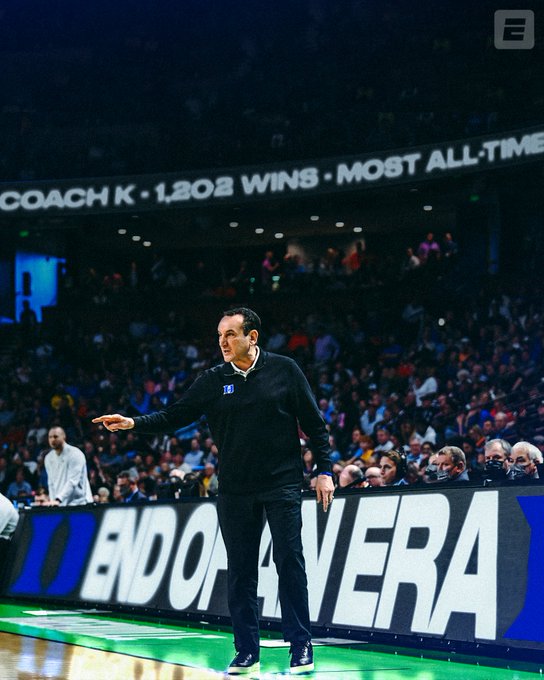
With a Torch Passed and Destiny Denied, Mike Krzyzewski Rides into the Sunset Pat Forde- Brynn Anderson/AP His arrival at this moment, this opportunity has been an exercise in patience and perseverance because, in this day and age of the NCAA Transfer Portal offering the fastest path to a fresh start, Coach K has stayed the course.
When was Mike Krzyzewski’s first game as Duke coach? March 18, 1980 — Mike Krzyzewski is introduced as Duke’s head basketball coach. Nov. 29, 1980 — Krzyzewski wins his first game as Duke’s coach, 67-49 over Stetson. Jan. 21, 1981 — A 56-47 win at N.C. State gives Krzyzewski his first victory against ACC competition. There were 15,356 days between March 18, 1980, to April 2, 2022.
NEW ORLEANS — There was no Hollywood ending for Krzyzewski, whose career clock ran out to give rise to a new king of Tobacco Road. The last Duke shot had caromed off the rim, the rebound cradled by North Carolina. It was, suddenly and swiftly, over. As the Tar Heels launched into celebratory orbit, bounding all over the Caesars Superdome court, Mike Krzyzewski folded his arms across his chest and waited for the final horn to signal the end of his life’s work.
The 75-year-old legend stood and made his way toward triumphant Carolina coach Hubert Davis. They shook hands, and Krzyzewski offered the congratulations he’d received from losing coaches 1,129 times—more than any men’s basketball coach in NCAA Division I history. Davis is exactly 1,100 career victories behind Coach K, but in that postgame handshake the torch was passed. There’s a new king of Tobacco Road now. As the Heels rejoiced, the Blue Devils left the court in emotional shambles. They had participated in a brilliant contest, one of the best in Final Four history, but there was no consolation in that after an 81–77 defeat at the hands of their bitter rivals. Center Mark Williams, who had played just 16 minutes due to foul trouble and missed two huge free throws in the final minute, tugged his white jersey up over his eyes. Guard Trevor Keels, who scored 19 points, walked just out of public viewing in the tunnel to the locker room and doubled over sobbing. The players walked past Mickie Krzyzewski, Mike’s wife, as she stood still as a statue, facing the court, a stricken look on her face. Mike did a short interview with CBS’s Tracy Wolfson, then walked off and met Mickie. This had been the familiar scene as Duke reeled off four NCAA tournament victories, walking off together as Coach K’s career kept being extended, round by round. The last walk was somber, her left hand in his right, as they followed the players to the locker room.
Coach Krzyzewski had seen a lot of playing and coaching careers end in this glorious but ruthless tournament throughout 47 years as a college basketball head coach, 42 of them at Duke. Now it was his turn. Then the Heels exited the court through the same tunnel, their locker room across the hall from Duke’s, the emotions diametrically opposed. Boisterous, exuberant, they almost floated. Guard RJ Davis and forward Brady Manek came up the ramp with their arms wrapped around each other, faces beaming. Davis was less outwardly giddy, but he did smile and point at someone as he walked by. This game will be remembered forever on Tobacco Road, and in any other locale where college basketball matters. “I think it reached a level that you would expect,” Krzyzewski said. “Those kids from both teams played their hearts out. I mean, the crowd was standing most of the game, I think. It was a heck of a game.” Indeed, it was an instant classic, 40 minutes of either held breath or dropped jaws depending on the moment. The hype for this first-ever Duke-Carolina matchup in the tournament had been immense, and then the actual play exceeded it.
Neither team ever led by more than seven points. Every mini-run was answered by another mini-run. Davis was wildly animated coaching his team, while Krzyzewski was more reserved while directing his team from a stool on the elevated court. There were soaring dunks and spectacular streaks of shot-making, including a late spate of three three-pointers in a span of 46 seconds—with the lead changing hands on each of them. Then Carolina gunner Caleb Love closed the thing down with a three at the 28-second mark, giving his team enough points to win. The final score was a near-identical callback to the other all-time classic Final Four semifinal Krzyzewski coached, but that time his team was on the winning side: Duke 79, UNLV 77, in 1991. He would go on to win his first of five national championships two days later, over Kansas. The perfect ending to his extraordinary career would have been title No. 6, of course, but sports defies scripting. Carolina wasn’t here to cooperate with a feel-good plotline, just as it failed to submit in Krzyzewski’s final home game four weeks ago.
Krzyzewski wasn’t overly emotional postgame. There were no public tears from him. He was focused on gratitude to his players, and was appreciative of the nobility of great athletic competition. “I’ll be fine,” K said. “I’ve been blessed to be in the arena. And when you’re in the arena, you’re either going to come out feeling great or you’re going to feel agony, but you always will feel great about being in the arena. “And I’m sure that that’s the thing when I’ll look back that I’ll miss. I won’t be in the arena anymore. But, damn, I was in the arena for a long time. And these kids made my last time in the arena an amazing one.”
This Duke team had played some exalted basketball in the NCAA tournament, rebounding impressively from the loss to Carolina in Cameron and an upset in the Atlantic Coast Conference tournament final against Virginia Tech. After rolling past Cal State–Fullerton in the opening round, the Devils rallied from a late, five-point deficit to defeat Michigan State. Then they put together a dazzling late offensive stretch in the Sweet 16 to defeat Texas Tech and its No. 1 ranked defense. K’s last win was over Arkansas, sending him to a record 13th Final Four.
“How these guys turned it around after we didn’t play well … was really one of the best things that’s happened for me as a coach in the last five, six years,” Krzyzewski said. Leaving San Francisco after defeating Arkansas and headed to New Orleans, the stars seemed to have aligned for the Hollywood ending. Krzyzewski’s retirement, announced last June, had been a dominant storyline all season that took on increasing magnitude come March. The tension of a single-elimination tourney meant that every time Duke played, it could be K’s last game. And then his team kept on winning, extending his career, pumping oxygen into the hope that he would go out a champion.
“Smells like destiny,” former Duke great Grant Hill had said the day the Devils won the West Region. But now the Tobacco Road team of destiny wears powder blue, not royal blue. A dozen games removed from an embarrassing home loss to Pittsburgh that threatened to knock the Heels out of NCAA tournament consideration, Carolina now is the first No. 8 seed to make the championship game in eight years. The postgame pace of movement in the Superdome hallways was a study in contrast. The Heels were in a hurry, happy to get to the interview room and talk about their biggest win ever over Duke, then briskly preparing to leave the building. There is one more game to rest up for, Monday night against Kansas, as Carolina tries to win its most improbable national title yet. For Duke, there was no urgency. It’s the offseason now. After North Carolina’s press conference ended, Davis boarded a golf cart headed back to the locker room. Krzyzewski was on one headed the other way, toward the interview room. Two carts passing in the night, carrying a coach on the ascent in his career and one who had reached the end.
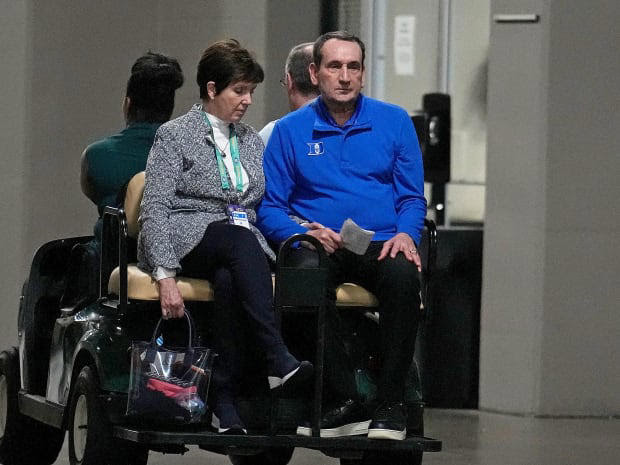
After the Duke press conference ended, Blue Devils Paolo Banchero, Keels and Wendell Moore Jr. got back on a cart for the ride to the locker room. Keels and Moore hung their heads. Banchero put his left hand on his forehead, the embodiment of tourney heartbreak. Their coach came out a few minutes later and again climbed onto the back of the cart next to Mickie. Looking up, he saw a phalanx of media members taking pictures of the scene. Always possessing a quick wit, K said to the assemblage of reporters and photographers, “Maybe you can superimpose a sunset.” The cart whisked Krzyzewski’s back to the locker room, where preparations were underway to head back to the team hotel. Golf carts kept rolling from the locker room to the loading dock, where tired Superdome employees were making their way out after a long day. The area smelled like stale beer and bus exhaust. At 11:40 p.m., Krzyzewski and Mickie left on the 10th golf cart making trips from the locker room to the bus. At 11:43, he climbed aboard the bus and sat next to his wife in the second row. He rubbed his face with his left hand, folded his arms across his chest, then stood up and went back a few rows to address his players one more time. Outside the bus, a security guard signaled to the police motorcycle escort to start their engines and turn on their flashing lights. They took the lead and the Duke bus followed, driving off into the warm and breezy Louisiana night. Their time in this tournament was done. Mike Krzyzewski had left the building. Left the sport. Left the sport at Duke and beyond better than he found it.
In every sense of the word, the man was “The Warrior.”
CUE THE MUSIC!!! Patty Smyth – “The Warrior” (Official Live Video) – YouTube This is over ten years too late, but fantastic that it’s finally happening. Paul O’Neill wasn’t just a New York Yankees star, but he truly lived up to his nickname. Think of ’90s pro wrestler Mick Foley. He put his body on the line so many times, jumping onto everyone on top of literally anything. Paul O’Neill was no different, chasing and diving after every ball even as he reached his late 30s. Four World Series rings in the Bronx. The 1994 AL batting title. Unquestionable grit and leadership that hasn’t been matched since, except maybe Derek Jeter. This is well-deserved, so expect the Yankees faithful to pack Yankee Stadium on August 21. Paul O’Neill always commanded that type of audience, and now he will one last time. To this day, his farewell chant in Game 5 of the 2001 World Series gives people chills.
How does Paul O’Neill’s career stack up to other Yankees retired number hopefuls? Paul Andrew O’Neill is a former right fielder and Major League Baseball player who won five World Series while playing for the Cincinnati Reds (1985–1992) and New York Yankees (1993–2001). In a 17-year career, O’Neill compiled 281 home runs, 1,269 runs batted in, 2,107 hits, and a lifetime batting average of .288. O’Neill won the American League batting title in 1994 with a .359 average, and was also a five-time All-Star, playing in 1991, 1994, 1995, 1997, and 1998.
O’Neill is the only player to have played on the winning team in three perfect games. He was on the field for the Cincinnati Reds for Tom Browning’s. He caught the final out (a fly ball) in David Wells’ perfect game and he made a diving catch in right field and doubled to help the Yankees win during David Cone’s perfect game in.
Early life
A Columbus, Ohio, native and Brookhaven High School graduate, O’Neill and his family were fans of the Reds. On a visit to the Reds’ Crosley Field shortly before it closed, six-year-old Paul had his picture taken wearing a Reds batting helmet and holding a toy bat. Over his shoulder could be seen Roberto Clemente of the opposing Pittsburgh Pirates. Like Clemente, O’Neill would become a right fielder and wear uniform number 21. His older sister is Molly O’Neill, a noted chef and cookbook author who was a food writer for the New York Times in the year 2000.
Paul O’Neill Born February 25, 1963, in Columbus, Ohio, he was a Major League Baseball player who won five World Series while playing for the Cincinnati Reds (1985–1992) and New York Yankees (1993–2001). During his 17-year career, O’Neill racked up 281 home runs, 1,269 runs batted in, 2,107 hits and a lifetime batting average of .288. O’Neill won the American League batting title in 1994 with a .359 average and was also a five-time All-Star (1991, 1994, 1995, 1997, and 1998).
Paul O’Neill’s No. 21 journey started with Clemente and ended in Monument Park On a visit to the Reds’ Crosley Field shortly before it closed, six-year-old Paul had his picture taken wearing a Reds’ batting helmet and holding a toy bat. Over his shoulder, Roberto Clemente (of the opposing Pittsburgh Pirates) could be seen in the background. After retiring from his Major League Baseball playing career, he authored a book entitled Me and My Dad: A Baseball Memoir. The book goes into a subject that O’Neill has rarely discussed: his relationship with his father who instilled in him a love for the game of baseball.
Like Clemente, O’Neill would become a right fielder and wear uniform number 21. O’Neill is fondly remembered by Yankee fans as the “heart and soul” of the team in the 1990s and Yankee owner George Steinbrenner labeled him as a “Warrior” due to his passion for the game. Since his retirement after the 2001 World Series, his number 21 was worn only once when relief pitcher LaTroy Hawkins briefly wore the number to start the 2008 season. On April 16, 2008, Hawkins switched to number 22 in response to the disapproval of many Yankee fans.
Baseball Career
O’Neill was drafted by the Cincinnati Reds in the 4th round of the 1981 Major League Baseball Draft. O’Neill made his major-league debut on September 3, 1985, and singled in his first at-bat. He also played in Puerto Rico’s winter league with the San Juan Metros and the Mayaguez Indians from 1985 to 1986.
Paul O’Neill on kicking ball blooper from 1989 (mlb.com) In a 1989 game against the Philadelphia Phillies at Veterans Stadium, O’Neill fielded a base hit, couldn’t hold onto it, and kicked it, left-footed, back to the infield, to prevent baserunner Steve Jeltz from scoring. Jeltz scored on a passed ball anyway, however, the incident is remembered as one of the all-time baseballs “bloopers.” A broadcaster quipped: “The Cincinnati Bengals are on the phone!”
>The Reds’ last World Series winning manager, Lou Piniella. From ESPN.com:
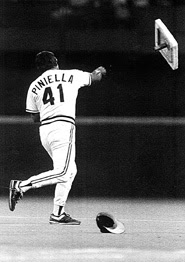
Aug. 21, 1990. Riverfront Stadium. Dutch Rennert called Barry Larkin out at first at the end of the fifth inning. Reds manager Lou Piniella comes out to argue the call. He throws his hat down. Rennert ejects him on the spot. But wait, there’s more. Piniella pulls up first base and throws it, and, dissatisfied with his first toss, picks it up and hurls it again, sending it flying and rolling all the way into short right.
“I just saw it (the base) laying next to my feet,” Piniella said after the game. “That just happened. You come in here and say to yourself, ‘What the hell is a 47-year-old man doing that for?’ I don’t know. It’s frustrating. The bag was lying there, and I grabbed it. Dutch Rennert is a fine umpire, and I didn’t want to show him up. I’ll talk to him tomorrow before the game.”
The Reds would go on to win the 1990 World Series defeating the heavily-favored A’s in four games – all in Piniella’s first season with the Reds. Incredibly, Sweet Lou and the Reds would part ways just two years later after the 1992 season. Piniella would go on to have successful runs with the Mariners, Devil Rays, and Cubs. Piniella retired today to be with his ailing mother – and you can watch his tearful press conference here. Lou – thanks for throwing the base, smashing the bubble game machine, kicking the dirt, fighting with Dibble, and a Wire-to-Wire World Championship. O’Neill also clashed with Reds manager Lou Piniella, who wanted O’Neill to change his swing to hit more home runs.
November 3, 1992: Eighteen days after being named General Manager of the Cincinnati Reds, Jim Bowden trades right fielder Paul O’Neill and minor league first baseman Joe DeBerry to the New York Yankees for outfielder Roberto Kelly. Bowden later laments this as the worst trade he ever made. O’Neill went on to win four World Championships with the Yankees (in addition to the 1990 championship with the Reds) and become known as “The Warrior” for the Yankees. In eight seasons with the Reds, O’Neill batted .259 with 96 home runs. In nine seasons with the Yankees, O’Neill batted .303 with 185 home runs and he won the American League batting title with a .359 mark in 1994. With the 1990 Reds World Championship team, O’Neill had batted .270 with 16 homers. He hit .471 in the 1990 National League Championship Series. In Bowden’s defense, O’Neill had a poor 1992, with his power production dropping by almost half from 1991 (36 doubles and 28 homers became 19 doubles and 14 homers) and he had turned 29 years old, the approximate age when many players begin their decline phase.
Meanwhile, Kelly wasn’t long for Cincinnati. After batting .280 in six seasons with the Yankees, Kelly batted .313 for the Reds in 125 games 1993-94, but couldn’t stay healthy and was dealt to the Atlanta Braves for center fielder Deion Sanders during the 1994 season. Kelly played for seven teams over the next six seasons, concluding a 14 year career with a .290 batting average and 124 home runs. During his time with the Reds, he preferred to go by “Bobby” Kelly rather than Roberto. On November 3, 1992, the Reds traded O’Neill to the Yankees for Roberto Kelly. O’Neill beat himself up after being traded by the Reds to The Yankees because he felt he somehow let his Hometown Team Down. However, In 1994, with O’Neill winning the batting title, the Yankees led the East division by six and a half games when the players’ lockout ended the season. The next season, the Yankees made the playoffs for the first time in 14 years and did so in every season for the remainder of O’Neill’s career.
In 1995, while still a player for the Yankees, O’Neill was featured in a cameo role on the NBC sitcom Seinfeld. In the episode entitled “The Wink,” O’Neill is approached by Cosmo Kramer in the Yankees’ locker room and is told by Kramer that he must hit two home runs in the same game so that Kramer can retrieve a birthday card signed by all the Yankees from a little boy who wasn’t supposed to get it in the first place. O’Neill replies that this is very difficult and that he is not usually a home run hitter; he then asks Kramer, “How’d you get in here anyways?” In the ensuing game, O’Neill hits a home run and later appears to have hit a second; the apparent inside-the-park home run is scored a triple due to the other team’s error, so the little boy Kramer is trying to appease is not totally satisfied. Kramer manages to get the Yankee-signed birthday card back from the boy, but he has now promised the boy that O’Neill will catch a fly ball in his hat during the next game. (Interestingly, such an act would be illegal under Major League Baseball rules).
He was an integral member of the New York Yankees’ last dynasty, helping them to win the World Series in , , , and . He ended Game 5 of the 1996 World Series by robbing former Yankee teammate Luis Polonia of the Atlanta Braves of an extra-base hit, preserving a victory for the Yankees. O’Neill played Game 4 of the 1999 World Series just hours after his father died. The Yankees won the game and swept the Braves to win their 25th World Series Championship. O’Neill famously was his own worst critic, seemingly never satisfied with his own performance and known for his emotion on the field; when disappointed with his performance or angry with an umpire’s decision he would attack water coolers or toss bats on the field. His tirades were both praised and criticized by the media and fans. O’Neill was involved in a brawl with Seattle catcher John Marzano. O’Neill had complained to the umpire that the previous pitch was high and inside. Marzano then hit the much bigger Paul O’Neill with a haymaker. The two grappled, and the benches cleared. On April 30, 1996, O’Neill was notable for hitting a long home run to Eutaw Street off Arthur Rhodes while playing at Oriole Park at Camden Yards. O’Neill is fondly remembered by Yankee fans as the “heart and soul” of the team’s dynasty in the 1990s. Yankee owner George Steinbrenner also labeled him as a “The Warrior.” He was given this nickname due to his passion and love for the game.
2001 World Series Game 5: Arizona Diamondbacks @ New York Yankees In Game 5 of the 2001 World Series, O’Neill received a sendoff from New York fans. While standing in right field in the 9th inning with the Yankees down 2-0, the entire stadium chanted his name. When the inning ended, O’Neill was still being cheered. With tears in his eyes, he tipped his cap, and another roar went up from the crowd at Yankee Stadium.
The Yankees won the game 3-2, but lost the series 4 games to 3. Since his retirement after the 2001 World Series, his number 21 has only been worn once, when relief pitcher LaTroy Hawkins briefly wore the number to start the 2008 season but, on April 16, 2008, Hawkins switched to number 22 in response to the criticism he received by many Yankee fans, all the more suggesting that number 21 may one day be retired for O’Neill.
Paul O’Neill Hated to Lose: A Look Back at the 1997 Playoffs
It occurred between World Championships, which might be the reason it is not mentioned when discussing the last Yankees‘ dynasty. But it was a performance that defined what the Yankees used to be. It ranks with the heroics of Mickey Mantle, Reggie Jackson, Bucky Dent and Chris Chambliss—except the Yankees lost.
Paul O’Neill’s Great Playoff Series
Paul O’Neill batted .421 in the first round of the 1997 playoffs against the Indians. He hit a home run in Game One, he hit a game-winning grand slam in Game Three, and he refused to be the final out of the series in Game Five. It is only 25 years ago, but it might as well be 125 years ago, because the game and the attitudes towards not accepting defeat have changed so radically.
Paul O’Neill wanted to win, but he hated to lose so much, he would do anything to win. As a character in The Wire once said, “You like to win. I don’t like to lose. It’s not the same thing.”
The Yankees’ Last Gasp
The Yankees were trailing the Indians, 4-3 in the top of the ninth inning in Game Five. The bases were empty, two were out, and Paul O’Neill was facing Jose Mesa. O’Neill hit a deep drive to right center field that missed tying the game by about five feet. As O’Neill rounded first, he had already decided that he had to get to second to put himself into scoring position. It appeared that he would be thrown out at second, but despite being beaten by the throw, O’Neill slid away from Omar Vizquel’s tag, banging up his chin—but getting into second safely.
When Paul got up, his face was full of blood, yet all that mattered was that he had given the Yankees a chance. When manager Joe Torre sent Scott Pose in to run for him, Paul objected passionately, but it did no good. Bernie Williams, the next batter, went after the first pitch, hit a fly ball to left, and the Yankees’ season was over.
Paul’s Passion
The 1997 playoff series against the Indians explained why Paul O’Neill threw his helmet, castigated himself, and lowered his head after striking out. Every game was the seventh game of the World Series, and every at bat was the fifth game of the 1997 playoffs. He might fail, but he never failed to try.
Mel Allen, the only Voice of the Yankees, used to tell fans that the Indians’ and White Sox‘ great pitcher, Early Wynn, would throw at his mother if she got too close to the plate. It has been said that Paul O’Neill looks like he wouldn’t want to lose to his kids in a game of wiffle ball.
We Lost
George Steinbrenner said “He showed you do not give up. Ever. Ever. A heart of a lion—that’s what you think of when you think of Paul O’Neill. I wish I had 25 like him.” When Mr. Steinbrenner shook hands with O’Neill and congratulated him in the clubhouse for his great playoff-series performance, Paul’s response summed up what Paul O’Neill was all about. “It doesn’t matter. We lost.”
Intensity and the pursuit of excellence cannot be separated. Some individuals demonstrate their intensity, overtly, while others possess it just as deeply but hide it within themselves. Whitey Ford, Derek Jeter, and Mariano Rivera were or are no less intense than Mickey Mantle, Billy Martin, or Whitey Ford, but in the attempts to make society increasingly “politically correct,” demonstrating intense feelings and emotions is frowned upon, which is too bad. Baseball needs more players like Paul O’Neill. There is nothing wrong in wanting to win at any cost.
References:
By BUSTER OLNEY. (1998, March 1). The Moment That Defines O’Neill: His Ninth-Inning Double Against the Indians Made Him a Yankee Hero BASEBALL Last-Gasp Double Defines O’Neill. New York Times (1857-Current file), p. SP1. Retrieved May 19, 2009, from ProQuest Historical Newspapers The New York Times (1851 – 2005) database. (Document ID: 116581613). Paul O’Neill at Baseball Library
Voices of the Game, Paul O’Neill Starting after his retirement from baseball in 2001, O’Neill now serves as an analyst on the New York Yankees Pregame Show and the New York Yankees Post-Game Show, as well as a color commentator for the YES Network. O’Neill returned to Ohio to live with his family. As a broadcaster, Paul O’ Neill’s greatest strength is his in-depth hitting analysis. Listening to him as he offers insight into each at-bat in the Yankees lineup is a great way to learn about the art of hitting. Here’s some of what he has had to say about several Yankees who’ve had a slow start at the plate in 2021, as well as other observations he has shared with YES Network audiences this season.
“Contact makes things happen.” O’Neill, a contact hitter himself, should know. While he doesn’t devalue home runs, O’Neill notices when a Yankee is trying too hard and pressing at the plate. He made his comment regarding contact during yesterday’s game against the Nationals, when Gleyber Torres was up with two strikes and the bases loaded in the 11th inning. Before the next pitch, Torres choked up on his bat and executed a swinging bunt grounder to win the game. During Gleyber’s struggles in April, O’Neill pointed out that Gleyber’s weight was falling away from the plate during his swing, and how that weight shift was making it very difficult for him to drive the ball away. In trying to pull the ball, O’Neill explained, Gleyber’s swing “had gotten longer and longer,” and his first move [before swinging] was opening up his stance and throwing off his mechanics. As O’Neill said, “That’s not how you get out of slumps.” He has commended Torres’ hitting ability, too. The way Torres is able to hit the ball to all parts of the field continues to impress O’Neill. He has also praised Gleyber’s ability to make adjustments on counts with two strikes.
Clint needs to learn what pitches to expect More than once this year, O’Neill has suggested that Clint Frazier’s reticence to swing stems from pitchers surprising him with a pitch he hadn’t expected to see. “He just saw a pitch on the inner half of the plate,” O’Neill told YES viewers on April 22. “The rest of the count will be soft stuff away and he should be anticipating it. As a hitter, you don’t mind seeing that.” He went on to explain that he believes Clint is pressing mentally, which, in Paulie’s experience, leads a hitter to “fly open on everything.” In other words, Clint had a good pitch to hit, yet he ended up striking out. According to O’Neill, when a guy in the lineup is struggling, it’s often because he’s missing good pitches.
Odd and ends O’Neill seems to identify with DJ LeMahieu’s approach at the plate and DJ, it seems, is a hitter after Paulie’s heart. O’Neill often comments on how LeMahieu is so good at staying inside, which allows him to drive the ball to left-center field. He’s good at covering the entire plate, and for him, that makes more pitches hittable. O’Neill is often criticized for being too goofy on air, but when it comes to breaking down hitting, he provides incredible insight and is able to break down at-bats in impeccable detail. On July 7, 2009, Paul O’Neill was inducted into the Irish American Baseball Hall of Fame (18 W. 33rd St. inside Foley’s NY Pub & Restaurant) in New York City along with longtime Los Angeles Dodgers owner Walter O’Malley, broadcaster Vin Scully, former player Steve Garvey, umpire Jim Joyce, and blind sports reporter Ed Lucas.
What Happened to Paul O’Neill? (Complete Story) (thecoldwire.com) Add another plaque to the crowded wall of retired numbers at Yankee Stadium. On Tuesday, the Yankees announced that they will retire Paul O’Neill’s No. 21 this season. With his pregame ceremony on Aug. 21, O’Neill will become the 23rd player or manager to have their number retired. The outfielder-turned-broadcaster who won four World Series titles with the Yankees already had a plaque in Monument Park honoring his contributions to the team, but now he receives the franchise’s highest honor.
The Yankees have not retired a number since they hung Derek Jeter’s No. 2 in 2017. With 21 now off the table, 11, 12, 14, 18, 19 and 22 are the only numbers under 28 that are neither retired nor worn by a current player or coach. O’Neill played the final nine seasons of his career with the Yankees, helping them break their playoff drought in 1995 and later their World Series drought. He’d appear in five total World Series with the Bombers in addition to his one with Cincinnati in 1990. Over his nine years in the Bronx, the tenacious veteran hit .303 with a .377 on-base percentage and .492 slugging percentage. His .359 batting average during the strike-shortened 1994 season also won him a batting title. From 1993 to 2001, the entirety of his Yankee career, O’Neill was worth 26.7 Wins Above Replacement, making him the eighth-most valuable American League outfielder during that stretch.
In 304 postseason plate appearances with the Yankees, O’Neill hit .281 and socked 10 home runs, 14 doubles and drove in 34 runs in 76 games. At 37 years old, he had a strong case for MVP of the 2000 World Series, ultimately losing to Jeter. In that five-game triumph over the Mets, O’Neill slashed .474/.545/.789 with four of his nine hits going for extra bases, including two triples. Early in his Yankee tenure, he also made a sterling defensive play to help seal the first World Series win of the dynastic run. In Game 5 of the 1996 series in Atlanta, O’Neill ranged deep into the gap to make a stabbing catch for the game’s final out, preserving a 1-0 win.
Other memorable O’Neill postseason moments include his ten-pitch walk against Armando Benitez in Game 1 of the Subway Series (a game which the Yankees were losing until O’Neill sparked a rally) and winning the 1999 championship after his father passed away during the World Series. While two short-lived Yankees (LaTroy Hawkins and Morgan Ensberg in 2008) have worn 21 since O’Neill retired, the number has basically been on ice for years. In 2017 when New Jersey native Todd Frazier was traded to the Yankees, he asked to wear the number specifically as a tribute to O’Neill. Instead, Frazier was given No. 29 after the equipment staff explained the potential controversy it could drum up, as both Hawkins and Ensberg were booed for having the audacity to wear an unretired number, even though Ensberg switched away from it during spring training.
Paul O’Neill’s No. 21 is going on a long list of retired Yankee numbers. (MATT CAMPBELL/AFP via Getty Images)
Rather than address the situation, O’Neill did not comment, turning a very minor story into a major headline. Now, with the number retirement becoming official, we can finally put the “Should anyone wear No. 21?” discussion to bed in favor of “Should No. 21 be retired at all?” For what it’s worth, O’Neill does not rank in the franchise’s top ten in career batting average, on-base percentage, slugging percentage, WAR, hits, doubles, home runs, RBI or wRC+. All guests in attendance for the Aug. 21 game against the Blue Jays will not only get to witness the retirement ceremony, but they’ll also receive a commemorative “Paul O’Neill Day” ticket. Looking ahead, CC Sabathia’s No. 52 seems like the next in line for retirement, as the team has already kept that out of circulation since his final game in 2019.
“The worst lies are the lies we tell ourselves. We live in denial of what we do, even what we think. We do this because we’re afraid. We fear we will not find love, and when we find it we fear we’ll lose it. We fear that if we don’t have love, we will be unhappy.” ― Richard Bach
The Worst Types Of Lies – 8 Harmful Lies You Tell Yourself
Want to know the worst types of lies? There are the 8 harmful lies you tell yourself.
Do you tell any of these to yourself? If so, beware these lies!
Frances Vidakovic With a degree in psychology, Frances Vidakovic is a certified life coach for goal getters, author of 20+ books, host of the Dream Big My Friend podcast and course creator. Her superpower: transforming moms from dreamers into doers. Frances has been featured on various platforms, including Scary Mommy, Thrive Global, Medium and SBS Radio.
Hey my friend, Lying to others is bad enough but lying to yourself is the worst of all lies. Do you know why? Because you can lie to anyone else in the world but you can’t ever lie to yourself. Not really.
Deep down you know the truth. The lies you tell yourself usually have an insidious purpose. You’re either trying to absolve yourself of responsibility or justifying inaction.
Be warned: the damage you do by lying to yourself is tremendous. A lie may care about the present but it seriously has no future. The truth may not cost anything right now but a lie over time could cost you everything. Tell a lie once and all your truths become questionable. She was so used to lies, that the truth confused her. ― Jeff Hood Lies may leave you at peace with others but you will always be at war with yourself. ― Marinela Reka Above all, don’t lie to yourself. The man who lies to himself and listens to his own life comes to a point that he cannot distinguish the truth within him or around him and so loses all respect for himself and for others. And having no respect he ceases to love. ― Fyodor Dostoyevsky
Here are 8 harmful lies you should avoid so you can finally take back control of your life:
TYPES OF LIES # 1 – There will be time in the future to do it. Do you want to do it or not? Often, we enjoy the idea of doing something, but lack the interest or determination to put it in time, work, or sacrifice to make it happen. Playing the guitar might sound like fun to you, but the idea of putting in hours of work to play at a mediocre level isn’t appealing. But here’s the truth: time waits for no one. If you really want to do it, you’ll find a way. If you don’t, you’ll find 1,000 reasons to put it off and procrastinate. Realize that you choose how you spend your time. The trouble is, you think you have time. ― Jack Kornfield Lost time is never found again. ― Benjamin Franklin Time is free, but it’s priceless. You can’t own it, but you can use it. You can’t keep it, but you can spend it. Once you’ve lost it you can never get it back. ― Harvey Mackay It is the time you have wasted for your rose that makes your rose so important. – Antoine de Saint-Exupéry, The Little Prince Regret for wasted time is more wasted time. ― Mason Cooley A man who dares to waste one hour of time has not discovered the value of life. ― Charles Darwin Either you run the day, or the day runs you. ― Jim Rohn
TYPES OF LIES # 2 – I can change another person. Think about how difficult it is to change yourself. Any change is extremely challenging, even when you’re highly motivated. Odds are that the person you want to change is less than enthusiastic. You have a losing battle on your hands. If it’s vital that the other person change, you’d be better off finding another person to fulfill the role. You cannot always control what goes on outside. But you can always control what goes on inside. ― Wayne Dyer When you let go of control and commit yourself to happiness, it is so easy to offer compassion and forgiveness. This propels you from the past, into the present. People that are negative, spend so much time trying to control situations and blame others for their problems. Committing yourself to staying positive is a daily mantra that states, “I have control over how I plan to react, feel, think and believe in the present. No one guides the tone of my life, except me! ― Shannon L. Alder I don’t have any control over what actually happens except for that I have full control over my will for myself, my intention, and why I’m here. That’s all that matters. ― Sza
TYPES OF LIES # 3 – I’m not like anyone else / there’s something wrong with me. Everyone believes they’re different from others. You are certainly unique, but you’re remarkably similar to the average person. You’re not deficient or flawed. You are perfectly perfect and there is absolutely nothing wrong with you! This type of thinking serves as an excuse to play the victim and remain small.
TYPES OF LIES # 4 – It will get better or go away if I just ignore it. Things tend to get worse if ignored.
Because guess what? Challenges will never, ever, ever, ever go away! Unless you have a magical fairy taking care of business for you, you’ll have to deal with the challenges of life directly. Otherwise, you’ll find your challenges grow and multiply. It is not in the still calm of life, or the repose of a pacific station, that great characters are formed. The habits of a vigorous mind are formed in contending with difficulties. ― Adams The brick walls are there for a reason. The brick walls are not there to keep us out. The brick walls are there to give us a chance to show how badly we want something. Because the brick walls are there to stop the people who don’t want it badly enough. They’re there to stop the other people. ― Randy Pausch Life’s Challenges Are Not Supposed To Paralyze You, They’re Supposed To Help You Discover Who You Are. ― Bernice Johnson Reagon I don’t run away from a challenge because I am afraid. Instead, I run towards it because the only way to escape fear is to trample it beneath your foot. ― Nadia Comaneci Success Is Due To Our Stretching To The Challenges Of Life. Failure Comes When We Shrink From Them. ― John C. Maxwell Being Challenged In Life Is Inevitable, Being Defeated Is Optional. ― Roger Crawford It’s Lack Of Faith That Makes People Afraid Of Meeting Challenges, And I Believed In Myself. ― Muhammad Ali When we least expect it, life sets us a challenge to test our courage and willingness to change; at such a moment, there is no point in pretending that nothing has happened or in saying that we are not yet ready. The challenge will not wait. Life does not look back. ― Paulo Coelho
TYPES OF LIES # 5 – I’m too young / I’m too old. Sure, it’s true that you won’t be a CEO at 3-years of age or start medical school at 106. However, age is much less limiting than you believe. History has proven it time and time again. The young and old have accomplished incredible things. You can too. You are not too old and it’s not too late. You are never too old to set another goal or to dream a new dream. ― C.S. Lewis It is not too late. You are not too old. You are right on time – and you are better than you know. ― Marianne Williamson
TYPES OF LIES # 6 – I don’t have any other choice. You have more choices than you could possibly realize. Here’s the thing: everything in your life is a reflection of a choice you have made. If you want a different result, make a different choice. If your habitual actions and thoughts are limiting, you really need to open your mind to all the possibilities.
There are always other choices.
Brainstorm with a creative friend and investigate your other options. Remember however that you are free to make whatever choice you want but you are not free from the consequences of the choice. Life is about choices. Some we regret; some we’re proud of. Some will haunt us forever. The message: we are what we choose to be. ― Graham Brown May your choices reflect your hopes, not your fears. ― Nelson Mandela It’s not hard to make decisions when you know what your values are. ― Roy Disney
TYPES OF LIES # 7 – I don’t want to make a fool out of myself. Like most of us, you’re probably far too inhibited.
You’re not a teenager anymore. It’s time to let go of the fear of others’ opinions. An exciting life is boldly lived. You need to live boldly.
When you’re bold, you’re going to receive some negative feedback. When you’re timid though, you’ll still receive negative comments. You’ll be criticized no matter what you do, so do what’s best for you.
Remember that 99% of the time, no one really cares. Everyone is too absorbed with their own issues. Act boldly and unseen forces will come to your aid. ― Dorothea Brande The doors will be opened to those who are bold enough to knock. ― Tony Gaskins We need to be visionary; we have to be bold. ― Angela Hunt Good Fortune favors the bold. ― James Swartz Whatever you can do, or dream you can, begin it. Boldness has genius, power and magic in it. ― Johann Wolfgang von Goethe
TYPES OF LIES # 8 – It’s too late. This is similar to “I’m too old.” Starting a business might have been more convenient before you got married and had children, but it’s still a possibility.
Honestly it is NEVER too late to chase a dream! The idea that it’s too late is just another excuse to justify staying where you are, comfortable in your own misery. All in all, by lying, you take the responsibility off of your shoulders and redistribute it. You lie to yourself in order to protect yourself from possible failure. And you really need to know the truth.
It’s never too late to start over. It’s never too late for a new beginning in your life.
If you weren’t happy with yesterday, try something different today. Don’t stay stuck. Do better. The time to make changes is now. It is never too late to be what you might have been. ― George Eliot The time for action is now. It’s never too late to do something. ― Antoine de Saint-Exupery Never too old, never too bad, never too late, never too sick to start from scratch once again. ― Bikram Choudhury But lying to yourself ensures that you’ll stay stuck.
Start being honest with yourself and face life head-on. You’ll be glad you did! The most dangerous lies are the lies you tell yourself. So stop lying to yourself.
You can lie to anyone else in the world but you can’t lie to yourself. Our lives improve only when we take chances and the first and most difficult chance we can take is to be honest with ourselves.
I Will Correct Myself — You Are Right, and I was Misled:
This is the Truth About TRUMP’s Grandfather Frederick Trump – Wikipedia You ask where I get my sources: I have celebrity status on social media from learning through others and for speaking the truth.
Going into the infrastructure plan itself Building a Better America | The White House most of the spending is for bullshit. Most of the spending for Covid 19 was also bullshit considering most of the grants handed out to businesses are based on being Unamerican and this spending will be paid off by future generations…which is bullshit.
In the last year home expenses have gone up drastically per household.
You don’t fix a problem by throwing more money at it. When it comes to health care you attack the root cause which is the cost to the providers.
Good Samaritan Hospital closed its doors in Dayton, Ohio.
Good Samaritan Hospital closed in 2018, impacting about 1,600 employees. The news came as a surprise to city officials, hospital employees and patients. Premier officials said it was unsustainable to operate two hospitals within five miles of each other.
All Obamacare did was increase insurance premiums. Doctors pay $350,000 for their education and that’s bullshit. What needs to be done is strike a balance in health care through enrollment fees. Where everybody pays and I mean everybody a percentage of their income. That money then should subsidize health care for their expenses and not go into a politician’s pocket. That’s true Universal Health Care Coverage!!!
Paulina Jaramillo is one of the many faculty experts at Carnegie Mellon University contributing to the work of the Wilton E. Scott Institute for Energy Innovation. Jaramillo, an assistant research professor in Engineering and Public Policy and executive director of the Renew Elec project, discusses whether hurricanes will clobber offshore wind turbines.
Offshore Wind Farms: Allaying Concerns About Hurricanes and About Fishing. But most wind turbines are not built to withstand a direct hit from the strongest hurricanes, according to a new study in Geophysical Research Letters that models the worst-scenarios caused by category-5 storms. Researchers predict new offshore turbines would face hurricane wind gusts of more than 223 miles per hour — but the turbines can only manage gusts of 156 miles per hour based on current engineering standards.
Part of the problem: Offshore turbine designs often draw from onshore wind turbines in Europe, where hurricane conditions are essentially nonexistent. “We need to make sure offshore wind energy is successful the first time around,” said Rochelle Worsnop, doctoral candidate at the University of Colorado Boulder, who spearheaded the project.
“We believe that this research can help guide those standards to help turbines placed in hurricane prone regions survive these major hurricanes.” Offshore wind energy development is growing along U.S. coasts. The first U.S. commercial offshore wind farm went into operation in December, and many more are on the horizon. Offshore wind energy generation could expand the nation’s energy supply with potential to provide 160,000 jobs and low-cost energy for millions of Americans.
Worsnop and her colleagues started this project by looking into where hurricane winds cross paths with offshore wind farms. At first, getting this kind of data proved nearly impossible. Hurricanes that come within striking distance of offshore wind turbines are infrequent. Plus, at the moment, offshore wind developments are few and far between. Most wind measurements she could find in public databases were recorded too high above the water or too far from shore to reflect what a wind turbine might experience.
So, Worsnop’s team member — George Bryan of the National Center for Atmospheric Research — recommended she use a computer simulation driven by hurricane data from the last 15 years. Bryan used this high-resolution model to recreate the worst of the worst — a category-5 hurricane eyewall, where winds can exceed 220 miles per hour — to see how wind turbines would hold up. The team also investigated how wind characteristics, such as changes in direction and turbulence, might affect turbines.
Large and fast changes in wind direction could be problematic.
Wind Turbines based upon Worsnop’s model. Wind turbines work best when facing directly into the wind, so turbine rotors swivel about the tower to maintain a wind-in-the-face orientation. The researchers found most turbines would not twist fast enough to respond. “We are learning more about the anatomy of a hurricane, which is improving the design resilience of future wind turbines,” Walt Musial, an engineer at the National Renewable Energy Laboratory and a senior author on the study, told NewsHour via email.
Their model also predicted wind direction changes up to 55 degrees between the ground and the tip of a blade — a measurement called veer. As a result, these category-5 winds could bend a turbine blade in one direction — say, at the tip — as it simultaneously applies stress on another portion, causing the blade to malfunction or break.
“One of the benefits of this study is that you can get a much better global, spatial quantification of that veer — and that’s fabulous, that’s exactly what a wind turbine designer needs,” said Sandy Butterfield, chairman of the International Electrotechnical Commission Renewable Energy (IECRE), the organization that writes the standards for wind turbines and other renewable energy equipment.
The researchers behind the study are now guiding a revamp of turbine engineering standards. Musial said they may take three years to implement. “The simulation is the best estimate we have. It’s more accurate than any other estimate for the kinds of winds that could really damage a wind turbine,” Butterfield, who was not involved in the study, said. “It’s going to help us update the standards to reflect wind turbine design criteria for hurricanes.”
Biden is pretending to be God; he wants to fix our climate which is a hoax.
Many politicians’ own mansions on the coast.
Bing:Does Al Gore own ocean front property? Al Gore got all that Bullshit started with his documentary: An. Inconvenient.Truth.2006 and one nation under God can’t fix a climate if all other countries are unwilling. The United States is a small percentage of the big picture. As far as your statement about water safety in the United States Most life-threatening waterborne diseases caused by microbes (such as typhoid fever or cholera) are rare in the United States (chlorine in water is a more alarming safety factor to the pineal gland than poor water quality.)
On January 6th: 700 patriots were arrested out of the 10s of 1000s which were there. A big percentage for holding a camera and taking pictures. Your comment about the Proud Boys, the Oaths Keepers, the 3 percenters don’t concern me. As much as Antifa which is an Obama and his Brother Hooded funded organization.
One last Tidbit: Biden can’t be helping poverty rates with gas prices and inflation rates spinning out of control. Bing: Bidens tax Increase for the Middle to Working Class. (Biden is lying about that as well.)
Nineteen-Eighty Four discusses censorship and talks about how the government and “big brother” have too much power because they can listen to you and watch your every move. “He put the diary away in the drawer (Nineteen-Eighty Four, 29),” is a good example of a way to protect against big brother. Big brother is an all powerful, all seeing power that can make things happen to people who speak against it.
The entire first part of this book talks about the narrator being scared. In section two, the narrator walks into a door and he is dripping in sweat. He is worried someone is going to be inside waiting for him. His diary is open with BIG BROTHER written on it. Big brother can look at you through everything you might not even think about.
A diary is a good way to protect yourself against this sort of thing. A diary is the one thing big brother cannot look at. A piece of paper is un-hackable and cannot — be looked at by other people. In movies we often see this as well. People use paper and pens to correspond because it is the only thing that cannot be hacked.
Big brother is the government monitoring everything they can, and paper and pens are some of the few things they cannot monitor. People live completely off the grid on the warnings of things like this book.
People live completely with no technology and take their time and care to not be seen by anything that ‘big brother’ might be able to look at. Big brother is an issue we see all the time and is an issue that is more apparent than some people might know through a corrupt media’s censorship. Biden taps U.S. oil reserves to ease gas prices.
President Biden announced an unprecedented set of actions to ease the financial squeeze for fuel, including accessing about a third of the nation’s strategic reserve until October. Errol Barnett has the latest on what this means for Americans.
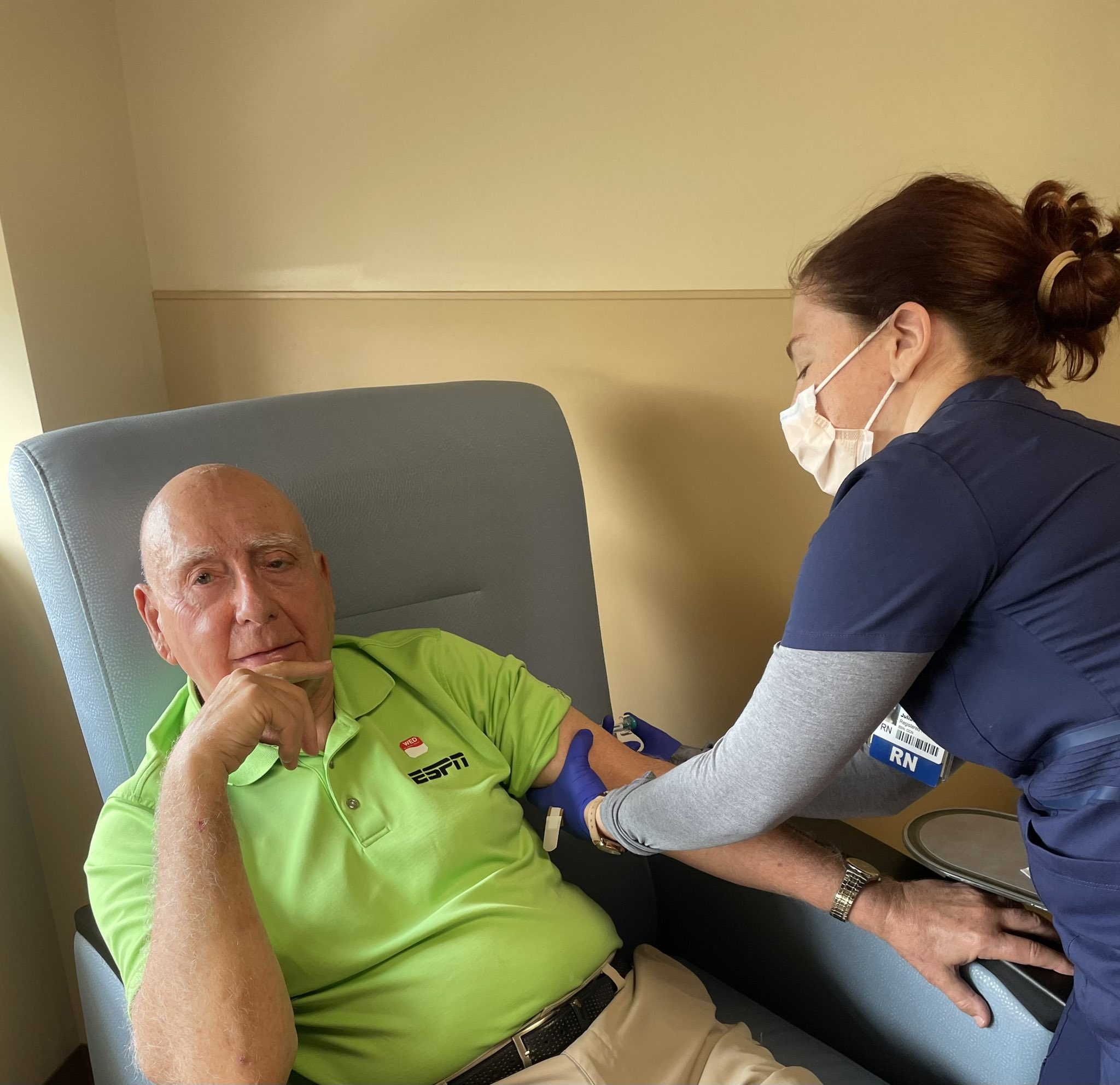
LAKEWOOD RANCH, Fla. — Dick Vitale stares at the TV wide-eyed, resting his lower back on the couch to relieve soreness from a Neupogen shot that’s meant to offset knifing pain from his second-to-last round of chemotherapy. His living room has windows that overlook a golf course in the backyard and opens up to an office that could pass as a sports museum from a Hall of Fame broadcasting career. Hallways are decorated with pictures of his five grandchildren and family vacations. Vitale’s wife of 50 years, Lorraine, scurries around the home to help pass out desert after dinner.
“Coach K needs a timeout, he needs a T.O., baby,” a raspy Vitale says as Texas Tech scores against Duke in Thursday’s Sweet 16 game the Blue Devils go on to win. Seconds later, an errant pass leads to a Duke turnover. Texas Tech responds with a dunk that prompts Mike Krzyzewski – Vitale’s longtime friend – to call timeout. “Mike was one play too late. Duke’s momentum was screwed after that last play,” he says. NOBODY LIKE VITALE: Broadcaster’s fight against childhood cancer continues
At his southern Florida home, Vitale can’t shut off his play-calling despite sitting out March Madness. He’s in the recovery stages of a seven-month cancer fight, cleared to use his signature voice just a week earlier after a “fricken brutal” several months of resting his vocal cords and communicating only via text or with a dry-erase white board. Lorraine, became emotional recounting her husband’s journey, has watched his spirits skyrocket since regaining his voice. “Having him quiet and unable to express himself, that was hard to watch. It was almost harder than the lymphoma (diagnosis),” she says. “For three months, I felt trapped. I was sobbing when I got my voice back,” Vitale tells USA TODAY Sports, his speech less animated and throat still tender from vocal cord surgery. “I love talking with people more than anything in life. And if I can’t communicate, I become so depressed.”
‘Cancer. Cancer. Cancer.’ Lorraine or Vitale’s “secretary” as he calls her, reads her husband’s chicken-scratch handwriting at night after NCAA Tournament games, then writes it on a jumbo dry-erase board for him to read the next day in four video segments breaking down the games. She shoots the videos herself before sending them to ESPN. “It keeps me occupied, keeps me away from thinking about cancer,” Vitale says. “It hasn’t been easy.
‘Cancer. Cancer. Cancer. Can he beat cancer?’ “ Even with those video breakdowns, something’s still missing this March in the relationship between one man and millions of college basketball fans. He’s unable to call the Final Four for ESPN International while resting his voice. Vitale, 82, says listening to Steven Zeitels, the doctor who “saved my voice” (and singer Adele’s vocal surgeon), hasn’t been easy. “I miss being on air so badly,” Vitale says. “When that red light goes on and we’re live, I’m talking to my friends. America, baby.” Vitale has been talking to his friends in their living rooms for 43 years as the voice of college basketball, and if he’s healthy, plans to call games next season.
‘(Expletive), it’s over!’ “Stick a fork in ‘em, they’re done,” Vitale says, watching No. 4 Arkansas upset overall No. 1 seed Gonzaga. “That’s what Jimmy (Valvano) used to say when a game was over.” Vitale’s son-in-law, Thomas Krug, counters during a dinnertime debate, noting how much time is left in the game. “(Expletive), it’s over!” Vitale quips. “They’re about to have a party in Fayetteville tonight.”
Guess who was right? Vitale’s family members, rallying behind him during his battle with cancer, don’t know him any other way than to have his bulldozing passion dominate the room. “What you see with my dad on TV isn’t all that different from who he is at home. He’s actually more passionate at home. There’s nothing censored about him,” says his daughter Terri, who has traveled to Boston for all of his cancer treatments.
“What it is: My Dad loves people and engaging with them. “Growing up, my dad had always been this larger-than-life figure. I’ve definitely been seeing him in a very vulnerable state with cancer.” Vitale has been sharing that vulnerability with the world – most notably, his 941,000-plus Twitter followers. Cancer and its treatments have caused unbearable bone and muscle pain, insomnia and worst of all, fear of time running out.
His engagement with fans isn’t just college basketball analysis. It’s about his matchup with the disease. He’s shared updates before and after big procedures, had Lorraine shoot video of him interacting with doctors and nurses, and displayed his raw emotions fighting the illness. “This is for those that are in my club of CANCER PATIENTS fighting the journey to beat this disease,” Vitale tweets last week.
“Yes, the scans, bloodwork, blood counts. chemo treatments. NEUPOGEN shots that cause intense pain wear on us but Remember as my buddy Jimmy V said, “Don’t Give Up – DON’T EVER GIVE UP.” He tweets March 8, shortly before finding he’s in remission: “Just finished PET SCAN. Now the anxiety is waiting for Dr. (Rick) Brown to call with results. ALL cancer patients know that feeling. It is NERVOUS TIME (hoping) for some good news .Really appreciate all the (support) & (love) from so many of you .”
“When we first came to the hospital, they tried to give him an alias to respect his privacy,” Lorraine says. “We all laughed because sure enough, he was putting everything on social media.” Terri adds: “At first it was like, ‘whoa he’s really sharing this.’ He does that to inspire people who are going through what he’s going through. I would argue that cancer made my dad’s spirit even stronger.”
The real Cinderella story Every morning, Vitale prays to St. Jude (the patron saint of lost causes) near a photo of his late mother and father, Mae and John. He says his emotional availability came from their love and he still hears their voices guiding him, telling “Richie” to never give up chasing his dreams and lifting him up when he was bullied as a child because of a drifting left eye. Vitale injured his eye in an accident as a toddler before having corrective surgery as an adult. Perhaps it’s that confident persistence he got from his parents that helped Vitale win his own “Cinderella story,” wooing his wife, Lorraine. During a recent dinner at an Italian restaurant in Sarasota, Lorraine recalls how Dick pursued her “at least five times” before she finally danced with him. “We’ve been dancing ever since,” he says, grabbing her face for a kiss. “And you’re still just as beautiful.” “But we’re like the odd couple,” she says. “We both like different things.” They find common ground with a love of concerts – and have an album full of pictures with everyone from Kenny Chesney to Bruce Springsteen to Drake. “I’d be nothing without Lorraine in this cancer battle,” Vitale says. “Nothing.”
‘John Calipari is sitting on the couch’ Growing up, Terri says she hardly knew her father was a celebrity until he needed bodyguards at a Final Four in the 1990s – when Dickie V had a bevy of commercials on TV. His lifestyle is still hardly normal. People in the Sarasota area ask for photos when he’s out to eat – and he’ll “never turn anyone away.” He’ll get a daily prayer message from Tennessee coach Rick Barnes in the morning. He’ll receive a text from John and Patrick McEnroe in the middle of the day. He’ll have a missed call from legendary coach and friend Bob Knight in the evening.
And he’ll moonlight as a heroic grandfather, getting his granddaughters a chance to meet Taylor Swift at a concert. “Sometimes I’ll walk in and John Calipari is sitting on the couch,” Terri says. “Nothing surprises me anymore. “But it felt so normal growing up because he’d call me at college and care as much about a chemistry test or my opponent in a tennis match as he did any of the four games he was calling that week.”
Not much has changed. Speaking to daughter Sherri about his granddaughter Ava’s tennis match against a top-seeded opponent, Vitale shares a timely bit of advice. “If Saint Peter’s can win as a No. 15 seed, she damn sure can win against that girl. You tell her that,” Vitale says. Lorraine argues that her husband has hardly changed with his spirit since she met him. She says that fame hasn’t gotten to him and has only accentuated what’s always been on display for her. “He was making flyers to get people to come watch his kids play as a coach in the 1960s and 1970s,” she says.
“Now, he’s doing the same thing with his (annual pediatric cancer) gala sending things out in the mail.” “My Dad sees through a different (lens). He’s always grateful,” Terri says. “What I’ve learned from his cancer battle is that life is all about perspective. When we found out he had lymphoma instead of (more deadly) bile duct cancer back in the fall, we literally went out to celebrate.” Vitale’s positive reframing is relentless, saying he’s won his own national championship by becoming cancer-free this March.
Entering his 37th season in 2021-22, Geno Auriemma has redefined the meaning of success as head coach of the University of Connecticut women’s basketball program. During his illustrious tenure, Auriemma has transformed the Huskies into an unmatched program of excellence. The UConn Huskies women’s basketball team is always a threat to win the national title and is considered the gold standard in the sport. UConn has consistently found a way to be successful, which has been the most impressive part of this extended championship run. The Huskies have 11 national titles, all coming since 1995. That was when the program won its first championship. The last few seasons have been a disappointment for UConn though, as the team hasn’t won a championship since 2016. That speaks not only to parity in recruiting but the overall investment in women’s basketball across the country. The Huskies are still a Final Four regular, with appearances every season since 2008 except for 2020 when March Madness was canceled due to COVID-19. Geno Auriemma teared up after UConn survived a double-OT thriller to advance to its 14th-straight Final Four!
In this UConn vs NC State postgame news conference, UConn head coach Geno Auriemma called it, “One of the best games I’ve ever been a part of since I’ve been at UConn.” Auriemma saluted both teams, and that this was a great showcase for what women’s basketball can be. He didn’t know Paige Bueckers would return to form in time to make an impact but saw his star guard carry the team to another Final Four. He expressed sadness at the injury suffered by Dorka Juhasz, and acknowledged his team was shaken. He said Juhasz had a tremendous impact on the game prior to her injury.
Geno Auriemma was overcome with emotion after UConn’s double-OT Elite Eight victory. The Huskies head coach cried while speaking with ESPN’s Holly Rowe after the win over NC State. Geno Auriemma and his UConn Huskies are headed to their 14th straight Final Four. And after his team survived a double-overtime Elite Eight thriller against the top-seeded NC State Wolfpack, following a season filled with injuries and uncharacteristic losses, the Hall of Fame head coach couldn’t help but break down and cry.
In his on-court interview with ESPN’s Holly Rowe, Auriemma wiped away his tears, shook his head in disbelief and explained that “it’s just been that kind of a year.” Geno Auriemma teared up after UConn survived a double-OT thriller to advance to its 14th-straight Final Four
Auriemma (right) looks at UConn Huskies point guard Paige Bueckers. AP Photo/Jessica Hill
“When you’re younger you think, ‘I got a million of these left in me,'” he said. “You get to a certain age, then, when you go, ‘I don’t know how many of these I have left.’ You don’t know how many opportunities you’re gonna get to be in this game.” “It means more,” Auriemma added. “It means more because each time you do it, there’s a new set of kids that have never been there, and they came to Connecticut for a chance to play in a Final Four.
And it’s just this overwhelming responsibility that you have to get them a chance. And we did. We did.” And they did in spectacular fashion. Despite missing 19 games during the regular season due to an injury and having yet to return to full strength, UConn superstar Paige Bueckers exploded for 27 points on 10-of-15 shooting from the floor to carry her Huskies to victory.
Bueckers. AP Photo/Jessica Hill
The sophomore point guard netted 23 of those game-high 27 points after halftime, with a whopping 15 coming over the two five-minute overtime periods. “Thank God Paige [Bueckers] came back,” Auriemma said. “She just gives everybody so much confidence and then everybody just … took turns making plays.” Though UConn looked to be pulling away in the first half, NC State closed the gap with a massive third quarter run and forced overtime after a neck-and-neck final stretch of regulation.
Once again, when the Huskies looked to have victory in hand as the clock wound down in the first overtime period, Wolfpack star Jakia Brown-Turner drained a last-second three-pointer from the corner to buy an extra five minutes for Wes Moore’s squad. Geno Auriemma teared up after UConn survived a double-OT thriller to advance to its 14th-straight Final Four!
UConn closed it out from there, with senior guard Christyn Williams making two layups in the final 20 seconds to ice the game. She finished with 21 points on the night, and freshman Azzi Fudd added 19. “It was just an amazing basketball game,” Auriemma said. “It really was a great showcase for our sport.” “Like I told Wes [Moore] after the game — I wish we both could go,” he added. “They probably won the game in regulation.
We had it won twice, and they just — they made us work for it.” Geno Auriemma teared up after UConn survived a double-OT thriller to advance to its 14th-straight Final Four. Players from both teams battle for a rebound during double overtime. David Butler II-USA TODAY Sports. Auriemma and company will now head to the Final Four in Minneapolis, Minn., to face the reigning-champion Stanford Cardinal in the national semifinal. Should the Huskies win, they’ll advance to their first championship game since winning the title in 2016.
UConn advances to 14th straight Final Four in 2OT classic vs. NC State. By Cassandra Negley·
Connecticut is on to its 14th consecutive Final Four after a double-overtime thriller.
The No. 2-seeded Huskies downed No. 1 seed NC State, 91-87, in what was essentially a home game in the Bridgeport region on Monday.
It was the first double-overtime game in the Elite Eight or later in women’s tournament history. Paige Bueckers came up clutch in the first overtime period and hit the opening 3-pointer 20 seconds into the second OT to put the Huskies up 80-77. UConn led by as many as five, the largest lead of either overtime period, but it still came down to the final few possessions. Up two, UConn (29-5) inbounded the ball with 10 seconds left, though it was close to a five-second call. Senior Christyn Williams laid in an easy bucket to clinch the win. She scored UConn’s final five points to close out with 21 and five rebounds. “It just signifies what we’ve been through all year,” Bueckers said on the ESPN broadcast. “A whole bunch of adversity, highs and lows, ups and downs. We stayed composed and we stayed together. I just love my team.” Bueckers got hot in a clutch first overtime period to score a game-high 27 points on efficient 10-of-15 shooting.
She was 6-of-7 from the free-throw line — critical seeing as the team was 12-of-20 — with six rebounds. The reigning national player of the year for a few more days, Bueckers looked her best self after a knee surgery that kept her out of 19 games. “Thank God Paige came back,” UConn head coach Geno Auriemma said on the broadcast. “She just gives everybody so much confidence. And then everybody just kind of played — everybody took turns making plays. “It was just an amazing basketball game. It was a great showcase for our sport.” Bueckers noted on the broadcast it was “win or go home” two days ago, but even with a win she’s going home to Minnesota. Two more wins nets her first national championship. The Huskies will face No. 1 seed and Spokane winner Stanford when the Final Four tips off in Minneapolis on Friday.
BRIDGEPORT, CONNECTICUT – MARCH 28:
The UConn Huskies pose for photos with the regional championship trophy after defeating the NC State Wolfpack 91-87 in 2 OT in the NCAA Women’s Basketball Tournament Elite 8 Round at Total Mortgage Arena on March 28, 2022, in Bridgeport, Connecticut. (Photo by Elsa/Getty Images)
UConn leads early, NC State charges back: The Wolfpack trailed by as many as 10 points in the first half, a not-unusual situation for the slow-starting squad, while missing easy buckets. Senior center Elissa Cunane was 2-of-6 for five points but came alive on an and-1 at 8:29 of the third that brought them within one, 34-33. NC State had a chance to tie it at 40 with three minutes left in the quarter, but missed easy shots came to haunt them again following a block on the other end. The top seed finally took the lead 35 seconds into the fourth quarter on a Jada Boyd layup assisted by Raina Perez. Diamond Johnson hit a 3-pointer on another assist by Perez that finished off a 12-2 run to put NC State up four. It was a back-and-forth duel for the final eight minutes.
It came down to which team could make the pivotal stop. In a way, it was NC State but also UConn that stopped itself. After a missed basket by Diamond Johnson, UConn committed a shot clock violation out of the timeout. Cunane tied the game at 1:03 and NC State had the final say after two missed free throws. But Johnson was triple-teamed and could only get it to Kai Crutchfield, who was forced to take a late and deep 3-point attempt in a bad look. NC State forces 2OT with Bueckers scoring 10 of UConn’s 16 points in the first overtime. Aaliyah Edwards gave UConn the largest lead of the frame with a lay-in off a pass from Azzi Fudd that made it 73-70 with 49 seconds left. Kayla Jones answered for NC State with contact on the basket, but there was no foul call.
Fudd hit two free throws to push the lead back to three and Crutchfield was fouled on a 3-point attempt but made only two free throws to miss out on tying the game again. UConn kept it in the hands of Fudd and Bueckers to kill clock and put good free-throw shooters at the line for any foul. Bueckers made both of her free throws again, but with six seconds still on the clock NC State coach Wes Moore was able to set up the play he wanted. And he did. Jakia Brown-Turner drilled the corner 3-pointer off a cross-court pass from Perez with a second left to force the second overtime. Brown-Turner led NC State with 20 points, eight rebounds and five assists. Perez had 10 assists but was 1-of-8 overall with a 3-pointer as her only points. Cunane scored 18 points shooting 8-of-13 with nine rebounds. The starters combined for seven blocks, but the 14 turnovers to UConn’s eight were problematic in the first half.
Paige Bueckers of the Connecticut Huskies cheers on her team during the game against the Louisville Cardinals in the Basketball Hall of Fame Women’s Showcase at Mohegan Sun Arena on December 19, 2021, in Uncasville, Conn. Photo by G Fiume/Getty Images
Dorka Juhász Injury. Connecticut’s season of injuries continued into the tournament. The Huskies came into the Elite Eight having used 11 different starting lineups since eight different players missed at least two games. Bueckers returned a month ago from leg surgery she underwent in December. Dorka Juhász was fouled on an offensive rebound and fell under the basket screaming in pain midway through the fourth quarter. The first replay was unclear, but another angle gruesomely showed Juhász injure her left wrist when she fell on it. The graduate student, who transferred from Ohio State, immediately left for the locker room with an ice pack on her wrist and did not return to the game. She was seen on the bench with her wrist heavily wrapped in the third quarter. “If we see one of our sisters go down, we’re gonna do it for her,” Bueckers said on the broadcast. “We all love each other. We’re all so close.” The two-time first-team All-Big Ten player averaged 7.5 points and 5.8 rebounds in 20.4 minutes per game for UConn, mostly off the bench. She had come in when Nelson-Ododa drew her second foul to begin the second quarter. The Huskies’ depth became dicey in the second half when bigs Edwards and Nelson-Ododa drew their third fouls at the 8:29 and 5:34 marks, respectively. Then Overcame it all when Edwards fouled out in the second overtime.
Please enjoy this sneak preview with Dr. Dana Flavin from the Missing Link docuseries.
How This World-Leading Doctor Treats Cancer Dr. Dana Flavin currently holds an honorary professor title from The Leicester School of Pharmacy at De Montfort University in the UK where she teaches the pharmacology of anti-cancer nutrients and off-label drugs. She received her Degree in Psychology and Chemistry from Loyola University and completed graduate school in pharmacology at Chicago Medical School.
Four years later, she was appointed Science Assistant to the Associate Bureau Director for Toxicology at the Food and Drug Administration in Washington D.C. During this time, she researched the molecular biology of cancer and tumor promotion, investigating the application of translational medicine into potential therapies for cancer. She was then appointed Science Advisor to the President of the Nutrition Foundation and began graduate studies at Howard University in Nutrient Biochemistry under the Department of Nutrition.
Several years later, with a Summa Cum Laude in Nutrition she moved to Germany and began her studies in medicine and completion of her M.D. degree in Innsbruck, Austria. With a total of 40 years devoted to research, Dr. Flavin started the Foundation for Collaborative Medicine and Research in Connecticut, a non-profit organization where she shares her knowledge in the areas of medicine, pharmacology and nutrition with patients and colleagues from around the world. Her medical success stories include the development of a new therapy for mononucleosis hepatosplenomegaly that cures children in 24 hours (published in the Journal of Orthomolecular Medicine, 2006) and a therapy for breast cancer patients that reverses brain metastases within 3 months (published in the Journal of Neuro-oncology, 2007).
She continually searches for new therapies globally, both conventional and complementary. Her most recent work involves a highly developed nanotechnology (Quantum dot), a collaborative effort using a nanocrystal delivery system to carry compounds and amplify their activities. These nanocrystals only affect cancer mitochondria, thereby stopping the cancer and reversing the disease.
Her ongoing global education in science and medicine has also helped discover and improve therapies for many diseases including cancer, autoimmune diseases (such as Graves thyroiditis), rheumatoid arthritis and viral diseases. Collaboration between Heidelberg Cancer Research Center and the USA is presently in development. Dr. Flavin has devoted her life to help humankind in every way possible and relieve suffering, find cures and bring back hope to the hopeless and health to those who were dying.
“I’ve been researching cancer since 1979. I started applying what I learned in 1992, and to my surprise, the tumors in my patients began to disappear. As I learned more methods, mechanisms and secret therapies over the years, I realized cancer is indeed curable and no longer the enemy.” – Dr. Dana Flavin
Dr. Flavin is spot on! I have been collecting antique medical books over a span of 40+ years. Doctors back around 1900 were curing cancer routinely. Based upon her statements I know she is correct. Cancer is a metabolic disorder. It is a disease of modern civilization. To quote Dr. Robert Bell from London in his 1908 classic book he states: “Cancer is Nature’s protest against disobedience. It is the penalty She imposes upon those who, knowingly or unknowingly, ignore Her teachings.”
He was a council member of the Order of the Golden Age.[4] Bell advocated fasting and a diet of uncooked vegetables and fruit, along with eggs and dairy as an optimal diet for maintaining health.[2] Bell later led cancer research at Battersea Anti-Vivisection Hospital and worked to publicize his view that surgical treatment for cancer was unnecessary and that cancer was preventable by dietetic and hygienic measures.[3][5]
Bell recommended his cancer patients fresh air and a vegetarian diet of uncooked vegetables, nuts and dairy products.[6] An article by Ernest Francis Bashford published by the British Medical Journal, in 1911, accused Bell of quackery for his cancer treatments; he successfully sued the author and journal for libel and was awarded £2,000 damages plus costs.[3][7] Bell died at the age of 81 in 1926.[2]
^ Granshaw, Lindsay; Porter, Roy. (1989). The Hospital in History. Routledge. p. 228. ISBN9780415003759 ^ “Medico-Legal”. The British Medical Journal. 1 (2685): 1403–1407. 1912. JSTOR25297611.
^ Austoker, Joan. (1988). A History of the Imperial Cancer Research Fund, 1902-1986. Oxford University Press. p. 66. ISBN9780197230756
The Missing Link is a NEW 9-part docuseries that reveals the little-know breakthroughs to conquering cancer, including the one “missing link” that no one seems to be talking about. Watch all 9 episodes FREE starting Tuesday, February 15th right here: https://go.conqueringcancer.com/
Prof. Dr Dana Flavin Talks about LDN and Cancer treatments and shares over 30 years of experience. Prof. Dr. Dana Flavin’s training and background are extensive! She is a scientist, a doctor, and very knowledgeable about nutrition. She dedicates most of her time to her Cancer patients with great success. With over 30 years of experience and 10 years of utilizing LDN along with other conventional medications and therapies, she has great success.
She continues to research every avenue of treatment, and is open-minded and curious. You will learn about and understand Cancer and how LDN has amazed her in hundreds of cases. She hopes studies will prove how effective LDN is for Cancer and other autoimmune conditions. This interview is one of my favorites! Review by Ken Bruce
The Russian invasion of Ukraine and a series of COVID-related shutdowns in China do not, on the surface, appear to have much in common. Yet both are accelerating a shift that is taking the world in a dangerous direction, splitting it into two spheres, one centered in Washington, D.C., the other on Beijing.
The world was not supposed to turn out that way. With the disintegration of the Soviet Union three decades ago, globalization seemed to be knitting all types of countries and societies into one prosperous order, bound together by trade, the internet, and, to a greater and greater degree, shared political and economic ideals. China’s capitalist revolution raised hopes that even that Communist giant would become too immersed in the democracy-led global system to turn against it.
As the 21st century has worn on, however, only those with rose-tinted glasses can still foresee this future, as political confrontation, economic nationalism, and cultural nativism resurface. Deteriorating relations between the U.S. and China, combined with Beijing’s heightened strategic and economic ambitions, have already ushered in renewed great-power competition and an ideological struggle between liberal and illiberal global norms. And now diplomatic fallout from the Ukraine crisis is ricocheting around the world in unanticipated ways, while the strain of the lengthening coronavirus ordeal has the potential to alter the international economic map.
As the Russian invasion continues, and China sticks to its zero-COVID strategy, the likelihood of these tensions solidifying competing blocs is only increasing. China’s leaders have already been unwinding their ties to the world. In recent years, Chinese President Xi Jinping has set in motion policies aimed at creating a new Pax Sinica—an altered world order built by Beijing. With a newly aggressive foreign policy, Xi has apparently come to see the U.S. as China’s chief strategic and economic adversary, and the U.S.-led global system as a constraint on Chinese power.
He has taken steps to decrease his country’s reliance on (and thus vulnerabilities to) the U.S. and its allies, stressing a “self-sufficiency” campaign to ensure that China controls the production of items key to the economy by securing supply chains and replacing imports with homegrown alternatives, including microchips and jumbo jets. His Belt and Road Initiative (BRI), ostensibly a development program to build infrastructure in needy nations, is in reality designed to promote Chinese political and business influence in emerging countries and bind them to China through trade, finance, and technology.
This reorientation emerges in the pattern of Chinese overseas investment: The U.S. is the top investment destination for Chinese companies on a cumulative basis, according to the latest analysis of Chinese outbound investment from the American Enterprise Institute. But from its peak of $53 billion in 2016, the flow plunged to $3 billion in 2019 and to a (pandemic-hit) $1 billion last year. Growing suspicion of Chinese companies in the U.S. has scared off investment, too. Meanwhile, BRI participants have risen in importance. In Beijing’s eyes, the Ukraine crisis is likely proof positive that Xi’s course is the best for China’s future. We can’t know with certainty what he and his top policy makers are thinking, but it is safe to assume that they are looking on the stiff sanctions imposed on Russia by a strengthened Western-alliance system with trepidation. Protecting China from just this type of punitive action is a major motivation behind the “decoupling” policies. President Joe Biden probably reinforced Xi’s conviction in a conversation last week by warning the Chinese leader that his country would face consequences if it aided Vladimir Putin’s war effort.
Meanwhile, the persistent coronavirus pandemic is straining the ties of trade. More than two years after the initial outbreak in Wuhan, China continues to pursue its zero-COVID standard and is still closing down entire cities, sometimes over a relatively small number of cases. The most recent shutdowns hit the country’s two most vital economic centers: Shanghai, the financial capital, and Shenzhen, a major technology and export hub.
In many respects, China’s approach has helped the global economy. Without a significant health crisis, China’s economy and its factories have remained open and on the job, easing already challenged supply chains. Yet the suddenness of these shutdowns has at the same time created uncertainty. Chinese authorities have hinted at a slight relaxation of anti-COVID protocols to exorcise more extreme measures and ease the disruption to a sagging economy—and indeed the shutdowns in Shenzhen and Shanghai have been less severe than elsewhere in China.
But these unknowns are adding to the pressure on international companies to diversify their sources of supply away from China, on top of rising costs, political risk, regulatory hurdles, trade disputes, and human-rights concerns. “There is this long-term sourcing diversification out of China,” Stephen Lamar, the chief executive officer of the American Apparel & Footwear Association, a business lobby group, told me. China’s zero-COVID policy “is another reminder of how problematic it can be to have your supply chains rooted in or passing through China right now.”
This great disentangling may never become a complete divorce. Relocating the Chinese manufacturing operations of a company like Taiwan’s Foxconn, supplier extraordinaire to Apple, is extremely difficult, as the firm’s bungled factory project in Wisconsin showed. There’s no reason to believe Starbucks coffee shops in China will close anytime soon, if ever. The world has been “flattened” so successfully over the past 40 years that unraveling what’s been done may be close to impossible. Unlike the Cold War, when the U.S. and Soviet blocs were clearly delineated, the two segments of the coming world will likely remain somewhat connected.
Yet the outlines of these two spheres are becoming more distinct, nonetheless. The fact that the war in Ukraine has alerted the U.S. and Europe to the new threats they face from aggressive authoritarian powers is also contributing to the emerging split by reinvigorating the transatlantic democratic alliance. As NATO solidifies in Europe, in Asia the Quad, a partnership that includes Australia, India, Japan, and the U.S., is coalescing into a China-containment club. Simultaneously, Beijing’s continued support for Moscow is forming the axis of an anti-West coalition, which already includes other destabilizers such as Belarus and North Korea.
Economically, too, Beijing and Moscow are looking to each other to decrease their reliance on the West and its allies: China has long sought to wean itself off the dollar, an exercise Russia is undertaking in real time. Technologically, the lines are being drawn more starkly. China has already separated itself from the global internet with the Great Firewall and is investing heavily in its own chip, AI, and electric-vehicle industries to overtake the technological leadership of the U.S. and its friends in Europe and Asia. Meanwhile, many countries have grown wary of (or been persuaded by Washington against) using Chinese technology, as shown by some governments banning telecom equipment from China’s Huawei Technologies.
As in the Cold War, some nations will be reluctant to take sides. India—a pioneer of the Non-Aligned Movement decades ago—finds itself in the odd position of growing closer to Washington on China policy, but, like Beijing, taking a soft stance on Russia. (Sniffing an opportunity to woo India, China’s foreign minister visited New Delhi last week to improve strained ties, but, in a sign of the complexity of today’s global diplomacy, appears to have made minimal progress.)
As the global divergence continues, however, countries will gravitate toward one side or the other, and (as during the Cold War) not necessarily on clear ideological grounds. Communist Vietnam, fearful of rising Chinese power, is open to American overtures, while democratic Pakistan, a Cold War ally of Washington’s that is now heavily linked to China through Belt and Road investments, has effectively become a client state of Beijing.
Changes in governments and leaders could prevent what seems an inexorable slide into a new world. Barring that, though, what could emerge are two semi-distinct spheres, with tighter economic ties within than between them. Each will use different technology and operate on different political, social, and economic norms. Each will likely point their nuclear missiles at the other and compete in a zero-sum game for power and influence. This is not the world anyone wanted. But it may be the world we’ll get anyway.
Fredrik Logevall, Belfer professor of international affairs at Harvard Kennedy School, and Arne Westad, Elihu professor of history at Yale University. Screenshot by Harvard Magazine.
IN A DISCUSSION OF THE RUSSIA-UKRAINE WAR hosted by the Ash Center for Democratic Governance and Innovation, Arne Westad, Elihu professor of history at Yale University, began with an overarching statement: “There is absolutely no doubt that this is, first and foremost, a war of conquest that we haven’t seen in Europe since 1944,” he said—different from the Soviet interventions in Hungary, Czechoslovakia, and the Balkans. “This is an attempt not just to take over a foreign state, but to wipe out the Ukrainian sense of nationhood.”
Westad’s statement set the tone of his conversation with Fredrik Logevall, Belfer professor of international affairs at Harvard Kennedy School. In the Tuesday talk, co-hosted by the Belfer Center for Science and International Affairs, the two scholars provided historical and contemporary context for the Russian invasion of Ukraine, analyzed its impact on foreign policy, and speculated on how the fighting could end.
Putin’s resentment of the West stretches well beyond a Cold War context, Westad explained, back to Bolshevism and Marxism in Russia. Putin spent “about half of [a recent] speech blaming Lenin for what had gone wrong in terms of Russian history,” he said. “So for those in this country, perhaps, that think that this has something to do with Communism…that’s not a good starting point.” Westad believes Putin’s motivations show how tough the war will be to end. “He started the war because he believes it’s widely important for the future he sees for Russia, to destroy Ukraine,” he said, “to make Ukraine, in terms of territory and people, part of Russia.” Whatever they achieve on the battlefield, Westad explained, they’re not going to achieve that goal.
So how can the conflict stop? While Logevall and Westad praised the leadership of Zelensky and the efforts of the Ukrainian military, they believe it’s highly likely that the much larger Russian force will defeat the Ukrainian army. But even if Russia reaches most of its strategic objectives and Putin declares victory, both believe a long-term rule over Ukraine will be unsustainable due to the massive loss of life and economic catastrophe a continuing conflict would cause. “It’s very hard for an occupied nation to see the occupying army as its friend,” Logevall pointed out. And while Putin has been able to offer some stability to Russians who experienced the chaos and decline of the 1990s, Westad said, this conflict and the continuing collapse of the ruble could undermine a continued occupation.
China, whom Russia relies on heavily for trade, could also play a role in ending the war, if it chooses. “This is the first global crisis that I can think of where China might possibly have a greater impact than the United States,” Westad said. And with increasing sanctions from the West, the reliance has only increased. “Let me very blunt about this: the moment the Chinese decide that they’ve had enough of this murderous conflict, the conflict will in some way stop.” China could have little interest in intervening, though; if the war leaves Russia even more “in the pocket” of China, “China will be able to further exploit Russia,” Westad said.
Logevall and Westad, natives of Sweden and Norway respectively, also remarked on the solidarity that Putin’s actions have triggered—likely to his surprise. “I would never have expected, maybe in my lifetime, to see a majority of Swedes, or a solid plurality of Swedes wanting to join NATO,” Logevall said. “We’re now seeing that and in Finland, the percentages are higher. The conflict also pushed Germany to push its biggest increase in military spending in its post-war era—something years of U.S. encouragement could not do alone. “On some level, at least, it underscores the degree to which Putin has miscalculated here,” Logevall said, “the degree to which this alliance…has been strengthened in the short term, maybe medium term, maybe long term by this.”
Is it useful for the current situation to be labeled as a second Cold War? No, Westad said: the structure of the international system is different enough that a direct comparison is not so useful. But this stance doesn’t suggest optimism. “In some ways it is more frightening because the Cold War did offer some stability,” he spoke. “This is perhaps less stable.” Though he believes the United States and China are the most powerful international players, the countries aren’t predominant in their influences the way the United States and the Soviet Union once were. He believes the environment more closely resembles the approach to World War I than the Cold War.
“Saying that ‘Our country, our people, are in need of territory, in need of buffer zones.…’ All of those kinds of statements would be easily recognizable to people who lived in that late 19th-century world,” Westad said. No Cold War, but perhaps something more chilling.
Dr Dale Bredesen emphasizes exercise in his protocol to reduce, even reverse, hippocampal atrophy in the brain; to increase BDNF (Brain Derived Neurotrophic Factor); and to work hand in hand with diet and fasting to create ketones to fuel the brain.
Now I’m just an ApoE4/4 layperson (no medical or scientific background) trying to make sense of EVERYTHING to live a healthful life in both mind and body. I’ve often wondered what the best exercise is “formula.” I’ve specifically pondered the role, if any, of strength training. I’ve heard that bodybuilders have a high IGF-1 which is contrary to longevity. What I was unsure about was if the high IGF-1 was the result of gym time, or if bodybuilders induce a high IGF-1 through diet to develop muscle growth.
Adding to my confusion was Dr Steven Gundry’s comment during his Ancestral Health Symposium presentation (August 2016) in addressing the lab results of a particular patient by saying, “that the last thing ApoE4s should be doing is CrossFit.”
Dr Gundry prides himself in aiding the longevity of his patients, particularly his ApoE4s. When we consulted with him, he made a point of telling us of two 4/4s, one 85, the other 86, and three 3/4s at 90, 91 and 93, all of whom are thriving, active, and “bright eyed and bushy tailed.” Toward the goal of longevity, one of the things Dr Gundry emphasizes is a low IGF-1 (insulin like growth factor). He’s told us IGF-1 is a marker for how well a person is aging, saying that super old people who are aging well in their late 90s/early 100s usually run an Insulin Like Growth Factor around 70. He also stresses keeping mTOR turned off. There is no way to measure mTOR directly, but IGF-1 seems to be a good proxy.
I now feel the culprit is the diet that the body builders follow to induce muscle growth that results in high IGF-1. Dr Gundry had previously told us IGF-1 is raised through sugars and animal protein. It can be also lowered to a certain extent with calorie restriction and intermittent fasting, but Dr Gundry mostly emphasizes lowering animal protein to bring IGF-1 down.
In my first consultation with Dr Gundry, May ’15, my IGF-1 was 129, and I was following a vegan diet (no animal protein) at the time! After incorporating intermittent fasting and following his diet which reduced my carbs/sugars, added good fats, and is nearly vegan with some, albeit low and only certain kinds of animal protein, my IGF-1 went down to 75.
But then I started a strength training program, and my IGF-1 went “up” to 79 on Jan ’17. What didn’t I know was this the result of adding strength training? the “holiday cheats?” or merely a reflection of everyday “noise?”
Dr Gundry had also previously told us that all the literature is very, very clear, that the amino acids in animal protein absolutely turn on mTOR and you want to keep it turned off. There’s a direct association of mTOR to cancer. According to Wikipedia, “Over-activation of mTOR signaling significantly contributes to the initiation and development of tumors and mTOR activity was found to be deregulated in many types of cancer including breast, prostate, lung, melanoma, bladder, brain, and renal carcinomas.”
Of additional interest to us ApoE4s, Wikipedia also says,“mTOR signaling intersects with Alzheimer’s disease (AD) pathology in several aspects, suggesting its potential role as a contributor to disease progression.”
So, during our recent consult, concerned about my recently adopted strength training program, I asked Dr Gundry about his comment that the last thing ApoE4s should be doing is cross-fit. He confirmed the indictment is on cross-fit, not on strength exercise in general. He told us that as ApoE4s, we have to be mindful that we have the potential to develop small vessel disease because our cholesterol is more “active” and small blood vessels occur in the brain, and in the heart, and elsewhere. He doesn’t view cross-fit as a strength training program; he views it as trying to damage your heart as much as you can.
He told us almost every patient of his who is a big time cross-fitter has positive Cardiac Troponin-I elevation which is a test that is hundred times more sensitive than the test used in an emergency room looking for heart attacks. When his cross-fit patients back off, their Cardiac Triponons go back to normal. Not just cross-fit, he says he also sees this in marathoners and in a patient of his who is an avid hiker.
I’d been going to a coach-supervised class (meaning I couldn’t wimp out) following progressively harder strength work-out routines for 4 months prior to my last lab test, yet my Cardiac Troponin-I was the lowest it’s ever been at a very good level of <.4. The range is listed from 0.0 to 2.7. So exercise is good, just not too much/too hard, especially for ApoE4s. I now attribute my bump in IGF-1 to my holiday “cheats.”
(Rats! Those blood tests won’t let you get away with anything!)
Although it is aimed at cancer, this article, “Muscles Fight Cancer – The Science behind Outmuscling Cancer” http://colinchamp.com/muscles-fight-cancer/ has helped me put some of the pieces together. I now understand some of the science behind why strength training is good for us ApoE4s. It specifically discusses how muscles fight cancer and addresses the relationship between exercise and IGF-1/mTOR. As suggested above by Wikipedia, mTOR also contributes to AD progression, so I felt it relevant to present here.
To highlight from the article: Resistance training increases IGFBP-3, which binds to insulin-like growth factor (IGF), decreasing its ability to promote cancer (growth factors are normal within the human body, but too many can lead to excessive cellular growth, including cancer growth)
The body holds a balance between TNF (tumor necrosis factor) and IL-6. Fat tissue secretes the pro-inflammatory cytokine TNF-alpha. Muscles secrete IL-6 which fights inflammation. The article says “inflammation is the fertilizer of cancer cells.” Having heard Dr Bredesen speak many times, my non-scientific mind says inflammation is also an AD “fertilizer.” AMPK (AMP-activated protein kinase) is an enzyme extensively expressed in our muscles, liver and brain. (my emphasis) It serves as an energy sensor and regulator. AMPK signals to our body and cells that it is not a time for building, but rather for breaking down. AMPK is the antithesis of cancer.
Muscle-derived IL-6 helps regulate AMPK (while muscle contraction directly activates AMPK), which stimulates the breakdown of fat and cholesterol, stimulates our mitochondria, and potentially fights cancer. I’ve also heard Dr Bredesen emphasize optimizing mitochondrial function. Mitochondria are the small subunits within cells that manage the energy supply for that cell— if they stop working well, this leads to early death of brain cells, causing shrinking of the brain, so stimulating mitochondria sounds like a good thing to me. AMPK blocks mTOR. mTOR is the same pathway that is blocked with targeted cancer drugs.
The article also introduces the Warburg hypothesis. Warburg showed that regardless of the presence of oxygen, cancer cells prefer to use glucose for energy. In normal cells, preference is given to the mitochondria for energy production. Newer data shows that AMPK blocks the Warburg Effect by blocking the ability of cancer cells to use sugar for energy.
AMPK is upregulated via several mechanisms (in no apparent order): • Muscle contraction during exercise with the more intense exercise resulting in increased expression of AMPK • Carbohydrate restriction (with or without fasting and even in the face of an increase in calories) • Intermittent fasting
“Exercise, contrary to dieting or overeating, appears to have the unique quality of driving both at the same time – fat loss and protein synthesis, AMPK and mTOR. This works, and this is going to be the main message of this concise piece of the Intermittent Thoughts series, because the exercise-induced muscular(!) AMPK-response differs from the one your brain and many other organs will exhibit, when you starve yourself during a diet.
Actually we have been knowing for quite some time that the predominant isoform of AMPK that is expressed during exercise is AMPK-alpha2. Back in 2000, Wojtaszewski et al. found that “high” (in this case >70% of the individual VO2max) intensity exercise for 60min selectively increased AMPK-alpha2 activity almost threefold (Wojtaszewski 2011). Similar to the results of previously discussed studies, the increased AMPK levels returned to baseline within 3h after exercise-cessation.
Only the increased expression of the alpha1 isoform of AMPK, but not AMPK-alpha2 does impair mTOR signaling. Against that background, the systemic antagonism of AMPK-alpha1 (expressed in liver, brain, and other organs) and mTORc1 mediated protein synthesis stands in stark contrast to the metabolically highly beneficial synergism of concomitant exercise-induced AMPK-alpha2 and mTORc1 expression.
To make a long story short: Exercise is unique in its ability to help you shed fat and build muscle “at the same time”, because it activates a specific isoform of the “starvation sensor” AMPK, which does not block the concomitant increase in protein synthesis subsequent to the (likewise) exercise-induced increase in mTOR phosphorylation.”
“What’s good for the obese is rarely good for athletes.” “A chronic overexpression of AMPK and consequent catabolism of metabolically active tissue (muscle and organ tissue) is unquestionable as undesirable as the fattening, cancer-promoting and life-shortening effects of chronic activation of the mammalian target of rapamycin (mTOR).”
I can never quite make up my mind whether to optimize my diet more for strength, body composition, and athletic performance (none of which I really “need” in my day to day life) via more BCAAs & Protein, Carbs, and Calories, or to optimize more for theoretical gains in ideal gene expression via less BCAAs & Protein, less Carbs, and fewer Calories, or to cycle between the two (on a weekly or seasonal basis), or stay at a moderate level in the middle. There’s also the slight optimization between cardiovascular / cognitive health via more dietary cholesterol and saturated fat & MCTs or less. Right now, I’m back on the Low-BCAA, lower-animal protein, low-SFA, low-carb, Gundry-protocol. Tricky!
Just a quick note on IL-6 being anti-inflammatory. Looking at the article and some quick references, it’s produced by working muscles and involved in local signaling to rebuild muscle.
So, IL-6 is pleiotropic, but it is principally defined as pro-inflammatory. You definitely don’t want high systemic IL-6 levels. Bredesen tests for IL-6 along with TNF-alpha for systemic inflammation. Just don’t want folks to think if their IL-6 tests are high, it’s a good thing.
High systemic IL-6 amounts are not good: Early after stimulation by antigen and APC, the Th cells begin to produce IL-2 and are designated Th0. As the Th cells continue to respond to the activating signal, they progress towards polar extremes of differentiation designated Th1, Th2, and Th17 depending on the nature of the cytokines present at the site of activation.54 IL-12 produced by macrophages or NK cells induces differentiation towards Th1, IL-4 produced by NK1.1+ T cells, basophils, or mast cells induces differentiation towards Th2 and TGFβ and IL-6 produced by yet to be defined cells induce differentiation towards Th17… Th17 cells are induced early in the adaptive response to extracellular bacteria and help to recruit the neutrophil response that eliminates these pathogens. They also direct the destructive inflammatory responses that are part of many autoimmune diseases.
http://www.ncbi.nlm.nih.gov/pmc/articles/PMC2923430/ After adjustment for potential confounders, having a high interleukin-6 level (> 2.0 ng/L) twice over the 5-year exposure period nearly halved the odds of successful aging at the 10-year follow-up (odds ratio [OR] 0.53, 95% confidence interval [CI] 0.38–0.74) and increased the risk of future cardiovascular events (OR 1.64, 95% CI 1.15–2.33) and noncardiovascular death (OR 2.43, 95% CI 1.58–3.80).
Is what Dr. Gundry saying about lectins true? This book has been roundly criticized by many sources: From online reviewers who say the book is poorly ghostwritten and he only wants to make money selling supplements… To credible critiques of his diet like an article by T Colin Campbell, author of the book The China Study. Campbell criticized some of the sloppy references in the book. Dr. Gundry makes an argument with a reference number, but if you actually follow the reference, the study does not always prove what Dr. Gundry said.
This makes it difficult to trust his more novel health claims. On the other hand, there is proof that eating certain foods containing lectins increases intestinal permeability and inflammation. For example, there’s good evidence that eating gluten increases intestinal permeability, but only in patients with Celiac disease who are specifically sensitive to it. “Leaky gut” also seems to be a real health issue with negative consequences, but few scientists or doctors would say it’s a primary cause of most major diseases. In short, there really is a lack of evidence.
If you follow The Plant Paradox Diet, you will undoubtedly be eating extremely healthy, but is it really necessary to cut out all grains and legumes to be healthy? Probably not. Although if you have some type of autoimmune disease, then this diet could be a lifesaver, as many of the examples used in the book were his patients with some kind of autoimmune disease.
Her past work can be found at The Federalist and National Review. She also has been featured in the Wall Street Journal, The Hill, Chicago Tribune, Forbes, and Genetic Literacy Project. She is the co-host of the Happy Hour with Julie and Liz on Apple Podcasts; she is a graduate of Eastern Illinois University and lives in suburban Chicago with her husband and two daughters.
Matthew Perna did nothing wrong on January 6, 2021.
Jake Angeli, who dressed in horns and furs during the U.S. Capitol riot, and Kamala Harris was bailing Antifa Members out of jail during the riots of 2020 in Blue Cities this was a perfect set up by the Pelosi Crime family.
Did ‘Antifa’ Jake Angeli Collude with Nancy Pelosi’s Son–in-Law? This Pennsylvania man walked through an open door on the Senate side of the building shortly before 3 p.m. that afternoon. Capitol police, shown in surveillance video, stood by as hundreds of Americans entered the Capitol. Wearing a “Make America Great Again” sweatshirt, Perna, 37, left after about 20 minutes.
Less than two weeks later, Perna was ensnared in what the former top U.S. prosecutor called a “shock and awe” campaign to round up Trump supporters and deter them from demonstrating at Joe Biden’s inauguration on January 20, 2021. After he discovered his image on the FBI’s most wanted list for January 6, Perna immediately contacted his local FBI office and voluntarily submitted to questioning; on January 18, six FBI agents arrested Perna at his home.
His life from that point turned into a nightmare. Perna was indicted by a grand jury in February 2021 on four counts including obstruction of an official proceeding and trespassing misdemeanors. Despite his nonviolent participation in the events of that day—he did not assault anyone, carry a weapon, or vandalize property—Biden’s Justice Department and local news media nonetheless made his life pure hell. Whenever his hometown paper, the Sharon Herald, published an article on its social media account about Perna, the majority of replies were “horrible and brutal,” his aunt, Geri Perna, told me on the phone Sunday. After more than a year of legal and public torture, Perna saw no way out.
“They broke him, they mentally broke him,” Geri said through racking sobs as she explained why her loved one ended his life. “He had run out of hope. I know he couldn’t take it anymore.”
In December, at the behest of his defense attorney, Perna agreed to plead guilty to all four counts. With no criminal record and no violent conduct on January 6, Perna and his family expected a prison sentence of less than a year; Perna’s sentencing hearing was scheduled for March 3, the seven-year anniversary of his mother’s death. But Matthew Graves, the U.S. Attorney for the District of Columbia handling every January 6 prosecution, intervened and asked the court to delay Perna’s sentencing so his office could make sure Capitol defendants are punished equally. “While every case and every defendant are different, the Government is attempting to ensure that similarly situated January 6 defendants are treated in the same manner,” Graves wrote in a motion on February 11. “The Government is attempting to do that in this case and that requires additional time for the Government’s internal review process to be completed.”
This was very bad news for Perna. Graves’ office has sought lengthy prison terms for defendants who plead guilty to the obstruction felony. In the case of Jacob Chansley, who, like Perna, committed no violent act on January 6 and was allowed into the building by police, Biden’s Justice Department sought 51 months in jail and three years’ probation? (Judge Royce Lamberth sentenced him to 41 months.) In sentencing recommendations on obstruction pleas, prosecutors have compared defendants to domestic terrorists and asked judges to act accordingly. “The need to deter others is especially strong in cases involving domestic terrorism, which the breach of the Capitol certainly was,” one of Graves’ prosecutors wrote in Chansley’s sentencing memo. “The sentence of this Court must drive home this fact for this defendant, and any others who may wish to emulate him: crimes committed against this country and democracy will be prosecuted and punished in accordance with the law.”
That appears to be what Graves would have demanded in Perna’s case as well.
Perna is at least the second known suicide of a January 6 defendant and in September, another defendant, John Anderson, died unexpectedly. His attorney, Marina Medvin, condemned the Justice Department’s false case against her client and in a statement said he “died a wrongly accused man who maintained his innocence to his last day.”When Perna learned his sentencing hearing was again delayed, he called his aunt. “‘I am guilty, I am guilty!” he told her. “He said that he deserved whatever punishment they were going to give him. That was the last straw. The constant harassment was too much.” Perna’s aunt told me that Matthew graduated at the top of his class at Penn State University and traveled the world teaching children in southeast Asia how to speak English. After his mother’s death—she died suddenly from a hospital mishap after fully recovering from a bout of leukemia—Perna became disillusioned with the healthcare industry and interested in more holistic remedies. At the time of his arrest, Perna was doing well as a CBD distributor with clients in many countries.
All of that changed after January 6. “We lost many friendships after the news was plastered all over the local newspapers,” his father, Larry, wrote to Judge John Bates seeking leniency for his son. “We were no longer comfortable going out in public, something I never in my life thought I would experience in the town where our family was respected and well known. This past year cost Matthew his income, the love of his life, his friendships, and his standing in the community. He will never be the same, and I ask that you take all of this into consideration before sentencing him.” But that sort of isolation clearly isn’t enough to satisfy Biden’s Justice Department as it continues to seek revenge against Americans who protested Joe Biden’s election on January 6. Federal prosecutors want jail time even for those charged with low-level misdemeanors such as “parading” at the Capitol. (Perna’s original indictment still includes the lie that Kamala Harris was in the building during the protest that day, the basis for thousands of criminal charges. It is unclear whether his lawyer notified the court about the falsehood before accepting the plea offer.)
Desperate for help, Perna and his family reached out to numerous political leaders including Donald Trump. On Christmas Day, Geri told me, Matthew went to Mar A Lago and attempted to get a letter to the former president to explain his plight.
He did not succeed in getting the letter to Trump. “I want Trump and everyone to know Matt’s name,” Geri told me. Her nephew was a longtime backer of Bernie Sanders before he became a Trump supporter.
“We are so angry and upset. Someone has to pay for this.”
But will anyone? In a fair world, local reporters, Matthew Graves and his prosecutors, Judge John Bates and anyone involved in this abusive prosecution would re-evaluate the human cost of what they’re doing and hang their heads in shame. Thousands of lives destroyed—for what? To sooth the fragile ego of Joe Biden and quench the insatiable lust for revenge by the Democratic Party? To notch legal victories to advance Beltway careers.
To create clickbait headlines. But these people have no shame—so no moment of reflection can be expected. After we spoke Sunday, Geri and Larry headed to the funeral home to make arrangements for Matt. “I miss my son,” Larry told me, his voice breaking. “This leaves a giant hole in my heart. I don’t know how I will get through this. He was a good person, so kind and considerate. He couldn’t harm a flea.”
Matthew Perna was failed by the country he loved, demonized by the news media, tormented by the world’s most powerful law enforcement, ignored by political leaders of both parties and betrayed by a federal judge sworn to defend justice does not appease the whims of a vengeful regime. Federal Jury Awards $14 Million to George Floyd Protesters Injured in Denver.