
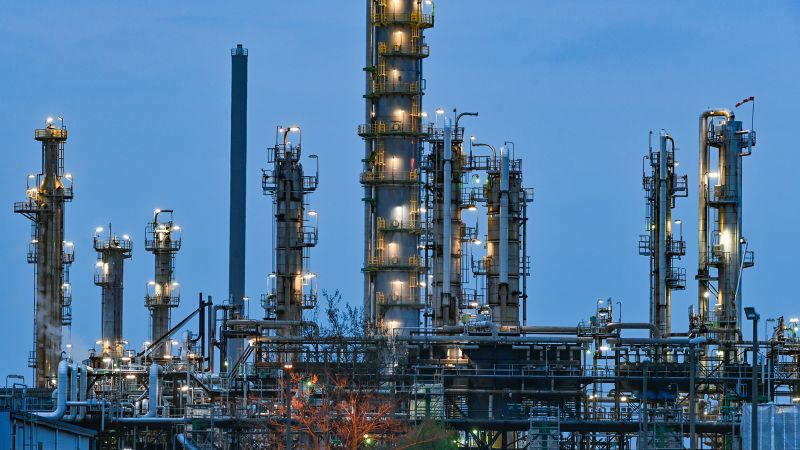
We have an oil crisis, a gas crisis and an electricity crisis all at the same time”
How nuclear power is changing – Search (bing.com)
Nuclear incidents like Fukushima and Chernobyl have made many fears nuclear power. But, for the most part, the technology has proved to be an emission-free, reliable way to produce large amounts of electricity on a small footprint. As a result, sentiments about the technology are beginning to change. The U.S. government & private companies including X Energy, NuScale and, Bill Gates-backed, TerraPower are pouring money into…
Manchin Missed a Furious Call from Biden After Sinking his $2 trillion Spending Bill on Live TV Because he Turned his Phone Off – Search (bing.com)
The world is grappling with gravity-defying energy price spikes on everything from gasoline and natural gas to coal. Some fear this may just be the beginning.
Current and former energy officials tell CNN they worry that Russia’s invasion of Ukraine in the wake of years of underinvestment in the energy sector have sent the world careening into a crisis that will rival or even exceed the oil crises of the 1970s and early 1980s.Unlike those infamous episodes, this one is not contained to oil.
“Now we have an oil crisis, a gas crisis and an electricity crisis at the same time,”
Fatih Birol, head of the International Energy Agency watchdog group, told Der Spiegel
in an interview published this week. “This energy crisis is much bigger than the oil crises of the 1970s and 1980s. And it will probably last longer.” The global economy has largely been able to withstand surging energy prices so far. But prices could continue to rise to unsustainable levels as Europe attempts to wean itself off Russian oil and, potentially, gas.
Supply shortages could lead to some difficult choices in Europe, including rationing.
Joe McMonigle, secretary general of the International Energy Forum, said he agrees with this depressing forecast from the IEA. “We have a serious problem around the world that
I think policymakers are just waking up to. It’s kind of a perfect storm,” McMonigle, whose group serves as a go-between for energy producing and consuming nations, told CNN in a phone interview. ‘I wouldn’t trust them.’
The Energy Secretary blasts Russia for ‘weaponizing’ energy.
The extent of a perfect storm — underinvestment, strong demand & supply disruptions from the war — will have wide-reaching consequences, potentially threatening the economic recovery from Covid-19, exacerbating inflation, fueling social unrest and undermining efforts to save the planet from global warming.
Birol warned of supply bottlenecks of gasoline and diesel, especially in Europe,
as well as rationing of natural gas next winter in Europe. “It is a crisis for which
the world is woefully unprepared,” said Robert McNally, who served as a top
energy adviser to former US President George W. Bush.
Not only are energy prices very high, but the reliability of the power grid is being challenged by extreme temperatures and severe drought. A US power grid regulator warned last month that parts of the country could face electricity shortages and even blackouts this summer. Former Obama energy adviser Jason Bordoff and Harvard University professor Meghan O’Sullivan wrote a piece in the Economist in late March warning that the world was on the cusp of “what may become the worst energy crisis
since the 1970s.”
‘Our fears have borne out’
Video: Inside the American struggle with rising energy prices.
“Since we wrote that, our fears have borne out,” Bordoff, co-founding dean of the Columbia Climate School, told CNN. Of course, there are key differences between today and the 1970s. Prices have not spiked nearly as much as they did then, and policymakers have not resorted to extreme steps like price controls. “Were we to resort to price controls and price caps, then we could have shortages,” McNally said.
When the war started, the West sought to avoid targeting Russia’s energy supplies directly because it was simply too critical to global markets. Russia is not just the world’s largest oil exporter, but it is the biggest natural gas exporter and a major supplier of coal. But as the brutality of the war became clear to the world, that hands-off approach did not last, with the United States and other countries banning Russian energy imports. Russia retaliated against Western sanctions by restricting or even halting its shipment of natural gas to multiple European countries.
The European Union announced plans this week to phase out 90% of Russian oil imports by the end of the year. That move has raised the specter of further retaliation from Russia. Energy experts sound an alarm about the US electric grid: ‘Not designed to withstand the impacts of climate change’. This tit-for-tat situation has only worsened the supply shortfall in energy markets that were already tight.
“We have not yet seen how bad this energy crisis is going to get,” Bordoff said.
Already, US gasoline prices have surged by 52% over the past year to record highs, angering the public and contributing to the nation’s inflation crisis. Prices for natural gas, a vital fuel for heating homes and powering the electric grid, have nearly tripled over the past year in the United States. Natural gas prices have skyrocketed even further in Europe, though they are well off their worst levels.
‘Putin just brought us there faster’
Today’s energy turmoil is not simply the result of the war in Ukraine.
It is also the byproduct of cratering investment in oil and natural gas, which are depleting resources that require massive sums of money just to maintain their production, let alone increase it. Upstream investment in the oil and gas sector stood at just $341 billion in also 2021, 23% below the pre-Covid level of $525 billion and well below the recent peak in 2014 of $700 billion, according to the IEF.
This investment shortfall has been brought on by a series of factors, including a push among investors and governments to bet on clean energy, the uncertain future of fossil fuels and years of weak and volatile oil prices. The California drought could cut the state’s hydropower in half this summer. “Because of the desire to bring down carbon emissions, we have a lot less appetite to invest in hydrocarbons. And that exacerbates the price volatility and makes it more difficult to resolve the supply side,” said Francisco Blanch, head of global commodities at Bank of America.
Europe was already grappling with an energy crisis last year and prices for natural gas, coal and oil were high long before the first Russian tanks began rolling into Ukraine.
“We were heading towards a crisis anyway. Putin just brought us there faster and sharper,” said McNally, who is now the president of consulting firm Rapidan Energy Group.
Shortages and gas lines?
The 1973 oil crisis was marked by hours-long lines at gas stations, fuel shortages and panic. Experts said they worry about fuel shortages again today, although they view that
as a greater risk in Europe than in the United States. Fuel shortages are a global problem. You’re going to see that very soon, though maybe not in the US,” said Bank of America’s Blanch. Blanch said he thinks this risk is lower in the United States because the country remains one of the biggest oil producers on the planet and is a major exporter of energy. Europe, on the other hand, is more reliant on foreign oil and natural gas — especially
from Russia.
The IEA chief warned of natural gas rationing in Europe, which is heavily dependent
on Russia for gas. Blanch noted that sky-high natural gas prices have already shut down factories in Europe. “Europe is already in natural gas rationing mode,” he said.
‘We have to be careful here’
Octopus CEO on renewable energy: Less gas means ‘less power and less leverage to Putin’
Energy experts told CNN they worry global policymakers are mismanaging the climate crisis, focusing too much on reducing supply and not enough on cutting the world’s appetite for fossil fuels. “We’re not doing nearly enough to reduce hydrocarbon demand consistent with our climate goals,” said Bordoff. Focusing on just one side of the equation risks not only price spikes but social unrest and turning the public off to climate action.
“We have to be careful here because if we allow the public to equate high energy prices with the energy transition, we’re doomed,” said McMonigle. “You will essentially lose public support, probably permanently.” McMonigle urged governments to send signals to investors that not only is it okay to still invest in fossil fuels, but it’s “necessary” for the world economy and progress in the energy transition.But even if policymakers convince investors to ramp up investment, that will take considerable time to result in more supply.
What could end the energy crisis
Of course, no one can say with certainty exactly how all of this will play out. And there could be surprises that ease the supply crunch. For instance, a diplomatic breakthrough that ends the war in Ukraine and allows sanctions to get lifted from Russia would be a game changer.
Birol said other surprises that would ease the energy crisis include an Iranian nuclear deal, a deeper economic slowdown in China or an agreement by Saudi Arabia and other OPEC producers to ramp up oil production. Inflation worries are real, but this isn’t the 1970s. He also reiterated that governments stand ready to release further emergency stockpiles of oil. However, even the record-setting release of US emergency stockpiles had just a modest and fleeting impact on gasoline prices.
In March, the IEA also urged governments around the world to consider drastic steps to slash oil demand, including reducing speed limits on highways, working from home up to three days a week where possible and car-free Sundays in cities. And there’s at least one other development that has been front-and-center lately and would ease the energy crisis: An economic recession, or at least one that’s deep enough to cause demand to collapse.
IS DONALD TRUMP A PEACEMAKER?
After allegations of Trump’s hateful statements about the U.S. armed forces were published in The Atlantic, Trump has defended himself as pro-military and anti-war.
His critics may scoff at these claims, but he was nominated for a Nobel Peace Prize
for his brokering of the Israel-UAE normalization deal.
Fighting to End the Endless Wars
Jack Hunter, Washington Examiner:
Trump has signaled at different times throughout his term that he wants to get the U.S. out of Afghanistan, which has resulted in some troop reductions… [he] should finally and completely ignore the countless Washington foreign policy “experts” who have been consistently wrong on Afghanistan. He should trust his instincts.
Building Peace Around the World
Emily Schrader, Jerusalem Post:
Much to the dismay of his detractors, Trump’s efforts toward peace have proven to
be remarkably successful… the Trump administration has seen tremendous success
in peacemaking in the region with the historic peace between the UAE and Israel –
an unprecedented victory for all parties involved.
What Did Trump Tell Woodward?
Staff, BBC:
US President Donald Trump knew Covid-19 was deadlier than the flu before
it hit the country but wanted to play down the crisis, according to [Woodward.]
[.] days after the White House declared the pandemic a national emergency,
the president told Woodward: “I wanted to always play it down. I still like
playing it down, because I don’t want to create a panic.”
Trump’s Covid legacy: left office with 24,255,934 coronavirus cases and 402,269 deaths,
according to data from Johns Hopkins University. Current Data: COVID-19 Map (jhu.edu)
Anti-Trump
Editorial Board, New York Post:
Are Joe Biden and Kamala Harris trying to prolong the pandemic?
[.] The anti-Trump media, too, are playing this game: “Scientists Worry About
Political Influence Over Coronavirus Vaccine Project,” The New York Times blared.
on The Gateway Pundit! Narrated by Political Prisoner Jake Lang from Inside Solitary Confinement! This is a MUST WATCH!
Migrant caravan traveling through Mexico to US could soon be largest ever
Migrant in potentially the largest caravan ever demands Biden keep asylum promise
Stephen-hawking-said-it-would-destroy-us-but-scientists-are-doing-it-anyway-unveiled
Amid record-high gas prices, Biden, Democrats demonizing American energy: Rep. Fallon
Biden Announces New Clean Energy Executive Actions – Search (bing.com)
More Americans at risk of gas & electric shut offs as prices rise & US moratoriums end.
Steve Hilton calls out Biden: Has there ever been a more pathetic excuse for president?
Biden doubling down in wrong direction on lowering gas prices: Jackie DeAngelis
Biden to sit for first interview in over 100 days, appearing on Jimmy Kimmel Live
Even the National Guard won’t be enough to solve border crisis when Title 42 ends
US Gas Prices May Top $5 a Gallon Soon, and More Trouble’s Coming (msn.com)
President Biden’s ‘war’ on fossil fuels is driving inflation, says KT McFarland
US, Latin America Developing Migration Pact to Address Surge (msn.com)
Pump Patrol: Demand for gas declines; gas prices continue to rise (msn.com)
Stuart Varney: Inflation spiral is souring the national mood (msn.com)
Lithium-Ion Battery Fires Are Burning Down More Homes Than Ever.
What Michael – yes Michael – Bolton’s book tells us (forward.com)
BIDEN HAS A PLAN TO REDUCE DIESEL FUEL PRICES (msn.com)
Proud Boys Charged with Sedition in Capitol Attack (msn.com)
Oil Dips After Piercing $120 as U.S. Inflation, GDP Worries Bite
Newell: Democrats to blame for anarchy on America’s streets.
U.S. COVID-19 Map: Tracking the Trends (mayoclinic.org)
Don’t run the same trick play twice in a row – YouTube
Bob Woodward new book – Search (bing.com)
It’s time to bet against America (msn.com)
John Bolton Trump – Search (bing.com)