
The Candida and Cancer Connection – Bing images
Candidiasis refers to an overgrowth of the yeast Candida albicans. All of us have the bacteria known as candida in our bodies. At normal levels, it is harmless and exists alongside the trillions of other bacteria in the mouth, vagina, rectum, and digestive tracts. The problem begins when there is too much candida, an overgrowth, which often leads to significant health problems. When there is an excess of Candida bacteria, it morphs into a fungus that causes untold damage to the host.
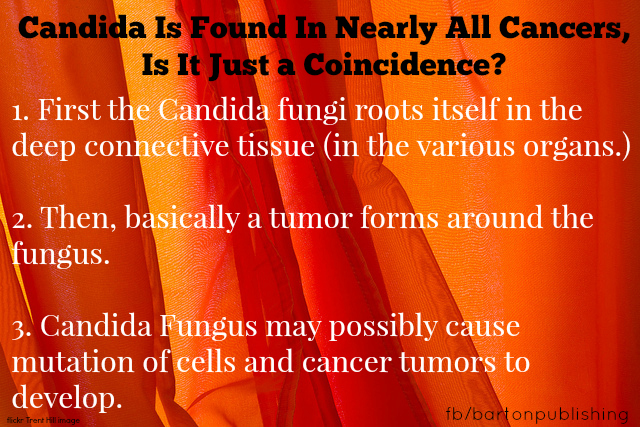
Several clinical studies indicate that up to 88% of cancer patients suffer from Candida overgrowth. Up to 83% of patients with leukemias, 50% of patients with solid tumors, and 77% of patients with hematological malignancies all suffered from Candida overgrowth. Fungal diseases kill more than 1.5 million and affect over a billion people worldwide. Could this be part of the reason we see a rise in cancer rates?
What Causes Candida Overgrowth?
The causes of Candida overgrowth include a high refined sugar diet (i.e., store-bought pastries, candy, chocolate bars, soft (fizzy) drinks, commercial ice cream, etc.), as well
as antibiotics, chronic prolonged stress, the contraceptive pill, chemical exposure, and diabetes. Usually, two or more of these can trigger candida to multiply and overwhelm
the body.
Symptoms Of Candida Overgrowth.
A person can have a mild, medium, or an extreme case of Candida overgrowth.
According to Amy Meyers M.D, depending on how many of the following symptoms
you are experiencing will indicate how severe your condition is:
Skin and nail fungal infections, i.e., athlete’s foot, ringworm, and toenail fungus
Vaginal infections, urinary tract infections, rectal itching, or vaginal itching
Severe seasonal allergies or itchy ears
Feeling tired and worn down or suffering from chronic fatigue or fibromyalgia
Digestive issues, i.e., bloating, constipation, or diarrhea regularly
Autoimmune diseases such as Hashimoto’s thyroiditis, rheumatoid arthritis,
ulcerative colitis, lupus, psoriasis, scleroderma, or multiple sclerosis
Difficulty concentrating, poor memory, lack of focus, ADD, ADHD, and/or brain fog
Dairy Intolerance
Irritability, mood swings, anxiety, or depression
Skin issues including eczema, psoriasis, hives, and rashes
Strong sugar and refined carbohydrate cravings
Nightmares (the body runs out of glucose in the
middle of the night and goes into a “panic mode”)
A Simple Candidiasis Home Test:

Put a glass of pure water beside your bed at bedtime.
First thing in the morning before you eat or drink anything, work up a
good amount of saliva in your mouth and spit it into the glass of water.
Leave this for 30 minutes and then return.
If the salvia is still floating on the top, you do not have Candidiasis issues.
If the salvia has legs going down, you have mild candida.
If the saliva becomes cloudy specks as well, then you have a medium level of candida.
Finally, if most of the saliva falls to the bottom of the glass of water, you most likely
have a more advanced form of Candidiasis.
Although this is not a 100% accurate test, it provides a very good indication
of whether or not you have candida issues.
Recents Posts
¿Is it Really True that Sugar is Bad for My Health?
Cancer Patients Usually Have Severe Potassium Deficiencies
Former President Bill Clinton Reversed His Heart Disease
by switching to a Plant Based Diet
Chemotherapy Detox Using Natural Products
Source Meet the professional team at Budwig Center
Some doctors theorize that candida or other systemic fungal infections cause or at the very least contribute to the development of cancer. When you examine the link between fungus and cancer further, this makes sense. A body wide candida infection plays havoc on the immune system. There is currently increasing concern about the relation between microbial infections and cancer.
More and more studies support the view that there is an association, above all, when the causal agents are bacteria or viruses. This review adds to this, summarizing evidence that the opportunistic fungus Candida albicans increases the risk of carcinogenesis and metastasis. Until recent years, Candida spp.
had fundamentally been linked to cancerous processes as it is an opportunistic pathogen that takes advantage of the immunosuppressed state of patients particularly due to chemotherapy.
In contrast, the most recent findings demonstrate that C. albicans is capable of promoting cancer by several mechanisms, as described in the review: production of carcinogenic byproducts, triggering of inflammation, induction of Th17 response and molecular mimicry. We underline the need not only to control this type of infection during cancer treatment, especially given the major role of this yeast species in nosocomial infections, but also to find new therapeutic approaches to avoid the pro-tumor effect of this fungal species.
Clarifying the Candida-cancer connection
By Greg Basky for SHRF and the University of Regina
Graduate student Easter Ndlovu is exploring the connection between cancer and Candida and hopes her work could eventually pave the way for treatments that prevent the fungus from killing immunocompromised patients. Because cancer patients’ immune systems are weakened by chemotherapy, they are more susceptible to bacterial and yeast infections. Studies have found that up to 80% of cancer patients who pick up a microbial infection while in the hospital receiving treatment die not from the cancer their body is battling,
but from the microbial infection.
Easter Ndlovu, a doctoral candidate in the University of Regina’s Department of Chemistry and Biochemistry, is exploring the connection between cancer and one of the most common forms of yeast infection. Her work could eventually pave the way for treatments that prevent the fungus from killing immunocompromised patients.
THE CANDIDA BIND
For the past two years, Ndlovu has been studying how strongly Candida binds to human cells and how much force is needed to separate the two. The young researcher, who was born and raised in Zimbabwe, has shown that the yeast Candida, which causes candidiasis (also known as thrush), adheres to different types of human cells with differing amounts of force.
“For example, it binds more to vaginal cells as compared to skin cells,” says Ndlovu.
“And it actually binds more to cancerous cells than to normal human cells.” Last year, while preparing for a research visit to Toulouse, France, Ndlovu stumbled upon the idea that Candida not only takes advantage of cancer patients’ weakened defenses, but might actually contribute to cancer development in the first place.
She worked with her co-supervisor, Etienne Dague, at the Centre National de la Recherche Scientifique (CNRS), using an atomic force microscope (AFM) with a special module that allowed her to quickly measure – at the nanoscale – how strongly Candida attaches to healthy and cancerous cells. Their finding – that Candida binds more forcefully to cancer cells – suggests it’s not just cancer patients compromised immune systems that make them more susceptible to the fungal infection.
Her trip abroad was made possible through a Mitacs graduate research award.
Biochemist Dr. Tanya Dahms, Ndlovu’s PhD supervisor at the U of R, feels strongly
that established researchers must support up-and-coming scientists,
to help equip them to find solutions to the big, complex problems facing our world today—challenges like climate change and pandemics. “They are our hope,” says Dahms, who holds a Collaborative Innovation Development grant from the Saskatchewan Health Research Foundation (SHRF). “We are helping build skills for the next generation,
so that they can tackle these huge problems.”
CANCER CONUNDRUM
Understanding how and why Candida attaches to cancer cells is a critical first step in finding ways to defend against the fungus, as this connection serves as the beachhead from which it mounts its attack, colonizing and infecting cells. It also may provide insight into how Candida might help transform normal cells into cancerous ones.
Ndlovu believes Candida latches on to cancer cells because they’re “stickier” than normal healthy cells. “When cells become cancerous, they undergo a rearrangement of their cytoskeleton—the network of protein filaments that exist within all cells,” she says. “Because the cytoskeleton provides support to the cell, when it’s disrupted the cell changes shape, its surface area grows, and it becomes softer, which makes it easier for Candida to adhere to the proteins and molecules than when the cytoskeleton is rigid.”
Her focus now is on figuring out what macromolecules are responsible for making
Candida stick more strongly to cancer cells. “One can never know everything in the
world of science. As genes mutate and new diseases emerge, there is always something to research.” Cancer research has been underway for decades, but scientists are still searching for answers, says Ndlovu.
“It would be very satisfying to contribute something positive to finding a cure.”
See this story in University of Regina’s Discourse Research Magazine
Vitamin and Mineral Deficiencies in Cancer Patients – Search (bing.com)
Know the cause Doug Kaufmann – Bing video
Doug Kaufmann Antifungal Diet – Bing video
Doug Kaufmann latest episode – Bing video
Doug Kaufmann Phase 1 diet food list – Bing video
Doug Kaufmann Phase 1 diet recipes – Bing video
Doug Kaufmann phase 1 diet – Search (bing.com)
Doug Kaufmann supplements – Search (bing.com)
Doug Kaufmann beta glucan – Search (bing.com)
Doug Kaufmann.website – Search (bing.com)
Lisa Richards Candida Diet – Search (bing.com)
When I was out today and went to Menard’s to get a Weather Band Radio.
Because of a near miss Saturday morning around 12: 50 am.
I talked to a sales lady about her Autoimmune problem.
She said what she learned mostly is that A.I. Diseases come from Candida Overgrowth.
She said that she got her life back virtually by eating vegetables which her Naturopathic Doctor put her on.
Lisa Richards is a nutritionist, published author, and creator of the Candida Diet.
She has been researching and writing on Candida overgrowth and Candida diet
for over 20 years.
Through her website, https://www.thecandidadiet.com/
Lisa has reached a total audience of over 20 million people.
Lisa created her Ultimate Candida Diet program, along with Dr Eric Wood, to help people on their journey to better digestive health. Too many people suffer from gut dysbiosis and all the symptoms that are related to it. Lisa’s program includes a 5-stage process designed to beat a Candida overgrowth with diet, probiotics, and natural antifungals.
More than 60,000 people have used the program to improve their gut health.
You can find Lisa online at the Candida Diet Facebook page, as well as her LinkedIn, Twitter, Pinterest, Google+ and Instagram accounts. Fatigue, digestive issues, joint pain, and skin issues are among the most common autoimmune symptoms – and are also common symptoms of Candida yeast overgrowth. Candida is not only a root cause behind autoimmunity, but the immunosuppressive drugs used to treat autoimmune diseases can cause Candida overgrowth, even if you didn’t have it before. Candida Diet and autoimmune diseases – Search (bing.com)
Hydroxychloroquine Autoimmune Diseases – Bing video
Hydroxychloroquine side effects – Search (bing.com)
Hydroxychloroquine for arthritis – Search (bing.com)
Hydroxychloroquine recipe – Search (bing.com)
Hydroxychloroquine Lupus – Search (bing.com)
Hydroxychloroquine 200 mg – Bing video
How to Use Low Dose Naltrexone for Autoimmune Diseases (azcentral.com)
An auto-immune disease is a condition where the body’s immune system becomes confused and attacks itself. Some doctors consider autism an auto-immune disease.
LDN has been used to successfully reduce symptoms in children with autism. Standard medicine doesn’t fully understand what causes auto-immune disease or how to treat it.
Autoimmune disease and LDN – Bing images
Talk to your doctor about Low Dose Naltrexone. Even though LDN is not a new treatment for autoimmune disease, many physicians are not familiar with its use. Do your research, and be prepared to explain and defend your decision to your doctor. Many have better luck getting a prescription from their General Practitioner, of PCP, than from their specialist.
Take your prescription to a good compounding pharmacy. Be sure the compounding pharmacy you chose has experience with low dose naltrexone. Many compounding pharmacies will take mail-in prescriptions. Low dose naltrexone is available in tablets, liquid and cream. Typical dosage is 4.5 mg each evening between 11 pm and 1 am, unless you have multiple sclerosis.
Every ‘One Shining Moment’ montage from 1987 to 2023, ranked
Sports World Reacts To Tuesday’s Caitlin Clark Announcement!!!
Former NCAA official rips women’s title game refs (msn.com)
Refs Offer Explanation For Controversial Tech On Caitlin Clark
In National Championship (msn.com)
Charles Barkley Shares Thoughts on ‘Unfortunate’ Caitlin Clark &
Angel Reese Taunting Controversy (msn.com)