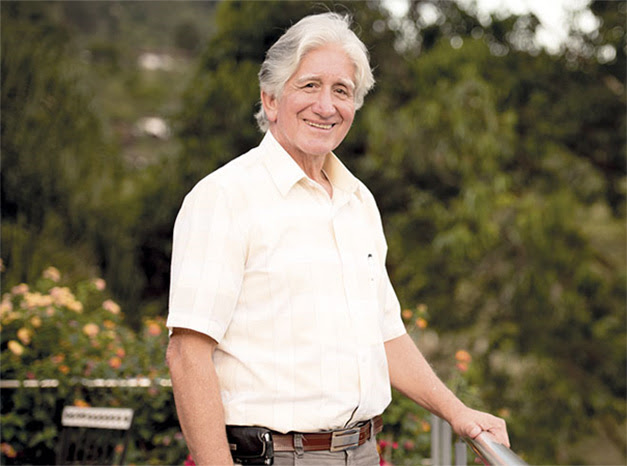
Francisco Lopera. [ Courtesy of the Consorcio de América Latina y el Caribe sobre la Demencia (LAC-CD).]
Dr. Francisco Javier Lopera Restrepo (1951-2024) As a young country doctor in the early 1980s, Lopera realized that the villages in the mountainous Paisa region around Medellin where he had grown up were home to families beset with a heritable form of early onset dementia. Since then, Lopera focused his clinical work and his research on these families and their disease. The result?
In large part, the Alzheimer’s Prevention Initiative. The API, together with its cousin, the Dominantly Inherited Alzheimer’s Network (DIAN), has pioneered therapeutic intervention trials founded on large-scale human data gleaned from decades-long clinical and biomarker studies of deeply phenotyped cohorts.
This description hardly reflects the effort involved. Early on, Lopera and colleagues traced afflicted families and their genealogies, building pedigrees that pointed to a founder mutation in the 18th century. Lopera forged international collaborations with Ken Kosik, Alison Goate, and Cindy Lemere, and, in the 1990s, co-authored seminal papers on the presenilin 1 gene and the E280A mutation that caused autosomal-dominant Alzheimer’s disease, named Paisa after its origin region (Alzheimer’s Disease Collaborative Group et al., 1995; Lemere et al., 1996; Lendon et al., 1997; Lopera et al., 1997).
By and by, Lopera built the interdisciplinary Grupo Neurociencias de Antioquia at the University of Antioquia in Medellin. By the late 2000s, Lopera, with many colleagues, students and mentees, had collected information on, and built clinical care for and research relationships with, a thousand members of this kindred.
This was the largest Alzheimer’s kindred known at the time, but it was only a start. When in 2008 Lopera met Eric Reiman, Banner Alzheimer’s Institute in Phoenix, the two joined forces with Banner’s Pierre Tariot and Jessica Langbaum to make prevention trials a reality. For that, the Colombian API registry needed to grow, and now, in 2024, it contains 6,000 kindred members from age 7 to the late 70s, of whom 1,200 carry the mutation that leads to MCI at around age 44, and dementia by 49.
Lopera embraced Reiman’s idea of working to help his families in a way that would help AD patients across the world. When Reiman and U.S. colleagues visited Colombia in 2008, Lopera introduced them to a gathering of 700 family members and took them to visit affected families in their homes. “It was a life-changing experience,” Reiman recalled.
In 2009 and in 2010, the API scientists convened leading AD researchers, funders, FDA regulators, drug developers, and others to persuade them that the time had come, and the tools were in place, to start FDA license-enabling trials of the most promising investigational drugs in cognitively normal people whose genetics and biomarker profiles put them within five years or so of developing Alzheimer’s symptoms (Feb 2010 news series).
Until then, leaders in the field had been paying lip service to this idea, calling it premature. At these gatherings, the pendulum swung toward action. “At the end, we went around the table, asking each participant for their concluding thoughts. Francisco was the last person to speak. When it was his turn, he simply said ‘My families are waiting,’ and everyone understood,” Reiman wrote in a 2023 letter recommending Lopera for the Potamkin Prize, which he won in 2024 (Mar 2010 conference news).

Francisco Lopera ringed by microphones and cameras at a GNA media event. Yakeel Quiroz, MGH, in red jacket on right. [Courtesy of Pierre Tariot.]
By 2011, API was in full gear, planning in detail for trials, bringing in more expertise. Media companies had caught on and were flocking to Medellin. In 2012, then-NIH director Francis Collins announced federal funding for API’s Colombia trial as part of the U.S. National Plan to Address Alzheimer’s (March 2011 news series; May 2012 news). READ MORE A Country Doctor, But Oh So Much More: Francisco Lopera, 73 | ALZFORUM
Remembering Francisco Lopera: A pioneer in the study of familial Alzheimer… | MedLink Neurology
On Tuesday September 10, 2024. Francisco Lopera died of cancer at his home in Medellin, Colombia. He was 73, and only just beginning to see his life’s work come to fruition.
Francisco Lopera (June 10, 1951 – September 10, 2024) was a Colombian neurologist who made major discoveries in the field of Alzheimer’s. He was a professor at the University of Antioquia in Medellín. He identified the world’s largest extended family with Alzheimer’s which he studied for decades and identified the genetic cause of their disease.[1]
- Kenneth Kosik
University of California, Santa Barbara - Posted: 16 Sep 2024
Francisco Lopera: A Memory and a Tribute
Autumn already!–But why regret an eternal sun if we are embarked on the discovery of divine light–far from all those who fret over seasons.—Arthur Rimbaud
.
Farewell, Pacho. How grateful I am to have had a moment of farewell, to say goodbye when still the sparkle in your eyes remained.
Dr. Francisco Javier Lopera Restrepo (1951-2024)
Three and half decades ago, in 1989, Francisco Lopera told me about a very large family who suffered from dementia with onset in their late 40s. That moment began a collaboration rare among scientists for its uninterrupted duration. He and Lucia Madrigal had pieced together on tattered scraps of paper a family tree that, when pasted together and unfurled across a table, revealed hundreds of individuals, a number that later grew to thousands.
Among the intertwining connections of marriages, of sons and daughters, of aunts and uncles, numerous cousins, and remote ancestors, what was apparent as Francisco listened to their stories was the fearsome presence of a disease that haunted them all. Thirty-five years ago, we did not know what that disease was until the first affected individual donated her brain and Juan Carlos Arrango flew with the brain to my house, in Boston at the time.
It was 11 p.m. when he knocked on my door with a bucket and a brain in formalin. The next morning, we cut and stained the brain and confirmed the clinical suspicion of Alzheimer’s disease with all the diagnostic hallmarks of plaques and tangles. Today, the brain bank in Colombia known as NeuroBanco contains about 500 brains and has been an invaluable source of tissue for research.
A few years after proving the Alzheimer diagnosis, in collaboration with Alison Goate, the responsible mutation was identified in presenilin 1 as a substitution of a glutamic acid for an alanine at position 280. Blood samples for this analysis had been collected over the previous years and stored in refrigerators that lost power numerous times during those tumultuous years, often leaving dried blood along the walls of the tube. Once found, the mutation became known as the paisa mutation in recognition of the people in Antioquia and a few surrounding states called paisas. One stereotype of the paisas is that they are a proud people.
On one occasion when I gave a talk in Cali there was a chuckle in the audience when I mentioned the paisa mutation. I asked what was funny. After all, the mutation causes a devastating disease. They said yes, of course, but the paisa are so proud, they are even proud of their mutation. The meaning of pride has changed since it made the list as one of the seven deadly sins to become a virtue regarding a sense of belonging to a group, and so was it with Francisco, a man deeply attached to his identity as a paisa. Despite offers from institutions all over the world he remained in Colombia, dedicated and at home.
Over the following years we traveled to the pueblitos of Antioquia through mountainous passes along winding roads, often stuck behind an exhaust-spewing overloaded truck struggling up the steep grade. These five- or six-hour trips began early in the morning, and after about two hours we always stopped for fresh pan de yuca and café con leche. Francisco pointed out a bend in the road on the way to San Raphael that was famous for kidnappings.
Along with us, sometimes in a van, sometimes in an SUV, were Lucia and members of the Grupo Neurociencias team from the university. Conversation was boisterous and animated on the way out and sleepy on the return. Francisco, who was rousing, even a bit verbose when he delivered remarks to the family, listened quietly to the running chatter of the team.
With some advance planning at our destinations, the extended family gathered to receive us with big welcoming greetings and hugs. We walked into a modest home with 20 or 30 people already there and more coming and going as the day wore on. We brought snacks and juice boxes and sometimes the family prepared dinner for us. Most were family, a few were onlookers, as very little is private in the small towns and neighborhoods.
The team wasted no time, first explaining our mission, to describe the disease which they knew all too well, the flip-of-a-coin inheritance pattern of an autosomal-dominant disease, the data collection process, and the acquisition of blood samples after carefully explaining informed consent to each subject.
The most animated moments were drawing the family trees. Family members huddled around Francisco as he asked about the parents and grandparents, the siblings and children, those affected and those who were healthy. Sometimes a key informant was missing, but a call to a neighbor reached a cousin who might open another branch of the family.
Glances and half smiles across the room suggested more than was being said about paternity. In every family, there was at least one young man whose death was called an accident, but usually meant a murder. In this painstaking way, the family tree grew to thousands and new founder mutations surfaced. This was medical practice in reverse—not, they come to us, but rather, we go to them.
Colombia is a country of many wonders. It is a place of dreams and nightmares, of outlandish notions and mystical beliefs. It is not surprising that such a country has produced such a remarkable person as Francisco, as it has others whose global impact extends far beyond the small size of the country. In 2018, I flew with Francisco, his wife, Claramonika, and his daughter Karina to Acandí and from there we took a speed boat called a chalupa to Sapzurro near the Panamanian border.
Like everything in Colombia—food, accents, slang—boats, too, are highly regionalized. We took a planchon to travel down the Sinú River to an indigenous village outside Monteria, a Johnson river boat to cross the Magdalena in the town of Suán. Sapzurro is the tiny town where Francisco did his “rural,” Colombia’s obligatory year of service after medical school. His medical school colleague Rafa joined us and they devoured chicharrones. An older woman there remembered him as the doctor who delivered her baby. She was effusive to see him.
For many years Francisco did this work in obscurity, with little money and zero recognition. I faced criticism from colleagues for what they saw as a human-interest story devoid of science. That began to change in 2004, when I brought Eric Reiman to Colombia and introduced him to Francisco.
At last, the dream of offering hope in the form of a clinical trial could be realized. This hope had been part of every family visit, and soon, with the extraordinary efforts of Carole Ho, a clinical trial was on the drawing board. From the barrios of Medellin to the remote countryside, where healing was often in the hands of the bruja, or witch doctor, people endorsed a scientific trial that could benefit Alzheimer patients worldwide.
I recall the first chapter of One Hundred Years of Solitude, in which the village people of Macondo lose their memories until one day a gypsy arrives and brings una sustancia de color apacible, a substance of a gentle color, and restores their memory. We sought the substance.
If we go looking for la sustancia de color apacible, we’re not just searching for an ingredient in a gypsy’s satchel—we’re tracing one of the deepest metaphors in Cien años de soledad: the possibility of recovering what a community has forgotten about itself.
Here’s where the search truly begins.
What restores memory in our own lives? What is our gentle-colored substance?
It might be:
- stories,
- rituals,
- objects,
- places,
- people who return unexpectedly,
- or the act of remembering itself.
Seeking the substance becomes a philosophical quest: How do we recover what we’ve forgotten about ourselves?
The gentle-colored substance restores not just memory but the ability to interpret reality.
It symbolizes the return of sense, context, and coherence.
This is why its color matters: it is apacible, calming, like the return of order after chaos.
The gentle-colored substance is the first symbolic gesture toward the idea that memory is salvation. It foreshadows the ending, where the final Buendía discovers the truth only by reading Melquíades’s manuscript—another “substance” that restores memory.
The substance symbolizes the act of reading as an act of remembering, and remembering as an act of healing.
Let’s take a stroll down memory lane Bing Videos
🧭 In one line
The gentle-colored substance is the quiet, luminous force that restores meaning, identity, and history—both to Macondo and to the reader.
The Memory-Reset Scene in One Hundred Years of Solitude
In the opening chapter of One Hundred Years of Solitude, the narrator — later revealed to be Colonel Aureliano Buendía — is facing a firing squad and recalls the founding of Macondo. At that time, the village was small, isolated, and still in a state of “recent” creation, with many things unnamed and only indicated by pointing Archive.
Every year, a caravan of gypsies visited Macondo, bringing “new inventions” that astonished the villagers. These included a powerful magnet, a telescope, and a magnifying glass. José Arcadio Buendía, the town’s founder, was fascinated by these objects and often imagined extraordinary uses for them LitCharts+1.
The memory-reset moment you recall is not literally described in the text as a gypsy bringing “una sustancia de color apacible” (a substance of a gentle color) to restore memories. Instead, the chapter’s opening is a flashback to a time when the people of Macondo had lost their memories — a state of collective amnesia that had been ongoing for some time. The gypsies’ arrival and their display of objects (especially the magnet) were part of the cycle of wonder and forgetting that defined Macondo’s early years LitCharts+1.
The “restoration” of memory is more symbolic: the gypsies’ gifts and José Arcadio Buendía’s experiments with them represent the introduction of external knowledge and technology into a society that had been cut off from the outside world. This act of introducing new things — the magnet, the telescope, the magnifying glass — is what triggers the memory of the past, even if the text does not name a specific “gentle-colored substance” as the memory-restorer.
In short, the memory-reset scene is a metaphor for the moment when Macondo is reintroduced to the world through the gypsies’ inventions, and through José Arcadio Buendía’s curiosity, the people begin to remember their history. The “gentle-colored substance” you recall is likely a poetic interpretation of the gypsies’ gifts, which serve as the catalyst for the memory’s return.
We now know the clinical trial did not show a therapeutic effect of treatment. But this trial was conducted like no other trial ever, thanks to the massive amount of groundwork laid down by Francisco as well as others including Lucia Madrigal, Silvia Rios, and David Aguillón, and most importantly, the trust the families placed in Francisco.
This was a trial on a single family who all shared the same point mutation and shared a mostly similar socio-economic status. That platform to which numerous subjects donated their time and their bodies remains, and the population continues to collaborate with new trials that will be one of the many legacies left by Francisco.
More science came in 2019 when the APOE3 Christchurch variant was suggested by Yakeel Quiroz and Joseph Arboleda as the basis for delaying the onset of familial Alzheimer’s disease caused by the presenilin mutation. The discovery of this variant has spurred international research efforts to understand the mechanism of this protective effect.
Family trees conceal untold stories of love and romance, of death and despair. We all experience tragedy and joy but in Colombia the mix differs. Somehow both happen simultaneously. Like when I saw Francisco in his last days—unable to talk or move—and showed him some slides of our memories. One of them was me falling off a hammock at the finca, and from some unsuspected reserve, he laughed.
Valley of Forgetting: Alzheimer’s Families and the Search for a Cure by Jennie Erin Smith
Francisco Lopera, the man who dreamed of curing his grandmother
Starting in the 1980s, neurologist Francisco Lopera began riding horseback through the mountains of his home country, Colombia, to explore a medical mystery that had been debilitating and killing people for centuries. In certain villages, residents routinely began suffering severe memory loss before middle age, then dying in their 50s. Lopera discovered that a rare genetic mutation was causing early onset Alzheimer’s disease.
He set out to avert it.
Jennie Erin Smith — an award-winning American science journalist and author — chronicles that work, following the neurologist, the families, and the research carried out in labs and through clinical trials. With the storytelling skills of a novelist, Smith shows in flesh and blood what happens when communities serve as sites for scientific investigation. The experiences are both uplifting and uncomfortable, raising questions about vulnerability, consent, and hope.
For example: How do scientists communicate reality to villagers who excitedly sign up for the trials believing they will be cured? This was named among the best books of 2025 by The New Yorker and The Wall Street Journal.
Cardiologists wish you would stop doing these things for high blood pressure
- These are results for Uncontrolled Blood Pressure can cause vascular dementia.
- LikeDislikeHow Uncontrolled Blood Pressure Can Cause Vascular DementiaUncontrolled high blood pressure (hypertension) is a major risk factor for vascular dementia, the second most common type of dementia after Alzheimer’s disease Blood Pressure UK+1. Over time, persistently elevated blood pressure can damage the brain’s blood vessels, reducing oxygen and nutrient supply to brain cells and leading to cognitive decline.How High Blood Pressure Damages Brain Vessels
- Small vessel disease: Chronic high blood pressure causes small brain vessels to become narrow, stiff, and less elastic, impairing blood flow to brain regions responsible for thinking, memory, and judgment Blood Pressure UK+1.
- Stroke and TIA: High blood pressure increases the risk of stroke (permanent vessel blockage or rupture) and transient ischemic attacks (mini-strokes), which can cause post-stroke dementia or multi-infarct dementia Blood Pressure UK+1.
- Silent damage: Even without a single major stroke, years of micro-damage to small vessels can accumulate, leading to widespread brain hypoperfusion and neuronal injury helpdementia.com.
- Vascular dementia results from reduced blood flow to the brain, starving brain cells of oxygen and nutrients Blood Pressure UK+1.The brain is highly sensitive to even brief reductions in blood flow; chronic underflow can cause permanent damage helpdementia.com.People with mid-life hypertension are more likely to develop dementia in later life, especially vascular dementia Alzheimer’s Society.
- Control blood pressure: Keeping it within target ranges (e.g., <150/90 mm Hg for most adults, with individualized goals) can significantly lower the risk of vascular dementia Johns Hopkins Medicine+1.
- Lifestyle changes: Healthy diet, regular exercise, weight management, limiting alcohol, and quitting smoking help protect blood vessels Alzheimer’s Society.
- Medication: Antihypertensive drugs can reduce dementia risk, and some studies show they may slow progression in those already diagnosed Johns Hopkins Medicine+1.
XXXXXXXXXXXXXXXXXXXXXXXXXXXXXXX
Francisco Lopera, the man who dreamed of curing his grandmother
Valley of the forgotten in Medellín. Colombia Alzheimer’s – Search Videos
The Long Goodbye: What it’s like to live with Alzheimer’s disease | 60 Minutes Australia – YouTube
An Australian travels to Denmark’s dementia village to confront their diagnosis | SBS Dateline
Laughing Through the Journey: Finding Joy, Humor and Resilience in Dementia Caregiving
What scientists have learned from studying people over 90 | 60 Minutes Archive
The tropical resort providing world-class dementia care | 60 Minutes Australia
Devoted son documents mum’s life with dementia | A Current Affair – YouTube
Colombian mutation of Alzheimer’s could hold key for scientific breakthrough
Medical breakthroughs and health stories | 60 Minutes Marathon
Finding the cure for dementia | 60 Minutes Australia
CNN’s World’s Untold Stories: Dementia Village