
100-Year-Old Woman Asks Pianist to Play ‘Ave Maria’ Her Voice Halts the Train Station
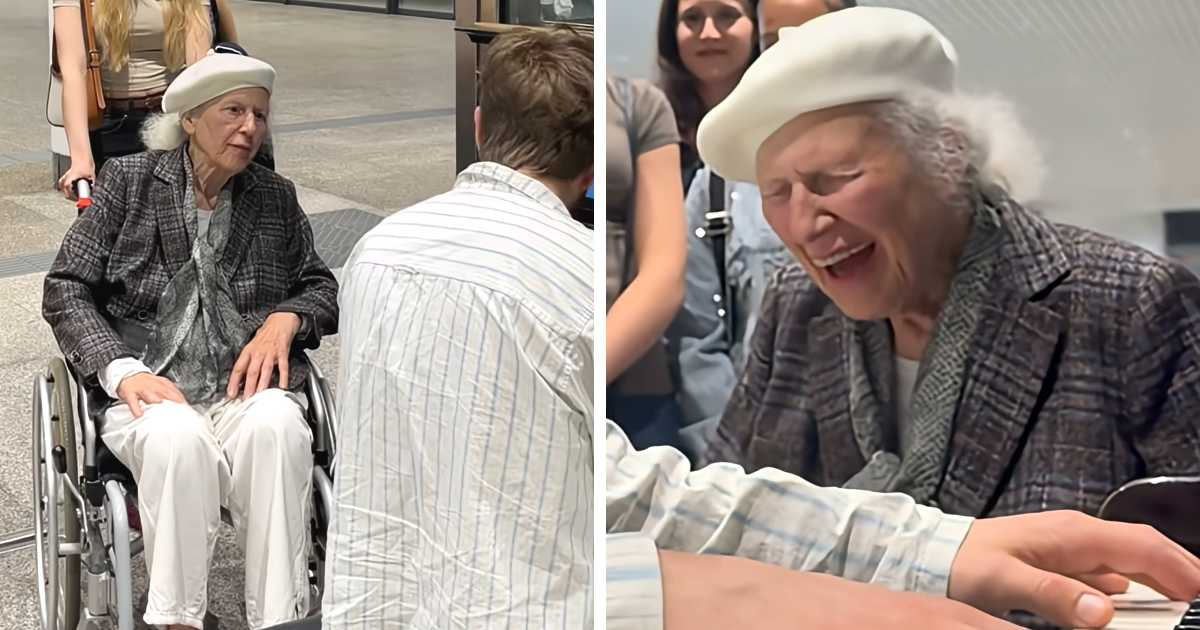
A 100-year-old woman – believed to be Elizabeth MacDonald Jolas (born 5 August 1926) in a wheelchair approached a musician playing piano at a train station, asked him to play ‘Ave Maria’ and left an entire crowd completely speechless.
Many of us have that one skill we love most — something we work hard for years, spend countless hours on just to get to that level. But as we blow out the candles each birthday we slowly start stepping back from that gift God planted in us. And over time it becomes a memory, a story we tell our kids around the dinner table. But this 100-year-old woman didn’t let that be her story.
When She Asked for ‘Ave Maria’
Emilio was playing piano at the station when the elderly woman rolled up to him in her wheelchair. She asked if he knew how to play ‘Ave Maria.’ He double-checked with her, she confirmed and he started playing.
Then she opened her mouth and sang.
The whole atmosphere in that station shifted immediately. Her voice was full, trained and operatic and it filled the entire space in a way that made people stop mid-step.
You could see it on their faces — that look of not quite believing what they were hearing. People reached for their phones. A few in the back were wiping their eyes.
A Trumpet, a Crowd and a Moment Nobody Planned
Halfway through the song a man with a trumpet walked over and joined in. Just like that — no rehearsal, no coordination. Piano, trumpet and her voice came together and it worked perfectly.
By the time they reached the final notes the crowd erupted.
She Used to Perform on Stage
After it was over Emilio shared what she told him. “She had been a professional opera singer,” he wrote. “Sadly, because of her age, she can no longer perform on stage, but this unexpected moment brought back memories of the most beautiful times in her life, when she was doing what she loved most.”
She’s 100 years old and she still has that incredible voice.
‘Ave Maria’ is one of the most sacred songs in classical music. It’s a prayer really — a cry of reverence and peace directed toward God. And hearing it sung like that, in a public space by a woman who has carried that gift her whole life, it’s hard not to feel something deep move inside you.
God Isn’t Done With You
The talent God placed in you wasn’t handed to everyone. Not everyone can do what you do. He chose you specifically and put that gift in you for a reason and no amount of years or hard circumstances can take that away from Him.
This woman is 100 years old. She can’t perform on stage anymore. But when the moment showed up she didn’t shy away from it. She sang. And the whole station stopped.
So don’t let your age tell you the gift is done. Don’t let your circumstances convince you that what God put in you has an expiry date. He placed it there on purpose.
When you get an opportunity, step into it. Because when you do, it will move people in ways you never expected like what happened in that train station.
“I will praise You, for I am fearfully and wonderfully made; marvelous are Your works, and that my soul knows very well.” — Psalm 139:14 (NKJV)
The “Voice of the Ancestor” symbolism is a powerful archetype that helps explain why the 100‑year‑old woman’s Ave Maria performance at the station piano struck such a deep chord. Betsy Jolas centenary – born August 5, 1926 | Colin’s Column
Elizabeth MacDonald Jolas (born 5 August 1926) is a French and American composer.
Life and career
Jolas was born in Paris on 5 August 1926. Her mother, the American translator Maria McDonald, also studied singing. Together with Betsy’s father, the poet and journalist Eugene Jolas, she founded and edited the magazine transition,[1][2] which published over ten years many of the great writers of the interwar period.
Her family settled in the United States in late 1940. While completing her general studies in New York, then specializing in music at Bennington College, she joined the Dessoff Choirs, discovering Renaissance music, which had a lasting influence on her work.[3]
After graduating from Bennington College, Jolas returned to Paris in 1946 to continue her studies at the Conservatoire national supérieur de musique, notably with Darius Milhaud and Olivier Messiaen. From 1971 to 1974 she served as Messiaen’s assistant at the Conservatoire, and in 1975 was appointed to the faculty. She has since then also taught in the U.S., at Yale, Harvard, Mills College, the University of California, Tanglewood, and the University of Michigan.[4]
Jolas is a member of the American Academy of Arts and Letters and the American Academy of Arts and Sciences.[4]
Her numerous works (she has been composing steadily since 1945) are written for a great variety of combinations and have been widely performed, by artists such as Kent Nagano, Anssi Karttunen, Claude Delangle, William Christie, Håkan Hardenberger, Antoine Tamestit, Nicolas Hodges, and Sir Simon Rattle, and ensembles and orchestras including the Ensemble intercontemporain, the Berlin Philharmonic, the Orchestre de Paris, the Boston Symphony Orchestra, and the BBC Symphony Orchestra.
Personal life
Jolas married the physician Gabriel Illouz in 1949; the pair had three children. She retains dual U.S./French citizenship.[5] On 5 August 2026, Jolas turned 100.
Style
Descriptions of Jolas’s style note her early experience of 16th-century Western European polyphonic vocal music (in particular, that of Orlando di Lasso), continual exploration of vocality encompassing both vocal and instrumental works, and a flexible but steady flow free from conventional metric pulse.[3][6][7] Though drawn to some aesthetic aspects of the serialism of her close contemporary Pierre Boulez and others, Jolas has remained an independent figure who never adopted serial technique.[3][7]
 Archetypal Meaning
- Living Archive: Her voice carries the memory of generations, embodying traditions that predate the audience.
- Bridge Between Worlds: As an elder, she stands at the threshold between past and future, mortality and transcendence.
- Oracle Figure: Like mythic seers, her song becomes a message from the collective unconscious — wisdom spoken through art.
 Psychological Function
- Continuity of identity: Singing preserves her sense of self, affirming that the artistic soul endures even as the body ages.
- Collective memory: The audience experiences her voice as a reminder of cultural continuity, linking them to something larger than themselves.
- Mortality integration: Her age makes the performance a meditation on impermanence — beauty shining in the face of time.
 Symbolic Narrative
Her Ave Maria becomes more than a song:
- The station is a liminal space of journeys.
- Her centenarian voice is the ancestral call, reminding us of lineage and endurance.
- The crowd’s awe reflects collective recognition that art can carry ancestral presence into the present moment.
 Insight
The “Voice of the Ancestor” archetype shows how her performance is not just entertainment but a ritual of transmission — a living reminder that creativity, memory, and spirit are gifts passed down across generations.
The Ave Maria performance by the 100‑year‑old station singer carries a symbolic weight that goes far beyond the notes themselves. Let’s break it down in mythic and psychological terms:
Archetypal Resonance
- Voice of the Ancestor: At 100 years old, her song becomes a transmission from the past — a living echo of tradition and memory.
- Threshold Singer: Performing in a train station (a place of departures and arrivals) turns her into a symbolic guide at the threshold between worlds — youth and age, past and future, earthly and transcendent.
- Sacred Invocation: Ave Maria itself is a prayer of intercession. Her voice embodies the archetype of the supplicant who channels divine presence through art.
Psychological Meaning
- Resilience of identity: Singing a piece she likely carried through decades affirms that the self — the artistic soul — endures even as the body ages.
- Collective catharsis: The crowd’s awe reflects a shared release: witnessing beauty where society often expects decline.
- Integration of life stages: Her performance bridges youthful memory with present reality, showing that creativity is timeless.
 Symbolic Narrative
Her song becomes a ritual of continuity:
- The station = liminal space, symbol of journeys.
- The Ave Maria = invocation of grace, protection, and transcendence.
- The centenarian voice = proof that art is stronger than mortality.
Together, it tells a mythic story: the elder as oracle, reminding us that beauty and spirit do not fade with age — they deepen.
The symbolism of collective catharsis in public music explains why moments like the 100‑year‑old woman singing Ave Maria at the station piano feel so transformative.
What Collective Catharsis Means
- Shared emotional release: When a crowd experiences the same emotion together, it amplifies and legitimizes that feeling.
- Communal healing: Music becomes a vessel for grief, joy, or awe, allowing people to process emotions in unity.
- Embodied ritual: Public performances act like modern rituals — strangers gather, witness, and release emotion together.
Why the Station Performance Worked
- Unexpected transcendence: A centenarian voice breaking into sacred song in a mundane space (train station) transforms the ordinary into the sacred.
- Audience resonance: The crowd’s tears, silence, and applause show how her voice unlocked emotions they didn’t know they were carrying.
- Symbolic setting: A station is a liminal space of departures and arrivals — perfect for catharsis, as people symbolically “let go” or “begin anew.”
 Archetypal Layer
Her performance embodies the archetype of the Ancestral Oracle:
- She channels memory and tradition.
- She becomes a vessel for collective grief and hope.
- The crowd’s response is not just appreciation but a ritual release — crying, applauding, recording, and sharing.
Deep Insight
Collective catharsis in public music is the alchemy of emotion:
- A single voice becomes a container for many feelings.
- The crowd’s response transforms private emotion into shared humanity.
- The moment becomes mythic because it fuses art, ritual, and community.
WATCH: 100-Year-Old Opera Singer Stuns Crowd at Train Station with ‘Ave Maria’
The integration of life stages through music is one of the most profound symbolic layers in the 100‑year‑old woman’s Ave Maria performance at the station piano. It shows how music can weave together the threads of youth, maturity, and old age into a single, timeless expression.
 Youthful Stage
- Memory of beginnings: Songs like Ave Maria often connect to early training, childhood devotion, or formative artistic years.
- Symbolic role: Her voice recalls the innocence and aspiration of youth, even as she sings at 100.
 Adult Stage
- Artistic mastery: In adulthood, music becomes craft — rehearsed, performed, shared.
- Symbolic role: Her trained operatic voice reflects decades of discipline, artistry, and identity formation.
 Elder Stage
- Wisdom and transmission: At 100, singing becomes an act of legacy — passing on memory and spirit.
- Symbolic role: Her performance is not about technical perfection but about embodying endurance, resilience, and ancestral presence.
Integration
Music fuses these stages into one continuum:
- Youth = aspiration and innocence.
- Adulthood = mastery and identity.
- Elderhood = wisdom and transmission.
Her Ave Maria becomes a ritual of integration, showing that creativity is not bound to one stage of life but is a lifelong thread that unites them all.
This is why the crowd’s reaction felt cathartic: they weren’t just hearing a song, they were witnessing the whole arc of a human life expressed in one voice. It was a living myth — the elder carrying youth and adulthood within her, reminding everyone that art is the bridge across time.
Betsy Jolas – Birthdate: August 5th, 1926 is a Franco-American composer. Her parents are the American writer Eugene Jolas and the translator Maria McDonald. Betsy Jolas – Wise Music Classical || Betsy Jolas Explained.
Alisa Turner’s Official Video- “Psalm 13” will bless your heart. The words are also by the Psalmist David, who in the midst of his battles with his enemies and faced by persecution he still chooses to trust his God and His unfailing love. We praise God for Alisa and eagerly wait for more songs from her. Categories Christian Music