Stargaze and See the Northern Lights
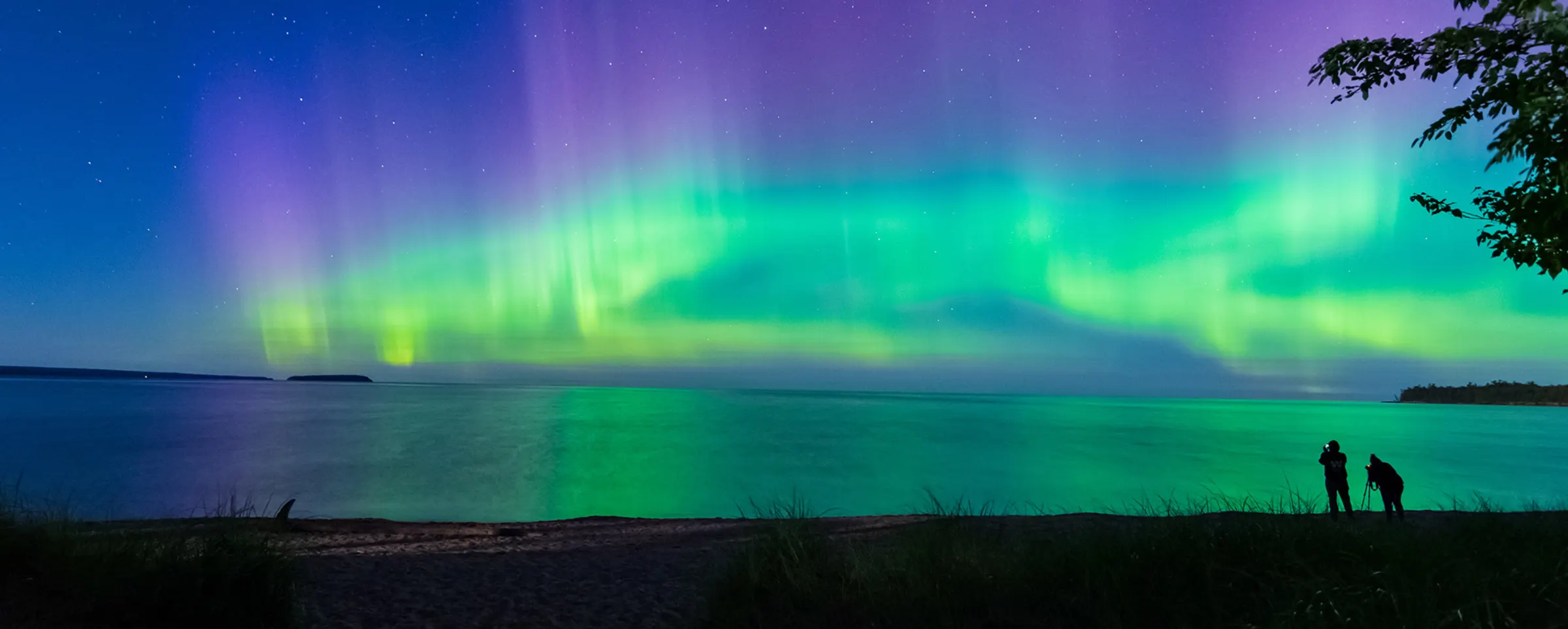
Some adventures are nearly impossible to replicate and stargazing in Michigan’s Upper Peninsula is one of them. When it comes to dark skies, few places on Earth surpass the U.P. Looking up at its dome of stars and planets and watching the Northern Lights shimmer and dance on the horizon will fill you with wordless wonder and awe.
Living on Michigan’s Upper Peninsula for One Summer is Last Item on My Bucket List.
Living on Michigan’s Upper Peninsula for One Summer — Bucket List Guide
A single summer in Michigan’s Upper Peninsula can be a lifetime of memories — from Mackinac Island’s Victorian charm to Porcupine Mountains’ wild trails, and Lake Superior’s rugged shores.
Why the U.P. is a Summer Bucket List Must
Michigan’s Upper Peninsula is vast, wild, and diverse — a mix of historic towns, untouched forests, and Great Lakes shorelines. Even seasoned travelers find new trails, lakes, and festivals to explore Upper Peninsula Travel and Recreation Association+1.
Why the Upper Peninsula is One of the Best Stargazing and Northern Light Viewing Areas on Earth
Most of us never see how amazingly bright and beautiful Nighttime Sky – Search Videos. Living in a city or suburb, lights from streets, parking lots and buildings dim the universe overhead and the Northern Lights on the horizon.
The Upper Peninsula, however, is mostly wilderness surrounded by three massive Great Lakes. There are few towns and most are small and emit little light pollution. In the fall through mid-spring, our days are shorter and nights are longer. That gives you more darkness to stargaze. Because the U.P. is closer to the North Pole, it increases the visibility of the Northern Lights, making it one of the top viewing areas in the contiguous 48 United States.
All these factors are why the stars, planets, nebulae, shooting meteor showers and Northern Lights pop into clear view on cloudless nights year-round.
What Causes the Northern Lights (aka Aurora Borealis)?
What creates the dazzling, graceful swirls of greens, purples, oranges and reds above the horizon? The celestial show occurs when sun particles ride on a solar wind and then collide with Earth’s atmosphere. It doesn’t happen every night, but when it does, you won’t want to miss it! Here’s how to plan your visit.
Best Times in the U.P. to Stargaze and See the Northern Lights
Stargazing is great all year. Go out on a clear night with no lake-effect snow in the weather forecast.
To see the Northern Lights, venture out on cloudless nights between August and April, with peak months being April, October and November. Check the forecast and tailor your search with these sites:
- NOAA Space Weather Prediction Center
- National Weather Service
- Aurora Forecast
- Keweenaw Dark Sky Park
When the KP Index is in the 0-2 range, the Aurora Borealis will be farther north, dimmer in intensity, and not as shimmery. When the index reaches the 3-5 range, the Northern Lights move farther from the poles and explode in color and motion.
The U.P.’s Best Stargazing and Northern Lights Viewing Spots
Go anywhere in the Upper Peninsula away from town lights to see the stars and planets. For watching the Northern Lights, the farther north you go, the more likely you will see them on the horizon.
The southern shore of Lake Superior offers the best views.
NORTHERN LIGHTS IN BARAGA@6:30am /9/29/25
These are some favorite areas throughout the U.P.:
- Copper Harbor – Keweenaw Dark Sky Park
- Pictured Rocks National Lakeshore
- Isle Royale National Park
- Drummond Island
- Brimley State Park
- Whitefish Point
- Grand Marais
- Munising
- Au Train
- Marquette
- Big Bay
- Escanaba
- Skanee
- Eagle River
- Ontonagon
- Baraga Bay
Drummond Island
This Lake Huron island in the far-eastern Upper Peninsula offers some of the best Northern Lights viewing in the world. Two places to plop down your blanket and look out to the horizon are Drummond Island Township Park Beach about six miles east of the ferry dock and Glen Cove Beach on the eastern end of the island, just north of Marble Head.
Brimley State Park
One of the oldest state parks in the Upper Peninsula, this park has 2,000 feet of sandy Lake Superior beach to watch the sky show on clear nights to the north.
Whitefish Point
Whitefish Point is located at the northeastern tip of the Upper Peninsula, 11 miles from the town of Paradise. Its Lake Superior rocky/sandy beach is renowned for rock collecting, freighter and bird watching, and seeing the Northern Lights.
Pictured Rocks National Lakeshore
The country’s first national lakeshore, Pictured Rocks pairs Lake Superior viewing with its historical, sandstone cliffs. If you think these views are stunning in the daylight, just wait for nightfall. With the park open 24 hours a day, you will have no trouble finding a spot to watch the Northern Lights and stargaze. Some popular viewing places are Grand Portal Point, Miner’s Beach and Twelvemile Beach.
Munising
Along M-28 between Munising and Marquette, take any of the Lake Superior pullouts to find a spot along the shore to catch the Northern Lights or star-filled sky. The nice thing about these pullouts is in winter you have the option to watch the sky show from the warmth of your car.
Au Train
Located in the Hiawatha National Forest, Au Train Beach is easily accessible from M-28. It’s a good dark sky area.
Marquette
The U.P.’s largest city has some of the best Northern Lights viewing, especially in the late fall and early winter months. Check out the M-28 pullouts mentioned above or hike in the summer months to watch this soul-stirring sky display from Sugarloaf Mountain.
Big Bay
The small town of Big Bay is 23 miles northwest of Marquette and is located on Lake Superior’s Big Bay. You can catch the Northern Lights from the Big Bay Point Lighthouse (now a bed and breakfast) or Squaw Beach.
Escanaba
Lake Michigan also offers some Northern Lights viewing destinations. As you travel along US-2, duck down the Garden Peninsula and Stonington Peninsula east of Escanaba. When Northern Lights conditions are right, claim your viewing spot at Fayette Historic State Park & Townsite , Sac Bay County Park or Ludington Park in Escanaba. All three are open year-round.
Read more about the Best places for stargazing in Michigan’s U.P.
Skanee
One of the best places near Skanee to view the Northern Lights and stars is in Arvon Township Park . It is along the Huron Bay, one of the largest freshwater fjords in North America.
Copper Harbor – Keweenaw Dark Sky Park
The U.P. is thrilled to have a dark sky park certified by the International Dark Sky Association. It is the third in Michigan. The Keweenaw Dark Sky Park is headquartered at the Keweenaw Mountain Lodge outside of Copper Harbord and extends to Brockway Mountain. The lodge opens its grounds nightly at no cost to the public and offers stargazing workshops and events throughout the year.

Isle Royale National Park
Isle Royale National Park — Minong “the good place” in Ojibwa — is one of the least visited national parks in the country. Conversely, it is also one of the most revisited and on National Geographic’s “Best of the World” list for 2021. While this remote and rugged Lake Superior park is a premier location to watch the Northern Lights, it is only open to visitors in the warmer months. Your best bet is to see the aurora between mid-April and late October.
Eagle River
On the west side of the Keweenaw Peninsula, Eagle River and Eagle Harbor , along M-26 offer some Northern Lights viewing on their Lake Superior coastline. Look north toward Canada and watch the sky dance!
Ontonagon
Framed by the vastness of Lake Superior, Ontonagon boasts a prime location for viewing the Northern Lights. With minimal light pollution and breathtaking northern vistas, it’s a photographer’s dream come true. The nearby Porcupine Mountains Wilderness State Park offers additional options for finding that perfect aurora-viewing spot.
How to Take Stunning Northern Lights Photos
You do not need a full-frame camera to capture the shimmering beauty of the Northern Lights, although many professional stargazers prefer them. Use any camera with manual controls so you can adjust the ISO, exposure time and aperture settings. Set ISO between 1600-3200 with exposure lengths between 15 and 30 seconds. Pack a wide-angle lens and set the aperture between f/2.8 and f/5.6.
Bring a lightweight, sturdy tripod and add an intervalometer and two to three fully charged batteries to your camera case.
In the Upper Peninsula, the Northern Lights are most often visible during September–March when the KP index is 5 or higher, with peak odds around the September and March equinoxes. auroraforecast.io+2.
Seasonal and Activity Patterns
- Best months: September through March is prime aurora season, with the equinox months (September and March) statistically most active due to higher geomagnetic storm frequency auroraforecast.io+2.
- Peak activity months: Some sources also highlight April, October, and November as strong months for sightings, often due to clear skies and favorable solar cycles
Upper Peninsula Travel and Recreation Association.
- Year-round possibility: Aurora can occur any night with enough solar activity, but in the U.P. it’s rare outside the fall–spring window because of shorter nights and more cloud cover in summer
How Often?
- The U.P. is far enough north (≈46–47°N) that moderate storms (KP 6–7) can produce visible aurora along Lake Superior’s northern shore auroraforecast.io.
- KP 5+ events are common enough that, in active solar cycles, you can expect dozens of visible nights per year in the U.P. during aurora season
greatlakesledger.com+1.
- In the current Solar Cycle 25 (peaking 2024–2025), geomagnetic storms are occurring more frequently than in past decades, increasing the odds of sightings
- However, clear skies are the limiting factor — even with a favorable KP index, cloud cover will block the view
Key Factors for Visibility
- KP index:
- KP 5–7: Common in U.P. during moderate storms; green glow to structured curtains auroraforecast.io+1.
- KP 8–9: Rare, but can be seen even in southern Michigan auroraforecast.io.
- Clear skies: Essential — check local forecasts for cloud cover
- Dark horizon: Lake Superior’s northern shoreline offers unobstructed views auroraforecast.io+1.
- Time of night: Best between 10 p.m. and 2 a.m.
My Michigan Beach and Travel.
Practical Takeaway
If you’re in the Upper Peninsula during fall–spring and the KP index is 5 or higher, you have a good chance of seeing the Northern Lights on a clear night. In the current high solar activity period, that could mean multiple sightings per month in peak season, but the exact number depends on weather and solar conditions auroraforecast.io+2.
Tip: Monitor NOAA’s Space Weather Prediction Center and local aurora forecast sites before heading out, and choose dark-sky locations like Keweenaw Dark Sky Park or Copper Harbor for the best odds auroraforecast.io+2.

What Causes the Northern Lights Phenomenon
The northern lights (aurora borealis) are caused by charged particles from the Sun colliding with gases in Earth’s upper atmosphere, producing glowing curtains of light  www.telescopeadvisor.com+1.
The northern lights are caused by charged particles from the Sun colliding with oxygen and nitrogen in Earth’s upper atmosphere, after being funnelled toward the poles by Earth’s magnetic field.
These particles originate in the solar wind and create glowing colours—mainly green, red, blue, and purple—when they excite atmospheric gases. Bing Videos
How the Northern Lights Work (Aurora Borealis Explained) #Shorts
Step-by-step process
- Solar wind emission – The Sun’s corona, heated to millions of degrees, constantly releases a stream of charged particles (mostly electrons and protons) called the solar wind, traveling at 300–800 km/s
- During solar flares or coronal mass ejections (CMEs), this flow can intensify dramatically
- Earth’s magnetic field interaction – Earth’s magnetosphere deflects most of the solar wind, but some particles are funneled toward the magnetic poles
Natural History Museum+1.
- Atmospheric collisions – These particles accelerate into the atmosphere at altitudes of 100–400 km, striking oxygen and nitrogen atoms
How the Process Works
1. The Sun Releases Charged Particles
The Sun constantly emits a stream of charged particles called the solar wind, travelling at 300–800 km/s. stellarnomads.com+1
Solar flares and coronal mass ejections (CMEs) can intensify this flow, sending billions of tons of plasma toward Earth. stellarnomads.com
2. Earth’s Magnetic Field Redirects the Particles
Earth’s magnetosphere deflects most solar wind, but some particles become trapped and funnelled toward the magnetic poles.  telescopeadvisor.com+1
These particles accelerate along magnetic field lines into the upper atmosphere, forming auroral ovals around the poles. 
3. Collisions Create Light
When the particles collide with atmospheric gases at altitudes of roughly 100–400 km, they excite oxygen and nitrogen atoms. stellarnomads.com
As these atoms return to their normal energy state, they emit light—producing the aurora.
Why the Colours Differ
Green: Oxygen at ~100–300 km. Natural History Museum+1
Red: High‑altitude oxygen above ~240 km. 
Blue/Purple/Pink: Nitrogen at lower altitudes.
Additional Facts
Auroras occur in both hemispheres: aurora borealis (north) and aurora australis (south). telescopeadvisor.com
They can also appear on other planets with magnetic fields and atmospheres, such as Jupiter and Saturn. 
The northern lights are therefore a visible result of space weather, linking solar activity to atmospheric physics on Earth. The Truth About God No Religion Will Ever Teach You | Watch