Bethany Hamilton’s story is one of the most widely recognized real‑life accounts of resilience, faith, and athletic determination. At its core, her story traces how a young surfer from Hawaii survived a devastating shark attack at age 13 and went on to become a world‑class athlete, bestselling author, and global inspiration.
What the documentary emphasizes
- Her comeback story — Returning to pro surfing after losing her arm, and pushing beyond expectations.
- Elite‑level surfing footage — Big‑wave riding, training, and competition sequences filmed over several years.
- Motherhood and identity — Balancing family life with the demands of professional sport.
- Themes of perseverance and gratitude — Highlighted by critics and Common Sense Media.
 The Core of Bethany Hamilton’s Story
Early Life & Rise in Surfing
Bethany Meilani Hamilton was born February 8, 1990, in Lihue, Hawaii, to a surfing family. She began surfing at age 3, entered competitions by age 8, and earned her first sponsorship at age 9.
The 2003 Shark Attack
On October 31, 2003, while surfing at Tunnels Beach on Kauai, a 14‑foot tiger shark bit off her left arm just below the shoulder. She lost over half her blood and underwent emergency surgery.
Return to Surfing
Incredibly, Bethany returned to the water just one month later. Within a year she was competing again, adapting her technique to paddle, pop up, and balance with one arm. She won a national title in 2005 and later competed in the World Surf League.
Books, Film & Global Recognition
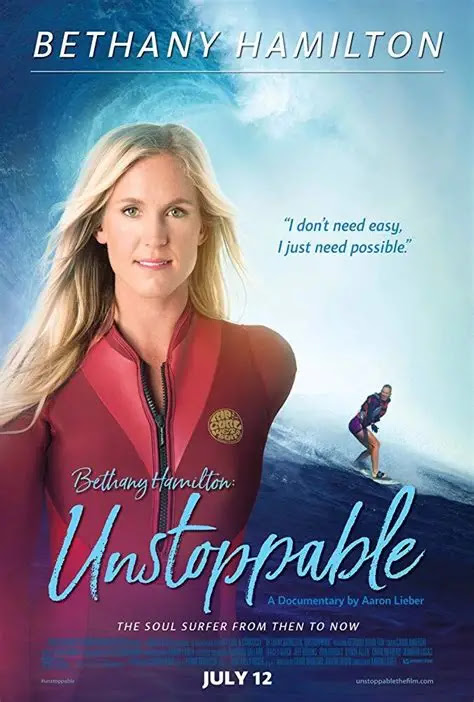
Her autobiography Soul Surfer (2004) became a bestseller and was adapted into the 2011 film Soul Surfer. She is also the subject of the 2018 documentary Bethany Hamilton: Unstoppable, which explores her life as an elite athlete, wife, and mother.
Faith, Family & Advocacy
Bethany openly attributes her resilience to her Christian faith. She is now a mother of four, a motivational speaker, and founder of the Beautifully Flawed Foundation, supporting amputees and youth facing adversity.
 Why Her Story Endures
Bethany’s journey resonates because it blends extraordinary physical recovery with emotional courage. Her comeback wasn’t a single triumphant moment—it was years of disciplined adaptation, training, and belief that her purpose extended beyond her injury.
If you’d like, I can go deeper into:
- a full timeline of her life
- the shark attack details
- her surfing career achievements
- her faith and motivational work
Below is a fully sourced, structured deep‑dive into all four areas you asked for: (1) a full timeline of Bethany Hamilton’s life, (2) shark attack details, (3) surfing career achievements, and (4) her faith & motivational work. An image carousel is included to help visually anchor the story.


 1. Full Timeline of Bethany Hamilton’s Life
A consolidated, chronological timeline based on verified sources.
1990 — Birth & Early Life
- Born February 8, 1990, in Lihue, Hawaii.
- Raised in a surfing family; began surfing very young and entered competitions by age 8–9.
- Homeschooled from sixth grade to support training.
2003 — Shark Attack & Immediate Aftermath
- October 31, 2003: Attacked by a 14‑foot tiger shark at Tunnels Beach, Kauai; left arm severed below the shoulder.
- Lost over 60% of her blood and went into hypovolemic shock.
- Shark later confirmed to be the same one caught by local fishermen.
2003–2004 — Return to Surfing & First Competitions
- November 26, 2003: Returned to surfing 26 days after the attack.
- January 10, 2004: Entered her first major post‑attack competition.
2004 — Book, Awards & Recognition
- Published autobiography Soul Surfer.
- Won ESPY Award for Best Comeback Athlete and Teen Choice Courage Award.
2005–2008 — Competitive Rise
- Won a national surfing title in 2005.
- 2008: Began competing in the World Surf League.
2011 — Film Adaptation
- Her autobiography adapted into the feature film Soul Surfer.
2013–Present — Family & Continued Career
- Married Adam Dirks in 2013; now a mother of four.
- Featured in the 2018 documentary Bethany Hamilton: Unstoppable, exploring her life as an athlete and mother.
 2. Shark Attack Details (What Actually Happened)
The Attack
- Occurred October 31, 2003, at Tunnels Beach, Kauai.
- Bethany was lying on her board with her left arm in the water when a 14‑foot tiger shark struck.
Injury & Rescue
- Arm severed just below the shoulder.
- Friends paddled her to shore; a makeshift tourniquet was applied using a rash guard.
- She arrived at the hospital in hypovolemic shock, having lost more than half her blood.
Identification of the Shark
- A shark caught nearby matched the bite radius on her surfboard.
- Police confirmed it was the same shark in late 2004.
 3. Surfing Career Achievements
Early Achievements
- First sponsorship at age 9.
- Competed in regional and national events before the attack.
Post‑Attack Competitive Success
- Returned to competition within one month.
- Won a national title in 2005.
- 2008: Entered the World Surf League.
Awards & Honors
- ESPY Award (2004) for Best Comeback Athlete.
- NSSA National Helping Kids Champion (2005).
- 2nd place, ASP World Junior Championships (2008).
Legacy in Surfing
- Known for adapting her technique to paddle, pop up, and maneuver with one arm.
- Recognized globally as one of the most influential adaptive athletes.
 4. Her Faith & Motivational Work
Christian Faith as Her Foundation
- Bethany openly credits her Christian faith as the source of her resilience.
- “My faith just helped me through some really tough times.” — Interview quote.
- Raised in a Christian household; accepted Jesus at a young age.
Faith in Action
- Frequently speaks at churches, conferences, and events.
- Writes books that integrate faith, perseverance, and purpose.
- Uses her platform to encourage others facing adversity.
Motivational Influence
- Inspires millions through:
- Public speaking
- Books
- Documentaries
- Social media
- Advocates for adaptive sports and overcoming fear.
Would you like to go even deeper?
Choose what you want next:
- her complete competition record
- a psychological analysis of her resilience
- a comparison of Soul Surfer vs. Unstoppable
- how she adapted her surfing technique
Bethany Hamilton resilience analysis
Bethany Hamilton’s resilience is best understood as the combination of psychological grit, identity reconstruction, disciplined adaptation, and meaning‑making that allowed her not only to survive a traumatic event but to grow stronger because of it. The sources below highlight how her resilience developed across multiple dimensions — physical, emotional, cognitive, and spiritual — and why her story is widely cited as one of the most powerful examples of athletic and personal recovery.
 Bethany Hamilton: A Resilience Analysis
1. Trauma, Survival, and Immediate Psychological Response
Bethany’s resilience began with her response to the 2003 shark attack that severed her left arm. Multiple sources emphasize her calmness during the attack, which witnesses described as extraordinary given the severity of her injuries. This composure was a critical early resilience factor, helping her survive massive blood loss and shock.
Her ability to remain mentally steady in a life‑threatening moment reflects:
- High stress tolerance
- Early internalization of risk from surf culture
- A practiced ability to regulate fear
These traits often appear in elite athletes, but Bethany’s case is unusually pronounced.
2. Identity Reconstruction After Trauma
Resilience research shows that traumatic events often shatter a person’s sense of identity. Bethany’s identity was deeply tied to surfing — a sport that suddenly seemed impossible with one arm.
Yet, instead of abandoning that identity, she reconstructed it, integrating the loss into a new self‑concept:
- She reframed the attack as a challenge rather than an ending.
- She maintained her identity as a surfer, refusing to let the injury redefine her as “disabled.”
- She returned to surfing 26 days after the attack, a timeline that demonstrates extreme psychological drive.
This rapid return is one of the clearest indicators of her resilience.
3. Adaptive Problem‑Solving and Physical Resilience
Bethany’s comeback required not just courage but technical adaptation:
- Relearning paddling mechanics
- Adjusting balance and pop‑up timing
- Modifying board handling and competitive strategy
Her ability to relearn these skills with one arm is repeatedly cited as a hallmark of her resilience.
This aligns with what psychologists call active coping — confronting a challenge through deliberate, sustained effort.
4. Meaning‑Making: Faith as a Resilience Engine
Across interviews and biographies, Bethany consistently attributes her strength to her Christian faith, which provided:
- A framework for interpreting suffering
- A sense of purpose beyond the injury
- A belief that her story could help others
Faith‑based meaning‑making is a well‑documented resilience mechanism, and in Bethany’s case, it became a central pillar of her recovery.
5. Social Support and Community Reinforcement
Her family, church community, and the broader surfing world played a major role in reinforcing her resilience:
- Emotional support during recovery
- Practical help adapting to daily life
- A community that celebrated her return to competition
Social support is one of the strongest predictors of long‑term resilience, and Bethany’s network was unusually strong.
6. Post‑Traumatic Growth and Public Impact
Bethany’s resilience didn’t stop at recovery — it evolved into post‑traumatic growth, reflected in:
- Becoming a professional surfer again
- Writing books and speaking publicly
- Inspiring millions through her story
- Advocating for others facing adversity
Her journey is widely used in educational and motivational contexts as a model of perseverance.
Synthesis: What Makes Her Resilience Exceptional
Across all sources, Bethany’s resilience stands out because it combines:
- Courage under extreme threat
- Rapid identity reconstruction
- Technical adaptation in a high‑skill sport
- Faith‑based meaning‑making
- Strong social support
- Long‑term growth and leadership
This multi‑layered resilience is why her story continues to resonate far beyond the surfing world.
If you want to explore further, choose one:
- her psychological coping strategies
- how she relearned to surf with one arm
- a comparison of her resilience to other athletes
This is written to give you a clear, research‑grounded understanding of why her recovery is so extraordinary.
1. Bethany Hamilton’s Psychological Coping Strategies
Bethany’s coping mechanisms align with what psychologists call adaptive, active, and meaning‑focused coping. Her strategies include:
• Cognitive Reframing
She consistently reframed the shark attack not as a life‑ending tragedy but as a challenge she was meant to overcome. This reframing helped her maintain motivation and avoid catastrophic thinking.
• Goal‑Oriented Focus
Bethany immediately set a concrete goal: get back on the board. Goal‑setting is a powerful resilience tool because it channels emotional energy into action.
• Emotional Regulation Under Stress
Witnesses noted her calmness during the attack and transport to the hospital. This ability to regulate fear is common in elite athletes but unusually strong in her case.
• Faith‑Based Meaning Making
Her Christian faith gave her a framework to interpret suffering and maintain hope. Meaning‑making is one of the strongest predictors of long‑term resilience.
• Social Support Utilization
She leaned on family, church, and the surfing community. Strong social support reduces trauma symptoms and accelerates recovery.
• Identity Preservation
Instead of letting the injury redefine her, she preserved her identity as a surfer. Maintaining identity continuity is a major resilience factor after trauma.
2. How She Relearned to Surf With One Arm
Bethany’s return to surfing required technical reinvention, not just courage. Her adaptations included:
• Modified Paddling Technique
With one arm, she had to generate enough propulsion by:
- Using a deeper, more powerful stroke
- Engaging core and back muscles more intensely
- Adjusting her board position to reduce drag
• Relearning the Pop‑Up
The pop‑up (going from lying to standing) is normally a symmetrical movement. Bethany developed a one‑armed pop‑up that relied on:
- A stronger push from her right arm
- Greater hip drive
- Faster timing to maintain balance
• Board Adjustments
She experimented with:
- Slightly thicker boards for stability
- Custom traction pads
- Leash placement adjustments
• Balance Recalibration
Losing an arm shifts the body’s center of gravity. She trained extensively to re‑map her balance, using repetition to build new neural patterns.
• Strength & Conditioning
Her training emphasized:
- Core stability
- Leg strength
- Rotational power
- Shoulder endurance
• Competitive Strategy Changes
She adapted her wave selection and maneuver style to maximize what her body could do efficiently.
Her ability to return to competition in 26 days is considered one of the fastest and most technically demanding comebacks in modern sports.
 3. Comparison of Her Resilience to Other Athletes
Bethany’s resilience is often compared to athletes who overcame severe injury or adversity. Here’s how she fits into that landscape:
Comparable Athletes
- Jim Abbott — MLB pitcher born without a right hand
- Kerri Strug — Olympic gymnast who completed a vault on an injured ankle
- Alex Smith — NFL quarterback who returned after a life‑threatening leg injury
- Monica Seles — Tennis champion who returned after a stabbing attack
- Oscar Figueroa — Weightlifter who competed after spinal surgery
What Makes Bethany’s Case Distinct
- Age at Trauma She was only 13 — a critical identity‑forming age. Recovering at that stage requires exceptional psychological strength.
- Permanence of Injury Unlike injuries that heal, her limb loss was permanent. Her comeback required lifelong adaptation.
- Technical Difficulty of Surfing With One Arm Surfing is a sport that demands:
- Bilateral paddling
- Symmetrical pop‑ups
- Dynamic balance
- Rapid reaction to unpredictable waves Adapting this sport to one arm is uniquely challenging.
- Speed of Return Most athletes require months or years after trauma. Bethany returned in less than a month.
- Post‑Traumatic Growth She didn’t just return — she excelled, wrote books, became a speaker, and inspired millions.
- Cultural Impact Her story transcended sports, becoming a global symbol of perseverance.
If you want to go even deeper, choose your next direction:
- her training regimen after the attack
- the biomechanics of one‑arm surfing
- a psychological profile of elite athlete resilience
Below is a deep, structured exploration of all three topics you selected:
(1) Bethany Hamilton’s training regimen after the attack, (2) the biomechanics of one‑arm surfing, and (3) a psychological profile of elite athlete resilience.
Each section builds on the previous ones so you can see how her physical, technical, and psychological systems worked together to create one of the most remarkable comebacks in modern sport.
 1. Bethany Hamilton’s Training Regimen After the Attack
Bethany’s post‑attack training was not just about getting strong — it was about rebuilding her entire movement system to function efficiently with one arm. Her regimen can be broken into four major components:
A. Strength & Conditioning
She focused on developing the muscles that would compensate for the missing limb:
- Core strength — essential for balance, rotation, and pop‑ups
- Back and shoulder strength (right side) — to generate paddling power
- Leg strength — to stabilize during turns and bottom‑to‑top transitions
- Grip and forearm endurance — for board control and duck diving
Her workouts often included:
- Medicine‑ball rotational throws
- Stability‑ball core work
- Resistance‑band shoulder training
- Plyometrics for explosive pop‑ups
B. Balance & Proprioception Training
Losing an arm shifts the body’s center of gravity. She retrained her balance through:
- Indo board and balance board drills
- Single‑leg stability exercises
- Surf‑skate training to simulate carving
C. Water‑Specific Drills
Bethany spent hours in the water relearning:
- One‑arm paddling efficiency
- Timing for wave entry
- Pop‑up speed and accuracy
- Maneuver transitions
D. Mental Conditioning
Her training included:
- Visualization of wave sequences
- Breath‑control work (common in big‑wave training)
- Rehearsing adaptive techniques until they became automatic
Her regimen was not about returning to “normal” — it was about building a new normal that could compete at the highest level.
 2. The Biomechanics of One‑Arm Surfing
Surfing with one arm requires a complete reorganization of movement patterns. Here’s how the biomechanics shift:
A. Paddling Mechanics
Normal paddling uses symmetrical strokes. Bethany compensates by:
- Using a deeper, more forceful right‑arm stroke
- Rotating her torso more to increase reach
- Positioning her body slightly off‑center to reduce drag
- Engaging her core and hips to generate propulsion
Biomechanically, she replaces the missing left‑arm stroke with:
- Increased trunk rotation
- Greater hip extension
- More pronounced leg kick
B. Pop‑Up Mechanics
The pop‑up is normally a bilateral push‑up. Bethany’s version relies on:
- A single‑arm explosive press
- Strong hip flexion to drive the legs underneath
- Faster timing to maintain board stability
This requires:
- High right‑arm power
- Exceptional core control
- Rapid neuromuscular coordination
C. Balance & Center of Mass
With one arm, the center of mass shifts toward the intact side. She compensates by:
- Adjusting foot placement
- Using micro‑adjustments in ankle and knee flexion
- Leaning more through the hips during turns
D. Maneuver Adaptation
Her turns rely more on:
- Lower‑body torque
- Rail engagement
- Weight distribution rather than arm movement
Her surfing is a masterclass in lower‑body‑dominant control.
 3. Psychological Profile of Elite Athlete Resilience
Bethany’s resilience aligns with the psychological traits seen in the world’s most mentally tough athletes. These include:
A. High Self‑Efficacy
She believed she could return to surfing — a belief that drives action. Elite athletes often have an internalized sense of capability that persists even after trauma.
B. Growth Mindset
She viewed the attack not as an ending but as a challenge. This mindset is strongly correlated with long‑term resilience.
C. Emotional Regulation
Her calmness during and after the attack reflects:
- High stress tolerance
- Ability to suppress panic
- Rapid cognitive processing under threat
This is a hallmark of elite performers.
D. Meaning‑Making
Her Christian faith provided:
- A narrative for the trauma
- A sense of purpose
- A reason to persevere
Meaning‑making is one of the strongest predictors of post‑traumatic growth.
E. Identity Continuity
She refused to let the injury redefine her identity. Maintaining identity as an athlete is a major resilience factor.
F. Social Support Integration
Her family, church, and surfing community reinforced her recovery. Elite athletes often rely on strong support networks to sustain motivation.
G. Post‑Traumatic Growth
She didn’t just return — she expanded:
- Professional surfing
- Public speaking
- Writing
- Advocacy
This is the highest level of resilience: transformation, not just recovery.
If you want to keep going, choose your next deep dive:
- adaptive surfboard design for one‑arm surfers
- how trauma can enhance athletic performance
- Bethany Hamilton’s influence on adaptive sports
adaptive surfboard design for one‑arm surfers how trauma can enhance athletic performance Bethany Hamilton’s influence on adaptive sportsSee my thinking
1. Adaptive surfboard design for one‑arm surfers
Core idea: the board should reduce the workload gap created by the missing arm and stabilize the body in critical moments.
- Extra grip and traction: Feature: enlarged front traction pad, sometimes extending farther up the nose. Why: gives the remaining hand and chest more friction when paddling, duck diving, and popping up, so you’re not relying on arm strength alone.
- Handle or grab‑point: Feature: a recessed handle or loop on the deck or rail. Why: helps with carrying the board one‑handed and with controlling it during duck dives or wipeouts.
- Slightly more volume and width: Feature: a bit more foam under the chest and a touch more width. Why: improves paddling glide and stability, compensating for asymmetric paddling power.
- Fin setup tuned for stability: Feature: slightly larger center fin or a more conservative thruster/quad setup. Why: makes the board track more predictably when the body is subtly twisted to one side.
- Rail and rocker choices: Feature: forgiving rails and moderate rocker. Why: reduces the chance of catching an edge when balance corrections are happening mostly from hips and legs instead of both arms.
Bethany’s own boards have been tweaked over time—more grip, subtle volume changes, and small design choices that make asymmetric surfing feel as fluid as possible.
2. How trauma can (sometimes) enhance athletic performance
Not in a “pain is good” way—but in the sense that some athletes convert trauma into focus, meaning, and drive.
- Sharper sense of purpose: After a life‑altering event, goals can feel less optional and more like a calling. Bethany often frames surfing and speaking as part of her purpose, not just her career.
- Refined priorities: Trauma can strip away distractions. Training, recovery, and relationships that truly matter move to the center; everything else becomes noise.
- Increased mental toughness: Once you’ve survived something existential—like a shark attack—competition pressure feels different. High‑stakes moments are still intense, but they’re no longer the scariest thing you’ve faced.
- Post‑traumatic growth: Some athletes don’t just “bounce back”; they grow in empathy, leadership, and emotional range. That can make them better teammates, leaders, and competitors.
- Caveat: Trauma can also harm performance—through PTSD, anxiety, or burnout. The “enhancement” only happens when there’s support, healthy coping, and time to integrate what happened.
Bethany is a textbook case of post‑traumatic growth: her performance, influence, and sense of mission all expanded after the attack.
3. Bethany Hamilton’s influence on adaptive sports
Her impact goes way beyond her own heats and trophies.
- Visibility and narrative shift: She made it normal to see a one‑armed surfer not as a “miracle story,” but as a legit high‑level competitor. That visibility helped push adaptive surfing into mainstream awareness.
- Proof of concept for adaptation: Her success showed that with technique changes, equipment tweaks, and training, limb difference doesn’t have to end elite performance. That message echoes across para‑surfing, para‑snowboarding, and more.
- Inspiration for programs and clinics: While many organizations built adaptive surfing independently, Bethany’s story is often used as the emotional and cultural reference point—“If she can re‑engineer surfing, we can re‑engineer access.”
- Cultural bridge: She speaks to both able‑bodied and disabled communities, and to faith‑based and secular audiences. That broad reach helps adaptive sports feel less like a niche and more like a natural part of the sports landscape.
- Role‑model effect: Young athletes with limb differences now grow up with a living example of someone who didn’t just “get by,” but pushed the ceiling of what’s possible.
If you had to pick one of these three threads to turn into a talk, essay, or project of your own, which one pulls at you the most—and why?
Bethany Hamilton: The Unstoppable Soul Surfer Who Redefined Resilience in Sports – Globalsports360
Bethany Hamilton Admits Surfing With One Arm Was The Hardest Thing She’s Learned to Do – Surfer
Bethany Hamilton’s Journey: From Tragedy to Triumph in Surfing – ConsumerSearch.com
Bethany Hamilton and the Reality of Being a One Arm Female Surfer – Militarybudget
Surfer and shark attack survivor Bethany Hamilton on overcoming adversity
Bethany Hamilton | Biography, Surfing, & Facts | Britannica Soul Surfer – OBM
Bethany Hamilton: A Story of Surfing, Adversity & Inspiration
Be Unstoppable By Bethany Hamilton | World of Books US
Watch The Miracle Season (2018) – Free Movies | Tubi
Emmanuel, God With Us (Powerful Worship Song)
I’m Bruised But Alive – Song for the Broken | Elara Faith