The Dawn of a New Age

Image result for the age of aquarius

The Age 0f Aquarius is about acknowledging the system is broken..

And crucially, not waiting for someone else to fix it. The Age of Aquarius is about making the most of our freedom while bearing the responsibilities for our own lives, too.

“I am no longer accepting the things I cannot change.
                                                            I am changing the things I cannot accept.”
 
When you seek solitude and can’t find it in your own mind. 
You are an infinite being with infinite possibilities and infinite potential: In the philosophy of anthroposophy (introduced by the philosopher, Rudolf Steiner, 1861-1925), both soul and spirit are defined and worked with, in the triumvirate of body, soul, and spirit. The human body has two aspects, a.) the physical substances such as oxygen, nitrogen, carbon, iron, and much more, ordered by b.) an astonishing divinely-inspired plan or design of the human body.
 .
The middle realm is soul, whose workshop is relationship. The themes of soul are, in contrast to the spirit’s light and freedom, darkness, and constraint. The soul is where we wake up in the morning saying, “I am here, time for another day.” Whether in that first moment of the dawning day we say “it’s another terrible day with terrible people in it giving me a hard time” or “another opportunity to meet the challenges, to learn, to develop the heart, to enjoy this beautiful place”—that is the work of the soul. In the soul we have the tools of thinking (cognition), feeling (affection), and willing (doing, volition). We use those tools in our engagements with others through sacred relationship.
.

With so much in transition, what can you do to future-proof ourselves? ‘The person who’s adaptable and trained to work in a number of settings will survive changes best, as will those who take responsibility without being asked,’ says Shelley. ‘If there is any quality essential for this new age, it’s retaining a youthful inquisitiveness about work and life.’ Transformation may not be tidy, but it’s full of opportunities. Whether you are a tech-loving rational thinker, or a new age hippy, consider whether you want to close your mind to the new world.

When patterns are broken, new worlds emerge.- so if you don’t like the world you are living in then change the pattern of it one thought at a time. We are fundamentally mirrors for each other.  And in our relational agreements, we can learn how to serve each other in a more conscious and neutral manner, in order that our intimate relationships can be more valuable vessels for spiritual growth. Without this understanding, and the tools necessary to craft such a relationship, we will often see the love and commitment of couples turn to spite and resentment.

THIS Is My Truth

Posted on October 13, 2017 by Ken

Some folks ask me not to tell people that I am a 24 year+ breast cancer survivor. will celebrate 25 years of survivorship in January 2018. Oh not that, but the fact that I never took chemo (due to chemical sensitivity), or radiation (protecting my heart), or hormonal therapy. This is MY truth.   Ann Fonfa, founder Annie Appleseed Project – October 2017    https://www.solitarius.org/2017/10/13/truth/
 .
Sean Swarner: Defying the Odds
.
Posted on August 8, 2017 by Ken
Inspiration image At age 13, Sean was diagnosed with stage IV Hodgkin lymphoma. He was told he had only months to live, however,  he made a full recovery. Then, when he was 16, his doctors discovered an Askin tumor on his right lung. This time, they told him he had just 14 days to live. Once again, he defied statistics. He’s believed to be the only person to ever be diagnosed with both types of cancer.   https://www.solitarius.org/2017/08/08/sean-swarner-defying-odds/
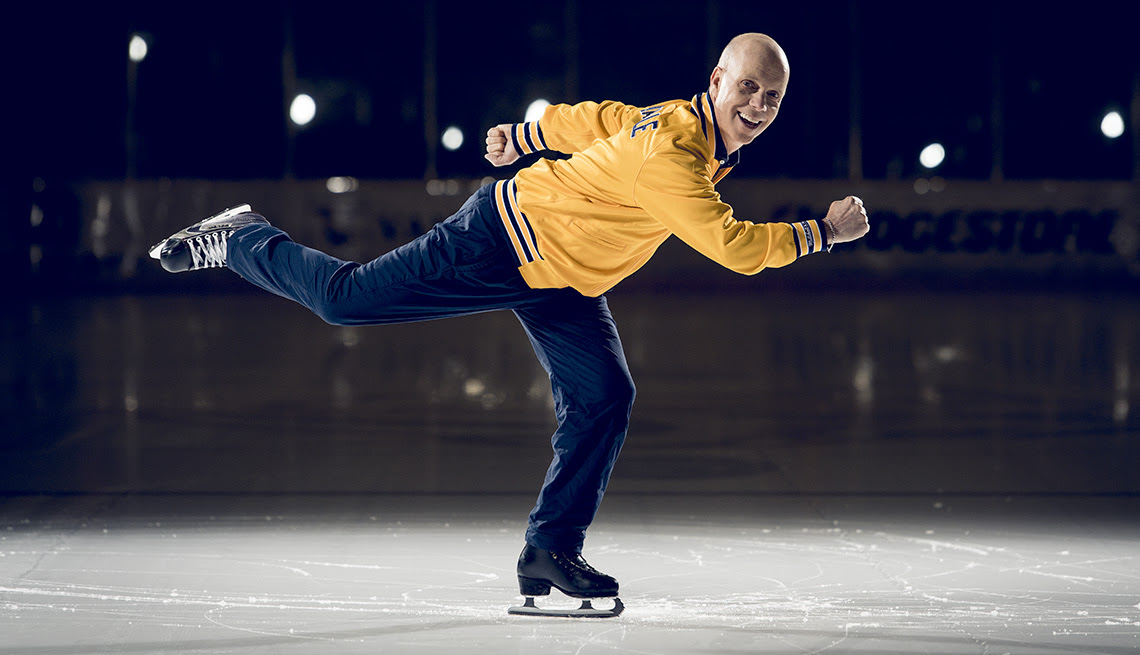
“Fall Down, Get Up and Smile at Kristi Yamaguchi.”

Posted on December 30, 2016 by Ken
 
Image result for scott hamilton Olympic Gold Medalist and figure skating commentator Scott Hamilton knows a thing or two about preparation and dedication. His sport demands that a competitor come as close to perfect as possible. No break or fault goes unpunished by the judges. Scott mastered the sport and its nuances to become the world’s best.  Always motivated when he would watch Kristi Yamaguchi fall down, get up and smile and continue her routine.

Where Did MY Cancer Originate!!!!

Posted on December 29, 2016 by Ken

Morgan Bolt

 I will be ending this year with reflection,  resolve  and renewal  knowing that I will    follow the blog of Morgan Bolt in 2017.  Morgan graduated  from Messiah College in   May of 2014 with a degree in sustainability. The following October he was diagnosed  with  Desmoplastic Small Round Cell Tumors,  a rare soft-tissue sarcoma considered       a pediatric cancer. 

He and his wife currently split their time between the Ronald McDonald House of New York City and Morgan’s parents’ home near Corning, New York. Morgan began writing under the pseudonym S. D. Gloria in 2013 when he wrote his  first novel.  You can find out more about his books at:      https://www.amazon.com/Tamyth-Rise-Gnurlbane-Trilogy/dp/1493599984

Dealing With Healing

Posted onMarch 20, 2015by Ken 

I was shocked and devastated when I received a Stage 3 breast cancer diagnosis.  After declining chemotherapy and radiation, it occurred to me,  if I had the power to create this disease. Then I had the  power within to resolve it.  That is the way it has always been with me in my personal and business life. 

  One day I decided I was done with it all. I was done with the Life ‘with” cancer and it was time to move into my life “after” cancer.  Any evidence     or thoughts,  there of,  to the contrary were also immediately discarded. Because I had a husband whom is my best  friend  and two daughters to continually live for.   ✦ಌ⊱♡❁ ✲ ❁♡⊰ಌ✦

Miracle on the Hudson

Posted on June 10, 2016 by Ken 
 

Related image

Usually at around age 35 …. a woman’s progesterone level …. begins                to decline and  become erratic. Many times this also goes unnoticed, or there maybe  increased premenstrual symptoms (PMS),  or increased menstrual bleeding. At Over 40,  women’s hormones begin to fluctuate, decrease and become imbalanced. Symptoms of hormone imbalance are varied and unpredictable – in other words INDIVIDUAL – and often go unrecognized     as symptoms of perimenopause/menopause.
While Some women sail through their perimenopause years without symptoms, but  approximately 75% of women in their 40’s and 50’s experience perimenopausal hormone imbalance symptoms.

You’re Never Too Young

Inline image 1

I had bleeding on an off since 1998. I was only 21 and my doctors didn’t think there was anything to be concerned about after I had a clean endoscopy. I told every doctor I went   to about my bleeding. For years I was dubbed “too young” and they assumed it was “just hemorrhoids” and nothing serious, especially not cancer.

Truth Be Told

Inline image 1

I remember October 5th 2011… quite vividly,  it was while…. I was talking       on the telephone  with a computer  ‘geek’  and  right before he informed me. That he works for $150 per hour whom informed me that Steve Jobs passed away.   I told this geek you don’t understand my website  would eventually help people like Steve Jobs survive cancer.  Through greater awareness of  the options and navigating the cancer cartels money making system. That `Geek told me what Life is About~is Making Money As I Hung UP on Him!!

   For Cherie Rineker        whom ran away  from home at 17,  never finishing high school in Holland, came to the United States at 20.  After marrying a military guy  she met at an U.S. Air Force Base,      in Amsterdam.  Cherie achieved her GED and went to college where I took no more than English 101.

 Becoming a flight attendant instead, which was her childhood dream.  Yet the entire book was written and edited by Cherie,  other than a friend,  Neshama Abrahams, that helped her with comma’s  and a couple of  grammatical mistakes.  As a Dutch woman I still see America a land of great opportunity if you are willing to work your butt off :>)

Cheryl Broyles

Posted on December 17, 2016 by Ken

Image result for cheryl broyles

I am  ALIVE:

In June 2000, I was told by a really horrible uncaring tech that did my radiation –“Don’t worry about the risks of the radiation, damage from it only come 10+ years later, and you with the GBM will be dead by then.” Not lying, he really said that! Well I guess he did tell the truth, the statistics did predict I would die within a year.

BUT now 16 years later I’m still alive and wondering what else will come along with me being a “long term survivor”. I know that not many people make it this long, so the docs don’t really know what to expect. But hey, I will keep recording my roller coaster ride & will share it with ALL of you other brain tumor fighters ( that will ALSO become “long term survivors” along with me!) YES, there are more and more long term survivors out there. The statistics are looking better and better over time. So plan on being one!

20 Life Lessons + 12 More

BEATING the Big C can teach you what really matters,

Inline image 1

  “I was desperately looking for ordinary people’s stories of surviving cancer when I was ill, but all I found were celebrities,” says Chris, 48, from Bristol. “It sounds strange but most people say they’re glad they had cancer because of the new perspective it brings. It’s sad that it should take cancer to do this – perhaps everyone can learn from our stories.”

For Erin Purchase, How frightening!

Posted on December 15, 2016 by Ken

Inline image 1

Recently I have became Facebook friends with Erin Purchase, also realizing what type          of genes a person may have acquired through birth …that helps them survive cancer.  That provides “determination in crucial situation.” Today Erin  posted this …on her timeline, I made a mistake this morning and drove to Portland,  a blizzard started while  I was there and I had to drive 200 miles home in it. I am thankful to be alive, home with my family right now.

Open Your Mind ~ Challenge Your Beliefs

Posted on December 11, 2016 by Ken
 
Image may contain: 1 person, smiling, closeupI’m 43. Found a lump in May. After watching it for a month I decided to get in checked & finally got an appointment July 28. Immediately, they prepared me for a likely cancer diagnosis. Had Ultrasound & Manmogram done that day (my first one) I left for Fiji the next day on a Medical Mission trip. 10 days later, home, had a biopsy 8/11 & confirmed IDC on 8/15. Refused Adjuvant Chemo. Started seeing a Naturopathic Doc- IV Vit C, Glutathione, Blood Ozone, Alpha Lipoic Acid- had 7 treatments.
.

Janice Digby McCartney Hoffman

Posted on July 31, 2016  by Ken

  “CURING CANCER IS A LIFETIME COMMITMENT”
Hello Everybody I am Janice Digby Mccartney Hoffman:
I am a 51 year old female from Pittsburgh, PA.  I have a husband and 4 children, 3 children are by my first husband who died in 1998 of a heart attack. In may 2011 I was experiencing extreme swelling of my face and my upper chest and arms. As my veins… would also bulge when I would wake up in morning.  As it looked like someone beat me up… then as the day went on… the swelling would go down a bit.  On May 19, 2011  I went to ER … as I had the swelling and was getting dizzy spells,  within  a  matter  of  no time at all…. they had found the tumor on my right lung.

Posted in Thought Provoking | Leave a comment

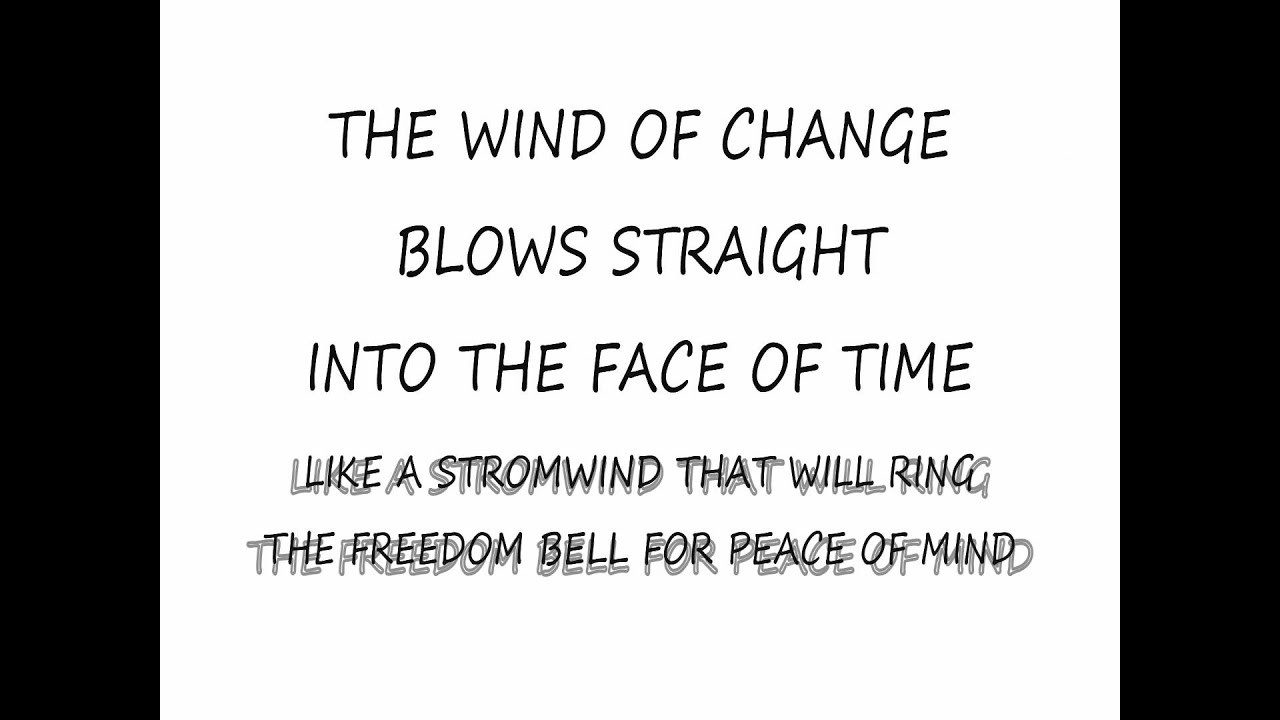
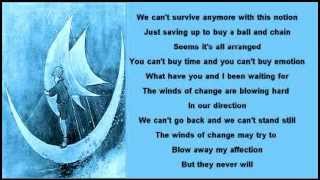
: Winds of change.

Image result for winds of change lyrics

💜💜 I believe all things are possible, life is what you make it…you alone can change the world💜

Definition of winds of change. : forces that have the power to change things —used generally to mean change is going to happen.  The winds of change. . .have begun to blow…. “Just around the corner a change is in the wind“. The winds of change are sweeping away corruption and cynicism. Does it mean that a change is expected soon?

Ann Cameron

Posted on June 25, 2016 by Ken

 Image result for ann cameron

 This  Woman  Cured  Her  Stage  –4-  Cancer  With  Only  One  Ingredient!!!
Her name is Ann Cameron, an author of 15 children’s books. On Tuesday July 30th, 2013 she had CT scan for malignant tumors on her lungs. On Thursday August 1st 2013, she got the results: “NO EVIDENCE OF CANCER.

She believes that carrots can cure cancer and rapidly,  without radiation,  chemotherapy,   or other dietary changes. Everyone diagnosed with cancer should try this remedy, because the result show up very fast.

Her husband’s died from lung cancer in 2005 despite chemotherapy and this was her first encounter of this cruel disease. So she refused to go the same way and refused chemotherapy.

“Chris beats cancer” is a blog for people who have found alternative ways of treating cancer to share their experience, and Ann is one of them.

“In June 2012, I was subjected to surgery for colon cancer, and after that I refused chemotherapy treatment.  Every day I felt better,  but after six months,  the control examination showed the cancer had spread to the lung,  and colon cancer, entered          in the fourth stage”, -says Ann.

Live Life With Unconditional Love

Posted on July 1, 2014 by Ken

  Image result for love

With  the  intentions  now  of  writing  blog  post  for  Cancer  Patients        and  Survivors,  this  amazing blog post comes  from Paula Doyle-Weigel.  Having estrogen- progesterone driven breast cancer removed only to see      it  comeback  six  months  later.  As women enter middle age  this natural phenomenon tips toward estrogen driven.

   For a second time six months later it had to be a huge disappointment. Deciding not again,  Paula decided putting her Faith in GOD’s hands and everything will be alright.  Living in Medicine Hat, Alberta, Canada, with the pollution quality average and the oil tar sands to  far to equate. Paula lived a clean  “vegan”   lifestyle  keeping  her  pH “alkaline”  balanced and thinking it can’t happen to me.

   However,  being a Critical Care Nurse (22 years) and enduring  family crisis with a brother  and  a H1N1 outbreak.  With a mother passing away     1 year later after a year and one/half battle that broke her heart and soul. After being ran down  from personal lost and  finishing her  first iron man contest that “stress load” caught her.

   Thereby,  being diagnosed six weeks after her second and training  for a third just 12 weeks later…. as it never happened.  Now  today  looking back: believing this awakening is taking her longer to heal  because her thoughts were a bit scattered and unfocused.  Today she is developing a mode of  self reflection and realization.

My Testimony, Health Schedule and Other Links

Posted on July 3, 2014 by Ken

    Doris Parreno's Profile Photo, Image may contain: 1 person, smiling, closeup

    Over n’ over again I hear cancer patients through their own research     and  natural therapy decisions.  It is  what  it is  and this website is about exploring the possibilities  and being curator you gain  firsthand account. Within my Facebook friends list: I learned another impressive experience from Doris Parreno of  Toronto,  Ontario,  Canada. This is the  first blog post        I talked openingly about a product,  however,  this warrants consideration?

   Doris having tried everything imaginable, even German Homeopathic Intense Therapies of  Caresang (American ginseng), Mistletoe, vitamin c, B17  and chelation. Imparted this piece of  advice:  learn when it comes to what  you put in my body now especially  for healing.  So choose only the best even  if  you have to pay little more… it surly beats IV therapy.

Therefore….  this  is  Doris Parreno’s  Experience:

After  having  some  cramping  in  my  stomach,  having  a little blood  come from my nose on a regular basis and feeling pretty tired on a daily basis.  I felt like a needed a  nap and sometimes the nap lasted a couple of  hours,  S0 I decided to go to doctor for       a routine physical. I did a mammogram and in November, 2011 was  diagnosed with  Breast Cancer, Triple Positive, Estrogen Positive, High Grade 3, DCIS, Invasive, Aggressive Carcinoma. 

The Quijano’s Experience

Posted on June 25, 2016 by Ken

    Image may contain: sky, cloud, skyscraper, outdoor and text

 This was first posted on October 24, 2014 by Ken via Yris Quijanos. Larry still does wonderful today because of their undying LOVE for one another!
.

Hello my name is Yris Quijano and I would like to share my husband’s journey with the visitants of Solitarius.org….  Thereby,  providing the HOPE  to other people whom are looking for answers to kill this horrible disease “Cancer.” My husband Larry was diagnosed with Small Cell Carcinoma Lung Cancer (Limited) on November 16, 2013.

    A large mass was found in his chest causing him so much pain; not even the strongest pain killer could relieve the terrible pain that penetrated his entire chest ~ left arm. While losing his voice after a very difficult biopsy. “Larry stayed at the hospital for 2 days.”  His needle chest biopsy caused his left lung to almost collapse.  His oncologist gave him four rounds of chemo (3 days each – staying in the hospital) while also enduring 30 radiation treatments.

Shannon’s Story

Posted on June 25, 2016 by Ken

Thank You CMN Hospital! You saved my life and many others without chemotherapy! You proved doctors wrong when they said I was dying.

Please visit to see what cutting edge treatment they use including Dendritic, PNC-27 and Bone Marrow Stem cell therapy! 

12657849_10204160038039934_3387725414951955218_o

TOUGH LOVE!
I have always believed the toughest love is people parting with their money, their time,   and service when they have a loved one fighting for their life with stage 4 cancer.

It seems to be the end of the road. The oncologist says to a cancer warrior after a long hard battle, “There is nothing left we can do for you!”. They are in shock; they go home feeling scared and tell those who they trust that their oncologist said, “it’s over”. It’s okay to break down and go through a period of defeat. Sometimes, that’s all it is, ” a moment”, or maybe longer until suddenly they feel a surge of will to fight. They don’t want to give up! They have faith in God or sheer will and do not see the expiration date stamped on their foot! They had heard of miracle stories, where success had happened even when all seemed lost! The thought is like a power surge through their mind, their soul, and body” What if I can be that miracle too! It’s a long shot, but, “What if”?

Vincent Crewe

Posted on June 25, 2016 by Ken

Chemo-Free Stage 4 Colon Cancer Survivor since 2006!

Vince-2

 In January 2007  and at the age of 57,  I was diagnosed with colon cancer which had  spread to the liver. As a non-drinker, non-smoking fella who had exercised most of his  life, this was a bit of a shock to put it mildly.

However, I am a person that gets stressed quite a bit and had recently experienced a     very tragic bereavement, which I think was the tipping point for my immune system.

Surgery was necessary as the colon was almost blocked and I had 2 small tumours removed from the liver in a second operation 3 months later. I knew enough about chemotherapy to avoid it completely.  I refused all  other follow up treatment that was offered, much to the disgust of the highly paid oncologist.

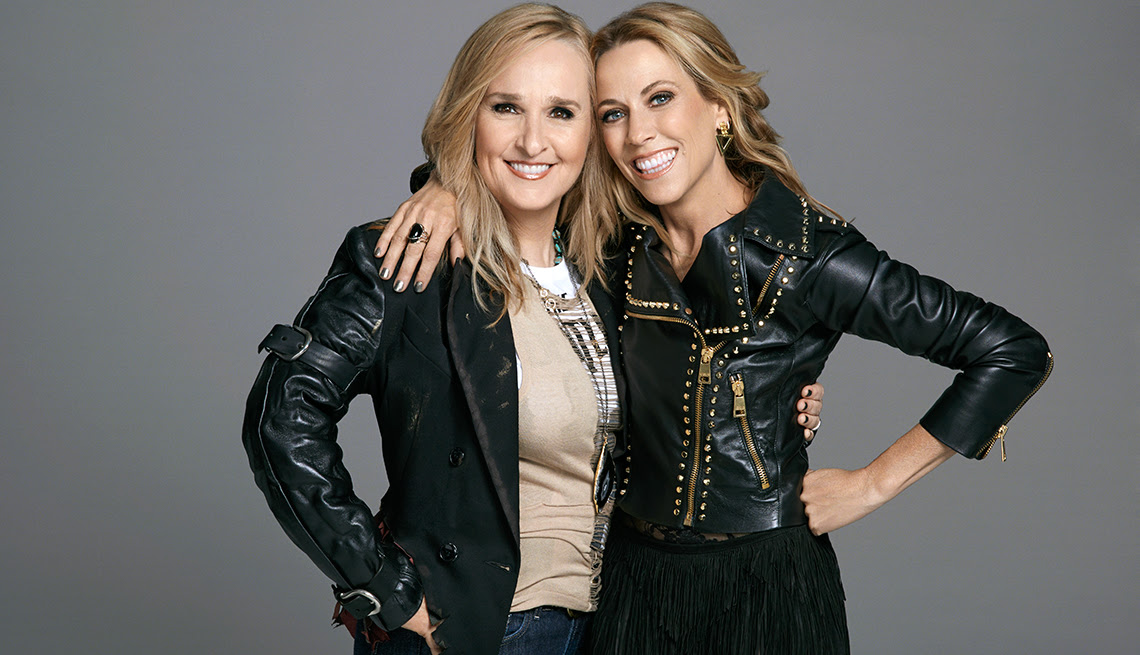
How 2 Music Legends Beat Cancer.

Melissa Etheridge and Sheryl Crow pose, Sheryl Crow and Melissa Etheridge Beat Cancer and HeartbreakSheryl Crow and Melissa Etheridge are now teaching us a thing or two about living with joy from Heartbreak.

En español l They’ve been good friends since 1988, two Midwestern girls making their way in a male-dominated industry. Born just nine months apart in neighboring states — Sheryl Crow in tiny Kennett, Mo., and Melissa Etheridge in Leavenworth, Kan. — they first met at the Los Angeles Sports Arena during Michael Jackson’s Bad concert tour.

Backstage, Crow, then a backup singer for the Gloved One, approached Etheridge, whom critics had compared to Janis Joplin and Bruce Springsteen when her first album came out that spring, and gushed, “I’m a huge fan of your record!”

“It was such a lovely surprise,” Etheridge remembers, “and one of the first times someone whose work I admired was already an admirer of my work.”

♥️ It’s A God Thing ♥️

 Posted on June 25, 2017 by Ken

Image may contain: 3 people, people smiling, people sitting and outdoor

Ken, I am Tammy Rushing Dunaway:

Because you care more about people going through this than anyone I know

y…ou are  a personal Hero of mine     

 I was dying… I did not know anything at all about what was happening to me. I went at least 6 times with tears rolling down my face begging for help. I was turned away.

Further into it when I knew what I was dealing with, I took the list of symptoms, pictures of Stachybotrys from my house etc.

 I was thinking that doctors…. they will be able to know how to help me now.
.
Instead, I felt like they didn’t believe me. Nothing was done, no questions nothing just silence and moved on. In the third and final stage of Mycotoxicosis… I made one last try… I knew I was dying.
While at the Drs office I contracted Strep. SO I called them back… I was so sick,but I felt like it was still thought to be my overactive imagination.
It is a horrible thing to go through. Zero support, I could not find help. I had family members who thought I was making it up too.
.

Who is Lothar Hirneise?

Posted on June 14, 2016 by Ken

According to one source, possibly one of the most knowledgeable persons     in the world on the subject of  cancer… Lothar Hirneise  is also “President and Founder of People against Cancer [Menschen gegen Krebs] Germany,    a non-profit organization established  to promote international research, education and consulting regarding alternative,  as well as conventional cancer therapies.

    His book, Chemotherapy Heals Cancer and The World is Flat, became          a bestseller within a  few months in Germany.  It also includes Hirneise’s research results  for over 100 alternative cancer therapies  as well as  his personal experiences,  conclusions  and wisdom distilled  from meeting     and learning from numerous cancer patients and survivors.

This Is A True Account

Posted on June 21, 2014 by Ken
    Related image

 While talking to a Facebook  friend last night whom told me an experience he had  with his wife and the Budwig Protocol.  His  wife  was  like  me  when I  first  heard  cottage cheese ….well  that’s  dairy.  While  his  wife had Triple Negative -ER, -PR, -HER2  Breast Cancer,  which  is  a non- hormonal driven  aggressive type.  She brought herself off  Budwig Protocol  for  fear of  dairy when she was responding to the treatment. 

  In this interview he felt strongly his wife’s life would have been saved “if ” she stuck  to the program.  What Dr. Johanna Budwig  discovered way back then was  the emulsification of  Quark  (cottage cheese in all us)  mixed with flax oil produced  a sulphurated protein. Which was capable of  penetrating the cancer cell wall and reversing the deficiency of  the cell thereby, healing cancer naturally.

According to Johanna’s Protocol,  patients to ill to consume the mixture        at  first  were treated with a retention enema  using 1/2 to 1 cup of  oil daily.   The patients would try to hold the oil for as long as possible, aiming for 15 – 20 minutes. When the patient retained enough strength to be  fed by mouth, they were switched to the mixture.

Ozone Therapy Benefits

Posted on January 15, 2016 by Ken

Image may contain: 2 people, including Saundra Rene Alma, people smiling, selfie and closeup

 DOES INSURANCE COVER OZONE THERAPY? This really depends on the specific terms of the insurance (legal) contract. Generally, insurance companies will NOT pay for medical care which they decide to classify as not usual and customary. In addition, all managed care is just that, financially managed to lower insurer costs!

In such circumstances you must look in you “benefits” package to determine what procedures and which physicians are covered. Due to our concern over the ethics of such arrangements, Dr. Edwards and Bio Health Center do NOT participate in any managed care organizations. It should therefore be assumed  Medical Ozone Therapy will NOT be covered by private insurance or managed care programs. Check with your insurer, health benefits manager or agent for the specifics of your particular coverage plan. Medicare™ and other public entitlement programs DO NOT cover Medical Ozone therapy.

One member of our Facebook Group having success through her own research’….Saundra Alma is applying it with Gerson Therapy as her cancer base foundation. http://www.scribd.com/doc/294107469/My-Cancer-Curing-Protocol !!!

My Thoughts on Cancer

Posted on June 14, 2015 by Ken

Related image by Jessica Walker

I don’t know much about other cancers,  but I look up hormone driven breast cancer             a lot because this is what I am in remission from.  I also think breast cancer needs to be approached in an integrative fashion  to include chemo,  radiation,  surgery,  medicines  and complementary protocols. To do it any other way, is in my opinion, playing Russian Roulette and plain suicide.  This includes  Vitamin C (Iv or liposomal ), Mushroom (esp. Coriolus), Frankincense, NAC, Lugol’s iodine, Reservatol, 2 Tablespoon ground flax seed everyday, and circumin with pepperine,  vitamin D3,  B-complex,  selenium,  wheat germ extract,  DIM, and  IC3, sulphoraphane (these last 3 relate to hormone driven cancer).

A good diet is essential as well to keep your immunity up, reduce carcinogenic and inflammatory foods and to prevent and reduce angiogenesis. An interesting TED talk about eating to starve cancer!!!    Getting to bed by 10:00 to maintain melatonin levels      is great.

The Tomaszewsky Story

Posted on October 3, 2015 by Ken
 
    Irene Tomaszewsky's Profile Photo, Image may contain: 2 people, people smiling, suit and closeup

This is Irene and when we learned of Walter’s diagnosis in November of 2011, we were devastated,  and couldn’t understand why or how this would have happened to us.  How could he have stage 4 mantle cell lymphoma when he went for a physical every year and always had a clean bill of health?

We sought expert opinions from top hospitals and specialists, all of whom recommended a stem cell transplant, with no guarantee of success.  This process,  not only,  involved bringing my husband virtually to the brink of death with no certainty of an outcome,  but also, would have a negative effect on me as his caregiver and spouse. We quickly realized that this was a serious  illness,  but at the time,  were unaware of  the emotional, mental, and physical factors that contributed to the manifestation of the disease.

Frighten to Death

Posted on June 20, 2015 by Ken

Image result for alyssia sade with Carol Smith.

 Trevor is officially 3 and half years cancer free on January 18th and I want to tell you all that the secret to surviving all of this is to get up when you are down, to fight more when you are struggling, to put in the extra effort when you are in sheer pain and to come back when no one is expecting you to. My purpose of sharing our story and to continue to share these results so publically is to try to turn that fear of cancer, (everybody’s greatest fear) into a future, not only free of the fear but a future where we could all learn how to take control of our own health, and possibly see in our lifetime that Cancer does have a cure and that cure is within us all.
.
Cancer lost the battle against us, it tried to make us weaker, It tried to frighten us into submission but instead it actually made us both stronger, It bought us closer together and gave us a purpose. To turn his wound of cancer into wisdom and to then share our story that we survived It . Research, Nutrition and cannabis oil are all it took for Trevor to heal his own body, I am so very proud that he continues to take such care of what he eats and continues to have these dreadful check ups so that we can show you all that sometimes good comes out of bad. Look at how well he looks, all his organs are in tact, no metastasis, no pain and no evidence of disease Cancer free officially for 3 and half years and he has now lived 3 years longer than the top Urologists in two different Countries told us that he would.
.
Today our Urologist told us again that anyone removing their bladder is not expected to survive longer than 2 years, shocking that the do not tell you this when they suggest that is the only cure!!! Shocking and hopefully our case study will help to change all of that!! Brent Wallace our Urologist wants to contact yours and is willing to pass over all Trevors records so both of you can be case study to our way of natural healing….our story is in the files under bladder cancer xx  http://www.whydontyoutrythis.com/2016/06/there-is-another-way-man-refuses-chemo-and-cures-his-bladder-cancer-with-these.html   —   
 

 LET YOUR SPIRIT BE…

Posted on April 30, 2017 by Ken

  Image result for let your spirit be michelle lyn denault Image result for let your spirit be michelle lyn denault

Ken I had run out of treatment options as surgery, and numerous chemos had failed,   and I had numerous tumors so radiation was not an option. I knew CART-T Cell therapy held great promise  and knew the CarT program was about to open … at Dana Farber …in Boston. However,  it was a month until it opened ~ it would be another month from there until I could  received treatment  and at that point my two oncologist told me …. I didn’t have two months to wait.

One Man’s Journey

Posted on April 5, 2015 by Ken

                      One man’s journey to peace on the Appalachian Trail

Paul Stutzman, a native of Holmes County, was born into an Amish family. His family left the Amish lifestyle soon after he was born, and joined a strict conservative Mennonite Church.

When he was in his mid-50s, after working for 25 years as a restaurant manager,  Paul lost his wife,  Mary,  to  breast cancer. Following that traumatic experience, he sensed a tug on his heart — a call to a challenge, the call to pursue a dream.

After  losing  his  wife  to  cancer  those  molehill of  problems that  folks turned into mountains became more than a desired   to listen to any more.  So when he decided to climb real mountain tops in search of peace,  freedom and meaning of life. The Appalachian Trail became the vehicle that told the story of finding that peace.


Chiara D’Agostino

Posted on February 3, 2018 by Ken
Image result for chiara d'agostino
Definition

What is triple negative breast cancer?

If you’ve been diagnosed with breast cancer, one of the first things your doctor will do       is determine whether the cancer cells are hormone receptive. Knowing if your cancer responds to certain hormones will help direct your treatment, and it can offer insight about your outlook. Chiara: How I Survived Triple Negative Breast Cancer
Hormone receptors tell your cells how to behave. Some cancer cells have receptors for     the hormones estrogen and progesterone,  as well as an overexpression of the human epidermal growth factor receptor 2 (HER2) gene.  If HER2 genes are overexpressed,         the cells make too much of the protein HER2.

If your cells have hormone receptors, the hormones they receive will actually support      the growth of your cancer cells. Not all breast cancer cells have these receptors, and not   all cancers overexpress the gene HER2. If your cancer isn’t receptive to these hormones and doesn’t have an increased amount of HER2, it’s called triple-negative breast cancer (TNBC). TNBC represents 15-20 percent of all breast cancers.  https://www.sharecancersupport.org/2008/08/how-i-survived-triple-negative-breast-cancer/

Hormone therapy stops hormones from causing cancer growth. Because TNBC cells lack estrogen and progesterone, and their HER2 genes aren’t overexpressed, the cells don’t respond well to hormone therapy or medications that block HER2 receptors. Instead of hormone therapy, treating TNBC often involves chemotherapy, radiation, and surgery

Posted in General News | Leave a comment

: A Light Still Shines

No expiration date: A tribute to our angel, Krysti Hughett | Tami Boehmer | Miracle Survivors

I awoke this morning to the news that Tami Boehmer has died. I feel heart-sick and shocked at the news.  I have been worried about Tami  for several weeks as she stopped blogging. I’ve just gone back to read her last blog post in September and right to the end, Tami maintained hope in the face of devastation. That hope carried Tami through to her diagnosis of a cancer recurrence in 2008, right up to the present day.  That’s not to say  she didn’t have dark days as her last blog post demonstrated.

“What people really don’t realize is there is strength in feeling your feelings. And with my dire situation now, it’s not an easy thing. Sooner or later, they have to come out, which is what happened this weekend.

It all started Saturday morning with a comment from our daughter about how she could see Mike and me as a cute, old couple.  I don’t know if she was testing the waters with me, but     I felt I must prepare her in some way. So I said, “I’m not sure I will make it to be an old lady, but we remain hopeful about this new trial and I’m doing everything I can to stick around as long as I can”.

Tami’s love for her daughter, Chrissy, and her husband Mike, shone through everything she wrote and was clear for all to see in the pictures and posts she shared on her Facebook page. Over the years – and I’ve known Tami since I first started blogging back in 2009 – I’ve watched as she spread her positive messages of hope and compassion to others. As we know, there can be a backlash against the message of “positivity” in the cancer blogosphere – but for me, Tami was never Pollyanna-ish in how she wrote or spoke about her experience. Yes, she shared a positive message – that’s there always hope; but she was realistic too. This was her truth and she shared it with others in the hope that they could find a light in the darkness.

Several people have told me lately I’m brave or that I’m a hero. I really don’t get it; and I’m not being falsely modest. What choice do I have, really? Before I had stage IV cancer, I remember telling a friend going through it that I didn’t think I would be strong enough to face a diagnosis like she was. She told me I would be, and she was right. As Eleanor Roosevelt says, “A woman is like a tea bag. She never knows how strong she is until she’s put in hot water.

Tami’s light still shines for me and for countless others. I will miss her voice in the blogosphere dreadfully. My heart aches for Mike and Chrissy who have lost a loving       and wonderful wife and mother. This horrible disease has stolen another beautiful    woman from our lives and we are all the poorer for it.

Author, blogger and cancer research advocate Tami Boehmer  52, of Dillonvale made her spiritual transition on November 4, 2015 after living with cancer for more than 13 years. Tami helped countless cancer survivors, their families and others with her message of hope.

Her books, From Incurable to Incredible: Cancer Survivors Who Beat the Odds and Miracle Survivors: Beating the Odds of Incurable Cancer and her blog Miracle Survivors have inspired readers around the globe.  Although, when you consider the story  From Incurable To Incredible  and this great read from Tami Boehmer mention Yvonne Cooper of Cincinnati overcoming this very incurable through the Bill Peeples Protocol and Dr Elyse Lower at UC Barrett Cancer Center or the right doctor elsewhere that can be found in forums.

Image result for tami boehmer From Tami’s Book: Sarcoma is probably one of     the worse cancers a patient can garner and when that’s combine with the fact these types are usually amongst the rarest of cancer types —  with little known about them. . . . it can become emotionally taxing.Leiomyosarcoma and with treatments being given it can be gut wretching difficult and unresponsive with the roller coaster ride taken from the time, hope and disappointment.    http://www.solitarius.org/2013/04/22/surviving-cancer/              https://www.solitarius.org/2017/12/21/working-cure/

If your not sold on the Bill Peeples Protocol ..

Google

Dr. Suzanne George Dana Farber in Boston 

 and

Dr. Breelyn Wilky, MD University of Miami Fla. 

…..Tami served as an advocate for metastatic breast cancer research, traveling across            the country to speak and lobby with the national leaders.  She lived with the disease for more than seven years,  prompting her oncologist to call her  the most proactive patient   he had ever had. Tami helped many through her volunteer work with organizations such as Pink Ribbon Girls.

She loved being a parent and a wife, socializing with family and friends, taking walks         in nature, traveling, swimming and listening to a wide range of music, especially from    the 1980s. She is survived by her husband Mike, daughter Chrissy,  brother Doug, of  Santa Cruz, CA, as well as loving in-laws, aunts, uncles, nieces, nephews and cousins.

Her parents and a brother preceded her in the transition. Tami was a long-time member of New Thought Unity Center and gained great spiritual strength through active participation in 12-step groups. A graduate of Ohio University, she worked in healthcare public relations for a number of years.

 Tami Boehmer, Author, Cancer Survivor: Many people ask me as a stage IV breast cancer survivor what I do with my diet to increase my odds in my favor and live a healthy life that I am living. I have three tips for you that you can use to supercharge your wellness.

1. To eat organic whole foods and that means… usually if you shop the perimeter of the grocery store, that’s where you will find the fresh produce, the whole grains. Lot of fruits and vegetables is key and more and more grocery stores are buying organic produce. The cost is coming down and it’s much better for you not to have these toxins in your body, so your body can focus on healing from the cancer.

2. The second point I have is to eliminate cancer promoting foods that could be in your diet. These include dairy. There are a lot of alternatives to dairy.  Dairy has some cancer promoting properties, so you want to limit that or eliminate it.  I use almond milk, which  is very tasty. I would make protein shakes with it. They have some cheese, artificial cheese that does not taste as good as the real stuff is. I found that I’ve gotten used to it.

And also another one is sugar. Sugar is a cancer-feeder. So you want to get rid of sugar in your diet. I know everything has sugar in it. Just look at your labels, see how many grams of sugar there is, you know,  how it comes up on the list of ingredients, you want to lower down there.  Try to eliminate desserts and focus,  you know,  except for maybe really real dark chocolate.

That is my big treat as I get like 85% dark chocolate, which is also a cancer fighting…     they found out that dark chocolate helps promote cancer fighting abilities. So sugar, you got sugar, dairy, and also you want to eliminate meat, red meat especially. My diet, I am eliminating all meat except for fish, cold water fish, which again the omega-3s. You want to make sure what you are doing is going to help promote cancer fighting and training your body. So those things you need to eliminate are greatly reduced.

3. My third tip for you is to just drink lot of water, that’s what the body needs, and green tea, is actually very very good for breast cancer. Cancer fighters have spent studies about that. I have really supercharged tea that I buy. It’s called Dr. Lee’s Tea for Health that has like five times the cancer fighting properties than a normal green tea has, otherwise generally drinking water too.

So, those are my three tips for you. Yeah, and get rid of the soda because if you don’t,     that step melts nails and all kinds of trouble things so imagine what it does to your body. So, those are my three tips for you that you can change your eating and help fight cancer.  http://goodthingsgoingaround.com/featured/thoughts-for-living-a-fulfilling-life/

Tami Boehmer, a wife, mother and former public relations executive in the health-care field, was celebrating her fifth year of living cancer-free when she discovered that she had a recurrence that had metastasized. Her cancer had spread to her lymph nodes, liver and chest. After getting a dire prognosis from her doctors, she turned to the Internet to search for others like her. She compiled the life-changing stories she found into her new book, “From Incurable to Incredible: Cancer Survivors Who Beat the Odds” and writes about people who have beaten the odds on her blog.

 Tami feels as if she is fulfilling God’s purpose through this work and it has taught    her that cancer doesn’t have to be a death sentence. In fact, it can be the beginning     of a new way of life with appreciation, hope, and discovering one’s potential

This information should not be relied upon as a substitute for personal medical advice, diagnosis or treatment. Use the information provided on this site solely at your own risk.  If you have any concerns about your health, please consult with a physician. 

Posted in General News | Leave a comment

Ty & Charlene Bollinger

   Related image

.
.
.
Posted in General News | Leave a comment

Ohio Medical Marijuana Program

 For some medical pot patients, program’s launch can’t come soon enough

Lawsuits and controversy threaten to delay scheduled    Sept. 8 rollout.

Teresa Woodward of Miamisburg has stage four cancer. She has yet to                   start the treatment her doctor recommends because of feared side-effects, and          worries Ohio’s medical marijuana program won’t be launched in time to help.

“I’m not here to get high,” said Woodward, whose breast cancer has spread                           to her lungs and bones. “I’m here to help myself get through this journey.”

Posted in General News | Leave a comment

“Invisible Worlds”..

Image result for How bacteria "talk"

Each microbiome is a snowflake. “Invisible Worlds” by MJ Richardson via geograph.org.uk.

We’ve been taught for decades that the microbes inside us outnumber our own cells.     And we’ve often been told it’s by a ratio of 10:1. That number was first introduced in      1972 as more of a vague estimate, without much significant factual basis, and has been perpetuated ever since. Well, sort of. In 2014, a researcher from the National Institutes    of Health called this very issue into question, and now, Ron Milo and Ron Sender from  the Weizmann Institute of Science in Israel, and Shai Fuchs from the Hospital for Sick Children in Canada have offered up a new estimate.

To determine the new ratio, the researchers looked at the available literature about microbe population numbers as they relate to the “reference man.” The reference man is between 20 and 30 years old, weighs about 154 pounds (70 kg) and is about 5’7″ (170 cm). The researchers combed through the original bacteria calculations and found that one of the larger overestimations was for microbes found in the colon.

Known to house one of the largest populations of bacteria,  the gut is indeed full                  of microbes.  But, when previous studies made their estimates,  they used the density of bacteria per gram of “wet content” of the colon, times the volume of the entire alimentary canal. But, these researchers argue,  the bacteria density of the colon is much higher than the rest of the tract,  so assuming that the entire alimentary canal  is as bacteria-filled as  the colon is would be overkill. (If you want to get really philosophical, you could question whether the so-called wet content’s bacteria is even part of our body, since it cycles through us daily.)

The new calculation came down to about 39 trillion bacteria to about 30 trillion human cells, a roughly 1:1.3 ratio. It’s important to note though, that this ratio is still an estimation, not an undisputed fact. As Ed Yong writes in The Atlantic, “my preference would be to avoid mentioning any ratio at all—you don’t need to it convey the importance of the microbiome and scientifically, it’s not all that interesting.”

  Today, the field of oncology is exploring new and diverse ways to fight cancer, from antibodies to vaccines to cracking the genetic code. All of these biological elements affect how cancer starts and how doctors can treat it. But according to a review published today in Science, the bacteria living in and around our bodies may hold keys to more effective cancer treatment in the near future.

   Human bodies host a staggering number of bacteria,  living inside and outside our      bodies in the intestines or on the skin.  In recent years,  these communities of bacteria, called microbiomes, have gotten much more attention, linked to many aspects of health.

The microbiome has also been shown to play a role in cancer.  Many bacteria have     evolved  to  change  the DNA of other cells  as a defense mechanism,  which can lead to cancer’s onset or its treatment.  Some types of bacteria have been shown to cause cancer under certain conditions.  The parts of the body  where  bacteria  are most populous are particularly hardy, effective at protecting the bacteria from penetrating the boundary into more sensitive parts of the body where they could cause harm.  But if there’s a breach of normal protections and some of these particular kinds of bacteria get through, they can be carcinogenic.

When good bacteria go bad.

Bacteria can affect cancer in three ways: by changing how much human cells reproduce,  by affecting the immune system, and by influencing cell metabolism.

When in a new environment, bacteria can turn off our cells’ immune responses, or turn them on unnecessarily,  creating inflammation  and  autoimmune conditions that break down tissues. Diets heavy in fiber or fat might change how intestinal bacteria metabolize energy, creating an acid as a byproduct that can make colon cancer more likely to happen, though studies so far have come to conflicting conclusions.

The tools are getting better. Tumor cells can be genetically sequenced to see if bacteria have affected them and, if so, the role that bacteria play in the microbiome. Oncologists can  engineer bacteria  to  kickstart the immune system  to help combat certain kinds of cancer or other cancer-causing bacteria, or to turn off the genes causing the cells to grow out of control in the first place. Treatments that act as heat-seeking missiles, treating only the cancer and not poisoning the entire body, can work better with boosts from the local microbiome.

Now that they understand some of the basic ways in which bacteria can play a role             in cancer, researchers still have a lot of questions. They want to know other ways that bacteria might affect cancer, if they can make different types of treatments more or less effective,  if single microbes  can make a difference  or  if they need to be in a particular configuration.  They  want  to  know  the role of diet  in  understanding gastrointestinal cancers like colon cancer,  or  why immunotherapy works  better in some microbiomes (like on the skin or in the stomach) than others (like the colon), and why the efficacy of these treatments vary from person to person.

Future research will look at how to use bacteria to diagnose cancer and identify those patients most susceptible  to side effects and complications.  Though the microbiome requires a lot of interdisciplinary research, says the review, it could hold important answers to fighting and understanding many different types of cancer.

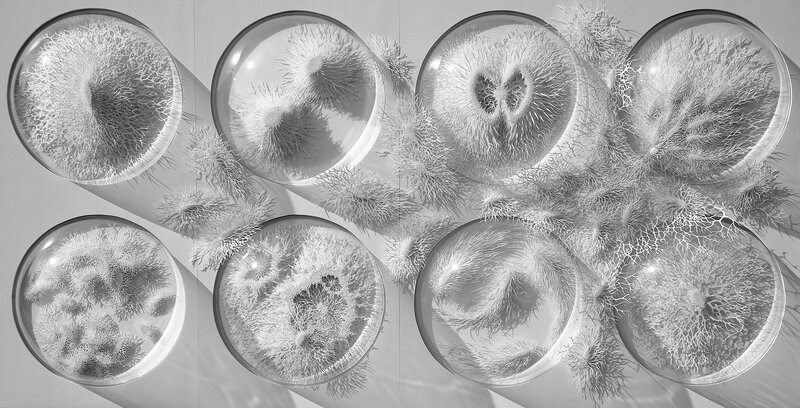
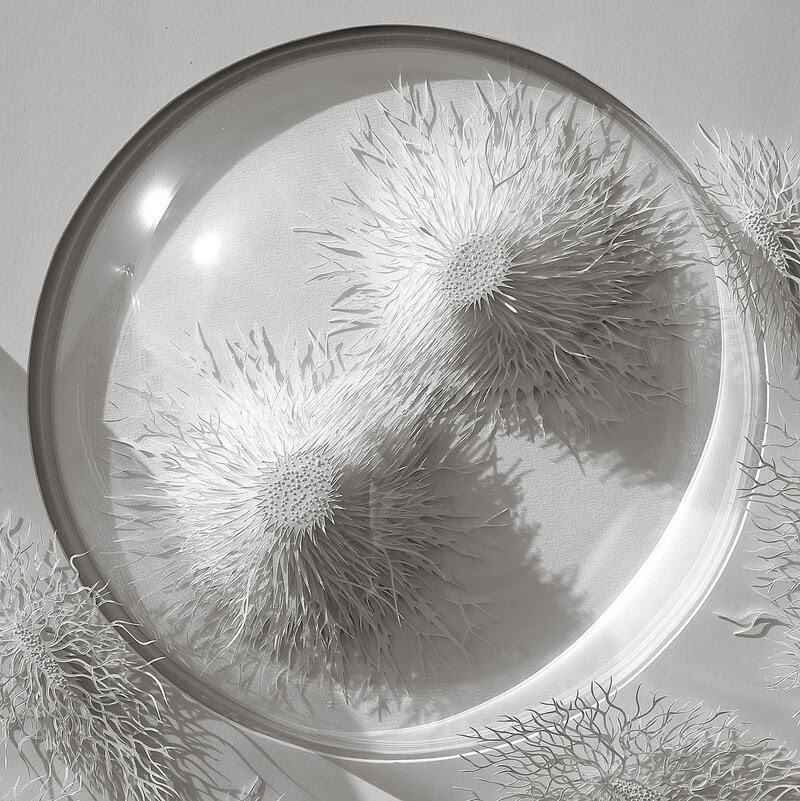
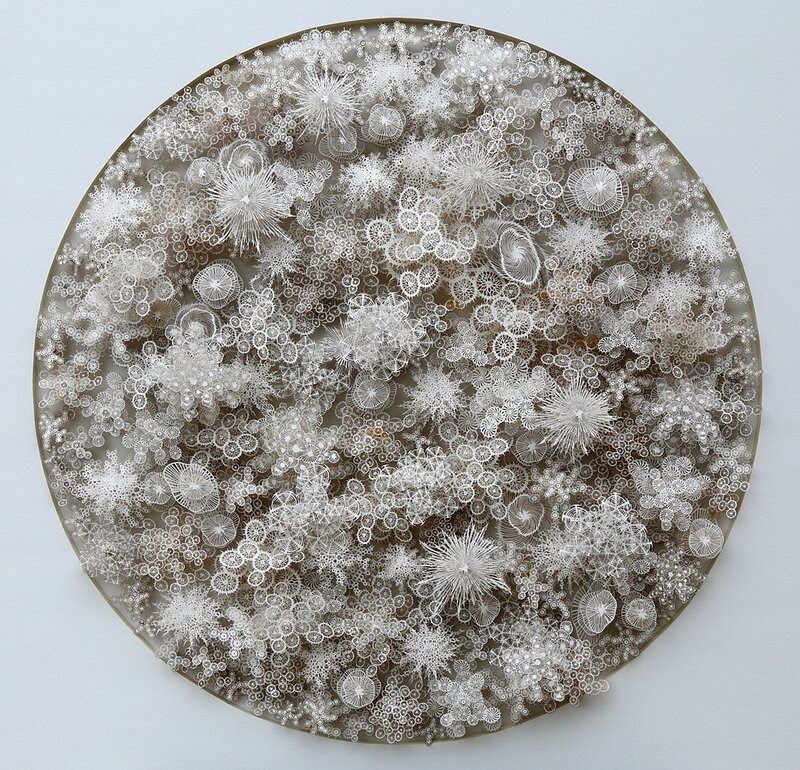
Artist Rogan Brown’s paper sculptures are many times larger than the organisms that inspire them. Magic Circle Variation 5 is approximately 39 inches wide by 39 inches tall in its entirety. Brown has created multiple versions of Magic Circle, the shape of which alludes to a petri dish and a microscope lens.

Do you remember cutting paper snowflakes in school? Artist Rogan Brown has         elevated that simple seasonal art form and taken it to science class.

These large-scale paper sculptures may evoke snow, but actually trade on the forms of bacteria and other organisms. The patterns may feel familiar, but also a bit alien. You’re not looking at a replica of a microbe, but an interpretation of one. And that distinction, Brown says, is important.

“Both art and science seek to represent truth but in different ways,” the 49-year-old artist, who lives in France, tells Shots. “It’s the difference between understanding a landscape by looking at a detailed relief map and understanding it by looking at a painting by Cezanne or Van Gogh.”

Brown wants to you to feel something looking at these sculptures.

Last year, he met with a group of microbiologists to plan an exhibition on the human microbiome. He became fascinated by the hidden world of microbes and the strange shapes of pathogens. He was particularly interested in humans’ fear of the invisible microbiological world. That meeting led him to spend four months creating Outbreak entirely by hand

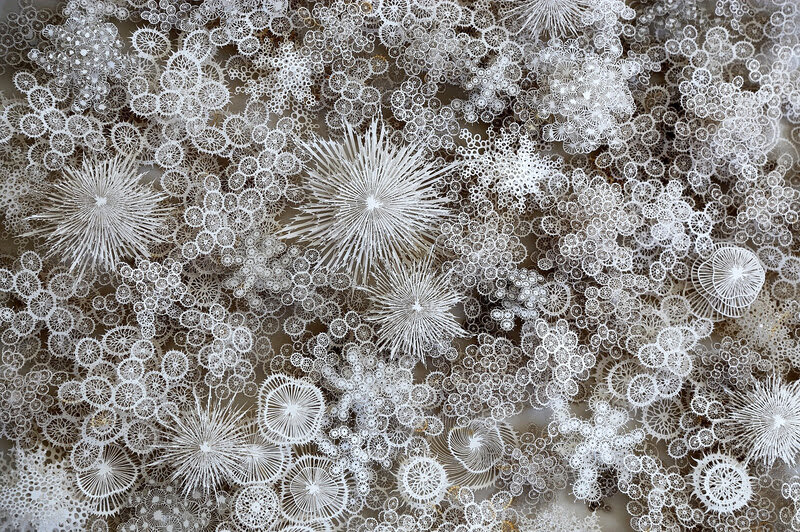
A detailed view of Outbreak shows the delicate forms Brown cut by hand. He says he works with paper because it “embodies the paradoxical qualities that we see in nature:      its fragility and durability, its strength and delicacy.”

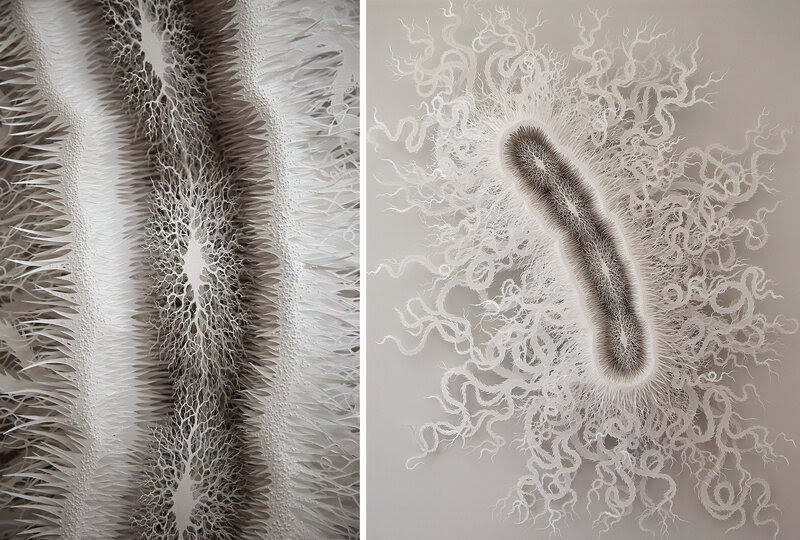
In Cut Microbe, that growth is chaotic. The whip-like appendages of the creature branch outward in an invasive way.

Those legs, Brown writes on his website, were inspired by the flagella of Salmonella and    E. coli, tiny appendages that help the bacteria move.

 Cut Microbe, left, was cut entirely by hand. The entire sculpture, right, measures approximately 44 inches tall by 35 inches wide. Brown says it was inspired by Salmonella and E. coli.

 Magic Circle borrows from the forms of bacteria, microbes, diatoms and coral.

Brown needed a laser to cut some of the more intricately designed shapes.

Some of Brown’s work is sliced meticulously by hand using a scalpel.  Others, like   the one above, are also cut using a laser. The end result is a fragile paper sculpture that borrows from what we can see as well as the artistic imagination.

“We live in a world dominated by science,” Brown says. “Art needs to work hard              to keep up or use the language and imagery of science for its own ends.”

Giulia Enders is working at the Israelite Hospital (Israelitisches Krankenhaus, IK)  author of the bestseller  ‘Gut: The Inside Story of Our Body’s Most Underrated Organ’.  Enders explains how and why she became fascinated by the functions and the importance of the human gastrointestinal tract, including the gut microbiota, in this talk held in TEDxDanubia, Budapest (Hungary), in May 2017.

TED Talk – How Bacteria Control Our Minds

Searches related to Each microbiome is a snowflake. “Invisible Worlds”..

This animated documentary celebrates the 17th-century citizen scientist Antonie van Leeuwenhoek,  whose discovery of microbes would change our view of the biological world.

Preview  Seeing the Invisible | Op-Docs | The New York Times

Posted in Information & Research | Leave a comment

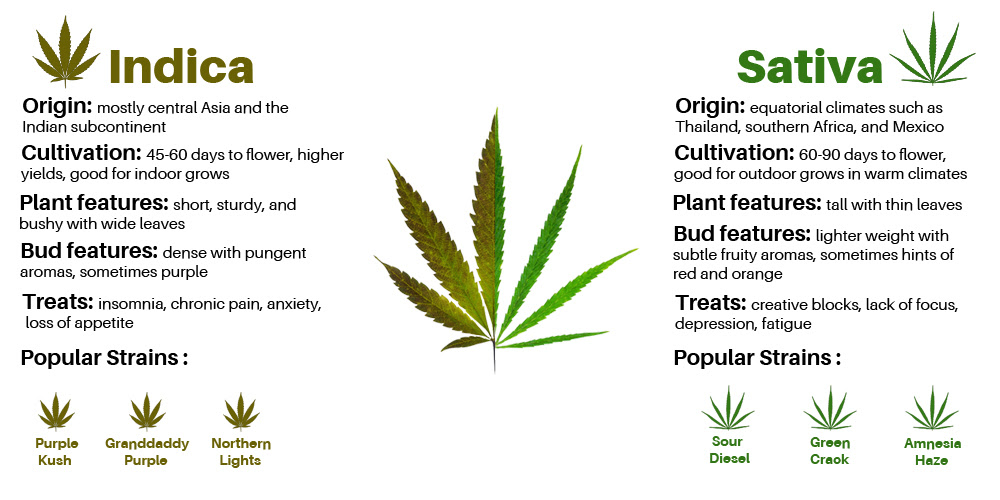
Difference Between Indicas and Sativas?

sativavsIndica1 The ultimate guide on indicas vs. sativas

Medicinal cannabis can be used to treat a wide variety of common conditions. Listen in as Genifer Murray, founder and president of CannLabs talks about testing medical marijuana  and the future of the industry. . .  – The Cannabis Guide 🙂

 Generally, medicinal cannabis results in the user having a sense of greater physical & mental relaxation, pain reduction, increased appetite, and better sleep. However, there are two main varieties of medicinal cannabis plants,  and each offers a different set of benefits. Understanding the difference between the two is important to finding the right strain for each patient.

The two major types of cannabis plants are Indica and Sativa. With each strain has               it’s own range of effects on the body and mind resulting in a wide range of medicinal benefits.  http://www.medicalmarijuanastrains.com/tag/good-for-cancer/

Indica strains generally provide a sense of deep body relaxation.

Sativa strains tend to provide a more energizing experience.

Typically, cannabis Indica plants are short, bushy plants with wide leaves. Indica plants typically grow faster and have a higher yield than the sativa variety. Medicine produced from cannabis Indica plants have higher CBD and lower THC counts.

The major qualities of Indica medicinal strains include:

  • increased mental relaxation
  • muscle relaxation
  • decreases nausea
  • decreases acute pain
  • increases appetite
  • increases dopamine (a neurotransmitter that helps control the brain’s reward            and pleasure centers)
  • for night time use

Cannabis Sativa plants are oppposite of the Indica strains and grow tall and thin            with narrow leaves. Sativa plants are also generally a lighter shade of green then their counterpart, the Indica strain.  Sativa strains take longer to grow, mature, and require more light. Medicine produced from cannabis Sativa plants have lower CBD and higher THC counts. 

The major qualities of Sativa medicinal strains include:

  • anti-anxiety
  • anti-depressant
  • treats chronic pain
  • increases focus and creativity
  • increases serotonin (a neurotransmitter involved in the regulation of learning,       mood, sleep, anxiety and appetite)
  • for day time use

Cannabis strains range from pure Sativa and Indica to hybrid strains consisting  of  both Indica and Sativa  (30% Indica – 70% Sativa, 50% – 50% combinations, 80% Indica – 20% Sativa).  However,  what is the difference between indica and sativa plants?   And how can you distinguish between a sativa vs indica high?

What is Indica and Sativa?

Both indicas and sativas are psychoactive varieties of the cannabis plant. That is, an   indica or sativa will get you high. But weed connoisseurs distinguish between the two because sativa vs indica effects can be extremely different. This largely has to do with   their origin stories.

Indica strains originated in colder, mountainous climates (think Afghanistan and Northern India) and sativas originated in more sweltering equatorial zones.

However, with the rise of modern cannabis breeding  and discovery that genetics are important to marijuana potency,  thousands  of  hybrid strains have also come onto the scene. These hybrids combine the effects of indicas and sativas.  And in the modern world,  we now distinguish between indica versus sativa vs hybrid strains.

GettyImages 857304434 resized The ultimate guide on indicas vs. sativas

Indica versus Sativa is a personal choice 

Both can we used for optimal results in different circumstances. The big difference between the two types of cannabis is that they have opposite effects once consumed.

So when you are consuming cannabis for medical reasons, you will want to use a strain that  causes  the desired effects.  It’s also worth noting  that cannabis effects individuals slightly differently based on your weight,  your consumption frequency, the source of the strain, and many other factors. Here are some cannabasics to get you on the right path.

Indicas

marijuana-leaf-shutterstock-800x430 

Indicas are known for their physically sedating effect. Some stoners use the mnemonic, “in da couch,” referring to the well-known body high of strong indica strains that make a person want to sink into their couch. Indicas are ideal for relaxing with a movie or music in the evening as a way to unwind after a long day’s work or as a relaxing interlude before bed. Great for kicking back with your Crafty Vaporizer before snoozing.

Indica plants tend to be short, squat, and bushy. The indica vs sativa leaves are plump and the foliage is dense. These are plants adapted to harsh environments like those found in the Hindu Kush mountain range. Indica vs sativa plants are also excellent producers of hash, and that’s no accident. They were undoubtedly bred that way, as hashish is the preferred method of cannabis consumption in much of the area from which they sprang.

Indica vs sativa plants don’t mess around when flowering; they get it done in six to eight weeks.                   This is almost certainly due to their mountain-born genetic programming; they want to produce the next generation’s genetics before frost hits. Indoor growers love the speediness with which indica versus sativa flowers bloom and flatten.

Medically speaking, the heavy resin and soporific potency of indica vs sativa flowers makes them prized by people with insomnia, anxiety, nausea and pain.

Common recreational effects of indica vs sativa strains include a happy sleepiness, relaxation, and strong hunger. Pure or nearly pure indica strains include Northern Lights, Hindu Kush, Critical Mass, Purple Kush, L.A. Confidential, Red Libandon Indica and God’s Gift.
 .

Sativas

Leaf_of_Cannabis_Sativa_by_b0gdanp

 Physically speaking, a true sativa plant will be tall, usually between 8 and        18 feet high, with thin leaves. Sativas originate from the warm climates of Mexico, Central America, and Southeast Asia and they thrive outdoors in      the heat.

Sativas, on the other hand, are known for their invigorating mental effects. The uplifting, cerebral effects of the sativa vs indica high make these strains ideal for social gatherings and creative pursuits like music, art and writing.

Sativas tend to be tall and gangly, with skinnier leaves. Originating in the sunny climates of Southeast Asia, Central America, and Mexico, these plants are sun-worshippers. They regularly grow between eight and 12 feet tall, but in optimal conditions outdoors, 18-foot monsters aren’t unheard of.

These equatorial strains take their time when flowering. In contrast to the six-to-eight-week flowering time of indicas, sativa flowering can stretch past 12 weeks, making the impatient growers crazy. The difference in lighting cost for indoor growers means that indoor sativas are sometimes more expensive in the shops.

The stimulating effects of sativas make them ideal for a motivational “wake and bake” session, akin to a cup of coffee. Pure or nearly pure sativa strains include Durban Poison, Thai, Ghost Train Haze, Panama Red, Strawberry Cough, Chernobyl, Trinity, and Amnesia Haze.

Are Sativas and Indicas Really That Different?

Some stoners are skeptical. . . . about whether there really is a big difference between the  sativa vs indica high. “It all just gets me stoned, man,” is something you might have heard in response to the indica vs sativa debate. This view has probably arisen because of all the hybrids currently available.

A majority of strains currently on the market are hybrids of various kinds, even if       they’re branded according to indica vs sativa categories.  Additionally, oftentimes in     illegal states people think they’re smoking… an indica or sativa when they’re not and have misconceptions about what works for them. Many people even claim that cannabis doesn’t work for them at all. And while this may be true (cannabis isn’t for everyone), it could also be because they simply have yet to go to a dispensary with a knowledgeable budtender who can direct them towards the right indica vs sativa, or something in-between. These days, it’s rare to find a pure sativa or pure indica strain, with most strains have some of each.

Here’s an indica vs sativa test you can do yourself,  if you’re so inclined.  Get a few  examples of the pure indica still available. Go for strains like L.A. Confidential, The Hog, and Afghan Kush.  Also,  get a few examples of pure sativas.  Strains like Durban Poison, Trainwreck,  Jack Herer,  and Green Crack should do.  Stick to a couple of the indicas for one session.  Have a separate,  all-sativa session on an entirely different day.  Draw your own conclusions about the difference between the indica vs sativa high.

The World of Hybrids

Hybrids can be broken down into three basic groups:

  • Sativa-dominant hybrids combine sativa’s cerebral high with indica’s relaxing  body effect. Headband, Alien Girl, Juicy Fruit, Sour Diesel, and Purple Trainwreck    are a few examples.
  • Indica-dominant hybrids provide pain relief with a soothing high. Afgooey,         Girl Scout Cookies, Tahoe OG, Skywalker OG, and Purple Urkle are examples.
  • Balanced hybrids combine the best of both worlds into one smoke with 50/50 indica/sativa genetics. Examples include White Widow, Blue Dream, Purple Diesel, and Super Silver Haze.

Hybrids

Hybrid strains occur when expert breeders select the best sativa and indica strains         and crossbreed them. Hybrids are frequently bred with other hybrids and can be sativa     or indica dominant. So, depending on the dominant strain, they will have similar effects  to their dominant strain.

Popular hybrid strains available in Denver include: Blue Dream, OG Kush, White Widow, and AK-47.

What is the difference between Sativa and Indica Cannabis types?

What Are the Best Cannabis Strains for Cancer-Related Symptoms …

Understanding Indica vs. Sativa: What’s the Difference?

Indica and sativa are the two main types of cannabis.

Cannabis Research Studies – Top Documentary Films

https://www.crescolabs.com/indica-vs-sativa/

Marijuanadoctors.com › Treatable Conditions

…And Then There’s Ruderalis

A third major type of cannabis, cannabis ruderalis, is a feral form of hemp native to Russia. It is non-psychoactive, as in the THC level is too low to get you high. It’s widely debated whether it’s a sub-species of Cannabis Sativa, but most people accept it as its  own species. It’s not often discussed or used for recreational purposes because it’s non-psychoactive, but it has been used historically to treat depression.

Preview Sativa VS Indica: Which Weed Is Better?

Posted in General News | Leave a comment

“Don’t wait to live”

Related image
September 24, 2014
While some sarcoma’s are seeing better results with immunotherapy. Like the type (Leiomyosarcoma) that took my father’s life 4/30/2006.  With sarcoma’s being a tough cancer to treat because of the various grades of any 1 type.  It’s gratifying to see a survivor. Cupit now is working toward her M.D. at the Mayo Medical School. Her desire is to become a pediatric oncologist.
.
Rhodes alumna Maggie Cupit is one of 8 individuals chosen as a 2014 National       Mortar Board Fellow. Mortar Board is a national honor society recognizing college       seniors for exemplary scholarship, leadership and service.
.
Since the establishment of the fellowship program in 1941,  more than $720,000  has been granted to help members pursue graduate or professional school.Cupit served as president of the Rhodes chapter and received a B.S. in chemistry from Rhodes in 2014.
.
While a student, she gained research experience in several scientific laboratories, clinical research projects and scientific writing endeavors. She  devoted countless volunteer hours to St. Jude Children′s Research Hospital, where she also conducted research as a St. Jude Summer Plus Fellow. Maggie was in her first year of college and thriving when she began to have swelling and soreness in her right knee.  She wasn’t an athlete, but did do yoga, so we figured it   was a result of that.  A sore knee doesn’t usually make a parent think of cancer,  so we waited it out from December to April. We finally went in for an x-ray and were told that    it didn’t show anything unusual.  Because she needed to go back to school,  we put the   MRI off until May.When the MRI was done, the doctor then saw what looked very invasive and concerning.  Within a week we were  at St. Jude Children’s Research Hospital  with a diagnosis and protocol ready to begin.  Ironically enough,  Maggie had been chosen  to work at St. Jude in a research lab with a doctor over the summer,  but instead of working at St. Jude  she became a patient.  Being  19, she was totally aware of what was at stake.She was in a terrible car accident when she was four and sustained a brain stem injury   almost took her life.  I couldn’t believe we were again facing such a terrifying situation.    We are now in month 11 of our treatment and doing well. Life isn’t the same and never      will be, but we have learned a great deal and grown in many ways.   https://maggiecupit.wordpress.com/If you need proof of the old adage “to truly understand something you must experience      it first-hand,” look no further than Maggie Cupit-Link.  As a Ewing’s Sarcoma survivor, Maggie has been able to convey her sarcoma journey uniquely as she served     as a 2015-2016 Sarcoma Scholar at the Mayo Clinic School of Medicine.

Maggie Cupit-Link
Mayo Grand Rounds Presentation- March 2017
.
I want to start with a few disclaimers.
Due to the spiritual and, at times, religious nature of this talk, I would first like to say that it is not my intention to exclude any types of believers or non believers in this discussion. It is my belief that all care providers are capable of impacting a patient’s spiritual healing, regardless of his or her faith background and personal beliefs. I would also like to disclose that I am a member of St. John the Evangelist Catholic Church.
However, this talk is not exclusively Catholic in nature—in fact, sometimes it isn’t very catholic at all. Finally, I would like to thank all of the people in my life who taught me the meaning of true love, especially my family, and first and foremost, my mother. Without her love, I doubt I would be alive to tell my story. And without her love, I am sure that my story would not be an inspiring one.   This speech is dedicated to my Mama.
Introduction
I have been asked to share with all of you today the story of a certain chapter in my life. It is a story that has become an important component of my personal identity. It is a story that includes the development of my passion for writing as well as the solidification of my future career as a physician. It is a story that is both horrible and beautiful; both filled with darkness and streaked with light; both depressing and uplifting. It is a story about doubt and faith; about dreams being broken and hope being created. It is a story about how spiritual healing impacts physical healing. And most importantly, it is a story about what it means to be a hero—for the hero in my story is not me, the cancer survivor; rather, the heroes in my story are the family members, the friends, the fellow patients, and the healthcare professionals who held my hand and guided me down the path of healing.
Diagnosis
It all started 7 years ago, during the summer of 2010, near the end of my freshman year at Rhodes College, a liberal arts school in Memphis, TN. I had just had the best year of my 19 years of life. I had finally found a place where I felt like I belonged, and I had cultivated the deepest friendships I’d ever had. I was a pre-med student, and I loved all of my classes, the sorority I joined, the school clubs I was a part of, and most of all, my newfound confidence and independence. To top it all off, I had just been selected for a competitive fellowship at the nearby St. Jude Children’s Research Hospital, which meant I had the opportunity to complete my own research project on childhood cancer.
 I was on top of the world—until something very unexpected brought me crashing down. As soon as the semester ended, I went home to see an orthopedist about a recurrent pain in my right leg that had been bothering me for several months. What happened next is best explained by a passage I wrote soon after: I knew something was wrong the moment the doctor came into the examining room. He wasn’t smiling, and he didn’t greet me with a hug as he had previously. He avoided eye contact and pulled up a stool. He sat down very slowly. You could’ve heard a pin drop. I stared out the window and waited.
The doctor tried to find the courage to speak, the courage to know what to say. Finally, I spoke up. “What’s wrong with my leg?” I said. He looked down at the papers on his lap. “It looks like there is some abnormal tissue in your leg.” Too many things went through my head. The words “abnormal” and “tissue” seemed like nothing to worry about when separate from each other. Together, though, especially in conjunction with me, they made my heart fall into my stomach. I looked back outside, at the small forest of pine trees, at the gray roof of the floors below us, at the cars driving by, and I asked, “Is it cancer?”
“That — is— a possibility,” he said, one word falling out of his mouth at a time, ripping the sentence into pieces. I knew by the way he looked at me when his eyes met mine that it was more than a possibility. It was a diagnosis. He already knew that there was cancer in my body. He just didn’t know how much. Death was a very real possibility. How did I get to that point? How did my normal, seemingly perfect life turn into something else? How did my biggest worry go from making good grades to surviving? Had I done something wrong? How had God let this happen to me? These were questions for which I had no answers. All I knew for certain was that none of it was fair.
One week later, in the middle of May, on the day I was scheduled to begin my research position at St. Jude, I walked through the doors of that very hospital as a childhood cancer patient. I had been diagnosed with Ewing sarcoma, a rare childhood bone cancer that occurs most often in young children and preteen boys. My disease was not common, predictable, hereditary, or even explainable. I was one in two million with a spontaneous gene mutation, and at the time I equated this to being very unlucky.
The Bad Year
I took a leave of absence from college and spent what would have been my sophomore year, from May of 2010 to May of 2011, being treated for cancer at St. Jude. Mama, my 14-year-old little sister, Flynn, and I, moved into an apartment at the Target House, a St. Jude housing facility for long-term patients. It is easy to remember the parts of that year that were agonizing. The fifteen cycles of chemotherapy, each of which I spent inpatient for five days at a time because of my intractable vomiting and how it felt like ants were crawling down my throat for days after each session. The limb-sparing surgery that removed my tibia and knee bones and replaced them with titanium prosthetics and the daily painstaking physical therapy that followed just so I could learn to walk again. The multiple infections to my leg wound that occurred after surgery, causing delays in my chemotherapy schedule and, at one point, sepsis.
  Being told I would always have a limp and never be able to wear high heels. The way my friends in college just down the road moved on with their lives while mine was put on pause. The realization that my dreams of returning to college and getting into to medical school might never become a reality because even if I did survive I might never regain my strength or mental capacity. The side effects from chemo were so difficult for my body that I sometimes wondered whether surviving was worth it. And everywhere around me, there were innocent children of all ages with the same awful disease receiving the same awful medications.
The shaky amount of faith that I’d previously maintained was shattered. I did not understand how any God could permit such suffering among innocent children who had yet to even experience many of life’s greatest joys. If there was a God, I concluded, I was no longer interested in paying him or her my respects. A few months into my treatment, my optimism and passion for life had been replaced with fear, anger, and doubt. My mother was worried about me and feared that this would impact the outcome of my treatment, so she asked me to meet with a chaplain at St. Jude.
Meeting Lisa
Her name was Lisa. I told her everything—how wonderful life had been before my illness, how it had all been taken away, how I felt surrounded by suffering children who were even more unworthy of their suffering than I. I told her how frustrated I became when people told me that this was “all part of God’s plan for me.” I told her I refused to believe or respect a God who planned for cancer to happen to anyone.I was amazed at how well Lisa listened. Never once did she attempt to interrupt my rant or correct my thoughts or beliefs. When I had finally finished, she smiled. “Wow,” she said, “you’re really angry with God. That’s okay, though; you’re allowed to be.” This shocked me. I had never been given that kind of permission before, especially by a preacher.
 Somehow, it was liberating.
When I asked Lisa how she could believe in a God when she so frequently witnessed the suffering of childhood cancer patients, she told me that she saw much more than suffering around her. Much of the time, she saw love and hope and joy. “But where in this place do you see God?” I asked her. “That is where I see God,” she said.
Finding God in Strange Places
After our meeting, I slowly began to grow in my understanding of what Lisa meant. I began carrying a small video camera around to take video clips when I found something that I thought somehow indicated the presence of God. It started with simple things that gave me small amounts of joy. The autumn leaves blowing in the wind outside. My little sister’s way of pushing me extra fast in my wheelchair to give me a thrill. The therapy dogs that came on Tuesdays. The huge squirrels living in the oak trees outside of Target House that came to us in groups when we threw shelled peanuts into the grass and waited for them.  https://www.amazon.com/Why-God-Suffering-Through-Cancer/dp/1625644787
And the way wearing strange hats around brought laughter—or a look of embarrassment—to random people.But then I started finding it in more complicated places. Playing with sick kids in the waiting room and discovering that my mood had improved by the time I left. The friend group we made at Target House, which we met with once a week to watch— and make fun of –the TV show the bachelorette. The inside jokes that my little sister and I had come to share since spending so much time together, and the understanding that she was sacrificing a year at home with her friends to be with me.
All of the times my older sister left college to come and spend time with me in the hospital. The loving way in which my mother helped me vomit for hours on end during chemotherapy sessions and bathed me afterwards because I was too weak to bathe myself. The ability of the sickest children at St. Jude to keep playing and laughing most of the time, to keep living life to the fullest. Many of them with metastatic disease, many of them enrolled on early phase clinical trials as a “last-resort”, and many of them with drug toxicities far more morbid than my own; in the midst of great suffering, often in the face of death, the children remained resilient.
Not bitter about their unfair disease or afraid of their unknowable futures (like me), they were able to be fully present in each moment, continuing to smile and laugh and play. They kept living, even as they were dying. The more time I spent in the waiting rooms, befriending the children or babysitting them while their parents took much-needed breaks, the more I realized that I wasn’t helping them; they were helping me.
My Caregivers
Most of all, I began to notice God, and to feel God’s love, in my caregivers. It was obvious that their mission was not merely to save lives; it was also make each moment left in a patient’s life count, based on an understanding that life is too short and fragile and delicate and full of chance to waste a second. This applied to every patient, whether his or her prognosis was promising or grave.
Let me give you some examples.
Dr. Pappo was not what I’d pictured for an oncologist to be like. Instead of serious, he was humorous. Instead of cynical, he was optimistic. Instead of building walls between himself and his patients, he built relationships with us. When I walked into the room, though, my blood counts were not the first thing Dr. Pappo addressed. He always asked me if I’d seen any funny movies lately. His recommendation for me when my spirits were low was always a trip to the movie theatre and a large bucket of popcorn mixed with chocolate candy. If I told him I had gained weight, which was a positive thing during treatment that I often viewed as a negative thing, he would simply reply, “me too,” while patting his stomach. He believed that laughter, not just chemo, was the best medicine.
Dr. Pappo’s children were grown, but he and his wife had 3 large dogs. He talked about them frequently, bringing pictures for his patients to look at and telling funny stories about them. He was quite an entertainer, dressing up as Mr. Potato Head from toy story on Halloween. Whenever I was inpatient for something, he would stop by unannounced, not just on morning rounds, and sit down on the couch with my mother. He sometimes even asked if we had any snacks to share with him that day. But Dr. Pappo was more than just funny. After my 13th cycle of chemotherapy, when my side effects had been worse than ever before, I felt depleted. I did not feel that I could physically or emotionally handle another treatment.
I decided to tell Dr. Pappo that I was finished. I think I expected him to laugh at me or tell me how terrible my request was. Instead, he said, “Ok. If you still feel like that when it’s time for the next treatment, then we won’t do it.” For whatever reason, I felt so empowered by his response. I felt like my opinion and my quality of life mattered just as much to him as me finishing the chemo I needed. By the next week, I had changed my mind; I would finish my treatment. My other doctor, Beth, was in her first year of pediatric oncology fellowship training that year. Because of our relative closeness in age, she could relate to me.
Now that I understand what residency and fellowship entail, I realize that Beth must have had a very busy schedule. Somehow, whenever I ended up in the hospital, she would make time to stop by and visit me. The week before Christmas, I was put in the hospital with shingles. To make matters worse, I had to be in an isolation room because many of the immunocompromised children were susceptible. This meant that I wasn’t allowed to leave one tiny room for the entire week leading up to Christmas. I was devastated. I had been looking forward to spending Christmas with my family in our decorated apartment at Target House.
The next day, Beth showed up in my hospital room, wearing a yellow contact precautions gown and gloves, and carrying a very large box. Inside the box were all of Beth’s Christmas decorations—she hadn’t had time to decorate her apartment and knew how much Christmas meant to me. We spent hours over the next few days adding more and more decorations to my room. I have never seen a hospital room look so festive before. When we ran out of decorations to add, Beth started bringing me Christmas crafts to make and hang up on the walls. I ended up being released from the hospital on Christmas Eve, but Beth had turned a potentially awful Christmas week into one of my all time favorite memories.
I do not remember many of the details of my chemotherapy sessions, because the only anti nausea drug that was helpful for me was a benzodiazepine. My family has since told me that I spent these days in and out of sleep, vomiting nearly every moment that I was awake. I was required to empty my bladder every 2 hours to prevent toxicity from the chemo-therapy drugs, however,  I was unable to walk due to the condition of my leg, so I used a bedside commode. I kept Taylor Swift songs playing on repeat and asked for warm blankets every 15 minutes. I wept frequently, often telling my family goodbye because I believed I was dying.
Beth stopped by to visit me during every one of these chemotherapy sessions. She wasn’t required to, and she knew that I might not remember it, but she kept coming. She would use window paint to write the number of treatments I had left—all of us were counting down. I do remember my last chemo. I didn’t start taking the anti nausea drugs as early as I usually did because I wanted to remember it. Beth brought lots of window paint and we decorated all of the windows inside and outside of my hospital room to broadcast the celebration that it was my last chemo. It is one of the happiest memories I have.
Throughout that year and into the following years as I returned for follow up visits, I became extremely close to both Dr. Pappo and Beth. They became family. My physicians were not afraid to become close to their patients; because for some of us, that was exactly what we needed most. Odie I want to tell you more about a particular patient now, because although I became close to many of the children I met that year, my bond with this child was unique. It was not a romantic connection—though that might have made for a better movie. Far apart in age, we were an unlikely pair of friends.
I noticed something different about him from the moment we first met, in the waiting room before we were called for our morning labs. He was wearing a hat and staring at the iPad in his lap. I immediately felt the desire to talk to him, despite the angry look on his face that signified he did not want to be bothered. His name was Odie, and he was twelve years old. He told me that he had liver cancer and that several doctors had told him he was going to die from it within the year. He was at St. Jude for a clinical trial because he wanted to try to fight for his life anyway.
I knew that befriending this little boy would end in heartache, but on that day I felt drawn to him. He needed a distraction, another angry teenager to relate to. He needed a friend. So I talked to him, making silly comments and jokes until he finally cracked a smile. Seeing him smile transformed my mood. I knew I couldn’t take away Odie’s cancer or his pain. I knew I couldn’t save his life. But from that day forward, I had a new goal: I was going to keep making Odie smile. I began seeking him out in the hospital. I wore ridiculous hats to my appointments to make him laugh. I brought him his favorite candy—bite sized twix, not regular size. I convinced him to go without a hat and expose his bald head with pride.
When I checked into the hospital, a nurse told me that the little boy down the hall was asking about me, so I visited him before starting my chemo. In the hallway, his mother began to cry. “He’s only himself when you’re around,” she said. And that’s when I realized that I wasn’t just helping Odie; Odie was helping me too. This child was teaching me to be fully present in the moment, to laugh through the pain, and to give of myself in order to receive. He wasn’t just a surrogate little brother; he was also a gift from God.As time went by and my cancer continued to shrink, Odie’s cancer continued to spread. He chose to return home for his hospice care, and I didn’t see him for two months.
When Odie returned to St. Jude, he was admitted to the hospital with a liver bleed, and he was placed in an isolation room because of an infection. According to hospital policy, immunocompromised patients were not allowed to visit patients in isolation rooms. But I begged Dr. Pappo to let me visit Odie. I knew it would be my last chance to talk to him. Dr. Pappo must have known how important this was for me, so he made put on the precautions gown and gloves, and I entered Odie’s room to say goodbye. I remember every word of that last conversation, but one sentence stands out the most. As he lay in bed, fully aware that he was dying, he said, “Maggie, having cancer was worth it because I got to meet you.”
I know that one day I will be reunited with Odie in some way, whether it’s in heaven, in another life, or when I see his smile in the smile of one of my future patients. Though, at the time of his death, I promised Odie that I would dedicate my life to fighting cancer, I have since realized that cancer is not the real enemy. The real enemy is found in hopelessness, in weakness, and in hardening the heart. The real enemy is failing to notice the life that is in and around us. The real enemy is forgetting how far we have come and from who it is that we come. The enemy is forgetting to look for life—forgetting to look for God.
After Therapy In May of 2011, after completing all of my chemotherapy and a little extra time in the hospital due to sepsis from a prosthetic leg infection, I was finally finished with my cancer treatment. After a karaoke- themed “no mo chemo party” and a trip to Hawaii, I spent the summer at home, resting and writing down everything I could remember about what I had experienced that year. It was undeniable that my year of cancer treatment had taken many things away from me. It took away all of my hair, my physical stamina, my fertility, half of my renal function, and much of the enamel on my teeth. It took away my sophomore year of college, many friends who lost track of me, the bones in my right leg, and my youthful naivety.
But it was even clearer to me that my cancer journey had given me much in return. I gained courage, hope, inspiration, and optimism. I gained countless new role models and many dear friends; some of them I got to see recover, and a few who I had to see leave this world behind. I gained a new career goal and a new passion for living life to the fullest. I gained a new type of faith, a new definition of God, and a new willingness to look harder for God when it is difficult to find him—or her.I gained all of this, not because I “fought” or “survived,” but because of the people who fought alongside me.
Not because I was a “hero,” but because my caregivers and loved ones were “heroes.” Not because I deserved it, but because it was given to me. And now that it is over, it seems most clear to me now that this is the way love works. This is the way grace works. This is the basis of what Christ and many other religious leaders have taught—that things can be given to us without rhyme, reason, or merit—out of love and love alone.
Light in Darkness
When I returned to college, I was surprised to find that my life did not feel “normal.” It was difficult to live in a world with priorities so different from the ones I had focused on for my entire illness. I channeled my frustration into the research project at St. Jude that had been waiting for me and into raising money for St. Jude by speaking at fundraisers, and I began a second degree in religious studies. I didn’t want to stop searching for God and for meaning.During my last religious studies class at Rhodes College, I read a book by the author Edward Edinger, who writes in the terminology of Carl Jung.
The ego, he describes, must be in a humbled state of darkness and need before it can perceive the dim light of the transpersonal psyche. In less confusing psychological terms, we are unable to see the true nature of reality or our inner selves until we are exposed to darkness, because the truth is so dim that we often miss it. Meister Eckhardt, a German mystic and very controversial figure in the history of the Catholic Church, put this in words that relate back to God: “God is bound to act, to pour himself out as soon as ever he shall find thee ready…finding thee ready he is obliged to act, to overflow into thee; just as the sun must needs burst forth when the air is bright and clear, and is unable to contain itself.”
I love this analogy of the sun, and it reminds me of the mindset that many Holocaust survivors described. It is said that the walls of Auschwitz bear the following inscription, scratched into the wall by a Jewish victim of the camp: “I believe in the sun even when it’s not shining. I believe in love even when I don’t feel it. I believe in God even when He is silent.” I think all of these words illustrate the concept that darkness or suffering serves as a connection to the spiritual world, as a place for God to enter. I have no doubt that God also exists in the light, I just think we are often too blind to notice it.
As I read the words that I wrote about my cancer years ago, I am reminded that the light can sometimes only be seen in the darkness. This story would not be complete without its actual ending. I completed my cancer therapy almost 6 years ago and have remained cancer free. Soon after I returned to college from being sick, I met a boy named Drew who saw past my short hair, scarred leg, and risk for relapse and became my boyfriend. My caregivers attended our joint graduation party. They also attended our wedding last May. Beth was a bridesmaid. Dr. Pappo a guest of honor, and he and I shared a dance right after my father daughter dance.
My career: I know that my experience will shape me as a developing physician. I know that every patient experience with illness is unique and that not all of them will be the same as mine. However, I do believe that human suffering is universal; my experience with suffering will likely resonate with that of many of my patients’. I am now very aware of the spiritual struggle that accompanies suffering. Although many people may be too embarrassed or ashamed to admit it, I know that it is often present. Many patients feel the need to ask “why?” when their life is taken over by illness, especially illness with no defined trigger.
 Many patients feel anger towards God. Many patients lose their faith, their hope, and their ability to find joy in the world when they are chronically or critically ill. I hope that I will be helpful to these patients in relaying to them the most important lesson that I learned the year of my suffering: God is present in many forms. For me, God was most apparent in the people who surrounded me. God was most apparent in love. The implications of this are huge when I think about my future patients. As caregivers, we are given opportunities, not only to tend to patient’s medical needs, but also to tend to their spiritual needs. I believe that these needs are often intertwined, and by allowing spiritual healing, we can only accelerate and strengthen physical healing.
The ending of my story
I would like to close with a quote by an anonymous author. Though it was written about cancer, the same struggles and triumphs apply to all forms of suffering. Cancer is so limited…It cannot cripple love. It cannot shatter hope. It cannot corrode faith. It cannot eat away peace. It cannot destroy confidence. It cannot kill friendship, It cannot shut out memories. It cannot silence courage. It cannot reduce eternal life. It cannot quench the Spirit. No, suffering from illness cannot quench the spirit—not when we as healthcare providers give ourselves in love to our patients.
Posted in Thought Provoking | Leave a comment

Believe in Yourself

Related image   Meet Minnesota Artist Bonnie Mohr.

Bonnie speaks about how she became an artist and her passion for art.

I AM: two of the most powerful words for what you put after them shapes your reality | Anonymous

Thoughts for today         ♥️ Loving yourself isn’t Vanity ♥️ ✨ It is Sanity
The universe will take unbelievable care of you,  if you will just allow it.  It wants for you everything that you want for yourself.  And it wants it just as much as you do. All you have to do is stop the resistance. And always know the cancer forums on the internet is where most people go 0nt0 to learn about others key  experiences!!!

Related image

Steve Jobs dropped out of college so he could drop in to the classes that looked more interesting. Reed College offered the best calligraphy course in the country. In those classes Jobs learned about serif and sans serif typefaces, something with no practical application to his life at the time.

“But ten years later, when we were designing the first Macintosh computer, it all came back to me. And we designed it all into the Mac. It was the first computer with beautiful typography. If I had never dropped in on that single course in college. . . the Mac would   have never had multiple typefaces or proportionally spaced fonts.  And since Windows   just copied the Mac, it’s likely that no personal computer would have them.

If I had never dropped out, I would have never dropped in on this calligraphy class,        and personal computers might not have the wonderful typography that they do.”

I remember real well the day Steve Jobs Died: October 5, 2011, in Palo Alto, CA.

I was on the phone with a computer geek and shortly before he told me his charges for helping me to start a website would be $150 per hour he stated, did you hear that Steve Jobs passed away today. These words created more motivation for me as the man that  also taught me how to How to live before you die | TED Talk was taken by this dreadful disease.

Like Steve Jobs I didn’t quit and began to discover?????????????????

WordPress Youtube University.

Not once in Mr. Jobs’ famous Stanford commencement address did he tell the students        that the previous four years was a complete waste of time. Instead he offered this advice: “Do what you love. Have the courage to follow your heart and intuition. Successful people somehow already know what you truly want to become.”   “These words inspire hope for people looking for a bright future. However living with pancreatic cancer.  Jobs did fight, and go on,  and do the things he wanted to do  while living with this disease,”  said Julie Fleshman,  president  and CEO of the Pancreatic Cancer Action Network,  a Manhattan Beach, Calif. organization that advocates for pancreatic cancer research and patient and family support.

Still, “the fact  someone with the kinds of resources that Steve Jobs had couldn’t fight    this disease is a strong statement” about the disease’s deadliness. It should be noted that while there is a small chorus of high tech dropouts who suggest college is a waste of time, millions of other young people see the value of a college experience. Among them, Reed Jobs, Steve’s son. Reed attends Stanford with the stated intent of becoming an oncologist. Reed doesn’t seem to be misinterpreting his father’s advice. https://www.livescience.com/16414-steve-jobs-pancreatic-cancer-deadly.html

I his guessing game: if Steve Jobs had suffered the more common form of pancreatic cancer, adenocarcinoma,  chances are he would have died soon after his 2003 diagnosis. The median survival for untreated advanced pancreatic cancer is about 3 1/2 months; with some survivors living eight months, though some will live much longer nine, eleven and twelve year survivors. But as Jobs later revealed, he had an unusual form of pancreatic cancer known as a neuroendocrine tumor or islet cell carcinoma.

So if Steve Jobs would be alive today what would be his best bet.        https://blogs.webmd.com/breaking-news/2011/10/steve-jobs-pancreatic-cancer.html

Preview {LEARN ENGLISH} Steve Jobs: Stanford Commencement |

SPEECH with BIG SUBTITLES

This information is from the https://www.cancerforums.net/

by westerja on Wed Dec 10, 2014 09:36 PM

I was diagnosed with stage 4 pancreatic cancer 1 year ago, 5 DEC 2013.  I started chemo 17 DEC 2013.  I have had 20 Rounds of chemo so far.  My CA 19-9 has gone from 202,000 to 40 after 19 Rounds.  I was told that I was terminal.  My Doctor has never had a patient respond this well and I may achieve remission.  You can read my story and follow my blog at http://jaywester.blogspot.com/  I continue treatments to this day.  Never give up hope!

In less than 2 months, my wife will be 2 years post diagnosis and 12 months post stopping all chemotherapy with no evidence of new or progressive metastatic disease and no tumor recurrence. Only treatment was Folfirinox from August 2011 to June 2012. He’s Currently working out at the local fitness center 5 days a week 3 hours per day doing cardiovascular, strength endurance and weight lift training and living life symptom free.

That’s the spirit Mary!  Never give in, never give up.  The mind and soul are powerful allies in the road to recovery.  Your body will do as the mind/soul commands if you truly believe you will get better.  Of course do the necessary medical things like surgery, chemo, anti-tumor supplements, fix your diet, etc., but if you deep down think you are going to live, you have a much better chance of living.  So in the words of Red, “either get busy living or get busy dying.”

Drink at least 60 ounces of water the day of a two days following chemo. You want to flush it out ASAP. You get all the benifits immediatly, after that you get the bad stuff. Good advice on cleansing.  Add foods like leafy greens that detox the liver.  Alot of the yuk feeling after chemo is an overwhelmed liver.

Same here by Cancerkin on Thu May 23, 2013 12:29 PM …my dad diagnosed in July 2011 …had 6 cycles of chemo (gemcetabine and cisplatin)…..and den traceva for 3 months…no treatment since jan 2012… Only ayurvedic medicines and diet changes and healthy living….last scan in feb 2013 showed liver mets almost gone ( on diagnoses der wer many in both lobes as big as 4 Cms) …pancreatic tumour shrunk to 1.5* 0.8 cms ( 7* 5 Cms on diagnoses)…my dad leads a very active life…he has been working full tym after the first chemo cycle…he wud have his chemo at the day care…it wud take about 5 hours and den go to work…never lost any hair…and never had any side effects apart from a mouth ulcer during the last cycle…in fact chemo made him more active…now it’s been 1 and half years since stopping all conventional treatments….and we continue to live life normally…most days cancer is not even mentioned…cheers to life!!

 We are Nagourney Cancer Institute, an accomplished cancer research and testing facility with a fully accredited federal and state licensed laboratory. … Through this testing Dr.  Robert Nagourney  and his team can help select the most effective and least toxic drug regimen for your cancer.. 
  http://www.chemocare.com/   http://www.radcare.org/                           ~~~~~~~~~~~~~~~~~~~~~~~~~~~~~~~~~~~~~~~~~~~~~~~~~~~~~~~~~~

Image result for i am the most powerful words

One thing I feel is helping me is juicing. By juicing the nutrition is easily digested and I feel it helps  maintain my weight  and gives me strength  to feel as normal as can be expected. I juice 4 pink lady apples in the morning with one half of beet.  Afternoon, I juice one and a half of blueberries (immune system)  and then  at  night 4 large carrots,  handful of green lettuce, 3 oz of green beans, and three oz of Brussels sprouts. My juicer takes out the rinds and pulp.

I also take two tbls of bitter gourd/ melon a day. It helps use less insulin and studies show that it attacks and kills cancer cells. There are two types of bitter melon. One is long and strat like a cucumber. This one does not work as well as the bitter gourd originating from India that is shorter and had a very prickly type flesh. I can can get them fresh from an Indian market in Baton Rouge. Studies on this fruit have been done with positive results. Bryankholmes51@yahoo.com. Google bitter melon.

Debbie, their seems to be to types. One is like a cucumber and I did not find that one to very effective. The one I purchase and use is skinny on the ends and chubby in the middle. They are normally smaller in size. It has a very prickly type skin. If you google bitter melon there is a website that identifies the two different fruits. I believe the one I use is Indian and the cucumber type is from Asia/Japan. If there was a wat to attach a photo I would send it to you.

Also check Korean markets around you. and I know there are several Indian markets.   they sell the indian bitter melon… it is very very bitter the way i mixed is 1 or 2 ounces of bitter melon juice (fresh, not cooked) with 1 lime, 1/2 lemon, salt, cayenne pinch, 1 recular cucumber, 1 or 2 garlic cloves, pinch of ginger fresh, 1/2 apple, blend or juice everything together. I would startwith 1 onz of bitter melon juice and then add  up to 2.

There are two types of bitter melons, one the Chinese which is light green and more round and big then the Indian  which is darker green in color,  and uneven skin with small ‘picks’ just, remove the seed from inside and blend it with spring water.  This one,  the Indian, it    is good for diabetics, lowers the sugar. I don’t know for what  reason you want to take it.      I didn’t read your previous message.

Phenolic acid, carotenoid composition, and antioxidant activity of bitter melon (Momordica charantia L.) at different maturation stages.  https://www.tandfonline.com/doi/full/10.1080/10942912.2016.1237961

The website is pancratic a.org / bitter melon. Studies you can also find by searching        the web are studies by the univ of conn and maryland. I have been taking it since may.    My current ca19 count is :48 down from 1100. This is also after 3 rounds / 8 sessions         of abraxane / gemzar combo. I take 2 tBLS twice a day strait up. Bryan

You should see the videos.. about things you have in your home, like plastics etc..              can affect your cancer or possible cause it

NCI-National Cancer Institute. These are the facilities that will increase your potential for survivability. Studies have shown this. The University of Louisville is NOT one. I live in Louisville and was diagnosed in Feb. I was advised by more than one physician to, “Get out of town! Go to MD Anderson, Johns Hopkins, IU, Vanderbilt, but get out of Louisville.” Here is a link for all of the NCi facilities in the US.     https://www.cancer.gov/research/nci-role/cancer-centers/find

https://www.cancercenter.com/community/survivors/peggy-kessler/


Whipple versus Nanoknife?  https://www.cancercompass.com/message-board/message/all,61233,0.htm?mid=436045

I would agree with the advice to go to one of the NCI comprehensive cancer institutes. Dr. Robert Martin at University of Louisville is one of the few in the nation who is using    IRE “nano knife” in an open surgery approach. My sister’s treatment has been thru Moffitt Cancer Center in Tampa, Fl. Dr. Gregory Springett medical oncologist, Dr. Sarah Hoffe radiation oncologist. After chemo and radiation, my sister’s tumor was still not surgically resectable in a traditional sense, thereby, the travel to Louisville for Dr. Martin’s modified Whipple surgery with the IRE. Treatment has been best when we’re engaged and seeking the best solutions for my sister, and it has not been all in one place. We made a trip to MD Anderson mid way thru first round of Fulfirinox and it was not a good fit. But, we were glad that we made the trip as it helped afirm the treatment options we were pursuing.

My sister, 42 at diagnosis, is closing in on 3 years of a similar diagnosis, although only 1-2 mets in the liver. 12 rounds of Fulfirinox, followed by high intensity stereotactic radiation, then the Nano knife. Dr. Springett at Moffitt in Tampa leads her medical oncology, Dr. Hoffe for radiology at Moffitt and Dr. Martin in Louisville for nano knife. Almost 2 years with no evidence of disease. Oct she’ll have a PET scan which she hasn’t had in awhile. There is hope. Get to a major cancer institute. I must say we had a 2nd opinion at MD Anderson and she chose not to follow their less aggressive advice. Read all of Phillip Jax’s posts here. His posts are a wealth of knowledge. If one chemo doesn’t work, try another. Hang in there. Let people help. It will be a wild ride for awhile. My sister talks to lots of folks thru Pan Can.

Hello! I’m so sorry to hear about your husband’s diagnosis. I would like to be able to bring you some Hope. I was diagnosis with inoperable adenocarcinoma pancreatic cancer 4 years ago. I just had a Pet scan last month and they are not seeing any cancer. Hooray!!!!!

I went through 4 rounds of flofirinox, 25 rounds of radiation plus Gemzar, 6 rounds           of Abraxane plus Gemzar, one more round of flofirinox and then a procedure called an I.R.E. Performed at the University of Louisiville, by Dr. Robert Martin.

I would highly recommend you seeing Dr. Martin, excellent doctor! Hopefully your husband can have the I.R.E done. In the short version, this procedure consist of them inserting probes into the tumor and then sending high volts of electricity into the tumor. This causes the pores of the tumor to open and then the tumor dies. I am alive because god gave me a miracle and somehow guided us to Dr. Martin. My journey was not easy, but now I am better than ever. My prayers are with you.

Hello TBreland, My tumor was to big the first time I went to see Dr. Martin, it was around 6cm. It needed to be 4cm or less. We went to see a dr. In TN, who put me on a lot some supplements, one, in which I feel may have helped shrink the tumor. He had me taking 5000mg of turmeric curcumin. It can upset your stomach, so you would need to take with food. Another one was selenium. I did have one more round of flofirinox, saw a faith healer and took these supplements and that is when my tumor shrank enough for Dr. Martin to perform the I.R.E. I did not have any liver mets. My tumor was tied up in the artery, so I was never a candidate for the Whipple. Curcumin is suppose to help reduce cancer cells. Please don’t hesitate to contact me, if you should need more information.

To who is interested in Nanokinfe, this is to share my personal experience with Nanoknife procedure. Google Dr. Robert Martin Louisville, Kentucky and you’ll get his contact info.

My wife was Stage III PC inoperable, we consulted Dr Watkins and Martin for Nanoknife surgery, but we chose Watkins because Stoney Brook Univ Med Ctr is close to our home. My wife had Nanoknife done by Dr. Watkins on April 30th. Originally he said the surgery will only last about 3-4 hours. But it took him 8 hours for the operation.

During the surgery, my wife had 2 unit blood transfusions due to severe blood loose.

After surgery, she developed severe infections and other complications like respiratory failure. She was unable to breath. Dr. Watkins had to re-open her again and they found   the leaked bile in her quadrant. They had to re-wash her abdomen. After they finished    the 2ndsurgery, wife was intubated at ICU for 1 week. Wife was hospitalized for 25 days.   At the end, Dr. Watkins decided to send her for physical therapy because wife was unable to walk. So it basically took 3 months for my wife to get recovered to be able to walk by herself.

But then she developed DVT, and she had been on high dose of Blood Thinner. I requested the Surgical Report from Dr Watkins office and it said they accidentally made a hole and dropped it when attempting to remove her gallbladder, there was large amount of bile flew out to her quadrant which could be the cause of the infection. We planned to continue the Chemo after surgery but my wife was too weak to start and never had a chance to do Chemo.

About 4 months later, we did a CT scan at August, the scan showed her cancer has come back and spread to the liver. CT also showed the area of pancreatic tumor ablated by Nanoknife has enlarged. This is completely unexpected and we were so devastated! We called Dr Watkins and he said it’s not uncommon…Also, Dr. Waktins told me that he was unable to completely remove the stent in wife’s bile duct and part of it still left inside her bile duct close to her small intestine, but it should not affect anything and we shouldn’t worry about it.

However, by end of Oct, my wife has developed bile duct obstruction again, her bilirubin and ALP started shooting up. We wife’s stent was originally ERCPed by the surgeon at MSKCC, so we called them and had a CT again to see what’s going on. Her Dr at MSKCC said the stent is clapsed and clogged again. We asked if it can be replaced, but the surgeon said there is no way he can reach it since Nanoknife has completely changed wife’s biliary route (Double-bypass Grastric surgery)… We called Dr Watkins his opinion; he wanted us to send him the CT scan for review. We sent the CT images weeks ago and called him many times to follow up, but he never returned our call. What’s wrong with this guy??What did he do to my wife?? I felt very upset about this. They bascially cut you open , sewed you up and thru you out!?

So above is my wife’s Nanoknife journey, but I think everyone is individual and different, some had good experience and some had bad ones. We certainly didn’t have a good result with it. If just talking about Nanoknife, I think it’s a very unique and promising technic for medical industry such as surgery, however, put technology aside, the surgeon’s skills still plays the most important role in the surgery. You certainly want to have the most skillful surgeon operate on you and won’t risk your life in some unskillful people’s hands. This is not like you bought sth defect, you can ask for return! There is no return for a mistaken surgery. The problem is that there are not many top-notch surgeons using Nanokinfe especially for PC, that would make a few less experienced surgeon who utilizes Nanoknife as their only weapon more popular.

Being diagnosed has really made me a better listener to my body. As well as gave me a new prospective and appreciation to life. Keep looking for answers you’re comfortable with. You are clearly outside of the norm, and you need a doctor who is intellectually interested enough in what can be learned from your success to really analyze your situation. Good luck. Let us know what happens

This link shows how the Nano-Knife was used on me

Nano-knife pancreatic cancer

Does anyone here have anything to share or information about the nanoknife  IRE procedure for pancreatic cancer? My mom is 55 years old and was totally healthy and active before diagnosed with stage 3 locally advanced pancreatic cancer in June 2011.

Her cancer is inoperable because it has encased the artery. She did a round a 5-FU      which her body did not tolerate well, then she did gemzar and targeted radiation and     now she is just on gemzar. The radiation shrunk the tumor but not much and still not enough to operate.

I saw something on the news about this new procedure IRE/nanoknife and the news     story made it sound great! It just happens to be at her hospital University of Maryland.        I do not know why they never offered this to us but when I called the doctor from the    news he went over her scans and set up a appointment leading us to believe things are promising.

I would appreciate ANY feedback on this . thank you !!!!

Image may contain: 1 person, text                                                    Tony Robbins – Your Mind Is The Key To Success         

Thanks for watching this motivational video! I hope it inspires and motivates you               to move forward to achieve more with your life.

For Pancreatic Cancer, first undertake Nanoknife (Irreversible Electroporation, IRE),   then the Whipple Procedure.

For journal articles on IRE prospects see the publications list at the bottom of http://clinicaltrials.gov/show/NCT01369420. Although the publications describe intervention by Radio Frequency Ablation (RFA), IRE may be expected to produce   similar or better results. Thus A fine article on the workings of IRE: http://www.ncbi.nlm.nih.gov/pmc/articles/PMC2989557/pdf/gn

Most IRE and RFA procedures are performed by interventional radiologists, not surgeons. It is better if you can find a surgical oncologist who utilizes the technology, because he will then be able to use it during open surgery as well, and he has better surgery perspectives. A related story is at http://commcgi.cc.stonybrook.edu/am2/publish/General_Unive Watkins’ profile is at http://uhmc-echoiisp.uhmc.sunysb.edu/echonet/physicianrefe

Do not waste your time on radiotherapy, such as Cyberknife. It is unlikely to gain any lasting benefit.

Much IRE work has been done at the following institutions:

  • Baptist Health,Little Rock,AR: 888-227-8478www.baptist-health.com ;
  • Valley Baptist,Harlingen,Texas 956-389-1854;
  • University ofMiami,Sylvester Cancer Center,Florida,https://www.med.miami.edu/patients/sccc_nanoknife.asp;
  • PiedmontCancerCenter,Atlanta,GA, 404-425-7925,http://piedmontcancer.org/oth/Page.asp?PageID=OTH000418;
  • Banner Health Good Samaritan,Phoenix,AZ, 602-839-2000
  • Surgeon Kevin Watkins of Stony Brook Univesity,New York, is using IRE on pancreatic tumors. Seehttp://commcgi.cc.stonybrook.edu/am2/publish/General_Univ
  • Special consideration should be given to Robert Martin, MD, PhD, FACS at theUniversity of Louisville, 502-629-3355, who is an oncological surgeon.
  • To Fred M Moeslein, MD, PhD, Assistant Professor, Diagnostic Radiology,University ofMaryland,School ofMedicine, who is an aggressive interventional radiologist.
  • ToStephen B. Solomon, MD, Chief of the Interventional Radiology,MemorialSloanKetteringCancerCenter.
  • ToSandeep Bagla,MD, CVIR Department,InovaAlexandriaHospital,Alexandria,Virginia, who is an interventional radiologist;
  • ToSteven J Citron, MD, Radiology Associates of Atlanta, Atlanta,Georgia.
  • The most IRE work on humans, though not Pancreatic, has been done by Dr Govindarajan Narayanan, Chief Vascular Interventional Radiology, University of Miami, Miller School of Medicine.

Overall the best institution for Pancreatic Cancer care is MD AndersonCancerCenterinHouston,Texas, but it surprisingly does not utilize IRE as yet. Pancreatic Cancer will metastasize to the liver. Douglas B Evans, 713.794.4324,            Fax: 713.745.4426, is  the most skilled pancreatic oncological surgeon in the nation.  Jeffrey Norton, of Stanford University, was the surgeon for Steve Jobs,         and is known for the aggressiveness of his surgery (which is good).

And, Steven A Curley, MD, of MDACC is likely the best liver surgical oncologist in the nation. He is a developer of RFA techniques. RFA, as Dr Curley has recently shown, has     a high cancer recurrence rate, which makes it surprising that MDACC has not acquired IRE (Nanoknife) equipment.

Do not hesitate to travel, thinking it inconvenient. Death is far more inconvenient. This cancer is a swiftly moving parade, one misstep, and one cannot go back to take a path forsaken earlier.

One final note: If you are accepted for therapy by an IRE practitioner, and he wishes to delay work to await the outcome of a previous procedure, do not wait. Have the IRE done immediately.

Preview  The Power Of I-AM (Chapter 1) –

The 2 Most Powerful Words!

Posted in Thought Provoking | Leave a comment

A Journey of Survival against all odds

Doctors said she had months to live, but another doctor removed her 'inoperable' brain tumor

    When a Florida mom was told she had a super-aggressive brain tumor,      she felt she’d been handed a death sentence. Without removal or treatment,  she’d only have a few months to live, and even adding treatment would only prolong her life another year or so if she didn’t have the tumor removed.

The problem? Her doctor said that her tumor was inoperable due to its location on her brain stem and was too risky to remove. They were willing to treat with radiation and chemotherapy and hope for the best, however,  she knew that to have a fighting chance, someone would need to remove her tumor.
 .
Stephanie, 27 and the mother of one, turned to writing in her state of despair.  She began    a blog to keep friends and family updated on her diagnosis and journey,  sharing not only details of her illness and what she was going through,  but her thoughts & feelings during this time as well.
                           ~~~~~~~~~~~~~~~~~~~~~~~~~~~~~~~~~~~~~~~~~~~

After reading about a mom’s inoperable brain tumor, surgeon offers new hope  by Meghan Holohan / / Source: TODAY

 In November, Stephanie started experiencing random, crippling headaches and thought she might have developed migraines. When her head started hurting every day, she couldn’t hold out any longer: in January she went to the doctor.
.

“I would lay there and cry,” Stephanie, 27, who lives in northern Florida, told TODAY. She asked that her last name not be used for privacy reasons. “I called the doctor and they had no idea what was going on.”

Stephanie visited a neurologist, who ordered a MRI of her brain and spotted something concerning. There was a mass nestled against her brain stem. The doctor referred to it as a lesion, so Stephanie didn’t grasp what was going on until she saw a piece of paper from the doctor and read the words “brain tumor.”

“It felt so surreal. When you have a headache, you don’t think you are going to go to the doctor and find out you have a brain tumor. I cried a lot,” she said.

She underwent a biopsy to determine the seriousness of the tumor.

“We were still holding on to hope that it was maybe less severe,” Stephanie said.

were still holding on to hope that it was maybe less severe,” Stephanie said.

 The results crushed those hopes.“They said ‘You have the most aggressive type of brain cancer and we can’t remove it, period,’” she recalled. “It was very scary.”

 Stephanie had a grade 4 glioblastoma, a cancer of the supportive tissues of the brain. Often, these tumors involve many types of cells, including blood vessels, and include many different types of cancer cells. Doctors often eschew surgery because the cancer cells infiltrate the brain and it’s difficult to remove them all. Even with treatments, most people with glioblastoma have a median survival rate of 15 months, according to the American Brain Tumor Association.

  After Dr. Michael Sughrue removed most of Stephanie’s brain tumor, she has been focusing on enjoying her time with her daughter and husband. Courtesy Ben Keeling Photography

Faced with such bleak news, Stephanie and her husband, Michael, turned to their faith.

She had to be strong for her 2-year-old daughter Sarah. A friend who survived cancer suggested Stephanie start a blog to make it easier for her to update people and help her process her feelings. She started writing about her inoperable brain tumor and the frustration she felt.

Then, Stephanie received an unbelievable message. A neurosurgeon in Oklahoma, Dr. Michael Sughrue, posted that he would like to see her MRI scan. He noted in his message to her that sometimes “inoperable is not inoperable.”

Stephanie emailed her MRI scans within 5 minutes. When Sughrue saw the images, he knew why others balked at performing surgery: the tumor rested against the brain stem and damaging the brain stem could be fatal. But Sughrue’s philosophy is that he wants to give patients the best chance.

“It is not easy,” he told TODAY. “It is not terrible. It is doable.”

“I always look at it and say, ‘Is there a realistic way I can do something positive?,’” he said.

Without surgery, Stephanie might only live about six months. The cancer is so aggressive and complex that chemotherapy and radiation wouldn’t work without removing some of the tumor.

“Surgery can’t get all of the cancer, but it can at least get it to a level where a drug might work,” he said.

He told Stephanie if she came to Oklahoma that week, he could perform the surgery and remove much of the tumor that Friday.

“Honestly, I thought it was going to be much worse,” she remembers him replying.

While Stephanie felt thrilled, she also worried.

“Initially, I was a little skeptical because we had three neurosurgeons who said no one would touch this. So why would this surgeon in Oklahoma say, ‘It is not as bad as I thought it would be,’” she said.

But she went and felt relieved after meeting him.

“This man is amazing,” she said.

        Within 24 hours of posting her initial entry, she was contacted by A neurosurgeon              in Oklahoma, Dr. Michael Sughrue After Dr. Michael Sughrue read about Stephanie’s inoperable brain tumor on her blog, he asked to see her MRI scan.

He thought he could remove it and he was right. She underwent surgery and Sughrue removed most of the mass. “It is really a remarkable story. She has a really bad tumor     and we did take it out,” he said.

Doctors normally recommend waiting four to six weeks after surgery to start chemotherapy or radiation, but because her cancer was so aggressive, Stephanie       started radiation right away. After a month of treatment, she’s home and taking a chemotherapy drug while looking for local doctors for treatment. She needs more         scans to determine the status of her health, so this is not a happy ending yet.

Still, she feels grateful for Sughrue.

“If nothing else, it buys more time,” she said. “We tried to not focus on all the negative around us and focus on living.”

This Remarkable Cancer Treatment Helped Jimmy Carter Combat Brain Tumor.

Dr. Andrew Sloan, director of the Brain Tumor and Neuro-Oncology Center at University Hospitals Case Medical Center in Cleveland, said scientist have only recently understood how “tumors recruit the immune system.”

  “Tumors have figured out how to turn off the immune system,”  Sloan said        in an interview with ABC News  when Carter first announced his diagnosis. “They recruit cells that surround them. … These are not cells that kill the tumor. They protect cells from part of the immune system.”

Drugs like pembrolizumab work by keeping the immune system from turning off. Dr. Leonard Lichtenfeld, deputy chief medical officer for the American Cancer Society, said such therapies, first presented in 2010, were the first new drugs for melanoma since the 1970s.

The drug works as a “checkpoint inhibitor,” altering certain pathways in the immune system so that the antibodies can identify  and fight any tumors in the body the way      they might fight a virus or cold, experts said. With the medication is much less toxic than chemotherapy,  it can react in colon,  liver  or lung inflammation,  according to published studies. Researchers are still trying to determine how long the medication can prompt the immune system to keep fighting. This drug is mainly given to melanoma patients.

In The Miami Valley 0f Ohio checkout the immunotherapy program at: http://ketteringhealth.org/cancercare/cancers.cfm#treat with back up                  nutritional support from Dr. Van Merkle http://take2healthcare.com/

Dr. Van Merkle has been in practice for over thirty years, with a concentration on nutrition. His studies include diplomates through the American Board of Chiropractic Internists, the American Clinical Board of Nutrition, the Chiropractic Board of Clinical Nutrition.

Dr. Merkle has been a guest speaker for the United States Air Force, CDID Annual Symposiums, Wright State Medical University, and CBCN Diplomate Lectures at Northwestern Health Sciences University. He has hosted a top-rated radio show in Dayton, OH, for 16 years.

Since 2001, Dr. Merkle has been providing continuing education lectures with a focus       on laboratory diagnosis and analysis. His mission is to provide education, methods, and resources to doctors  who want to add nutrition  to their practice.  His double-patented, automated laboratory analysis program, Science Based Nutrition™, bringing him closer   to his goal.   https://www.youtube.com/watch?v=iyxaeehr9Go

Dr. Brimhall has educated thousands of practitioners through his Six Steps to Wellness seminars and his Puzzle Piece newsletter. He has invented over 130 nutritional products, holds two patents, and consults for nutritional and laser companies.

Dr. Brimhall received his Doctorate of Chiropractic from Palmer College of Chiropractic,   is a Fellow of the International Academy of Medical Acupuncture, and a Diplomat of the International College of Applied Kinesiology. The Brimhall Wellness Center is located in Mesa, AZ.

Lab test results are not only a vital part of a functional medicine approach to care but    also an important defense against professional liability. Not to see is not to KNOW! This webinar will give the practitioner the information and the skills they need to present to patients the value of lab testing and the impact that testing is likely to have upon their health outcome.

Doctors Brimhall and Merkle will share important tests at co-op prices as well as a complete computerized method of interpreting and reporting to the patients. The findings and the reports are based on science. The doctors will share their knowledge and point out the advantages of co-op laboratory testing which include making out-of-pocket testing affordable for more patients. The costs are reduced by as much as 80%.

You will learn about: Proper testing and computerized evaluation systems that reduce  your time and help your practice become more efficient, accurate, consistent, profitable. With The doctors’ secrets for successfully employing laboratory testing Science Based Nutrition™’  complete blood and nutritional analyses  Objective and deliverable reports that your patients will want to show their family, friends, and other healthcare providers Growing your practice without outside marketing.

Treating a Brain Tumor With a Gamma Knife

Gamma knife surgery delivers high doses of radiation to a brain tumor to shrink the tumor and destroy cancer cells.

It’s called a gamma knife, but there’s not a blade on it. This medical device, which involves no cutting at all, delivers radiation to a spinal cord or brain tumor with the intent of destroying the tumor cells.

Gamma Knife Surgery: What It Is and How It’s Done

Gamma knife surgery is a type of stereotactic radiosurgery, which is a form of radiation therapy that aims low-dose radiation beams, coming from all sides of the head, directly at the brain tumor. This results in a high dose of radiation at the center of the tumor, where the many radiation beams meet.

Gamma knife surgery uses three-dimensional imaging techniques to accurately target the tumor before the radiation is given. After taking MRIs (magnetic resonance imaging scans) and CT (computed tomography) scans, your treatment team will plan your treatment with gamma knife surgery.

https://my.clevelandclinic.org/health/treatments/16559-gamma-knife-radiosurgery

Tumor freezing, or cryosurgery, is a procedure that kills cancer cells by freezing them with liquid nitrogen or argon gas. Patients may find tumor freezing as a less invasive surgical option to remove external and/or internal cancerous and noncancerous tumors.

Glitter...Glitter...Glitter...Glitter...Glitter...Glitter...Glitter...Glitter...Glitter...Glitter...Glitter...Glitter...Glitter...Glitter...

Jeremy Plumb has been called  Bill Nye of pot science. His enthusiasm bubbles over    when he talks about the plant’s medical  and therapeutic properties.  The Willamette Weekly even called him Portland’s mad scientist of cannabis. Jeremy Plumb has been called the “Wizard of Weed” and was voted best “budtender” in Portland, Oregon, last year. It’s no wonder: Plumb is a virtual encyclopedia of information about marijuana’s therapeutic effects, history and chemical complexity.

  Plumb is on a mission to use science,  medicine  and  marketing to redefine marijuana.  “This is the first moment where we have all of the resources of science and modern insight to meet this amazing task, which is not just about understanding phytochemistry, but the reflecting of our own physiology,” Plumb told the Vanguard.

His state-of-the-art cannabis farm, Newcleus Nurseries, is practicing sophisticated          ag-tech and regenerative farming practices.

But you’ll hardly ever hear the 39-year-old co-founder of the Portland pot dispensary   Farma use the word “marijuana,” which he says was “invented with racist intent and broadcast by yellow journalism.” He’s referring to the use of the word by racists and   others who wanted to outlaw the plant in the 1930s.

“Cannabis” is the word preferred by Plumb, who is also CEO of Portland pot farm Newcleus Nurseries. “We must update our language in order to pursue a new, more meaningful relationship with this remarkable plant,” he says. “We are passionately committed to reframing every facet of the Prohibition era views on cannabis, also including the language.”

  That commitment is easy to see at Farma, where Plumb and his partners take a      scientific approach to selling cannabis to customers taking advantage of Oregon’s 2015  law that made it legal for adults to possess pot for recreational use.  Medical marijuana   has been legal in Oregon since 1998.

“Farma was the first dispensary in the world to begin to curate with the consistent lab results approach that we’ve taken and measuring terpenes and putting the overall terpene value on the shelf,” Plumb explains. “Terpenes are the aromatic compounds in cannabis that we also know have therapeutic effects and affect the altered states.”

And Farma makes it relatively easy for customers without a scientific background to understand how the chemicals in a particular pot plant might affect them. “We put on    the shelf a color spectrum, and we indicated three positions for red and three positions   for blue. These are meant to correlate to either a relaxing and calming state in the blue     or a focusing and euphoriant effect with the red.”

Helping Plumb delve into the various chemical components in cannabis is Rodger Voelker, lab director at OG Analytical, which screens pot plants for pesticides and other chemicals.

He says Farma and other marijuana businesses he works with are interested in “what we refer to as chemotyping, which is basically a measure of the primary chemical constituents of the cannabis product.”   https://www.farmapdx.com/menu/

“This would be very similar to what we do with wine right now,” Voelker says. “We have Malbecs, and we have Cabernets, and we have Pinots. As consumers, we can taste them and we know there are different types of wines, and we will select a given wine to match whatever our mood is for that particular time. And I think there’s a lot of reason to believe we can do the same thing with cannabis.”

Plumb expands on the wine metaphor, dividing the cannabis world into premium and   low-end brands. “One of the big changes that’s coming down the pike is the distinction between artisanally produced cannabis and commodity cannabis,” he says.

 “ In Oregon,  you have a devotion to craft and artisanal production, and        I believe that distinction. . . will start to become more and more clear in the market.  I think that cannabis will really change forms and not be relegated to a small subculture in a kind of Prohibition era.  And that’s the transition happening over the next five years that I’m most excited about.”

Note: Through out my research I have seen success cannabis and brain tumors and also believe Oregon is the Happening State. Because it’s the only state that takes out of staters as long as you gain a release from your doctor and go through the State Department 0f Health and gain your medical card!!!


Posted in Thought Provoking | Leave a comment