The tiny village hidden inside the Grand Canyon
The remote American town where 250 people live with no road out — and why they choose it over everywhere else.
Story by Maya Linton
Key takeaways
- Isolation & Access: Supai has no road connection; residents reach the village via an 8-mile hike, horseback, mule, or helicopter, making it the most isolated community in the contiguous U.S.
- Mule-Train Mail: It is the last U.S. town where mail is delivered by mule train, carrying about 41,000 pounds of supplies weekly, preserving a unique piece of American history.
- Havasupai Life & Waterfalls: Home to the Havasupai Tribe, residents stay for cultural, spiritual, and practical reasons. The village protects the turquoise Havasu Falls, a spectacular but hard-to-reach natural wonder.
Supai, Arizona – Search Videos — at the bottom of a side canyon of the Grand Canyon, on the Havasupai Indian Reservation — is the most remote community in the contiguous United States. No road reaches it. The approximately 200 to 250 residents of Supai access their village by an 8-mile hike, by horse or mule, or by helicopter. It is the only place in the United States where the U.S. mail is still delivered by mule train.
The village has a school, a general store, a small lodge, a café, and a post office, all supplied by pack animals descending the canyon trail. The residents — members of the Havasupai Tribe, whose name means “people of the blue-green water” — have lived in this canyon for over 800 years and have chosen to remain despite the extraordinary isolation. Here is what life is actually like in the most remote town in America, why the residents stay, and what visitors who make the difficult journey actually find.
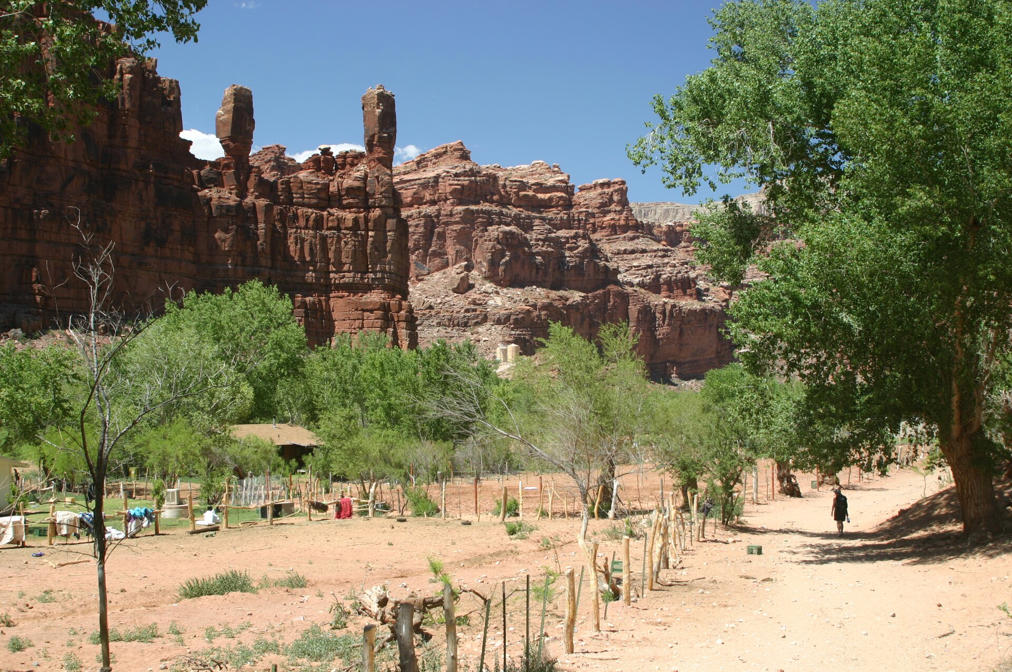
Supai sits at the bottom of Havasu Canyon, a tributary canyon of the Grand Canyon, in northwestern Arizona.
The village is approximately 3,000 feet below the canyon rim.
The only land access is via an 8-mile trail that descends approximately 2,000 feet from the trailhead at Hualapai Hilltop.
The trail is not paved, not maintained as a road, and not accessible to any motor vehicle. The residents and the limited tourism traffic descend on foot, on horseback, or on mules.
Supplies — food, mail, construction materials, everything — arrive by mule train or, increasingly, by helicopter. The village has no road connection to the outside world, making it the most genuinely isolated permanent community in the lower 48 states.
The Mule-Train Mail Delivery

Source: Wikipedia
Supai is the last place in the United States where the U.S. Postal Service delivers mail by mule train. The mail mules descend the 8-mile trail daily, carrying letters, packages, and supplies to the village post office.
The post office uses a special postmark commemorating the mule-train delivery.
The mule trains carry approximately 41,000 pounds of mail and supplies into the canyon weekly during peak periods. The mule-train mail delivery is both a practical necessity and a genuine piece of living American history — a delivery method that has disappeared everywhere else in the country but remains the only feasible option for Supai.
The Havasupai People

Source: Wikipedia
The Havasupai Tribe — federally recognized, with approximately 700 enrolled members of whom roughly 200-250 live in Supai village year-round — has occupied the Havasu Canyon area for at least 800 years, possibly far longer. The tribe’s name means “people of the blue-green water,” referring to the distinctive turquoise waterfalls that the canyon’s mineral-rich water produces.
The Havasupai traditionally farmed the canyon floor in summer and hunted the plateau in winter, until the U.S. government confined them to the canyon in the late 19th century. The tribe regained a substantial portion of its traditional plateau land in 1975 through an act of Congress — one of the largest restorations of land to a Native American tribe in the 20th century.
The Blue-Green Waterfalls

Source: Wikipedia
Supai’s isolation protects one of the most spectacular natural features in the American Southwest — the series of Havasu Falls and associated waterfalls below the village. The waterfalls produce their distinctive turquoise-blue color from high concentrations of calcium carbonate (travertine) in the spring-fed water. Havasu Falls, Mooney Falls, Beaver Falls, and the other cascades draw the limited tourism that supports the village economy. The falls are accessible only by continuing past the village on foot. The combination of the difficult access and the spectacular destination has made the Havasupai falls one of the most sought-after and difficult-to-reach travel destinations in the United States.
Why the Residents Stay

Source: Wikipedia
The Havasupai residents who remain in Supai do so for reasons that combine the practical, the cultural, and the spiritual. The canyon is the tribe’s ancestral home — the connection to the specific land spans centuries and is central to Havasupai identity. The isolation, which an outsider might experience as a hardship, is for many residents a protection — a buffer against the pressures and pace of the outside world.
The tribe maintains its own governance, school, and community institutions within the canyon. The tourism economy (limited and tightly controlled by the tribe) provides employment. The residents have explicitly chosen, across generations, to maintain their canyon community rather than relocate to the accessible world above. The choice to remain in the most isolated town in America is a deliberate cultural and personal decision rather than a circumstance of being trapped.
What Visitors Actually Experience

Source: Wikipedia
Visitors to Supai must obtain permits from the Havasupai Tribe in advance — the permits are limited, sell out rapidly (typically within hours of release each year), and are required for the overnight stays necessary to see the waterfalls. The journey requires the 8-mile hike (or horse/helicopter arrangement), and visitors must be prepared for the canyon environment — extreme summer heat, flash-flood risk, limited services, and the genuine remoteness.
The village itself offers a small lodge and a campground further down the canyon near the falls. The tribe tightly controls the visitor numbers to protect both the environment and the community. Visitors who make the journey consistently describe it as one of the most extraordinary travel experiences available in the United States — both for the spectacular waterfalls and for the genuine encounter with a community living in deliberate isolation.
The Flash Flood Risk

Source: Wikipedia
The Supai canyon faces a specific and serious natural hazard — flash flooding. The narrow canyon can channel sudden, violent floods during summer monsoon storms, even from rainfall miles away on the plateau. Major floods in 2008, 2010, and subsequent years have damaged the village, the trails, and the waterfalls (the 2008 flood substantially altered the configuration of several falls).
The flood risk is a constant element of canyon life and a serious consideration for visitors. The tribe and the National Weather Service monitor flood conditions, and the canyon has been evacuated by helicopter during major flood events. The flood risk is part of what makes life in Supai genuinely challenging.
The Modern Challenges

Source: Wikipedia
Life in the most remote town in America carries genuine modern challenges. Medical emergencies require helicopter evacuation. The school serves limited grades, requiring older students to leave the canyon for further education. Internet and cellular access is limited. The cost of supplies, all of which must be packed in by mule or flown in by helicopter, is substantially higher than in the accessible world.
The tribe faces the ongoing challenges of maintaining a community, an economy, and cultural continuity in extreme isolation. The residents navigate these challenges as the price of maintaining their ancestral canyon home. The choice to live in Supai is not a choice of convenience — it is a choice of identity, heritage, and connection to a specific extraordinary place that the residents have determined is worth the substantial difficulty of reaching and inhabiting.

 Great Miami Riverway·Sponsored
US Largest Paved Trail Network – The Great Miami Riverway – 99 Miles Of Paved Trails
The story of Supai is, ultimately, a story about what people will choose when they value place and heritage over convenience and connection. In a country defined by mobility, by the interstate highway, by the assumption that everywhere should be reachable by car, Supai stands as the deliberate exception — a community that has chosen, across centuries and generations, to remain in a place that no road will ever reach.
How Supai Compares to Other Remote American Communities

Source: Wikipedia
Supai’s isolation is extreme even by the standards of America’s most remote places. Several other communities approach it but none quite matches the specific “no road at all” status. Whittier, Alaska — population approximately 270 — is accessible only through a single one-lane tunnel that closes at night, and most residents live in one building, but it does have a road and a port. Monowi, Nebraska has a population of one. Several Alaskan bush communities are accessible only by plane or boat. Cass, West Virginia and other former company towns are remote but road-connected. What makes Supai unique is the combination of genuine year-round habitation by a substantial community (200-250 people), the complete absence of any road, and the continuous occupation of the site for over 800 years. It is not a ghost town, not a single-person curiosity, and not merely difficult to reach — it is a living community that has chosen permanent residence in a place that can only be reached on foot, by animal, or by air.
Planning a Respectful Visit
Travelers hoping to visit Supai and the Havasupai falls should understand that this is a living tribal community, not a national park, and the visit requires advance planning and respect. Permits are mandatory, limited, and released on a specific schedule each year (typically February 1), selling out within hours. There are no day-use permits — all visitors must commit to an overnight stay. The tribe controls all access, and the permit fees support the community.
Visitors should approach the journey as a guest in someone’s home rather than as a tourist at an attraction, follow all tribal rules, respect photography restrictions, support the Havasupai-owned businesses, and recognize that the privilege of visiting one of the most extraordinary places in America comes with the responsibility of treating the community and its land with genuine care.
Cancer Incidence in Supai, Arizona
Supai is a small, remote community in the Havasupai Nation, located deep within the Grand Canyon. It is accessible only by helicopter, mule, horse, or foot, and is served by the Supai Health Station, a federally funded facility providing primary and specialty care to about 1,000 tribal members Indian Health Service.
Cancer Rates in Arizona
Statewide, Arizona’s age-adjusted cancer incidence rate for all cancers (all stages) in 2023 was 392.4 cases per 100,000 people, compared to the U.S. average of 448.6 State Cancer Profiles. This means that, on average, about 392 people in every 100,000 Arizonans are diagnosed with cancer each year.
Supai’s Geographic Context
Supai is in La Paz County, which has one of the highest cancer rates in Arizona — 432.2 cases per 100,000 in 2023 State Cancer Profiles. This is above the state average, placing it in the top tier of counties for cancer incidence.
Factors Influencing Cancer Risk
Cancer risk in any area depends on a mix of factors:
- Lifestyle and environmental exposures (e.g., smoking, diet, air/water quality)
- Access to screening and early detection
- Socioeconomic and cultural factors affecting health outcomes
- Occupational exposures in nearby industries
In remote areas like Supai, limited access to advanced screening and specialized care can influence cancer detection rates, even if incidence rates are high.
Key Takeaway
Residents of Supai, like other La Paz County residents, face a higher-than-average cancer incidence risk compared to the rest of Arizona and the U.S. population. The new Supai Health Station is designed to improve access to preventive care, early detection, and treatment, which can help reduce the impact of these higher rates Indian Health Service.
If you are considering health planning for Supai residents, focusing on early screening programs, culturally appropriate health education, and improved access to care can help address both incidence and outcomes.
Cancer Rates in Supai, Arizona
Supai, AZ (zip 86435) is a small community in Coconino County with limited access to healthcare, which can affect cancer detection and treatment. While there is no direct, publicly available cancer incidence or mortality rate for Supai itself, we can understand the risk context by looking at broader regional data.
Regional cancer rates in Arizona
According to CDC data, Arizona’s overall cancer mortality rate is about 119–131.52 deaths per 100,000 population (age-adjusted) CDC. Within the state, some counties have notably higher rates. For example, Mohave County (which includes parts of the Navajo Nation and nearby rural areas) had the highest cancer rate per 100,000 in the 2016–2020 period at 755.6 Stacker. Other high-rate counties include Gila, Cochise, and La Paz, while Coconino County (where Supai is located) had a rate of 334.2 per 100,000 Stacker.
Supai’s healthcare access
BestPlaces notes that Supai Village has few local hospitals and medical facilities, making it difficult for residents to access specialized cancer care or timely treatment BestPlaces. This can contribute to higher cancer-related mortality if diagnoses are delayed or treatments are unavailable.
Why rates may be higher in some rural areas
Several factors can influence cancer rates in rural or remote communities:
- Limited access to screening and early detection
- Fewer specialists and treatment options
- Higher prevalence of risk factors such as smoking, obesity, or environmental exposures Stacker+1
- Potential environmental or occupational hazards in certain industries
Understanding and Improving Healthcare Systems for Indigenous Peoples
Bottom line
While Supai’s exact cancer rate is not published, it is in a county with a relatively high cancer rate compared to the state average, and the community’s limited healthcare access means residents may face challenges in early detection and treatment. If you are considering moving to or living in Supai, it’s important to weigh these factors with local healthcare resources and screening availability.
COMMUNITY PROFILE: The Havasupai Tribe “people of the blue green water” have lived in the Grand Canyon and north-central Arizona for more than 1,000 years. The Havasupai Reservation was established in 1880. Prior to the 1800s, the Tribe would move families up to plateaus in the fall and winter months, then back down into the canyon to plant drops during the spring and summer. The Havasupai dialect is the only Native American language that is spoken by more than 95 percent of its indigenous population.
The Havasupai Reservation is located at the end of Indian Route 18 off historic Route 66. The Reservation is 188,077 acres of canyon land at the western edge of the Grand Canyon’s South Rim. Residents live in Supai Village, 3,000 feet down Havasu Canyon. The village is only accessible by foot, horse, mule, or helicopter. According to the 2020 Decennial Census, there are 47 housing units and 214 people living on the Havasupai Reservation.
The Havasupai Tribe has four revenue-generating enterprises: Havasupai Tourism, Havasupai Lodge, Havasupai Cafe, and Havasupai Trading Post. The Havasupai Tourism Enterprise manages all tourist activities including guided and unguided tours, a campground near Havasu Falls, and saddle and pack horses to carry goods and visitors in and out of the canyon. The tiny village hidden inside the Grand Canyon
Health disparities such as lower life expectancy and a disproportionate burden of diseases persist for Native American populations throughout the U.S. A 2022 review of studies about environmental health outcomes in the Navajo Nation found high rates of diabetes, cardiovascular disease, obesity and metabolic syndrome – a group of diseases that increase the risk of heart disease, diabetes and stroke.
The Navajo Nation is one of the largest Native American reservations in the U.S. and delivers health services to over 244,000 people. The Navajo Nation currently has 12 primary care facilities run by the Indian Health Service (IHS), the federal agency that provides health services to American Indians and Alaska Natives. The Arizona Department of Health Services reports that the Navajo Nation is considered a “medically underserved area” by both state and federal regulators.
In November, the IHS, in partnership with the Havasupai Tribe, celebrated the opening of the Supai Health Station, a new and upgraded replacement facility located on the tribe’s lands at the bottom of the Grand Canyon. Accessible only by helicopter, mule or on foot, the new 12,700-square-foot facility replaces a 2,200-square-foot clinic constructed in 1972; the new facility provides space for primary care, dental, pharmacy and medication dispensing, lab, and radiology services.
The Dilkon Medical Center, a new facility run by the IHS and located in the Navajo Nation, opened in Dilkon on Aug. 4. The new facility offers 12 in-patient beds, as well as primary care, eye care, dental care, diagnostic imaging, laboratory, pharmacy, physical therapy, behavioral health and support services.
Sage Memorial Hospital is scheduled to open a new 90,000-square-foot, 25-bed hospital located in Ganado on May 30, 2024. The hospital and medical, dental and field clinics are operated by a private, nonprofit corporation, Navajo Health Foundation-Sage Memorial, and provide health care for about 23,000 people in the area.
The AZDHS report showed that the Navajo nation has 0.3 hospital beds per 1,000 residents, compared to a statewide average of 1.9 beds per 1,000 residents. But IHS doctors said calculating the number of hospital beds is not the best way to evaluate health care. Drs. Christopher ‘Topher’ Jentoft, clinical director, and Jessica Weeks, chief of primary care, see patients at the Chinle Comprehensive Health Care Facility, one of 12 IHS health care centers in the Navajo region.
“It’s hard to put it in terms of number of hospital beds per patient population, it’s a really significant oversimplification,” Jentoft said. “What leads someone to need to be in a hospital bed overnight is not just related to how many people that there are in the community, but what the resources in the community are, what the underlying health situation for the community or individuals in the community are, as well as resources for health care.”
Medical facilities throughout the country, particularly in rural areas, are experiencing doctor and nurse shortages. Jentoft said the Chinle facility has never filled its 60 inpatient beds, but it has had times when it has not had enough staff to attend to every patient. He said this sometimes forces the facility to transfer patients to other hospitals in Albuquerque, Phoenix, Flagstaff or Tucson.
“In the month of October, the Chinle facility had roughly 140 primary care appointments per day,” Jentoft said, “probably about 100 patients per day in the emergency department.”
Navajo Nation currently has 37 nurse practitioners, while Arizona has 9,932. To encourage people to work for Navajo facilities, IHS is providing recruitment incentives such as loan repayment programs and scholarship programs, “which encourage people of American Indian or Alaskan Native descent to pursue healthcare careers,” Weeks said.