Brave Like Gabe Rare cancer advocate. Relentless optimist. Pro runner.
We are all STRONG. But we don’t realize how STRONG we really are, until being STRONG is all we have left.
Gabriele “Gabe” Grunewald (née Anderson) 6/25/1986 – 6/11/2019 was a professional American middle-distance runner and lifelong Minnesotan, born and raised in Perham, MN (population 2,985). Gabriele ran professionally for Brooks beginning in 2010 until her passing in 2019.
She won a single track & field state title in the 800-meters competing for Perham High School. Gabriele walked-on to the University of Minnesota cross country and track & field teams in 2004, where she was a part of several Big Ten Championship squads and eventually became an NCAA track & field All-American with a runner-up finish in the 1500-meters in 2010, her final collegiate race.
Her career highlights include a 4th-place finish in the 2012 USA Olympic Trials and a USA Championship title in the indoor 3000-meters in 2014. Her personal best in the 1500-meters is 4:01.48, making her the 11th fastest performer in USA history. Gabriele survived multiple bouts with cancer—initially diagnosed with a rare salivary gland cancer, adenoid cystic carcinoma, in 2009, and thyroid cancer in 2010. Throughout her cancer journey, Gabriele continued to compete and run professionally.
Gabriele aimed to return to elite competition in 2018 and continued training despite ongoing treatments and setbacks. She strongly believed in finding out what was possible despite her diagnosis and encouraged other cancer survivors to keep their minds open to the possibility of achieving their dreams and other goals by being brave in their own way. After living for 10 years with adenoid cystic carcinoma, Gabriele passed away on June 11, 2019, at her home in Minneapolis surrounded by family and friends.
Her story and legacy continue with the Brave Like Gabe Foundation that inspires others to share their own struggles while also helping to find better, more effective treatments for rare cancers. Throughout each new diagnosis and treatment, I have made the choice to run and train when my body allows. It hasn’t always been easy, but it has always been the right decision for me. From the very first day I was told I had cancer in 2009,
I knew running would be a big part of my journey back to health. It has truly been my refuge; when everything else seems to be going wrong and the outcomes are far beyond my control, I can find perspective and hope on the run. I believe that continuing to pursue my goals on the track has helped me to carry on with purpose in my life in the face of an uncertain future.
The mental boost I get from my daily run has become so important to me and is something I wish I could share with every cancer survivor.
It has become more and more of a challenge over the past two years (since my recurrence) to maintain the consistency and intensity of training required to be one of the best runners in the world, but I’m not giving up on my dream of taking one more shot at the Olympics in 2020! Being brave, for me, means not giving up on the things that make me feel alive — Gabriele Grunewald.
“I’ve always loved running and I never want cancer to take that away from me,” Grunewald tells PEOPLE, “Having the opportunity to be a professional runner was something that I never expected.”
Her battle began when she was first diagnosed in 2009 with adenoid cystic carcinoma, a rare form of cancer. Surgery to remove the tumor from her salivary gland was successful, but two years later the cancer reappeared in her thyroid, which was also removed.
For five years she was healthy, living her life, traveling and competing. She finished fourth in the 1500 at the 2012 U.S. Olympic Track & Field Trails and won the 2014 USA Indoor 3,000-meter title.
It was in August 2016, that she discovered her cancer came back for the third time— but now in her liver. “That was a huge bummer, and it was tough,” says Grunewald, who married her college boyfriend in 2013. “I had a big surgery that removed half of my liver and the tumor.
I couldn’t run for like three or four months.”
But as soon as she could, she got back to training until her first scan in March showed that small tumors had returned. “I’m running, but not fast because I’m going through chemo,” she says, which she started on June 6. “The most important thing for me has just been trying to stay involved in the sport that I love even though it’s been hard to manage my health issues with running.”
She added: “It’s something that I felt like I really needed to do just to carry on and have something to look forward to.” When Gabe Grunewald crossed the finish line this past June in the US. Outdoor Championship. The 31-year-old middle distance runner was undergoing chemotherapy to treat adenoid cystic carcinoma. A rare cancer that had recurred for the fourth time. The National meet fell during an off week of treatment.
She and her fellow world-class runners walked single file, hair tied in ponytails, to the starting line of one of track’s premier events. The women were a lithe pack, and it was difficult to pick out Grunewald. Identified by the purple half-moon scar that stretches across her abdomen.
The runners toed the starting line, the crowd fell silent, a gun sounded, and they were off. Grunewald is not the world’s fastest 1,500-meter runner, although she is competitive and fierce down the stretch. Her emotion was greeted down the front stretch by the running community with enormous cheer as the other runners circled around her with well wishes.
That was on June 22, and on July 12 Grunewald announced via Instagram that her body did not respond to chemotherapy. She explained her next step would be Immunotherapy and would be working with one of the best doctors at Memorial Sloan Kettering Hospital in New York City. However, it wasn’t a devastating update being dealt a terrible hand once again.
She deals with her dilemma with optimism, unwavering strength and with an uplifting spirit. She still runs regularly often after spending hours at the hospital for her transfusion. Gabe reveals I am in a tough situation — but I want my story to be as positive as it can be. I am not in control of my cancer, but I am in control of my attitude and how I live my life.
That’s the message she wants to send — our circumstances don’t define us; we can live our lives even in the face of a life-disrupting event like a cancer diagnosis. Across her abdomen, Grunewald bears a scar, the aftermath of surgery she had in August 2016 to remove a tumor from her liver. But this 13-inch strike across her middle is also a symbol of what she has been through and how she intends to keep living her life with her passion for running.
To receive a serious cancer diagnosis is to feel an overpowering desire to retreat within and to try to block out the chirpings of your mind. Grunewald made the decision to crawl out.She talks about her disease in the way of a stream tumbling down a mountain.
She has a website and a Twitter feed, and she encourages supporters to contribute to research on this cancer. “I’m a young adult with cancer,” Grunewald said. “I don’t always love talking about it. It’s not a made-for-TV movie. It’s real. It’s scary.” She gives and she receives, and that helps. “I love when people reach out to me, because it helps me get out the door.”
Grunewald grew up in tiny Perham in Otter Tail County, a three-hour drive northwest of Minneapolis. She rode the bench in basketball. Running, even as temperatures dropped to 10 below and ice formed on her lips, was her freedom. “Small-town politics could make team sports a headache,” she said. “Running is all about you.” “I hope people see that you can still make something beautiful and powerful out of a bad situation.” — Gabriele Grunewald
Scholarly Resources. “There is substantial evidence that higher levels of physical activity are linked to lower risks of several cancers.” (1) “Too much rest can lead to loss of body function, muscle weakness, and reduced range of motion. So today, many cancer care teams are urging their patients to be as physically active as possible during cancer treatment. Many people are learning about the advantages of being physically active after treatment, too.” (4) “Research indicates that physical activity may have beneficial effects for several aspects of cancer survivorship–specifically, weight gain, quality of life, cancer recurrence or progression, and prognosis (likelihood of survival). Most of the evidence for the potential benefits of physical activity in cancer survivors comes from people diagnosed with breast, prostate, or colorectal cancer.” (2a, 2b)
WAYS EXERCISE CAN HELP Keep or improve your physical abilities (how well you can use your body to do things) Improve balance, lower risk of falls and broken bones Keep muscles from wasting due to inactivity Lower the risk of heart disease Lessen the risk of osteoporosis (weak bones that are more likely to break) Improve blood flow to your legs and lower the risk of blood clots Make you less dependent on others for help with normal activities of daily living Improve your self-esteem Lower the risk of being anxious and depressed Lessen nausea Improve your ability to keep social contacts Lessen symptoms of tiredness (fatigue) Help you control your weight Improve your quality of life
Pulitzer Prize winner Jeffrey Marx is the author of “Walking with Tigers: A Collection of LSU Sports Stories” and five other books. You can follow him on Twitter: @LSUTigersBook
This is the third in a three-part series. To read Part I, go here. For Part II, go here. _____
Tom Brady had funny remark about Joe Burrow’s career path (msn.com) Give him his early-morning time alone on the balcony outside his office — his time of solitary prayer and reflection — and then just give him non-stop people and action. Give him noise and bustle. “Commotion all the time,” Kelly Orgeron says.
“Like … he can’t handle coming into a quiet room.”
Joe Burrow is fine with a quiet room. He is happy to be alone. No need for constant interaction or a lot of external stimuli when he has down time. “He really likes to be by himself … or in a very quiet environment,” Robin Burrow says. “Even when he comes home, we might all be together, but we’re watching our favorite shows or a movie, or he’s playing video games.
“And I think that probably speaks to the fact that Joe grew up — even though he’s got Jamie (now 41) and Dan (38), the older boys — they were really not around in the house a lot as he was growing up. He was basically an only child with two brothers. It was mostly just me and Joe there. Jimmy was gone a lot, coaching or working, and recruiting and all that, so our house was always quiet, and I think that’s just kind of what Joe got used to.”
There are many other preferences and traits that set Coach O and Joe apart. Countless biographical details and personal tidbits also show us how different their journeys have been — how different they must be.
Coach O: hometown of little Larose, Louisiana, where the largest intersection has nothing to do with pavement or a stoplight. It is the intersection of Bayou Lafourche and the Gulf Intracoastal Waterway. Joe: The Plains, Ohio, 1,000-plus miles from Baton Rouge but it might as well be planets away. The Plains is in the rugged Appalachian region and listed on the National Register of Historic Places for its Native-American burial mounds.
Coach O: Growing up, he thought himself the luckiest kid in the world whenever his mom, Coco, made him a shrimp po-boy and French fries for breakfast. Joe: Early in his time at LSU, he was teased by teammates for choosing salad instead of piling his dinner plate with the rich offerings of regional fare.
Coach O: had a summer job shoveling shrimp in Grand Isle. Also had a temporary job digging ditches. Joe: did a New York summer internship with Goldman Sachs, one of the most prestigious financial firms in the world. Did not dig any ditches on Wall Street.
Coach O: known and loved for his distinct way of speaking that is equal parts rumbling machinery and Cajun creativity — all of it lubricated and energized by a combination of Red Bull and endless passion. Joe: not always able to decipher exactly what his head coach was saying. “The first year it was tough,” he recently said on The Rich Eisen Show.
As much as outsiders’ dwell on all the obvious differences, though, there is something else about Coach O and Joe that stands out to people who know them best. It is the remarkably long list of similarities. Both had been doubted and denied: Coach O fired at Ole Miss and passed over for the USC head job after a stellar stint as interim coach. Joe ignored by Nebraska — his dream school — and never able to win the starting job at Ohio State.
Both had been dogged by consistent questions about their so-called limitations: Was Coach O really just a defensive line coach without “the smarts” or proper personality to succeed in the CEO role of a head coach? Did Joe have the arm strength to make all the throws he needed to make
Both used their critics as motivation.
Both kept pounding away.
Both finally made it to the top of college football.
And they had done it the same way. With relentless work and perseverance. With intensity and grit. With sturdy belief in themselves. With a natural love of competition. With toughness and single-minded focus. Derek Ponamsky spent as much time as anyone with Coach O and Joe — and he is still amused by the way people looking from afar automatically thought of them as being so different.
As if they were Felix and Oscar — complete opposites — from the old movie and TV show The Odd Couple. “No, they’re pretty much the same guy,” Ponamsky says. “I think if you cut them open, it’s the same exact DNA. They just look different. They just sound different. They’re just from different places. I mean, I’m telling you, they’re the same guy.”
How would he describe that guy?
The most straightforward, no-nonsense, passionate and compassionate person you could find. Always displays the mentality of a defensive player … just wants to go out and attack. And no BS. If he tells you something is going to happen, it happens. Always.
After following Coach O and Joe throughout the season, Marty Smith, ESPN reporter and storyteller extraordinaire, also saw the power of their similarities and the blending of two men into a singular being: “this two-headed monster of very like-minded philosophical approaches.”
Visiting with Jordy Culotta and T-Bob Hebert on their Baton Rouge radio show, Off the Bench, Smith described those shared approaches by temporarily speaking in the role of that Coach O-Joe combination monster: “We’re blue-collar. We’re tough as hell. We approach life like a linebacker – with snot bubbles and blood. And we’re gonna go do this our way. And it couldn’t be more Louisiana, y’all.” _____
Two primary factors allowed for the monster to be created and then held it together: mutual trust and mutual respect. And the bond was unbreakable. Over time — with Joe’s role as team leader constantly gaining strength — his interactions with Coach O extended well beyond the norm for any player and coach. “The more Joe showed me he could do, the more I gave him the team,” Coach O says. “He was kind of like a player-coach for me.
“I believed in Joe. And I knew that he’d tell me the truth. He never told me what I wanted to hear. He told me what I needed to hear.” Joe agrees — saying he never sugarcoated anything for Coach O: “If I thought we had a bad practice, I was going to tell him. If you don’t trust your head coach enough to say that — to tell him anything — then you’re not going to be a great team.
I don’t think you can be a great team if you don’t have the trust in each other to be honest and direct.” Joe had the confidence to tell Coach O whatever he wanted or needed to say. Coach O had the trust to then act on what he was hearing. Never before, not throughout his entire career, had Coach O sought out and relied upon input from any player as regularly as he did with Joe.
Sometimes it was Coach O walking over from working with the defense to check in with Joe about how practice was going for the offense. You guys getting what we want out of this period? Is what we’re doing here going to work against that coverage?
Is it too windy out — should we go inside to finish?
“Coach O spent most of his time with the defense and was very rarely ever with us,” tight end Thaddeus Moss says. “But when he would come over to the offense, first guy he’d come up to was Joe.” Coach O might ask about anything. “And Joe would just tell him straight up … almost like a coach-to-coach conversation.
It most definitely didn’t seem like coach to player.”
Sometimes it was more than just on-the-field practice stuff — such as Coach O seeking Joe’s input with the specific game plan against that week’s opponent. “He put a lot of trust in me,” Joe says. “And that’s something that I really appreciated … that I was very involved in the game planning and that he trusted me enough to hear my insights.”
Coach O also went to Joe about off-the-field matters large and small: What was the overall pulse of the team? Was there anything he needed to know about? What did Joe and the guys want for dinner? What did he think of bowling and a movie as team activities for the two nights leading up to the national championship game in New Orleans.
“I would describe them as father-son … as close as it’s going to get,” Clyde Edwards-Helaire says. “And then when it came to business, it was man-to-man … always 100 percent truthful, 100 percent heartfelt with everything they did and interacted about.”
One of the most dramatic and impactful examples of Joe’s input came in the days leading up to the 2019 Peach Bowl, which was LSU’s semifinal game of the College Football Playoffs. Edwards-Helaire, one of the most important offensive players for the top-ranked Tigers, had a hamstring injury. Who would replace the star running back against No. 4 Oklahoma?
LSU had two heavily recruited freshmen, Tyrion Davis-Price and John Emery, waiting in the wings. Conventional wisdom pointed to one of them. Joe did not. He wanted redshirt freshman Chris Curry — and privately spoke up for him. Curry had barely played in two seasons. He was fourth string. But Joe felt he had earned the opportunity in practice.
“Chris was a scout-team guy all year, and he never stopped fighting,” Joe says. “He didn’t get discouraged. All he did was work really, really hard. I wanted to reward that. And I’m glad that the coaches felt the same way.” Joe’s explanation makes him sound as if he were one of the coaches. Was he even aware how unusual it was for a college player to be so involved in a decision like that?
“It didn’t feel like it was weird,” Joe says. “I had been involved in decision-making for most of the year. It started out with decisions about the game plan … and then kind of evolved into them asking me what I thought about stuff like that.”
Curry got the start. And the selection worked out well. He displayed an impressive combination of flash and physicality — rushing for 90 yards on 16 carries.
LSU dominated from start to finish and left Atlanta with a 63-28 blowout win.
The LSU Tigers were headed to the national championship game. _____
Joe and Coach O talked about things other than football every now and then. But not too often. And never for long. “He was all football, I’m all football,” Coach O says. “That was the best thing about it.” That does not mean their interactions were always serious.
In his earliest days at LSU, one hot summer afternoon before the start of his first camp with the Tigers, sun blazing in full force, Joe got a feel for what he could expect. He was working on his own at the football facility, throwing into a net, and Coach O happened to walk by.
“Hey, Joe,” he said. “What do you think of Ray Baker?”
Joe did not know a lot of guys on the team yet — not even their names. But he didn’t want to sound clueless … didn’t want to be a guy who wouldn’t know a teammate. So, he just went with it.
“Yeah, he’s good,” Joe said. “He’s really good.”
Coach O gave him a look of bewilderment and walked away.
Joe turned to the only other person there with him, Foster Moreau, and sought help: “Who’s Ray Baker?”
Moreau laughed: “The sun. That’s what he calls the sun.”
He explained: Ray as in rays of sun. Baker as in it will take you out here.
Joe thought that was funny. It also was a sign of things to come. He and Coach O would always get a good chuckle out of their light moments. They could come at any time. But Joe and Coach O practically had a weekly appointment. Late in Thursday practices, there was always a period of about ten minutes devoted to special teams.
Joe would be standing off to one side of the field — nothing he had to do during this period. And Coach O would walk over to him. “It was almost like clockwork,” says Jorge Munoz, now the passing game coordinator at Baylor. “It would just be Joe and Coach O off to the side … and they would just talk and visit.
But I think that was their bonding time a little bit.”
Coach O says it was intentional. He might use part of the time to check in about something related to the team. Mostly, though, he wanted to be silly and light, tossing out a ridiculous comment or two just to keep things loose.
“Hey, Joe, you know I used to be a tight end in high school?”
“You want to see some film of the 1977 state championship game?”
And then the banter would go from there — the star quarterback and the big old defensive-lineman-turned-head-ball-coach yukking it up for a few minutes.
Joe always loved it.
“That’s kind of just who we were as a team,” he says. “You know, we were very serious about what we did. But we didn’t take ourselves too seriously. And I think that was the beauty of what we did as a team. We just had a lot of fun together.” Joe even had a favorite line Coach O used multiple times during their little Thursday get-togethers.
“Hey, Joe, are you guys putting in that forward pass today?” As if the “old” coach who played in the 1970s had come up back in the days of leather helmets and offenses that did nothing but run the ball. It made no difference that the silly line was on repeat. Joe laughed every time — still does as he recalls it: “Because I think it just shows how old-school Coach O is.” _____
Dan Burrow had purchased a T-shirt with Coach O’s image on it. He’d bought one for his brother Jamie, too. They enjoyed wearing them and anything else that announced the depth of their devotion to their favorite coach and his team. They enjoyed everything about being part of the purple-and-gold universe that is LSU football.
Robin Burrow had a favorite spot before home games. Standing in a crowded area just outside the door to the LSU locker room, she would watch the players and coaches finish their walk down Victory Hill. It was there that she would see Joe for one final wish of good luck before he went inside. It was also there that Kelly Orgeron always made a point of seeking her out for a hug and a few words before entering the stadium.
For the Burrow family, there had been one missing piece during Joe’s first season in Baton Rouge. Jimmy was still coaching at Ohio University. With Joe entering his final year of college ball and the hope of so much excitement ahead, that was no longer going to work. Jimmy did not want to miss any of his son’s games.
So after 38 straight years of coaching, he retired at 65 and became a fixture wherever the Tigers were playing — home or away. The Burrows had a regular tailgating spot outside Tiger Stadium. Jimmy was interviewed so often as the season progressed — even had his own weekly segment on ESPN radio in Baton Rouge — that he might as well have been issued a media credential.
What a year it became for the whole family.
Joe kept taking the impossible and transforming it into routine activity — breaking records every step of the way.
The Tigers kept rolling over opponents.
And the magical moments kept piling up.
For the Burrows, one of the most memorable happened the afternoon of Saturday, Nov. 9, on the field of Bryant-Denny Stadium in Tuscaloosa, Alabama. It would have been enough that LSU snapped Alabama’s 31-game home winning streak with a 46-41 takedown of Nick Saban and the Crimson Tide. The victory made it nine straight wins for the Tigers and solidified their status as the top-ranked team in the nation. But there was more.
It happened while LSU was celebrating after the game. Coach O and Joe were standing next to each other — front and center — during the traditional singing of the alma mater.
“Joe, your mom and dad are in the stadium?” Coach O asked.
Joe smiled as he nodded in affirmation.
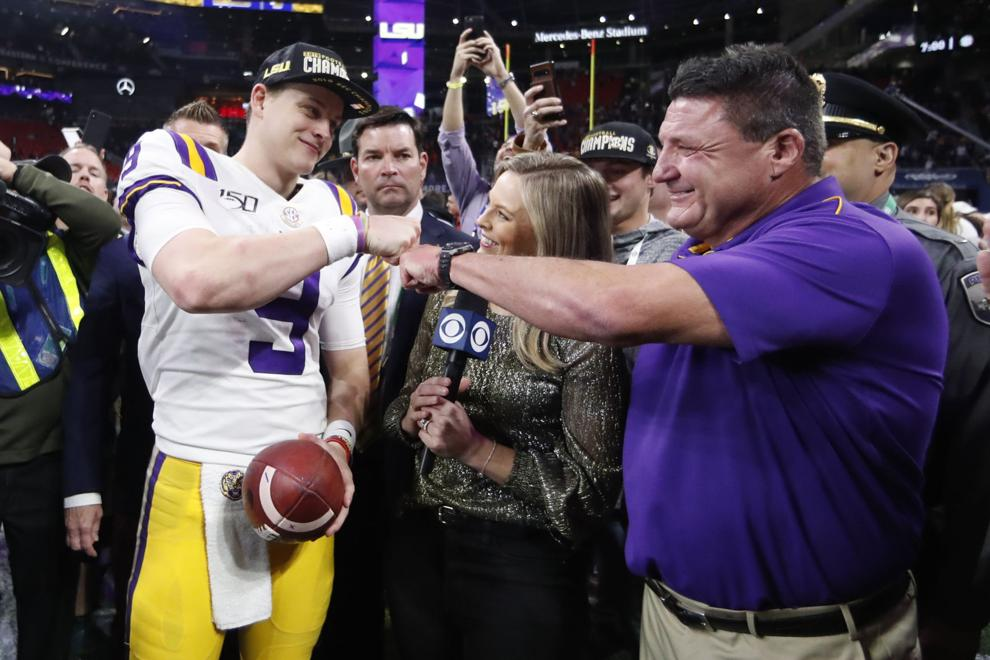
Coach O cackled, lifting his right hand for a fist bump, and they knocked knuckles.
“How about Dan?” Coach O said.
“Dan just got engaged,” Joe gushed.
“He did? Really?”
“He got engaged yesterday.”
The exchange was extraordinary not only in its time and place: the head coach asking about his quarterback’s family right after the most significant LSU victory in years … smack in the middle of such an emotional celebration.
It was also remarkable for its substance within the ever-expanding football fairytale that never stopped getting better — the fact that an Ohio kid choosing to play ball in Louisiana would also somehow lead his brother to find the love of his life.
In September 2018, Dan was in Alabama for the LSU-Auburn game and — through friends — met an Auburn alumna named Jama Cash. They first saw each other in a parking lot outside Jordan-Hare Stadium. Dan and Jama hit it off. Their long-distance relationship kept growing. And two days earlier, back in Alabama, visiting Jama before attending the LSU-Alabama game, Dan had popped the big question.
So, what if Joe was off by a day in his postgame announcement of the engagement? He had been focused on other things. Bottom line: The Burrow brothers were leaving Alabama with mighty big victories both on and off the field.
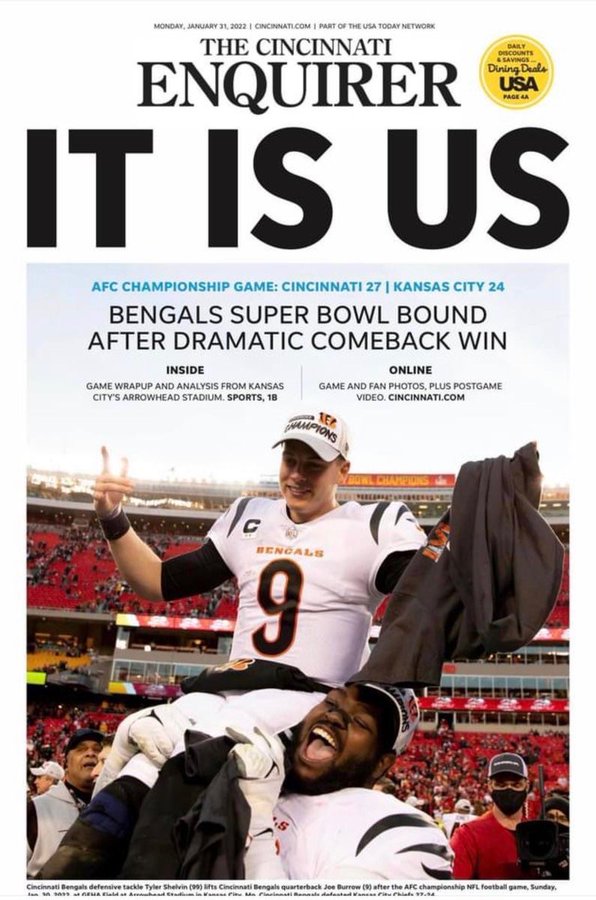
With the alma mater finishing — forever L-S-U — Coach O and Joe formed representative Ls with the fingers of their right hands and raised their celebratory digits for all to see. Defensive lineman Tyler Shelvin then lifted Joe onto his right shoulder — a mountainous man ready to transport a triumphant king — and off went the Tigers. _____
As the backup quarterback, redshirt sophomore Myles Brennan always had to stay ready in case anything happened to Joe. He had another priority, too. He wanted to support Joe and make sure everyone knew that he was fully behind him. Although Brennan had hoped to be the starter by this point in his career — and was understandably not thrilled when LSU added Joe to the team — they were now friends and hotel roommates the nights before games. Plus, Brennan was a team guy before anything else.
With that in mind, whenever Joe threw a touchdown pass, scored himself, or otherwise led LSU to points, Brennan routinely tried to be first to greet him coming off the field. There was one exception. If Coach O was headed toward Joe, Brennan waited his turn.
He was not about to step in front of the head coach. But being so close at such moments put Brennan in the perfect position to see something he otherwise would have missed. It was the way Coach O and Joe looked at each other.
Sometimes they would hug. Other times they would share a fist bump or chest bump. Whatever they did, it was the way they looked each other in the eyes that stood out to Brennan as the perfect illustration of their relationship. No words were needed. The look alone always reminded Brennan of the special bond between his coach and teammate.
What exactly did he see between them at those moments?
“Just … I don’t even know,” Brennan says. “I don’t know the words to describe it.”
He pauses. Then he tries again: “I mean, I want to say love.
And I feel like that is the word.”
Joe embraces the word choice: “I just saw the eyes of a competitor who knew what we we’re trying to do and knew that I was going to get the job done. And I think that has a lot to do with love. Because Coach O had a lot of trust in me — and I had a lot of trust in him.”
Love.
“Like a father-son,” Coach O says. “Like a family would love each other.”
Coach O also offers his own interpretation of what he saw in Joe’s eyes. It starts with something that happens every Thursday of the season.
In the team meeting, Coach O put a color photo of an eagle on the big screen behind him. It was a close-up head shot dominated by the white of feathers and a menacing yellow-gold beak. More than anything, though, the photo was all about the eyes. They were intense.
The oval pupils were large and black and unmistakably locked in on something. A message had been placed at the bottom of the photo. In large, gold letters: FOCUS. And below that: If you chase two rabbits, you catch none. Coach O pointed to that eagle and told his players those were the eyes he wanted to see from them during games.
“It’s total focus,” he says now. “Myles might call that love. I call it total focus. We’re in war. There’s not a lot of things to say. It’s just that frickin’ look, man. And Joe and I have had that same look. It’s a competitive look. It’s serious.”
Call it what you want — love or focus. When Coach O and Joe connected eye-to-eye like that, it was indeed serious business: two men — together as one — stalking a lone and ill-fated rabbit. _____
They did not miss a single rabbit.
Fifteen rabbits chased. Fifteen rabbits caught.
In college football, that makes you national champions with a perfect 15-0 record. In Louisiana, that makes you royalty: a quarterback and a coach who will be celebrated for the rest of your days … and then for many more once your own days are done.
Joe started the season as a 200-to-1 long shot to win the Heisman. After leading the most prolific offense in the history of major college football — 48.4 points per game — he ended the year as the most decorated player in LSU history. His 60 touchdown passes set the NCAA record for most in a season. He broke nearly every LSU single-season passing record and numerous SEC marks as well.
Coach O collected national “Coach of the Year” awards from The Associated Press and other organizations. Clearly, they were impressed that nearly half of LSU’s wins — seven of them — came against teams that were ranked in the top 10.
After one of those games, the 37-10 shellacking of No. 4 Georgia for the SEC championship, Joe and Coach O played hot potato with the game ball.
Coach O handed it to Joe — wanting him to keep it as a souvenir. Joe gave it right back — wanting Coach O to have it. Safety JaCoby Stevens saw that as symbolic of their relationship: “Joe looks at Coach O as a role model. He looks at him as a leader. And Coach O looks at Joe as a son.”
Stevens also saw that moment as a clear definition of his coach and quarterback as individuals: “For Coach O, it’s never about him. It’s about us. It’s about his players.
And for Joe to hand the ball back to Coach O — it’s not about Joe. He’s not doing it for himself. He’s doing it for Coach O. He’s doing it for all of us. So those are two selfless men. Everything they do, everything they’re doing it for, it’s bigger than them.”
For Coach O, such an approach goes back to his childhood days down the bayou.
For Joe, it goes back to life with a caring family in a humble pocket of Ohio.
For both of them — as a pair — it goes back to one weekend they will long remember … and especially to a single conversation one night in a restaurant parking lot.
Multiple times during their amazing run last season — once while in New York for the Heisman presentation, once in New Orleans after beating Clemson for the national championship, and there were other times — Coach O privately shared a celebratory thought with Joe: “Thank God we went to Mike Anderson’s and had those crawfish.”
The exact words of Joe’s response varied each time he heard that.
But his core sentiment never changed: “Damn straight! I’m glad we did it.” _____
Joe Burrows Incredible Heisman Acceptance Speech (EMOTIONAL) – YouTube Joe is bigger than ever in the LSU football ops building. That’s what happens when your All-American quarterback wins the Heisman, leads your team to the national championship, and is now projected to be the first player picked in the upcoming NFL draft. He blows up — figuratively anyway.
At the moment, though, Joe is literally as big as he’s ever been in this building, too. Just turn toward the mammoth TV screen — 220 diagonal inches overlooking the lobby. There he is. Joe is still giving his Heisman speech. He is again gathering himself after finally getting out those opening words — “You have no idea what you mean to my family” — directed to Coach O.
ESPN now has them in split screen. Coach O nods toward his quarterback.
Jimmy Burrow, left arm draped over Coach O’s back, gently grips his shoulder.
Robin Burrow reaches across her husband and momentarily takes Coach O’s right hand for a squeeze.
Joe, meanwhile, sniffs, wipes his eyes, takes in a big breath, audibly exhales, and sniffs again.
“You know, I didn’t play for three years,” he says.
Sniff. Quick wipe of the nose with the back of a finger.
“You took a chance on me …”
Voice breaking: “… not knowing if I could play or not.”
Pause. Sniff. Exhale.
Joe’s eyes are a mess: puffy swamps now spilling over.
“And I’m forever in your …”
Deep breath. Big exhale. Sniff.
“… forever grateful for you.”
Coach O tightens his right hand into a fist and lifts it toward Joe. He shakes it in gratitude and support … in togetherness … in shared emotion. It is as close as he can get to knocking knuckles without being able to reach.
Coach O is now himself that eagle from those Thursday meetings in the team room. Focused. His eyes are locked on Joe. They are moist. They are full. But he somehow manages to hold on without actually shedding a tear. He’ll later share what he was thinking: “Better not start crying on national TV.” And how he kept from breaking: “Just gritted it out a little bit.”
Joe unleashes another big exhale.
Then: “Can you imagine a guy like Coach O …”
Sniff. Eye wipe.
“… giving me the keys to … to his football program.”
Sniff. Eye wipe. Sniff.
“He just means so much to me and my family …”
Sniff. Nose wipe.
“… and to LSU. I sure hope they give him a lifetime contract. He deserves it.”
And with that the mood is instantly lightened — the silent theater filled with laughter and applause. Joe laughs. His parents laugh. Ed and Kelly Orgeron laugh.
Robin Burrow claps three times. Then she turns to Kelly. Reaching across Jimmy and Coach O, Robin extends her left arm and takes hold of Kelly’s right hand. Robin uses her own right hand to give Kelly’s two light taps. She leans in and kisses the back of Kelly’s hand. She gives it two more taps. Then Robin and Kelly look into each other’s eyes — two mothers of boys, two wives of coaches, two proud women sharing a moment they will always own. _____
The LSU sports world already had its most important pieces of action footage. In football, it was the black-and-white majesty of Billy Cannon’s legendary Halloween Run in 1959 — the 89-yard punt return giving the top-ranked Tigers a 7-3 victory over No. 3 Ole Miss and propelling Cannon to become the first LSU Heisman winner. In baseball, it was Warren Morris hitting the most dramatic home run in school history: his two-out, walk-off shot — bottom of the ninth inning and trailing Miami 8-7 — to win the 1996 College World Series.
Now LSU also had its most unforgettable piece of off-the-field footage — Joe Burrow live from New York — a speech for the ages. It was not only the love we saw between Joe and Coach O that elevated the speech to instant classic. It was also the way Joe revealed parts of himself we had never seen. It was the way he opened up and let his emotions pour out. As Joe would later say: “That’s the most I’ve cried in 23 years of living.”
He began by thanking his offensive linemen. Who does that? Who wins a Heisman and starts by naming each guy on the O-line? Joe also brought up a non-football topic that nobody saw coming: the overwhelming problem of poverty in his home region of Southeast Ohio and the attendant issue of childhood hunger.
His closing words on the subject were spoken with great feeling and sincerity: “I’m up here for all those … all those kids in Athens and in Athens County that go home to not a lot of food on the table — hungry after school. And you guys can be up here, too.”
It was a lesson for all of us. As things turned out, Joe’s message would also evolve into a lesson for himself. Thanks to his speech — watched by close to three million ESPN viewers and pieces of it bouncing all over the internet — people began donating to the Athens County Food Pantry. More than $500,000 was donated in two weeks.
What a beautiful way for Joe to learn about the power of his new platform — so quickly realizing how strong it was and how easily he could use it to help others.
He was both awed and inspired by that.
Others felt the same way about the overall substance and feel of his speech — about the depth and emotion of it all. Tom Rinaldi of ESPN had it just right on the broadcast: “The pauses spoke as loudly as anything else.”
Congratulating Joe on stage, shaking his hand and hugging him, 1981 Heisman winner Marcus Allen told him, “Your speech was better than your season.”
If the immediate outpouring on social media could have been reduced to one collective statement, it might have been this: I’m not crying. You’re crying.
The Orgerons could hardly believe what they had just seen out of Joe.
“We were completely blown away,” Kelly says. “We just didn’t expect that.
We had never seen Joe show any emotions like that.”
“Not one time,” Coach O concurs.
Gov. John Bel Edwards, a devoted fan of LSU football and friend of the Orgerons, had been sitting next to Kelly in the front row. He thought back to something Coach O told him before the season — that the 2019 Tigers were going to be “scary good … really good” and would even have a chance to play for the national championship. As Edwards remembers the conversation: “He had a lot of confidence in the entire program, but especially in Joe Burrow.”
Sitting in New York only months later — watching Joe accept the Heisman and seeing how much Coach O and the entire state of Louisiana meant to him — felt “sort of surreal” for the governor. He was glued to Joe’s speech.
“It was tremendously emotional in the room,” Edwards says. “I remember wondering how it was coming across on TV. If somebody was sitting in their living room watching it, I was wondering whether it was coming across the same way. And obviously it did. I think Joe connected with people all across the country … just by being so sincere and genuine and authentic.”
Bunnie Cannon, Billy’s youngest daughter, 50 and an employee of the Tiger Athletic Foundation, had also been in the front row. Seated across the aisle from the Orgerons and Joe’s parents, she could see pretty much everything when Joe was speaking. She saw Coach O’s cheek quivering … saw the rims of his eyes getting red. She took in every word, every movement, and every emotion as Joe spoke to Coach O — and she felt the bond. She saw the love.
Bunnie also thought about her father. Oh, how she wished he could have been there to see that LSU finally had another Heisman winner. She knew how happy that would have made her dad. She also knew he would have been instantly drawn to Joe — would have savored that speech as if a proud grandfather. “I was a basket case,” Bunnie says. “I was doing the ugly cry … total ugly cry … tissues in my hand.”
Chris Fowler, longtime host of the Heisman Trophy ceremony for ESPN, never anticipated any emotion at all. He had great respect for Joe — for the way he played and for how he handled himself. But Fowler had also seen him as being “almost robotic … sort of insulating himself from the emotions” in the days leading up to the ceremony. When ESPN was timing out its broadcast, Fowler told his producers not to worry about Joe going too long as a speaker: “I didn’t think he would be expansive.”
Fowler was wrong. And he came to see that as a good thing.
Standing just off stage, the veteran broadcaster watched with amazement as Joe delivered one of the most powerful speeches he had ever seen — so packed with feelings and the expression of feelings that Fowler could hardly believe it. He now puts it this way: “Twenty-six years of doing this, of being ringside, having the honor of presenting the guy who wins the Heisman and then interviewing him right afterward, that one stands out.”
Once the speech was done and the ESPN show was over, Fowler noticed that Joe had left his folded sheet of paper — his notes — on the podium.
So, what if Joe had hardly even looked at his bullet points? Fowler thought Joe should have the piece of paper as a keepsake.
So, he tracked him down.
Handing Joe, the paper, Fowler said: “You might want this back … pretty cool souvenir.” Joe thanked him and put the paper in a pocket of his suit jacket. Fowler shared a final thought: “That speech you gave was a gift to everybody.”
Some gifts are better than anything that can be bought in a store or wrapped in a box. For a special group of four beaming recipients — Ed and Kelly Orgeron, Jimmy and Robin Burrow — the gift would forever represent a shared journey and their endless gratitude for every step along the way. It was the gift of seeing Joe — their Joe, the young man, not just Burreaux the football star — breaking out of his comfort zone and leaving an indelible mark of passion and purpose … shining for all the world to see.
“Just made my heart want to burst,” Kelly says.
She thought back to the Joe Burrow who first showed up in Baton Rouge: “very, very guarded … walls up … not someone you would sit down with to just chit-chat and have conversation.”
She thought about the way Joe had gradually opened up during his time at LSU: “letting his guard down — somewhat — and also falling in love with the people of Louisiana.” And now: “those raw emotions … completely showing all of his raw emotions up on the stage like that.”
There was one additional gift Kelly felt throughout that night. It was the way Joe’s parents so naturally embraced the Orgerons and pulled them in as complete partners in all the glory and celebration. Jimmy Burrow with his arm around Coach O when Joe was speaking.
Robin Burrow repeatedly reaching out — literally reaching out with her hands — to Coach O and Kelly. The Burrow parents shared whispered comments with the Orgerons — their words punctuated by the warmth of loving looks.
“They didn’t have to do those things,” Kelly says. “I mean, they are the parents, and they are the ones that should be getting all the attention.” But the Burrows did what came naturally. And that allowed Kelly to feel something she would always cherish.
Yes, she was there as the wife of a coach. But she also felt like an additional parent — as if the Burrows and Orgerons were actually four parents sitting together to witness the public crowning of one son.
When Robin found out Kelly had framed it that way — four parents together — she responded with a grateful wow and then a stretched-out awwww.
“I mean, goodness, none of us would have been sitting there without Coach O, and Coach O includes Kelly,” Robin says. “I just can’t even say enough how much we appreciate the opportunities that Coach O has given to Joe, and the support, and the communication between them and our family. It’s just been wonderful.”
To adopt and adapt from Coach O: Two families. One heartbeat.
Coach O says he and Joe ended up joined at the hip. Joined in a two-year football journey that gave new life to both of them. Joined in a storybook ending that took them to the highest of heights. Joined in a stunning chapter of LSU sports history that will be told and retold for years to come.
Jimmy Burrow has a thought about the perfect way to publicly and permanently commemorate the relationship: “If Joe ever has a statue, there better be one of Coach O right by him, right?”
The idea is mentioned to Joe.
“Absolutely,” he says. “You know, I meant what I said in my Heisman speech.
Give him a lifetime contract. He’s done more for LSU than I think anybody ever has.”
So, lifetime contract first … “joined-at-the-hip” statue after that?
There is no pause now. No wipe of the eye. No sniff.
Heisman Joe just answers without a beat: “Absolutely.”
Matthew Stafford spent 12 years trying to get to a Super Bowl in Detroit and falling short.
Matthew and Kelly Stafford have been together for over a decade.
In his first season with the Los Angeles Rams, he did it.
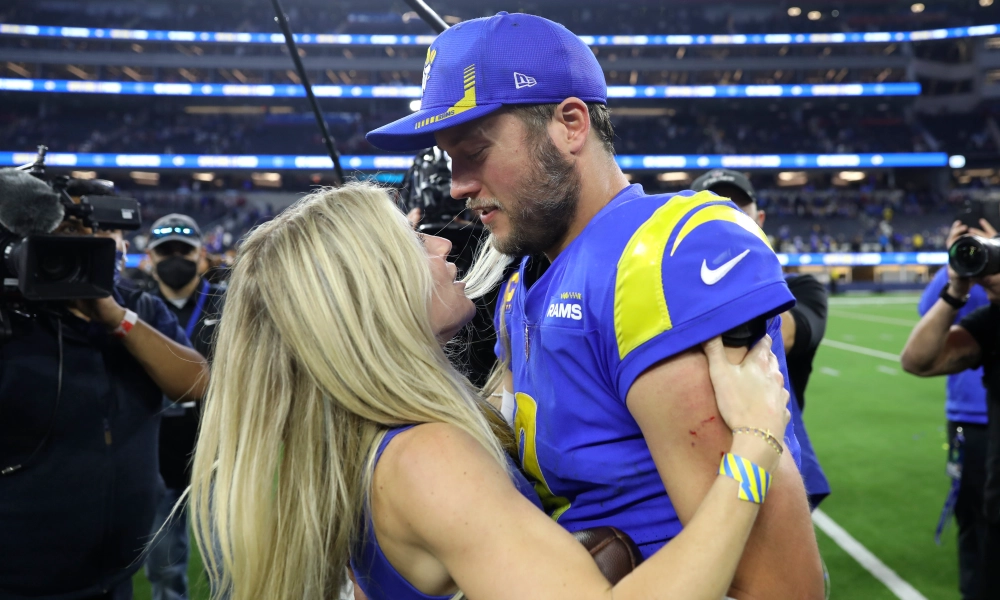
And Kelly Stafford, who has been with him while they were at Georgia, got to celebrate with him on the field after the QB took down the San Francisco 49ers on Sunday in the NFC title game to clinch a spot in Super Bowl 56, which will be played at home in Los Angeles. The Rams quarterback doesn’t share too much about his private life, but his wife Kelly certainly does. With her large social media following, Kelly posts photos of their family pretty regularly. She also makes occasional headlines for some of her passionate outbreaks at games.
Here’s what you need to know about Matthew Stafford’s wife, Kelly.
Who is Matthew Stafford’s wife? Kelly Stafford has become quite the celebrity herself despite just being married to tenured NFL quarterback Matthew. As of January, Stafford has 300,000 followers on Instagram. She posts various photos of her personal life, including family outings or updates of their children. She also posts a lot about the Los Angeles Rams or her husband’s former team, the Detroit Lions.
How long have Matthew and Kelly Stafford been together? The Stafford’s met while both students at the University of Georgia. Matthew was the Bulldogs’ starting quarterback from 2006-2008 until he was drafted by the Detroit Lions in 2009. Kelly was a year younger than Matthew. She was a football cheerleader during the time Matthew was quarterback.
How many kids do Matthew and Kelly Stafford have? The couple has four daughters together: twins Sawyer and Chandler, Hunter and Tyler. Sawyer and Chandler were born in April 2016, making them five years old. Hunter was born in August 2018, making her three years old. Then, Tyler was born in July 2020, making her about a year and half.
At the time, she detailed in an Instagram post where her health troubles began. “Within the last year, I began to notice things that I thought were just me getting older. I would show my girls how to do a front roll or twirl in ballet class and immediately feel dizzy & off balance… Things that I had been doing my entire life were now, all of a sudden, difficult,” Kelly explained.
After enduring several bouts of vertigo, Kelly was advised by Stafford’s team doctor to get an MRI of her brain. “A few days later we were hit with the results. I had a tumor sitting on some of my cranial nerves,” she continued.
“All I heard was brain tumor & that they had to do surgery to take it out. so that is what we are going to do & we believe we found the best doctor to do it.” Following the procedure, Kelly penned a touching message to Dr. B. Gregory Thompson, who performed the operation.
After undergoing surgery for a brain tumor in 2019, Instagram/Kelly Stafford
Kelly Stafford posted an Instagram message to her doctor, who performed the operation. “This is him; the man God chose to remove my brain tumor. After my diagnosis, Matthew and I visited doctors all over the US. He made it a super easy decision after we met Dr. Thompson @ the U of M hospital,” she wrote on Instagram in May 2019. “When I spoke w/ him, he reminded me of my dad. He truly cared & was empathetic, which meant so much to me.” In October 2019, Kelly chronicled her experience in an essay for ESPN, praising Stafford for everything he had done for her throughout the harrowing ordeal.
“Matthew was incredible during the whole process. He was literally by my side at every step. I had exercises I needed to do — some of them were seemingly simple, like shaking my head left and right — and Matthew helped me through all of it,” she recalled.
Kelly was very open about her experience with the tumor. She even wrote a detailed account of her experience that was published on ESPN. She also posted updates throughout her experience on Instagram.
Stafford was traded to the Rams in early 2021 after 12 seasons with the Lions. Instagram/Kelly Stafford
New beginnings: The early days of 2021 brought about new changes for the Stafford’s, whose NFL home became Los Angeles after 12 seasons in Detroit. Following the news of Stafford’s trade to the Rams, Kelly thanked the Lions fanbase, as well as the city of Detroit, in a heartfelt Instagram message.
“This place, our home, the people… it’s hard to find the words to explain what this place means to me. Random tears come very often when I think about not being here. This place supported me during the toughest time of my life and during the happiest times and I want to thank y’all in the right way,” she shared.
Does Kelly Stafford have a podcast? In September 2021, Kelly began a podcast called: The morning after with Kelly Stafford. So far, Kelly has completed 19 podcast episodes that are released weekly. She covers topics in her personal life, including sharing details about her relationship with husband Matthew, along with mothering experiences. She even detailed the “pretzel gate” incident that happened back in November. Needless to say, Kelly does not hold back talking about anything on her podcast.
Tony Bennett, 95, leaves his heart onstage in a moving final concert with Lady Gaga By Catherine E. Shoichet, CNN
Tony Bennett and Lady Gaga perform ‘One Last Time’ Tony Bennett won over generations of fans crooning “I Left My Heart in San Francisco.” And on his 95th birthday, the beloved singer left his heart on the stage of Radio City Music Hall.
Six months after Bennett and his family revealed he is suffering from Alzheimer’s. Bennett sang alongside Lady Gaga before sold-out crowds in a two-concert series in early August billed as his final New York performances. Now the rest of the world has a chance to take in the moving August 3 show in a TV special, “One Last Time: An Evening with Tony Bennett and Lady Gaga,” which aired Sunday on CBS. In addition to his signature song, Bennett performed standards like “Fly Me to the Moon” and “Steppin’ Out with My Baby” and duets with Lady Gaga including “Love for Sale” and “Anything Goes.”
His family members have said sometimes Bennett doesn’t know where he is and what is happening around him. But onstage in the TV special, the legendary performer didn’t miss a beat.
Tony Bennett reveals he has been diagnosed with Alzheimer’s Belting out “New York, New York” before Bennett took the stage, Lady Gaga teared up when she paused to talk about him. “He’s, my friend. He’s my musical companion. And he’s the greatest singer in the whole world. And I’m counting on you, New York, to make him smile. So, you better cheer. You better yell. You better laugh. You better cry. You better give your soul.”
The Radio City Music Hall audience held up its end of the bargain. Bennett got his first standing ovation before even singing a note — and racked up at least a dozen more throughout the night. In “Fly Me to the Moon,” when he crooned the line, “Let me sing forever more,” the audience erupted in cheers. At one point the camera panned to an audience member shouting, “We love you!”
Bennett, whose singing career spans eight decades, is no stranger to performing for throngs of adoring fans. Still, before the concert, family members told “60 Minutes” they weren’t sure what would happen during the show. But wife Susan Benedetto said that once she saw him onstage that night, his eyes twinkling and arms outstretched toward the crowd, she knew everything would be alright.
“He became himself. He just turned on. It was like a light switch,” she told “60 Minutes” in a segment that aired last month. That’s because music and performing are so ingrained in the singer, according to Bennett’s neurologist, Dr. Gayatri Devi.
“People respond differently based on their strengths. In Tony’s case, it’s his musical memory, his ability to be a performer. Those are an innate and hardwired part of his brain,” Devi said on “60 Minutes.” “So even though he doesn’t know what the day might be, or where his apartment is, he still can sing the whole repertoire of the American Songbook and move people.”
Tony Bennett and Lady Gaga performed together at The Grammys in 2015. Bennett released his first album with Lady Gaga in 2014. Their latest collaboration, a Cole Porter tribute album titled “Love for Sale,” was released in October. Last week it garnered six Grammy nominations. After the nominations, Lady Gaga told BBC Radio 2’s “The Zoe Ball Breakfast Show” that it’s been heartbreaking to watch what Bennett is going through.
She told “60 Minutes” that Bennett had been calling her “Sweetheart” every time she’d seen him since the pandemic began, and she wasn’t sure he knew who she was. But when she came onstage to join him during the Radio City Music Hall concert, Bennett appeared to have no doubt.
“Wow,” he said as she twirled around in a shimmering gold gown. “Lady Gaga!” A look of joy flashed across Lady Gaga’s face. She bent over, her head in her hands, before doing another twirl. “I had to keep it together, because we had a sold-out show and I had a job to do,” Lady Gaga told “60 Minutes.” “But I’ll tell you, when I walked out on that stage, and he said, ‘Lady Gaga,’ my friend saw me, and it was very special.”
Lady Gaga gave the world — and me — a powerful gift.
After the successful Radio City Music Hall shows, Bennett canceled future tour appearances. His son and manager Danny Bennett told Variety those New York concerts would be his last. “This was a hard decision for us to make, as he is a capable performer. This is, however, doctors’ orders,” Danny Bennett said. “It’s not the singing aspect but, rather, the traveling. Look, he gets tired. The decision is being made that doing concerts now is just too much for him.”
Lady Gaga told “60 Minutes” she heard a powerful message in Bennett’s last Radio City Music Hall performances. “It’s not a sad story. It’s emotional. It’s hard to watch somebody change. I think what’s been beautiful about this, and what’s been challenging, is to see how it affects him in some ways, but to see how it doesn’t affect his talent,” she said. “I think he really pushed through something to give the world the gift of knowing that things can change, and you can still be magnificent.” Despite his Alzheimer’s, Tony Bennett prepares to perform with Lady Gaga
Joel Sartore Reflects on 15 Years of Photographing At-Risk Species for Photo Ark. By Jessica Stewart on August 24, 2021
Photo Ark 15 Year Anniversary – Bing video Joel Sartore is a photographer, speaker, author, teacher, and a 20-year contributor to National Geographic magazine. His hallmarks are a sense of humor and a Midwestern work ethic. Joel’s assignments have taken him to every continent and to the world’s most beautiful and challenging environments, from the High Arctic to the Antarctic.
Simply put, Joel is on a mission to document endangered species and landscapes in order to show a world worth saving.
A endangered Florida panther, Puma concolor coryi, at Tampa’s Lowry Park Zoo. (Photo: Joel Sartore/National Geographic Photo Ark)
His interest in nature started in childhood, when he learned about the very last passenger pigeon from one of his mother’s Time-Life picture books. He has since been chased by a wide variety of species including wolves, grizzlies, musk oxen, lions, elephants and polar bears.
His first National Geographic assignments introduced him to nature photography, and also allowed him to see human impact on the environment first-hand. In his words, “It is folly to think that we can destroy one species and ecosystem after another and not affect humanity.
When we save species, we’re actually saving ourselves.”
In addition to the work, he has done for National Geographic, Joel has contributed to Audubon Magazine, Geo, Time, Life, Newsweek, Sports Illustrated and numerous book projects. Joel and his work have been the subjects of several national broadcasts including National Geographic’s Explorer, the NBC Nightly News, NPR’s Weekend Edition and an hour-long PBS documentary, At Close Range. He is also a contributor on the CBS Sunday Morning Show with Charles Osgood.
Joel is always happy to return from his travels around the world to his home in Lincoln, Nebraska where he lives with his wife Kathy and their three children.
Having created portraits of over 11,000 species under human care, Sartore is on track to hit his goal of photographing 20,000 animals in 20 years. From amphibians and reptiles to birds, fish, and mammals, the Photo Ark is a reminder of what can happen when we take away the precious habitats that these animals need to thrive. The portraits are used as educational tools in the classroom and through exhibitions and publications, raising awareness to the general public.
As Photo Ark celebrates its 15-year anniversary, the project continues to get people talking about endangered species. To celebrate this special anniversary, Photo Ark is currently running a sale on its print inventory. Just go to the Photo Ark store, use the code PhotoArk15 by August 31, 2021, and you’ll receive a discount. All proceeds from the store go back into making the project possible.
We were lucky enough to catch up with Sartore and ask him to reflect back on 15 years of the Photo Ark.
A federally threatened koala, Phascolarctos cinereus, with her babies at the Australia Zoo Wildlife Hospital. (Photo: Joel Sartore/ Photo Ark)
How has the mission of Photo Ark changed over the past 15 years, if at all?
The mission behind the National Geographic Photo Ark hasn’t changed. If anything, I feel like we’ve made an actual impact. When I started the Ark 15 years ago, my mission was to inspire people to help protect species and get them to care. That’s always going to be an uphill battle, but I’m proud to say that we’ve moved the needle.
A pygmy slow loris, Nycticebus pygmaeus, at Omaha’s Henry Doorly Zoo and Aquarium. (Photo: Joel Sartore/ Photo Ark)
Over the course of the 15 years, what’s your proudest moment with Photo Ark?
I have a few, but National Geographic Magazine pulled together a story not too long ago about the work many people are putting forward to save the Florida grasshopper sparrow.
Historically, the Florida grasshopper sparrow inhabited the prairies of central Florida. In the last few years, however, it has neared extinction, with biologists struggling to find the reason why. When the Photo Ark covered the bird for an Audubon Magazine cover story, it got so much attention that the U.S. Government went from spending $20-30k per year to document its demise, to $1.2 million to begin a captive breeding program. That breeding program is a success today, and so there’s real hope for the sparrow, thanks to the hard work of the researchers and breeding centers such as White Oak Conservation Center in Yulee, FL.
Two Golden snub-nosed monkeys, Rhinopithecus roxellana, at Ocean Park Hong Kong. (Photo: Joel Sartore/National Geographic Photo Ark)
You’re now more than halfway through the 25-year project. What’s been the most challenging part of Photo Ark?
My goal is to photograph the approximately 20,000 species in the world’s zoos, aquariums, and wildlife sanctuaries. At this moment, I’ve photographed nearly 12,000 species. I’ll have to travel farther and wider to get the remaining species for Photo Ark.
What’s on the roster coming up and what’s the game plan for the next 10 years? Well, I’m now able to do a bit more traveling. The past few months I’ve been driving across America to take photos of species in various zoos and aquariums (and also some even in my own backyard of Lincoln, Nebraska), which has been exciting. Soon I’ll be working in Peru, the Middle East, and Southeast Asia. For the next 10 years or more, I’ll be working on Photo Ark.
The bottom line is, I’ll likely be doing this for the rest of my lifetime.
An endangered baby Bornean orangutan, Pongo pygmaeus, named Aurora, with her adoptive mother, Cheyenne, a Bornean/Sumatran cross, Pongo pygmaeus x abelii, at the Houston Zoo. (Photo: Joel Sartore/National Geographic Photo Ark)
What do you hope the public takes away from your work? I want people to care, to fall in love, and to take action for species conservation. Quite literally, our future depends on nature. We cannot continue to destroy one species and ecosystem after another and think it won’t matter to humanity. It’s quite the opposite—everything we depend on, our air, water, and food, hangs in the balance.
What’s one species that you haven’t photographed yet that you are hoping to get in front of the camera? I hope to take a photo of the Amazon River dolphin, also known as the pink river dolphin. It only lives in freshwater in South America. Time will tell.
An endangered Malayan tiger, Panthera tigris jacksoni, at Omaha Henry Doorly Zoo. (Photo: Joel Sartore/National Geographic Photo Ark)
The Photo Ark is a National Geographic project which has the goal of photographing all species living in zoos and wildlife sanctuaries around the globe in order to inspire action to save wildlife.
The project has been documented in a series of books and in a three-part documentary first shown on PBS and then released to home video. A selection of photographs from the project has been exhibited in various museums, zoos, and exhibition halls around the world. The documentary, RARE: Creatures of The Photo Ark, was awarded the Best Conservation Film award in 2018. The Photo Ark was featured on American television program 60 Minutes, with the episode first airing on October 14, 2018.[1]
It is a multiyear effort which originally intended to document 12,000 species [5] living in zoos and wildlife sanctuaries. In November 2021, the 12,000th species was photographed by Satore who was 59 at the time, and the new goal was announced as being 15,000 species, which Satore anticipated would take him another 10 to 15 years.[6]
According to a February 2017 press release by National Geographic, one half of Earth’s animal species could go extinct by 2100. “Joel Sartore… is acutely aware of this devastating reality and is passionate about protecting our planet’s animals.”[7] Regarding the scope of the project, Sartore said: “The logistics of pulling off a project of this scope is numbing at times. The travel, the long hours, the setup and teardown of our mobile photo studio… it wears me down just thinking about it”.[8]: page 170
In a February 2017 interview with NPR, regarding the issue of him being able to complete the project before retirement, Sartore said: “I will be greatly relieved when all this is done, but I figure another 15 years or so, that’s what it’s going to take. No matter what, I’m going to get it done if I can still do it, if I can still walk and talk and shoot”.[9] Sartore says that National Geographic sees themselves as responsible stewards of the environment and says that they are in it for “the long haul”.
He said that he believed that if he could get the project started, National Geographic would see its value, and he believes that they have. Since starting the project, Sartore says several species he photographed are now extinct. “It saddens me greatly, but also angers and inspires me to want to give everything I’ve got to this project and use extinction as a wakeup call. As these species go away, so could we.”[10]
Satore gained a love of nature while growing up in Nebraska. He was amazed by the idea of species going extinct and thought that he would never see such occur in his lifetime. However, now he believes that in the 11 years he has worked on the Photo Ark project, he has seen 10 go extinct.[11] In a March 2018 interview, Sartore said that he went to the Omaha zoo regularly as a child, getting to know the various animals. He says that his parents “made sure he was out in nature and appreciated it”, which he says made all the difference.[12]
In a February 2018 interview, Sartore said that he began the Ark project about 12 years ago when he was caring for his three young children while his wife was being treated for cancer, leading Sartore to consider his own future. “That’s how the Ark got started, and I’ve been going at it ever since.”[13]
In an April 2018 interview, Sartore said he had been a National Geographic photographer for over 27 years, and although he worked for 15 years doing various conservation stories, the impact was not enough to “stop the extinction crisis”. So he realized that maybe “very simple portraits lit exquisitely so you can see the beauty and the color, looking animals directly in the eye with no distractions, would be the way to do it.”[10]
The lush and unique photography in this book represents National Geographic’s Photo Ark, a major initiative and lifelong project by photographer Joel Sartore to make portraits of the world’s animals—especially those that are endangered. His powerful message, conveyed with humor, compassion, and art: to know these animals is to save them.
Sartore is circling the globe, visiting zoos and wildlife rescue centers to create studio portraits of 12,000 species, with an emphasis on those facing extinction. With a goal of photographing every animal in captivity in the world, he has photographed more than 6,000 already and now, thanks to a multi-year partnership with National Geographic, he may reach his goal.
This book showcases his animal portraits: from tiny to mammoth, from the Florida grasshopper sparrow to the greater one-horned rhinoceros. Paired with the eloquent prose of veteran wildlife writer Douglas Chadwick, and an inspiring foreword from Harrison Ford, this book presents a thought-provoking argument for saving all the species of our planet. The Photo Ark – Introduction HD – Bing video
Joel Sartore Photography: Website | Facebook | Instagram | Twitter My Modern Met granted permission to use photos by National Geographic.
JESSICA STEWART Jessica Stewart is a Contributing Writer and Digital Media Specialist for My Modern Met, as well as a curator and art historian. Since 2020, she is also one of the co-hosts of the My Modern Met Top Artist Podcast. She earned her MA in Renaissance Studies from University College London and now lives in Rome, Italy.
She cultivated expertise in street art which led to the purchase of her photographic archive by the Treccani Italian Encyclopedia in 2014. When she’s not spending time with her three dogs, she also manages the studio of a successful street artist. In 2013, she authored the book ‘Street Art Stories Roma‘ and most recently contributed to ‘Crossroads: A Glimpse into the Life of Alice Pasquini‘. You can follow her adventures online at @romephotoblog.
‘The Guardian’ reports that in the past 50 years, a fourth of all the birds in North America have disappeared. In a recent opinion piece, author Kim Heacox shines a light on these amazing creatures and the grim warning their disappearance represents for humans.
Pictured: Charlotte Bellis, reportedly during her time in Afghanistan.
Stranded and pregnant New Zealand journalist turns to TALIBAN for help. Even before the Taliban retook power in August, Afghanistan ranked as one of the worst countries in the world to be a woman. Al Jazeera journalist Charlotte Bellis finds a country fearful of what the future might hold. 12/15/2021 Afghanistan: Women’s Rights (msn.com) Duration: 05:04
A pregnant New Zealand journalist stranded in Afghanistan has turned to the Taliban for help after being unable to return to her homeland because of Jacinda Ardern’s draconian Covid curbs. Charlotte Bellis, a broadcast journalist, said she has repeatedly tried to return to New Zealand since she learned she was pregnant in September.
Charlotte has submitted 59 documents to New Zealand officials in Afghanistan in an attempt to secure an emergency return home, but her bid was turned down and led her to turn to the Taliban, one of the world’s most oppressive regimes, for sympathy.
It’s a particularly cruel twist of fate for the woman who was revered worldwide for her fearless questioning of the jihadist group’s previous record on women’s rights. To add insult to injury, Ms. Bellis has warned that pregnancy can be a death sentence in Taliban-controlled Afghanistan because of the poor state of maternity care and lack of surgical capabilities. Speaking to 1News about her situation, Ms. Bellis asked: ‘To the NZ Government, I ask what do you want me to do?
I have done nothing wrong. I got pregnant and I am a New Zealander.
‘At what point did we get so bogged down in these rules we’ve come up with that we can’t see that she’s a Kiwi in need of help and she needs to come home?’
Although the spread of COVID-19 has been limited in New Zealand and just 52 deaths have been reported since the start of the pandemic, the nation still requires citizens to spend 10 days in isolated hotels run by the military.
The ‘zero Covid’ policy has repeatedly come under fire and the strict self-isolation restrictions have now caused a backlog of thousands of people desperate to return home. Ms. Bellis has become one of the most high-profile Kiwis to fall victim to New Zealand’s extreme border controls,
As Prime Minister Jacinda Ardern (pictured)
Faces further embarrassment over her policies. Writing in the New Zealand Herald on Saturday, Ms. Bellis said it was ‘brutally ironic’ that while she had once questioned the Taliban about their treatment of women, she was now asking the same questions of her own government. ‘When the Taliban offers you – a pregnant, unmarried woman – safe haven, you know your situation is messed up,’ she wrote.
Jacinda Ardern has faced a slew of criticism from campaigners and members of the public after imposing strict Covid curbs since the start of the pandemic.
International borders were promptly closed on March 19, with a nationwide lockdown enforced on March 25 after 102 cases, and no deaths, were recorded in the country. New Zealand has managed to keep the spread of the virus to a minimum during the pandemic and has reported just 52 deaths among its population of five million. Stories of citizens stranded abroad in dire circumstances have caused embarrassment for Jacinda and her government, but Ms. Bellis’s situation is particularly striking.
Last year, Bellis (right)
Was working for Al Jazeera covering the withdrawal of American troops from Afghanistan when she gained international attention by questioning Taliban leaders about their treatment of women and girls. In her column on Saturday, she said she returned to Qatar in September and discovered she was expecting a baby with her partner, freelance photographer Jim Huylebroek, a contributor to the New York Times. She described the pregnancy as a ‘miracle’ after earlier being told by doctors she could not have children.
She is due to give birth to a girl in May. Extramarital sex is illegal in Qatar and Ms Bellis said she realized she needed to leave. She repeatedly tried to get back to New Zealand in a lottery-style system for returning citizens but without success. She said she resigned from Al Jazeera in November and the couple moved to Mr Huylebroek’s native Belgium, but she could not stay long because she was not a resident. She said the only other place the couple had visas to live was Afghanistan.
Ms. Bellis said she spoke with senior Taliban contacts who told her she would be fine if she returned to Afghanistan. ‘Just tell people you’re married and if it escalates, call us. Don’t worry,’ she said they told her. She said she sent 59 documents to New Zealand authorities in Afghanistan, but they rejected her application for an emergency return. New Zealand’s COVID-19 response minister Chris Hipkins told the Herald his office had asked officials to check whether they followed the proper procedures in Ms. Bellis’s case, ‘which appeared at first sight to warrant further explanation’.
Chris Bunny, the joint head of New Zealand’s Managed Isolation and Quarantine system, told the Herald that Ms Bellis’s emergency application did not fit a requirement that she travel within 14 days. He said staff had contacted her about making another application that would fit the requirements. ‘This is not uncommon and is an example of the team being helpful to New Zealanders who are in distressing situations,’ he wrote.
Ms. Bellis said pregnancy can be a death sentence in Afghanistan because of the poor state of maternity care and lack of surgical capabilities. She added that after talking to lawyers, politicians and public relations people in New Zealand, her case seems to be moving forward, although she has yet to be approved for passage home.
It comes after Ardern announced a swathe of new measures under the country’s Covid Red Alert system, meaning a return to universal mask-wearing and stricter quarantine requirements for New Zealanders. The PM rolled out the restrictions after just nine cases of the Omicron variant were detected in a single family that flew to Auckland for a wedding earlier this month. Under limits incurred by New Zealand’s My Vaccine Pass, those who are unvaccinated will be unable to eat at indoor restaurants or visit gyms or hairdressers. Any Kiwis working in health and disability, education, fire and emergency, police, defense, and corrections must be able to show proof of having vaccines.
From February 3, the wearing of bandanas, scarves or t-shirts pulled over the nose in public places such as gyms and cafes will be banned. And under new Covid curbs enforced by Ardern, all residents must wear face masks in public areas such as shops and there are limits on gatherings to a maximum of 100 people from Monday after a cluster of Omicron cases were detected in the country. The changes mean Ardern was forced to postpone her own wedding. Anyone testing positive must now isolate for 14 instead of ten days – and household contacts have to isolate for an additional ten days on top, leaving them to stay indoors for 24 days.
Pictured: Anti-vaxxer protesters at a Covid vaccination clinic in Auckland.
Ardern has faced a slew of criticism from campaigners and members of the public after imposing strict Covid curbs since the start of the pandemic. International borders were promptly closed on March 19, with a nationwide lockdown enforced on March 25 after 102 cases, and no deaths, were recorded in the country. On June 8, the PM announced there had been no new community transmissions within the past fortnight and says she is ‘confident New Zealand has eliminated community transmission of Covid’.
But within two months, Auckland was placed under strict lockdown measures after just four new cases were recorded in the city area. A draconian ‘Zero Covid’ goal was then implemented across the country, with New Zealand aiming to completely eradicate the virus from its shores. But this policy was met with ridicule as the Delta variant ripped through the world in the summer of 2021, prompting a return to multiple weeks of lockdown for Auckland’s 1.7million residents. Critics slammed the return of draconian curbs on everyday life, pointing to the fact other countries have started to reopen despite reporting thousands of new cases.
MailOnline columnist: Dan Wootton hit out at the ‘terror and paranoia’ that has enveloped New Zealand since implementing its drastic zero-Covid policy while the rest of the world learns to live alongside the virus. His deeply personal column prompted support from a host of British and New Zealand readers, including former All Black star Zinzan Brooke, who tweeted: ‘Completely agree with Dan here’.
How often do you see the sunrise over Folly Beach?
It’s therapeutic and puts things in perspective without the noise.
Sometimes, you just need a break. In a beautiful place.
Alone. To figure everything out.
Yes, can someone help me get to that place literally.
A place you don’t have to buy a ticket for.
Most beautiful music in the world is your heartbeat.
It gives you an assurance that you survive —
even when the world leaves you alone.
Good morning… world
Self-Care Tip 1:The calmer you are, the clearer you think.
Being calm is a state of being. You can’t practice staying calm by sitting alone, closing your eyes and observing your thoughts like a passing cloud.
Let it come and go. Don’t judge, don’t get involved, just watch! All riches and all material things that anyone acquires through self-effort begin in the form of a clear, concise, mental picture of the thing one seeks – Think and grow rich. Never has any decision that was made in anger turned out to be good. The same applies to decisions made when you were overly joyous.
Keeping your emotions in check, whether they’re positive or negative, while making important life decisions – top 1% trait.
This is because your brain waves slow down and become more regular when you calm down. This makes it easier for your brain to process information and come up with solutions to problems. So, I’m always calm!
I’ve seen enough to know what can happen when you’re not.
It’s dangerous, when your thoughts are moving faster than you can process them.
It’s been proven by neural brain scans.
Stress dampers the cerebral cortex, thus affecting executive functions.
Self-Care Tip 2: The less you give a f*ck the calmer you are.
Choose which things to give f*cks for.
And the clearer you think, the calmer you become. Cause and effect.
A clear mind can calm the troubled sea. The challenge is calming yourself down.
I love how ppl hate seeing someone so calm
In other words: try your absolute best to stay and remain calm
Self-Care Tip 3: 24 hours don’t make a day. It’s the count of hours that are Serene.
Set peace of mind as your highest goal and organize your life around it. -Brian Tracy
Psychology says, being alone until you feel like you again are a form of self-care.
Be alone. In the midst of this you will learn about yourself.
You will grow, you will figure out what inspires you, you will curate your own dreams, your own beliefs, your own stunning clarity. Psychology says, being alone, not lonely, can be addictive.
Once you realize the calm and peace it brings, you will be craving for more.
Being alone within yourself…will always be the perfect self-care routine, because you tend to realize the potential you have.
Self-Care Tip 4: Be alone. Get inside your mind.
Figure things out and return to a different person.
Being private, staying low-key and not telling everyone everything is self-care.
Stay Positive [Granted Your life will change] Maybe Today!!!
Self-Care Tip 6: A private life is a happy life — Stay private always.
When you keep yourself private you have complete control of your life.
With no external influences trying to cause you harm.
The less people who know your business the better of you are.
Normalizing keeping things private, in this overexposed world, keeping your privacy is a real flex. Not everyone needs to know about you. Stay low and enjoy a peaceful life.
The funny thing is that when you decide to be private you become very conspicuous.
I think we have to express ourselves not with everyone, but someone should be in our life to whom we can share anything to be free from burden.
BOTTOM LINE: Outside energy often throws off goals.
Keep it private and let the results speak for themselves.
Agreed! I personally know some people who hate seeing others progressing in life.
And the sad part? Some of these people are my friends
WELLINGTON, New Zealand (AP) — When the coronavirus began spreading around the world, the remote Pacific archipelago of Kiribati closed its borders, ensuring the disease didn’t reach its shores for nearly two full years.
Kiribati finally began reopening this month, allowing the Church of Jesus Christ of Latter-day Saints to charter a plane to bring home 54 of the island nation’s citizens.
Many of those aboard were missionaries who had left Kiribati before the border closure to spread the faith abroad for what is commonly known as the Mormon church.
Officials tested each returning passenger three times in nearby Fiji, required that they be vaccinated, and put them in quarantine with additional testing when they arrived home.
More than half the passengers tested positive for the virus, which has now slipped out into the community and prompted the government to declare a state of disaster.
An initial 36 positive cases from the flight had ballooned to 181 cases by Friday.
Kiribati and several other small Pacific nations were among the last places on the planet to have avoided any virus outbreaks, thanks to their remote locations and strict border controls. But their defenses appear no match against the highly contagious omicron variant.
“Generally speaking, it’s inevitable. It will get to every corner of the world,” said Helen Petousis-Harris, a vaccine expert at the University of Auckland in New Zealand.
“It’s a matter of buying enough time to prepare and getting as many people vaccinated as possible.” Only 33% of Kiribati’s 113,000 people are fully vaccinated, while 59% have had at least one dose, according to the online scientific publication Our World in Data. And like many other Pacific nations, Kiribati offers only basic health services.
Dr. Api Talemaitoga, who chairs a network of Indigenous Pacific Island doctors in New Zealand, said Kiribati had only a couple of intensive care beds in the entire nation, and in the past relied on sending its sickest patients to Fiji or New Zealand for treatment.
He said that given the limitations of Kiribati’s health system, his first reaction when he heard about the outbreak was, “Oh, my lord.”
People clear ash off a damaged area in Nuku’alofa, Tonga, Thursday, Jan. 20, 2022, following Saturday’s volcanic eruption near the Pacific archipelago. Kiribati and several other small Pacific nations were among the last on the planet to have avoided any virus outbreaks, thanks to their remote locations and strict border controls. But their defenses appear no match against the highly contagious omicron variant.
Kiribati has now opened multiple quarantine sites, declared a curfew and imposed lockdowns. President Taneti Maamau said on social media that the government is using all its resources to manage the situation and urged people to get vaccinated.
The Church of Jesus Christ of Latter-day Saints, based in the U.S. state of Utah, has a strong presence in many Pacific nations, including Kiribati, where its 20,000 members make it the third-largest Christian denomination. The church has about 53,000 missionaries serving full time around the world, working to convert people.
FILE – This image made from video provided by Broadcom Broadcasting.
Shows a damaged Mormon church on the Tongan island of Atata, Sunday, Jan. 16, 2022, the day after tsunami caused by a volcanic eruption near Tonga.
The pandemic has presented challenges for their missionary work, which is considered a rite of passage for men as young as 18 and women as young as 19.
As the pandemic ebbed and flowed, the church responded. It recalled about 26,000 missionaries who were serving overseas in June 2020, reassigning them to proselytize online from home before sending some back out into the field five months later.
When COVID-19 vaccines became widely available in many countries in April 2021, church officials encouraged all missionaries to get inoculated and required it of those serving outside their home countries.
Church spokesperson Sam Penrod said the returning missionaries remained in quarantine, were cooperating with local health authorities and would be released from their service upon completion of their quarantine.
“With Kiribati’s borders being closed since the onset of the pandemic, many of these individuals have continued as missionaries well beyond their 18 to 24 months of anticipated service, with some serving as long as 44 months,” he said.
Before this month’s outbreak, Kiribati had reported just two virus cases: crew members on an incoming cargo ship that ultimately wasn’t permitted to dock.
But the Kiribati charter flight wasn’t the first-time missionaries returning home to a Pacific Island nation tested positive for COVID-19.
In October, a missionary returning to Tonga from service in Africa was reported as the country’s first — and so far, only — positive case after flying home via New Zealand.
Like those returning to Kiribati, he also was vaccinated and quarantined.
Tonga is desperately trying to prevent any outbreaks as it recovers from a devastating volcanic eruption and tsunami earlier this month.
The nation of 105,000 has been receiving aid from around the world but has requested that crews from incoming military ships and planes drop their supplies and leave without having any contact with those on the ground.
“They’ve got enough on their hands without compounding it with the spread of COVID,” said Petousis-Harris, the vaccine expert. “Anything they can do to keep it out is going to be important. COVID would be just compounding that disaster.”
In the long term, however, it is going to be impossible to stop the virus from entering Tonga or any other community, Petousis-Harris said.
Nearby Samoa, with a population of 205,000, is also trying to prevent its first outbreak. It imposed a lockdown through Friday evening after 15 passengers on an incoming flight from Australia last week tested positive.
By Thursday, that number had grown to 27, including five front-line nurses who had treated the passengers. Officials said all those infected had been isolated and there was no community outbreak so far.
While the incursion of the virus into the Pacific has prompted lockdowns and other restrictions, there were signs that not all traditional aspects of island life would be lost for long.
“Government has decided to allow fishing,” Kiribati declared on Thursday, while listing certain restrictions on times and places. “Only four people will be allowed to be on a boat or part of a group fishing near shore.”
Melanie Ham, a beloved 36-year-old DIY YouTube star, died on Jan. 12 after her battle with cancer. Ham had nearly 1 million subscribers on YouTube and posted weekly videos full of helpful tips and tutorials for knitting, quilting, crocheting and more. Her husband, Robert Ham, confirmed the news on Instagram, writing in part, ‘She loved passionately, created beautifully, provided abundantly and was my best friend all the way to the end.’
She was open about her cancer journey.
Melanie had a hard-fought cancer battle, and she was open with her fans every step of the way. She initially details her health struggles in a 2019 blog post, where she revealed that doctors discovered a mass on one of her kidneys in Dec. 2018. She got surgery that removed her left kidney, the mass and two lymph nodes. All seemed well, but in Aug. 2020, Melanie revealed that the cancerous mass had returned. She said in a YouTube video that “the tumor came back in multiple locations, very rapidly.”
Melanie later revealed that her official diagnosis was Epithelioid Angiomyolipoma. From there, Melanie continued to keep her fans updated as she fought the cancer. In an October 2021 update, she revealed she underwent surgery five months prior that was successful, but the cancer continued spreading. Melanie’s intense chemo caused her to lose her hair. “We’re always trying to stay optimistic that this will be the treatment that works, but the truth is there is no clear path on how to battle this,” she said in her final health update, “so we’re just gonna keep fighting.”
A Celebration of Life will be held for Melanie. In the wake of Melanie’s passing, a Celebration of Life is planned for Saturday, January 29 at 11 a.m. at Crossroads Community Church in Valencia, California. A post from Melanie’s Instagram said that “colorful attire” is encouraged. Cards and flowers can also be sent to the church to honor Melanie. For fans that wish to participate, they can livestream the event at www.lifeatcrossroads.org/eventstream. YouTube Star Melanie Ham Dead at 36 After Cancer Battle (msn.com) The social media star’s husband Robert announced “with a heavy heart and deep sadness” that his “sweet, amazing, beautiful wife Melanie” died on Jan. 12 following her battle with cancer. She was 36 years old. “If you’ve been following our journey, I’m sure you were, like us, hopeful she could defeat this insidious disease,” he wrote in a Jan. 12 Instagram post. “Over the past few months things have been progressively getting worse and we’re thankful that we made it to this point through the holidays and tried to make every moment count.” Robert revealed that Melanie passed away just nine days before their 16th anniversary. “My family, our doctors, our nurses and especially Melanie fought until the end and did all we could do to avoid today, but that is not our path,” he continued. “Let me reassure all those rooting for us, Melanie fought like a warrior queen.”
Celebrity Deaths: 2022’s Fallen Stars During her lifetime, Melanie created crochet, quilting, sewing and DIY tutorials via her YouTube channel, where she’d accumulated about 811,000 subscribers, and her blog. In his message, Robert described Melanie as someone who “loved passionately, created beautifully, provided abundantly and was my best friend all the way to the end.” At the end of his post, he asked her followers to “hug those you love today, put up a toast of Bourbon (her favorite, that she hasn’t partaken in during her journey) and say a prayer” for their two “beautiful, strong children.” In December 2018, doctors discovered a mass on Melanie’s left kidney. She had surgery the following week, she explained in a 2019 blog post, in which she had her left kidney, the mass and two lymph nodes removed. Afterwards, she learned the tumor was benign.
But in August 2020, she shared with her followers that the mass had returned. “So, it was a benign mass,” she said in a YouTube video at the time, “but now it’s not.” As she wrote in a blog post, the “tumor came back in multiple locations, very rapidly.” Melanie said she had an Epithelioid Angiomyolipoma or PEComa, which she described as part of the “Sarcoma family of cancers” and “very. very rare.” She continued to keep fans updated on her surgeries and cancer treatment.
Her last health update post was in October 2021. “Back in May you might remember I had a surgery. The goal was to be tumor free, and the procedure was a success at the hands of my amazing surgeons,” she wrote at the time. “We were very happy with the outcome…. but only 5 weeks after surgery I had new symptoms and after a scan, we discovered that the cancer spread and had become very aggressive… again.” Melanie described the news as “another one of those gut punches” but didn’t lose hope. “The next best option was to try and get things under control, so we immediately started a harsher chemo regimen,” she wrote. “So, in June, I started a drug combo that made my hair fall out and have some of the ‘chemo’ side effects I had so far been able to avoid. That was a really hard moment for me. Robert shaved my head and we just cried together. We were of course hopeful that this chemo would work but after a few rounds we scanned again, and the chemo wasn’t doing a darn thing – all the cancer was still progressing. Another gut punches.” She noted she “switched chemo drugs” at the end of August and after experiencing “Some complications” in September was “doing much better.” “We’re always trying to stay optimistic that this will be the treatment that works, but the truth is there is no clear path on how to battle this,” she wrote, “so we’re just gonna keep fighting.”
A celebration of life for Melanie will be held on Jan. 29.
An Update on My Cancer Journey (16 Years and Counting!)
This is a deeply personal blog. In it, I’m sharing an important health update, as well as some hard-earned tips for how to navigate the fear of medical tests and scan anxiety. Though this post is specific to my cancer journey,
these tools can be applied to lots of other scary shit pickles.
A few months ago, I realized that I was overdue for my 2-year CAT scan, blood tests and visit with my oncologist. My first thought was: “Damn it! I don’t have time for this. I’m just too busy.” But I quickly realized that “I’m too busy” is an affirmation. It sends a message to my body that I’m not a priority, my health isn’t important, and neither is my life. That message certainly isn’t in alignment with my love for myself or my health goals—I needed to flip the script, posthaste!
So, I quickly reached for better thoughts by telling myself that my health and safety are my top priorities, and that nothing would get in the way of me taking care of myself. Then I made self-care accountability a topic on a recent Wellness Wednesday live broadcast. I asked for you to hold me accountable for making and going to these extremely important appointments.
Pssst… I also encouraged you to schedule any health check-ups you’ve been blowing off. Have you done that yet, dear one? Something I didn’t share during that Wellness Wednesday is that I was very anxious about that appointment. Maybe my heightened emotions were influenced by the fear I have around my dad’s journey with pancreatic cancer and how helpless I feel at times. Or maybe it was because I’ve been feeling some new pains in my rib cage, which had me wondering if my disease had finally spread to my bones. Or perhaps it was that strange lump in my arm that was secretly freaking me the F out. Or maybe it was that I’d just agreed to some exciting opportunities this fall, and in the back of my mind I was afraid that my disease had finally woken up and become aggressive. That would mean pressing pause and putting my full focus on my health—again. As you can tell, there’s been a lot of uncertainty swirling around in my mind. While I’m skilled at staying grounded and not catastrophizing, these symptoms and fears put my practice to the test! That’s the thing about being a cancer patient. Every little ache, pain or sneeze can send you into a tailspin of sweaty worry. And when that happens, we need tools to help diffuse those emotions before they totally take over and spread like a nasty contagion. So, here’s what I did to calm myself down, return to my center and connect with my heart.
When I got to the Dana-Farber Cancer Institute.
(The self-care accountability did help!), I hunkered down in the public bathroom (a spiffy place, by the way!) and did two things. First, I looked in the mirror, stared deeply into my own green eyes and with all the compassion I could muster, I said: “I love you. I’m here for you. Whatever happens, we’ve got this. We’ll figure it out. I’ve got your back and I always will. I love you.”
Deep breath… And another… And yet another. I kept breathing and repeating those words over and over again until I could feel the butterflies (no, more like gassy dragons!) in my stomach calm down. And they did. Second, I started to make a mental list of all the things that are right with me.
Sure, I have dozens of tumors in my lungs and liver, a weird pain in my ribs and a strange lump in my arm, but there are so many parts of me that are working exceptionally including those that are struggling. This simple exercise brought me back to a place of gratitude for all that is working in my life. And when you’re in gratitude, it’s harder to be in anxiety.
The next time you feel out of control or like the floor is about to fall out from under you, try these tips. They may seem hokey or woo-woo, but believe me, these little exercises are powerful soul medicine.
Ok, and now for the news: All is well. Cue the band! The lump in my arm is a harmless fatty tumor, there’s nothing going on with my rib cage (looks like I pulled a muscle while using my favorite workout app—no further metastasis, I’m just out of shape, lol), and the tumors in my liver and lungs are still stable. Deep sigh… I’ve been living with this strange stage IV sarcoma for more years than I thought I would, and all truly is well. But there’s more! My oncologist felt confident enough to suggest that I could come back in 3-5 years (I’ve been going every 2 years or more since getting diagnosed). What?! That’s like a lifetime to me. I never thought he’d say something like that or that I could experience that much time (and freedom) between hospital visits. Tears… In his words, “we’re just thrilled.” After comparing 16 years of scans, the consensus is that even though I still have cancer, I’m well enough and it’s indolent enough to give me more breathing room—and I’ll gratefully take it.
Epithelioid Angiomyolipoma versus Kris Carr. Plus, I also learned that there’s a clinical trial underway for my disease (epithelioid hemangioendothelioma). The first of its kind. So that’s some potential progress for my rare sarcoma and all the patients who live with it—some of whom have a more aggressive form.
I can’t tell you how happy I am to share this news with you all, especially those of you who have followed my journey since the beginning. Though I don’t write about cancer as much as I used to, it’s still always in the background of my mind and it always will be. It continues to teach me, and I continue to define myself by my values, desires, goals and love—not cancer.
Join me on social media! I share simple ways you take impeccable care of yourself—body, mind and soul. Instagram and Facebook. I did a Wellness Wednesday episode on this topic and shared more tips for dealing with health anxiety— check out the replay here!
Thanks again for supporting me, friends. And don’t forget to make your well- being a priority. Book those doctor appointments and do whatever else you need to do. The world needs you (and so do I).
P.S. Need more help dealing with stress and anxiety? These simple grounding exercises will help you return to your center when you feel out of control or like the floor is about to fall out from under you.
A must read for anyone interested in our mind’s ability to influence one another and our environment. A timely message for all of us. — Marci Chimoff, co-author of Chicken Soup for the Woman’s Soul
Water fountains or any water sources are not that popular in Europe for many reasons: Local governments do not want to take responsibility for possible group poisoning.
Europeans do pay attention to their water. It is common knowledge to not drink water from unknown sources.
Water fountain is such a source. People in Europe are overprotective about their comfort – sharing the same tap with strangers – even if they didn’t touch it, seems like breaking this zone.
READ MORE: Everything is Electricity | Cancer Quick Facts (solitarius.org) A powerful book which teaches us the effect of positive thought on our material world. Nature becomes a sublime reflection, a mirror for our positive intent. This is a must read for those interested in helping to heal the world through consciousness. — Brandon Bays, author of The Journey
Anyone wishing to penetrate the aesthetic, sacred, yet practical dimensions of water should read this book. — Larry Dossey, MD, author of The Extraordinary Healing Power of Ordinary Things
The Spirit of Water is a beautiful proof of the interconnectedness of everything and from that, the profound influence each of us has. — Gangaji, author of The Diamond in your Pocket
The Spirit of Water is a must read for anyone interested in our mind’s ability to influence one another and our environment. This is a timely message for all of us. — Marci Shimoff, co-author, Chicken Soup for the Woman’s Soul
We are awakened to the fact that we are interconnected with water for not only our physical survival but for wellbeing on every level of body, heart and soul. A fabulous and inspiring book! — Diane and Kerry Riley authors Sexual Secrets for Men and Sexual Secrets for Women.
From the Publisher What is the Spirit of Water? What hidden message does it carry for all of us? The answer lies in the emerging research of Masaru Emoto and his innovative discovery revealed through ice crystal photography. For over a decade, Masaru Emoto and the team at IHM in Tokyo, Japan (the International Health Medical Research Institute, established in 1986 by Masaru Emoto), have been photographing ice crystals from water that has been exposed to outer stimuli such as words, music, images and thoughts. These images reveal how water stores and transmits information, revealing how our consciousness manifests through this liquid medium.
This illustrates the ability of our minds to manifest consciousness in physical form. Ice crystal photography reveals a message for all of us, uniquely depicted in the stunning images presented within this book. The essential message from water is that we are more powerful than we realize. What we do, say and even think has a dramatic effect upon water. After all, our bodies are mostly water (roughly 70 percent). Imagine how our thoughts, words and actions affect our body.
Our mind works the same way. Water is a mirror which reflects back to us the very nature of our mind.
What Masaru Emoto was able to discover through his research is that everything has an underlying vibration. When water is exposed to outer stimuli it absorbs this information which is later observed under the microscope when frozen. Beautiful ice crystals form when exposed to positive vibration whereas a negative stimulus creates distorted formations. At the smallest subatomic level, everything is in a constant state of vibration. Ice crystal photography points to this.
The title of this book, The Spirit of Water, does not suggest that there are ‘spirits’ per say, in our water. Rather, it is that our consciousness or spirit can be imbued and carried by water.
You might think of water much like an artist’s canvas. Paint it with words, thoughts and actions and you will get a picture. The question is, what kind of pictures are we painting? In our troubled world, Emoto’s message is timely, perhaps now more than ever. That message is “with our thoughts we create our world.” This message is nothing new. The sages throughout time have all taught this truth. What is new is that we can now observe this process in physical form and experiment with it. For many people their view is “I’ll believe it when I see it.”
Through Masaru Emoto’s images, `seeing is now believing’. We co-create our world and it starts with each one of us. Can one person make a difference to themselves and our world through their thoughts and feelings?
The answer is certainly yes. In our modern times, water has lost its significance to many people. The sacredness of water was always acknowledged by ancient civilizations. They treated water as something sacred. It was revered and cherished as a divine substance of life and purity. In today’s world we have forgotten these things. Water is mostly neglected and seen as nothing more than a cheap commodity. Since water is fundamental to all life, valuing it properly will lead to valuing other things too – it is not possible to value water and not to value ourselves. Like a stone dropped into a still pond, the ripples touch every part of our being and ultimately our fragile world.
When we look upon the beauty of ice crystals, water is providing us an opportunity to see the world through a different lens. To thank water before we drink it and to feel gratitude for its life-giving properties is an attitude, we all can share. It is from this place that we can once again honor water and likewise ourselves. It is this attitude of gratitude which can create an impetus for change. Ice crystal photography reveals that we are so much more than our physical forms. What we experience in our daily lives is but the tip of an iceberg compared with the potential of our minds. Ice crystal photography reveals that the mind is an array of endless possibilities dancing in the free play of space.
When we focus our minds, this unlimited potential concentrates into one place and can be imprinted in water. Masaru Emoto’s work shows us a way to measure the effects of our minds and the quality of our thoughts.
It reveals how positive or harmful words, thoughts and actions impact on our wellbeing and our environment. In the coming chapters, I will elaborate on how we can make use of the understanding that water can give us, offering an insider’s perspective of this magnificent microcosmic world.
The Spirit of Water will take you deeper into the inner meaning of ice crystal photography as well as some of the practical applications of Hado in everyday life. We will explore the following topics: * An overview of ice crystal photography, including some frequently asked questions regarding how ice crystals form; * A scientific experiment conducted on ice crystal formation utilizing double-blind conditions; * The eight classifications of ice crystals, the unique properties of water, its structure and how it bonds, as well as its chemical properties; * The origin of water and current problems facing the world’s water.*
The chemical quality of water as well as different methods of water filtration and purification, and also what constitutes positively charged water; * The microcosmic world of water’s hexagonal structure and the significance of the hexagon in relation to physical and vibrational purity. This will illustrate some of the primary methods for generating a hexagonal structure in water as well as the health benefits of drinking hexagonally structured water; * The hexagonal structure found in nature, as in snowflakes and the hexagonal wax structure of beehives. We shall look at sacred geometry, numerology and mathematics in relation to the hexagon.
* The origins of healing water and wells around the world where water is reported to have miraculous healing effects; * How our consciousness, words, images, music and prayer are reflected in water; * The world of Hado, the law of sympathetic resonance, and the Hado of emotions, the senses and how we can relate to our world through the lens of Hado; * The Hado of illness and wellness, and what causes health imbalances; * The Hado of cooking and what constitutes positively-charged food. * A series of practical exercises demonstrating how to use the principles of Hado in our daily life, including practical meditations and exercises.
Hado is a Japanese word meaning wave motion or vibration. In the context of this book, it refers to the subtle energy that exists in the universe. My personal journey with ice crystals Many people ask me how I came into contact with Masaru Emoto’s work. More than ten years ago I came across a Japanese version of his book The Messages from Water, Volume 1 on the desk of my local naturopath. It was in Japanese, and I couldn’t speak the language. But the ice crystal images spoke volumes. I pored over them with the curiosity of a child. After several fruitless attempts to get the book into Australia, I resigned myself to the fact that it was `not to be’.
It would be a few years until the message from water would once again tap me on my shoulder. The second time I encountered this work was through my Buddhist meditation teacher. During a public lecture the spoke of Emoto’s work with a suitable blend of interest and skepticism. I felt that if Emoto’s work had caught his attention, there must be something to it.
A few years passed and it was not until the screening of worldwide hit What the Bleep do, we know?!, which featured his images of ice crystals, that I was tapped a third time. Although the movie presented just a glimpse of these images, it struck me how widely his message had now traveled.
By a strange coincidence, some weeks later a friend of mine rang me to say that he was taking a flight to Los Angeles in one week’s time to attend Masaru Emoto’s Hado Instructor School and asked if I would like to come along. Well, I prize myself on being spontaneous, but one week’s notice was a little too spontaneous. I was nonetheless curious to hear about his trip and eagerly awaited news of his return. A couple of weeks passed, and my friend returned with his eyes wider than ever before. Upon hearing of his experiences, I was determined to attend the next instructors’ training, wherever it would be.
In 2005, Masaru Emoto had begun to offer Hado instructor training to Westerners outside Japan and the third Hado Instructors’ Training was on Big Island, Hawaii. Armed with several questions about the intricate details of the experiments as well as a healthy curiosity, I made the journey to Hawaii. As it turned out I was able to get all my questions answered, despite a series of `lost in translation’ episodes involving a great number of hand gestures and second-hand interpretations through Emoto’s translators. Following my time in training with Masaru Emoto I began to have some interesting experiences in my daily meditations.
My mind was all over the place. I experienced a tremendous bout of creativity and began writing down a series of meditations and practices relating to the application of Hado and ice crystal photography. It was as if something other than myself was writing through me. I had experienced this sort of thing before, but nothing this strong. Over the months that followed, a complete system of practices evolved. I would also receive inspiration in dreams and before going to sleep and waking up. I would keep a notepad and pen beside my bed so I could scribble my inspirations down in the dark, and then I tried to decipher these the following morning.
Following the Hado Instructor School in Hawaii (and having been certified as a Hado Instructor) I was officially granted permission to share the work of Masaru Emoto. I teamed up with my friend, who had completed the second Hado Instructors’ School and we decided to form an Australian Institute dedicated to sharing Emoto’s work. We decided to call it Hado Institute Australia (HIA). What followed was an intensive period of formulating seminar presentations, writing the content for a website and establishing just what we were about.
In April of 2006 I made arrangements to visit IHM in Tokyo with a group of students, so that we could see the offices and laboratory firsthand. After navigating our way through the subways of Tokyo, we managed to find Emoto’s office. What followed was a tour of the facility and an official welcome from IHM’s president Mr. Hazaka. Our main aim for visiting IHM was to conduct an experiment on how Reiki affects the tap water of Tokyo. This hadn’t been done before. The results and full description of this experiment is detailed in Chapter 6. The results were positive, and we had the opportunity to see how IHM functions.
Following my return to Australia, we embarked on a series of seminar presentations in Australia on ice crystal photography and Hado and we received an encouragingly positive response. We ran workshops on applying the principles of Hado in daily life and shared the Emoto teachings on water. In July 2006 Masaru Emoto commenced an Australian tour and I was invited to be his driver during the west coast leg of his tour. After picking him up from the airport we had several hours to pass until his wife arrived early that morning.
We discussed Hado and his vision for a global shift for humanity. It was at this meeting that he suggested that I write the first Hado book from a western perspective. Embracing his suggestion, the result is this book you are now reading. Since the first ice crystal photograph was taken in September 1994, a small ripple started. This ripple has spread out across the world and has now touched the lives of millions of people. The majority of the ice crystal images presented in this book have been published for the very first time and I would like to thank Masaru Emoto and his team of researchers for entrusting me with the job of sharing this important message.
As you turn the pages, I invite you to let the images speak directly to you. Allow some time to reflect. Sink into the vibrational quality of each image. Let the hidden qualities of water speak to you. These natural mandalas are part of you. They represent the potential for peace in our time. I invite you to share them, to make them your own. It is a fascinating and complex topic and I hope you will experience, as I have, the magic of the hidden message of water.
Let me finish this introduction with a traditional Japanese invocation: moshimo machigaega gozaimashitara arakajime owabi moushi agemasu. Translated: If you make a mistake, we apologize in advance.
“Please forgive me if I’ve made a mistake.” ~ Lawrence Ellyard Fremantle, Western Australia, November 2006
From the Back Cover ‘The Spirit of Water’ illustrates the world of water in a unique fashion. It takes the reader into the world of ‘Hado’, the universal law of vibration and resonance. Following the international success of Masaru Emoto’s books, this book goes deeper into explaining how to utilize our mind and awareness to use Hado principals in our daily lives not only to benefit ourselves but those around us, and ultimately our world.
The book covers every aspect of water from its worldwide use and current problems of pollution and supply, down to the microscopic world of its hexagonal structure. It looks at its healing properties, health imbalances, its use in food and diet, and features a series of practices and meditations on how to use the principles of Hado in daily life. It includes a world first scientific ‘double-blind’ experiment on the effects of consciousness on water and ice crystal results.
Lawrence Ellyard is a Certified Hado Instructor personally trained by Masar Emoto, author of the New York Times bestseller ‘The Hidden Messages in Water’ and the first Western author to publish on this topic from a Western perspective.
‘A must read for anyone interested in our mind’s ability to influence one another and our environment. This is a timely message for all of us.’ Marci Shimoff, co-author of Chicken Soup for the Woman’s Soul.
‘A beautiful proof of the interconnectedness of everything and, from that, the profound influence each of us has.’ Gangaji, author of The Diamond in Your Pocket.
The front page of the Brooklyn Daily Eagle newspaper with the headline ‘Wall St. In Panic As Stocks Crash’, published on the day of the initial Wall Street Crash of “Black Thursday,” Oct. 24, 1929. Icon Communications.
When Was the Great Depression? Before we can explore the causes, we first need to define what we mean by the Great Depression. Economists and historians have struggled for almost 80 years to account for the American Great Depression, se_710270.pdf (social studies.org) The Great Depression was a global economic crisis, having been triggered by political decisions including war reparations post-World War I, protectionism such as the imposition of congressional tariffs on European goods or by speculation that caused the Stock Market Collapse of 1929. Worldwide, there was increased unemployment, decreased government revenue and a drop in international trade. At the height of the Great Depression in 1933, more than a quarter of the U.S. labor force was unemployed. Some countries saw a change in leadership as a result of the economic turmoil. In the United States, the Great Depression is associated with Black Tuesday, the stock market crash of October 29, 1929, although the country entered a recession months before the crash. Herbert Hoover was the President of the United States. The Depression continued until the onset of World War II, with Franklin D. Roosevelt followed Hoover as president.
Possible Cause: World War I The United States entered World War I late, in 1917, and emerged as a major creditor and financier of post-War restoration. Germany was burdened with massive war reparations, a political decision on the part of the victors. Britain and France needed to rebuild. U.S. banks were more than willing to loan money. However, once U.S. banks began failing the banks not only stopped making loans, but they also wanted their money back. This put pressure on European economies, which had not fully recovered from WWI, contributing to the global economic downturn.
Possible Cause: The Federal Reserve The Federal Reserve System, which Congress established in 1913, is the nation’s central bank, authorized to issue the Federal Reserve notes that create our paper money supply. The “Fed” indirectly sets interest rates because it loans money, at a base rate, to commercial banks. In 1928 and 1929, the Fed raised interest rates to try to curb Wall Street speculation, otherwise known as a “bubble.” Economist Brad DeLong believes the Fed “overdid it” and brought on a recession. Moreover, the Fed then sat on its hands: “The Federal Reserve did not use open market operations to keep the money supply from falling…. [a move] approved by the most eminent economists.” There was not yet a “too big to fail” mentality at the public policy level.
Possible Cause: Black Thursday (or Monday or Tuesday) A five-year bull market peaked on September 3, 1929. On Thursday, October 24, a record 12.9 million shares were traded, reflecting panic selling. On Monday, October 28, 1929, panicked investors continued to try to sell stocks; the Dow saw a record loss of 13 percent. On Tuesday, October 29, 1929, 16.4 million shares were traded, shattering Thursday’s record; the Dow lost another 12 percent. Total losses for the four days: $30 billion, 10 times the federal budget and more than the $32 billion the U.S. had spent in World War I. The crash wiped out 40 percent of the paper value of common stock. Although this was a cataclysmic blow, most scholars do not believe that the stock market crash, alone, was sufficient to have caused the Great Depression.
Possible Cause: Protectionism The 1913 Underwood-Simmons Tariff was an experiment with lowered tariffs. In 1921, Congress ended that experiment with the Emergency Tariff Act. In 1922, the Fordney-McCumber Tariff Act raised tariffs above 1913 levels. It also authorized the president to adjust tariffs by 50% to balance foreign and domestic production costs, a move to help America’s farmers. In 1928, Hoover ran on a platform of higher tariffs designed to protect farmers from European competition. Congress passed the Smoot-Hawley Tariff Act in 1930; Hoover signed the bill although economists protested. It is unlikely that tariffs alone caused the Great Depression, but they fostered global protectionism; world trade declined by 66% from 1929 to 1934.
Possible Cause: Bank Failures In 1929, there were 25,568 banks in the United States; by 1933, there were only 14,771. Personal and corporate savings dropped from $15.3 billion in 1929 to $2.3 billion in 1933. Fewer banks, tighter credit, less money to pay employees, less money for employees to buy goods. This is the “too little consumption” theory sometimes used to explain the Great Depression but it, too, is discounted as being the sole cause.
Effect: Changes In Political Power In the United States, the Republican Party was the dominant force from the Civil War to the Great Depression. In 1932, Americans elected Democrat Franklin D. Roosevelt (“New Deal“); the Democratic Party was the dominant party until the election of Ronald Reagan in 1980. Adolf Hilter and the Nazi party (National Socialist German Workers’ Party) came into power in Germany in 1930, becoming the second largest party in the country. In 1932, Hitler came in second in a race for president. In 1933, Hitler was named Chancellor of Germany.
Black Monday (1987) – YouTube Black Monday is the name commonly given to the global, sudden, severe, and largely unexpected stock market crash on October 19, 1987. In Australia and New Zealand, the day is also referred to as Black Tuesday because of the time zone difference from other English-speaking countries. All of the twenty-three major world markets experienced a sharp decline in October 1987. When measured in United States dollars, eight markets declined by 20 to 29%, three by 30 to 39%, and three by more than 40%. The least affected was Austria while the most affected was Hong Kong with a drop of 45.8%. Out of twenty-three major industrial countries, 19 had a decline greater than 20%. Worldwide losses were estimated at US $1.71 trillion. The severity of the crash sparked fears of extended economic instability or even a reprise of the Great Depression. Bottomline: What caused Black Monday in 1987.
3 Reasons Why Stocks Have Been Plummeting By Eric Levitz
The first 21 months of the COVID-19 pandemic were tough for human beings. But they were spectacular for stock markets. The S&P 500 ended 2020 worth 16 percent more than it had been at the year’s onset. In 2021, the index climbed another 27 percent. Alas, this January has sent a chill down equity traders’ backs. America’s major stock indexes have declined for three straight weeks. And on Monday morning, shares fell further still, with the S&P 500 shedding another 2.4 percent in value, bringing the benchmark index down to “correction” levels, a threshold defined as a 10 percent drop from a near-term high. Even after an afternoon rally erased the morning’s losses, the S&P 500 remains on pace for its worst month since March 2020’s COVID crash — and its worst start to a year in recorded history. Many Wall Street analysts believe that stocks remain far from their bottom. Morgan Stanley’s Michael Wilson, deploying a years-stale Game of Thrones reference, declared Monday that “winter is here” for equities. Legendary asset manager Jeremy Grantham, meanwhile, insists that we’re witnessing the catastrophic pop of the fourth “super bubble” of the past century. Some traders are more bullish about the market’s medium-term fortunes. But virtually all see near-term turmoil and are putting their money where their mouths are.
So, what explains the sudden death of the pandemic rally?
Myriad factors have contributed to the markets’ woes, but three developments have been especially critical:
1) The Federal Reserve is removing “the punch bowl.” The S&P 500 forfeited its high on January 5, when Fed officials unveiled the minutes of their December policy-making meeting. Those notes revealed that the central bank expected to raise interest rates three times in 2022, in light of the tightening labor market and persistent inflation. This was a faster pace of monetary tightening than many traders had anticipated, and they adjusted their portfolios accordingly. By itself, the Fed’s notes didn’t trigger a stampede for the exits. But it durably shifted the mood among investors. And the new climate of bearishness was reinforced a week later, when new data revealed that December had witnessed the highest rate of inflation in four decades, a development that seemed likely to reinforce the Fed’s inclination toward tightening.
Central bank policy always influences stock-market values. Equities compete with bonds for the world’s savings. When benchmark interest rates are low, stocks become a better value proposition, as the alternative to investing in risk assets is to accept little to no return on one’s capital. Savings therefore flood into stocks, propping up their value. By the same token, when interest rates rise, the relative appeal of bonds does, too, and savings slosh out of equities and into Treasuries. But the pandemic rally was even more sensitive to central-bank policy than most. After all, the Fed arrested the March 2020 crash — and birthed the ensuing boom — by taking unprecedented measures to increase the appeal of risk assets. Since the pandemic’s onset, the central bank has not only kept short-term interest rates near zero but bought upwards of $80 billion in Treasuries every month. These purchases put further downward pressure on rates by ensuing healthy demand for the government’s bonds, no matter how low their return. The stratospheric highs of the major stock indexes reflected this tilted playing field more than it did conventional measures of their companies’ likely future earnings.
Further, in part because the pandemic disrupted in-person service and retail firms more than digital giants, the COVID-era rally was powered by tech stocks. At the end of 2021, more than half of the S&P 500’s value derived from Apple, Microsoft, Amazon, the company formerly known as Facebook, Alphabet, Tesla, and the chipmaker Nvidia. Alas, tech stocks, especially smaller ones, are even more vulnerable to rising interest rates than the typical equity. This is because most tech firms are valued for their long-term growth potential. When the return on safe assets is negligible, the cost of locking up one’s capital in a risk asset that won’t pay off for years isn’t very high. But the more risk-free interest a present-day dollar buys, the less appealing “growth” stocks have. In 1955, then-Fed chairman William McChesney Martin argued that the central bank’s job during inflationary booms was to serve as the “chaperone” who “has ordered the punch bowl removed just when the party was really warming up.” One might say that, in the present context, the Fed is removing a punch bowl that it had previously spiked with MDMA, just as the partygoers’ serotonin levels were starting to fall. And traders fear that Jerome Powell & Co. will become even bigger party-killers after their meeting this week, in part because of another adverse development:
2) The odds of inflation dissipating in 2022 have declined in recent weeks. When consumer prices first began spiking last year, both the Federal Reserve and investors were unperturbed. In their view, inflation would prove “transitory.” As the economy reopened, demand was bound to temporarily run ahead of supply, especially in sectors that were hard-hit by the pandemic. In time, however, markets would recalibrate. After all, an outsize portion of price increases were concentrated in a small number of goods. Once automakers revved up production, falling car prices alone would take a large bite out of inflation. A heavily caveated version of this analysis remains plausible. Although inflation has proven more persistent than the Fed had hoped, it remains relatively narrowly distributed. More than half of December’s 7 percent CPI increase derived from spikes in the prices of energy, new vehicles, and used vehicles. As Leslie Lipschitz and Josh Felman note in Barron’s, if you assume that the prices of those products will stay flat through 2022, while others continue to rise at their present rate, then inflation will fall by 4 percentage points this year.
Yet markets can no longer have much confidence in an imminent stabilization of prices. If the pandemic subsides come springtime, that could ease some supply-side woes in the automotive sector. However, it might simultaneously drive a demand-induced surge in the prices of restaurant meals, airline tickets, and hotel fares. More critically, the consumer-price index does not currently reflect the soaring cost of housing in the United States. The rate on a new lease is between 15 and 20 percent higher today than it was one year ago. The CPI’s measure of shelter costs remains dampened because a lot of tenants are still paying rental rates that were set nearly a year ago. As leases turn over, however, that measure will soar. And since housing accounts for such a large share of the typical American consumer’s spending, a 15 percent increase in rents would translate to a four-point increase in overall inflation.
Meanwhile, private demand is likely to remain robust through 2022, as newly hired workers find themselves with more disposable income and middle-class Americans still have plenty of excess savings left to burn through.
Beyond these structural forces, there’s a growing risk of a contingent inflationary shock. Russia is the world’s No. 2 oil producer, and Ukraine is one of the world’s leading energy hubs. Should the former invade the latter, analysts say that the price of oil could shoot up past $100 a barrel. Meanwhile, China’s “zero-COVID” policy is all but certain to fail when pitted against the exceptionally transmissible Omicron variant. Given the relatively low levels of natural immunity against COVID among the Chinese population, Omicron has the potential to cause severe outbreaks in the world’s largest exporter, further exacerbating supply-chain difficulties. If inflation were to once again exceed the Fed’s expectations, it could raise interest rates by even more than its December minutes projected. Such an occurrence would not only reduce the relative appeal of stocks to bonds, but also threaten to derail the broader economic recovery, depressing profits in the process.
3) Corporate earnings have been a mixed bag. Finally, corporate earnings have not been robust enough to ease investors’ anxieties. Which isn’t to say that it’s been an especially bad earnings season. About one-fifth of the companies in the S&P 500 have filed their fourth-quarter results, and 82 percent of these firms beat analysts’ expectations. But stock valuations are forward-looking. And companies’ guidance to investors — which is to say, their official expectations for earnings in the months to come — has been lower than anticipated, with only a single S&P 500 corporation, Micron Technology, beating earnings estimates and raising its expectations for future profits. None of this means that the present correction is bound to turn into a full-blown crash. It remains possible, in the coming months, supply-side bottlenecks will ease, tensions between Russia and Ukraine will blow over, Omicron will leave Chinese exporters unscathed, and falling goods prices will mitigate the influence of rising rents. In such a scenario, inflation will cool off, the Fed will leave out a little punch, and stocks could very well recover their lost highs. Virginia’s new Republican governor, who banned critical race theory in schools, is launching a tip line for parents to report their kids’ teachers (msn.com)
Fall outdoor getaways that won’t break the bank, per Hopper The National Park Service has released its annual visitation report for 2020. As you might expect, COVID-19 closures resulted in a significant drop, falling 28% from 327.5 million visitors to national parks in 2019 to 237 million in 2020. (First Reduction in Attendance in American History.) Scroll through to see the top 10 most-visited national parks for 2020. Starting with The Ten Most Visited “National Parks” in 2020. Out of the 423 parks in the National Park System in 2020, there were 62 with the naming designation “national park” when these visitor statistics were collected. Please note, the total of park units and units with the naming designation “national park” may have changed in this current year.
ParkRecreational Visits 1 Great Smoky Mountains National Park 12.1 million 2 Yellowstone National Park 3.8 million 3 Zion National Park 3.6 million 4 Rocky Mountain National Park 3.3 million 5 Grand Teton National Park 3.3 million 6 Grand Canyon National Park 2.9 million 7 Cuyahoga Valley National Park 2.8 million 8 Acadia National Park 2.7 million 9 Olympic National Park 2.5 million 10 Joshua Tree National Park 2.4 million Visitation Numbers (U.S. National Park Service) (nps.gov)
What Arizona voters think of Sen. Kyrsten Sinema after filibuster vote, censure The non-profit Voto Latino has launched its “Adios Sinema” campaign after the Arizona Senator Kyrsten Sinema was censured by her state’s Democratic party over her filibuster vote. NBC News’ Leigh Ann Caldwell breaks down how Arizona voters are reacting to Sen. Sinema’s vote and how it could impact her re-election campaign.