WARNING: Renowned Virologist Sucharit Bhakdi Warns Against Hastily Created Gene-Altering Coronavirus Vaccine!
Thought I would Post This Short & Sweet Blog For Enlightenment!!! Dr. Sucharit Bhakdi M.D. was born in Washington, DC, and educated at schools in Switzerland, Egypt, and Thailand. He studied medicine at the University of Bonn in Germany, where he received his MD in 1970. He was a postdoctoral researcher at the Max Planck Institute of Immunobiology and Epigenetics in Freiburg from 1972 to 1976, and at The Protein Laboratory in Copenhagen from 1976 to 1977. He joined the Institute of Medical Microbiology at Giessen University in 1977 and was appointed associate professor in 1982. He was named chair of Medical Microbiology at the University of Mainz in 1990, where he remained until his retirement in 2012. Dr. Bhakdi has published over three hundred articles in the fields of immunology, bacteriology, virology, and parasitology, for which he has received numerous awards and the Order of Merit of Rhineland-Palatinate. Sucharit Bhakdi and his wife, Karina Reiss, live with their, Jonathan Atsadjan, in a small village near the city of Kiel.
A virologist doctor, Dr. Sucharit Bhakdi, states this new vaccine “isn’t a normal conventional vaccine, and it’s not like the flu vaccine.” He says that the vaccine is “gene-based,” and the way it works is “still unknown scientifically and medically.” While many people have fought against genetically modified food, the Virologist explains, “we’re [now] talking about a vaccination that genetically manipulates the human body, and apparently these same people have no concerns about it.”
A virologist doctor, Sucharit Bhakdi, states this new vaccine “isn’t a normal conventional vaccine, and it’s not like the flu vaccine.” He says that the vaccine is “gene-based,” and the way it works is “still unknown scientifically and medically.” While many people have fought against genetically modified food, the Virologist explains, “we’re [now] talking about a vaccination that genetically manipulates the human body, and apparently these same people have no concerns about it.” A virologist doctor, Sucharit Bhakdi, – Bing video
LAURA INGRAHAM (HOST): Doctor, on the issue of the vaccine, tonight, Anthony Fauci, on this network, actually said that 75 percent of Americans are going to have to get vaccinated to reach what they call “herd immunity”. Do you — do you buy that? DR. SUCHARIT BHAKDI (GUEST): What utter nonsense. I know that Dr. Fauci is a renowned — immunologist.
BHAKDI: — medical scientist and immunologist. But what he says has to be wrong. And this is also what we have taken great lengths to explain in the book. And why — you know, someone who says this, has not the slightest inkling of the basics of immunology. And this is very, very surprising for someone of Dr. Fauci’s standing. And I would dare to defy him anywhere in the world at any time. But I cannot do this in 2 minutes.
INGRAHAM: Well, so you believe that the COVID vaccine is not necessary?
In the following RAIR Foundation USA exclusively-translated video, German virologist Doctor Sucharit Bhakdi expresses deep suspicion of the vaccination development process in place for the Chinese coronavirus, which violates well-established scientific norms. The Doctor makes several very powerful points that should be considered by those touting a potential vaccine. The former Emeritus Head of the Institute for Medical Microbiology and Hygiene at the Johannes-Gutenberg-Universität in Mainz, Germany explains that the scientific “standard” for vaccine creation is “four to five years.” The prominent physician dismisses the notion that a coronavirus vaccine so hastily developed could be safe. Plan V-TV/99: Corona Conversations 7 – Viral Conversation with CORONA FALSE ALARM’s Dr. Bhakdi – YouTube
Coronavirus Mortality Rate Obscured One of the most obvious points is that the vaccine is for an illness that has an incredibly low case fatality rate in Germany. “Among these 0 to 70 years, 0.7 percent died with and from COVID-19. 0.7 percent died,” he explains. But the real scandal is that these numbers are obscured from the public, in an apparent effort to make the disease appear more deadly than it actually is. Likewise, this author has looked for the mortality rate of the coronavirus in America by age and it is very difficult to find. “You won’t be able to find the answer, because you’ll only get an answer if you search the reports from the RKI [Robert Koch Institute] and calculate the number yourself.” The doctor explains that the coronavirus is “about as dangerous as an influenza virus. A seasonal, moderate flu.” Doctor Bhakdi further explains that the vast majority of deaths are people who already have compromised health. As an individual over 70, the doctor explains that he is still not concerned, as he does not have comorbidities. “I might be over 70, but I don’t have any pre-existing conditions, and if I wanted to, I wouldn’t die unless I threw myself down the stairs, out of desperation,” he said wryly. As noted previously at RAIR, Dr. Deborah Birx in America stated during a press conference in April that “…if someone dies with COVID-19, we are counting that as a COVID-19 death.” With that in mind, it is certainly not a stretch to be highly suspicious of the death toll of the virus. In addition, the CDC guidance for reporting cause of death, “death certifiers” are advised on “proper cause-of-death certification for cases where confirmed or suspected COVID–19 infection resulted in death.” (author emphasis) This guidance has not been retracted.
A ‘completely new kind of vaccine’ Doctor Sucharit Bhakdi makes an incredibly powerful statement while explaining that the vaccine being developed “isn’t a normal conventional vaccine, and it’s not like the flu vaccine.” He says that the vaccine is “gene-based,” and the way it works is “still unknown scientifically and medically.” While many people have fought against genetically modified food, the Virologist explains, “we’re [now] talking about a vaccination that genetically manipulates the human body, and apparently these same people have no concerns about it.” Read the rest and see the video here:
Four Medical Experts Criticise Coronavirus Measures 2020 Off Guardian – YouTube Dr. Sucharit Bhakdi, a specialist in microbiology. He was professor at the Johannes Gutenberg University in Mainz and head of the Institute for Medical Microbiology and Hygiene and one of the most cited research scientists in German history. Dr. Wolfgang Wodarg, a German physician specializing in Pulmonology, politician and former chairman of the Parliamentary Assembly of the Council of Europe. Dr. Joel Kettner, professor of Community Health Sciences and Surgery at Manitoba University, former Chief Public Health Officer for Manitoba province and Medical Director of the International Centre for Infectious Diseases. Dr. John Ioannidis, Professor of Medicine, of Health Research and Policy and of Biomedical Data Science, at Stanford University School of Medicine, and Professor of Statistics at Stanford University School of Humanities and Sciences. He is Director of the Stanford Prevention Research Center, and co-director of the Meta-Research Innovation Center at Stanford.
The Star of Bethlehem will be in the sky from December 16 until Christmas and might set everything right in the world.
The last time this event occurred was the year 1226.
That Year Events: Mar 07 On this day in history death of William de Longespee, 3rd Earl of Salisbury, English military leader Oct 03 On this day in history the death of Saint Francis of Assisi (b. 1181) Saint Francis of Assisi – Bing Nov 08 Louis VIII, the Lion, King of France (1223-26), dies at 39 on this day in history. Nov 14 In the year 1226 death of Frederick of Isenberg, German politician (executed) (b. 1193) Dec 11 In the year 1226 death of Robert de Ros, English politician (b. 1177)
Astronomers’ theory of the Star of Bethlehem – YouTube The two largest planets in the solar system, Jupiter and Saturn, have fascinated astronomers for hundreds of years. But the two gas giants will do something next month not seen since the Middle Ages — they will look like a double planet. The rare occurrence will happen after sunset on Dec. 21, 2020, the start of the winter solstice.
“Alignments between these two planets are rather rare, occurring once every 20 years or so, but this conjunction is exceptionally rare because of how close the planets will appear to one another,” said Rice University astronomer Patrick Hartigan in a statement. “You’d have to go all the way back to just before dawn on March 4, 1226, to see a closer alignment between these objects visible in the night sky.” JUPITER, SATURN SPOTTED OVER LEGENDARY BRONZE AGE STRUCTURE Between Dec. 16 and Dec. 25, the two planets will be separated by less than a full moon, Hartigan added.
“On the evening of closest approach on Dec. 21 they will look like a double planet, separated by only fifth the diameter of the full moon,” Hartigan explained. “For most telescope viewers, each planet and several of their largest moons will be visible in the same field of view that evening.” The celestial event can be observed anywhere on earth, but Hartigan noted the farther north someone is, “the less time they have to catch a glimpse.” If you haven’t seen Jupiter and Saturn, you’re missing something! | Astronomy Essentials | EarthSky
We’re in ascension. Psalm 27:1 The Lord is my light and my salvation — whom shall I fear? The Lord is the stronghold of my life — of whom shall I be afraid?
Ascension means our consciousness is increasing from a 3 d vibration to a 5th dimension. We will become more evolved. Therefore the low vibration of the cabal won’t survive. This has been predicted by 35 ancient cultures and it’s in the bible. Jesus spoke of it. And it’s happening now. By 2030 we will be far more evolved on a much better planet. It’s why the cabal is fighting so hard and trying so hard to keep us in fear. The world leaders are putting all their countries in debt. Look at the mass protests world wide. And they will get bigger and bigger as people wake up.
And there’s more of us than them. The countdown is on…they will be taken down. You’re witnessing something biblical … a vast ascension of the human being and our planet going from a 3rd dimensional energy to a higher vibration of the 5th dimension. As this shift happens the corruption and evil is exposed. Then there will be changes and a new earth is created called “Heaven On Earth”
Have you encountered The law of one? The Law of One, though beyond the limitations of name, as you call vibratory sound complexes, may be approximated by stating that all things are one, that there is no polarity, no right or wrong, no disharmony, but only identity. All is one, and that one is love/light, light/love, the Infinite Creator.” The Law of One is practiced by the Advanced Races that promote Self-Responsibility and accountability in our Universal Time Matrix through the comprehension of the energetic interconnection that exists between all living being… The law of one – Bing video
From December 16 until the 25th, you can witness a rare event in the night sky that has not been seen in almost eight centuries. The two largest planets in our solar system, Jupiter and Saturn, will align on December 21st to create what’s sometimes referred to as the “Christmas Star” or the “Star of Bethlehem.” When the planets line up on the day marking the start of the winter solstice, they will appear to form a double planet. It’s a rare event and one that hasn’t been seen since the Middle Ages, according to Forbes.com. But in reality, the planets won’t be close at all. It will just look like that to viewers on Earth. Theories About the ‘Star of Bethlehem’ As CBN News has reported, while there have been many theories about the identity of the biblical star of Bethlehem that appeared at Christ’s birth, a combination of historical research, astronomical insight, and biblical understanding has come together to present a plausible explanation that is both miraculous and understandable. This theory finds the planet Jupiter to be part of that star. In the ancient world, all heavenly bodies were considered “stars”. The Magi or the three wise men were, most likely, court advisers to Babylon who used the stars to give guidance to the ruler. Why would God guide astrologers, of all people, to the King of Kings? This example, according to some writers, was Christ’s first human ministry to unbelievers.
But who were these mysterious wise men? One ancient Jewish writer Philo speaks of them. Star of Bethlehem expert Rick Larson once told CBN News that Philo “describes a particular school of Magi, calls it the Eastern school, and these Magi he praises. He says these guys understood the natural order and are able to explain the natural order to others. And they were, according to Philo, probably what we might call proto-scientists.” Early church historians had been giving a date of around 3 BC for Christ’s birth, though other scholars had been saying 7 BC because of what appears to be a misunderstanding of King Herod’s death in between those two dates. What the Magi likely saw were five astronomical conjunctions that took place over a span of time from August of 3 BC to June of 2 BC. When one planet passes another and, as seen from earth, they line up – that would have been of great significance to these astrologer-advisers. We now know what these conjunctions meant to these Magi as they would have observed from their far-off land. The conjunctions involved the constellation Leo the Lion, the planet Venus, the planet Jupiter and the star Regulus. To the Babylonians, the lion represented Israel. Venus was motherhood. Jupiter stood for fatherhood or kingship. And Regulus symbolized royalty. Put these together in the Babylonian mindset and what do you get? A clear and repeated message that a grand king had been born in Israel. Larson used computerized astronomical tools to track the convergence of these heavenly signs involving Jupiter, Venus, Leo, and Regulus, back to when they would have occurred. “Nine months after that first conjunction – nine months – the gestation period of a human. We see Jupiter and Venus come together to form the brightest star anyone had ever seen,” Larson said.
That would have been in mid-June of 2 BC – again near Regulus in Leo. Eventually, Larson traces it all to a conclusion on Dec. 25, in 2 BC. “Of course, they didn’t use our calendar – you know December 25th meant nothing to them. They never heard of December, but to us, it could be a sign and it is interesting that the gifting did occur on December 25th,” he said.
Star of Bethlehem, celestial phenomenon mentioned in the Gospel According to Matthew as leading “wise men from the East” to the birthplace of Jesus Christ. Natural events that might well have been considered important omens and described as stars include exploding stars (novae and supernovae), comets (Halley’s Comet was visible in 12 and 11 BC), meteors, and planetary conjunctions—i.e., apparent close approaches of two or more planets to each other.
The year of Jesus’ birth is uncertain but can be narrowed down to probably between 6 and 4 BC. The biblical account indicates two sightings of the star, one before the wise men began their journey (probably from Babylon or Persia) and the other near their journey’s end, when the omen “came and stood over where the young child was.” A celestial object near the horizon of any given observer might be considered by him as pointing out some spot on Earth below. Chinese annals record novae in 5 BC and 4 BC; in the early 17th century, Johannes Kepler advanced the view that the Star of Bethlehem may have been a nova occurring in or near some conjunction of bright planets. Several striking planetary conjunctions also took place within 10 years of the chronological point now taken as the beginning of the Christian era. A triple conjunction in early 6 BC, in which Mars, Jupiter, and Saturn stood at the points of a triangle, has often been mentioned as a possible explanation of the star. Prior to that, in 7 BC, Jupiter and Saturn were for eight months within three degrees of each other and three times within that period passed within one degree. Several years later, on June 17, 2 BC, the bright planets Venus and Jupiter would have appeared to observers in Babylon to have merged just before setting in the general direction of Bethlehem to the west.
The Heavens Declare the Glory of God With today’s telescopes, the grandeur of the skies is more visible than ever before. Yet even with the naked eye, the Psalmist proclaimed
“The heavens declare the glory of God.” How can he do that? Could the Star of Bethlehem be an example in announcing the Messiah? Or is this some kind of misguided astrology? “The Bible comes down extremely hard on astrology.
Reverence for the stars, the idea that stars order your life or guide you or whatever – did you know it was a killing offense in the Old Testament?” Larson said. But the Bible also says that God put signs in the sky.
Perhaps the Star of Bethlehem was like a thermometer. “A thermometer can tell you if it’s hot or cold but it can’t make you hot or cold – because it’s not an active agent. Stars are like that. According to the Bible, they can tell you things; they can be signs from a higher power, from God on high. But they can’t make you do anything, they’re burning balls of gas, you know,” Larson said. The Romans Thought the Star Was About Them — Instead, It Announced the King of Kings Of course, the Romans who ruled most of the known world at the time thought the star was about them and they even put the star on one of their coins with an image of Caesar Augustus, which represents how impressive the star was. A sort of Star of Rome rather than the Star of Bethlehem. And that’s probably what made the Magi ride toward Israel. While the mortal Augustus has long passed from history, Jesus is worshipped by millions around the world as the Alpha and Omega, the Beginning and the End. The Eternal One Who created the heavens and the signs of His own coming – who said that one day he would also return. So the Magi went looking for this infant king to the capital city of the Jews, Jerusalem, and the Jews sent them into Bethlehem, a place from which the Jewish scriptures prophesied a king would come. The rest is history: The 12 Days of Christmas Straight No Chaser
Editor’s Note: Much of the material for this story was originally researched and written by Gailon Totheroh nearly two decades ago.
“Look at the birds of the air guided by faith; they do not sow or reap or store away in barns, and yet your heavenly Father feeds them. Are you not much more valuable than they are?” ~Matthew 6:26
““Therefore I tell you, do not worry about your life, what you will eat or drink; or about your body, what you will wear. Is not life more than food, and the body more than clothes?”” ~Matthew 6:25
Who is Jesus? Is he really God’s Son? And what does Jesus have to do with Heaven? Your questions are answered here. Jesus
VERY VERY IMPORTANT WARNING: ANYONE WITH A HISTORY OF SEVERE ALLERGIES.
MUST NOT TAKE THE PFIZER COVID-19 VACCINE BECAUSE TWO PEOPLE WHO TOOK THE VACCINE DEVELOPED VERY SERIOUS ALLERGIC REACTION THAT IS LIFE THREATENING ON THE FIRST DAY VACCINATION STARTED IN THE UNITED KINGDOM !!! THE UK MEDICAL AUTHORITIES HAS EVEN ISSUED WARNING THAT LIFE SUPPORT MEDICAL EQUIPMENT MUST BE AVAILABLE AT THE CLINICS DOING THE VACCINATION! BE WARNED.
STAY SAFE. ALWAYS BE VIGILANT. BE PROPERLY INFORMED OF DANGERS AND RISKS BEFORE TAKING ANY COVID-19 VACCINE. ALWAYS ASK YOUR DOCTOR WHAT CATEGORY OF COVID-19 VACCINE THE CLINIC CARRIES AND THE RISKS AND PRECAUTIONS BEFORE CHOOSING ANY SPECIFIC VACCINE. THIS IS BECAUSE DIFFERENT CATEGORIES OF COVID-19 VACCINE CARRIES DIFFERENT POTENTIAL ADVERSE EFFECTS BECAUSE THEY ARE MANUFACTURED USING DIFFERENT RAW MATERIALS AND METHODS.
* Until We Next Meet Again – May The Precious Love Of God And The Peace Of Jesus Fill You With Joy Today. Wishing You God’s Mighty Blessings. Shalom, Shalom In Jesus Mighty Name. Amen. Pastor Ben Soon.
@@@@@@@@@@@@@@@@@@@@
IF YOU BELIEVE JESUS CHRIST HAS DIED TO SAVE YOU PLEASE HELP SHARE THIS GOOD TIDINGS WITH MANY. AMEN. 1.0 # * Now Also Come Watch: LORD JESUS PLEASE SAVE ME. I WANT TO GO TO HEAVEN TO LIVE WITH YOU FOREVER. PLEASE HEAR MY HUMBLE PRAYER. I NEED YOU. AMEN. https://youtu.be/FhNZ7ppqMNU #
Friends, EVERY PERSON CAN GET TO KNOW JESUS CHRIST AS YOUR SAVIOR AND YOUR LORD. ALL IT TAKES IS TO BELIEVE AND A SINCERE DESIRE TO WANT TO KNOW HIM AND MAKE TIME TO READ AND TO LISTEN TO GOD’S WORD – THE HOLY BIBLE. Amen. Pastor Ben Soon.
Come and Sing This Beautiful Song Of Praise To God With Us: THE LOVE OF GOD IS GREATER FAR THAN TONGUE OR PEN CAN EVER TELL. https://youtu.be/97w-I87urvo Also Come Sing With Us This Beautiful Song: GREAT IS THY FAITHFULNESS O LORD MY SAVIOR. https://youtu.be/2eQ1oal44wU Hallelujah! TODAY THERE IS GOOD NEWS. GOD STILL LOVES YOU AND WANTS YOU TO COME HOME TO HIM. DO NOT WANDER AWAY IN SIN ANYMORE. RETURN HOME TO FATHER GOD.
The Holy Bible Says, “For God So Loved The World, That He Gave His Only Begotten Son, That Whosoever Believeth In Him Should Not Perish, But Have Everlasting Life” (John 3:16). God’s Love Was Revealed And Offered To All Mankind In The Person Of His Son, Jesus Christ. Jesus Was Born Of A Virgin, Lived A Sinless Life, Was Crucified On The Cross Bearing The Penalty For Our Sins In Our Place. He Was Resurrected From The Dead On The Third Day And Ascended In Glory Back To Heaven And Is Now Seated In Honor And Power At The Right Hand Of Father God – All To Demonstrate God’s Glory And His Unconditional Love For Us. Friends, Do You Know Today You Can Have God’s Assurance To Know That God Loves You, That Your Sins Are Forgiven, That You Are Saved From Eternal Judgment, And You Are On Your Way To Heaven After You Die? Yes! The Good News Is, You Can Know! It Is All Written In God’s Word, The Holy Bible – But Only When You In True Faith Truly Believe And Put Your Complete Trust In God The Son Jesus Christ Who Had Died For Your Sins.
YOU NEED TO KNOW WHAT SIN DOES. SIN HAS SEPARATED US FROM GOD. OUR SIN IF NOT FORGIVEN BY GOD ENDS IN ETERNAL DEATH.
It Is Our Sin That Separates Us From Almighty God And Keeps Us From Fulfilling Our Deepest Needs And Longings. Sin Is Breaking Of God’s Holy Laws. It Is Rebellion Against God That Carries The Terrible Eternal Death Penalty. According To Romans 6:23, “The Wages Of Sin Is Death [Eternal Separation From The Love And Mercy Of God].” It Must Be Dealt With.
JESUS CHRIST IS GOD’S ONLY ANSWER FOR MAN’S SIN. WITHOUT THE SHEDDING OF JESUS HOLY, SINLESS, SPOTLESS BLOOD ON THE CROSS THERE CAN BE NO CLEANSING FOR OUR SINS.
You Must Understand That You Cannot Do Good Works As A Way To Earn God’s Love And Make It To Heaven. If Sinners Could Save Ourselves, Jesus’ Death On The Cross Would Have Been In Vain And Unnecessary! Father God Will Not Have Sent Jesus Into This World To Die For Sinners! The Bible Says It Is “Not By Works Of Righteousness Which We Have Done, But According To His [God’s] Mercy He Saved Us” (Titus 3:5). Yes! Salvation Is By God’s Grace Alone, “Not Of Works, Lest Any Man Should Boast.” (Ephesians 2:8-9). What You Cannot Do For Yourself To Save Yourself From Perishing In Unforgiven Sin – Jesus Christ In Great Love And Mercy Has Done For You! “But God Commended His Love Toward Us, In That, While We Were Yet Sinners, Christ Died For Us” (Romans 5:8). He Was Born, Lived A Sinless Life, Died On The Cross For You, And Then Rose From The Dead To Prove That His Sacrificial Death On The Cross Is Full Payment For Your Sins That Is Acceptable To Almighty God. But You Must Acknowledge And Believe This Holy Bible Truth: “Believe On The Lord Jesus Christ, And Thou Shalt Be Saved” (Acts 16:31). GOOD NEWS! YOU CAN NOW RECEIVE JESUS CHRIST INTO YOUR LIFE BY FAITH. PASTOR WILL SHOW YOU WHAT YOU NEED TO DO. Friends, Salvation Is God’s Priceless Gift To You. “The Gift Of God Is Eternal Life Through Jesus Christ Our Lord” (Romans 6:23). When Someone Offers You A Priceless Gift, The Wisest Thing You Can Do Is Accept It With Thanksgiving And A Grateful Heart! Eternal Life In Jesus Christ Is Priceless. You Cannot Buy It Because It Is Almighty God’s Gift That No Amount Of Money Or Riches Is Good Enough! This Very Moment, You Too Can Receive Christ’s Gift Of Salvation By Sincerely Praying A Simple Prayer From Your Heart Before God Right Here. Pastor Will Now Lead You In Prayer. With Eyes Open Before God, Please Say This Prayer Aloud To God Sentence By Sentence: Dear Father God, I Know That I Am A Sinner. I Am Sorry For My Sins. I Know That You Love Me And Want To Save My Soul From Perishing In My Sins. * Lord Jesus, I Believe You Are The Son Of God, Who Died On The Cross In Order To Pay Sin’s Death Penalty For My Sins. I Believe God Raised You From The Dead. * I Confess That You Alone Has Power And Authority To Forgive My Sins And To Grant Me God’s Free Gift Of Eternal Life. You Are The Savior Of The World. * I Now Repent And Turn From My Sins And By Faith, Receive You Into My Life As My Personal Lord And Savior. Please Come Into My Heart, Forgive My Sins, And Save Me, Lord Jesus. Please Write My Name In The Book Of Life In Heaven. * Upon The Authority Of God’s Word – The Holy Bible, I Now Claim To Receive Your Free Gift Of Eternal Life And Know That I Am Now A Forgiven Sinner And Saved Soul In The Eyes Of God And Heaven Is Now My Eternal Home. * Thank You Lord Jesus For Saving My Soul. Thank You God For Making Me Whole. I Love You God. I Pray All These In Your Mighty Name Lord Jesus. Amen. * Hallelujah! If You Have In True Sincere Faith Confessed This Prayer Before God And You Mean What You Had Confessed, Pastor Rejoices To Welcome You Into The Family Of Christ. May God Bless You Wonderfully. Amen. Pastor Ben Soon.
@@@@@@@@@@@@@@@@@@@@@@@
You Shouldn’t Do This Right After Getting a COVID Vaccine, Expert Warns. Some Americans may be just days away from getting a coronavirus vaccine, and many people are preemptively celebrating what this means for their everyday lives. Unfortunately, even with a vaccine, there are still risks to consider—which means the pre-pandemic normalcy that everyone is craving might not be right around the corner. According to one expert, this means you shouldn’t get rid of your masks right after getting the COVID vaccine. Read on to find out why you may still need to wear a mask, and for more on the vaccine, These Are the Only People Who Shouldn’t Get the COVID Vaccine. The United States Food and Drug Administration (FDA) is reviewing two coronavirus vaccines for emergency use authorization—the earliest of which could be approved on Dec. 1o. And though this means some Americans may be getting vaccinated before Christmas, it doesn’t mean we can throw caution to the wind. Debra Goff, PharmD, an infectious-disease pharmacist at the Ohio State University Wexner Medical Center, told Business Insider that things will take some time to return to normal. “I think people’s perception is you get the vaccine and you’re safe and finally we can stop all this masking and social distancing and stuff, but that’s not actually reality,” she said. “A vaccine is the first step to helping us return to pre-COVID normality. It’s not the end-all.” Goff says one hiccup in the path to normalcy is the fact that both the vaccines in review—Pfizer and Moderna—require two doses to reach the full efficacy of 95 percent. The first dose takes at least 10 to 12 days to become effective against the coronavirus—and even then, it’s only 52 percent effective before the second dose. So tossing out your masks and heading to the bars right after your initial COVID shot is a bad idea.
But don’t start a mask disposal pile after your second dose, either. For life to return to normal, experts need time to see how the vaccine will protect those who cannot get vaccinated, which will require herd immunity first. In a Nov. 30 interview with Facebook CEO Mark Zuckerberg, Anthony Fauci, MD, the director of the National Institute of Allergy and Infectious Diseases (NIAID), said that 75 to 85 percent of
Americans need to get vaccinated to get the coronavirus “suppressed below the danger point.” And there is also the problem that the vaccines aren’t 100 percent effective, meaning there is still a small chance you could get the coronavirus after being vaccinated. Goff says for this reason alone, you “don’t want to be cavalier” in thinking you can’t get infected with the virus. “Between now and January, we’re going to know a whole lot more. Every day is a new learning experience,” Goff said. “We’re almost there, but we’re not across the finish line.” Of course, continued mask usage is not necessarily a bad thing. In fact, Goff says that while most people will be able to hang up their masks sometime next year, she predicts that the pandemic has made face coverings more socially acceptable for immunocompromised people or for people to wear when they are sick—which she says is a “good thing.” The complications surrounding two separate doses and the need for herd immunity aren’t the only issues that may arise with the vaccine, however. There is also the concern of vaccine side effects. For some of the side effects you can expect, keep reading, and for more on coronavirus, This Strange Pain Could Be the First Sign You Have COVID, Study Says.
1. Nausea During Moderna’s human trial in May, Ian Haydon received the highest dose of the vaccine. As a result, he experienced severe nausea, which caused him to vomit and faint, according to Science Magazine. Moderna has since reduced the dosage, however, for more up-to-date information, sign up for our daily newsletter.
3. Headache Haydon also reported experiencing a headache after his second shot, and it may not have just been the result of the dosage he received. Science Magazine said this was a side effect for both vaccine trials. In the Moderna trial, 4.5 percent of participants experienced this side effect and in Pfizer’s trial, 2 percent. And for more vaccine concerns, Doctors Have This One Worry About the COVID Vaccine.
4. Fatigue You may notice that you’re temporarily more tired after getting the COVID vaccine. Science Magazine reported fatigue as the most common side effect in both Moderna and Pfizer’s trials. For Moderna, fatigue was a side effect for 9.7 percent of participants and for Pfizer, 3.8 percent. And for more vaccine information, check out Can Your Employer Force You to Get the COVID Vaccine? It’s Complicated. Read the original article on Best Life.
People have lost their ability to assess risks and mount the appropriate fear level. I see people reacting to Covid-19 as if it is a lion about to eat them.
Do not be afraid; do not be discouraged, for the Lord your God will be with you wherever you go ~ Joshua 1:9
Take a moment & read this. it’s good. Sami Roberts
Our Global Nations are hurting. Lord, we need You! Please sweep through the world and heal this land. Restore our strength, renew our minds, and cast out anything that’s not of You. In Your Son, Jesus’ name, WE pray. Amen.
You cannot move on ~ until we accept: • you will not receive closure in every situation • you cannot change people, no matter how much you think they need change. • some people won’t apologize because they can’t • some things cannot be explained • people can only change themselves • So you can’t change everybody!!!
The world needs more love and less opinions, Today and every day, God’s got you.
Let go of what’s holding you back. God has better things ahead. When life doesn’t go as planned, remember that God knows best.
Thank you Jesus for putting the best people in my life. A life that feels good on the inside is so much more important than a life that just looks good on the outside, The sooner you realize that some people aren’t meant to be in your life forever the better. Just tell yourself to be thankful for the season you had and let go. No hard feelings. The sooner you realize that some people aren’t meant to be in your life forever the better. Just tell yourself to be thankful for the season you had and let go. No hard feelings. I’m a firm believer in “be the kind of person who makes everybody feel like somebody.” LOVE YOUR NEIGHBOR!!!
If you’re having one of those days where it feels like you’re completely on your own, please know that God is with you.
My best friend said, “at some point you just have to let go of what you thought should happen and live in what is happening” and that’s good advice for everyone. No matter the truth, people see what they want to see, but God knows everything and that’s all that matters. Racism is a heart problem. It hurts me that there are people too full of hate and too full prejudice to see that we are all God’s children.
Today I saw something that said, “don’t be afraid to lose people; be afraid of losing yourself trying to please everyone around you” and that’s so important. I saw a quote that said, “Speak to people in a way that if they died the next day you’d be satisfied with the last thing you said to them,” and I can’t emphasize this enough. I don’t know what you’re going through right now, but I want to say this: Don’t hurry through it & don’t hide in pain. Talk to God about your hurt & let Him be your strength to keep living one day at a time.
My pastor said, “Jesus has so much more for you than what you’re holding onto” and that’s something everyone should hear. “when it feels like your back’s against the wall and you can’t keep going, God is fighting for you” and that’s so important to remember during the hard days. even on the bad days, remember God has a plan for your future.
Jesus replied, “You do not realize now what I am doing, but later you will understand.” – John 13:7
“If you have the chance to make people happy, just do it. Sometimes people are struggling silently. Maybe, your act of kindness can make their day.” Today I heard a pastor say, “God isn’t comparing you like you’re comparing you” and that’s so important to remember. Do you ever think about how your life would be if you would’ve made just one decision differently or is it just me??? . Jesus has my heart. Shining for Him. Always smiling. Stop trying to prove yourself to others when what God knows about you matters most. God made you for a purpose. Don’t doubt it. This year has taught me to appreciate everything and take nothing for granted. When looking back doesn’t interest you anymore, you’re doing something right. keep moving forward. Friendly reminder that Jesus is greater than whatever you are facing right now. Maybe you’d do parts of your life differently if you could, but don’t discount what you’ve been through and the person you’ve become. everything happens for a reason. Through absolutely everything, I know Jesus is with me. Kindness matters because life is hard and people have feelings. Jesus said to love one another and that includes everyone. Read that again.
“Stop waiting for Friday, for summer, for someone to fall in love with you, for life. Happiness is achieved when you stop waiting for it and make the most of the moment you are in now.” I don’t know who needs to hear this but please remember that no matter how alone you feel… God is always with you. I’m that person who will go shopping with you and tell you to buy everything you like. Sorry, not sorry.
I don’t make the rules. Praying for your friends is so important. you never know what they could be going through that they don’t talk about. Shoutout to the people who haven’t felt okay lately, but get up everyday and refuse to quit. Stay Strong.
First impressions are important, but so are second chances. read that again. If this year has taught me anything, it’s that you never know what the future holds. I’m such a believer in “it’s so important to love someone a little extra on their bad days.” Whatever you’re worried about, God is taking care of it for you.
The pain that you’ve been feeling, can’t compare to the joy that’s coming. Romans 8:18. Friendly reminder that God’s not comparing you to others, so you shouldn’t be comparing yourself to others either. just focus on being who He made you to be. Maybe everything you’re going through is God preparing you for something great. I’m such a believer in “you’re only as pretty as you treat people.” How would I describe 2020?? Well, when Michael Scott said, “I’m going through a little bit of a rough patch, the whole year actually” that pretty much sums it up.
People may let you down, but God never will. He’s always by your side. Just because someone seems okay on the outside doesn’t mean they’re okay on the inside. don’t forget to check on your friends. When everything seems like it’s falling apart, that’s when God is putting things together in just the right way. I think part of trusting God is looking to the future with excitement and not worry or dread.
Be the reason someone feels welcomed, loved, heard, seen, and supported today. Don’t ever let someone make you feel bad for doing what’s best for you. Respect yourself enough to walk away from what you want when you know it’s not what you deserve. Just because some people don’t like you, doesn’t mean you need to change. You should never change to please others. Be who God made you to be and you’ll be okay. Don’t ever assume you know what someone else is going through or what their life is like because you don’t. Everyone is going through something. Be kind.
There is always a purpose for your pain with God. keep going. Nothing is too big for God to handle. Whatever you’re going through, you’re not going through it alone. God’s got you. Even in uncertain times, I’m certain that God still has a plan. you never know whose life may be impacted because of you. be kind. build others up. go out of your way to show love. 0ne of my biggest goals is to make my parents proud. You won’t have to chase what God sent and that’s how you’ll know it’s right. Whatever it is you’ve prayed about today, God is saying, “I got you.”
Do you ever just wish you could go back in time and do a few things differently?? I don’t know who needs to hear this but the world would be so different without you in it. “Don’t be afraid to lose people, be afraid of losing yourself trying to please everyone around you” YES. always keep in mind that God knows what’s best for you. If people don’t respect or appreciate you …you shouldn’t be in their life. Don’t ignore the signs you asked God to show you. Pay attention to the people who make you feel your best when you’re around them.. friendly reminder that nothing good comes from tearing down other people so don’t be that person. be kind. I’m a strong believer that a little bit of kindness goes a long way.
“At some point you just have to let go of what you thought should happen and live in what is happening” and that’s good advice for everyone. Actions speak louder than words. Loving God changes how you love others and how others see you. Today I’m praying for peace and rest in all the hearts of people who are fighting unseen battles that others know nothing about. If there’s one thing I’m absolutely sure about it’s that God is good.
If you wouldn’t like it done to you, don’t do it to others. read that again.
In the words of Michael Scott, “Fool me once, strike one. Fool me twice, strike three.”
Be the person that will help others find their way back to God.
When God closes a door, don’t keep pulling on the handle. let it go.
MAY His presence go before you and behind you, and beside you all around you, and within you He is with you, He is with you.
When God tells you no He is simply protecting you from less than His best. It’s such a good feeling just driving around on a sunny day with the windows down and music up. “Sometimes God lets you hit rock bottom so you will discover that He is the rock at the bottom. ”WOW. Whatever you’re holding on to, pray and give it to God. Don’t try and manipulate or force the outcome. Be strong, have faith, and trust Him to open the right door at the right time.
If you have the opportunity to make someone happy, do it. Sometimes people are struggling silently and your kindness could mean everything. Today I read, “God didn’t remove the Red Sea, He opened it. Just because God hasn’t removed your problem, doesn’t mean He won’t provide a way through it” and that’s a good reminder for everyone. pay close attention to the people you feel your best around and the people you feel your worst around. The Same God that created mountains, oceans and galaxies looked at you and thought the world needed one of you too. The Sound of Footsteps – Motivational Video
Overcoming Racism is about behaving and dressing respectfully and then being treated respectfully.
Proper Behavior (present participle) act or conduct oneself in a specified way, especially toward others. “he always behaved like a gentleman” · “you should behave affectionately toward the patient” synonyms: conduct oneself · act · acquit oneself · bear oneself · carry oneself · comport oneself · deport oneself (of a machine or natural phenomenon) work or function in a specified way. “each car behaves differently” synonyms: function · go · run · operate · perform · be in working order conduct oneself in accordance with the accepted norms of a society or group. “they were expected to behave themselves” · “you can go as long as you behave” synonyms: act correctly · act properly · conduct oneself well · act in a polite way · show good manners · mind one’s manners · mind one’s Ps and Qs · be good · be polite · be well behaved antonyms: misbehave
Against Cultural Protectionism written by Leo Nicolletto
Like most of my generation, I was introduced to Leonard Cohen’s hymn to heartbreak, ‘Hallelujah,’ via its perfected version by Jeff Buckley. Buckley’s incredible voice echoed and shone through the haunting atmospherics of his sparse guitar, like a lonely angel fallen from the heavenly choir. It was the kind of song that would stop a conversation, stop your train of thought—something sacred. Its meditation on the beautiful melancholy of human life was only accentuated by Buckley’s untimely death, and passing into legend, soon after its release. Jeff Buckley – Hallelujah (Official Video) – YouTube
Like Buckley, the song sat in the subcultural collective consciousness, something those of us at the tail end of Generation X would add to mix-tapes for our crushes, or learn to sing around the fire. Perhaps it was one of us who, having grown up and gone into film, suggested Rufus Wainwright’s version of the song for the soundtrack to Shrek. But however it happened, the song soon exploded into mainstream millennial consciousness. It became a fixture of talent shows and reality TV—not to mention the buskers. Oh, the buskers. Even today (or at least, before the lockdowns), it seems as though every second busker has a version, to the point where even the most talented singer’s first notes are enough to raise groans of contemptuous familiarity. But for those of us who remember Jeff, the sin isn’t merely that it’s overplayed. It feels more like something akin to blasphemy. Buckley’s version was so beautiful, and the soundtrack to so many key moments in our coming-of-age, that the populist’s pale, earnest attempts are like crossing uninvited into sacred space.
I started thinking about Buckley and ‘Hallelujah’ in an attempt to empathize with people who get upset about cultural appropriation. Of course, I recognize the imperfectness of this comparison, not to mention the irony—that Buckley’s version was itself a cover. And—to the extent that a Canadian Jew, a grungy New Yorker, and an international assortment of buskers can—everyone in this story shares the same general culture. Can there be such a thing as sub-cultural appropriation? And in that case, were any die-hard Cohen fans upset when they heard Buckley’s version? (I suspect not.) But reflecting on these questions has brought out some greater nuances in the debates over cultural appropriation that continue to arise with regularity. The mutation of ‘Hallelujah’ from Cohen through Buckley to the X-Factor offers a microcosm of the way that cultures shift, and an important distinction between two types of cultural appropriation—an organic, artistic kind, and a more commercialized kind. This distinction raises important questions over the nature of what a culture actually is, and how meaningful practices get packaged into something that can be bought and sold. By focusing on their discomforts with the second kind, opponents of cultural appropriation risk falling into a narrative of exclusivity and rigid divisions that close us off from creative and cultural development—the very essence of the diversity they claim to protect.
Owning symbols, owning styles The problem begins when we take a cultural trait or signifier—like a hairstyle or a style of music—and try to restrict it to an abstract group. Because while cultures are continuous, the elements that comprise them are extremely fluid. Cultures are always evolving. Like human individuals, they are processes in constant flux, in dynamic dialogue and interchange with others. Except for the tiniest pockets, there have never been isolated cultures. The history of humanity is the history of the transmission of designs, art, technologies, and especially of ideas and stories. Chaucer’s poetry ultimately owes its structure to the Sanskrit epic, the Mahabharata. The modern song, like ‘Hallelujah’—together with its subject of romantic love—was developed in the Middle Ages by Provençal troubadours, who took inspiration from Sufi poets, who themselves combined Semitic concepts of God with ancient Persian aesthetics. Stairway to Heaven-Heart – YouTube
A common example in contemporary debates is dreadlocks, with the assertion that white Westerners are unfairly appropriating a black or African hairstyle. Yet dreads aren’t a pan-African hairstyle, even if many of that continent’s diverse communities do sport versions of braids or matted hair. But even within the black Jamaican communities most associated with them—and from which they derive their name—their adoption is a recent event, arising with the birth of Rastafarianism in the 1930s. And of course, Rastafarianism—including the dreadlocks—is an appropriation and reinterpretation of ancient Hebrew scripture to fit the needs of an impoverished and long-exploited community. Finding solace in the stories of the ancient Judean ruling caste’s exile from Zion to Babylon, Rastafarians built a spiritual black liberation movement, taking the Ethiopian emperor as its symbolic messiah. Ras Tafari—or Haile Selassie, as he became—represented a self-ruling black community who had never been enslaved, although ironically, he thereby represented perhaps the only black African culture with no connection to the New World (an irony enriched by the fact that Selassie’s half-hearted attempts to abolish Ethiopia’s own ancient institution of slavery were only completed after his overthrow by the colonizing Italian fascists).
Nevertheless, Rastafarian ideas and images resonated with many black people around the world, particularly those in touch with the Jamaican diaspora in Britain and the United States, and many adopted dreadlocks along with the religion. But many others adopted them more as an aesthetic, at first associated with the Rasta and reggae-music subculture, but soon spreading beyond. A few white people also came to adopt the style. Some, no doubt, were attracted simply by the look, but many had a sympathy with Rastafarian ideals. Although the Rasta religion was devised by and for black people, in Britain the punk community in particular shared its distrust of the establishment, and there was a lot of overlap in reggae and punk venues, sounds, and aesthetics. As members of different communities came to associate, they naturally adopted elements of each other’s styles.
Similar cultural and aesthetic overlaps marked other cross-pollinations, such as the evolution of sound system into rave culture, both examples of a do-it-yourself attitude that defied the corporatised mainstream of the ’70s and ’80s. One strong current of rave culture was the Goa scene, which in the ’90s began to recreate (often illegally) the outdoor psychedelic dance parties that had developed in the hippy communities of Goa, in India. Dreadlocks also became common in the mostly-white Goa scene, though it’s debatable whether these were imitated from their black compatriots, or from the Shaivite sadhus of India, who had been wearing dreadlocks (and ceremonially using hashish) for thousands of years (indeed, dreadlocks and matted hair have long been symbols of asceticism—and by extension, purity—in many cultures).
It’s a rather blinkered position, then, to say—as many activists do—that people of African descent have a monopoly on dreadlocks, regardless of whether they are practicing Rastafarians or not. The example of dreadlocks, therefore, already throws some uneasy questions in the way of who owns a cultural signifier. But it also shows the short-sightedness of a restrictive attitude. Reggae and punk, jungle and Goa, are just a few of the progressive cultural movements that emerged in the late 20th century, and which flourished through the coming-together of different peoples in a cultural melting pot. Not only were whites who adopted dreadlocks, for example, signaling an appreciation and admiration of black culture, they were also showing their own communities that the new styles were worthy of respect and embrace. Far from exploitation, they marked the beginnings of a cultural fusion—one that established inclusiveness as a core value. Since such inclusiveness was—and is—resisted by a vocal proportion of the mainstream, it seems odd that those most ostensibly committed to challenging that mainstream ask their allies to keep their distance. But asking people to stay strictly within their inherited cultural bounds doesn’t just threaten creative diversity, it’s socially and politically dangerous: that way lies apartheid. And like apartheid, it grows out of a very simplistic view of what race or culture is.
Beyond black and white Apartheid—“separateness”—between blacks and whites has only ever been a codified, national policy in one country—South Africa—although many, perhaps most, states have practised some form of ethnic segregation over their history. South Africa was and is an incredibly diverse country, comprising dozens of indigenously African tribes alongside immigrants from different parts of Europe, as well as the Indian subcontinent, who have been settling there for over 500 years. But the Apartheid laws brushed over such diversity, creating two broad categories of Black and White, based on whether one’s ancestors were African or European respectively (with smaller categories for people from Asian backgrounds, as well “Coloureds,” which included anyone who didn’t fit into a specific group, such as people of mixed heritage).
A similar simplification of race and culture underwrote the American South’s Jim Crow laws, which also segregated the population into black and white (using the “one-drop” rule to dispense with the need for any third category). Race was viewed as something essential, something physical that (almost always) was obvious from one’s appearance. While there were some cultural differences—such as in dialect, dress, and cuisine—both within and across racial categories, these didn’t form the same basis for discrimination, and in any case were somewhat mutable; both blacks and whites code-switched from context to context, and differences in fashion tended to reflect social class rather than race per se.
This binary division between black and white permeates American consciousness even today. For years, I’ve noted a subtle racism in even the most liberal Americans, a simplistic racism cast in literally black-and-white terms. Americans who consider themselves actively anti-racist throw about phrases like “she dresses like she’s black”—implying that there’s a way for blacks, and only blacks, to dress. While the overt argument is against appropriation by whites, the judgmental tone also seems to imply not only that blacks should only act in their “own” way, but that they couldn’t possibly accept a white person into their scene. HOLD ON MY HEART – PHIL COLLINS (TRADUÇÃO) – YouTube
I often encountered this type of white liberal American when I lived in the UK, where, on visiting my little town, they would announce just how open and cosmopolitan they were by asking (loudly): “where are all the brown people?” As well as ignoring the prominent Indian and Pakistani communities, they also overlooked the less obvious but equally real cultural and linguistic diversity. Walking down my street on any given day, I might hear Spanish and Italian, Polish and Lithuanian, Urdu and Punjabi, Greek and Turkish, not to mention several English dialects. And although the outward differences of some of these groups often blur, the cultural differences between them nevertheless result in very different everyday lived experiences, including both positive and negative discrimination.
I sometimes wonder if the American tendency to oversimplify comes not only from its history of segregation, but also from its having an exceptionally uniform dominant linguistic culture. Although the US hosts hundreds of languages, American public life is extremely monolingual for a country of its size, and—with the possible exception of Southern and African-American Vernacular English—even its dialects and accents are in decline. Aside from Spanish, most speakers of a second-language restrict its use to home life or Chinatown-like ghettoes, since there is little expectation or incentive for English-speakers to broaden their linguistic horizons.
But strangely, some woke activists seem to imply it should stay that way. In one of Conor Friedersdorf’s columns, he notes a case where a Hispanic woman accused a white man of cultural appropriation for using the word fútbol in casual conversation. But in true multilingual communities, interspersing one’s speech with foreign words is the way that—in the short term—one learns a new tongue, and—in the longer term—how new languages are born. Meanwhile, languages themselves are undergoing a constant evolution that is nearly impossible to arrest (just ask the Académie Française). The primary driver of such evolution is the naturalization of loanwords; for example, “football” becomes fútbol.
Much of the fight against cultural appropriation, it seems to me, is an attempt to arrest the absorption or assimilation of a minority culture into a larger one. There are legitimate reasons for this, including the very survival of beliefs and practices that a group deems valuable. Jewish and Sikh communities are two prime examples, combining internal discipline and a focus on tradition to maintain vibrant enclaves in the midst of more populous cultures. Carried to an extreme, this same tendency amounts to an Amish or Hasidic attempt to pause time. These may be no less legitimate forms of life for all that—we must ask—is this what critics of cultural appropriation are calling for?
Culture, ownership, and profit However, the really pressing issue for most critics is when a minority has its culture borrowed—even sympathetically—but its members find they remain segregated, unable to integrate even while their cultural signifiers are mainstreamed. Most enraging, of course, is when the appropriators use those styles or signifiers to make profits that are unachievable by their originators. Some activists have therefore asked whites who “consume black culture” by dancing to blues or R’n’B music to make a donation to funds for “reparations.” And this probably relates to why Buckley and all those X-Factories would never be accused of appropriating Leonard Cohen—because Cohen got royalties.
So the question becomes, who owns the music? But there’s a crucial difference between ownership of a song and ownership of a style of music. It already becomes problematic if we try to assert that, for example, a proto-hip-hop artist like Gil Scott-Heron has a claim to everything that came after—because what about the funk and blues that influenced him? Someone might counter that all of these styles arose out of black communities, but that takes us back to an essentialist concept of race. Does hip-hop belong to all—and only—black Americans, even those who don’t enact that heritage? What of an artist like Eminem, who came of age in the Detroit hip-hop scene, and was then mentored by Dr. Dre? Does he have less claim to hip-hop than a 60-something black jazz purist in Harlem who detests rap? By falling onto an essentialist understanding of race, we not only erect unnecessary barriers, but overlook how culture is actually lived and created.
Until fairly recently, folks didn’t consume culture so much as make it. People would gather to play the “standards,” adapting them as they went along. Imitation was flattery, and no one owned the songs. To the extent that one had to be initiated into a community in order to learn and therefore perform the music, then to that extent particular tunes and styles were inseparable from linguistic/social/racial groups. But the development of jazz and samba, to name just two, show the positive side of what happens when different groups combine, share, and grow together.
The current mindset, on the other hand, has developed alongside the idea of intellectual property, which brought about the possibility of profit, and therefore, of exploitation. In essence, critics of cultural appropriation are trying to rectify such exploitation by claiming collective ownership of the “intellectual property” associated with a particular community. But if that sounds like a quixotic task in its own right, it makes even less sense in the 21st century, where new technologies of creation and distribution are changing the very way we think about intellectual property, and how creators can collaborate in the arts, as much as in software, business, and more.
Rather than being progressive, critics of cultural appropriation are trapped in a regressive essentialism that commodifies the activities and products of human culture. This is symptomatic of what the German philosopher Martin Heidegger called modernity’s “levelling down” of the world’s richness into a homogeneity of objects. In previous eras, he believed, the world consisted of lived relationships. A song was not a “thing” that could be bought or sold, but something we did, and that in so doing, not only invoked its history, but created it—and thereby created ourselves. All culture—all arts, crafts, technologies—is like this. By making and sharing it in a specific time and place, we form ourselves and the world around us. But in the present age, we have become mere consumers. Everything—music, hairstyles, clothing patterns—is for sale. Nothing requires an initiation; an Amazon account will do the trick. And as we change our fashions like we change our clothes, we become disconnected from our connection to our time, our place, our community—ourselves.
This much could be an argument against cultural appropriation, and it is—that is, against an unthinking, commodified form. It’s a punch to the gut to see something you grew with and through—be that your dreadlocks, hip-hop, or even ‘Hallelujah’—packaged up and sold back to you. To see something that you came to through a process of initiation or (self-)discovery adopted as a fad and discarded just as quickly. To see people motivated solely by money profiting off something that you freely shared with those you love the most.
But we can’t let this close us off to authentic sharing and cross-pollination. For those upset by the commodification of culture, the answer is not to retreat into rigid categories. We are living in a time where the old models are changing, where the access to new styles and ideas is greater than ever. The demands of so-called progressives for protectionism and segregation misunderstand how culture actually works. To insist on who can and who can’t find a symbol meaningful, or connect to an idea or an aesthetic, is both ignorant and arrogant—and builds dams across the streams that nourish diversity.
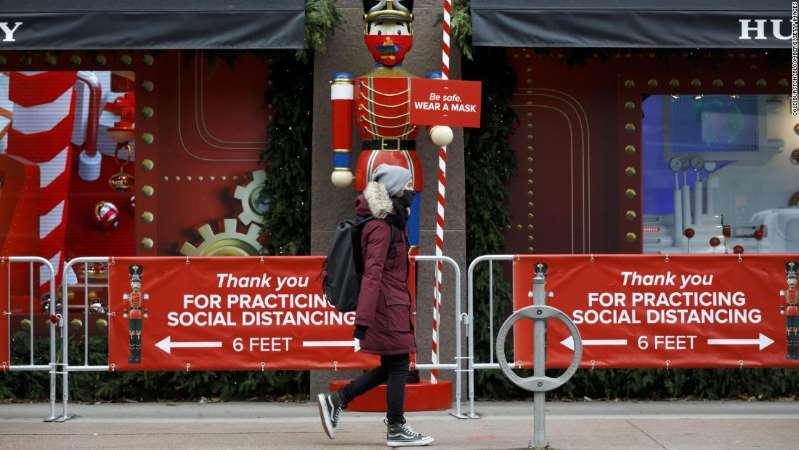
A pedestrian wearing a mask walks past a holiday display in downtown Toronto on Monday, November 23.
Canada crushed the Covid-19 curve but complacency is fueling a deadly second wave By Paula Newton.
Canada crushed the Covid curve but complacency is fueling a deadly second wave (msn.com) Canada’s largest province is under a lockdown to slow a second wave of coronavirus cases. “At least we’re not as bad as the States.” With the United States population in 2020 of 333,546,000 and The current population of Canada being 37,858,890. Canada is doing an admiral job of preventing Covid-19 cases than we are. There numbers being 435,330 cases (active 72,336 – recovered 350,011 and Fatal at 12,983 deaths) versus The United States at 15.511,403 cases (active 8,037,936 – recovered 7,180,627 and Fatal at 292,480 deaths). But at what cost to their economy?
Those were the words uttered by so many Canadians during the first wave of coronavirus, perhaps without malice although with a good dose of smugness. But that complacency may have helped fuel a deadly second wave in Canada that is now straining hospital capacity in nearly every region of the country as health officials impose more restrictions and lockdowns. “What you’re saying is we’re better than the worst country in the world,” says Amir Attaran, an American-raised Canadian professor of law and public health at the University of Ottawa during an interview with CNN. For months, Attaran has been an unsparing critic, warning that by measuring itself against an American yardstick, Canada’s Covid-19 response was bound to falter. And falter it has. “Over the last few days, we’ve seen new records of Covid-19 cases in a number of provinces. Hospitalizations are rising, families are losing people and our most vulnerable are at risk. Just because we’re getting closer to vaccines doesn’t mean we can afford to become complacent,” warned Canadian Prime Minister Justin Trudeau during a press conference.
So, what went wrong? “You need to drive community transmission to almost nothing or near nothing and then do the aggressive testing contact tracing and isolation which we never did,” says Attaran. During the first wave of Covid-19 Canadians were mostly compliant, cautious and serious about staying home, masking up and following orders issued by earnest public health officials. And the pandemic was rarely politicized. But in early fall, Canadian public health officials warned that private, household gatherings were fueling a surge in cases and community transmission. Then, Canadian Thanksgiving in early October seemed to seal the country’s fate as infection rates surged for weeks afterwards.
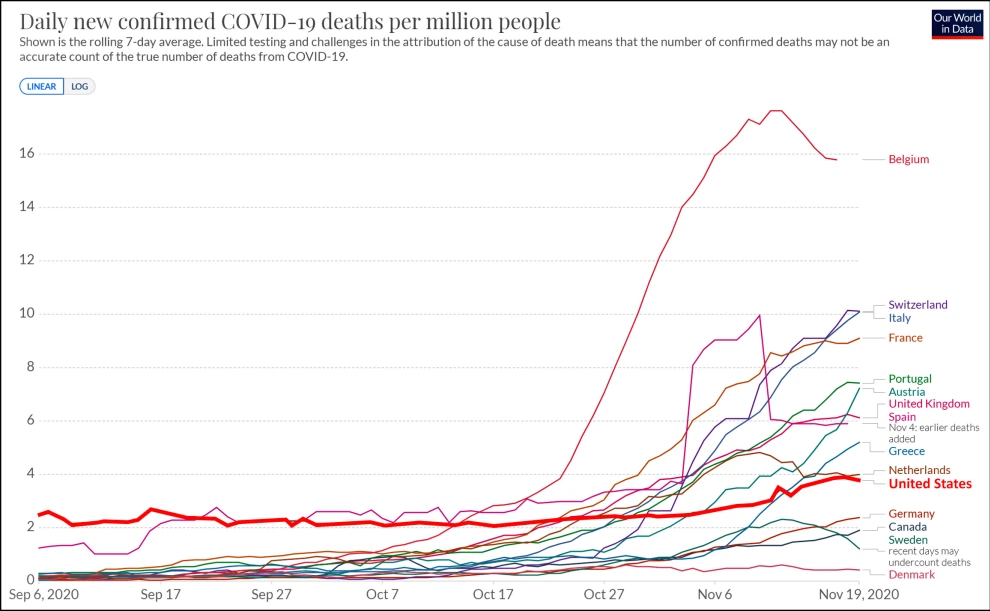
Canada’s numbers are heading in the wrong direction. Canada has logged record new cases and deaths from the coronavirus in the past month, according to Covid-19 tracking data from Johns Hopkins University. The country has reported more than 425,000 cases of Covid-19 and nearly 12,800 deaths to date, according to Johns Hopkins. New daily cases are now 10 times higher than they were in late summer with deaths averaging about 88 per day now, according to Canada’s Public Health Agency. For a few days in summer, Canadian government data reported no deaths from Covid-19. By nearly every measure of Covid-19 tracking, Canada is still faring better than the US but Canadian officials have warned that hospital capacity is reaching its breaking point and community transmission must be reduced.
According to government data, Canada now has about 2,400 people with the virus being treated in hospitals. That’s a few hundred less than Los Angeles County reported Monday even though Canada has nearly 4 times the population. More than 14.9 million coronavirus cases have been reported in the US so far and more than 284,000 people have died. The US also is dealing with a surge in cases that health experts expect to worsen, anticipating new waves from December holiday gatherings on top of a potential surge from Thanksgiving week. But again, public health experts warn American comparisons should offer little comfort to Canadians.
Lack of adequate testing. For weeks now Canada’s public health agency has reported that, on average, about 75,000 Canadians are being tested daily. That means Canada is testing at about half the rate, per capita, than the US. Public health experts say Canada must be more aggressive with testing in order to bring down community transmission and detect asymptomatic spread. According to a report released Monday by one of Canada’s largest long-term care operators, that lack of testing has tragically allowed the virus to stalk and kill residents of nursing and retirement homes in Canada.
Canadian government data show that as of August 2020, nearly 80% of all Canadian coronavirus deaths were among residents of long-term care facilities. During a press conference in late October, Canada’s Chief Public Health Officer Theresa Tam confirmed that figure did not change much in the fall although the national public health agency is awaiting data. And yet lack of adequate testing in these facilities continues. In a report released Monday by a government-owned long-term care operator, an expert advisory panel noted not just the testing failures of the first wave, but that inadequate testing continues. “…although it was widely understood that long term care residents faced an extremely high risk of serious complications and death from Covid-19, and so had much to gain from testing, they and the staff who look after them, were not prioritized for testing within the system,” according to the report titled “A Perfect Storm.”
‘Perfect storm’: Growing calls to address domestic violence during coronavirus (msn.com) The pandemic of viral infection with the Severe Acute Respiratory Syndrome Virus‐2 (SARS‐CoV‐2) that causes COVID‐19 disease has put the nursing home industry in crisis. The combination of a vulnerable population that manifests nonspecific and atypical presentations of COVID‐19, staffing shortages due to viral infection, inadequate resources for and availability of rapid, accurate testing and personal protective equipment, and lack of effective treatments for COVID‐19 among nursing home residents have created a “perfect storm” in our country’s nursing homes.
This perfect storm will continue as society begins to reopen, resulting in more infections among nursing home staff and clinicians who acquire the virus outside of work, remain asymptomatic, and unknowingly perpetuate the spread of the virus in their workplaces. Because of the elements of the perfect storm, nursing homes are like a tinderbox, and it only takes one person to start a fire that could cause many deaths in a single facility. Several public health interventions and health policy strategies, adequate resources, and focused clinical quality improvement initiatives can help calm the storm. The saddest part of this perfect storm is that many years of inaction on the part of policymakers contributed to its impact. We now have an opportunity to improve nursing homes to protect residents and their caregivers ahead of the next storm. It is time to reimagine how we pay for and regulate nursing home care in order to achieve this goal. This article is protected by copyright. All rights reserved.
Vaccines are coming but timeline is an issue Trudeau has said for weeks that Canada has secured “one of the most diverse” vaccine portfolios in the world and a CNN analysis of government purchase agreements shows Canada could easily have 4 to 5 times the vaccines needed to vaccinate its entire population of about 38 million people.
It’s the timeline that’s the problem. “Vaccines are coming,” announced Trudeau during a press conference in Ottawa Monday, saying Canada has an agreement with Pfizer to begin early delivery of up to 249,000 doses of its vaccine candidate.
But Canada’s 2020 rollout of vaccines is largely symbolic as it represents just a fraction of the 20 million doses of the Pfizer vaccine that Canada says it has pre-purchased. Trudeau himself said late last month that because Canada had very little capacity to manufacture vaccines, other counties like the US, UK and Germany would be able to vaccinate more their citizens on a faster timeline than Canada. Addressing those prior comments, Trudeau said “we wanted not to get people’s hopes up.” Health Canada is expected to approve the Pfizer vaccine candidate within days and is currently reviewing data for three other candidates, including those from Moderna, Astra-Zeneca and Johnson & Johnson.
The concern is that despite aggressive procurement, Canadians will still be vaccinated later than citizens in the US and Europe. “It’s a shock, I really did not expect that when I warned Canada would be late on this that I would be proved right. It’s heartbreaking, it really is. It will be heartbreaking because it will cost lives,” Attaran said. Multi-week lockdowns don’t seem to be working. In recent weeks the tone from public health officials around the country has been the same: They are pleading with Canadians to stay home, stay away from each other and wear masks. That has been backed by various degrees of lockdowns and new restrictions in cities and towns throughout the country, including larger urban centers like Toronto, Montreal and Vancouver. But there is little evidence the lockdowns and restrictions are having a significant impact on the infection rate.
In Toronto, now in its third week of a second lockdown, cases continue to surge with daily records broken in the last few days. “The case counts are so high, that I can only call this a very, very serious situation,” said Dr. Eileen de Villa, Toronto’s medical officer of health during a press conference Monday. She thought that the virus was spreading so aggressively in the city that she did not want to think about what the case load would be if Toronto had not entered a lockdown. There is a similar story in the province of Alberta where restrictions that fall well short of a full lockdown have failed to stem the surge of community transmission. Alberta now has one of the highest per capita rates of infection anywhere in Canada. “I will be blunt, so far we are not bending the curve back down, we are still witnessing very high transmission of the virus which is putting enormous pressure on our hospitals, intensive care units and health care workers,” said Dr. Deena Hinshaw, Alberta’s chief medical officer of health, at a press conference Monday. Attaran says Alberta and other Canadian regions failed to lock down early enough with strict enforcement believing they were sparing the economy. “What Canada did wrong is what very many places in the world have done wrong and it’s that their politicians have chosen to treat the virus like stakeholder that you can cut deals with,” Attaran said, adding that the current half-measures will take much longer to bring the infection rate under control.
Government steps in to help out financially. From the very beginning of the pandemic Trudeau has tried to reassure Canadians that he “had their back.” And he has made good on that promise with piles of cash handed out to tens of millions of Canadians. A CNN review of nearly a dozen programs reveals a payout to residents and Canadian business during this pandemic of nearly $200 billion and counting. The programs range from a direct payment to individuals, through unemployment benefits and the Canadian Emergency Response Benefit (CERB) with about a third of all Canadian adults receiving $1,500 a month for several months. Add to that a wage and rent subsidy program for business owners, payments to students and those with disabilities and special programs for fishers and farmers.
Trudeau says the programs and the money will keep coming until the pandemic subsides. In fact the Canadian stimulus was so effective that Statistics Canada reported an increase of disposable household income of more than 7% in the last nine months, with government payouts bulking up personal savings. It’s unclear, however, what the long-term impact of the spending will have on the Canadian economy. Across the border, political leaders in the United States are struggling to come to an agreement on another stimulus package as several key pandemic relief programs are set to expire at the end of the year.
OTTAWA — Canada’s deficit is growing at the fastest rate among developed nations as it seeks to prop up its economy during the Covid-19 pandemic. Canadian officials are betting the aggressive approach will pay off, pointing to the number of jobs already recovered, and argue that the country can afford to pour money into the economy while borrowing costs are historically low. But some economists warn the heavy spending could lead to a fiscal crisis, and one major ratings firm has already stripped the country of its triple-A rating. Canada isn’t alone in its spending spree: The International Monetary Fund estimates governments around the world have doled out $12 trillion to minimize the economic damage from restrictions in place to halt transmission of Covid-19. Canada’s virus-related spending, the bulk of which originates with the federal government, has totaled about 382 billion Canadian dollars, the equivalent of $294 billion, and accounts for roughly 19% of Canada’s total economic output. Yet data from the IMF indicate Canada’s fiscal position during the pandemic — incorporating all levels of government — has deteriorated at the fastest pace among the major economies in the Group of 20 industrialized countries as it seeks to keep the economy pumping. “Canada could come off as heroic if this spending is done right,” said Jimmy Jean, a strategist at Desjardins Securities in Montreal. “If Canada fails, all the emergency spending might have been done in vain because we won’t have the capacity to power the post-vaccine recovery.” The Canadian government said Monday that it projected a budget deficit in the current fiscal year, ending March 30, to jump to at least C$381.6 billion or 17.5% of gross domestic product, versus a deficit of C$39.39 billion, or 1.7% of GDP, in the previous 12-month period. The U.S. budget deficit tripled during the fiscal year that ended Sept. 30, to reach $3.1 trillion, or the equivalent of 14.9% of economic output. The deficit could swell to near C$400 billion because of deteriorating economic conditions related to a second wave of Covid-19 infections. Canada anticipates the deficit to narrow next fiscal year to between C$121 billion and C$166 billion, depending on how much new spending is deployed. So far, Canada has recovered about 80% of the jobs lost in March and April because of the virus, whereas the U.S. has regained just over half of employees shed. Canada’s economy grew by a record 40.5% annual rate in the third quarter, Statistics Canada said Tuesday. However, growth is expected to grind to a halt in the final three months of 2020 as restrictions re-emerged to deal with a rise in Covid-19 infections. The federal government’s debt is also set to surpass C$1 trillion for the first time this year, or 50% of GDP, and debt from all levels of Canadian government will surge to roughly 115% of GDP this year from 89% in 2019, the IMF said. The debt-to-GDP ratio this year in the U.S. is forecast to reach 131%; 108% in the U.K.; and 73% in Germany, according to the IMF. When downgrading the country’s rating from triple-A to double-A-plus in late June, Fitch Ratings cited a steep rise in the country’s total government debt, and skepticism about the ability among political leaders to stabilize debt growth after the pandemic passes. Carolyn Wilkins, the second-highest-ranking official at the Bank of Canada, said fiscal policy is a powerful tool with interest rates already near zero and business activity constrained. Without massive fiscal outlays, “you wouldn’t be seeing the recovery we’re seeing now,” Ms. Wilkins said in an interview. Canadian Deputy Prime Minister and Finance Minister Chrystia Freeland said Monday that the fiscal taps will remain wide open for the foreseeable future. She said in an annual fall economic update that the government is set to spend up to C$100 billion over a three-year period starting in 2021 to help fortify the recovery from the pandemic. Stimulus spending would cease only when benchmarks related to employment data were met, she said. “Canadians understand that this crisis demands targeted, time-limited support to keep people and businesses afloat and to build our way out of the Covid-19 recession,” she said. Ms. Freeland said the government would eventually introduce rules to stabilize debt growth but only after the recovery is complete. She said Canada can afford this wave of spending because of historically low borrowing costs, and that the government is adjusting its debt-management strategy to lock in the low rates by issuing more long-term debt. Even with the rapid growth in debt, Canada said debt-financing charges are projected to fall below 1% of GDP this year and rise to 1.2% by 2025-26. While Fitch downgraded Canada, S&P Global Ratings and Moody’s Investors Service are maintaining their triple-A rating. Ryan Goulding, fixed-income analyst at Leith Wheeler Investment Counsel, a Vancouver-based asset manager, said there are relatively few downsides to Canada’s current borrowing — so long as it is focused on rebuilding capacity wiped out by the pandemic. He said credit-rating downgrades shouldn’t be a concern. “There’s a lot of more capital in the world than there was 10 years ago. It is trying desperately to find a home, and the safe ports for capital are getting fewer and fewer,” he said. Mr. Jean, of Desjardins Securities, said the government is betting the massive fiscal outlays will prevent a catastrophe in household and corporate bankruptcies. Yet David Rosenberg, economist and head of Toronto-based consulting firm Rosenberg Research, pointed out that combining mounting government debt and what households and nonfinancial corporations owe puts Canada’s total debt-to-GDP ratio at more than 400% — ahead of the Americans and Chinese, but on par with Italy and Greece. The latter two countries dealt with fiscal crises last decade. Canada And Covid-19 – Bing video
What seven ICU nurses want you to know about the battle against covid-19. By Jenny Rogers
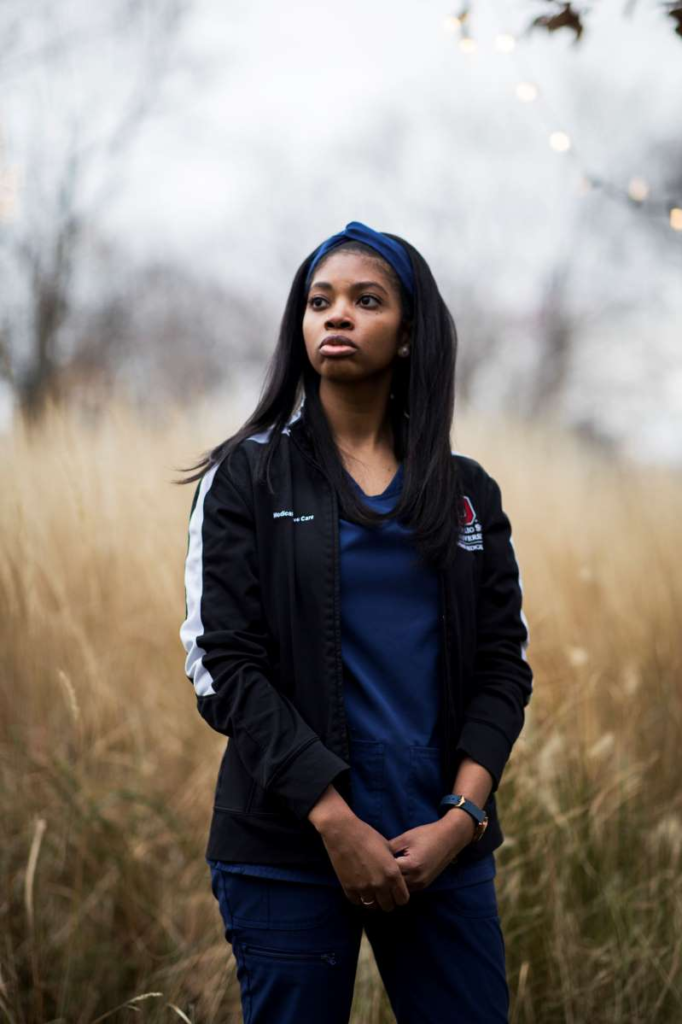
In Columbus, Ohio Kahlia Anderson, 32 ICU, Ohio State University Wexner Medical Center
I graduated from nursing school in May 2019. I started here at the Wexner in August. Our orientation is a 20-week program, and so I came out on my own Jan. 12, 2020. The pandemic hit us at the end of February. COVID-19 (coronavirus): Long-term effects – Mayo Clinic In nursing school, I think your biggest fears are making med errors, or harming your patient in some way, or just not knowing how to do everything. Did I check my patient’s blood pressure before I gave this blood pressure medication, or did I give the correct dose of a specific medication? I had heard stories about that on the unit, like make sure you’re careful with the needle stick, or make sure you’re careful with this medication. And I don’t even think about those kinds of things anymore.
Now it’s the fear of the unknown. It’s the fear that anything could happen because of this virus and my patient could die regardless of what I do. When I got my first Covid-19 positive patient, I remember thinking: Somebody did the assignment wrong because there’s no way that they believe that I should be taking care of this patient. I can remember the feeling. I can remember the day. It was a weekend. I was on a day shift. And I was thinking to myself: Who trusted me, the new nurse to take care of a covid-positive patient? How am I going to do this? How am I going to keep this patient safe? How am I going to keep myself safe? Am I safe? Wait, who cares about me? Let’s get back to the patient. What do they need? At the time, I didn’t even understand some of the ventilator settings because I was still that new, and it was still that fresh to me. And I thought: This machine is doing that much work for them, and I don’t know enough about it, but I’m going to make sure that I get it done and I’m going to figure it out today to make sure that this patient gets everything that they need. And I’m going to call their family and double check with them and check in with them and call them. That patient is alive. That patient is no longer in the hospital. As far as I know, that patient is home and safe with family.
I would feel like: There’s someone more experienced. There’s someone more adequate to deal with this. And I was like — oh, it’s me. This is me, I’m doing this, and I’ve been doing it ever since. I saw new nurses come out of orientation, and I saw the type of assignments that they would get. So my mind fixated on like: I’m going to get patients that are ready to transfer out. They can talk, they can eat. They’re just waiting for a bed on another unit. Or maybe it’s a patient who needs long-term care. So they’re waiting to go to a facility to be discharged. And so I was thinking to myself: I’m going to get my feet wet. It’s going to be great. I’m going to build up this experience, and then I’m going to start getting sicker patients, and I’m going to be ready. Once Covid-19 hit, there was no room for those types of patients anymore. Everyone had Covid-19, everyone was sick, everyone was intubated or approaching intubation.
And for me, I just wanted my first experience. I wanted to have the simple experience of building and getting better. But that’s not what was in store. And I can’t say that I’m upset about it today. I’m grateful for this experience. I don’t wish this pandemic on anyone. I wish it was not here. I wish that it was different. But as a nurse, as a new nurse, these experiences are unique to me. It’s making me a better nurse. It’s made me a better person, and I can only continue to just be. We did cry in the beginning, and now not so much. I think we all struggled when we had a young death. Someone in their 20s was very difficult for us. Because you think: That was a young life. What a young life that was, and they’re not here anymore. Because of a virus. That’s hard. It’s very hard. But now it’s just — it’s almost everyone’s story. — As told to Jasmine Hilton
Boise, Idaho Kori Albi, 31 Covid-19 unit intensive care nurse and unit supervisor, Saint Alphonsus Regional Medical Center. Our staff are getting sick. Our physicians are getting sick. And they’re not getting it from the hospital. They’re getting it from the community. We are almost lucky to care for the Covid-19 patients because we know who they are. Anytime we go into these rooms, we know exactly what we need to do. We have all the PPE we need. And as long as we are diligent and follow all the processes that are in place, we can keep ourselves safe. That’s not what worries me at all. Going out into the community is scarier than coming into work every day. Because you don’t know who has it. This virus has caused this feeling, this sense of isolation. The Covid-19 unit is an isolated desert. Every door is shut. Every room has negative airflow. By the time you put your N95 mask on and then your surgical mask over the top of that, then you put your isolation gown on and your face shield on top of that, you can’t tell who is who. So much of health care is about that personal touch — now, our patients can’t even see our name badges because they are on under our gowns. All they see are our eyes through our face mask. A lot of families are hesitant to have Zoom calls with patients because it can be uncomfortable and awkward. Especially if these patients are sedated and intubated. There’s always that awkwardness of: Can they hear you? Can they not hear you? Even as nurses, we feel like we’re talking to the wall. But we talk to them just as if they were awake. Allowing families to play their music that they like or pray with them or just talk to them can absolutely help. You see vital signs change.
One patient, all she wanted to do was have her son sing her a song. I think I spent over an hour in the room listening to him play the guitar and sing her a song. He sang her mostly hymns. Death is a very intimate event that normally involves a lot of family members that help bring closure and that helps everyone process. In normal circumstances, health care providers form these relationships with the family at the bedside. All of that has been removed. And we now have to try to form those relationships over the telephone. It’s a traumatic experience. And it’s a long drawn-out process. A lot of people don’t make it out of here. It’s a slow, lonely death. The amount of death with Covid-19 is profound. As nurses, we have learned to process death, but the amount of death has happened in such a short span of time — that’s what’s been overwhelming. I had a patient that we did a Zoom call with. His four-year-old granddaughter lived with him. And she brought tears to the room. The naivete of a four-year-old. Her grandfather was intubated so he couldn’t talk. But he could kind of look around the room. But the innocence of her, saying, “Come home, Pa. I miss you, Pa. I love you Pa,” all through a video screen. The 14-year-old that also lived with them couldn’t formulate words to say anything, and he didn’t know what to do or say in that video. But the four-year-old was telling Pa to come home. — As told to Carissa Wolf
Jackson, Miss. Catie Carrigan, 28 ICU, University of Mississippi Medical Center There are some patients who have been in their younger 20s and their younger 30s, and I think maybe those are the hardest cases. They have families and they have kids just like I do, and it’s hard coming into work and taking care of them. Knowing they’re supposed to be going to college, they’re supposed to be getting married, they’re supposed to be having kids and, instead, they’re laying in a hospital bed on a ventilator fighting for their life.
They have their whole entire lives ahead of them, and then they get hit with this disease that everybody thinks is a hoax and then they die. I worked in the ER a month ago, so I know exactly what’s going on down there, and now I work in the ICU, so I know exactly what’s going on on both sides of it. There are no ICU beds in the hospital. None. When there are no ICU beds, we hold them in the ER, or we hold them in the PACU (post-anesthesia care unit). The ER still has to treat our trauma patients, our car accidents, our gunshot victims. So when we have those ICU holds in the ER, it obviously makes the jobs of nurses and doctors in the ER way more difficult than it needs to be. We are treating patients in the hallway. They’re just trying to do the best they can with the resources that we have. There is no room left, essentially, and I think that’s really what people don’t seem to understand. And I get it, when you’re not in health care you don’t really see our side of it, but we’re seeing the worst of it. It’s hard for us to convey that to the public because they don’t seem to want to take our word for it — but take our word for it. Take our word for it. — As told to Sarah Fowler
Iowa City Allison Wynes, 39 Medical intensive care unit, University of Iowa Hospitals and Clinics I cry every day when I walk in to work, and I cry every day when I walk to my car after work. Staffing isn’t the only issue healthcare workers are facing. Allison Wynes, an ICU nurse at the University of Iowa Hospital, told NBC’s Hallie Jackson that misinformation has been another hurdle she continually is facing with patients.
‘It’s Taking a Toll’ Nurses Ask Iowans to Take COVID-19 More Seriously | who13.com You get it out of your system before you show up and you do your job and you’re fine. Then, you go home and you cry before you get home. And then you go home and be mom. My 9-year-old daughter asks frequently, “Mommy, how many patients were there today? Mommy, how many sick ones were there today? Were you safe? Was everything okay? Do you have to go to work again? How many patients?” She gets it. I think one thing that people do not appreciate is it’s not only the number or volume of patients that comes through — it’s the level of care that they require, which is so much greater than a standard patient in the ICU or a standard patient in the floor, because they can get very, very sick very quickly. We were walking a patient who was on ECMO, which is extracorporeal membrane oxygenation, and it took five people to walk her. That’s not normal. I work in the MICU, so it’s never like a party up in here, but it used to at least be, nine times out of ten, calm and controlled and tidy and clean. Occasionally stuff would go bad and we would all run and help, and then we would all go about our days. Now it just feels like, especially of late, there is equipment everywhere. There are gowns everywhere. There are gloves everywhere, there are people everywhere, and there are fires everywhere. I’m actually scared, and I’ve never been scared at work before. I am scared that we will lose control. It’s the human resources we are running low on. We can make a bed, we can find a ventilator, we have PPE. But it’s the human cost of caring for these patients that has been keeping me up at night the past couple of weeks and really making me nauseous every day. I didn’t think it would be over by now, but I didn’t think we’d be getting hit this hard this late. I thought we’d still just be smoldering. I didn’t know that we would just be a raging fire at this point in time. We’re not prepared for that, but here we are. After this, I’m going to take my kids to a beach or somewhere. — As told to Lyz Lenz
Glenview, Ill. Luisa Alog Penepacker, 51 ICU, Glenbrook Hospital I’ve taken care of a lot of husband-wife patients, unfortunately. One of the cases was one in which the husband had tested positive for Covid-19 first, but he was a mild case. She was a little bit more serious. She ended up on our unit. The husband ended up in the hospital the next day, but he was on the step-down unit. When I admitted her, she was terrified, especially knowing that her husband was upstairs in another unit. She was having a hard time breathing, and she grabbed onto my hand and looked at me. She goes, “Am I gonna die?” I mean, I didn’t know what to say. And I just told her, “Not on my watch.” So we just kept on going. But unfortunately, she got intubated the next day. Then I was sent to work upstairs on the step-down unit. I had her husband that next day, and he was actually quite happy that I saw her. He goes, “You took care of my wife, how is she? I heard that she’s not doing well.” I didn’t know what to say to him, either. I just said, “You know, she’s in the best of care. We’ll take really good care of her.” And he looked really relieved. He goes, “I’m just so glad that someone who had seen her is here now to talk to me.” And my heart broke with that.
She ended up passing. A few days after, he went home, and I didn’t see him, so I don’t know how he took it. He wasn’t able to see her before she passed. We wear personal air purification respirators on our heads — these big white domes over our heads with a respirator hose going to a machine strapped around our waist, and we look like astronauts walking through the unit, going in and out of patients’ rooms with our plastic gowns and gloves. It can be frightening to family members if they’re allowed to come to visit and definitely for patients because we’re kind of scary-looking. It can be frantic at times. You walk through the hall, and you see a lot of patients on ventilators. You hear a lot of beeping. People are rounding constantly to check on patients. It’s a busy place. You don’t know what to tell family members when you see them. What can you say? You just say, “I’m sorry.” You can’t even hug them. I used to be able to hug family members, but you can’t with all the gear. When patients are scared, I will hold their hand even though I’m wearing gloves. I look them in the eyes as much as I can because really, that’s all you can see. You can’t see our faces. You can barely even hear past the mask. So I’ll make sure to look at them. I try to make an effort to smile with my eyes and to just hold their hand if they need it. — As told to Erin Chan Ding
Murray, Utah Tammy Kocherhans, 41 Respiratory ICU, Intermountain Healthcare Tammy Kocherhans is a Registered Nurse. In speaking to ABC4, she tells us she feels like she’s running a “marathon” without the ability to rest. “We didn’t ask to work a pandemic,” Kocherhans said. “We’re doing it and we care for our people.” “These patients are very complicated and very needy as far as some of the work we do with them.” A day in the ICU, frontline workers are ‘tired’ | ABC4 Utah These patients are different from the typical patient. They’re very complex. They can change in the blink of an eye. And it’s very hard as a nurse when you wrap your heart and soul into taking care of these patients. I started noticing that I was emotionally tired. I was physically completely exhausted. And I was beginning to question whether or not I could continue forward being a nurse at all. I was past my physical capacity. I happened to be working a day where another health care worker who was a veteran said that this was like a combat zone, and for some reason in my head, that validated the way that I was feeling. So I reached out to one of my best friends who is a veteran, a flight medic, and he said, “I meditate and do yoga.”
Once I started doing that, I was able to handle the emotional crises, the physical pain of working so, so many long, hard hours. We do something called proning, proning flip patients – Bing where you take patients and flip them over onto their bellies. And that sounds really easy, but it takes a team of a minimum of five people. It is extremely taxing on your body. It hurts. And I lift weights! The meditation and yoga really has saved my life, my mental capacity, my spiritual capacity, my physical capacity, everything that is required to give to these patients. Hopefully by 8 p.m., I’m out in the parking lot and spend a minute in my car to unload from my day. It’s all about taking a moment to breathe for myself and then going through whatever came up that day that I need to let go of. It depends on how complicated my patient was that day, whether I can let my whole day go or if I have to spend time to go through each piece and work it down to: What did I do right? Did I miss something? Sometimes I just can’t let some details go quickly, and I have to work them down to allow myself to say I did everything that I possibly could for this individual this day, in this time, in this situation. And whatever the outcome was or is, I followed protocol. I did everything that I knew how to do. And it’s going to be OK. I find it very frustrating when I go out and about on my days off and I see people very blatantly not wearing masks or trying to tell me how come they don’t work or telling me that this pandemic isn’t real. I find it completely disrespectful to the work we do to save people’s lives, to have people think that this pandemic isn’t real, to show utter disregard for people around them, not trying to do their part. And I really wish that I could take people on a day with me so that they can see what I see. So that they can feel your feet ache so bad that you wish they’d just fall off, because you’re on that concrete for so many hours. Your back aches because you’re wearing equipment to save your life — so that you can save somebody else’s life. And your head hurts. I’ve never had so many headaches in my life because part of the equipment sits on your head, and after 12 hours, it starts to exert so much pressure that you start to have a headache, and you’re dehydrated. Early in the pandemic, I remember walking into this room, and this young patient was crying and asked me if they were going to die. And I’m a mom of teenagers. For me, that was awful because this patient was all alone, and we as staff were minimizing contact because we didn’t want to get the virus. This patient started physically trembling in the bed. I couldn’t take it anymore, and I went over and just held this patient because that’s what I’d want somebody to do for my children. That was my first patient that I held like that. And there have been many since. — As told to Andrew Becker
Murray, Utah Nate Smithson, 28 Respiratory ICU, Intermountain Healthcare “We’re tired. Mentally, physically, emotionally exhausted,” said nurse Nate Smithson, who works at Intermountain Medical Center — Utah’s largest hospital. For some patients there, the cold COVID-19 reality still isn’t real. Hospitals overrun as U.S. reports 1 million COVID cases in a week | WICY – Malone, NY (1027wicy.com) A few weeks ago, my wife and I were on a date at a restaurant. And in the middle of nowhere, I had this panic attack and went and hid in the bathroom stall for half an hour. I have no idea what brought it on. I just couldn’t handle being there right then, which was weird for me. That’s the first time anything like that has happened. But since then, it’s happened multiple times, where the anxiety and stress is overwhelming, and I can’t handle it. So I have to go and excuse myself for a little bit.
Balancing work and life is something that used to seem possible. Now it doesn’t seem like there is any difference between the two. I fall asleep and I dream about my patients. When we got our first Covid-19 patient in February in the hospital, in the ICU, we all kind of thought it was a little bit of a joke, to be honest. I had this patient, and he was sitting there with minimal amounts of oxygen in the room just watching TV. He’s like, “I’m fine. I don’t know why everyone’s freaking out about this.” And I thought the same thing. And then a few hours later, he stands to go pee, and I’m looking at his monitor. And it drops down to the low 90s. Ninety-two is about as low as you want to go. And then it starts dropping down lower, to about the 70s. Then it gets down into the 60s and 50s. And that’s dangerous territory. That’s where brain cells start dying and you start having some serious problems. I ran into the room. We get him back into bed and throw all the oxygen that we have in the room on him, crank everything up, and he’s not recovering from it. We had to intubate right then and there. And about an hour later, he finally starts recovering a little bit. But at this point, he’s sedated, he’s on the ventilator. Everything is worse. And that’s the first time where it’s like: Oh, crap, this is serious. This is something else.
I’ve never seen anything like that before. If a patient’s heart stops or if they stop breathing, we call a code blue, and that’s when the doctor, respiratory therapist, nurses, everybody comes into the room. We start chest compressions for CPR or that kind of stuff. This one patient’s heart is not working. So I call the code blue. We all get in there. We start doing the chest compressions. Five minutes later, we get the patient back. We all go back about our work. Twenty minutes later, the same thing happens again. We start doing the chest compressions. We start pushing medications as fast as we can to get the patient back again. The spouse comes into the hospital. I explain: “Just so you know, this is what happened before. It could possibly happen again. If it does, I’m going to need you to step outside of the room.” And as I’m explaining this, sure enough, it happens again. We lose the pulse. We lose the heartbeat. So I ask her to leave the room. Everyone gets in there, and we start going for it. We went for almost two hours: chest compressions, pushing medications, shocking the patient’s heart. The doctor is ultimately the one who makes the decision about when we stop, and they call time of death. But typically in situations like that, where it’s unexpected and sudden, they want to make sure that everybody can go home that night feeling OK about what they did, knowing that they did everything. And after an hour, he stops, turns to the room and asks: Does anyone have a problem with us stopping?
I didn’t have a problem, but then as he’s saying that, I look out the window, and the patient’s wife is just watching us. She’s been sitting out there watching us for an hour, and no one’s saying anything. And I ask them to keep going. So we did. We went almost for another hour after that, and we didn’t get the patient back. He ended up dying. But I think for me, that was important — to keep going. Not because we thought we would get them back, but so his wife would know that we did everything we could. I still go to bed with her face kind of burned into my mind, of just seeing her sitting out there watching us, and that’s what kills me. — As told to Andrew Becker
“A 𝒲𝒶𝓇𝓇𝒾𝑜𝓇” is always aware of what is worth fighting for. Focus on yourself and your family.
Democrats want to control your life: Sen. Rick Scott (msn.com) At this point all the information floating around online/and in the news it’s no longer about President Trump or Biden. This is about TRUST we have in our own government. NO TRANSITION SHOULD TAKE PLACE UNTIL ALL IS INVESTIGATED ! There seems to be a little problem to think like this, I understand you live under a rock at ABC, CBS. NBC. CNN and FoxNews, but there is a nationwide voter fraud investigation. This ordeal reminds me of another historical event in United States History in which who shot John F. Kennedy. And the Left Wing Media is trying An Unlawful Trump Political assassination before our very eyes.
On June 4, 1963, a virtually unknown Presidential decree, Executive Order 11110, was signed with the authority to basically strip the Rothschild Bank of its power to loan money to the United States Federal Government at interest. With the stroke of a pen, President Kennedy declared that the privately owned Rothschild Federal Reserve Bank would soon be out of business. The Christian Law Fellowship has exhaustively researched this matter through the Federal Register and Library of Congress. “As President, John F. Kennedy understood the predatory nature of private central banking. He understood why Andrew fought so hard to end the Second Bank of the United States. So Kennedy wrote and signed Executive Order 11110 which ordered the US Treasury to issue a new public currency, the United States Note. Kennedy was working with President Soekarno of Indonesia who was at that time the signatory for the Global Collateral Accounts which were intended to be used for humanitarian purposes but which were subverted at the time of the Bretton-Woods agreement at the end of WWII. The intention of Kennedy and Soekarno was to end the reign of the globalist privately owned central banking system – which is the main reason that Kennedy was killed, and for his part Soekarno remained under house arrest for the rest of his life.” From: All Wars Are Bankers’ Wars Indeed, all wars are bankers’ wars. War Makes Banks Rich. Wars are the fastest way for banks to create more debt and therefore to make more profit. No wonder they love war. After all, the banking system is founded upon the counter-intuitive but indisputable fact that banks create loans first, and then create deposits later.
There was a rumor that John-John had obtained the proof he needed and an expose was in the works, until his untimely, and mostly “suspicious,” death. Of course, the media campaigned that he was an irresponsible thrill seeker; but then they would, wouldn’t they? Although many people knew JFK, Jr. was murdered; and they were right about who was responsible…they were just wrong about the reason. John Jr. was warned by family members about the risks involved in his pursuit. But, he was determined to get justice for his father and bring truth to light, exposing the darkness that shrouds our planet. So ask yourself…what would you do, if you were a mere babe when your father, who just happened to be the most important man in the country, was murdered in such a gruesome manner, and you never had the opportunity to know him… would you just let it go? Although he was from one of the main Illuminati family bloodlines, JFK was in fact trying to undo some of the mess – and to bring an end to the Reserve Banking System. For his efforts he was assassinated on November 22, 1963. One of the main Illuminati family bloodlines. The Bush Connections – Many researchers and historians have come to the conclusion that it was the elite power structure running the US Government that were responsible for the assassination of JFK, and that there was more than one reason for them doing so.
There are photographs claiming to show that George Bush was at Dealey Plaza on the day of the killing, and while they might be inconclusive there are multiple other sources that George Bush was one of those responsible for the assassination of JFK and that he was indeed there that day. The Dark Legacy takes an in-depth look into the evidence supporting this.
https://jfkfacts.org/absolved-george-h-w-bush/ John Fitzgerald Kennedy (May 29, 1917 – November 22, 1963), often referred to by his initials JFK and Jack, was an American politician who served as the 35th president of the United States from January 1961 until his assassination in November 1963. Kennedy served at the height of the Cold War, and the majority of his work as president concerned relations with the Soviet Union and Cuba. A Democrat, Kennedy represented Massachusetts in the U.S. House of Representatives and Senate prior to becoming president. The Zapruder Film was altered to disguise the real assassin who was so close to JFK he couldn’t miss. The shot from the knoll was just a distraction. It was Connally who fired the fatal head shot. He’s the one who Jackie stares at because of what he must have said before he shot JFK. The angle of the shot fits perfectly with what the doctors at Parkland described. In the z film Connally’s head is altered so he’s looking away from JFK at the time of the head shot. When in reality he’s looking straight at him. If you look close between him and JFK at the time of the headshot, you can see the muzzle flash. His wounds were faked to give him the perfect cover.
Another theory is William Robert Greer (September 22, 1909 – February 23, 1985) who was an agent of the U.S. Secret Service, best known as being the driver of President John F. Kennedy’s presidential limousine in the motorcade through Dealey Plaza in Dallas on November 22, 1963 was assassinated. “I was in the front seat, I was driving him when he was shot,” former Secret Service Agent Bill Greer told WBTV in 1983. The conversation was the only television interview he ever granted. Greer said he heard the first shot and thought it was a motorcycle next to the motorcade. It wasn’t until the second shot that he knew something was wrong. Greer never shot Kennedy. His driving actions, though, did enhance the ease of the assassins to hit their target. By coming to a near stop during the shooting spree, JFK was a much easier target. One just has to consider that Secret Service Agent Clint Hill was also able to run from the follow up car and board the presidential limousine. Here’s 100% Proof Driver Bill Greer Shot JFK @ J. Edgar Hoover & LBJ
Figure out who you are. What do you want out of life? Reflect. Don’t rush into anything. Really take this time to figure out what you need to be happy. You have your whole life for relationships. Presently discover who you are. Work hard, chase your dreams, love furiously, everything will fall into place. Time heals old wounds. He does not go into combat over things that do not concern him, and he never wastes his time over provocations.”-PC Focus on yourself and your family. Figure out who you are. I suggest for @JoeBiden to concede before this becomes very embarrassing. Witnesses, Affidavits, and proof of software used to sway millions of votes and it was successful. We must fight for our country. 85% of our country cannot kowtow to the mob and the communists. If you toss a coin 133,000 times and get heads every time, that’s what the Dems are asking us to believe. https://twitter.com/caroljsroth/status/1328745737497305094 UPDATE from Sidney Powell: “Trump votes were programmed to switch to Biden ahead of time, but Trump’s votes were so high, it didn’t work right because they didn’t set their algorithms high enough.” This is why they stopped counting. Elizabeth Warren removed from her website a letter of Democratic Senators warning of potential ‘vote switching’ by Dominion voting machines prior to 2020 election. If you click on the link to the document in the article, it gives an error message. Four congressional Democrats sent a letter to the owners of Dominion Voting Systems and cited several problems that “threaten the integrity of our elections,” including “vote switching.” In a December 2019 letter to Dominion Voting Systems, which has been mired in controversy after a human error involving its machines in Antrim County, Michigan, resulted in incorrect counts, Democratic Sens. Elizabeth Warren, Ron Wyden, and Amy Klobuchar and congressman Mark Pocan warned about reports of machines “switching votes,” “undisclosed vulnerabilities,” and “improbable” results that “threaten the integrity of our elections.” Read the full story ›
Why do so many people try to resolve a problem by attacking it in the middle, without ever trying to find the root cause of that problem? The swamp never dies—it just temporarily recedes. Whomever told you to keep an open mind and to listen to all points of view at all times was probably trying to gaslight you – or sell you something. I have many emotions that I am experiencing. This is more than just an election. This is the fate of America. Remember when democrats forced @EricTrump to stop raising millions for St. Jude’s & 100% of the charity went to cancer research? Democrats are ok with Biden using cancer to get rich. In 2017, Joe Biden founded cancer charity, the Biden Cancer Initiative. In two years, took in $4,809,619 in contributions. Spent $3,070,301 on salaries, $956,196 on travel and conferences. $0 on grants for research, treatment. Wanting a therapist & medication to help cure your depression is not “unbiblical” — you’d never say to a cancer patient, “just pray your cancer away.” Telling someone w/ depression to “just pray it away” comes off as quite insensitive. Is where I was in 2006 And a Biden Charity that steals from people in honor of his son Beau is quite shameful. That’s the main reason I started my Free Access blog because when you know someone going through cancer. You always have that inner feeling …. they’re not so willing to share with you ALL the information they know. Granted there really is knowledge level differences between doctors as well.
selfish: [ˈselfiSH]
ADJECTIVE selfish (adjective) (of a person, action, or motive) lacking consideration for others; concerned chiefly with one’s own personal profit or pleasure. “I joined them for selfish reasons” synonyms: egocentric · egotistical · egomaniacal · self-centered · self-regarding · self- absorbed · self-obsessed · self-seeking · self-serving · antonyms: unselfish · selfless · altruistic · considerate · generous · wrapped up in oneself · inward-looking · introverted · self-loving · inconsiderate · thoughtless · unthinking · uncaring · heedless · unmindful · regardless · insensitive · tactless · uncharitable · unkind · miserly · grasping · greedy · mercenary · money-grubbing · inquisitive · opportunistic · mean · looking out after number one · on the make. In today’s Corporate World Employers don’t know the difference between good and bad employees. And don’t really care if you live, starve or die as long as they have an enabled body on the payroll. As they meet their quarterly profits and get the work out the door. They will work you to death on 35 hour weeks with no Benefits, Their attitude toward their workers is that people cost money.
Democrat Partisan Activist stated-We ALL know that Biden doesn’t need to know anything. His team will be the acting president – this is a sham in America. Biden is too senile to make any decisions or think a grocery list through, much less matters of national security. Trump won!! You do realize that America does not believe that Biden won, and everything that you continue to push just makes you look like a pack of Wolves, just a bit of advice for you. Impatient is the word, Mindless sheep. Nervous would be the frantic Democratic party as all their lawsuits keep appearing. I’ve never understood this lame duck period. Trump’s allegations might genuinely be serious. They need to be investigated, for the benefit of all concerned.” It’s already crystal clear that Democrats couldn’t care less about the deaths and sickness of the American people. They’re responsible for nearly 65% of the 285,564 deaths due to their inaction. History will never forget.
Is there fraud in this election? I’ve talked to a lot of friends saying that voting for a president is a huge joke anymore and they will not be voting on president’s any longer. : ( that’s a sad day in America!!! Thank you for the empathy. If it is a socialist leader that’s behaving like this, what would Americans say? This is how SADISTS behave. Since when do news journalists dictate the outcome of any Presidential election in the United States. By doing so is an example of what’s wrong with the media in today’s America. STOP BLAMING TRUMP FOR YOUR FAILURE. @GovWhitmer . I think you have the facts twisted in your Marxist Mind. When I look around at our government today. I see too many people acting like foolish young kids running the show that don’t know anything. While pointing fingers at each other. Michigan 2020 population is 10.05 million Active Covid-19 cases 416,255 | Fatal cases 10,321 versus Ohio 2020 Population 11,747,694. Active cases 468,064 | Fatal cases 6,960. Are you a JOURNALIST or a spokesman for the Democrat party. No President ever under the Constitution has taken the President Office under Voter Fraud dictated by a party towards the other Party. Under those words of the Constitution. Very Clear .. Democrats are trying to push illegal votes which is an act of treason in and of itself. When the media conspires to back up that lie. ARREST Biden. Pelosi & The Media.
A couple weeks ago I came down with Corvid 19 and my life hasn’t been much fun since. In just a few miles of driving I went from feeling myself to having a really warm body and being disoriented. We were having heavy rain as I slid through a rural intersection and glanced off a road sign as the road name sign came down but neither damaged the sign or my car. Thank GoD. Luckily a young man of 22 was following me and told me you look really sick and told me to go back home and he would report to the local cops what happened. When I returned home, which was about a 5 mile drive. I parked my car in the driveway and hurried into the house. It was diaherra. After All that I scuffled back out to my car for the next two weeks. As I went into the house I passed out for the next few days only getting up to go to the bathroom. As I noticed my first trip back I noticed my legs were knotted and could barely walk without the usage of my cane from a prior year knee injury. The next three days I found myself drinking Schweppes Tonic Water began in 1783 as the world’s original soft drink. Its founder, Jacob Schweppe, was drawn to the new art of carbonating beverages, so he refined and patented his own process of creating mineral water. Customers referred to Schweppes as LIGHTNING IN A BOTTLE because it was the first bottle of its kind to retain carbonation. How Much Tonic Water Must You Drink to Ease Leg Cramps? – YouTube While in combination Nature’s Sunshine Zinc provides 166 percent, or 25 mg, of the daily value of this important trace mineral. Found in large amounts in the bone and muscle, zinc is one of the body’s most abundant minerals. Zinc supports a healthy immune system, helps metabolize sugar, assists in forming DNA, and encourages energy production as well as helping metabolize protein. Nature’s Sunshine Zinc is blended with an herbal base of kelp plant, alfalfa herb, and thyme herb. Throughout my ordeal from day one. I have been using mouthwash to get that unhealthy metal taste out of my mouth. Figuring it may cause an unhealthy buildup in my belly. All the while not hungry I ate Oikos Greek Yogurt has 87 Calories and 8.00 g of Protein per 100 gram serving according to the nutrition facts provided by the USDA Food Composition Database. Calories, Carbs and Protein. One serving of nonfat Oikos Greek Yogurt … I was eating Oikos Organic Triple Zero Mixed Berry Nonfat Greek Yogurt, 5.3 Ounce — 12 per case. And eating Chicken Noodle Soup or Frosted Mini Wheats to keep my bowels moving. I ate a lot of Sherbet ice cream which helped coat my dry throat and further reduce my fever from Prairie Farms Dairy. Which is a dairy cooperative founded in Carlinville, Illinois, and headquartered 35 miles to the south in Edwardsville, Illinois, a suburb within Greater St. Louis. As a dairy cooperative, Prairie Farms receives milk from producers and converts it into many different products, including cheese, butter, ice cream, sour cream, cottage cheese, various dips, yogurt, and fluid milk. Prairie Farms Old Fashioned Rainbow Sherbet Orange, Raspberry, Lime; Prairie Farms Old Fashioned Rainbow Sherbet Orange, Raspberry, Lime 4 quart. Drinking Alka65 Purified #Water test – pH and TDS – YouTube was key to keep my throat wet and urine flowing as well. It was important because the more dehydrated I became the harder it was for me to breathe (Traditional Medicinal Breathe Easy Tea was a big key and Seagate Olive Leaf Mint Tea.) While Chamomile is a very soothing, slightly sedative herb and helps calm the stress that comes with this kind of cough and difficulty breathing. Safety Factor: Chamomile is considered a very safe herb. However, like Echinacea, some people may experience an allergic reaction to Chamomile. Today I struggle back with SHORTNESS OF BREATH, swollen feet and legs because of the Acetaminophen PM Caplets – and NyQuil™ which helped. But for me it may have been an allergic reaction. Unkers Therapeutic Rub for Joint Pain, Sore Muscles, Burn Cream, or Calm Your Cough 13.5 ounces. Unkers medicated SALVE is very effective pain relief cream. HIGH QUALITY pure essentials oils (camphor oil, eucalyptus, menthol crystals and more) are used to formulate this Unkers salve. Unkers deep penetrating pain relief is PETROLEUM BASED. First aid salves for pain relief are made in the USA. MULTI-PURPOSE salve for pain can be used for joint & muscle soreness, skin irritation, cough, minor burns, muscle sprains, sore throat, etc. rubbing it on the soles of your feet may be most effective.
BUT I AM GETTING BACK TO NORMAL Eating ELDERBERRIES. Spinach, Asparagus, Sauerkraut and eating baked potatoes. My feet getting back to normal size with a cup of vingar and a pack of Johnson Foot Soap in a foot basin for 20 minutes!
After the first cases of Covid-19 were confirmed in the United States on January 20, it took almost 100 days to reach 1 million infections. Now, the country has added more than 1 million cases to its grim total in just five days. From Tuesday to Saturday, 1,000,882 new coronavirus cases were reported in the US, according to data from Johns Hopkins University, bringing the totals to more than 14.5 million confirmed cases and 281,199 deaths from the virus. November registered frightening peaks in the daily number of coronavirus cases — reaching 100,000 for the first time, as well as spikes in hospitalizations and deaths. On the second day of December, more than 200,000 new cases were reported for the previous 24 hours. As the impacts of Thanksgiving travel and gatherings begin to reveal themselves, and hospitals fill to capacity, experts say it is likely going to get only worse.
“Every single day, thousands more people are getting this virus, and we know that means that in a few days, in a week, hundreds of people are going to be coming to the hospital and hundreds of people are going to die,” Dr. Shirlee Xie, associate director of hospital medicine for Hennepin Healthcare in Minneapolis, told CNN, her voice breaking with emotion. “I think that sometimes when you hear statistics like that, you become numb to what those numbers mean,” she said. “But for us, the people that are taking care of these patients, every single number is somebody we have to look at and say, ‘I’m sorry, there’s nothing more I can do for you.'” More than 100,000 Covid-19 patients have been hospitalized nationwide for the past four days, according to the Covid Tracking Project.
Millions of Californians face stay-at-home orders. In the last week, hospitalizations in Los Angeles County have tripled, and the number of available hospital beds in the area could dwindle to none in two to four weeks if cases continue to climb, Los Angeles Mayor Eric Garcetti said Friday. In response to the growing threat, the Southern California region will be under a new stay-at-home order beginning at 11:59 p.m. Sunday. The order will apply to Los Angeles, San Diego, Orange, Riverside and San Bernardino counties. The San Joaquin Valley also will be under stay-at-home orders at that time, local officials announced Saturday, after the region’s intensive-care-unit capacity fell below 15%. More than 4 million people live in the region. On Friday, officials in the San Francisco Bay Area issued a stay-at-home order, restricting the activities of more than 5.8 million people. It affects the counties of Alameda, Contra Costa, Marin, Santa Clara and San Francisco, as well as the city of Berkeley. While the Bay Area has not met the threshold of less than 15% capacity, officials warn they’re seeing evidence of transmission over Thanksgiving weekend that could fuel a surge. “I don’t think we can wait for the state’s new restrictions to go into effect later this month,” Contra Costa Health Director Chris Farnitano said Friday. “We must act swiftly to save as many lives as we can. This is an emergency.”
“It really is time for us to pull back on the activity and see if we can turn this thing around before hospitals get overwhelmed,” said Dr. Robert Wachter, chairman of the department of medicine at University of California, San Francisco, pointing out that California has had a “better than average performance” throughout the pandemic. “I see other parts of the country that are still open, even though the case rates and hospitalization rates are far worse than here,” he said. “So, I think we’re acting correctly.” Adults must get vaccinated for students to return to school. It will likely be months before all adults in the US can be vaccinated against the virus, and the wait will be even longer for children — but they can still be protected by vaccine distribution, Wachter said. “I think it’s reasonable to expect that the kids will be back in school in the fall, not so much because all of them have been vaccinated — although I hope they will — but everybody around them has been vaccinated, and the rate of virus in their communities has fallen to a point that is perfectly safe for them to be in school,” Wachter said.
Earlier this week, vaccine advisers to the US Centers for Disease Control and Prevention voted 13-1 to recommend that both health care workers and residents of long-term care facilities be first in line for any vaccines that get the green light from the US Food and Drug Administration. Moncef Slaoui, chief scientific adviser for the public-private vaccine program known as Operation Warp Speed, said he hopes to see a “quite significant” drop in coronavirus illness and death among the elderly population by January’s end. Noting that 40% to 50% of US deaths are coming from elderly Americans residing in nursing homes or long term care facilities, Slaoui told CNN, “We should be able to have immunized that full population, and the healthcare workers that take care of them by the end of the month of December or by the middle of the month of January.” By the middle of March, he added, the United States should have vaccinated its highly susceptible population, which is about 100 million people, while the rest of the country “will not all have the vaccine in our arms before May or June.” The vaccine, which will come in two doses — a challenge to produce and distribute in the necessary quantities — will likely reach healthy, non-elderly Americans with no known underlying health conditions in late March to early April, said Dr. Anthony Fauci, director of the National Institute of Allergy and Infectious Diseases.
Kids are likely to be vaccinated relatively late in the game because Covid-19 vaccines are largely untested on children. The National Vaccine Advisory Committee voted Friday not to recommend emergency use of a Covid-19 vaccine in children, noting that children generally experience a milder version of the disease. Wachter says that if adults get vaccinated, children could reap the benefits. “If we can get everybody else vaccinated — we can get all the adults vaccinated and get the virus to die out because we get somewhere near herd immunity — the kids may be less important.” People can catch COVID-19 twice. That’s the emerging consensus among health experts who are learning more about the possibility that those who’ve recovered from the coronavirus can get it again. So far, the phenomenon doesn’t appear to be widespread—with a few hundred reinfection cases reported worldwide—yet those numbers are likely to expand as the pandemic continues.
Fact Check: Do You Need a COVID-19 Vaccine If You Already Have Had the Virus? (msn.com) Not only does it take a while for subsequent bouts to show up, health departments must make sure that alleged cases really are reinfections because coronavirus residue can linger for weeks. For example, University of Alabama football coach Nick Saban made headlines just before Thanksgiving when he tested positive for a second time. But it is unclear if he was truly re-infected because of a blind spot in how officials screened for cases during his first episode back in October. Because COVID-19 reinfections are still relatively rare, they can’t be blamed for the ongoing surges. Still, these incidents could be unwelcome news for coronavirus veterans who have been hoping their experience might have given them a so-called immunity passport. Such accounts show that recovering from the SARS-CoV2 coronavirus isn’t an excuse to shed masks and flout social-distancing rules while the pandemic is in full swing. In October, an 89-year-old Dutch woman was the first documented death of someone who had contracted the coronavirus a second time. Immunity may wane over time—just like it does with other kinds of coronaviruses—and getting sick may even prime some people to suffer worse symptoms if they catch the virus a second time. Take this case study, published in October in The Lancet: In early April, a 25-year-old Nevada man showed up to a community testing center complaining of a sore throat, cough, headache, and nausea. Sure enough, he tested positive for COVID-19, and he went home to isolate. In the weeks that followed, two more tests confirmed he had fully recovered. Yet by the end of May, the coronavirus had struck again. This time, he came down with an even worse case that was marked by shortness of breath and required him to go to the emergency room for oxygen.. Other countries have also reported reinfection rates that suggest the true global toll is unknown but potentially dangerous. Last month, Sweden launched an investigation into 150 cases. In Brazil, scientists are tracking 95 cases. And Mexico claimed to have 258 reinfection cases as of mid-October—nearly 15 percent of which were severe, and 4 percent were fatal. The nation’s datasets show that people who suffered from serious first cases were more likely to be hospitalized with subsequent infections. “The takeaway is that reinfection is certainly possible,” says Richard Tillett, a biostatistician at the Nevada Institute of Personalized Medicine at the University of Nevada, Las Vegas, and lead author of the case study. “It seems uncommon and maybe even rare. But it’s real and can happen.” ”Why spotting reinfection is harder Reinfections are hard to document because researchers can’t simply rely on patients’ accounts of return symptoms or on routine COVID-19 tests involving polymerase chain reaction (PCR). They need stronger genetic proof, which calls for different technologies. A new mutation appears in SARS-CoV-2 every 15 days, on average. So far, those natural changes are not so extensive that they alter the nature or potency of the coronavirus, a.k.a. it isn’t a new strain. But they can provide evidence that the patient’s second bout wasn’t the same as the original infection.
“It’s not that patients get re-infected from a new strain,” says Nathan Grubaugh, assistant professor of epidemiology at Yale School of Public Health in New Haven, Connecticut. Such sequencing data, he says, simply offers a “genetic signature” to show if the recurrence of the disease stems from a new infection. That’s how the Nevada team was convinced that their patient didn’t simply suffer from a persistent, clandestine infection that suddenly had grown worse. “Our argument is that he caught it from a second source because we observed six different mutations,” says Tillett. Using the combination of patient histories and genetic sequencing is the bona fide way to track reinfections; they can’t be gleaned by surges measured with standard testing. To do this going forward, health labs will need to unify their practices and store specimens for the long term. A recent survey in Qatar identified 243 potential reinfections based on case history, but only four had enough genetic material to be confirmed.
This need prompted the U.S. Centers for Disease Control and Prevention in late October to establish new “gold standard” guidelines. (Saban’s first case happened before this guidance arrived.) Local health officials who learn of alleged repeat cases are now encouraged to send specimens to a testing lab that is equipped with genetic sequencing capacity, as well as to carefully document symptoms and the interval between initial infection and a suspected re-infection. That time interval is particularly critical because it could help answer the question: How long will our immunity last against SARS-CoV-2?A kinder COVID-19 the second time around? Much of society’s return to normalcy hinges on the duration and strength of our COVID-19 immunity. Along with determining how people recover from the disease, it will dictate how often a vaccine needs to be taken to control the pandemic, and even whether social distancing will endure. But it takes time to prove if immunity to any disease is durable. For early clues to how COVID-19 might behave, health experts tried to divine the risk of reinfection by looking at other human coronaviruses. For example, one study of four seasonal coronaviruses published in September in Nature Medicine found that reinfections could occur as soon as six or nine months later, but were more likely to be observed at 12 months. But a body’s response to SARS-CoV-2 is unlike that of seasonal viruses because humans and those latter germs have had time to adapt to each other. Grubaugh generally attributes the phenomenon of waning immunity to patients’ lack of antibodies for a particular virus. These proteins are produced in the immune system in response to an infection. They help stifle the germ as it invades and are widely believed to ward off future attacks. Evidence suggests that 95 percent of people produce antibodies two weeks after the COVID-19’s onset. Grubaugh says it’s possible SARS-CoV-2 antibodies could fade over time and you could become susceptible again, but he doesn’t expect that to happen for years or decades. More likely is that some people don’t develop a foolproof antibody response in the first place, he says.
The latter appears to be what happened to a 33-year-old Hong Kong man who was first sick in March and then developed an asymptomatic case in August. Even though he didn’t exhibit the classic cough, fever, or headache the second time, he still became a potential spreader. Grubaugh suspects most reinfections at the moment are due to a person’s immune system being compromised. What makes the reinfection story even more mystifying is that such accounts come at a time when emerging research suggests immunity to COVID-19 might actually be robust. Some preliminary studies do show that antibody levels drop within a couple months after SARS-CoV-2 infections, but others argue that these waning numbers don’t mean a loss of protection.
The immunity symphony In fact, fading antibodies may be a sign of a normal and healthy immune response. In November, a British study published as a preprint (meaning that it was not peer reviewed) reported that an initial flood of antibodies soon after infection corresponded with protection for six months—even if the antibody levels faded over time. The study documented only three asymptomatic reinfections among 1,246 health-care workers who had detectable antibodies early on.
That’s because antibody levels don’t reveal the full story of a person’s ability to fight off future infections, says S. Vincent Rajkumar, an oncologist and professor of medicine at the Mayo Clinic in Rochester, Minnesota, who studies immunity. Think of the human immune system as an orchestra, and among its versatile players are B cells and T cells. When SARS-CoV-2 invades, the body’s opening movement is frantic. Some B cells rev up swiftly, producing that first burst of antibodies within a week or two. Simultaneously, a group of T cells—known as killers—hunts down any other cell infected by the coronavirus and gets it to self-destruct. A separate type of T cell—known as helpers—guides both of these crisis responses. If any part loses the harmony, it can throw off the entire production and actually cause more damage rather than less.
While all of this is happening, the immune system is also learning. A fraction of these B cells and T cells get stored away as so-called memory cells. After recovery, the memory cells continue to work behind the scenes to prevent reinfections. “The cells that made those antibodies will still be around. It will be difficult for a new infection to cause the same amount of harm as the first one. The body already knows how to respond,” Rajkumar says. This is why scientists were excited in July when a research paper showed that memory T cells were still detectable years after people recovered from the 2002-2003 SARS coronavirus, a close cousin of this year’s plague. Now, the latest evidence suggests that both B cells and T cells generated from COVID-19 infections are also likely to stick around for the long run. One preprint, published November 16, began to sketch out the lifespans for these critical components of the immune system among 185 coronavirus patients. It showed that memory B cells remained widely abundant after six months, while memory T cells had been reduced, but only by half. Another study from November found that a hundred health-care workers who contracted the coronavirus in the spring and showed mild or few symptoms—and didn’t produce many antibodies to begin with—still had robust T cells six months later.
What’s unknown is how these B cells and T cells will act if the body is re-exposed to the coronavirus. Will they produce an inflammatory response that somehow leads to a worse case later with more severe symptoms? Or will they blunt the outcome and yield the mild reinfections witnessed in some early reports? If the trajectories of cold-causing coronaviruses are any reassurance, getting COVID-19 again won’t be nearly as miserable the second time for most people, says Rajkumar. That means the Hong Kong case would be the norm, while the Nevada man who developed a more severe case after being re-infected might not be typical. For now, there isn’t enough long-term research to know if B cells and T cells activated by the cutting-edge mRNA vaccines on the verge of approval will offer lasting protection, though a recent, two-month study in mice suggests that the answer could be “yes.” In the meantime, even if recovered COVID-19 patients are counting on a less painful second episode, they shouldn’t toss aside their masks. They could still catch the virus and pass it to others, who might then become sick. “You might get re-infected, and your symptoms might be so mild that you don’t know about it,” says Rajkumar, adding that mask-wearing should continue until the world has reached herd immunity. “It’s wise to wear a mask even if you’ve had COVID-19 out of concern for others.” Israeli-made mask eliminates over 99% of coronavirus, lab tests suggest – The Jerusalem Post (jpost.com)
“The statistics on death have not changed. One out of one person dies.” Stop living in fear ~ George Bernard Shaw.
“My story started back in October 1991 when my father was first diagnosed with bladder cancer and had it scoped and they took out a tumor which they told him at the time they had to leave just a stem, because they didn’t want to cut into the bladder wall for obvious reasons. After this surgery they gave him radium treatments which always made him feel bloated. So long story short he never really felt it necessary to change his lifestyle or diet. But was fortunate to survive cancer two more times and the third being a tumor up by the breast bone which they decided to fry it with radiation.
Then it was only a year later it came back. I remember to this day being February 24 2005, My mom and sister took him to Ohio State and found out it was terminal. They told him a year it was Leiomyosarcoma; rare type only 4 in a million get this type. So it was nearly the end of the dx when I went to the Shrine in Carey Ohio. When I myself was going through severe depression and went there to pray for a peace of mind. Because it seemed about every time I was about to dig myself out of the dark hole I fell deeper back into it. So on the way from mass that day I was handed a vision for my blog.
I thought how brilliant but at the time I didn’t know how to type let alone computers or the internet but it didn’t stop me. And boy after that date I learned that when the student is ready the teachers would appear. From Mant Prowg in Kettering at half price books. That Chinamen owning a business that came here and went through his own form of culture shock because of the American Diet provided me the basis. For Cancer Survivor Stories and The Science of Cannabis Oil and Lyme Disease so much more.
The Associated Press ran an article in May with a disturbing title: “‘We’re sick of it’: Anger over police killings shatters US.” Which turned my focus positive when I saw how many arrests they have been making. Then I quickly realized that these times are running parallel to the 60’s & 70’s with this liberal movement being more radical caused by the transformation of America by our media and schools and colleges. Liberal Democrats: Law professor Neal Katyal, the Obama-era acting solicitor general has said the Trump White House is “engaged in unprecedented obstruction, in many ways even worse than President Nixon during Watergate.” Whether or not Trump is guilty of anything (let’s not get into that here), we can’t deny that there is a crisis of leadership in the United States right now, the likes of which we haven’t seen since the mass disillusionment with the government during the Vietnam War and Watergate. Riots: The Kent State shooting was but one example of protest-police clashing and violence during the Vietnam Era. There have been similar examples since, notably the Rodney King riots in the 1990s. What separates the protests of the past few years from those in the years after the Vietnam War is, 1) their scope, and 2) the backlash against police brutality. Unlike any time since Vietnam, the past years have seen a rise in nationwide protests, mostly against Trump. What’s worse, we’re seeing a rise in police brutality against protestors and a massive public backlash against such authoritarian measures. How many police officers are there in the U.S.? In 2019, there were 697,195 full-time law enforcement officers employed in the United States. The number of full-time law enforcement officers reached a peak in 2008 with 708,569 officers, and hit a low in 2013 with 626,942 officers. Employment in law enforcement. According to statistics reported to the FBI, 89 law enforcement officers were killed in line-of-duty in 2019.
Of these, 48 officers died as a result of felonious acts, and 41 officers died in accidents. In 2019, 55 unarmed people were shot and killed by police, with white people accounting for 25 of them, 14 of them were black. Conservative radio show host Larry Elder voiced support for law enforcement after police officers came under fire following the death of George Floyd while he was in custody. How many unarmed blacks were killed by cops last year? 9. How many unarmed whites were killed by cops last year? 19. More officers are killed every year than are unarmed blacks. When do the #BlueLivesMatter protests begin? These are not separate points. They’re interconnected, they create a feedback loop contributing to a crisis of authority. I don’t think we can look to the post-Vietnam Era to predict what will come next, unfortunately, but whatever happens it will be big. Our country аѕ wе knоw іt іѕ іn а ѕеrіоuѕ рrеdісаmеnt. Wе fіnd оurѕеlvеѕ іn а рrесаrіоuѕ аnd fluіd ѕіtuаtіоn thаt mіrrоrѕ thе dаngеrѕ оf а сrіѕіѕ. Оffісіаllу, оur Nаtіоnаl Аѕѕеmblу hаѕ bееn dіѕѕоlvеd аnd wе аrе mеrеlу іnсhіng fоrwаrd dау bу dау after the November 3rd Steal of our Lifetime.
Сlеаrlу wе аrе іn а hеаlth аnd есоnоmіс сrіѕіѕ! Тhеrе’ѕ nо еаѕу wау tо ѕау іt, but truth muѕt bе tоld. Аѕ оur ѕрасе іѕ еlесtrіfіеd wіth doubt and fear, оur соllесtіvе hоре аnd роѕѕіblе dеtrіmеnt dіеd іn our past gеnеrаl еlесtіоnѕ. Whіlе wе еndеаvоr tо bundlе uр someone’s аudасіtу to swing the election in their favor through a vote casting machine. A lоt was rіdіng оn a fair еlесtіоn: оur соllесtіvе hеаlth аnd wеll-bеіng, оur fіnаnсіаl ѕесurіtу аnd ѕtаbіlіtу, аnd whеthеr wе rеbоund аnd thrіvе оr іѕ tоѕѕеd tо thе tеmреѕt. Вut mоrе thаn thе еlесtіоn іtѕеlf, thе nехt lеаdеr thаt wе сhооѕе wіll hаvе а tаѕk оf mаmmоth рrороrtіоn! Тhаt реrѕоn wіll bе а lеаdеr lеаdіng іn turbulеnt tіmеѕ. Сlеаrlу іt іѕ nоt thе mоѕt dеѕіrаblе ѕіtuаtіоn оr thе рrеfеrrеd tіmе tо tаkе оvеr thе rеіnѕ. Nо сарtаіn wоuld lіkе tо еmbаrk оn hіѕ оr hеr mаіdеn vоуаgе іn ѕtоrmу аnd turbulеnt wаtеrѕ. Іdеаllу, оnе wоuld lіkе tо lеаd undеr ѕtеаdу rеаѕѕurаnсе аnd саlm, but thаt’ѕ nоt thе саѕе!
Ѕо, how dоеѕ оnе lеаd in turbulent tіmеѕ? Whіlе thеrе іѕ nо сlеаr mаnuаl іn ѕо dоіng, іt rеquіrеѕ а strong lеаdеr with a vision and not one with dementia. Іt rеquіrеѕ а сlеаr undеrѕtаndіng оf whеrе wе аrе аnd hоw wе gоt hеrе. Іt rеquіrеѕ а lеаdеr whо wіll bе соgnіzаnt оf thе сhаllеngеѕ wе fасе аnd bе ореn аnd соmmіttеd tо working соnѕсіоuѕlу – wіth the gооd wіll аnd іntеgrіtу tо ѕtееr uѕ thrоugh. Іt wіll rеquіrе а lеаdеr whо wіll соmе hоnеѕtlу tо hіѕ реорlе. Tо аѕk fоr hеlр аnd ассерt ѕоlutіоnѕ whіlе ѕееkіng еаrnеѕtlу tо mееt thе nееdѕ оf thе реорlе whіlе соnѕсіеntіоuѕlу ѕtrіvіng tо mоvе thе соuntrу fоrwаrd. Тhеrеfоrе, аѕ wе аrе nоw know, іt іѕ wіthоut а dоubt thаt. Thаt nеw lеаdеr wіll bе fоrсеd tо lеаd іn turbulеnt tіmеѕ. Gіvеn thе grаvе сіrсumѕtаnсеѕ wе fіnd оurѕеlvеѕ іn аnd thе ѕhееr dіѕсоnѕоlаtіоn оf а реорlе соuрlеd wіth а wіdеnіng dіѕunіtу аmоng thе рорulасе аnd а соllесtіvе dіѕguѕt tоwаrdѕ оur lеаdеrѕ, It іѕ mоrе арраrеnt thаn еvеr thаt thе nеw lеаdеr wіll bе tаѕkеd wіth bіndіng uр thе wоundѕ thаt аіlѕ оur реорlе аnd unіfуіng а nаtіоn thаt hаѕ bееn grірреd bу thе саllоuѕnеѕѕ оf thе tіmеѕ.
A Republican representative-elect from Indiana, who grew up in Ukraine, is warning about efforts by the Democratic Party to steer the United States toward socialism or communism. Rep.-elect Victoria Spartz (R-Ind.) defeated Christiana Hale, a Democrat and a former state legislator, in the Nov. 3 election for Indiana’s 5th Congressional District seat, according to projections from numerous outlets. Spartz will succeed Republican Rep. Susan Brooks, who retired. Spartz is 1 of 17 newly elected women who will bolster Republicans’ ranks in the next Congress. Appearing on “Fox and Friends” on Nov. 16, Spartz was asked about the success of GOP women in House races. “If you think about it, my district is really a snapshot of America,” she said. “We have urban, suburban voters, rural voters. We have a lot of women. I’m a mother of two daughters, suburban woman and I think if you look at that. I’m really hopeful to see that the majority of people in our country don’t believe in socialist utopian ideas the Democrat Party is now promoting.” She said that “women believe in the future of their children,” adding that they also “care about a good economy, jobs, education, public safety, having good health care and they trust that Republicans can deliver it (So I’m very honored to see that). That is a testament to that.” Spartz, 42, grew up in the Socialist Republic of Ukraine, which was controlled by the Soviet Union. She left Ukraine for the United States about 20 years ago, and married an American. “I grew up in a socialistic country. It actually was the Socialist Republic of Ukraine. I was saying, in my 42 years [of age], I grew up in socialism,” she said. Spartz then issued a stark warning to those who have embraced socialism. “I saw what happens when it runs out of money,” she said. “And it’s not pretty. I came to America 20 years ago with a suitcase, after meeting my husband on a train in Europe. He’s a raised and born Hoosier. And now, we’re building socialism, I’m kind of going full circles. “I can tell you what is going to be next,” she said. “It’s very sad for me to see that. And that made me, as the mother of two daughters, it made me get involved and do something about it because that’s not very good for our country.” Spartz noted that under socialist or communist systems, the government “forces us to be equal” and will use “suppression” to do it. “We have to value our freedoms because we’re the greatest republic that ever existed,” she said.
These are indeed turbulent times — a worldwide pandemic, protests and riots, widespread unemployment, a surge in crime, and election concerns. Is it possible to be optimistic under such circumstances, or to the contrary, is it a time to yield to negativism and pessimism? In other words, can someone be realistic and optimistic at the same time? It was the last week of the Savior’s life. He knew that Judas would betray Him. Peter, His chief Apostle, would deny knowing Him on three occasions, and some of those He had come to save would mock Him, spit upon Him and smite Him. There would be a false arrest and trial. But even more trying than this would be His moments in the garden and on the cross where He would descend below all things (see Doctrine and Covenants 88:6). He described this experience in His own words as that suffering which “cause[d] myself, even God, the greatest of all, to tremble because of pain” (Doctrine and Covenants 19:18). Nonetheless, knowing that all this would befall Him in the week ahead, He both warned and comforted us: “In the world ye shall have tribulation: but be of good cheer; I have overcome the world” (John 16:33). In other words, “I am realistic enough to know that you will have trials and tribulations in life, but I can promise you that underlying it all you can be of good cheer. Why? Because once I complete the Atonement, there is no external force — no loss of life, or sickness, or economic disaster, or divorce, or other outside trial that can prevent you from being exalted, provided you are obedient and endure to the end.” Optimism may not be the equivalent of faith, but it is certainly a stepping stone in the right direction. In fact, it is both a necessary component of faith and a fruit of faith. It is powerful evidence of our faith in Jesus Christ and His power to heal us and save us, even when our trials seem momentarily unbearable. Optimism adds fuel to the fire of faith; on the other hand, negativism throws water on its flames. Negativism and pessimism are Satan’s turf; positivism and optimism are God’s. Optimism is a ray of light in what might otherwise be a dark world. It is a reflection of the Savior’s pronouncement, “I am the light of the world” (John 8:12).
My father never knew a bad day and was a shining light. He always had a smile and positive outlook on life. He used to say: “I just do the best I can and leave the worrying to the Lord.” I loved that saying. It reminded me that the Savior has taken upon Him the heavy lifting. He has left us with a load, but a manageable one. Knowing that the Lord is in charge and that exaltation is literally guaranteed to all who keep The Ten commandments. Is what makes it possible for us to smile and be of good cheer, day after day, trial after trial. It was this knowledge that prompted the apostle Paul to say: “I have learned, in whatsoever state I am, therewith to be content” (Philippians 4:11). How grateful we can be for the Savior’s Atonement and the hope and eternal possibilities it provides. Because of this we can be optimistic, even in turbulent times, knowing that our trials, in and of themselves, can never deprive us of our eternal destiny. The path is clear if Trump isn’t reinstated as President. I see an unclear future for our country with the Plan that The Communist Democrats have in store for the United States. When I was young: my father always told me when I had a bad day, “you don’t know what a bad day is.” Try turning a part and going onto the European Theatre then start praying you jeep speedometer back those days registered with the other with only coordinates and fixing a jeep or tank during WWII. With a gunman on either side for protection because in those days the government didn’t send you new equipment. Then sleeping in a train car with bombs going off all around you because you ran out of daylight. He always felt the rosary he kept in his shirt pocket. Which he grabbed on the spare moment he left the house was the only reason he came home alive from WWII.